
Professional negligence claims in the construction and property sectors cost UK businesses over £2.8 billion annually, with surveyors increasingly called upon to provide expert testimony that can make or break multi-million-pound cases. When building defects, valuation errors, or construction failures lead to litigation, Expert Witness Surveyors in Professional Negligence Claims: CPR Part 35 Compliance and Diminution in Value Calculations become the critical bridge between technical building knowledge and legal proceedings. These specialists must navigate complex regulatory requirements while delivering impartial, evidence-based assessments that quantify financial losses with precision.
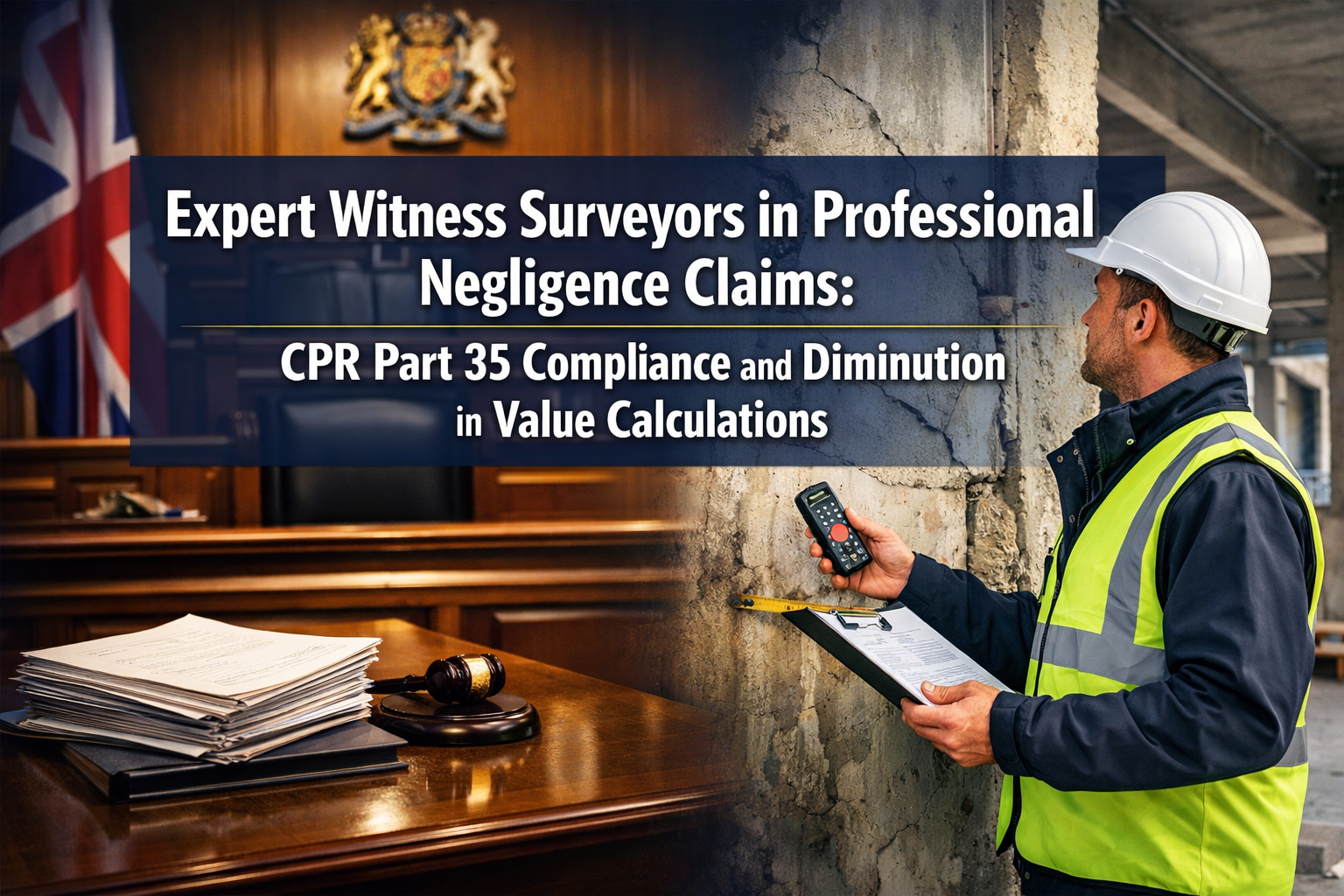
The role demands a unique combination of technical surveying expertise, valuation proficiency, and comprehensive understanding of civil procedure rules. In 2026, as construction disputes grow more sophisticated and courts demand higher standards of expert evidence, surveyors must master both the science of property assessment and the art of legal compliance.
Key Takeaways
- CPR Part 35 mandates that expert witnesses owe their primary duty to the court, not to the instructing party, requiring complete independence and impartiality in all professional negligence cases[5]
- All expert reports must include specific compliance statements confirming understanding of court duties, with reports addressed directly to the court rather than solicitors[4]
- Diminution in value calculations require rigorous methodology combining comparative market analysis, cost-to-cure assessments, and stigma valuations to quantify property losses accurately
- Expert witness surveyors must possess both technical building knowledge and valuation expertise to effectively assess defects and their financial impact in negligence claims
- Proper documentation and transparency in methodology are essential for reports to withstand cross-examination and judicial scrutiny
Understanding the Role of Expert Witness Surveyors in Professional Negligence Claims
What Constitutes Professional Negligence in Property Matters
Professional negligence occurs when a surveyor, architect, engineer, or construction professional fails to exercise the reasonable skill and care expected of a competent practitioner in their field. These failures can manifest in various forms:
Common Types of Professional Negligence:
- 📋 Survey Negligence: Failure to identify significant defects during property inspections
- 💰 Valuation Errors: Overvaluing or undervaluing properties, causing financial loss
- 🏗️ Design Defects: Inadequate specifications or drawings leading to construction failures
- 🔍 Inspection Failures: Missing critical structural issues during building surveys
- 📝 Advice Negligence: Providing incorrect guidance on building regulations or planning matters
When these failures result in financial loss, the injured party may pursue legal action. This is where expert witness surveyors become indispensable to the litigation process.
The Dual Expertise Required
Expert witness surveyors must possess a distinctive combination of skills that sets them apart from general practitioners. They need comprehensive building pathology knowledge to identify and analyze defects, coupled with valuation expertise to quantify the financial consequences of those defects[3].
This dual capability allows them to:
✅ Assess the technical nature and cause of building defects
✅ Determine whether professional standards were breached
✅ Calculate the diminution in property value resulting from negligence
✅ Provide credible testimony under cross-examination
The complexity of modern construction and the sophistication of property markets in 2026 mean that courts increasingly rely on experts who can bridge the technical-financial divide with authority and clarity.
CPR Part 35 Compliance: The Foundation of Expert Evidence
The Overriding Duty to the Court
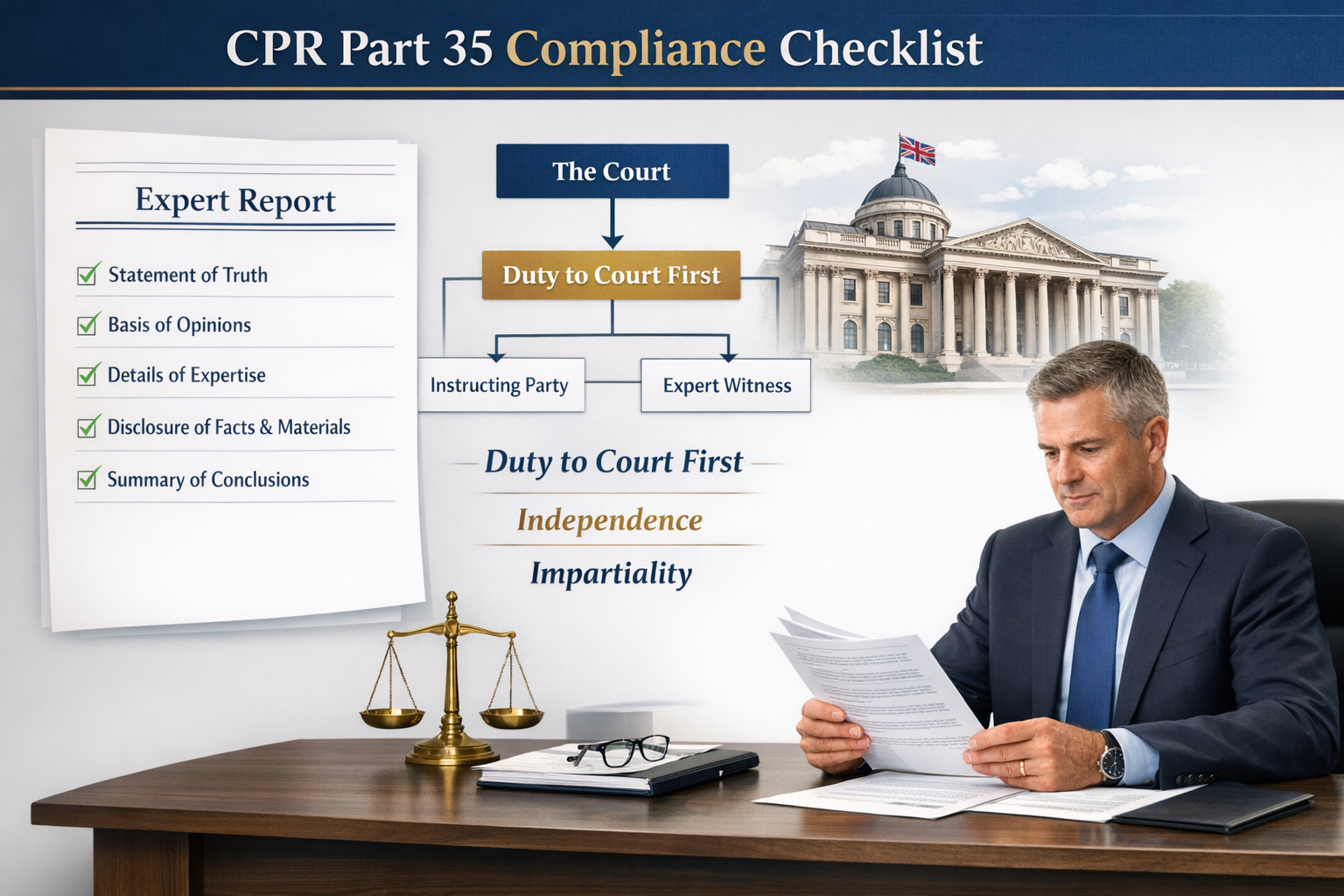
The cornerstone principle of Expert Witness Surveyors in Professional Negligence Claims: CPR Part 35 Compliance and Diminution in Value Calculations is enshrined in CPR 35.3: experts have an overriding duty to help the court on matters within their expertise, which takes precedence over any obligation to the party instructing them[5].
This fundamental requirement means that expert witnesses must:
- 🎯 Provide objective, unbiased opinions regardless of which party pays their fees
- ⚖️ Present balanced evidence that includes facts both favorable and unfavorable to their client
- 🔍 Remain independent from the litigation process and outcome
- 📊 Base conclusions on verifiable data and sound methodology
Many surveyors struggle with this transition from advocate to impartial expert. The duty to the court means that an expert must be prepared to disagree with their instructing solicitor's case theory if the evidence doesn't support it.
Mandatory Report Requirements Under CPR Part 35
The Civil Procedure Rules establish specific formatting and content requirements that all expert reports must satisfy. According to CPR 35.10, expert reports must include[4]:
| Report Element | Requirement | Purpose |
|---|---|---|
| Addressee | Report addressed to the court, not instructing party | Reinforces duty to court |
| Qualifications | Details of expert's qualifications and experience | Establishes credibility |
| Instructions | Statement of instructions received | Ensures transparency |
| Facts & Assumptions | Clear statement of facts and assumptions relied upon | Allows scrutiny of basis |
| Investigation Details | Who carried out examinations and their qualifications | Validates methodology |
| Range of Opinion | Acknowledgment of alternative views if applicable | Demonstrates objectivity |
| Summary of Conclusions | Clear, accessible summary of key findings | Aids court understanding |
| Statement of Truth | Declaration of understanding of duties to court | Confirms compliance |
The compliance statement required under CPR 35.10(2) is particularly critical. Every expert report must conclude with a declaration that reads: "I understand my duty to the court and have complied with that duty"[1]. This statement carries significant weight—failure to include it can result in the report being excluded from evidence entirely.
Addressing Reports to the Court
A common error among newly appointed expert witnesses is addressing their reports to the instructing solicitor rather than to the court. This seemingly minor detail actually reflects a fundamental misunderstanding of the expert's role[3].
Correct format:
"Report prepared for the County Court at Central London"
Incorrect format:
"Report prepared for Smith & Jones Solicitors on behalf of Mr. Johnson"
This distinction emphasizes that the expert serves the court's need for objective evidence, not the client's desire for supportive testimony. Understanding these requirements is essential for anyone providing chartered surveyor services in litigation contexts.
Maintaining Independence and Impartiality
Independence goes beyond simply including the correct statements in a report. It requires a mindset shift that many practitioners find challenging. Expert witnesses must:
🔸 Avoid advocacy – Present evidence objectively without arguing the case
🔸 Acknowledge limitations – Clearly state where expertise ends
🔸 Consider alternative explanations – Explore competing theories fairly
🔸 Resist pressure – Maintain positions even when instructing parties disagree
🔸 Update opinions – Revise conclusions if new evidence emerges
The courts have repeatedly emphasized that an expert who acts as an advocate for their instructing party undermines the entire expert evidence system and may face professional consequences[5].
Diminution in Value Calculations: Quantifying Property Losses
Understanding Diminution in Value
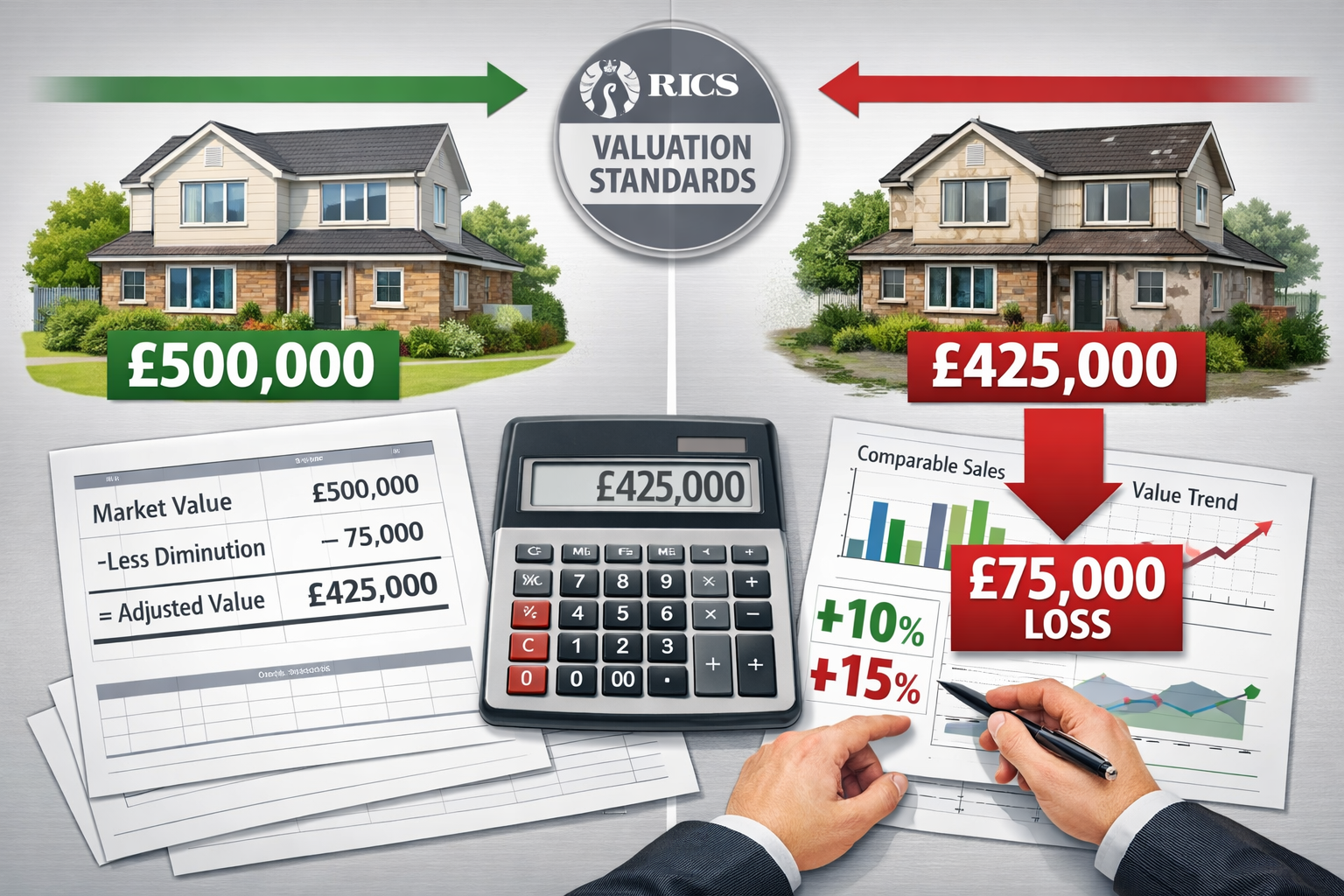
Diminution in value represents the difference between what a property would be worth in its defect-free condition and its actual market value given the defects present. This calculation forms the cornerstone of damages assessment in professional negligence claims involving property.
The concept encompasses three potential components:
- Physical Diminution: The reduction in value due to the physical presence of defects
- Cost to Cure: The expense required to remedy the defects (when this differs from physical diminution)
- Stigma: Additional value loss due to the property's history, even after repairs
In professional negligence cases, determining which measure of loss applies—and calculating it accurately—requires sophisticated valuation expertise combined with understanding of legal principles.
Methodologies for Calculating Diminution
Expert witness surveyors employ several established methodologies when calculating Expert Witness Surveyors in Professional Negligence Claims: CPR Part 35 Compliance and Diminution in Value Calculations:
1. Comparative Market Analysis Approach
This method involves:
- 📊 Identifying comparable properties in similar condition (defect-free)
- 📊 Identifying comparable properties with similar defects
- 📊 Analyzing the price differential between the two groups
- 📊 Adjusting for other variables (location, size, features)
Example: A property with structural movement might be compared against similar properties without defects to establish the market's perception of value loss.
2. Cost-to-Cure Approach
This methodology calculates:
- 🔧 The full cost of remedial works to restore the property to proper condition
- 🔧 Professional fees associated with remediation
- 🔧 Consequential losses (temporary accommodation, business interruption)
- 🔧 Potential betterment adjustments
The cost-to-cure approach is particularly relevant when defects are repairable and the claimant intends to undertake remediation.
3. Before-and-After Valuation
This approach requires the expert to provide:
- Hypothetical valuation: What the property would be worth without defects
- Actual valuation: What the property is worth with defects present
- Differential: The diminution in value
This method demands rigorous analysis and must account for market conditions at the relevant valuation dates, not current conditions.
The Stigma Factor in Valuation
Even after defects are repaired, properties may suffer residual value loss due to stigma—the market's perception that a property with a history of problems is less desirable than one without such history[6].
Stigma calculations are particularly contentious because they involve subjective market perception. Expert witnesses must support stigma claims with:
✔️ Market evidence of how similar properties with repair histories have performed
✔️ Buyer psychology research demonstrating reluctance to purchase previously defective properties
✔️ Comparable transactions showing price differentials
✔️ Expert market knowledge of local buyer preferences
Courts scrutinize stigma claims carefully, requiring robust evidence rather than speculative assertions.
Practical Challenges in Diminution Calculations
Several practical difficulties arise when calculating diminution in value:
Timing Issues: Should valuation be assessed at the date of negligence, date of discovery, date of trial, or some other point? The answer significantly impacts calculations in changing markets.
Hypothetical Scenarios: Experts must value what would have been without negligence—an inherently hypothetical exercise requiring careful reasoning.
Multiple Defects: When several defects exist, determining whether their combined impact is cumulative, overlapping, or synergistic requires nuanced analysis.
Market Volatility: In rapidly changing property markets like those seen in 2026, isolating value loss due to defects from general market movements becomes complex.
Betterment: If repairs result in improvements beyond the original condition, courts may reduce damages to account for this betterment.
Documentation and Evidence Requirements
To withstand scrutiny under CPR Part 35 Compliance, diminution calculations must be supported by comprehensive documentation:
📁 Comparable sales data with detailed analysis
📁 Inspection photographs clearly showing defects
📁 Repair cost estimates from qualified contractors
📁 Market reports evidencing local conditions
📁 Methodology explanations showing calculation steps
📁 Assumption statements clarifying the basis of valuations
Expert witnesses should maintain detailed working papers that allow their calculations to be replicated and verified by opposing experts or the court.
Preparing Expert Reports in Professional Negligence Cases
Structuring the Expert Report
A well-structured expert report following Expert Witness Surveyors in Professional Negligence Claims: CPR Part 35 Compliance and Diminution in Value Calculations principles typically includes:
1. Introduction and Qualifications
- Expert's professional background and relevant experience
- Membership in professional bodies (RICS, CIOB, etc.)
- Previous expert witness experience
- Confirmation of CPR Part 35 compliance understanding
2. Instructions and Scope
- Clear statement of questions posed by instructing solicitors
- Documents and evidence reviewed
- Site inspections conducted
- Limitations on scope or access
3. Factual Background
- Chronology of relevant events
- Description of the property and works
- Summary of alleged negligence
- Parties involved and their roles
4. Technical Analysis
- Detailed examination of defects or issues
- Assessment of standards applicable at relevant time
- Opinion on whether professional duties were breached
- Causation analysis linking breach to loss
5. Valuation and Quantum
- Methodology for calculating diminution in value
- Comparable evidence and market data
- Detailed calculations with supporting appendices
- Range of values if appropriate
6. Conclusions
- Summary of key findings
- Direct answers to instructed questions
- Statement of matters outside expertise
- CPR Part 35 compliance declaration
Common Pitfalls to Avoid
Even experienced surveyors can fall into traps when acting as expert witnesses:
❌ Advocacy: Presenting arguments rather than evidence
❌ Overreaching: Opining on matters outside expertise
❌ Insufficient investigation: Drawing conclusions without adequate site inspection
❌ Poor documentation: Failing to maintain detailed records of methodology
❌ Ignoring contrary evidence: Cherry-picking facts that support one narrative
❌ Unclear assumptions: Not explicitly stating the basis for opinions
❌ Inadequate qualifications: Accepting instructions in unfamiliar specialisms
These errors can result in reports being given reduced weight or excluded entirely, potentially exposing the expert to criticism and damaging their professional reputation.
The Role of Joint Statements and Expert Meetings
Courts frequently direct opposing experts to meet and produce joint statements identifying areas of agreement and disagreement. These meetings serve to:
- Narrow the issues requiring judicial determination
- Identify common ground that can be accepted as fact
- Clarify the precise nature of disagreements
- Potentially reach consensus on technical matters
During expert meetings, surveyors must maintain their independence while engaging constructively with opposing experts. The joint statement should clearly delineate:
✅ Agreed facts – Matters both experts accept
✅ Agreed opinions – Technical conclusions both support
✅ Disagreed matters – Issues requiring court determination
✅ Reasons for disagreement – The basis of differing opinions
These collaborative processes exemplify the court-focused nature of expert evidence under CPR Part 35.
Real-World Applications and Case Studies
Residential Survey Negligence Example
A homebuyer instructed a RICS surveyor to conduct a Level 3 Building Survey before purchasing a Victorian terrace for £650,000. The survey failed to identify significant structural movement and subsidence affecting the rear extension.
Expert's Analysis:
- Inspection revealed clear evidence of movement visible at time of original survey
- Comparable properties without defects valued at £650,000-£670,000
- Subject property with defects valued at £520,000-£540,000
- Diminution in value: £120,000
- Cost to cure (underpinning and repairs): £85,000
- Residual stigma: £15,000
The expert witness surveyor provided detailed photographic evidence showing crack patterns that should have been identified, referenced RICS standards applicable at the survey date, and supported the valuation differential with six comparable transactions.
Commercial Valuation Negligence Example
A developer relied on a surveyor's valuation of £2.4 million for a commercial property when securing development finance. The property was subsequently found to have significant fire safety defects reducing its value to £1.8 million.
Expert's Approach:
- Reviewed original valuation report and methodology
- Assessed whether fire safety issues were discoverable through reasonable inspection
- Analyzed comparable commercial property transactions
- Calculated diminution based on cost-to-cure and market impact
- Determined negligence caused £600,000 loss
The expert's report addressed whether the original surveyor's methodology complied with RICS Red Book standards and whether reasonable skill and care had been exercised.
Construction Defect Dispute
A contractor was alleged to have negligently constructed a residential extension, resulting in water ingress and structural inadequacy. The homeowner claimed £150,000 in damages.
Expert Witness Assessment:
- Conducted detailed inspection identifying multiple defects
- Determined which defects resulted from negligent construction versus design issues
- Calculated cost-to-cure: £95,000
- Assessed diminution in value: £110,000
- Recommended lower of the two figures as appropriate measure
The expert's independence was demonstrated by identifying that some alleged defects were actually design failures outside the contractor's responsibility, reducing the claim by £30,000.
Selecting and Instructing Expert Witness Surveyors
Qualifications and Experience to Look For
When instructing expert witnesses for professional negligence claims, solicitors and parties should seek surveyors with:
🎓 Professional Qualifications: MRICS or FRICS membership, ideally with specialist accreditation
📚 Technical Expertise: Demonstrated knowledge in the relevant property type and defect category
⚖️ Expert Witness Training: Formal CPR Part 35 training and understanding
📋 Report Writing Skills: Ability to communicate complex technical matters clearly
🗣️ Court Experience: Previous testimony experience and comfort under cross-examination
🔍 Valuation Capability: Proven expertise in property valuation methodologies
For complex cases involving party wall disputes or specialized construction techniques, additional niche expertise may be necessary.
The Instruction Process
Proper instruction of expert witnesses involves:
1. Clear Terms of Reference
Define precisely what questions the expert should address and what opinions are sought.
2. Complete Documentation
Provide all relevant documents, plans, photographs, and correspondence without filtering.
3. Access Arrangements
Ensure the expert can inspect properties and interview relevant parties as needed.
4. Timeline Expectations
Establish realistic deadlines for reports considering the complexity of analysis required.
5. Budget Transparency
Agree on fee structures and ensure the expert understands any cost constraints.
Cost Considerations
Expert witness fees for Expert Witness Surveyors in Professional Negligence Claims: CPR Part 35 Compliance and Diminution in Value Calculations typically range from £150-£350 per hour in 2026, depending on experience and complexity. A comprehensive expert report might require:
- 8-15 hours for site inspection and investigation
- 15-25 hours for research, analysis, and valuation
- 10-20 hours for report writing and documentation
- 5-10 hours for joint expert meetings
- 8-12 hours for court attendance and testimony
Total costs for a moderately complex case might range from £8,000-£25,000. While significant, these costs are often recoverable from losing parties and are essential for establishing or defending claims worth substantially more.
Best Practices for Expert Witness Surveyors
Maintaining Professional Standards
Expert witness surveyors must adhere to both legal requirements under CPR Part 35 and professional standards set by RICS and other bodies. This dual obligation requires:
Continuous Professional Development: Staying current with building regulations, construction techniques, valuation methodologies, and legal developments.
Professional Indemnity Insurance: Maintaining adequate coverage for expert witness work, which carries distinct risks from standard surveying practice.
Ethical Conduct: Declining instructions where conflicts of interest exist or where expertise is insufficient.
Quality Assurance: Implementing internal review processes to ensure report accuracy and compliance.
Effective Communication with Legal Teams
While maintaining independence, expert witnesses benefit from clear communication with instructing solicitors:
- 📞 Early engagement to understand case strategy and key issues
- 📞 Regular updates on investigation progress and emerging findings
- 📞 Transparent discussions about limitations or challenges
- 📞 Clear explanations of technical matters in accessible language
This collaboration must never compromise the expert's independence or objectivity.
Preparing for Cross-Examination
Court testimony represents the ultimate test of an expert's opinions. Effective preparation includes:
✔️ Thorough familiarity with all report content and supporting documents
✔️ Anticipating challenges to methodology and conclusions
✔️ Practicing clear explanations of technical concepts
✔️ Maintaining composure under aggressive questioning
✔️ Admitting limitations rather than defending indefensible positions
The most effective expert witnesses combine technical authority with humility, acknowledging what they don't know while confidently explaining what they do.
The Future of Expert Evidence in Property Disputes
Technological Developments
The landscape of Expert Witness Surveyors in Professional Negligence Claims: CPR Part 35 Compliance and Diminution in Value Calculations continues to evolve with technology:
Digital Documentation: Drone surveys and 3D scanning provide comprehensive visual records that enhance expert analysis.
Data Analytics: Sophisticated valuation models using big data improve the accuracy and defensibility of diminution calculations.
Virtual Inspections: Remote assessment technologies expanded during recent years now supplement traditional site visits.
AI-Assisted Analysis: Machine learning tools help identify patterns in defect causation and predict value impacts.
Regulatory Changes
The civil justice system continues to refine expert evidence requirements. Recent trends include:
- Greater emphasis on proportionality in expert costs
- Increased use of single joint experts in lower-value claims
- Enhanced scrutiny of expert qualifications and methodology
- Stricter enforcement of CPR Part 35 compliance
Expert witnesses must stay informed of these developments to maintain effectiveness.
Market Dynamics
The property market in 2026 presents unique challenges for diminution calculations:
- Market volatility following economic uncertainty
- Sustainability factors affecting property values
- Building safety concerns post-regulatory reforms
- Changing buyer preferences in post-pandemic environment
These factors require expert witnesses to demonstrate current market knowledge and sophisticated analytical capabilities.
Conclusion
Expert Witness Surveyors in Professional Negligence Claims: CPR Part 35 Compliance and Diminution in Value Calculations represent a specialized intersection of technical expertise, valuation proficiency, and legal knowledge. The role demands unwavering commitment to independence and impartiality, rigorous methodology in calculating property losses, and comprehensive understanding of civil procedure requirements.
Success in this field requires surveyors to master the dual disciplines of building pathology and property valuation while maintaining the objectivity and integrity that courts depend upon. The overriding duty to the court under CPR Part 35 isn't merely a procedural formality—it's the foundation upon which the entire expert evidence system rests.
For property professionals considering expert witness work, the path forward involves:
🎯 Obtaining specialized training in CPR Part 35 requirements and expert witness procedures
🎯 Developing robust valuation skills beyond standard surveying practice
🎯 Building experience through mentorship with established expert witnesses
🎯 Maintaining independence even when facing pressure from instructing parties
🎯 Investing in continuous learning to stay current with technical and legal developments
For those instructing expert witnesses, the key is selecting practitioners who combine technical authority with demonstrated commitment to objectivity, clear communication skills, and proven court experience.
As professional negligence claims grow more complex and courts demand higher standards of expert evidence, the surveyors who excel in this field will be those who embrace both the technical challenges of diminution calculations and the ethical obligations of CPR Part 35 compliance. The work is demanding, but for those with the right combination of skills and integrity, it offers the opportunity to play a crucial role in achieving justice in property disputes.
Whether you're a property owner pursuing a negligence claim, a professional defending against allegations, or a surveyor considering expert witness work, understanding these principles is essential for navigating the complex landscape of construction litigation in 2026.
For professional assistance with expert witness services or comprehensive building surveys, consult with qualified RICS-registered surveyors who understand both the technical and legal dimensions of property assessment.
References
[1] Construction Dispute Resolution 101 – https://www.oseimc.com/construction-dispute-resolution-101
[2] Expert Witness Cpr Part 35 – https://www.kelhamconcept.com/professional-services/expert-witness-cpr-part-35/
[3] The Role Of The Surveyor Expert And Their Evidence In Litigation – https://www.falcon-chambers.com/publications/articles/the-role-of-the-surveyor-expert-and-their-evidence-in-litigation
[4] Part35 – https://www.justice.gov.uk/courts/procedure-rules/civil/rules/part35
[5] fenwickelliott – https://www.fenwickelliott.com/research-insight/newsletters/insight/39
[6] Residential Buildings – https://www.jspubs.com/expert-witness/si/r/residential-buildings/
