
The homebuying landscape in 2026 has transformed dramatically. As mandatory condition surveys become increasingly common and upfront disclosure requirements reshape property transactions, a new battleground has emerged: disputes over defects, valuations, and survey accuracy. When disagreements escalate to litigation or arbitration, expert witnesses step into the spotlight, armed with technical knowledge and bound by evolving professional standards. Understanding Expert Witness Roles in 2026 Homebuying Reform Disputes: Defending Survey Evidence Under New Upfront Standards has never been more critical for property professionals, legal practitioners, and homebuyers navigating this complex terrain.
The Royal Institution of Chartered Surveyors (RICS) recently launched the 5th edition of its Expert Witness standard for global consultation, marking the first major update since 2014 [1]. This development coincides with significant changes in real estate professional standards, creating a perfect storm of regulatory evolution that directly impacts how survey evidence is presented, challenged, and defended in property disputes.
Key Takeaways
- RICS has updated its Expert Witness standard for the first time since 2014, establishing clearer duties to tribunals over clients and enhancing independence protections [1]
- Mandatory upfront surveys are creating new dispute categories around defect disclosure, valuation accuracy, and professional liability
- Expert witnesses must now navigate enhanced conflict of interest requirements and modern evidence standards including digital documentation and AI integration [1]
- Survey evidence defense requires understanding both technical survey protocols and evolving legal frameworks governing property transactions
- Professional independence and unbiased reporting remain paramount, with clearer guidance on fee arrangements and risk mitigation strategies [1]
Understanding the 2026 Homebuying Reform Landscape
The Shift Toward Mandatory Condition Surveys
The property market in 2026 operates under fundamentally different rules than previous years. While the UK has not yet implemented fully mandatory seller surveys nationwide, the direction of travel is clear. Industry pressure, consumer protection advocacy, and lessons learned from other jurisdictions have pushed the market toward upfront condition disclosure as standard practice.
This shift mirrors developments in markets like Australia and parts of Europe, where seller-commissioned surveys have reduced transaction failures and improved transparency. However, with transparency comes complexity. When defects are disclosed upfront, questions arise:
- Was the survey comprehensive enough?
- Did the surveyor miss critical issues?
- Are valuations based on survey findings accurate?
- Who bears liability when undisclosed defects emerge post-purchase?
These questions frequently require expert witness testimony to resolve, making the role of surveying professionals in dispute resolution increasingly vital.
Key Regulatory Changes Affecting Expert Witnesses
The National Association of REALTORS (NAR) has implemented significant changes to its Code of Ethics, including amendments to Article 7 that limit disclosure requirements to a REALTOR's direct clients rather than all transaction parties [2]. While this applies primarily to US markets, the ripple effects influence international property standards and dispute resolution approaches.
More directly relevant to UK practitioners, RICS issued a Practice Alert in April 2025 reminding members of their obligations in expert witness work, particularly in housing disrepair cases [1]. This alert laid the groundwork for the comprehensive 5th edition standard now under consultation.
For homebuyers considering whether they need a home survey when buying a home, understanding these regulatory shifts helps contextualize the importance of thorough, professionally conducted surveys that can withstand scrutiny in potential disputes.
The Evolving RICS Expert Witness Standard: What Changed in 2026
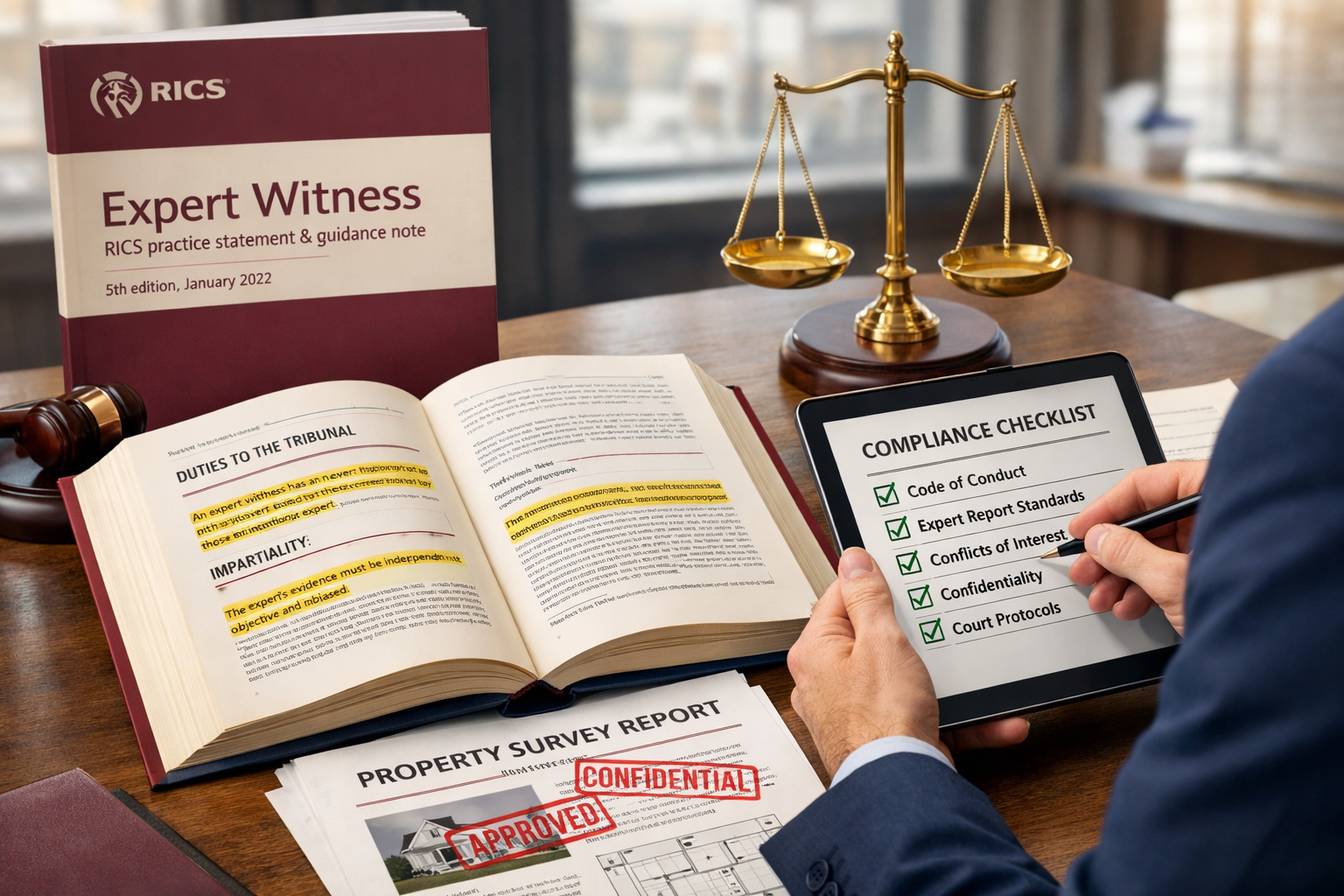
Primary Duty to the Tribunal
The cornerstone principle of the updated RICS Expert Witness standard establishes unequivocally that the primary duty of expert witnesses is to the tribunal, not the client [1]. This isn't entirely new—it has been a fundamental principle for years—but the 5th edition strengthens and clarifies this obligation with unprecedented detail.
For chartered surveyors acting as expert witnesses in homebuying disputes, this means:
✅ Independence must be absolute: Personal relationships with clients cannot influence findings
✅ Objectivity trumps advocacy: The role is to assist the court, not to "win" for the client
✅ Full disclosure is mandatory: All relevant information must be presented, even if unfavorable to the instructing party
✅ Professional integrity over commercial interests: Fee arrangements cannot compromise impartiality
Enhanced Conflict of Interest Disclosure
The 2026 standard includes significantly clearer requirements for identifying and disclosing conflicts of interest [1]. In the context of homebuying reform disputes, conflicts can arise in numerous scenarios:
- A surveyor previously inspected the property for a different client
- The expert has ongoing commercial relationships with one of the parties
- The surveying firm has financial interests in the transaction outcome
- Previous professional opinions conflict with the current expert position
The updated standard requires not just disclosure but also an explanation of how conflicts will be managed or why they don't materially affect the expert's ability to provide unbiased evidence. Understanding what chartered surveyors do helps contextualize these professional obligations.
Fee Guidance and Independence Protection
One of the most practical additions to the 5th edition is clear guidance on conditional and deferred fees [1]. Previously, ambiguity around fee arrangements created risks to professional independence. The new standard addresses:
| Fee Type | Guidance | Rationale |
|---|---|---|
| Conditional Fees | Generally prohibited for expert witness work | Creates incentive to favor instructing party |
| Deferred Fees | Acceptable with proper disclosure | Maintains independence if not outcome-dependent |
| Fixed Fees | Recommended approach | Eliminates financial incentive bias |
| Hourly Rates | Acceptable with clear engagement terms | Transparent and predictable |
For disputes involving Level 2 or Level 3 home surveys, expert witnesses must ensure their fee arrangements don't compromise their ability to provide objective analysis of the original survey's adequacy.
Global Application with Local Legal Recognition
The 5th edition applies worldwide while recognizing local legal differences [1]. This is particularly important as property markets become increasingly international. An expert witness in a London property dispute might need to reference standards from other jurisdictions or work within legal frameworks that vary significantly from English common law.
The standard is designed to work within various legal systems while maintaining core professional principles, ensuring RICS members can operate consistently regardless of jurisdiction.
Expert Witness Roles in Defending Survey Evidence
Establishing Survey Methodology and Standards
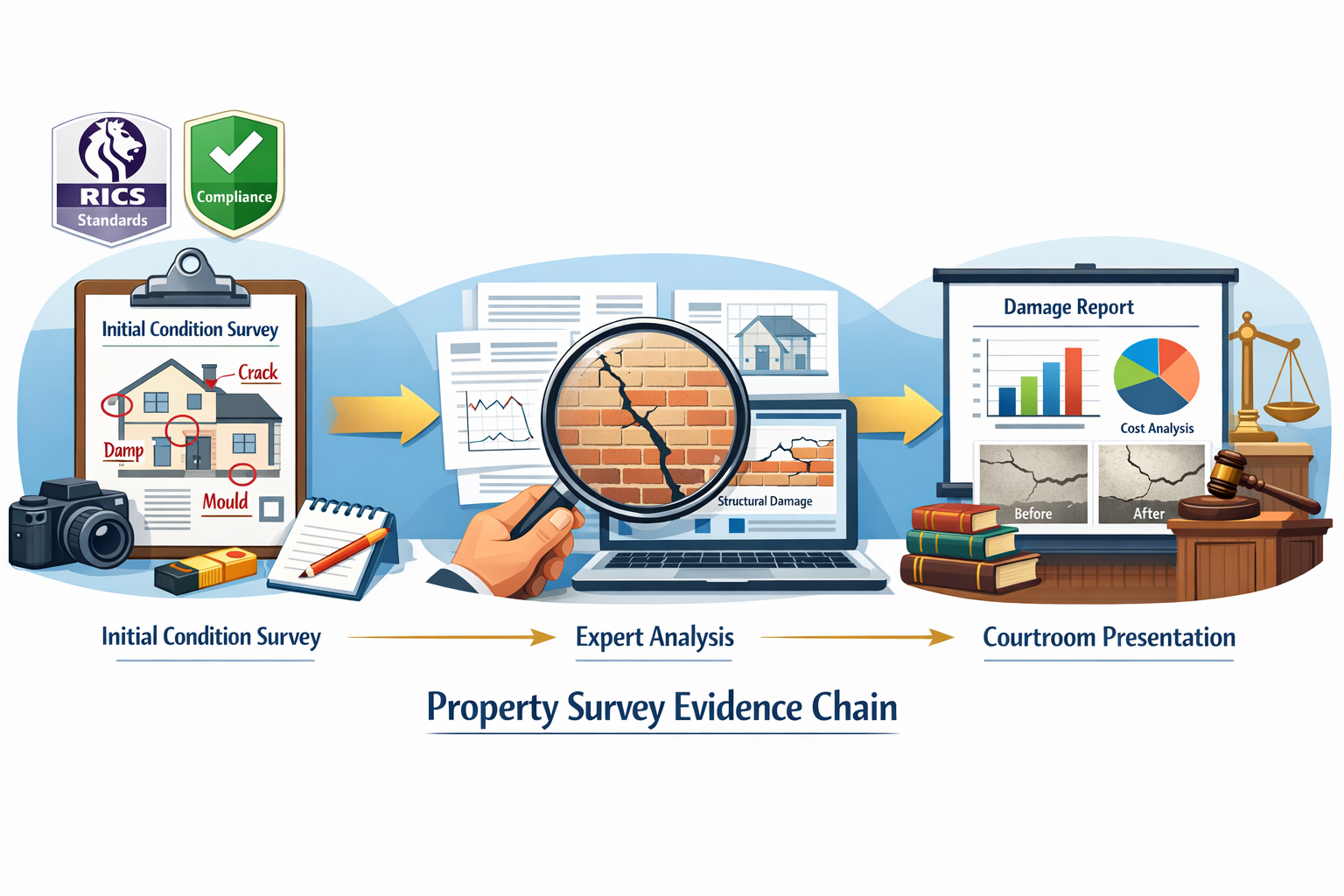
When survey evidence comes under challenge in homebuying disputes, the expert witness's first task is establishing what reasonable professional standards required at the time of the original survey. This involves:
- Defining the survey scope: Was it a Level 2 RICS Homebuyer Survey or a more comprehensive Level 3 Building Survey?
- Identifying applicable standards: What RICS guidance, technical standards, and professional protocols applied?
- Contextualizing limitations: What areas were explicitly excluded or inaccessible during the original inspection?
- Establishing reasonable expectations: What defects should a competent surveyor have identified versus those that were genuinely hidden?
Expert witnesses must help tribunals understand that surveys have inherent limitations. A homebuyer survey is not a structural engineering report, and certain defects may not be visible or detectable without invasive investigation.
Analyzing Alleged Survey Deficiencies
The core of many homebuying reform disputes centers on claims that the original survey was inadequate. Expert witnesses must systematically analyze:
Technical Competence: Did the surveyor apply appropriate investigation methods? For specialized issues like subsidence, was a subsidence survey recommended when appropriate?
Reporting Standards: Was the survey report clear, comprehensive, and compliant with RICS reporting requirements? Did it properly categorize defects using the standard condition rating system?
Professional Judgment: Were the surveyor's conclusions reasonable based on the evidence available during the inspection? This is often the most contentious area, as reasonable professionals can sometimes reach different conclusions from the same observations.
Causation Analysis: If defects were missed, did this actually cause financial loss to the buyer? Perhaps the buyer would have proceeded with the purchase regardless, or the defect was disclosed through other means.
Valuation Disputes and Survey Evidence
Upfront surveys directly impact property valuations, creating another category of disputes where expert witness testimony proves crucial. When a buyer claims they overpaid due to survey deficiencies, expert witnesses must:
- Establish the property's actual condition at the time of sale
- Determine what a reasonable buyer would have paid knowing the true condition
- Calculate the cost of remedying defects versus the impact on market value
- Consider whether the defects affect the property's fitness for purpose
The 2026 homebuying reforms have made these valuation disputes more common, as mandatory upfront disclosure creates clearer baselines for expected condition. Understanding comprehensive guides to home surveys helps frame these valuation discussions.
Preparing Court-Ready Reports Under New Standards
The updated RICS standard emphasizes quality and relevance of expert evidence [1]. Court-ready reports in 2026 must:
📋 Include clear methodology: Explain exactly how conclusions were reached
📋 Address counterarguments: Acknowledge alternative interpretations and explain why they were rejected
📋 Provide complete documentation: Include photographs, measurements, technical references, and supporting data
📋 Use accessible language: Technical content must be understandable to non-specialist tribunal members
📋 Declare limitations: Clearly state what the report does and doesn't cover
📋 Confirm independence: Include the required statement of truth and duty to the tribunal
Modern Evidence Standards: Digital Documentation and AI Integration
Digital Evidence in Property Surveys
The 2026 RICS Expert Witness standard explicitly addresses digital evidence and new legal procedures [1]. Modern property surveys increasingly incorporate:
- Drone surveys for roof and elevation inspection (drone survey services)
- Thermal imaging for damp and insulation issues
- 3D laser scanning for accurate measurements
- Digital photography with metadata timestamps
- Cloud-based reporting with real-time updates
Expert witnesses must understand how to authenticate, present, and defend this digital evidence. Questions arise about:
- Data integrity and the possibility of manipulation
- Proper calibration of technical equipment
- Interpretation of thermal or spectral imaging
- Chain of custody for digital files
Artificial Intelligence and Expert Analysis
Perhaps most significantly, the 5th edition includes provisions for artificial intelligence use [1]. AI is increasingly used in property analysis for:
- Defect pattern recognition in photographs
- Predictive modeling for structural issues
- Automated report generation
- Market valuation algorithms
Expert witnesses must be prepared to explain:
✓ How AI tools were used in their analysis
✓ The limitations and potential biases of AI systems
✓ Why AI-assisted conclusions remain professionally sound
✓ The human oversight applied to AI-generated outputs
This represents a significant evolution in expert witness practice, requiring ongoing professional development to stay current with technological capabilities and limitations.
Specific Dispute Categories in 2026 Homebuying Reforms
Structural Defect Disclosure Disputes
These disputes typically arise when buyers discover significant structural issues post-purchase that they claim should have been identified in the upfront survey. Common scenarios include:
- Foundation problems: Settlement, subsidence, or heave not adequately flagged
- Roof defects: Structural issues beyond normal wear requiring major repair
- Damp and water ingress: Systemic moisture problems affecting habitability
- Structural alterations: Unauthorized or poorly executed modifications
Expert witnesses must determine whether these defects were reasonably detectable during a standard survey or whether they required specialist investigation. The distinction between Level 2 and Level 3 surveys becomes critical in these cases.
Valuation Accuracy Challenges
With upfront surveys influencing offer prices, disputes over valuation accuracy have increased. Expert witnesses address:
- Whether the surveyor's valuation fell within reasonable professional parameters
- How specific defects should have affected the valuation
- Market conditions and comparable property analysis
- The difference between market value and mortgage lending value
These disputes require expert witnesses with both surveying and valuation expertise, often necessitating joint expert appointments or separate experts for different aspects.
Professional Negligence Claims
When surveys are alleged to be fundamentally inadequate, professional negligence claims follow. Expert witnesses must evaluate:
- Duty of care: What did the surveyor owe to the client?
- Breach: Did the surveyor's conduct fall below reasonable professional standards?
- Causation: Did the breach cause the claimed loss?
- Quantum: What is the appropriate measure of damages?
The updated RICS standard's emphasis on risk mitigation for high-volume cases and template usage [1] is particularly relevant here, as standardized approaches can sometimes lead to inadequate customization for specific properties.
Awaab's Law and Housing Disrepair Cases
RICS members acting as expert witnesses in housing disrepair claims must note evolving legislation like Awaab's Law (effective October 2025) and the Housing Health and Safety Rating System (HHSRS) [1]. While these primarily affect rental properties, the principles extend to homebuying disputes where health and safety issues are at stake.
Expert witnesses must stay current with:
- Statutory timelines for addressing hazards
- Categories of housing health and safety risks
- Landlord and seller disclosure obligations
- Remediation standards and costs
Best Practices for Expert Witnesses in 2026 Homebuying Disputes
Maintaining Professional Independence
The bedrock of credible expert witness testimony is unwavering independence. Practical steps include:
🔹 Document everything: Maintain detailed records of all instructions, communications, and analytical processes
🔹 Resist pressure: Politely but firmly decline requests to modify conclusions to favor the instructing party
🔹 Disclose limitations: Be transparent about areas outside your expertise or where evidence is inconclusive
🔹 Seek peer review: Where appropriate, have complex analyses reviewed by colleagues
🔹 Continuous education: Stay current with technical standards, legal developments, and professional requirements
Verifying that your surveyor is properly qualified becomes crucial—learn more about verifying surveyor credentials in the UK.
Effective Communication with Legal Teams
Expert witnesses must bridge the gap between technical surveying knowledge and legal requirements. This involves:
- Early engagement: Discuss the case thoroughly before committing to provide evidence
- Clear scope definition: Ensure instructions precisely define what opinions are sought
- Regular updates: Keep instructing solicitors informed of findings as they develop
- Plain language: Translate technical jargon into accessible explanations
- Realistic timelines: Provide achievable deadlines for report preparation and testimony
Preparing for Cross-Examination
The tribunal room is where expert witness credibility is truly tested. Effective preparation includes:
- Master your report: Know every detail, reference, and calculation
- Anticipate challenges: Identify weaknesses in your position and prepare responses
- Review source materials: Re-examine the original survey, property documentation, and relevant standards
- Practice testimony: Rehearse explaining complex concepts clearly and concisely
- Stay composed: Maintain professional demeanor regardless of aggressive questioning
Collaborative Expert Approaches
The 2026 landscape increasingly favors joint expert appointments and expert meetings to narrow issues. Best practices include:
- Approaching opposing experts with professional courtesy
- Genuinely seeking common ground where evidence supports it
- Clearly articulating areas of disagreement and the reasons for differing opinions
- Producing joint statements that assist the tribunal by reducing contentious issues
- Maintaining independence while being collaborative
The Future of Expert Witness Roles in Property Disputes
Emerging Trends and Challenges
As homebuying reforms continue evolving, expert witnesses face several emerging challenges:
Increased volume: Mandatory upfront surveys may generate more disputes initially as the system beds in, requiring more expert witnesses with appropriate qualifications.
Technological complexity: Digital evidence, AI analysis, and advanced surveying techniques require continuous professional development to maintain expertise.
International standards convergence: As property markets globalize, expert witnesses must understand multiple jurisdictional approaches while maintaining local legal compliance.
Climate change considerations: Building resilience, flood risk, energy efficiency, and sustainability factors are increasingly central to property valuation and condition assessment.
Professional Development Imperatives
To remain effective in this evolving landscape, expert witnesses must:
- Engage with the RICS consultation process: Provide feedback on the 5th edition standard to shape final requirements
- Pursue specialized training: Attend courses on expert witness skills, legal procedures, and emerging technical areas
- Build cross-disciplinary knowledge: Understand legal principles, valuation methodology, and technical surveying
- Develop communication skills: Practice explaining complex concepts to non-specialist audiences
- Network professionally: Connect with legal practitioners, fellow experts, and industry bodies
Understanding what surveyors check during inspections provides foundational knowledge for expert witness work.
Conclusion: Navigating the New Expert Witness Landscape
The intersection of Expert Witness Roles in 2026 Homebuying Reform Disputes: Defending Survey Evidence Under New Upfront Standards represents a critical evolution in property professional practice. As mandatory condition surveys become standard and upfront disclosure requirements reshape transactions, disputes over survey adequacy, defect identification, and valuation accuracy will inevitably increase.
The updated RICS Expert Witness standard provides a robust framework for navigating these challenges, emphasizing independence, transparency, and professional rigor. For chartered surveyors, understanding these evolving requirements isn't optional—it's essential for maintaining professional credibility and serving the justice system effectively.
Actionable Next Steps
For Property Professionals:
- Review the RICS 5th edition Expert Witness standard consultation documents
- Assess whether your current practice aligns with updated requirements
- Invest in expert witness training and professional development
- Establish clear engagement protocols that protect independence
- Build relationships with legal practitioners who understand technical surveying issues
For Homebuyers and Sellers:
- Commission comprehensive surveys from qualified professionals
- Understand survey limitations and scope before purchase
- Maintain detailed documentation of property condition
- Seek expert advice early if disputes arise
- Choose legal representation experienced in property survey disputes
For Legal Practitioners:
- Engage expert witnesses early in the litigation process
- Provide clear, comprehensive instructions defining scope
- Respect expert independence and avoid pressure to modify opinions
- Facilitate expert collaboration to narrow issues where appropriate
- Stay informed about technical surveying standards and capabilities
The homebuying landscape of 2026 demands higher standards, greater transparency, and more sophisticated dispute resolution. Expert witnesses who embrace these changes, maintain unwavering professional independence, and continuously develop their technical and communication skills will play an invaluable role in ensuring fair, evidence-based outcomes in property disputes.
Whether you're a chartered surveyor in West London or elsewhere in the UK, understanding these evolving standards positions you to serve clients effectively while upholding the highest professional standards. The path forward requires commitment to excellence, continuous learning, and dedication to the fundamental principle that expert witnesses serve the tribunal first and foremost.
References
[1] Rics Launches Global Consultation On Updated Expert Witness Standard – https://www.rics.org/news-insights/rics-launches-global-consultation-on-updated-expert-witness-standard
[2] 2026 Summary Of Key Professional Standards Changes – https://www.nar.realtor/about-nar/policies/2026-summary-of-key-professional-standards-changes
