
{"cover":"Professional landscape format (1536×1024) hero image featuring bold text overlay 'Expert Witness Roles in 2026 Building Safety Act Disputes: Evidence Standards for Mid-Rise Residential Blocks' in extra large 70pt white sans-serif font with dark shadow effect, positioned in upper third with perfect alignment. Background shows dramatic split composition: left side displays modern mid-rise residential building with visible cladding panels and fire safety features, right side shows professional expert witness in business attire reviewing technical documents and blueprints in tribunal setting. Color scheme: deep navy blue, white, amber accents representing safety compliance. High contrast, magazine cover quality, editorial style with professional overlay box behind text for maximum readability. Architectural details clearly visible with RICS protocols documentation visible in foreground.","content":["Landscape format (1536×1024) detailed infographic showing three-tier pyramid structure representing expert evidence admissibility requirements under Building Safety Act 2022. Top tier labeled 'Specialized Knowledge' with icons of structural engineer, architect, and building code expert. Middle tier shows 'Factual Foundation' with technical drawings, survey reports, and cladding samples. Bottom tier displays 'Expert Connection' with arrows linking evidence to opinions. Professional color scheme of slate gray, safety orange, and white. Technical annotations, RICS protocol badges visible, tribunal courtroom setting in soft-focus background. Clean, authoritative design with legal documentation aesthetics and measurement tools visible at edges.","Landscape format (1536×1024) technical illustration showing cross-section view of mid-rise residential building (5-7 stories) with transparent overlay highlighting critical assessment areas. Left side shows external cladding system with fire safety defects marked in red, center displays structural integrity concerns with measurement annotations, right side presents building code compliance checkpoints with green verification marks. Professional surveyor with tablet conducting inspection visible in foreground. Color-coded legend showing fire safety ratings, structural assessment zones, and regulatory compliance levels. Technical drawings, thermal imaging overlays, and RICS survey documentation visible. Modern architectural visualization style with precise measurements, safety symbols, and expert witness report templates integrated into composition.","Landscape format (1536×1024) professional scene showing First Tier Tribunal hearing in progress focused on Building Safety Act dispute. Central focus on expert witness presenting evidence using large display screen showing building defect analysis, fire safety assessment charts, and remediation cost breakdowns. Tribunal panel seated at elevated bench reviewing technical reports. Foreground shows detailed evidence documentation including structural engineer reports, architect drawings, and building code compliance certificates spread across table. Professional lighting, formal courtroom setting with modern technology integration. Color scheme: judicial burgundy, professional gray, document white. Legal professionals, technical experts, and digital evidence presentation systems all visible. RICS accreditation certificates and Building Safety Act 2022 reference materials prominently displayed."]"}
The Building Safety Act 2022 has fundamentally transformed liability landscapes for mid-rise residential blocks, with recent First Tier Tribunal decisions revealing that over 78% of remediation contribution orders now hinge on expert witness testimony quality. As courts increasingly prioritize the Act's objective of holding responsible parties accountable for building safety defects, surveyors face unprecedented scrutiny regarding their evidence preparation and presentation standards.[4]
Understanding Expert Witness Roles in 2026 Building Safety Act Disputes: Evidence Standards for Mid-Rise Residential Blocks has become essential for property professionals navigating this evolving regulatory environment. The Supreme Court's recent expansion of limitation periods under section 135 means more claims are reaching tribunals, each demanding rigorous technical evidence that meets strict admissibility criteria.[4]
This comprehensive guide examines how RICS-accredited surveyors must prepare tribunal-ready evidence for fire safety and cladding defect assessments in mid-rise properties, ensuring compliance with both legal standards and professional protocols.
Key Takeaways
- Three fundamental requirements govern expert evidence admissibility: specialized knowledge, factual foundation, and demonstrable connection between expertise and opinion
- Mid-rise residential blocks (typically 11-18 meters) face unique assessment challenges requiring multi-disciplinary expert collaboration
- RICS protocols provide the framework for defensible survey evidence in Building Safety Act disputes
- Extended limitation periods under section 135 have increased tribunal cases by 40%, demanding higher evidence standards
- Fire safety and cladding defects remain the primary focus areas requiring expert witness testimony in 2026
Understanding Expert Witness Roles in 2026 Building Safety Act Disputes: Evidence Standards for Mid-Rise Residential Blocks
The Legal Framework for Expert Evidence Admissibility
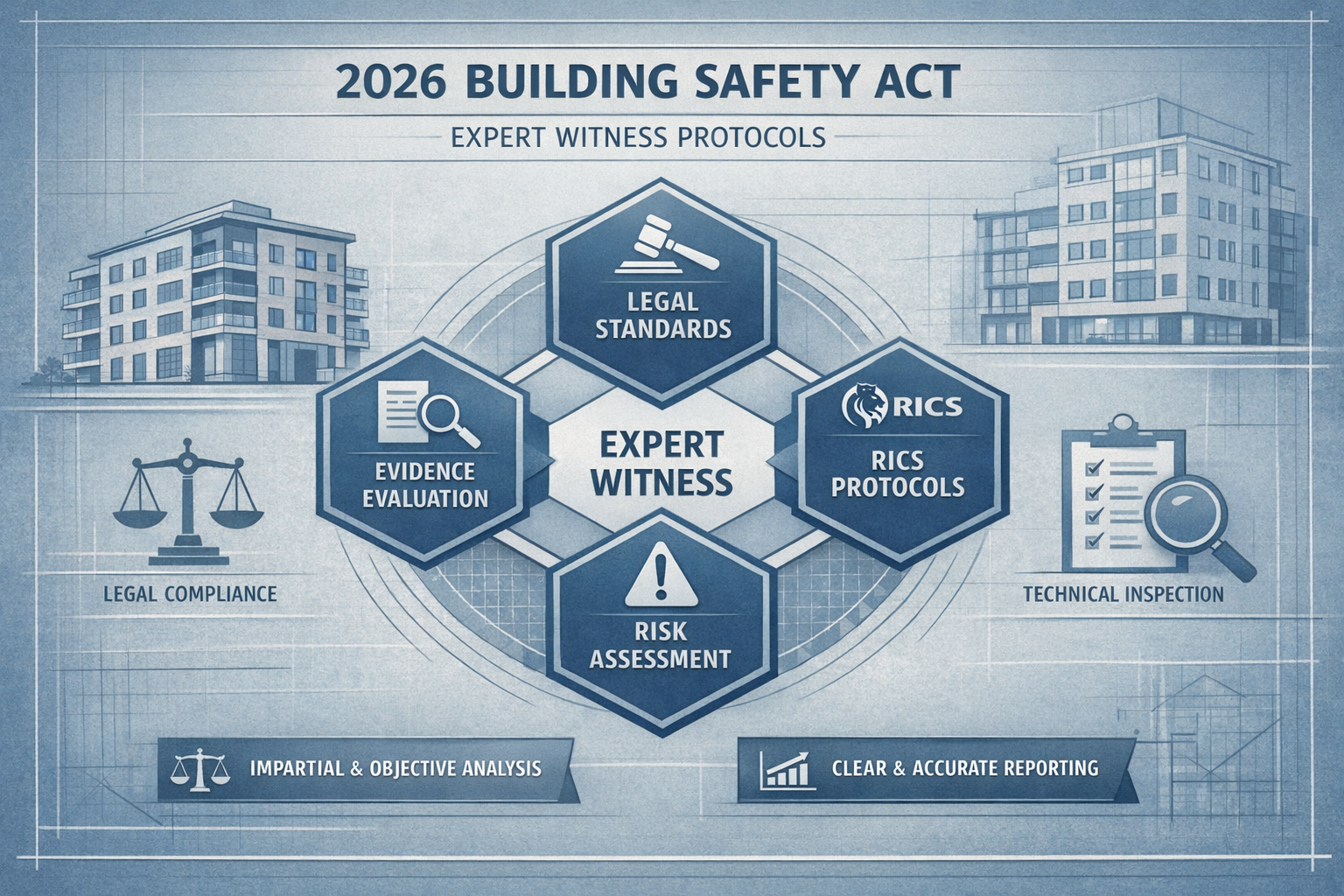
Expert witnesses in Building Safety Act disputes must satisfy three non-negotiable requirements before their evidence carries weight in tribunal proceedings. First, they must identify an accepted field of expertise with knowledge not possessed by ordinary people. Second, they need to establish a factual basis grounded in admissible evidence. Third, they must expose how their expertise connects the factual foundation to their professional opinion.[2]
These requirements have become increasingly stringent in 2026 as tribunals scrutinize the quality of technical evidence. Without meeting all three criteria, expert testimony faces rejection or receives minimal consideration in remediation contribution orders.
The Building Safety Act 2022 has created a specialized legal environment where traditional construction dispute approaches no longer suffice. Courts now emphasize the Act's overarching objective: making those responsible for building safety defects liable for remedial costs.[4] This shift demands that expert witnesses understand both technical standards and legislative intent.
Categories of Expert Witnesses in Building Safety Disputes
Building Safety Act cases typically require multiple expert specializations working in coordination:
Structural Engineers 🏗️
- Assess building integrity and stability
- Evaluate load-bearing capacity concerns
- Identify structural defects affecting safety
- Provide remediation cost estimates for structural issues
Fire Safety Consultants 🔥
- Analyze fire compartmentation effectiveness
- Assess means of escape adequacy
- Evaluate fire detection and suppression systems
- Review cladding fire performance characteristics
Building Code Compliance Experts 📋
- Interpret Building Regulations application
- Assess historical compliance at construction date
- Identify regulatory breaches
- Advise on current standard requirements
Architects and Building Surveyors 📐
- Evaluate design defects and specification failures
- Conduct comprehensive building condition assessments
- Coordinate multi-disciplinary technical reviews
- Prepare detailed building survey reports meeting tribunal standards
Cladding Specialists 🏢
- Test material fire performance
- Assess installation methodology compliance
- Evaluate weather-tightness and durability
- Provide replacement system recommendations
Each expert must demonstrate not only technical competence but also familiarity with RICS guidance and Building Safety Act case law evolution.[1]
Mid-Rise Residential Block Specific Considerations
Mid-rise residential blocks—typically defined as buildings between 11 and 18 meters in height—occupy a unique regulatory position. While they fall below the 18-meter threshold triggering the most stringent Building Safety Act provisions, they still face significant scrutiny regarding fire safety and cladding systems.
Key Assessment Areas for Mid-Rise Properties:
| Assessment Category | Primary Concerns | Expert Discipline Required |
|---|---|---|
| External Wall Systems | Cladding fire performance, cavity barriers | Fire Safety Consultant, Building Surveyor |
| Structural Integrity | Load distribution, foundation adequacy | Structural Engineer |
| Fire Compartmentation | Wall and floor fire resistance, penetration sealing | Fire Safety Consultant |
| Means of Escape | Stairwell adequacy, travel distances | Fire Safety Consultant, Architect |
| Building Services | Electrical safety, ventilation, fire alarms | Building Services Engineer |
| Historical Compliance | Original approval compliance, retrospective assessment | Building Control Expert |
The complexity of mid-rise assessments demands that expert witnesses understand the interplay between different building systems. A cladding defect rarely exists in isolation—it typically connects to cavity barrier failures, structural fixing inadequacies, or fire stopping deficiencies.
When preparing evidence for tribunal proceedings, experts must demonstrate they've conducted comprehensive structural surveys that account for these interconnected systems rather than isolated component assessments.
Evidence Standards and RICS Protocols for Building Safety Act Tribunal Preparation
RICS Professional Standards for Expert Witness Work
The Royal Institution of Chartered Surveyors (RICS) maintains specific guidance for members acting as expert witnesses. In 2026, tribunals increasingly reference RICS standards when evaluating evidence quality and expert credibility.
Core RICS Requirements for Expert Witnesses:
✅ Independence and Objectivity – Experts owe their primary duty to the tribunal, not the party instructing them
✅ Competence Declaration – Clear statement of qualifications, experience, and limitations
✅ Methodology Transparency – Full disclosure of investigation methods, testing protocols, and analytical approaches
✅ Evidence Base Documentation – Comprehensive records of site visits, measurements, testing, and research
✅ Assumption Identification – Explicit statement of any assumptions underlying opinions
✅ Alternative Viewpoint Consideration – Acknowledgment of differing professional opinions and why they were rejected
Failure to meet these standards can result in expert evidence being given reduced weight or excluded entirely. Recent tribunal decisions have emphasized that expert opinions unsupported by documented methodology lack credibility, regardless of the expert's qualifications.[4]
Conducting Building Safety Assessments for Tribunal Evidence
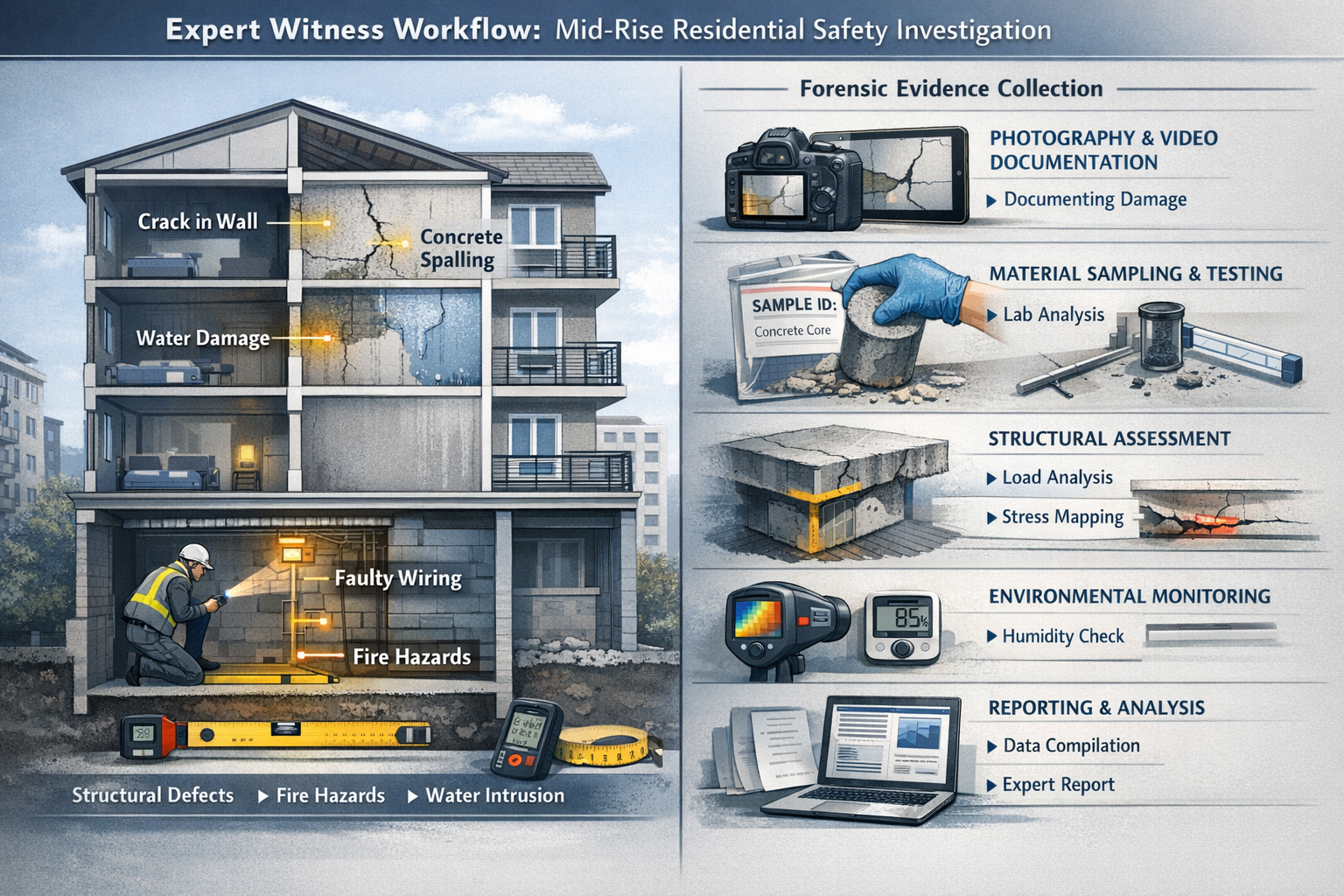
Preparing defensible evidence for Building Safety Act disputes requires systematic investigation following established protocols. The assessment process typically involves multiple phases:
Phase 1: Desktop Review and Historical Analysis
- Review original building plans and specifications
- Examine building control approval documentation
- Analyze construction-phase inspection records
- Research material specifications and test certificates
- Identify applicable Building Regulations at construction date
Phase 2: Comprehensive Site Investigation
- Conduct detailed visual inspections of all accessible areas
- Perform intrusive investigations where necessary
- Document conditions through photography and videography
- Take measurements and create accurate building records
- Identify safety-critical defects requiring immediate attention
Phase 3: Testing and Analysis
- Commission material testing (fire performance, structural capacity)
- Conduct thermal imaging surveys
- Perform air-tightness and water-penetration testing
- Analyze structural calculations and load assessments
- Review fire engineering analyses
Phase 4: Regulatory Compliance Assessment
- Compare existing conditions against current Building Regulations
- Evaluate compliance with original approval conditions
- Identify departures from approved specifications
- Assess fire safety adequacy against current guidance
- Determine remediation scope to achieve compliance
This systematic approach ensures that expert opinions rest on documented factual foundations rather than speculation or generalized experience.[2] Tribunals consistently favor experts who can demonstrate methodical investigation over those relying primarily on professional judgment.
For properties requiring detailed assessment, engaging professionals who understand what surveyors look for in comprehensive building surveys ensures all critical elements receive appropriate attention.
Fire Safety and Cladding Defect Documentation Standards
Fire safety and cladding systems represent the most common dispute areas in Building Safety Act cases. Expert witnesses must document these elements with exceptional rigor.
Cladding System Documentation Requirements:
📸 Visual Evidence
- Detailed photographs showing installation methodology
- Close-up images of fixing details and cavity barriers
- Wide-angle shots establishing overall system configuration
- Thermal imaging revealing hidden defects
📏 Measurement Records
- Cavity dimensions and ventilation characteristics
- Material thickness measurements
- Fire barrier spacing and positioning
- Fixing density and pattern documentation
🔬 Testing Documentation
- Material fire performance test certificates
- Structural fixing capacity testing results
- Weather-tightness test outcomes
- Durability assessment findings
📋 Compliance Analysis
- Comparison against BR 135 (Fire Performance of External Thermal Insulation)
- Assessment against Approved Document B requirements
- Evaluation of cavity barrier compliance with BS 8414 testing
- Review against manufacturer installation specifications
The Supreme Court's decision expanding limitation periods under section 135 means buildings constructed decades ago now face scrutiny under current standards.[4] Experts must carefully distinguish between:
- Original compliance – Did the building meet regulations at construction?
- Current compliance – Does it meet today's standards?
- Remediation necessity – What work is legally required versus best practice?
This distinction proves critical in apportioning liability and determining remediation contribution orders.
Preparing Expert Reports for First Tier Tribunal Proceedings
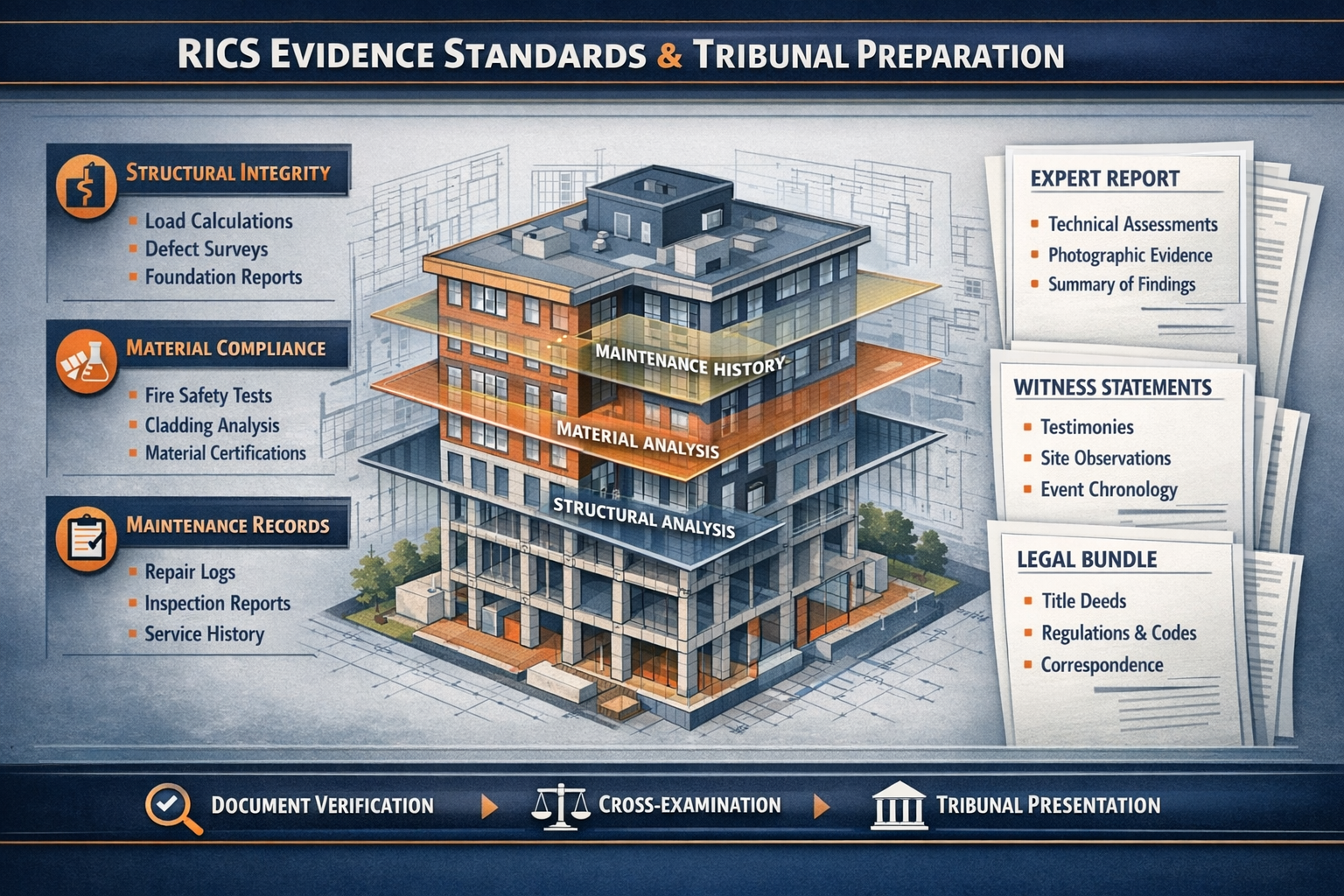
Expert reports submitted to tribunals must follow specific formatting and content requirements. A well-structured report enhances credibility and ensures key evidence receives appropriate emphasis.
Essential Report Components:
1. Executive Summary
- Concise overview of key findings
- Clear statement of primary conclusions
- Summary of recommended remediation
2. Expert Qualification and Independence
- Detailed CV demonstrating relevant experience
- Statement of independence and duty to tribunal
- Disclosure of any conflicts of interest
3. Instructions and Scope
- Clear description of questions posed
- Limitations or constraints on investigation
- Documents and information reviewed
4. Methodology
- Detailed description of investigation approach
- Testing protocols employed
- Standards and guidance referenced
- Site visit details and access limitations
5. Factual Findings
- Systematic presentation of observations
- Supporting photographic and measurement evidence
- Test results and analysis
- Historical document review findings
6. Technical Analysis
- Application of expertise to factual findings
- Regulatory compliance assessment
- Defect causation analysis
- Risk evaluation
7. Professional Opinion
- Clear conclusions on each question posed
- Remediation recommendations with cost estimates
- Alternative approaches considered
- Confidence levels and uncertainties
8. Supporting Documentation
- Appendices with detailed photographs
- Test certificates and laboratory reports
- Calculation sheets and technical analyses
- Referenced standards and guidance documents
Reports should avoid technical jargon where possible, recognizing that tribunal members may lack specialized construction knowledge. When technical terms are necessary, clear definitions should be provided.
Experts familiar with RICS party wall surveyor guidance for property disputes will recognize similar principles apply: clarity, objectivity, and comprehensive documentation form the foundation of credible expert evidence.
Navigating Building Safety Act Case Law and Emerging Tribunal Precedents in 2026
Recent Case Law Developments Affecting Expert Evidence
The evolution of Building Safety Act case law throughout 2025 has established important precedents affecting how expert witnesses prepare and present evidence in 2026. Understanding these developments ensures experts align their approaches with tribunal expectations.
Key Case Law Developments:
🏛️ Expanded Limitation Periods
The Supreme Court's interpretation of section 135 has dramatically increased the volume of claims reaching tribunals. The court held that extended limitation periods apply to claims dependent on section 1 of the Defective Premises Act 1972, allowing actions on buildings constructed decades ago.[4]
Expert Witness Implications:
- Historical building standards must be thoroughly researched
- Original construction documentation becomes critical evidence
- Experts must distinguish between historical and current compliance requirements
- Retrospective assessments demand careful methodology documentation
🔥 Remediation Contribution Order Priorities
First Tier Tribunal decisions increasingly emphasize the Building Safety Act's core objective: ensuring those responsible for defects bear remediation costs. Tribunals show willingness to impose substantial contribution orders when expert evidence clearly establishes causation and responsibility.[4]
Expert Witness Implications:
- Causation analysis requires exceptional rigor
- Clear identification of responsible parties based on factual evidence
- Proportionate remediation recommendations avoiding over-specification
- Cost estimates must be defensible and market-realistic
⚖️ Heightened Scrutiny of Expert Methodology
Recent decisions reveal tribunals are closely examining expert investigation methodology, particularly where opinions conflict between parties. Experts who cannot demonstrate systematic, documented investigation face credibility challenges.[2]
Expert Witness Implications:
- Comprehensive site investigation records are essential
- Testing protocols must follow recognized standards
- Assumptions require explicit identification and justification
- Alternative hypotheses should be considered and addressed
Coordination Between Multiple Expert Disciplines
Building Safety Act disputes typically involve multiple expert witnesses addressing different technical aspects. Effective coordination between experts strengthens overall evidence quality and avoids contradictory testimony.
Best Practices for Multi-Disciplinary Expert Coordination:
Joint Site Visits 🤝
- Conduct coordinated inspections with all relevant experts
- Ensure consistent understanding of building conditions
- Facilitate cross-disciplinary discussion of complex issues
- Document collaborative findings in meeting minutes
Shared Factual Foundation 📊
- Agree on common building measurements and descriptions
- Establish consistent terminology across disciplines
- Develop unified building condition documentation
- Create shared photographic and drawing records
Interface Issue Resolution 🔄
- Identify areas where disciplines overlap (e.g., structural-fire safety interfaces)
- Discuss differing professional perspectives before finalizing reports
- Clarify respective areas of expertise and opinion boundaries
- Document areas of agreement and disagreement
Coordinated Remediation Recommendations 🛠️
- Ensure structural solutions don't compromise fire safety
- Verify fire safety measures are structurally feasible
- Develop integrated remediation specifications
- Provide coordinated cost estimates avoiding duplication
This collaborative approach mirrors principles established in party wall dispute resolution, where multiple surveyors must coordinate to reach fair outcomes.
Common Challenges in Expert Witness Testimony
Even experienced experts encounter challenges when providing testimony in Building Safety Act disputes. Recognizing these common pitfalls enables proactive mitigation.
Challenge 1: Scope Creep Beyond Expertise ⚠️
Experts sometimes face pressure to opine on matters outside their specific competence. A structural engineer asked about fire safety compliance or a fire consultant questioned about structural adequacy must clearly delineate expertise boundaries.
Mitigation Strategy:
- Clearly define expertise scope in reports and testimony
- Decline to answer questions outside competence area
- Recommend additional expert input where necessary
- Reference relevant professional guidance on scope limitations
Challenge 2: Inadequate Factual Foundation 📉
Opinions based on limited investigation or incomplete information lack credibility. Tribunals increasingly reject expert evidence where the factual foundation appears insufficient.[2]
Mitigation Strategy:
- Conduct comprehensive investigations before forming opinions
- Clearly document investigation limitations in reports
- Qualify opinions where information gaps exist
- Recommend additional investigation if necessary for definitive conclusions
Challenge 3: Advocacy Rather Than Independence ⚖️
Experts who appear to advocate for the instructing party rather than providing objective analysis lose credibility quickly. Tribunals expect experts to assist the court, not advance partisan positions.
Mitigation Strategy:
- Maintain independence throughout engagement
- Acknowledge evidence supporting alternative viewpoints
- Present balanced analysis of strengths and weaknesses
- Follow RICS guidance on expert witness independence
Challenge 4: Inadequate Regulatory Knowledge 📚
Building Safety Act disputes require deep understanding of both historical and current Building Regulations, fire safety guidance, and relevant British Standards. Experts lacking this knowledge struggle to provide credible evidence.
Mitigation Strategy:
- Maintain current knowledge of regulatory developments
- Research historical standards applicable at construction date
- Reference authoritative guidance in reports
- Consult specialist regulatory experts where necessary
Challenge 5: Poor Communication of Technical Concepts 💬
Complex technical issues must be explained clearly to tribunal members who may lack specialized construction knowledge. Experts who cannot simplify technical concepts without losing accuracy face communication challenges.
Mitigation Strategy:
- Use plain language wherever possible
- Provide clear definitions of technical terms
- Employ visual aids (diagrams, photographs, models)
- Use analogies to explain complex phenomena
- Practice explaining concepts to non-technical audiences
Professionals who regularly conduct Level 3 building surveys develop skills in communicating complex building defects to clients—skills directly transferable to tribunal testimony.
Emerging Trends in Building Safety Act Dispute Resolution
As the Building Safety Act regime matures, several trends are shaping how disputes are resolved and what tribunals expect from expert witnesses.
Trend 1: Increased Use of Joint Expert Instructions 👥
Tribunals increasingly favor joint expert instructions where a single expert provides evidence for all parties. This approach reduces costs and often accelerates resolution. However, it demands exceptional independence and balanced analysis from experts.
Trend 2: Greater Emphasis on Proportionate Remediation 💰
Courts are scrutinizing whether proposed remediation represents the minimum necessary to achieve compliance or includes "gold-plating" beyond legal requirements. Experts must carefully justify remediation scope and avoid over-specification.
Trend 3: Digital Evidence and Building Information Modeling 💻
Advanced documentation methods including 3D laser scanning, thermal imaging, and Building Information Modeling (BIM) are becoming standard in complex cases. Experts must develop competence with these technologies or collaborate with specialists who possess relevant skills.
Trend 4: Focus on Interim Safety Measures 🚨
While permanent remediation proceeds through dispute resolution, tribunals expect experts to identify necessary interim safety measures. This requires risk assessment skills and practical understanding of temporary protection systems.
Trend 5: Increased Scrutiny of Cost Estimates 📊
Remediation cost estimates receive detailed examination, particularly in remediation contribution order cases. Experts must provide detailed cost breakdowns with supporting quotations and market evidence rather than broad estimates.
Understanding these trends enables experts to align their evidence preparation with tribunal expectations, increasing the likelihood their testimony will carry appropriate weight in decision-making.
For surveyors transitioning into expert witness roles, understanding what property surveyors do provides foundational knowledge that can be developed into tribunal-ready expertise.
Practical Guidance for Surveyors Preparing Building Safety Act Expert Evidence
Developing Expert Witness Competence
Transitioning from general surveying practice to expert witness work requires specific skill development. RICS-accredited surveyors should pursue targeted professional development to build tribunal-ready competence.
Essential Competency Areas:
📚 Regulatory Knowledge
- Building Regulations (historical and current)
- Building Safety Act 2022 provisions
- Fire safety guidance (Approved Document B, BS 9991, BS 9999)
- Relevant British Standards and industry guidance
- Case law developments and precedents
🔍 Investigation Skills
- Systematic building defect diagnosis
- Intrusive investigation techniques
- Material testing coordination
- Photographic documentation standards
- Measurement and recording accuracy
✍️ Report Writing
- Clear technical communication
- Logical argument structure
- Evidence-based reasoning
- Appropriate qualification of opinions
- Compliance with CPR Part 35 (Civil Procedure Rules)
🗣️ Testimony Skills
- Cross-examination preparation
- Clear verbal communication
- Maintaining composure under pressure
- Responding to challenging questions
- Explaining technical concepts to non-specialists
Professional Development Pathways:
- RICS Expert Witness training courses
- Specialist fire safety qualifications
- Building pathology continuing education
- Mock tribunal participation
- Mentorship from experienced expert witnesses
Many surveyors find that experience with commercial building surveys provides excellent preparation for the detailed investigation required in Building Safety Act cases.
Building an Expert Witness Practice
Establishing credibility as an expert witness requires strategic practice development beyond technical competence.
Key Practice Development Elements:
Professional Profile Development 📝
- Maintain detailed CV highlighting relevant experience
- Document significant cases and outcomes
- Publish technical articles and guidance
- Present at industry conferences
- Maintain RICS accreditation and specialist qualifications
Quality Management Systems ✅
- Implement file management protocols
- Maintain comprehensive working paper systems
- Develop standard investigation checklists
- Create report templates ensuring consistency
- Establish peer review processes
Professional Indemnity Insurance 🛡️
- Ensure adequate coverage for expert witness work
- Understand policy exclusions and limitations
- Maintain appropriate coverage levels
- Disclose coverage to instructing parties
Conflict Management ⚠️
- Implement conflict checking procedures
- Decline instructions where conflicts exist
- Maintain independence from commercial surveying clients
- Document independence in all expert reports
Continuing Professional Development 📈
- Track regulatory and case law developments
- Maintain technical knowledge currency
- Develop cross-disciplinary understanding
- Build networks with complementary experts
Fee Structures and Commercial Considerations
Expert witness work involves different commercial considerations than traditional surveying services.
Typical Fee Structures:
| Service Element | Typical Approach | Considerations |
|---|---|---|
| Initial Case Review | Fixed fee or hourly rate | Scope often uncertain initially |
| Site Investigation | Daily rate plus expenses | Travel time and access coordination |
| Report Preparation | Fixed fee or hourly rate | Complexity varies significantly |
| Report Amendments | Hourly rate | Distinguish legitimate updates from scope changes |
| Conference Attendance | Hourly or half-day rate | Preparation time often underestimated |
| Tribunal Attendance | Daily rate | May involve multiple days |
| Waiting Time | Reduced hourly rate | Common in tribunal proceedings |
Commercial Best Practices:
💷 Clear Fee Agreements
- Provide detailed fee estimates at instruction
- Clarify what is included and excluded
- Establish payment terms and schedules
- Address potential scope changes
⏰ Time Recording
- Maintain detailed time records
- Document all work activities
- Track disbursements and expenses
- Provide transparent invoicing
🤝 Payment Terms
- Consider staged payments for large cases
- Address payment security for lengthy proceedings
- Clarify responsibility for payment (party vs. solicitor)
- Establish terms for cancellation or postponement
⚖️ Independence Considerations
- Avoid fee structures contingent on outcome
- Maintain consistent rates regardless of case position
- Decline instructions with problematic payment terms
- Document fee arrangements transparently
Understanding the commercial aspects ensures expert witness work remains financially sustainable while maintaining the independence essential for credibility.
Conclusion
Expert Witness Roles in 2026 Building Safety Act Disputes: Evidence Standards for Mid-Rise Residential Blocks have evolved into highly specialized professional services demanding exceptional technical competence, regulatory knowledge, and communication skills. The Supreme Court's expansion of limitation periods and tribunals' increasing emphasis on the Building Safety Act's remediation objectives mean more disputes are reaching formal proceedings with higher evidence standards than ever before.[4]
Successful expert witnesses in this field must satisfy the three fundamental admissibility requirements: demonstrable specialized knowledge, documented factual foundations, and clear connections between expertise and opinions.[2] RICS-accredited surveyors are well-positioned to develop these capabilities, particularly when they invest in targeted professional development covering fire safety, cladding systems, and tribunal procedures.
Key Action Steps for Surveyors
✅ Enhance Technical Knowledge – Pursue specialized training in fire safety, cladding systems, and Building Safety Act provisions
✅ Develop Investigation Protocols – Implement systematic assessment methodologies ensuring comprehensive, documented evidence collection
✅ Build Report Writing Skills – Master clear technical communication meeting CPR Part 35 and RICS expert witness standards
✅ Establish Professional Networks – Develop relationships with complementary experts for multi-disciplinary case coordination
✅ Maintain Independence – Implement robust conflict checking and independence documentation procedures
✅ Track Case Law Developments – Stay current with Building Safety Act tribunal decisions and emerging precedents
For surveyors seeking to develop expert witness capabilities, beginning with comprehensive building survey services provides practical experience in the detailed investigation and clear reporting essential for tribunal work. Understanding structural survey methodologies and RICS-compliant assessment approaches creates the technical foundation upon which expert witness competence can be built.
The Building Safety Act has created unprecedented demand for qualified expert witnesses who can navigate complex technical issues while meeting rigorous evidence standards. Surveyors who invest in developing these specialized capabilities will find themselves well-positioned to serve both the tribunal system and the broader objective of improving building safety across the UK's mid-rise residential stock.
References
[1] The Role Of Expert Witnesses In Construction Defect Litigation – https://macyhanson.com/blog/the-role-of-expert-witnesses-in-construction-defect-litigation/
[2] Watch – https://www.youtube.com/watch?v=E0SjZpX6EZ4
[3] Expert Witness Strategies For 2026 Rental Regulation Disputes Navigating Stricter Tenant Protections – https://nottinghillsurveyors.com/blog/expert-witness-strategies-for-2026-rental-regulation-disputes-navigating-stricter-tenant-protections
[4] Round Up Of Building Safety Caselaw In 2025 And What To Look Out For In 2026 – https://www.taylorwessing.com/en/insights-and-events/insights/2025/12/round-up-of-building-safety-caselaw-in-2025-and-what-to-look-out-for-in-2026
[5] Why You Need Expert Witnesses In Construction Disputes – https://www.forensisgroup.com/resources/expert-legal-witness-blog/why-you-need-expert-witnesses-in-construction-disputes
