
The landscape of property disputes has fundamentally shifted in 2026. As the Commonhold and Leasehold Reform Bill progresses through Parliament, expert witness preparation for 2026 leasehold reform disputes has become increasingly complex. RICS professionals providing evidence in tribunals and courts must now navigate new valuation methodologies, updated service charge standards, and unprecedented conversion challenges. With RICS experts providing parliamentary testimony in March 2026 on critical implementation issues, the stakes have never been higher for surveyors preparing defensible evidence in leasehold transition cases[5].
The transition from traditional leasehold structures to commonhold options creates a unique challenge for expert witnesses. Valuation methodology remains unresolved, secondary legislation awaits consultation, and professional standards have become mandatory for all RICS members[1][3]. This comprehensive guide equips surveyors with the knowledge needed to build robust cases in this evolving regulatory environment.
Key Takeaways
✅ RICS professional standards are now mandatory for all members and regulated firms, fundamentally changing how expert witnesses must conduct valuations and prepare evidence in 2026[3]
✅ Valuation methodology remains critically unresolved as the Commonhold and Leasehold Reform Bill references LAFRA 2024, which still awaits further consultation and secondary legislation[1]
✅ The updated RICS Service Charge Residential Management Code (fourth edition) establishes new benchmarks for fairness, transparency, and professionalism that expert witnesses must incorporate into dispute analysis[2]
✅ Education, consistency, and minimizing misinterpretation are identified by RICS experts as key success factors when preparing evidence for leasehold reform disputes[4]
✅ Building Safety Act 2022 compliance is now integrated into expert witness considerations, reflecting the growing importance of fire safety and health compliance in property valuations[2]
Understanding the 2026 Regulatory Landscape for Expert Witness Preparation
The regulatory framework governing expert witness preparation for 2026 leasehold reform disputes has undergone significant transformation. RICS provided crucial parliamentary evidence in March 2026, addressing valuation challenges, managing agents' roles, and conversion barriers that directly impact how surveyors prepare expert testimony[5].
The Commonhold and Leasehold Reform Bill Impact
The current legislative environment creates both opportunities and challenges for expert witnesses. The Bill references the Leasehold and Freehold Reform Act 2024 (LAFRA 2024), yet critical elements remain undefined pending consultation and secondary legislation[1]. This uncertainty requires expert witnesses to:
- Acknowledge regulatory gaps when providing valuation evidence
- Reference pending guidance that may affect future dispute outcomes
- Document assumptions clearly when established methodology is unavailable
- Maintain flexibility in evidence preparation as standards evolve
Mandatory RICS Professional Standards
Since 2026, RICS professional standards have become mandatory for all members and regulated firms that have chosen RICS regulation[3]. This shift fundamentally changes the expert witness landscape:
| Previous Framework | 2026 Mandatory Standards |
|---|---|
| Voluntary best practice guidance | Enforceable professional obligations |
| Flexible interpretation allowed | Strict compliance required |
| Limited disciplinary consequences | Regulatory action for non-compliance |
| Variable quality across practitioners | Consistent standards across all RICS members |
For expert witness services, this means every valuation, report, and testimony must demonstrate explicit compliance with current RICS standards. Failure to do so can undermine credibility and expose the expert to professional sanctions.
Valuation Methodology Challenges
Vanessa Griffiths MRICS, providing expert evidence to Parliament, emphasized that "education, consistency and the minimisation for misinterpretation is key" to successful implementation[4]. This principle directly applies to expert witness preparation in several critical areas:
Ground Rent Reform Implications: The impact on loan note repayments represents a new valuation concern requiring clear guidance[1]. Expert witnesses must address how ground rent changes affect property values in dispute cases.
Commonhold Conversion Valuations: With consent thresholds lowered to 50%, experts must determine when leaseholders need professional advice and appropriate insurance[1]. This creates complexity in valuation evidence for conversion disputes.
Service Charge Disputes: The updated RICS Service Charge Residential Management Code now emphasizes fairness, transparency, and professionalism, establishing new benchmarks for dispute analysis[2].
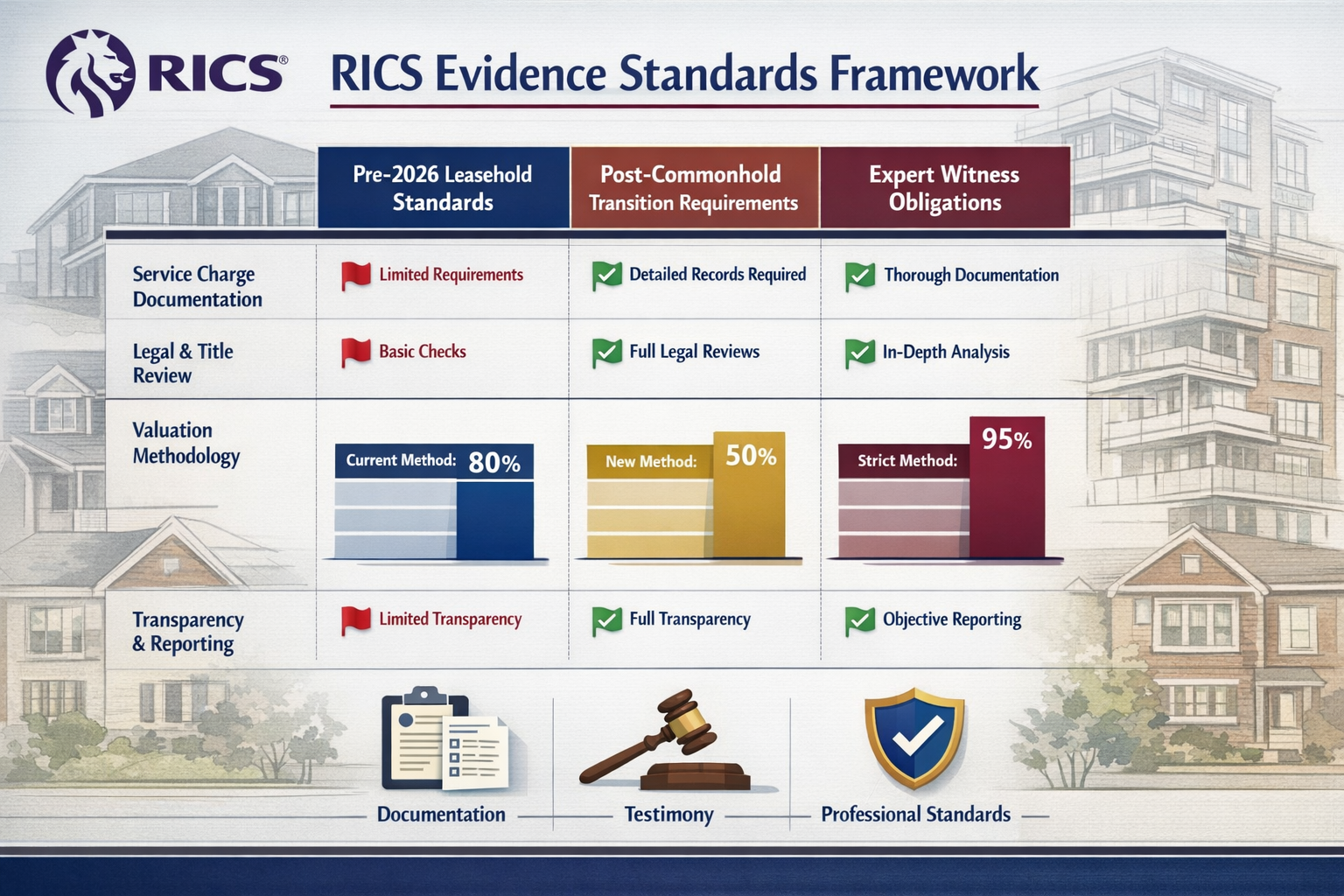
RICS Evidence Standards Post-Commonhold Shift: Core Requirements
The RICS evidence standards post-commonhold shift establish rigorous requirements for expert witnesses preparing testimony in leasehold reform disputes. Understanding these standards is essential for building defensible cases in 2026.
Updated Service Charge Residential Management Code
The fourth edition of the RICS Service Charge Residential Management Code introduces fundamental changes that expert witnesses must incorporate into their analysis[2]. Key provisions include:
Transparency Requirements: Managing agents must provide clear, accessible information about service charges. Expert witnesses evaluating service charge disputes must assess whether this transparency standard was met.
Fairness Principles: The Code emphasizes fair treatment of leaseholders. When preparing evidence, experts should evaluate whether charges were reasonable and proportionate under the new standards.
Professionalism Benchmarks: The Code establishes clear professional conduct expectations. Expert witnesses must reference these benchmarks when assessing whether managing agents met their obligations.
Building Safety Act 2022 Integration
Building safety compliance has become integral to expert witness considerations in 2026[2]. The updated Service Charge Code reflects the growing importance of fire safety and health compliance, creating new areas of expert analysis:
- Fire safety assessment costs and their reasonableness in service charge disputes
- Building Safety Act compliance expenses and their allocation among leaseholders
- Reserve fund adequacy for future safety-related remediation work
- Professional certification requirements for building safety managers
For surveyors conducting RICS building surveys, these considerations must now be integrated into expert evidence preparation.
Mandatory Reserve Funds Analysis
RICS has established mandatory reserve funds for both commonhold and leasehold as an essential standard[1]. Expert witnesses must factor this into service charge valuations and dispute analysis by:
- Evaluating reserve fund adequacy based on property condition and anticipated maintenance
- Assessing contribution fairness among different leaseholders or commonhold unit owners
- Analyzing fund management and whether it meets RICS professional standards
- Determining appropriate funding levels for long-term property maintenance
Professional Competence and Regulatory Consistency
RICS has emphasized professional competence and regulatory consistency as essential for managing agents, estate agents, and letting agents[1]. Expert witnesses must evaluate whether professionals involved in disputes met these standards:
Competence Assessment: Did managing agents demonstrate appropriate qualifications and knowledge?
Regulatory Compliance: Were Regulation of Property Agents (RoPA) recommendations followed?
Continuing Professional Development: Did agents maintain current knowledge of evolving standards?
This analysis often proves crucial in disputes involving alleged mismanagement or professional negligence. Understanding what surveyors do and their professional obligations helps establish credibility when providing expert testimony.
Documentation and Evidence Standards
Expert witnesses preparing for 2026 leasehold reform disputes must maintain rigorous documentation standards:
Source Material Verification: All facts and figures must be traceable to reliable sources with clear citations.
Methodology Transparency: Valuation approaches must be explicitly explained and justified under current RICS guidance.
Assumption Documentation: Where regulatory uncertainty exists, all assumptions must be clearly stated and reasonable.
Professional Skepticism: Evidence must demonstrate critical evaluation rather than advocacy for either party.
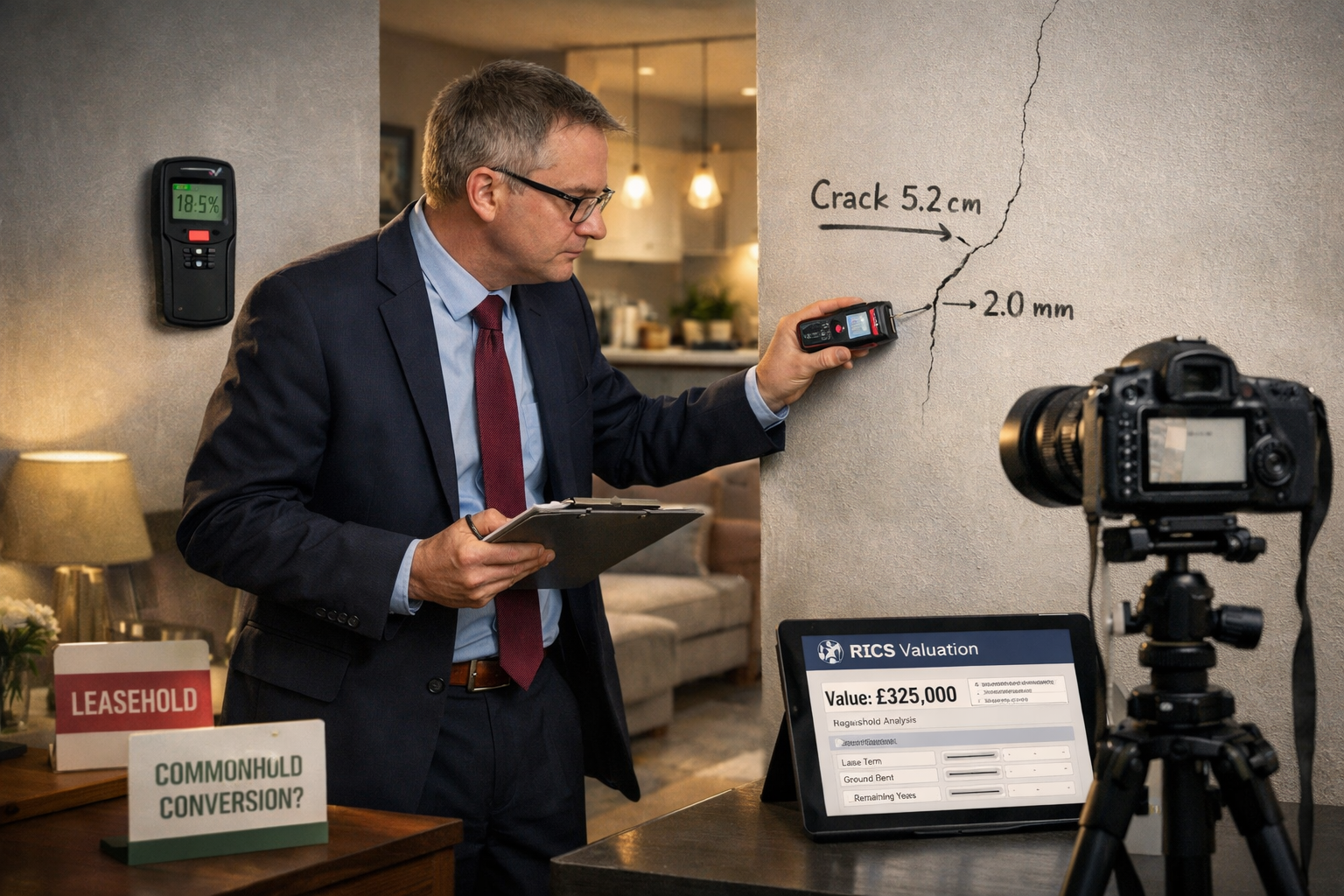
Building Defensible Cases: Expert Witness Preparation Strategies
Preparing defensible evidence for expert witness preparation for 2026 leasehold reform disputes requires systematic methodology and thorough understanding of RICS evidence standards post-commonhold shift.
Comprehensive Property Assessment
Expert witnesses must conduct thorough property assessments that address both traditional valuation factors and new commonhold-related considerations:
Physical Condition Analysis: Document all defects, maintenance issues, and building safety concerns that may affect valuation or service charge disputes. This mirrors the comprehensive approach used in building surveys.
Commonhold Conversion Viability: Assess whether the property is suitable for commonhold conversion, considering structural interdependencies, shared facilities, and management complexity.
Service Charge Reasonableness: Evaluate historical service charges against the updated RICS Service Charge Code standards for fairness and transparency[2].
Reserve Fund Adequacy: Analyze whether reserve funds meet mandatory RICS standards and are sufficient for anticipated maintenance[1].
Valuation Methodology in Uncertain Regulatory Environment
The absence of finalized valuation methodology guidance creates challenges for expert witnesses[1]. Effective strategies include:
Multiple Valuation Approaches: Present evidence using several recognized methodologies to demonstrate value range rather than single-point estimates.
Sensitivity Analysis: Show how different regulatory outcomes might affect valuations, acknowledging pending secondary legislation.
Comparable Evidence: Use recent market transactions involving similar properties, noting any leasehold-to-commonhold conversions.
Expert Judgment Documentation: Clearly explain professional judgment applied when established guidance is unavailable.
For disputes involving lease extension costs, experts must now factor in how potential commonhold conversion options might affect valuation.
Addressing Lender Readiness Issues
Lenders' readiness for commonhold mortgages has been identified as a critical implementation challenge[1]. Expert witnesses may need to address mortgage-related valuations by:
- Documenting lender policies regarding commonhold properties in 2026
- Assessing marketability of properties affected by leasehold reforms
- Evaluating financing availability for commonhold conversions
- Analyzing impact on property values when mortgage options are limited
Service Charge Dispute Evidence Preparation
Service charge disputes represent a significant portion of leasehold cases. Expert witnesses must prepare evidence that addresses:
Reasonableness Assessment: Compare charges to market rates and RICS Code standards[2].
Transparency Evaluation: Determine whether managing agents provided adequate information to leaseholders.
Professional Standards Compliance: Assess whether agents met mandatory RICS professional standards[3].
Building Safety Costs: Evaluate whether Building Safety Act 2022 compliance costs were appropriately allocated[2].
Commonhold Conversion Dispute Strategies
With consent thresholds lowered to 50%[1], conversion disputes have become more common. Expert witnesses should prepare evidence addressing:
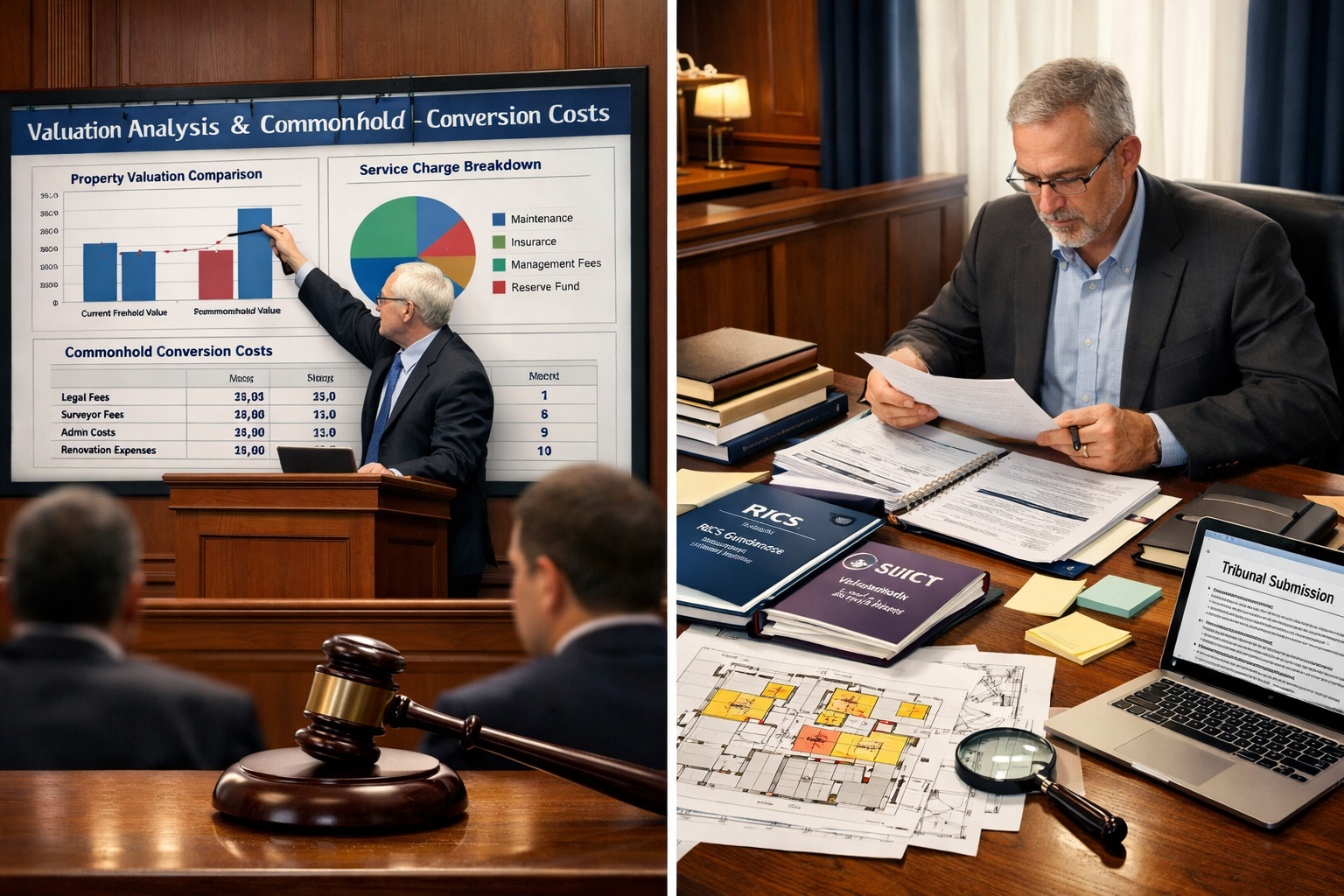
Conversion Cost Analysis: Provide detailed breakdown of conversion expenses, including legal fees, valuation costs, and administrative charges.
Impact on Individual Units: Assess how conversion affects different leaseholders, particularly those with varying lease terms.
Insurance Requirements: Evaluate appropriate insurance coverage for converted commonhold properties.
Management Structure Viability: Analyze whether proposed commonhold association management is practical and sustainable.
Cross-Examination Preparation
Robust expert witness preparation includes anticipating challenges to evidence:
Methodology Defense: Be prepared to justify valuation approaches, especially where regulatory guidance remains pending.
Assumption Scrutiny: Expect detailed questioning about assumptions made in uncertain regulatory environment.
Alternative Scenarios: Prepare responses to alternative valuation methodologies or interpretations.
Professional Standards Knowledge: Demonstrate comprehensive understanding of current RICS standards and their application.
Similar to preparation for party wall disputes, leasehold reform cases require meticulous documentation and clear communication of technical concepts.
Implementation Timeline Uncertainty
A clear implementation timetable for commonhold reforms remains absent[1], creating ongoing market uncertainty. Expert witnesses must navigate this by:
Acknowledging Timeline Gaps: Explicitly state when implementation dates affect valuation conclusions.
Scenario Planning: Present evidence for different implementation timeline scenarios.
Market Impact Analysis: Assess how uncertainty itself affects current property values and transaction activity.
Monitoring Regulatory Updates: Maintain current knowledge of legislative developments that may affect pending cases.
Leveraging RICS Parliamentary Evidence
The parliamentary evidence provided by RICS experts in March 2026 offers valuable insights for expert witness preparation[5]. Key themes to incorporate include:
- Valuation challenges specifically identified by RICS leadership
- Managing agent role clarifications that affect professional standards assessments
- Conversion barrier analysis that explains why some properties face implementation difficulties
- Education and consistency priorities that support clear, understandable evidence presentation
Professional Credibility and Independence
Maintaining professional credibility is paramount. Expert witnesses must:
Demonstrate Independence: Show that evidence is objective and not influenced by the instructing party's desired outcome.
Maintain RICS Compliance: Ensure all work meets mandatory RICS professional standards[3].
Continue Professional Development: Stay current with evolving leasehold reform legislation and guidance.
Document Qualifications: Clearly establish expertise in both valuation methodology and leasehold reform specifics.
Verifying surveyor credentials becomes increasingly important as professional standards become mandatory and disputes become more complex.
Practical Checklist for Expert Witnesses
To ensure comprehensive preparation for expert witness preparation for 2026 leasehold reform disputes, use this practical checklist:
Pre-Engagement Phase
- ✅ Confirm expertise in both leasehold valuation and 2026 reform legislation
- ✅ Verify no conflicts of interest with parties or properties involved
- ✅ Review current RICS mandatory professional standards applicable to the case
- ✅ Understand tribunal or court procedures and evidence requirements
- ✅ Clarify scope of expert instructions and expected deliverables
Investigation Phase
- ✅ Conduct thorough property inspection documenting all relevant conditions
- ✅ Review all lease documents, service charge accounts, and management records
- ✅ Analyze comparable market evidence for similar properties
- ✅ Assess compliance with updated RICS Service Charge Code[2]
- ✅ Evaluate Building Safety Act 2022 compliance and related costs[2]
- ✅ Document reserve fund adequacy against mandatory RICS standards[1]
- ✅ Research lender policies affecting property marketability[1]
- ✅ Identify any pending regulatory changes affecting valuation
Report Preparation Phase
- ✅ Structure report according to tribunal or court requirements
- ✅ State qualifications, experience, and professional memberships clearly
- ✅ Declare any limitations or assumptions in methodology
- ✅ Present multiple valuation approaches where appropriate
- ✅ Reference specific RICS standards and guidance supporting conclusions
- ✅ Include sensitivity analysis for uncertain regulatory factors
- ✅ Provide clear, jargon-free explanations accessible to non-experts
- ✅ Support all factual statements with verifiable sources
- ✅ Include comprehensive appendices with supporting documentation
Pre-Hearing Phase
- ✅ Review opposing expert's report and identify areas of disagreement
- ✅ Prepare responses to anticipated challenges to methodology
- ✅ Update evidence with any recent regulatory developments
- ✅ Participate in expert discussions or joint statements if required
- ✅ Prepare visual aids or summaries to support testimony
- ✅ Rehearse clear explanations of technical concepts
- ✅ Ensure all documentation is organized and easily accessible
Testimony Phase
- ✅ Present evidence clearly and confidently
- ✅ Acknowledge limitations and uncertainties honestly
- ✅ Respond to cross-examination without advocacy or defensiveness
- ✅ Correct any errors or misstatements immediately
- ✅ Maintain professional demeanor throughout proceedings
- ✅ Refer to documentation when needed rather than relying on memory
Conclusion
Expert witness preparation for 2026 leasehold reform disputes demands unprecedented rigor as RICS evidence standards evolve post-commonhold shift. The regulatory landscape has fundamentally changed, with mandatory professional standards, updated service charge codes, and unresolved valuation methodology creating both challenges and opportunities for surveying professionals.
Success in this environment requires comprehensive understanding of the Commonhold and Leasehold Reform Bill's implications, meticulous compliance with RICS mandatory standards, and systematic preparation that addresses both traditional valuation factors and new commonhold-related considerations. The parliamentary evidence provided by RICS experts in March 2026 highlights the critical importance of education, consistency, and clear communication in navigating these complex disputes[5].
Expert witnesses must acknowledge regulatory uncertainty while building defensible cases based on established professional standards. The updated RICS Service Charge Residential Management Code, Building Safety Act 2022 integration, and mandatory reserve fund requirements provide clear benchmarks for evaluating disputes, even as implementation timelines and detailed valuation guidance remain pending[1][2].
Actionable Next Steps
For Surveyors Preparing Expert Evidence:
-
Review Current RICS Standards: Ensure comprehensive understanding of mandatory professional standards and the updated Service Charge Code[2][3]
-
Develop Commonhold Expertise: Build knowledge of conversion processes, consent thresholds, and implementation challenges specific to 2026 reforms[1]
-
Establish Robust Methodologies: Create systematic approaches to valuation and evidence preparation that address regulatory uncertainty while maintaining professional rigor
-
Maintain Professional Development: Stay current with evolving legislation, secondary guidance, and RICS updates affecting leasehold reform disputes[5]
-
Build Documentation Systems: Implement comprehensive documentation practices that support defensible evidence and demonstrate RICS compliance
For Property Professionals Engaging Expert Witnesses:
-
Verify RICS Compliance: Ensure experts demonstrate current knowledge of mandatory professional standards and 2026 reform implications[3]
-
Assess Relevant Experience: Confirm expertise specifically in leasehold reform disputes, not just general valuation work
-
Request Comprehensive Scope: Instruct experts to address all relevant factors including Building Safety Act compliance, reserve funds, and commonhold conversion viability[1][2]
-
Allow Adequate Preparation Time: Recognize that 2026 reform disputes require more extensive investigation and analysis than traditional cases
-
Facilitate Information Access: Provide complete documentation including service charge accounts, management records, and lease terms
The transition to commonhold options and reformed leasehold structures represents the most significant change to property ownership in decades. Expert witnesses who master RICS evidence standards post-commonhold shift will provide invaluable service to tribunals, courts, and parties navigating these complex disputes. By combining technical expertise with clear communication and rigorous professional standards, surveyors can build defensible cases that support fair resolution of leasehold reform challenges in 2026 and beyond.
For professional assistance with expert witness services or Red Book valuations in leasehold reform disputes, consult qualified RICS professionals who demonstrate current knowledge of 2026 standards and commonhold transition requirements.
References
[1] Rics Responds To Latest Government Reforms On Leasehold And Commonhold – https://www.rics.org/news-insights/rics-responds-to-latest-government-reforms-on-leasehold-and-commonhold
[2] Rics Publishes Updated Service Charge Residential Management Code – https://www.rics.org/news-insights/rics-publishes-updated-service-charge-residential-management-code
[3] Changes For Property Lawyers To Expect In 2026 – https://broadfield-law.com/thought-leadership/changes-for-property-lawyers-to-expect-in-2026/
[4] Rics Input Commonhold Leasehold Reform – https://www.surveyorlocal.co.uk/news/post/rics-input-commonhold-leasehold-reform
[5] Update From Justin Young Rics Ceo March 2026 – https://www.rics.org/news-insights/update-from-justin-young-rics-ceo-march-2026
