
Only 23% of UK homebuyers commission an independent valuation before exchanging contracts, yet the gap between an online estimate and a professionally assessed figure can run to tens of thousands of pounds on a single transaction. That gap is not merely a number on a screen, it can determine whether a mortgage is approved, a legal settlement is fair, or a negotiation is won or lost.
The debate around Chartered Surveyor vs DIY Valuation Tools: Professional vs Non-Professional Approaches to UK Property Valuation has intensified in 2026 as free online tools have grown more sophisticated and artificial intelligence has entered the surveying profession itself. Understanding when each approach is appropriate, and when cutting corners is genuinely costly, is now an essential skill for buyers, sellers, and property investors alike.
Key Takeaways
- DIY valuation tools use Automated Valuation Models (AVMs) powered by Land Registry and comparable sales data, but RICS explicitly states that a "raw" AVM output without valuer input does not meet professional standards.
- Chartered surveyors conduct physical inspections and produce RICS Red Book-compliant reports accepted by lenders, courts, and government bodies.
- For standard residential transactions, online tools are useful for orientation; for high-value, contested, or non-standard properties, a chartered surveyor is essential.
- New 2026 RICS guidance on AI in valuation formalises how surveyors must use automated tools within governed, accountable workflows.
- The future points toward hybrid valuation, AVM technology embedded within professional practice, rather than the replacement of surveyors by algorithms.
What Are DIY Valuation Tools and How Do They Work
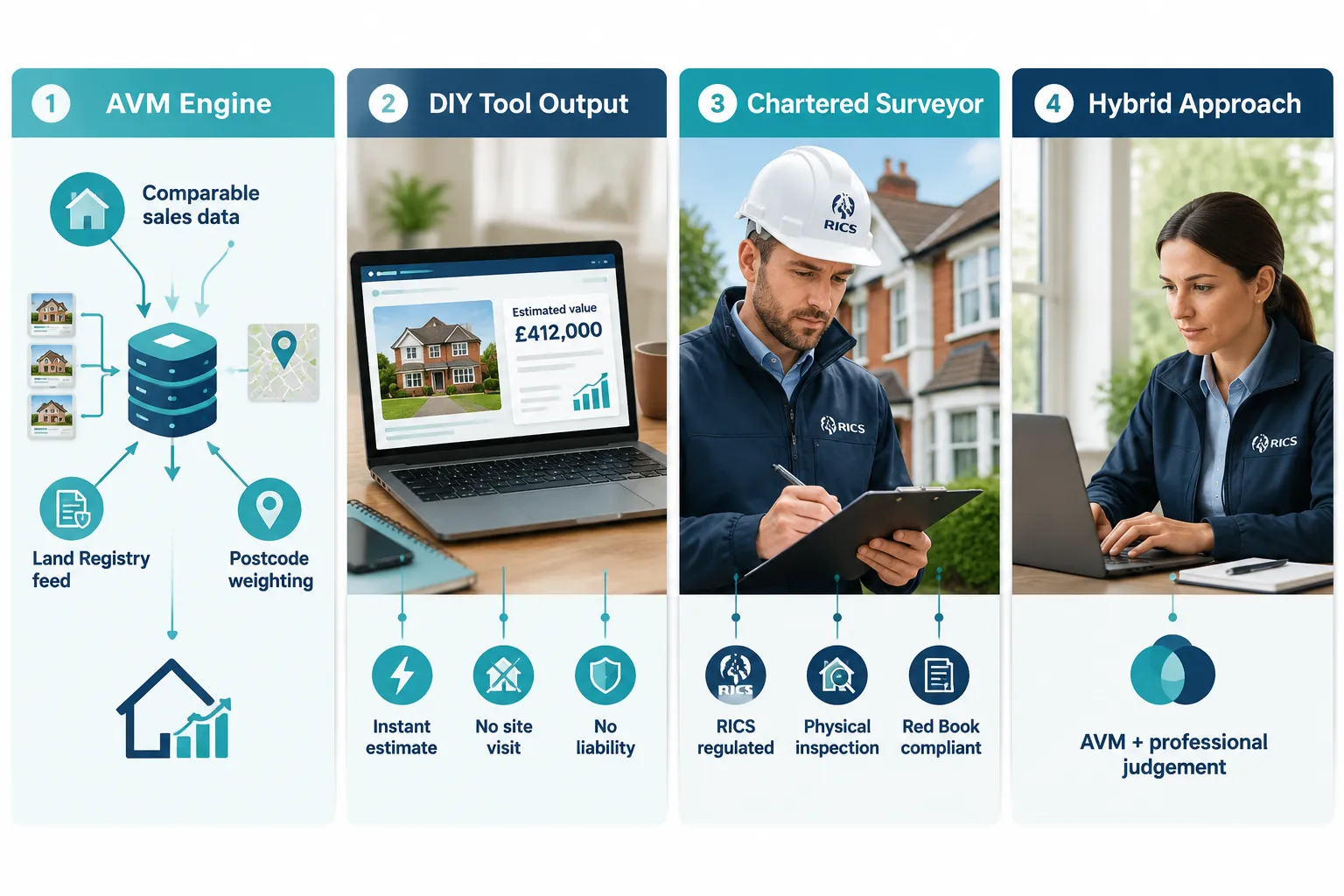
Consumer-facing property valuation tools have proliferated across the UK market. Platforms such as Zoopla's Home Values [7], RealAdvisor [10], and specialist tools like ValuIQ [5] and Offrly [8] offer instant property estimates free of charge. CheckMyStreet [9] provides neighbourhood-level data to support those estimates. These tools draw on publicly available datasets, primarily HM Land Registry sold prices, Rightmove and Zoopla listing histories, and postcode-level market indices, and run them through Automated Valuation Models (AVMs).
An AVM is a statistical algorithm that identifies comparable transactions, applies weighting for location, property type, size, and condition, and outputs a price range or point estimate. The technology is not new, lenders have used AVMs internally for years, but consumer-facing versions have become considerably more accurate for typical properties.
How AVMs generate estimates:
- Identify recent sold prices for comparable properties within a defined radius
- Apply regression modelling or machine learning to weight relevant variables
- Adjust for time elapsed since comparable sales
- Output a confidence interval alongside the headline figure
RICS acknowledges that modern AVMs can achieve strong accuracy for homogeneous, frequently transacted property types [6]. Some AVM providers now highlight independent auditing and claim bank-grade accuracy for standard residential stock. The line between a "DIY" tool and a professional-grade data product has genuinely blurred at the technology level.
However, RICS is unambiguous on one critical point: a raw AVM output, without valuer input and professional judgement, does not constitute a compliant valuation under its standards [3]. The output is data, not a valuation.
What a Chartered Surveyor Actually Delivers
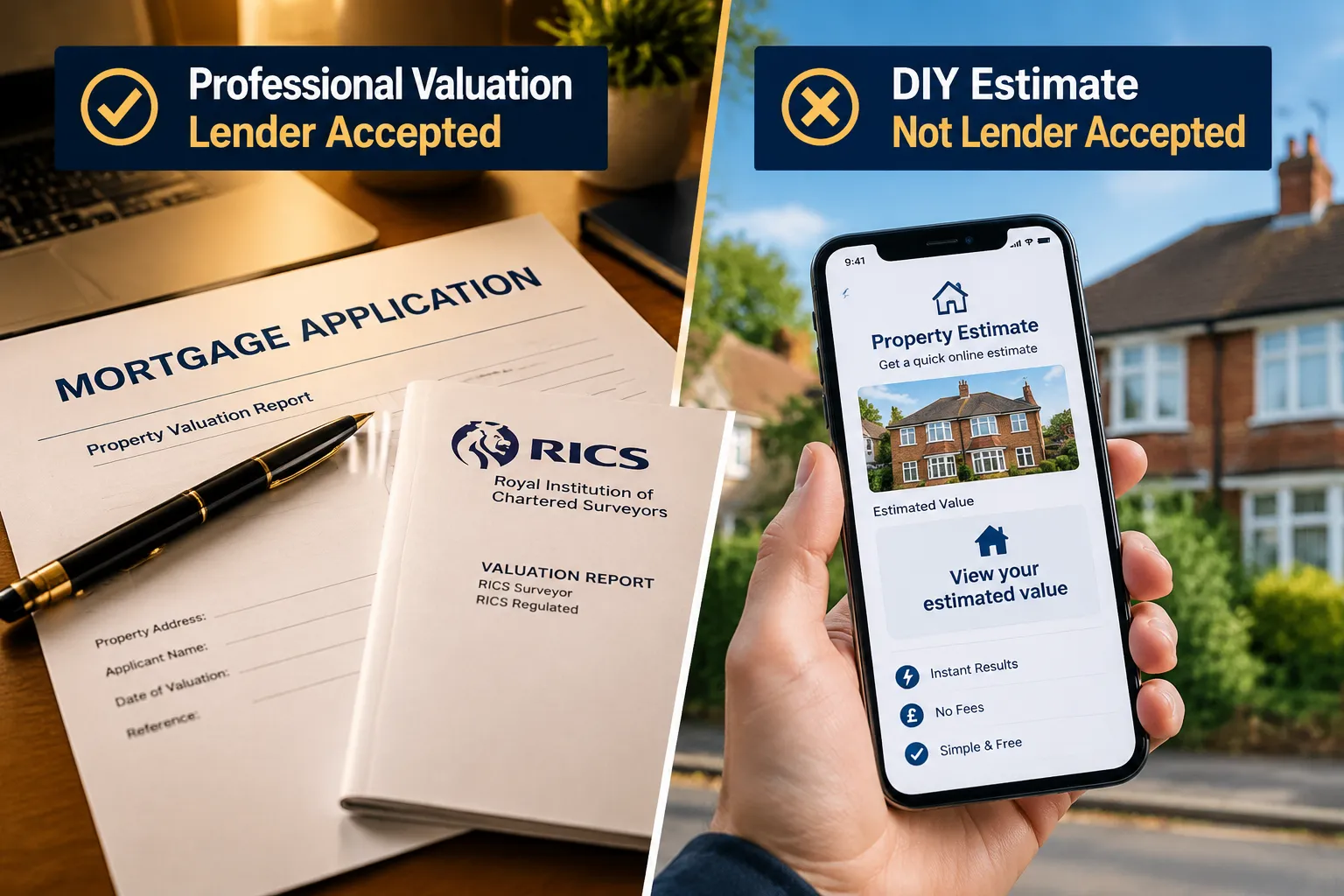
A chartered surveyor brings something no algorithm currently replicates: a physical inspection of the specific property, combined with professional accountability. RICS-registered valuers operate under the RICS Red Book (formally the RICS Valuation, Global Standards), which governs methodology, disclosure, and the basis of value used.
A professionally produced valuation report, such as those available through Notting Hill Valuation Reports, will typically include:
- A confirmed basis of value (usually Market Value as defined by RICS/IVS)
- Physical inspection notes covering condition, construction type, and any defects observed
- A comparable evidence schedule with commentary on adjustments made
- A signed declaration of independence and professional indemnity insurance cover
- Compliance with the RICS Red Book, making it acceptable to lenders, courts, HMRC, and tribunals
This matters commercially. Mortgage lenders require a RICS-compliant valuation before advancing funds. A RICS valuation is the only form of evidence accepted in matrimonial proceedings, probate, capital gains tax disputes, and tribunal hearings. For lease extension valuations, shared ownership transactions, and Help to Buy redemptions, a chartered surveyor's report is a legal requirement, not an optional extra.
"Professional valuations are preferred for regulated, high-stakes purposes; AVMs are framed as appropriate only in certain use cases.", RICS AVM guidance [3]
Where Chartered Surveyors Outperform Algorithms
AVMs struggle with properties that deviate from the norm. Consider these scenarios where algorithmic tools are demonstrably unreliable:
| Property Type | AVM Limitation | Professional Advantage |
|---|---|---|
| Period properties with structural issues | Cannot detect damp, subsidence, or roof defects | Physical inspection identifies material defects |
| Properties with planning anomalies | Cannot assess unauthorised extensions or enforcement notices | Surveyor reviews planning history and flags risk |
| Leasehold with short lease | May not accurately model lease length impact on value | Specialist knowledge of leasehold legislation applied |
| Unique or non-standard construction | Comparable evidence is thin or absent | Surveyor applies judgement to limited evidence |
| Properties undergoing renovation | Listed price and condition diverge sharply | Surveyor values as inspected, not as listed |
Recent data confirms that AVMs are least reliable precisely where the stakes are highest: non-standard, unique, or defect-affected properties [6]. For loft space valuations or freehold valuations, where the uplift or premium depends on specific legal and physical factors, algorithmic tools have no meaningful accuracy.
The Risk Dimension: When Getting It Wrong Is Expensive
The commercial consequences of relying on a DIY valuation at the wrong moment are significant and underappreciated.
Mortgage applications. Lenders commission their own panel valuations, but buyers who enter negotiations armed only with an online estimate may overbid relative to the lender's figure. The result is a valuation shortfall, the buyer must fund the gap from their own resources or renegotiate. A pre-purchase chartered surveyor's report can identify this risk before an offer is made. As explored in detail in why hiring a residential surveyor could save you thousands, professional advice at the right stage frequently pays for itself many times over.
Legal and tax matters. HMRC does not accept an online estimate as evidence of market value for capital gains tax, inheritance tax, or stamp duty purposes. Courts do not accept them in divorce proceedings. A matrimonial valuation must be prepared by a RICS-registered valuer to carry evidential weight. Similarly, charities disposing of land must comply with the Charities Act valuation requirements, which mandate a qualified surveyor's report.
Negotiation. A well-evidenced professional valuation is a powerful negotiating instrument. A buyer presenting a chartered surveyor's report identifying a structural defect or an overvalued comparable has a defensible basis to reduce an offer. An online estimate is easily dismissed by a vendor or estate agent as a rough guide.
The cost of professional advice in context. The cost of valuation varies by property type and complexity, but for most residential properties it represents a fraction of 1% of the transaction value. Against the risk of a valuation shortfall, an HMRC penalty, or an unfavourable legal settlement, the professional fee is commercially rational.
The 2026 Landscape: AI, Hybrid Valuation, and RICS Guidance
The most significant development in UK property valuation in 2026 is the formalisation of AI and AVM use within the chartered surveying profession. RICS has published dedicated guidance on AI in real estate valuation [2] and an AVM roadmap [1] that sets out how surveyors should integrate automated tools within accountable, governed workflows.
The key regulatory position is clear: surveyors may use AVM outputs as one input among several, but the professional must exercise independent judgement, disclose the use of automated tools, and take personal responsibility for the final figure [4]. A surveyor who simply adopts an AVM output without critical review is not compliant with RICS standards.
This creates an important distinction that consumers often miss:
- DIY tools use AVM engines and present the output directly to the end user, with no professional intermediary, no physical inspection, and no liability.
- Chartered surveyors may use the same underlying AVM engines and data platforms, but within a governed workflow that includes inspection, professional judgement, disclosure, and indemnified accountability.
The technology is converging; the governance is not. RICS notes rapid adoption of AVMs driven by speed and cost savings, but highlights that significant challenges, data quality, model transparency, and the handling of non-standard properties, keep professional valuations central to the market [6].
Emerging guidance points firmly toward a future of hybrid valuation: AVM technology embedded within professional practice, accelerating the data-gathering phase while the surveyor adds the judgement, inspection, and accountability layer that algorithms cannot provide [2]. This is not a threat to the profession; it is a redefinition of where professional value is added.
Choosing the Right Approach: A Practical Decision Framework
The choice between a chartered surveyor and a DIY tool is not binary for every situation. The following framework reflects current expert consensus and RICS guidance.
Use a DIY valuation tool when:
- Conducting initial market research before listing or making an offer
- Tracking the approximate value of a property over time for personal financial planning
- Benchmarking an estate agent's asking price against independent data
- The decision carries no legal, tax, or lending consequences
Instruct a chartered surveyor when:
- Applying for a mortgage or remortgage (lender requirement)
- Buying or selling a high-value, unique, or non-standard property
- Involved in divorce, probate, or any legal proceeding
- Calculating capital gains tax or inheritance tax liability
- Exercising a lease extension or freehold purchase right
- Involved in a shared ownership staircasing transaction
- Seeking to negotiate a price reduction on the basis of condition
Chartered surveyors operate across London and the wider UK. Whether the property is in West London, Guildford, Hampshire, or East London, RICS-regulated professionals are accessible and their reports carry national legal standing.
Understanding Valuation Factors That Tools Miss
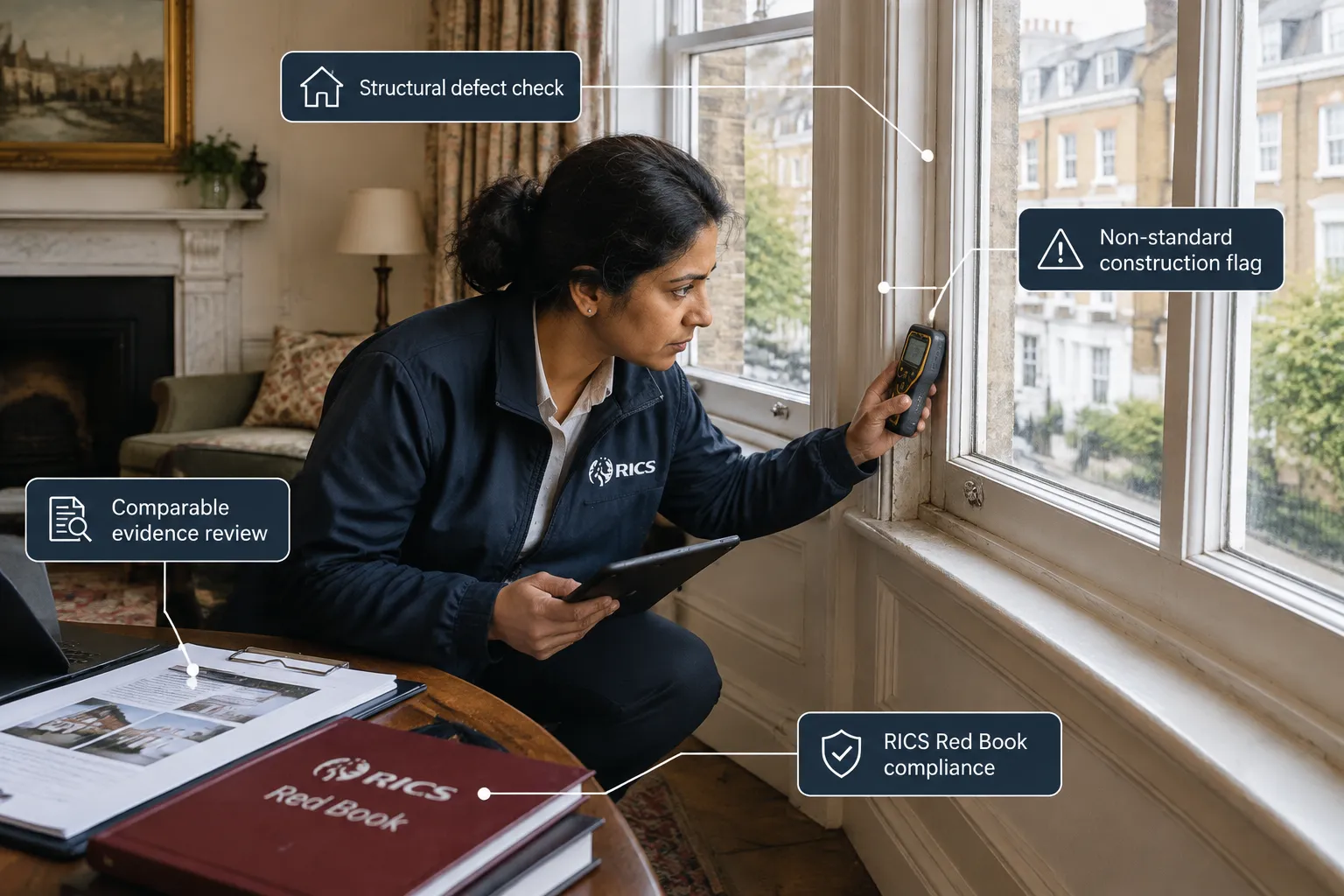
One of the most instructive ways to understand the professional vs non-professional divide is to examine the valuation factors that AVMs systematically underweight or ignore entirely.
Physical condition is the most significant. An AVM has no mechanism to identify a cracked lintel, rising damp, or a roof nearing end of life. These defects can reduce market value by 5-20% on an affected property, yet the algorithm will price the property on the basis of its address and floor area, not its condition.
Legal encumbrances, restrictive covenants, rights of way, chancel repair liability, and flood risk designations, are not consistently captured in the datasets that power consumer AVMs. A chartered surveyor's report will flag these as material considerations affecting value.
Micro-location factors, proximity to a planned development, a flight path change, or a commercial use next door, require local knowledge and current awareness that no national dataset reliably provides.
Lease terms for leasehold properties are a particularly acute example. The impact of a short lease on value follows a non-linear curve that requires specialist knowledge to apply correctly. An AVM treating a 72-year lease the same as a 125-year lease will produce a materially misleading figure.
These are not edge cases. They are common features of the UK property market, particularly in London and other high-demand urban areas where leasehold tenure, period construction, and planning complexity are the norm rather than the exception.
Conclusion
The comparison of Chartered Surveyor vs DIY Valuation Tools: Professional vs Non-Professional Approaches to UK Property Valuation ultimately resolves to a question of purpose and consequence. DIY tools are genuinely useful for orientation, market monitoring, and initial benchmarking. They have improved significantly and, for homogeneous standard properties, can produce estimates that are directionally accurate.
But accuracy and compliance are different things. RICS is explicit: a raw AVM output is not a valuation [3]. It carries no professional liability, no physical inspection, no legal standing, and no accountability. For any decision where those things matter, a mortgage, a legal proceeding, a tax calculation, a high-value negotiation, a chartered surveyor is not a luxury. It is the commercially rational choice.
Actionable next steps:
- Use free online tools to form an initial view of a property's market position before engaging an agent or making an offer.
- Before exchanging contracts, commission a RICS-compliant valuation and survey from a chartered surveyor, particularly for older, leasehold, or non-standard properties.
- For any legal, tax, or lending purpose, instruct a RICS-registered valuer and confirm the report will be prepared under Red Book standards.
- If you are unsure which level of survey or valuation is appropriate, consult a chartered surveyor directly, many offer a free initial discussion to clarify requirements.
- Stay informed about how AI and hybrid valuation are changing professional practice; RICS guidance published in 2026 provides the authoritative framework for understanding these developments.
References
[1] Rics Avm Roadmap – https://www.rics.org/content/dam/ricsglobal/documents/standards/rics_avm_roadmap.pdf
[2] Ai In Real Estate Valuation – https://www.rics.org/profession-standards/rics-standards-and-guidance/sector-standards/valuation-standards/ai-in-real-estate-valuation
[3] Automated Valuation Models – https://www.rics.org/profession-standards/rics-standards-and-guidance/sector-standards/valuation-standards/automated-valuation-models
[4] Ai Or Automated Valuation Model – https://community.rics.org/viewdocument/ai-or-automated-valuation-model
[5] valuiq.uk – https://valuiq.uk/
[6] April 2022 Automated Valuation Models Insight – https://www.rics.org/content/dam/ricsglobal/documents/standards/april_2022_automated_valuation_models_insight.pdf
[7] Home Values – https://www.zoopla.co.uk/home-values/
[8] offrly.co.uk – https://offrly.co.uk/
[9] checkmystreet.co.uk – https://www.checkmystreet.co.uk/
[10] realadvisor.co.uk – https://realadvisor.co.uk/en