
The UK's housing stock faces an unprecedented transformation. With an estimated 25 million homes requiring energy improvement [1], the retrofit sector is experiencing explosive growth—but also facing a critical trust deficit. Following the Quality in Retrofit Summit and the mandatory implementation of the RICS Residential Retrofit Standard in October 2024, building surveyors must fundamentally adapt their approach to Adapting Building Surveys for 2026 Retrofit Projects: RICS Guidance Post-Quality in Retrofit Summit requirements. This shift represents more than procedural updates; it demands a complete reconceptualization of how professionals assess, document, and guide retrofit interventions.
The stakes couldn't be higher. Widespread retrofit failures—resulting in damp, mould, condensation, and performance gaps—have exposed the dangers of inadequate assessment [2]. As we navigate 2026, surveyors equipped with RICS guidance and systems-based methodologies are positioned as essential gatekeepers between ambitious energy efficiency goals and quality outcomes that protect homeowners and building fabric alike.

Key Takeaways
- RICS Residential Retrofit Standard became mandatory for all RICS members and regulated firms on October 31, 2024, establishing binding requirements for retrofit service delivery [1]
- BS 40104 provides the standardized framework for retrofit assessments, mandating a systems-based approach rather than component-focused inspections [2]
- Trust restoration is the sector's foundational challenge, with professional independence and quality assessment positioned as solutions to widespread retrofit failures [3]
- New RICS pathway to associate membership in Residential Retrofit Surveying creates specialized credentials, with the program already oversubscribed due to strong demand [2]
- Retrofit assessment is a foundational step, not administrative formality—robust surveys prevent performance gaps, unintended consequences, and building defects [2]
Understanding the RICS Residential Retrofit Standard Framework
Mandatory Requirements for 2026 Retrofit Projects
The RICS Residential Retrofit Standard represents a watershed moment for building surveying professionals. Implemented as mandatory guidance in October 2024, this framework establishes concise mandatory and recommended requirements that govern how RICS members deliver retrofit services [1]. Unlike previous voluntary guidance, these standards carry professional accountability implications.
The standard addresses the enormous scale of the retrofit challenge. With 25 million UK homes requiring energy improvements [1], the sector demands professional rigor to prevent the quality failures that have plagued early retrofit efforts. The framework mandates:
✅ Adherence to BS 40104 for all retrofit inspection tasks
✅ Systems-based assessment methodology rather than isolated component evaluation
✅ Comprehensive risk identification including moisture, ventilation, and thermal performance
✅ Professional independence throughout the assessment and recommendation process
✅ Ongoing CPD requirements specific to retrofit competencies
For surveyors accustomed to traditional Level 3 building surveys, the retrofit standard introduces additional complexity. Assessments must evaluate not just current condition but also retrofit suitability, performance potential, and systemic interactions between building elements.
The BS 40104 Assessment Framework
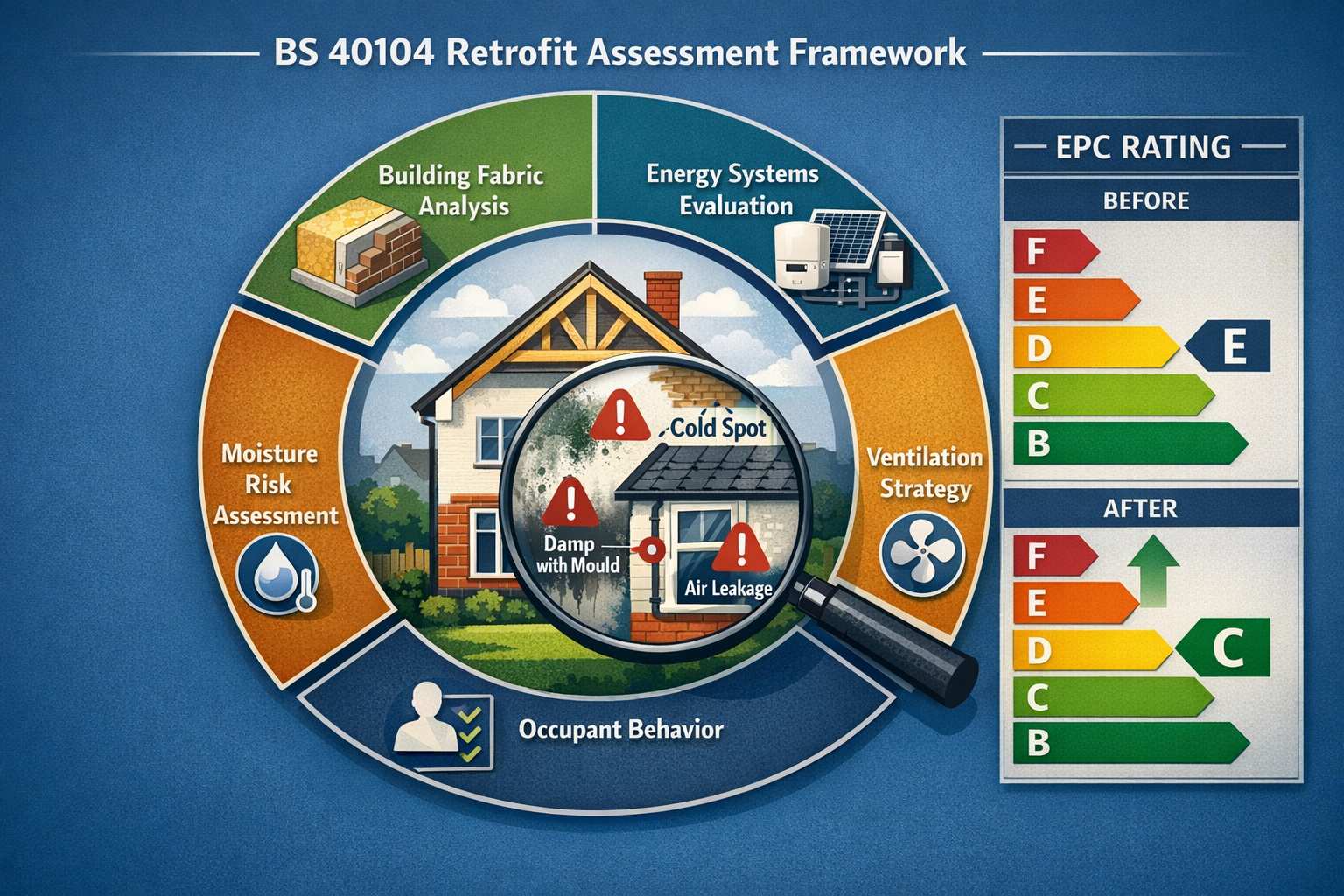
BS 40104 (Assessment of Dwellings for Retrofit) provides the technical backbone for adapting building surveys for 2026 retrofit projects. This British Standard establishes a structured, repeatable methodology for evaluating properties before retrofit interventions [2].
The framework requires surveyors to assess:
| Assessment Component | Key Evaluation Areas | Retrofit Relevance |
|---|---|---|
| Building Fabric | Wall construction, insulation levels, thermal bridging, air tightness | Determines insulation strategy and ventilation requirements |
| Moisture Management | Existing damp issues, condensation risk, breathability | Prevents trapped moisture post-retrofit |
| Ventilation Systems | Current provision, air change rates, occupant behavior | Ensures adequate indoor air quality after fabric improvements |
| Heating & Services | System efficiency, distribution, controls | Identifies appropriate heat pump or system upgrade pathways |
| Building Pathology | Structural defects, material degradation, historic alterations | Flags repair priorities before retrofit works |
This comprehensive approach contrasts sharply with traditional surveys that primarily document visible defects. BS 40104 demands forward-looking analysis of how proposed interventions will interact with existing building characteristics.
Systems-Based Approach: Adapting Building Surveys for 2026 Retrofit Projects
From Component Inspection to Integrated Analysis
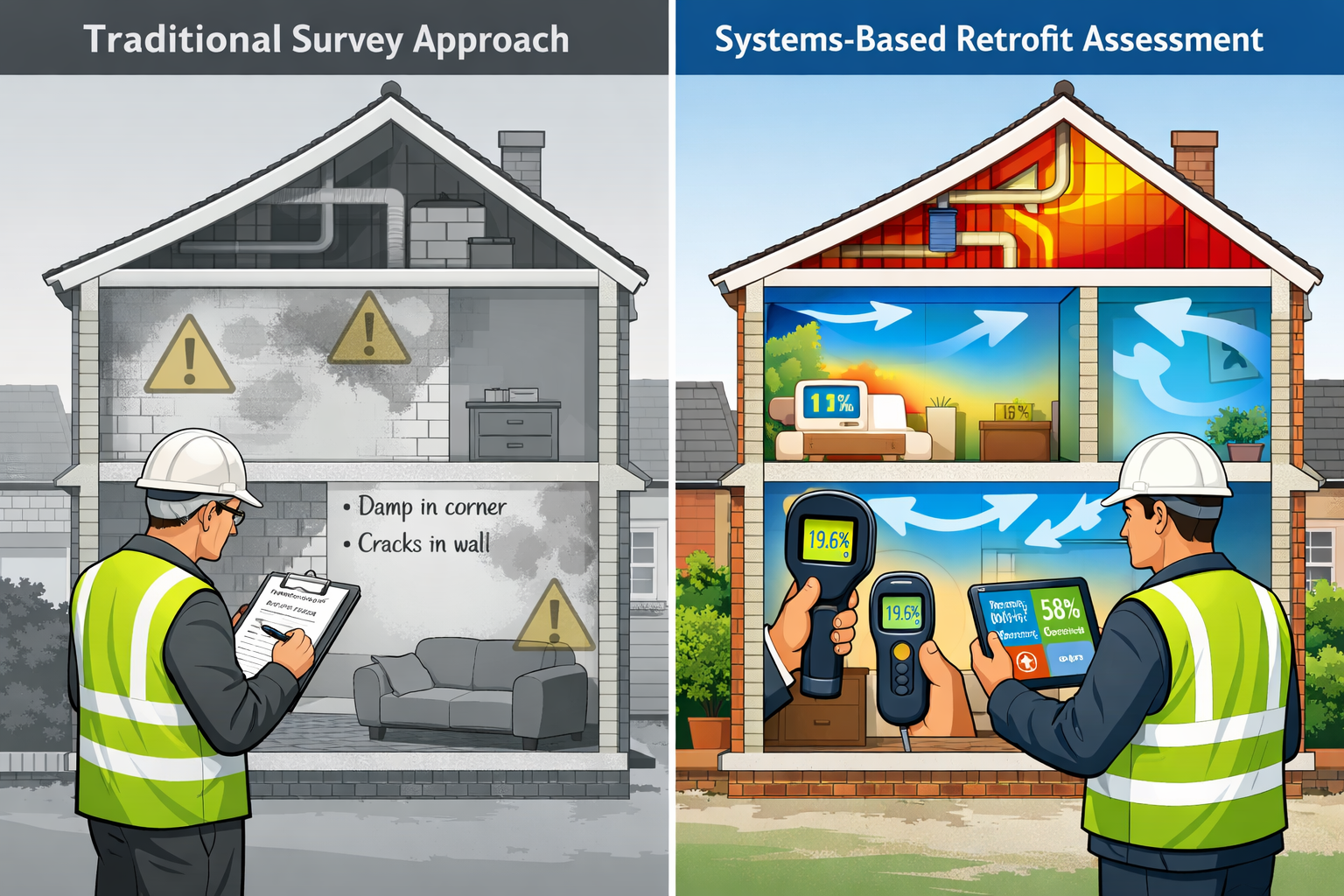
The RICS guidance post-Quality in Retrofit Summit emphasizes a fundamental shift: surveyors must understand buildings as integrated systems rather than collections of separate components [2]. This systems-based methodology acknowledges that retrofit interventions create complex interactions between fabric, services, and occupant behavior.
Consider a common scenario: adding external wall insulation to a solid-walled Victorian terrace. A traditional component-focused survey might simply note wall condition and recommend insulation. A systems-based retrofit assessment evaluates:
🏠 Fabric interactions: How will reduced wall breathability affect moisture movement?
💨 Ventilation requirements: What mechanical ventilation is needed to prevent condensation?
🌡️ Thermal performance: Will improved insulation create overheating risks in summer?
🔧 Service integration: How do heating system upgrades coordinate with fabric improvements?
👥 Occupant factors: What are usage patterns, moisture generation, and behavioral considerations?
This holistic perspective prevents the unintended consequences that have plagued poorly-planned retrofits, including damp, mould, and indoor air quality deterioration [2]. For professionals conducting structural surveys, the systems approach adds layers of building physics analysis to traditional structural assessment skills.
Identifying Retrofit Failure Risks
Widespread retrofit failures have created the impetus for enhanced professional standards. Documented cases show works failing to deliver intended carbon savings while causing significant defects including damp, mould, and condensation [2]. These failures typically stem from:
Assessment inadequacies:
- Insufficient pre-work moisture surveys
- Failure to identify existing ventilation deficiencies
- Inadequate thermal bridging analysis
- Overlooking building pathology requiring pre-retrofit repair
Design flaws:
- One-size-fits-all solutions ignoring building-specific characteristics
- Inadequate ventilation provision post-fabric upgrade
- Thermal bridge creation through poor detailing
- Incompatible material selections for historic buildings
Installation issues:
- Poor workmanship creating air leakage paths
- Inadequate vapor control layer installation
- Insufficient attention to junctions and penetrations
The systems-based approach mandated by RICS guidance addresses these failure modes by requiring comprehensive pre-retrofit assessment that identifies risks before works commence. This preventive methodology protects both building fabric and homeowner investment.
Professional Competency and the RICS Retrofit Pathway
New Qualifications for Adapting Building Surveys for 2026 Retrofit Projects
Recognizing that retrofit assessment demands specialized expertise, RICS has introduced a new pathway to associate membership (AssocRICS) in Residential Retrofit Surveying [2]. This credential builds on existing entry requirements while extending RICS conduct and competency standards into the retrofit specialty.
The pathway is already oversubscribed, indicating strong demand from surveying professionals seeking recognized credentials in this growth area [3]. The qualification framework blends:
Core surveying competencies:
- Building inspection methodology
- Defect identification and diagnosis
- Construction technology knowledge
- Report writing and communication
Retrofit-specific expertise:
- Building physics and thermal performance
- Energy efficiency measures and technologies
- Moisture risk assessment
- Ventilation strategy development
- BS 40104 assessment framework application
For professionals already qualified in traditional building surveys, the retrofit pathway represents upskilling rather than complete retraining. However, it demands serious engagement with building science principles that may not have featured prominently in conventional surveying education.
Continuing Professional Development Requirements
The RICS framework mandates structured CPD and ongoing training for retrofit specialists [2]. This requirement acknowledges that retrofit technology, materials, and best practices continue to evolve rapidly. Surveyors must maintain currency in:
📚 Technical standards: Updates to BS 40104, PAS 2035, and related guidance
🔬 Building science: Hygrothermal modeling, air tightness testing, thermal imaging
🛠️ Technologies: Heat pump systems, ventilation strategies, insulation materials
⚖️ Regulatory frameworks: Building Regulations Part L updates, EPC requirements
🏛️ Heritage considerations: Retrofit approaches for traditional and listed buildings
This ongoing learning requirement ensures that professionals conducting RICS Homebuyer surveys or comprehensive building assessments maintain expertise aligned with current best practices.
Restoring Trust: Independence and Quality in Retrofit Assessment
The Trust Deficit Challenge
The Quality in Retrofit Summit identified trust deficit as the foundational problem in the retrofit sector [3]. This challenge overshadows even technology and policy issues. Homeowners lack clarity on which professionals to trust, and delivery systems often reward box-ticking over genuine quality outcomes.
RICS leadership has articulated this clearly: "any professional sector brings independence" [3]. The institution's role is ensuring retrofit is handled correctly from start to finish, with professional surveyors serving as independent advisors rather than parties with vested interests in specific solutions or contractors.
This independence principle distinguishes professional retrofit assessment from:
❌ Contractor-led assessments with inherent conflicts of interest
❌ Product manufacturer recommendations prioritizing specific technologies
❌ Grant-driven evaluations focused on subsidy eligibility rather than optimal outcomes
❌ Tick-box compliance meeting minimum standards without quality consideration
The RICS framework positions chartered surveyors as trusted intermediaries who evaluate properties objectively, recommend appropriate interventions based on building-specific factors, and protect homeowner interests throughout the retrofit process.
Quality Over Compliance: A Cultural Shift
RICS advocacy extends beyond technical standards to sector culture. The institution demands that all documents needed for correct retrofit delivery be free, easy to find, searchable, and downloadable [3]. This zero-barriers approach to information access supports quality outcomes by ensuring professionals and homeowners can access authoritative guidance.
The emphasis on quality over mere compliance represents a cultural shift. Rather than viewing retrofit assessment as an administrative hurdle before accessing grants or meeting regulatory minimums, the RICS framework positions it as an essential foundational step that determines project success [2].
This perspective aligns with broader surveying principles. Just as professionals conducting specific defect surveys provide detailed analysis of particular concerns, retrofit assessors must deliver thorough, building-specific evaluations rather than generic recommendations.
Practical Implementation: Adapting Survey Methodologies for Retrofit Projects
Enhanced Inspection Protocols
Adapting building surveys for 2026 retrofit projects requires enhanced inspection protocols that go beyond traditional visual assessment. The systems-based approach demands:
Pre-inspection preparation:
- Review of property age, construction type, and alteration history
- Examination of existing EPC data and previous survey reports
- Identification of likely retrofit measures based on property characteristics
- Preparation of building-specific assessment checklist
On-site evaluation:
- Thermal imaging to identify heat loss, thermal bridging, and insulation gaps
- Moisture measurement using electronic meters at multiple locations
- Ventilation assessment including air change rate estimation
- Air tightness evaluation identifying major leakage paths
- Building fabric analysis documenting wall construction, roof configuration, and floor types
- Services review assessing heating system, hot water provision, and electrical capacity
Post-inspection analysis:
- Integration of findings into systems-based framework
- Risk identification for proposed retrofit measures
- Development of sequenced improvement recommendations
- Performance gap prediction and mitigation strategies
These enhanced protocols require equipment investment and time allocation beyond standard building surveys. However, they provide the comprehensive foundation necessary for successful retrofit project planning.
Reporting and Recommendations
Retrofit assessment reports must communicate complex technical information to diverse audiences, including homeowners, contractors, designers, and grant administrators. Effective reports balance:
Technical rigor:
- Detailed documentation of current building performance
- Quantified assessment of improvement potential
- Specific identification of risks and constraints
- Reference to relevant standards and guidance
Accessibility:
- Clear explanation of findings in non-technical language
- Visual aids including photographs, thermal images, and diagrams
- Prioritized recommendations with cost-benefit context
- Practical next steps for property owners
Professional independence:
- Objective evaluation without product or contractor bias
- Disclosure of limitations and uncertainties
- Recommendations based on building-specific factors rather than generic solutions
For surveyors experienced in producing comprehensive structural survey reports, retrofit assessments require additional sections addressing energy performance, improvement pathways, and systems interactions.
Integration with Broader Surveying Practice
Retrofit Considerations in Standard Building Surveys
Even when retrofit is not the primary purpose, building surveys in 2026 increasingly incorporate energy efficiency and retrofit potential assessment. Homebuyers purchasing older properties frequently ask about improvement possibilities, and surveyors providing Level 2 Homebuyer surveys benefit from understanding retrofit implications.
Standard surveys can flag:
🔍 Retrofit opportunities: Properties particularly suitable for specific improvements
⚠️ Retrofit constraints: Historic features, construction types, or conditions limiting options
💡 Pre-retrofit repairs: Defects requiring resolution before energy efficiency works
📊 Performance potential: Realistic improvement expectations based on property characteristics
This integration ensures that even general-purpose surveys provide value regarding retrofit considerations, positioning surveyors as comprehensive property advisors rather than narrow specialists.
Specialized Retrofit Survey Services
Beyond standard building surveys, many practices now offer dedicated retrofit assessment services. These specialized offerings include:
Pre-retrofit surveys:
- Comprehensive BS 40104 compliant assessments
- Detailed risk analysis for proposed measures
- Sequencing and prioritization recommendations
- Grant application support documentation
Post-retrofit verification:
- Confirmation of work quality and specification compliance
- Performance testing and validation
- Defect identification requiring remediation
- Documentation for warranty and certification purposes
Retrofit project monitoring:
- Staged inspections during installation
- Quality assurance and specification compliance checking
- Early intervention to prevent installation defects
These specialized services complement traditional offerings like damp surveys and roof surveys, creating comprehensive service portfolios addressing modern property challenges.
Challenges and Opportunities in 2026
Current Sector Challenges
Despite progress in professional standards, the retrofit sector faces ongoing challenges that affect surveying practice:
Skills shortage:
The rapid expansion of retrofit demand has outpaced professional capacity. Even with oversubscribed RICS pathway programs [3], the sector needs thousands of qualified assessors to meet the 25 million home improvement target [1].
Technology evolution:
Retrofit technologies continue to evolve rapidly, from advanced heat pump systems to innovative insulation materials. Surveyors must maintain currency with these developments while applying proven assessment principles.
Regulatory complexity:
Building Regulations, planning requirements, grant schemes, and professional standards create a complex regulatory landscape. Navigating these frameworks while maintaining focus on quality outcomes demands significant expertise.
Cost pressures:
Comprehensive retrofit assessments require time and specialized equipment, creating cost pressures in a sector where homeowners may be reluctant to invest in professional advice before committing to improvement works.
Opportunities for Surveying Professionals
The retrofit transformation also creates significant opportunities:
Market expansion:
With 25 million homes requiring improvement [1], the addressable market for retrofit assessment services is enormous and sustained over decades.
Professional differentiation:
RICS credentials and demonstrated retrofit expertise provide competitive differentiation in a crowded marketplace, building on the trust associated with chartered surveyor status.
Service integration:
Retrofit assessment integrates naturally with existing services, from pre-purchase surveys to ongoing property management advice, creating opportunities for comprehensive client relationships.
Sector leadership:
Surveyors equipped with systems-based assessment skills and professional independence are positioned as sector leaders, shaping retrofit quality standards and protecting homeowner interests.
Case Study: Systems-Based Assessment in Practice
Victorian Terrace Retrofit Assessment
A practical example illustrates how adapting building surveys for 2026 retrofit projects differs from traditional approaches:
Property: Mid-terrace Victorian house, solid brick walls, suspended timber floors, original sash windows, gas central heating
Traditional survey approach would document:
- Wall condition (fair, some repointing needed)
- Floor condition (some movement, ventilation adequate)
- Window condition (functional but draughty)
- Heating system (aging but operational)
Systems-based retrofit assessment evaluates:
Fabric analysis:
- Solid wall construction limits insulation options (internal vs. external)
- Suspended floors create cold bridging and air leakage
- Single-glazed sashes contribute 25% of heat loss
- Roof space has minimal insulation (50mm original)
Moisture risk:
- Solid walls currently breathable; external insulation would alter moisture dynamics
- Internal insulation risks interstitial condensation without vapor control
- Existing slight rising damp requires resolution before insulation
- Bathroom lacks adequate ventilation, creating condensation risk
Ventilation strategy:
- Natural ventilation through sash gaps currently provides air changes
- Post-retrofit fabric improvements require mechanical ventilation with heat recovery (MVHR)
- Chimney breasts could accommodate ventilation ducting
- Kitchen and bathroom extract fans need upgrading
Heating integration:
- Air source heat pump viable but requires radiator upgrades
- Fabric improvements must precede heat pump installation
- Hot water cylinder replacement needed for heat pump compatibility
- Electrical supply upgrade required for heat pump operation
Recommended sequence:
- Resolve rising damp and repoint masonry
- Install roof insulation (300mm) and improve air tightness
- Upgrade windows to high-performance double glazing
- Install MVHR system
- Add external wall insulation (subject to planning)
- Upgrade heating system to heat pump
This systems-based approach identifies interdependencies and sequencing that prevent costly mistakes and ensure optimal outcomes—value that traditional component-focused surveys cannot provide.
Future Developments and Sector Evolution
Emerging Technologies and Assessment Methods
The retrofit assessment field continues to evolve with emerging technologies:
Advanced diagnostics:
- Drone-based thermal imaging for roof and facade analysis
- AI-powered defect detection from survey photographs
- Whole-house energy modeling software
- Real-time indoor air quality monitoring
Digital integration:
- Building Information Modeling (BIM) for retrofit planning
- Digital twins enabling performance prediction
- Cloud-based reporting platforms
- Integration with smart home systems for post-retrofit monitoring
Surveyors must balance adoption of beneficial technologies with maintaining core assessment competencies and professional judgment.
Policy and Regulatory Trajectory
Future policy developments will shape retrofit assessment requirements:
Potential regulatory changes:
- Mandatory retrofit assessments for property transactions
- Enhanced EPC requirements with retrofit roadmaps
- Stricter building performance standards
- Expanded grant schemes requiring professional assessment
Professional standards evolution:
- Ongoing refinement of RICS retrofit guidance
- Integration with broader sustainability frameworks
- Enhanced competency requirements
- Quality assurance and peer review protocols
Staying engaged with chartered surveyor professional development ensures practitioners remain ahead of these evolving requirements.
Conclusion
Adapting building surveys for 2026 retrofit projects represents a fundamental evolution in surveying practice. The mandatory RICS Residential Retrofit Standard, combined with the BS 40104 assessment framework, establishes professional rigor in a sector plagued by quality failures and trust deficits. The systems-based approach—understanding buildings as integrated systems rather than isolated components—provides the comprehensive foundation necessary for successful retrofit outcomes.
For surveying professionals, this transformation creates both challenges and opportunities. The skills required extend beyond traditional building inspection to encompass building physics, energy systems, and risk assessment. However, the enormous scale of retrofit demand (25 million UK homes requiring improvement) creates sustained market opportunity for qualified practitioners.
The RICS pathway to associate membership in Residential Retrofit Surveying, already oversubscribed, provides a clear route to specialized credentials. Combined with ongoing CPD requirements, this framework ensures professionals maintain expertise aligned with evolving best practices.
Most importantly, the emphasis on professional independence and quality over compliance positions chartered surveyors as trusted advisors in a sector where homeowners desperately need objective guidance. By conducting comprehensive, systems-based assessments and providing building-specific recommendations, surveyors protect both building fabric and homeowner investment while advancing the UK's energy efficiency goals.
Actionable Next Steps
For surveying professionals:
✅ Pursue RICS retrofit pathway credentials to formalize specialized expertise
✅ Invest in diagnostic equipment including thermal cameras and moisture meters
✅ Engage with BS 40104 framework through training and practical application
✅ Develop systems-based assessment skills through CPD and case study review
✅ Build retrofit assessment services as complement to traditional survey offerings
✅ Maintain professional independence and quality focus in all retrofit work
✅ Stay current with evolving standards through RICS resources and sector engagement
For property owners and industry stakeholders:
✅ Prioritize professional assessment before committing to retrofit works
✅ Seek RICS-qualified surveyors with demonstrated retrofit expertise
✅ Understand retrofit as systems challenge requiring comprehensive evaluation
✅ Invest in quality assessment to prevent costly failures and unintended consequences
✅ Follow sequenced recommendations rather than pursuing isolated improvements
The retrofit transformation of the UK's housing stock represents one of the most significant built environment challenges of the coming decades. Professional surveyors, equipped with enhanced competencies and guided by robust standards, are positioned as essential enablers of this transformation—ensuring that ambitious energy efficiency goals translate into quality outcomes that protect buildings, occupants, and investments for generations to come.
References
[1] Retrofit – https://www.rics.org/profession-standards/rics-standards-and-guidance/sector-standards/real-estate-standards/retrofit
[2] Retrofit Assessment Surveyors Upskilling – https://ww3.rics.org/uk/en/journals/property-journal/retrofit-assessment-surveyors-upskilling.html
[3] Sparks Of 2026 9 Rics And The Return Of Professional Trust In Retrofit – https://www.refurbandretrofit.com/sparks-of-2026-9-rics-and-the-return-of-professional-trust-in-retrofit/
