
{"cover":"Professional landscape format (1536×1024) hero image with bold text overlay: 'Schedules of Condition Best Practices for Party Wall Surveys: Avoiding Costly Disputes in 2026' in extra large 70pt white bold sans-serif font with dark semi-transparent background panel, centered upper-third composition. Background shows a UK terraced brick property with a surveyor in high-visibility vest photographing a shared party wall, clipboard in hand, natural daylight, warm brick tones contrasted with professional navy and white text. Editorial magazine cover quality, high contrast, authoritative property surveying aesthetic.","content":["Detailed landscape format (1536×1024) showing a professional party wall surveyor kneeling beside a brick party wall interior, using a high-resolution DSLR camera to photograph existing hairline cracks and plaster defects at close range. A printed schedule of condition report with annotated photographs lies open on the floor nearby. Warm interior lighting, exposed brick texture, measuring tape stretched across the wall surface. Color palette: warm brick red, neutral grey, professional white. Editorial quality, sharp focus on documentation process.","Detailed landscape format (1536×1024) depicting a split-screen infographic style image: left side shows a terraced London property with visible construction scaffolding and party wall, right side shows a structured checklist document with columns for room-by-room condition notes, photographic references, crack measurement annotations, and surveyor sign-off boxes. Clean sans-serif typography overlays, navy blue and white color scheme, subtle grid lines suggesting professional documentation standards. Editorial quality, informational graphic aesthetic.","Detailed landscape format (1536×1024) showing a formal dispute resolution meeting scene viewed from above: a rectangular conference table with two property owners on opposite sides, a neutral party wall surveyor in the center holding a bound schedule of condition report with photographic evidence. Legal documents, annotated floor plans, and a laptop displaying timestamped photographs are spread across the table. Muted professional tones of grey, navy, and white. Overhead angle, editorial quality, conveying conflict resolution through documentation."]

Party wall disputes have surged by 40% in 2026 compared to the previous year, driven by a wave of construction activity across UK urban centres — and the average additional surveyor cost per dispute now stands at £3,500 [1]. That figure does not include legal fees, project delays, or the damage to neighbour relationships that can follow a poorly managed claim. The single most effective tool for preventing those costs is a well-prepared Schedule of Condition. Following schedules of condition best practices for party wall surveys: avoiding costly disputes in 2026 is no longer optional good practice — it is a professional and legal necessity.
This guide walks through the step-by-step process of creating robust photographic and descriptive schedules of condition, drawing on the RICS 8th Edition guidance and real-world examples, to protect both surveyors and property owners from false or exaggerated damage claims.
Key Takeaways
- A Schedule of Condition must be prepared before any notifiable party wall works begin, ideally alongside the party wall notice.
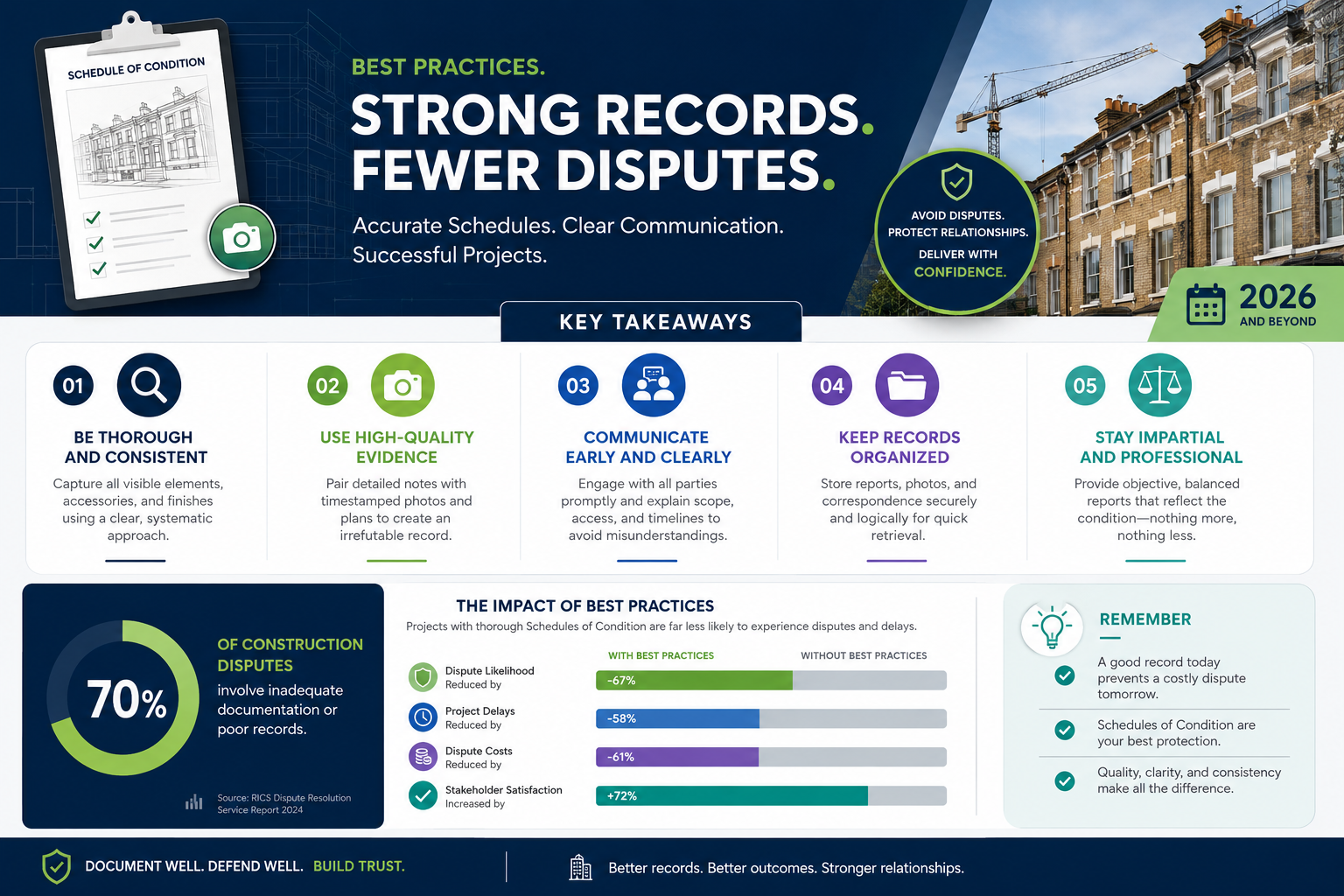
- High-resolution photography, precise measurements, and room-by-room written descriptions form the foundation of a defensible record.
- Best practice in 2026 requires extending the schedule beyond immediately adjacent properties to all structures that could be affected by the proposed works.
- The 2025 Supreme Court decision in Cooper v Ludgate House Ltd confirmed that inadequate pre-work documentation can result in substantial damages awards against building owners.
- Digital tools and professional standards now demand significantly higher documentation quality than was expected even five years ago.
What Is a Schedule of Condition and Why Does It Matter in 2026
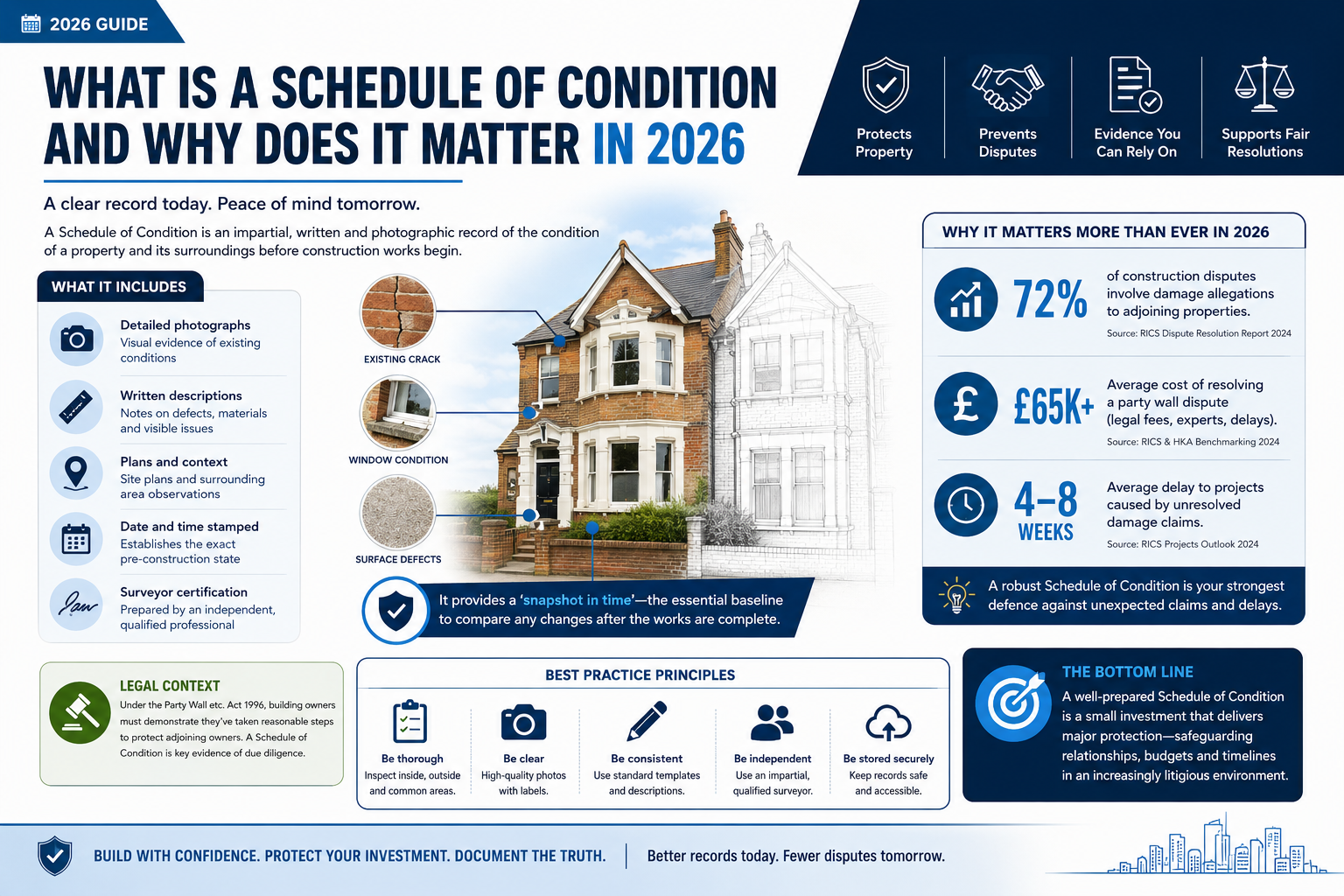
A Schedule of Condition is a factual, pre-works record of the existing state of an adjoining property — or any structure that could be affected by construction activity. It is prepared by a qualified party wall surveyor and forms an integral part of the party wall process under the Party Wall etc. Act 1996.
Its core purpose is straightforward: to establish an objective baseline. If a neighbour later claims that construction caused a new crack in their ceiling or damaged their plasterwork, the Schedule of Condition either confirms or refutes that claim by showing what existed before the first tool was lifted. Without it, disputes become a matter of competing memories rather than documented fact [6].
In 2026, the legal stakes are higher than ever. The Supreme Court's 2025 ruling in Cooper v Ludgate House Ltd set a clear precedent: where proper party wall procedures — including comprehensive schedules — were not followed, courts are prepared to award substantial damages [5]. That ruling has sharpened the focus of both building owners and their surveyors on documentation quality.
For anyone navigating the party wall process, understanding the complete party wall process step by step is essential context before commissioning a schedule.
The Difference Between a Schedule of Condition and a Full Building Survey
A Schedule of Condition is not a structural assessment or a defect investigation. It does not advise on repairs or value a property. Its sole function is to record the existing condition — visible cracks, staining, settlement patterns, decorative finishes — so that any post-works comparison is grounded in evidence. A comprehensive condition survey report goes further in analysis, but for party wall purposes, the schedule's descriptive and photographic record is what counts.
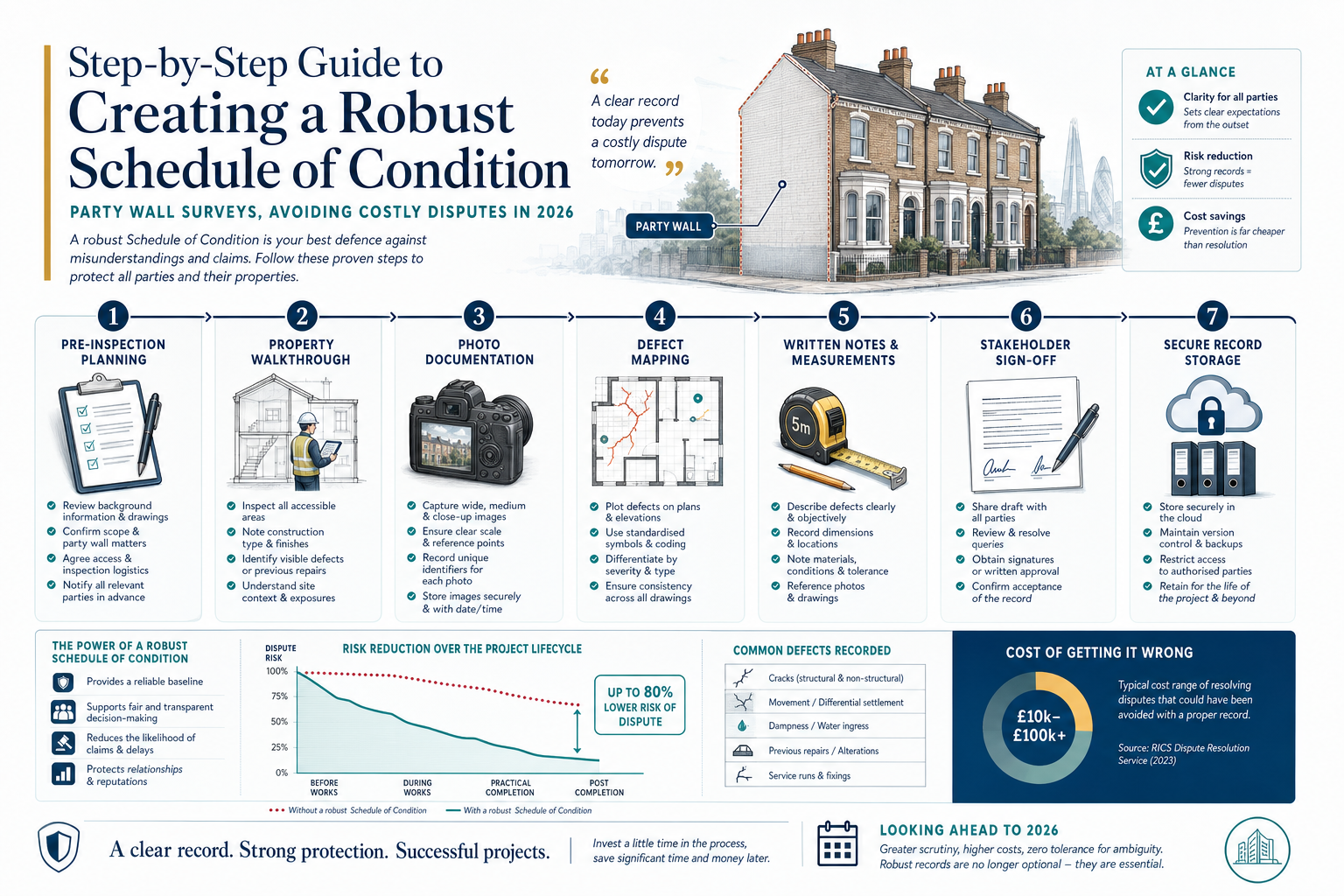
Step-by-Step Guide to Creating a Robust Schedule of Condition
Applying schedules of condition best practices for party wall surveys: avoiding costly disputes in 2026 means following a structured, repeatable methodology. The following steps reflect current RICS 8th Edition expectations and professional consensus.
Step 1: Time the Schedule Correctly
The schedule must be prepared before construction begins — and ideally at the same time as, or shortly after, the party wall notice is served [3]. Leaving it until the week before works start is a common and costly mistake. If any damage occurs during the notice period or during mobilisation, an undated or late schedule will not provide reliable protection.
The party wall notice itself triggers the process. Once an adjoining owner receives notice, both parties should agree on access for the surveyor as quickly as possible. For guidance on notices and the obligations they create, see party wall act notices: what they are and how to respond.
Step 2: Identify All Properties Within the Zone of Influence
A critical update in 2026 best practice is extending the schedule beyond the immediately adjacent property. Any structure that could reasonably be affected by the proposed works — including properties two or three doors away from deep excavations or piling operations — should be included in the documentation [2].
This is particularly relevant for:
- Basement excavations and underpinning works
- Piling and ground anchoring
- Demolition of load-bearing structures
- Large-scale extensions in terraced rows
Surveyors who limit their schedule to the single adjoining property and then face a claim from a property further along the terrace will find themselves without evidence. The cost of extending the schedule is modest compared to the cost of defending an undocumented claim.
Step 3: Arrange and Confirm Access
Access to the internal rooms of adjoining properties is essential for any schedule involving structural works [3]. External photography alone is insufficient when cracks in internal plasterwork, ceiling finishes, or floor surfaces are the most likely sites of claimed damage.
Access is arranged through mutual agreement. Under the Party Wall etc. Act 1996, a building owner has a statutory right of access for the purposes of carrying out works, but the schedule inspection itself is typically arranged by consent. Surveyors should:
- Give reasonable written notice of the inspection date
- Confirm the scope of the inspection in advance
- Bring photographic identification
- Provide a copy of the completed schedule to the adjoining owner promptly after the visit
Where access is refused, the surveyor should document the refusal in writing. This creates a record that protects the building owner if a claim later arises from a room that could not be inspected.
Step 4: Conduct a Room-by-Room Internal Inspection
The inspection itself should follow a systematic, room-by-room structure. Each room should be recorded with:
| Element | What to Record |
|---|---|
| Walls | Cracks (location, length, width), staining, bulging, previous repairs |
| Ceilings | Cracks, cornice damage, water staining, sagging |
| Floors | Gaps between boards, cracked tiles, uneven surfaces |
| Windows and doors | Sticking frames, cracked glass, gaps in reveals |
| External elevations | Pointing condition, brickwork cracks, render defects |
| Chimney stacks | Leaning, cracked flaunching, missing pots |
Crack measurement is non-negotiable. Every crack should be measured and described using a recognised classification system. The BRE crack classification scale (Categories 0-5) is widely accepted and provides a consistent framework that holds up to scrutiny in dispute proceedings.
Step 5: Apply High-Resolution Photography Standards
Photography is the backbone of any defensible schedule. In 2026, the professional standard demands significantly higher image quality than was expected in previous years, reflecting both the capabilities of modern equipment and the evidentiary expectations of courts and tribunals [2].
Best practice for photographic documentation:
- Use a camera capable of producing images of at least 12 megapixels
- Photograph every defect noted in the written record
- Include a scale reference (ruler or graduated rod) in every close-up image
- Capture wide-angle context shots before close-up detail shots
- Use consistent, even lighting — avoid flash glare on smooth plaster
- Embed GPS metadata and timestamps in image files
- Number photographs sequentially and cross-reference each image to the written schedule
A schedule with 200 well-organised, timestamped photographs is far more defensible than one with 20 generic room shots. The investment in thoroughness pays dividends if a claim is made months or years later.
Step 6: Write Precise Descriptive Notes
Photography alone is not sufficient. Written descriptions must accompany every photograph and must be specific enough to stand alone as evidence. Vague language such as "some cracking noted" is inadequate. Precise language such as "hairline crack, Category 1 (BRE scale), running diagonally from the top-left corner of the window reveal, approximately 320mm in length, 0.1mm width, no previous repair evident" is what the record requires [4].
Descriptions should cover:
- Exact location within the room (using compass directions and measurements from fixed reference points)
- Nature of the defect (crack, stain, spalling, settlement)
- Dimensions
- Apparent age (fresh, weathered, previously repaired)
- Any relevant context (proximity to drainage, previous works evident)
Step 7: Compile, Sign, and Distribute the Schedule
The completed schedule should be bound as a formal document, signed by the surveyor, and distributed to all parties — building owner, adjoining owner, and any appointed surveyors — before works begin [6]. It should be appended to or referenced within the Party Wall Award.
A schedule that is prepared but never formally distributed, or that is completed after works have started, provides significantly weaker protection. The timing and distribution of the document are as important as its content.
For a full understanding of how the schedule fits within the broader award framework, the complete guide to party wall awards provides essential context.
Common Mistakes That Lead to Costly Disputes
Even experienced practitioners make errors that undermine the protective value of a schedule. The most frequent causes of disputes in 2026 include failure to serve proper notice, disagreements over the schedule itself, damage claims, and access refusals [7]. Understanding where schedules fail is as important as knowing how to prepare them correctly.
Inadequate Coverage of the Property
Limiting the inspection to easily accessible areas — the ground floor, the front elevation — while omitting loft spaces, cellars, or rear outbuildings creates gaps that claimants will exploit. A thorough schedule covers every part of the property that could plausibly be affected.
Poor Photographic Organisation
A folder of 300 unnumbered, unlabelled photographs with no cross-reference to the written schedule is almost useless in a dispute. Organisation is as important as volume. Every photograph must be traceable to a specific entry in the written record.
Failure to Record Pre-Existing Damage Clearly
Some surveyors are tempted to minimise the description of pre-existing defects to avoid alarming the adjoining owner. This is a serious error. A thorough record of existing damage — however extensive — actually protects both parties. It prevents the building owner from being held liable for damage that predates their works, and it gives the adjoining owner an honest record of their property's condition.
Late Preparation
Preparing the schedule after works have already begun is the single most damaging procedural failure. Even a delay of a few days can create uncertainty about whether observed damage is pre-existing or construction-related. The schedule must precede the first day of notifiable works without exception [3].
A well-prepared Schedule of Condition is not a bureaucratic formality — it is the single most effective piece of evidence available to both parties when a dispute arises.
Digital Tools and Evolving Professional Standards
The evolution of digital technology has transformed Schedule of Condition protocols. In 2026, professional standards demand documentation quality that reflects current technological capabilities [2]. Several tools and approaches are now considered standard practice among leading party wall surveyors.
Drone Photography for External Elevations
Where properties have inaccessible roof structures, high chimney stacks, or complex rear elevations, drone photography provides coverage that would otherwise require expensive scaffold access. Drone images should be treated with the same metadata and labelling standards as ground-level photography.
360-Degree Room Capture
Spherical camera systems that capture entire rooms in a single image provide an immersive, navigable record that is increasingly accepted as supplementary evidence in dispute proceedings. These images capture spatial relationships between defects that sequential flat photography cannot convey.
Condition Survey Software
Dedicated survey software allows surveyors to link photographs directly to annotated floor plans, generate automatically numbered image libraries, and produce professionally formatted reports. This reduces the risk of organisational errors and produces a document that is immediately legible to non-specialist parties, including judges and mediators.
For those working with a surveyor on party wall matters, understanding what a party wall surveyor does helps property owners engage more effectively with the process and ask the right questions about documentation standards.
Protecting Both Building Owners and Adjoining Owners
A common misconception is that the Schedule of Condition exists solely to protect the building owner — to give them a defence against exaggerated claims. In practice, it protects both parties equally [6].
For the building owner, the schedule provides evidence that a claimed defect pre-existed the works, or that the works did not reach the area where damage is alleged.
For the adjoining owner, the schedule provides a documented baseline. If genuine damage occurs and the building owner disputes liability, the schedule confirms what the property looked like before works began — making it far easier to establish causation and recover compensation.
This mutual protection is why experienced surveyors treat the schedule as a shared interest rather than an adversarial document. When both parties understand its purpose, access negotiations are smoother and the resulting document is more comprehensive.
If a dispute does arise despite a well-prepared schedule, understanding the options for resolving party wall disputes is the logical next step.
For building owners who are uncertain whether their project requires a party wall agreement in the first place, the guide on whether you need a party wall agreement provides a clear starting point.
Conclusion
The principles behind schedules of condition best practices for party wall surveys: avoiding costly disputes in 2026 are straightforward, but their consistent application requires discipline, thoroughness, and an understanding of what the evidence will need to demonstrate if a claim arises.
The actionable steps are clear:
- Commission the schedule at the same time as serving the party wall notice — never after works begin.
- Extend coverage to all properties within the zone of influence, not just the immediately adjacent owner.
- Conduct a systematic, room-by-room inspection with access to internal spaces.
- Apply high-resolution, timestamped, GPS-tagged photography with scale references in every close-up image.
- Write precise, BRE-classified crack descriptions that cross-reference every photograph.
- Compile a formally signed document and distribute it to all parties before the first day of works.
- Use digital tools — survey software, drone photography, 360-degree capture — where they add coverage or clarity.
The £3,500 average additional cost of a dispute [1] is avoidable. The legal exposure created by the Cooper v Ludgate House Ltd precedent is real. A professionally prepared Schedule of Condition, executed to the standards described above, is the most cost-effective investment a building owner or their surveyor can make before breaking ground.
For professional guidance on commissioning a schedule of condition report, or to understand how it fits within the full party wall process, speaking with a qualified party wall surveyor is always the recommended first step.
References
[1] Party Wall Surveys Amid 2026 Construction Boom Resolving High Demand Disputes In Uk Housing Hotspots – https://manchestersurveyors.com/party-wall-surveys-amid-2026-construction-boom-resolving-high-demand-disputes-in-uk-housing-hotspots/?utm_source=openai
[2] Schedules Of Condition In Party Wall Agreements Best Practices For 2026 Pre Work Documentation – https://partywallsurveyorlondon.uk/blogs/schedules-of-condition-in-party-wall-agreements-best-practices-for-2026-pre-work-documentation/?utm_source=openai
[3] Schedule Of Condition Party Wall – https://www.aylingassociates.com/knowledge/schedule-of-condition-party-wall?utm_source=openai
[4] Schedule Of Condition – https://echelonpartywall.co.uk/resources/guides/schedule-of-condition/?utm_source=openai
[5] Kingston Upon Thames Party Wall Disputes South West London Renovation Boom 2026 – https://kingstonsurveyors.com/kingston-upon-thames-party-wall-disputes-south-west-london-renovation-boom-2026/?utm_source=openai
[6] Schedule Of Condition – https://www.coburnspartywall.co.uk/schedule-of-condition.html?utm_source=openai
[7] The Reality Of Party Wall Surveying In 2026 Fees Disputes And Daily Challenges From Industry Pros – https://www.canterburysurveyors.com/blog/the-reality-of-party-wall-surveying-in-2026-fees-disputes-and-daily-challenges-from-industry-pros/?utm_source=openai
