
Fewer than one in three mid-rise private rented sector (PRS) blocks built before 1990 have undergone a formal structural condition assessment in the past decade — yet from 2026, landlords face legally binding response deadlines the moment a tenant reports a suspected hazard [1]. That gap between historic neglect and new statutory obligation sits at the heart of every terminal dilapidations dispute now being prepared across England's PRS market.
Dilapidations Schedules Incorporating Awaab's Law Hazards: Building Surveyor Tactics for 2026 PRS Lease-End Disputes is no longer a niche specialism. The convergence of Awaab's Law Phase 2, the Renters' Rights Act 2024, and updated RICS Dilapidations guidance has fundamentally changed how building surveyors must structure, quantify, and defend terminal schedules for periodic tenancies. Damp and mould, fire safety deficiencies, and electrical hazards are no longer background context — they are foreground legal obligations with hard deadlines and criminal sanctions attached.
Key Takeaways
- Awaab's Law Phase 2, effective 2026, mandates that structural collapse risks, damp, mould, fire, and electrical hazards be explicitly addressed within dilapidations schedules, with statutory response timelines for landlords.
- The Renters' Rights Act 2024 abolishes fixed-term assured shorthold tenancies, meaning terminal schedules must now be prepared for periodic tenancies with less predictable end dates.
- RICS Dilapidations guidance (Appendix to Professional Statement) requires surveyors to quantify hazard remediation costs separately and defend them against section 18(1) Landlord and Tenant Act 1927 diminution caps.
- A well-prepared schedule of condition at lease commencement remains the single most effective tool for limiting dispute exposure at lease-end.
- Expert rebuttal of inflated landlord claims — particularly on hazard items — requires thermal imaging evidence, third-party specialist reports, and a clear audit trail of tenant notifications.
How Awaab's Law Phase 2 Reshapes the Terminal Schedule
The Statutory Hazard Categories Now in Play
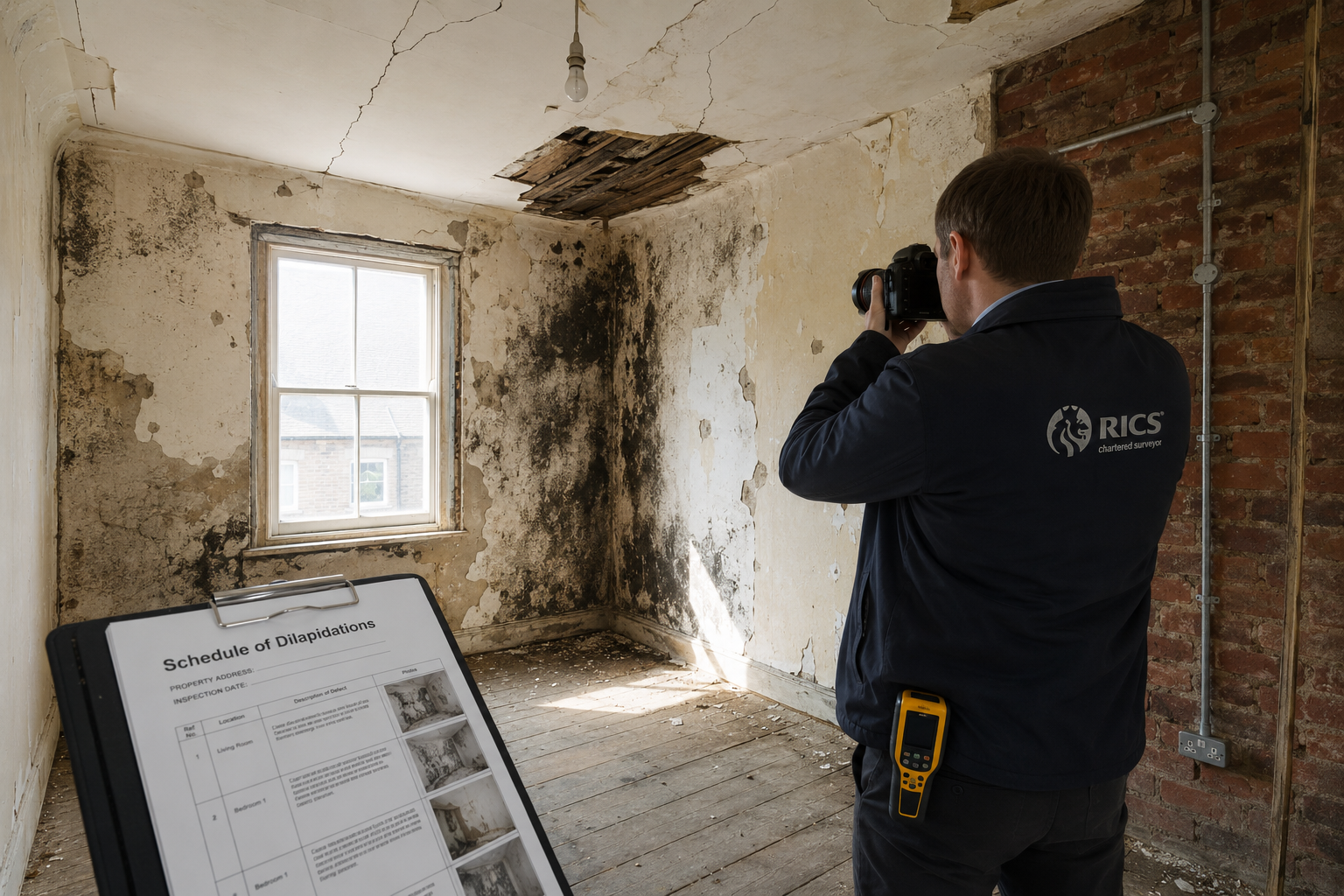
Awaab's Law, enacted following the tragic death of Awaab Ishak in 2020, initially focused on social housing. Phase 2, effective from 2026, extends its reach across the private rented sector, imposing mandatory investigation and remediation timelines on landlords when tenants report hazards [1]. For building surveyors preparing dilapidations schedules, this creates a dual obligation: the schedule must record the physical condition of the property at lease-end, and it must flag whether any items constitute a notifiable hazard under the new framework.
The hazard categories most frequently encountered in PRS dilapidations work are:
- Damp and mould — Category 1 hazards under the Housing Health and Safety Rating System (HHSRS), now subject to 14-day investigation deadlines and 7-day emergency repair timelines under Awaab's Law Phase 2 where health risk is acute.
- Fire safety deficiencies — Missing or non-compliant smoke alarms, blocked means of escape, defective fire doors, and inadequate compartmentation.
- Electrical hazards — Deteriorated wiring, overloaded circuits, absent RCD protection, and non-compliant consumer units.
- Structural collapse risks — Cracked lintels, failing parapet walls, deteriorating balcony soffits, and compromised structural elements in pre-1990 construction [1].
Each of these categories must now appear as a discrete section within the terminal schedule, with the surveyor's findings cross-referenced to the relevant HHSRS hazard score and, where applicable, the Awaab's Law response deadline that would have applied during the tenancy.
Why Periodic Tenancies Complicate Quantification
The Renters' Rights Act 2024 abolishes the fixed-term assured shorthold tenancy as the default PRS instrument. From its implementation date, most PRS lettings operate as periodic tenancies, with landlords able to recover possession only on specified grounds. This structural change has a direct impact on dilapidations schedules incorporating Awaab's Law hazards.
In a fixed-term lease, the terminal schedule is prepared at a known expiry date, and the surveyor can calculate a clear diminution in value based on the property's condition relative to its state at lease commencement. In a periodic tenancy, the end date is uncertain until notice is served. This means:
- Condition evidence must be gathered continuously, not just at lease commencement and termination.
- Hazard items may have been reported during the tenancy, creating a paper trail that either supports or undermines the landlord's dilapidations claim.
- The section 18(1) cap — which limits a landlord's dilapidations claim to the diminution in the value of the reversion — becomes harder to calculate when the tenancy duration is variable.
Surveyors acting for landlords should maintain a rolling photographic and inspection record throughout the tenancy. Those acting for tenants should audit all hazard notifications sent during the tenancy, since a landlord's failure to respond within Awaab's Law timelines may constitute a partial or complete defence to a dilapidations claim on those items [1].
Integrating Damp, Fire, and Electrical Hazard Protocols into the Schedule
Damp and Mould: Evidence Standards and Quantification
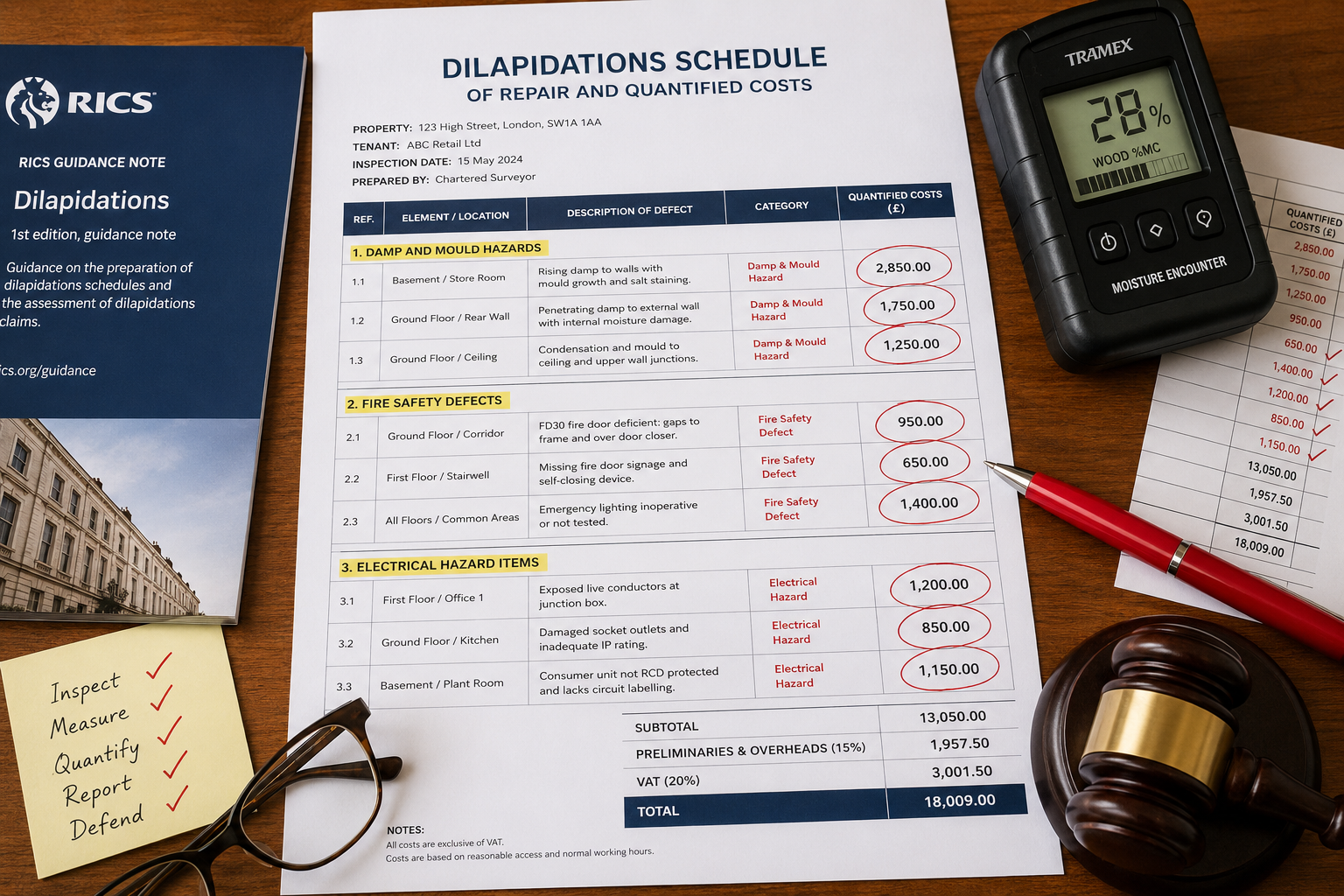
Damp-related claims are the most contested items in PRS terminal schedules. Landlords frequently assert that mould growth and associated damage are tenant-caused, while tenants argue that inadequate ventilation, structural defects, or pre-existing penetrating damp are the root causes. Awaab's Law Phase 2 changes the evidential landscape significantly.
Under the new framework, a landlord who received a tenant notification of damp or mould and failed to investigate within 14 days cannot credibly claim that the resulting damage is solely the tenant's responsibility [1]. The surveyor preparing the terminal schedule must therefore:
- Obtain copies of all tenant notifications, including emails, text messages, and formal written complaints.
- Use a calibrated moisture meter and, where appropriate, thermal imaging camera to establish whether damp is penetrating (structural), rising (ground-related), or condensation-based (potentially occupant-related).
- Quantify remediation costs separately for each damp type, since only condensation damp attributable to tenant behaviour is recoverable in full without the section 18(1) cap applying.
A useful rule of thumb: if moisture readings exceed 25% WME (Wood Moisture Equivalent) in wall plaster at a height above 1.2 metres, penetrating or structural damp is the more probable cause, and a landlord's claim on those items will face robust challenge.
For a thorough baseline understanding of what a comprehensive property inspection should cover, a Level 3 building survey provides the most detailed framework, and its methodology translates directly into dilapidations schedule preparation for complex PRS properties.
Fire Safety Deficiencies: Mandatory Disclosure and Liability
Fire safety items in a terminal schedule carry particular weight because their absence during the tenancy may constitute a criminal offence under the Smoke and Carbon Monoxide Alarm (Amendment) Regulations 2022, independent of any dilapidations liability. Surveyors must record:
| Item | Compliance Standard | Common Defect Found |
|---|---|---|
| Smoke alarms | One per storey, interlinked in HMOs | Missing, battery-only in older stock |
| Carbon monoxide alarms | Required where solid fuel appliance present | Absent in properties with log burners |
| Fire doors | FD30 minimum in HMOs | Non-compliant gaps, missing intumescent strips |
| Means of escape | Clear, unobstructed, signed | Blocked by tenant storage or landlord alterations |
| Electrical installation | EICR valid, max 5-year cycle | Expired EICR, no RCD protection |
Where a fire safety deficiency existed at lease commencement and was not recorded in a schedule of condition, the landlord cannot recover the cost of remediation from the tenant. This is one of the most common errors in landlord-prepared schedules and one of the most straightforward grounds for expert rebuttal.
Electrical Hazards: The EICR Audit Trail
Electrical Installation Condition Reports (EICRs) are mandatory for all PRS properties in England, with a maximum five-year cycle. A terminal schedule must record the EICR status at both lease commencement and termination. Where an EICR was not obtained at the start of the tenancy, the landlord's ability to claim for electrical remediation works is severely compromised.
Awaab's Law Phase 2 classifies certain electrical defects — particularly those classified as C1 (danger present) or C2 (potentially dangerous) in the EICR — as hazards requiring emergency response [1]. If a tenant reported an electrical fault during the tenancy and the landlord failed to act within the statutory timeframe, that failure becomes a material fact in any subsequent dilapidations dispute.
Surveyors preparing schedules for tenants should request the full EICR history as part of the pre-dispute evidence-gathering process. Those acting for landlords should ensure that any electrical items claimed in the schedule are supported by a current EICR and a clear comparison with the condition recorded at lease commencement.
RICS Guidance, Expert Rebuttals, and Tactical Considerations for 2026
RICS Dilapidations Professional Statement: The 2026 Position
The RICS Dilapidations in England and Wales Professional Statement (7th edition) sets out the framework within which all RICS members must operate when preparing or responding to terminal schedules. Key obligations include:
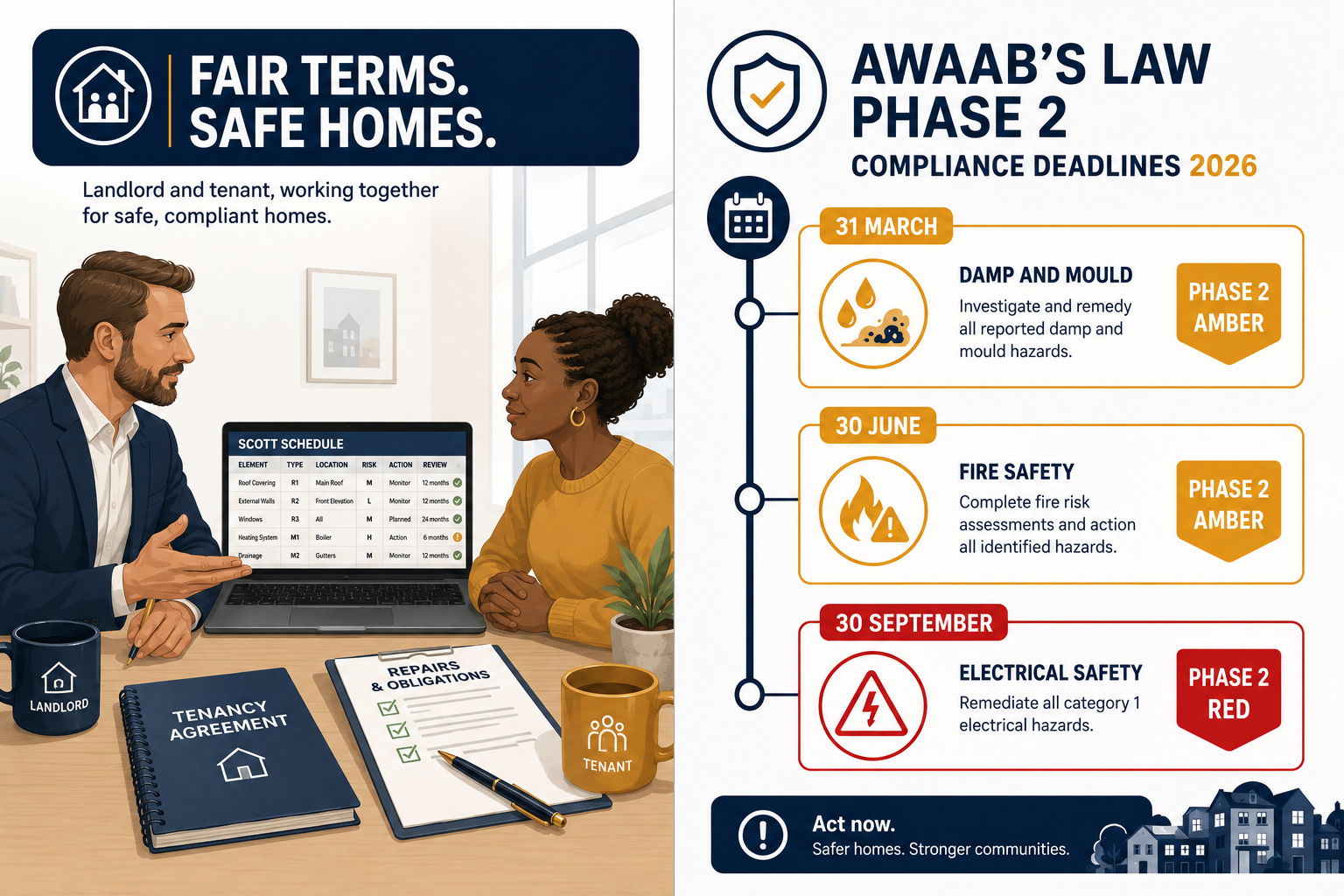
- The Scott Schedule format must be used in any dispute proceeding to the County Court or Upper Tribunal, with columns for the landlord's claim, the tenant's response, and the surveyor's agreed or disagreed position.
- Quantification must be based on actual remediation costs, not notional reinstatement to a theoretical standard. Where Awaab's Law hazards are involved, the cost of bringing the property into statutory compliance is a legitimate head of claim — but only where the defect arose during the tenancy and was not pre-existing.
- The section 18(1) cap remains the tenant's primary financial protection. A surveyor acting for a tenant must produce a diminution valuation — typically a Red Book-compliant RICS valuation — demonstrating that the landlord's actual financial loss is less than the cost of the claimed works.
Professional bodies including RICS are actively updating their guidance to align with Awaab's Law Phase 2, providing members with tools to assess and report hazards within the new statutory framework [1]. Surveyors who have not yet completed specialist training on HHSRS hazard scoring and Awaab's Law compliance deadlines are exposed to professional negligence risk if their schedules omit or misclassify hazard items.
For surveyors and landlords operating across London and the South East, specialist chartered surveyors in West London and chartered surveyors in South West London are increasingly being instructed to provide expert rebuttal reports in PRS dilapidations disputes where Awaab's Law hazards are in contention.
Tactics for Landlord Surveyors
1. Front-load the evidence. Commission a stock condition survey at the point of letting, not just a basic inventory. A stock condition survey records structural, mechanical, electrical, and hazard-related conditions in a format that directly supports a terminal schedule.
2. Maintain a hazard notification log. Every tenant communication about damp, fire safety, or electrical issues should be logged with a date, a description of the reported hazard, and the landlord's response. This log is the primary defence against a tenant's argument that the landlord's failure to respond under Awaab's Law timelines negates the dilapidations claim.
3. Instruct specialist sub-reports early. Where the terminal schedule includes damp, fire, or electrical items of significant value, instruct a specialist — a damp surveyor, fire risk assessor, or electrical engineer — to produce a supporting report. This strengthens the quantification and reduces the risk of the item being struck out at the Scott Schedule stage.
4. Apply the section 18(1) cap proactively. Rather than waiting for the tenant's expert to raise the diminution argument, commission a pre-schedule valuation to understand the realistic cap before finalising the claim quantum. Overclaiming is a tactical error that damages credibility across the entire schedule.
Tactics for Tenant Surveyors
1. Audit the hazard notification history. Before responding to any terminal schedule that includes damp, fire, or electrical items, obtain a complete record of all tenant notifications during the tenancy. A landlord who failed to meet Awaab's Law investigation or remediation deadlines has, in effect, acquiesced to the hazard condition, which materially weakens their claim on those items [1].
2. Challenge the causation evidence. Many landlord schedules assert tenant-caused damage without adequate evidential support. Thermal imaging reports, independent damp surveys, and third-party electrical assessments are powerful rebuttal tools. The burden of proof on causation lies with the landlord.
3. Deploy the section 18(1) cap aggressively. In a periodic tenancy context, the reversion value calculation is particularly sensitive to market conditions. A falling rental market or a property requiring significant Awaab's Law compliance expenditure regardless of the tenancy outcome will substantially reduce the cap, often to a fraction of the landlord's claimed sum.
4. Reference the Renters' Rights Act protections. The Act introduces new protections against retaliatory eviction and strengthens tenants' rights to challenge unlawful charges. A dilapidations claim that appears to be a disguised mechanism for recovering costs that should properly be borne by the landlord under Awaab's Law may be challenged on these grounds.
For properties where structural complexity adds further dispute risk, a RICS building survey provides the level of technical detail needed to support or rebut high-value dilapidations claims, particularly where pre-1990 construction methods are involved.
The Structural Collapse Dimension
Awaab's Law Phase 2 specifically mandates that structural collapse risks and falling elements be explicitly addressed within dilapidations schedules [1]. For mid-rise PRS blocks — typically defined as four to six storeys — this creates a new category of terminal schedule item that was rarely seen before 2026.
Structural items to assess include:
- Parapet walls and coping stones
- Balcony soffits and balustrades
- Lintels over window and door openings
- Staircase structural integrity
- Roof structure condition where accessible
Where a structural defect is identified, the surveyor must record not only the remediation cost but also the urgency classification under Awaab's Law — since a defect classified as an emergency hazard carries a 24-hour landlord response obligation [1]. Failure to document this correctly exposes the surveyor to professional criticism and the landlord to criminal liability.
Industry analysts predict that the enforcement of Awaab's Law will drive a significant increase in demand for qualified building surveyors with specialist hazard assessment skills, as landlords across the PRS seek to ensure compliance and manage lease-end liability [1]. For those seeking a clearer picture of what a comprehensive building inspection entails, the RICS home survey framework offers a useful reference point for the standards of evidence expected in dispute contexts.
Conclusion
The integration of Awaab's Law hazard protocols into dilapidations schedules is not optional for building surveyors operating in the 2026 PRS market — it is a statutory and professional obligation. Terminal schedules that fail to address damp, fire safety, electrical, and structural hazard categories in discrete, quantified sections will face challenge at every stage of the dispute process, from the Scott Schedule exchange through to tribunal.
Actionable next steps for surveyors and landlords in 2026:
- Commission a stock condition survey at the commencement of every PRS letting, with explicit HHSRS hazard scoring recorded.
- Establish a documented hazard notification and response log from day one of the tenancy, maintained throughout its duration.
- Ensure all EICRs, gas safety certificates, and fire risk assessments are current and filed with date-stamped evidence.
- When preparing a terminal schedule, instruct specialist sub-reports for any damp, fire, or electrical item exceeding a threshold value — typically 2,500 GBP or above.
- For tenants responding to a schedule, audit the landlord's Awaab's Law compliance record before accepting any hazard-related claim item.
- Engage a RICS-qualified building surveyor with specific experience in PRS dilapidations and Awaab's Law compliance to prepare or rebut the terminal schedule.
The legal and financial stakes in 2026 PRS lease-end disputes are higher than at any previous point in the sector's history. Surveyors who adapt their practice to this new landscape — combining rigorous hazard assessment with disciplined quantification and a thorough understanding of the Renters' Rights Act — will be best placed to serve their clients and withstand expert scrutiny.
References
[1] Building Survey Protocols For Structural Collapse Risks Under Awaabs Law 2026 Mid Rise Prs Due Diligence – https://nottinghillsurveyors.com/blog/building-survey-protocols-for-structural-collapse-risks-under-awaabs-law-2026-mid-rise-prs-due-diligence?utm_source=openai
