
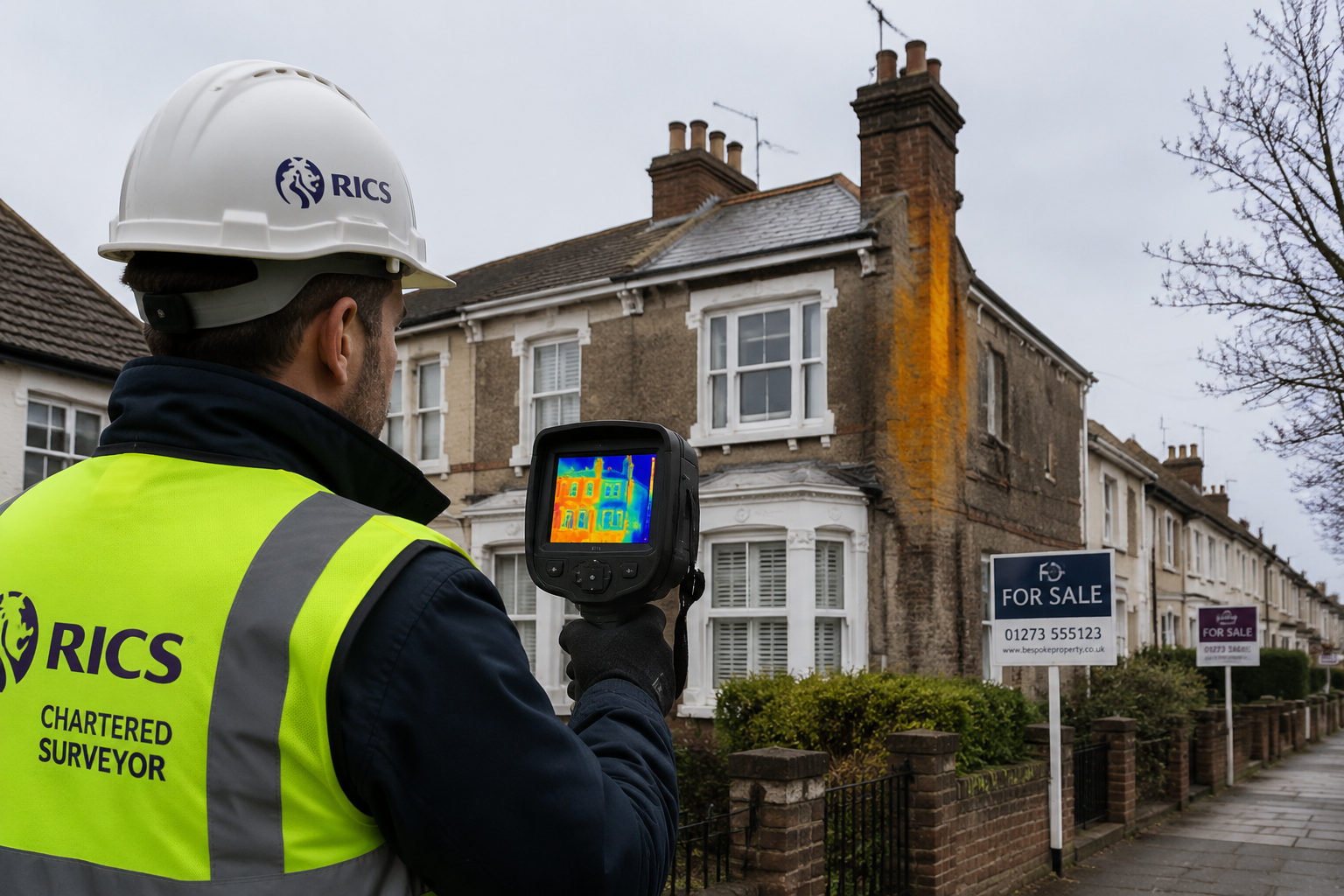
A property that looks pristine to the naked eye can conceal thousands of pounds worth of hidden defects behind its plaster, beneath its roof, and within its walls. In South East England's correcting market of 2026, where transaction volumes have softened and buyers are scrutinising every line of a survey report, that gap between apparent condition and actual condition is becoming a critical valuation battleground. Thermal imaging for valuation adjustments in lagging markets: detecting hidden defects in South East properties 2026 has moved from a specialist add-on to an essential diagnostic tool that RICS-regulated surveyors are increasingly deploying to produce defensible, evidence-based valuations that automated valuation models simply cannot replicate.
Key Takeaways
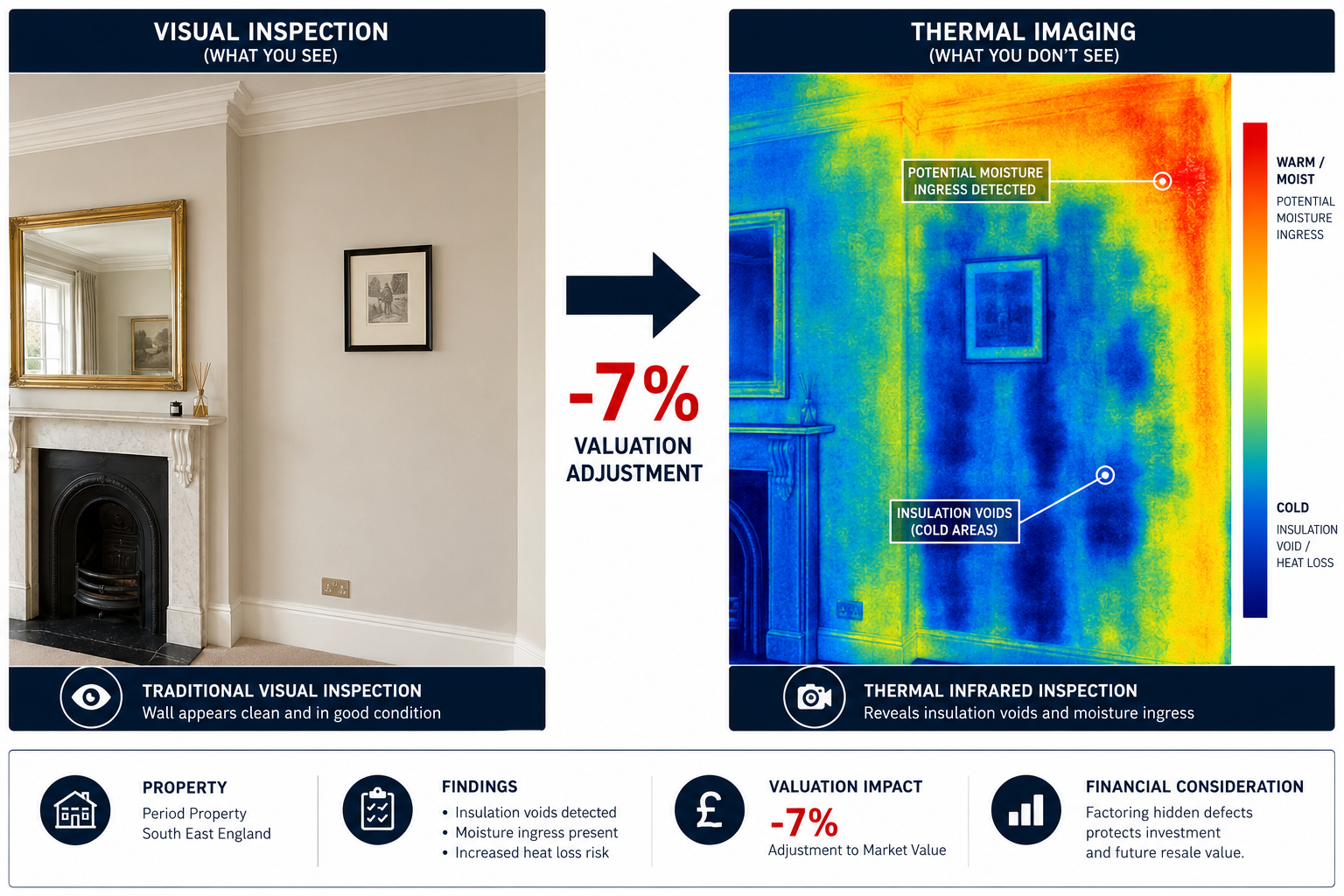
- Thermal imaging reveals hidden defects — damp, insulation voids, air leakage, flat-roof leaks — that standard visual inspections miss, directly informing valuation adjustments.
- In lagging South East markets, thermography-supported surveys are enabling price renegotiations and more conservative valuations, often in the range of 3–10% depending on defect severity.
- The global thermal imaging market is valued at approximately USD 7.0–7.6 billion in 2026, with building diagnostics cited as a primary growth driver as camera costs fall [1][2].
- RICS Level 2 and Level 3 surveys that incorporate infrared thermography produce more accurate defect quantification than visual-only inspections, strengthening their authority over automated valuation models.
- Energy performance ratings — closely linked to thermal efficiency — are increasingly capitalised into South East property prices, making thermal diagnostics a direct input to EPC-related value adjustments.
Why Lagging Markets Amplify the Need for Thermal Diagnostics
A lagging or correcting market is defined by slowing price growth, extended days-on-market, and heightened buyer caution. South East England has displayed these characteristics through 2024 and into 2026, with transaction volumes below the long-run average and buyers far more willing to use survey findings as leverage in price negotiations.
In rising markets, buyers often waive or rush surveys. In lagging markets, they commission them carefully and act on the results. This behavioural shift creates a direct commercial case for enhanced diagnostic tools.
Automated valuation models (AVMs) — the algorithms used by lenders and online portals to generate instant property estimates — are inherently backward-looking. They rely on comparable transaction data, which in a lagging market is both sparse and stale. They cannot see inside a wall. They cannot detect the moisture bloom spreading behind a freshly painted surface or the insulation void above a Victorian bay window.
This is precisely where thermal imaging for valuation adjustments in lagging markets: detecting hidden defects in South East properties 2026 adds measurable value. A RICS-regulated building survey supported by thermographic evidence produces a defensible, asset-specific valuation that reflects actual condition rather than modelled averages.
The Cost of Invisible Defects
Consider a typical South East semi-detached property built between 1900 and 1950. Its walls may show no visible damp. Its ceilings may appear intact. Yet infrared thermography might reveal:
- Cold bridging at every floor joist end, indicating missing cavity insulation
- A moisture plume tracking from a failed parapet gutter across the party wall
- A flat-roof extension with pooling water visible only as a thermal anomaly
- Air leakage around a chimney breast that has been blocked but not sealed
Each of these defects carries a remedial cost. Aggregated, they can easily reach £15,000–£40,000. In a lagging market where a seller is already under pressure, a thermography-backed survey report presenting quantified remedial costs is a powerful renegotiation instrument.
How Thermal Imaging Works in a Building Survey Context
Infrared thermography detects surface temperature differences across a building's fabric. Because heat moves through materials at different rates depending on their density, moisture content, and continuity, a thermal camera translates those temperature gradients into a false-colour image that makes invisible problems visible.
The technique is most effective when there is a meaningful temperature differential between inside and outside — typically at least 10°C. In the South East, this condition is reliably met from October through March, making autumn and winter the optimal survey seasons for thermographic work.
What Thermal Cameras Detect
| Defect Type | Thermal Signature | Valuation Impact |
|---|---|---|
| Insulation voids | Cold patches on internal walls/ceilings | EPC downgrade, heating cost uplift |
| Moisture ingress | Cool, irregular patches (evaporative cooling) | Structural risk, mould liability |
| Flat-roof failure | Warm patches after daytime solar loading | Replacement cost £8,000–£25,000 |
| Air leakage | Cold streaks around frames, junctions | Energy loss, comfort penalty |
| Thermal bridging | Cold linear patterns at structural elements | Condensation risk, long-term damage |
The global thermal imaging market is projected to reach approximately USD 7.0–7.6 billion in 2026, with building diagnostics and predictive maintenance among the primary growth drivers [1][3]. Falling camera costs — driven by increased production volumes and competition among manufacturers — mean that professional-grade handheld thermal imagers are now accessible to a much wider range of surveyors and inspection firms [2][4].
"Thermal imaging is no longer a premium add-on. In a market where hidden defects can move a valuation by five figures, it is a core risk management tool."
For surveyors operating across South East locations, from chartered surveyors in Barnes to chartered surveyors in Hampshire, the practical barriers to deploying thermal cameras have dropped significantly.
Thermal Imaging for Valuation Adjustments in Lagging Markets: Step-by-Step Protocol for Level 3 Reports
A rigorous thermographic inspection integrated into a RICS Level 3 building survey follows a structured protocol. Ad hoc use of a thermal camera without proper methodology produces unreliable results and is professionally indefensible. The following framework reflects best practice for South East property surveys in 2026.
Step 1: Pre-Survey Conditions Assessment
Before attending site, confirm that thermal conditions are suitable:
- Temperature differential: Minimum 10°C between internal and external ambient temperatures for at least three hours prior to inspection.
- Solar loading: Avoid surveying external facades within two hours of direct sunlight, as solar gain creates false thermal signatures.
- Heating status: The property should have been heated normally for at least 24 hours prior to inspection. Unheated properties produce flat thermal images that mask defects.
Document all conditions in the survey report. This protects the surveyor professionally and gives the client context for interpreting findings.
Step 2: Systematic Internal Survey
Work room by room, scanning:
- All external walls at mid-height and at floor/ceiling junctions
- Ceilings below flat roofs and at eaves
- Around all window and door frames
- Chimney breasts and flue routes
- Areas around pipework and service penetrations
Use a grid-pattern scanning technique — horizontal sweeps followed by vertical sweeps — to ensure complete coverage. Photograph every anomaly with both the thermal image and the corresponding visible-light image side by side. This pairing is essential for report clarity and for supporting any valuation adjustment claim.
Step 3: External Survey (Where Applicable)
External thermography is most useful for:
- Flat roofs (best conducted at night after a warm day, to detect retained moisture through differential cooling)
- Parapet walls and parapets
- Extension roofs and dormer cheeks
- Areas around downpipes where blockages cause persistent damp
For properties where external access is restricted, drone surveys can provide aerial thermal imaging of roofs and upper facades that would otherwise be inaccessible.
Step 4: Defect Classification and Remedial Cost Estimation
Each thermal anomaly identified must be:
- Classified by defect type (moisture, insulation void, air leakage, structural)
- Graded by severity (minor, moderate, significant)
- Linked to a remedial action with an estimated cost range
- Cross-referenced with any damp meter readings, visual observations, or other diagnostic data
This classification framework transforms raw thermal data into actionable valuation evidence. A RICS specific defect survey may be recommended for any anomaly that requires deeper investigation beyond the scope of the Level 3 report.
Step 5: Valuation Adjustment Calculation
Once remedial costs are quantified, the surveyor must assess their impact on market value. This is not a mechanical deduction — it requires professional judgment about:
- Buyer perception risk: Some defects (e.g., visible mould, structural movement) carry a perception discount beyond their direct remedial cost.
- Marketability impact: In a lagging market, defects that reduce a property's appeal to mortgage lenders can suppress the buyer pool and therefore the achievable price.
- EPC implications: Insulation voids and air leakage failures that emerge from thermographic inspection may require EPC reassessment. Research on EPC premiums in England and Wales indicates that homes with better ratings can attract 3–8% price premiums, while poorly rated properties face corresponding discounts.
Professional commentary in UK surveying trade media has described thermography-supported valuation down-adjustments of 3–10% in cases involving quantified building envelope failures. These are case-based expert judgments, not universal rules, but they illustrate the scale of impact that rigorous thermal diagnostics can have on a final valuation figure.
EPC Ratings, Thermal Efficiency, and South East Property Values in 2026
Energy performance has become a front-of-mind issue for South East buyers and lenders in 2026. Proposed future minimum EPC standards for rental properties, combined with rising energy costs, have made thermal efficiency a tangible financial variable rather than an abstract environmental concern.
Thermal imaging sits at the intersection of building pathology and energy performance assessment. When a thermographic survey reveals significant insulation voids or air leakage, it does not merely identify a defect — it identifies an EPC liability. A property currently rated EPC D may, on the basis of thermal evidence, require substantial investment to reach the EPC C threshold that is increasingly demanded by lenders and tenants.
This creates a direct valuation mechanism:
Thermal defect identified → EPC upgrade cost quantified → Valuation adjusted to reflect net-of-upgrade value
For buyers using mortgage finance, lenders are increasingly scrutinising EPC ratings as part of their risk assessment. A thermographic survey that uncovers evidence of widespread insulation failure can, in some cases, affect a lender's willingness to advance at the agreed price, triggering a formal valuation review.
Surveyors producing RICS valuation reports for South East properties in 2026 are therefore well-advised to treat thermographic findings not merely as defect evidence but as inputs to a broader energy-value analysis.
Thermal Imaging Versus Automated Valuation Models: Why Human Expertise Wins in Lagging Markets
Automated valuation models have grown in sophistication and are widely used by lenders, portals, and investors for rapid price guidance. In active, data-rich markets, their accuracy is reasonable. In lagging markets, they fail in predictable ways.
Key limitations of AVMs in lagging South East markets:
- Sparse comparables: Fewer transactions mean less data, wider confidence intervals, and greater reliance on older, potentially unrepresentative sales.
- Condition blindness: AVMs have no mechanism to account for hidden defects. A property with £30,000 of concealed damp damage and a property in perfect condition with the same floor area and postcode will receive near-identical AVM outputs.
- Lagging price signals: In a correcting market, AVMs tend to overestimate values because their training data reflects the higher prices of the recent past.
Thermographic survey evidence directly addresses the condition blindness problem. A detailed valuation report supported by infrared imagery and quantified remedial costs gives lenders, buyers, and courts a defensible, asset-specific view of value that no algorithm can replicate.
This is particularly relevant for complex property types common in the South East — Victorian terraces with original fabric, converted flats with shared building envelopes, and extended properties where additions of varying ages create thermal discontinuities. Understanding the full range of valuation factors that affect these property types requires professional judgment informed by physical evidence, not statistical modelling alone.
When to Commission Thermographic Surveys
| Scenario | Thermographic Survey Recommended? |
|---|---|
| Pre-purchase Level 3 survey on pre-1970 property | Strongly recommended |
| Valuation for mortgage on extended/converted property | Recommended |
| Matrimonial or probate valuation dispute | Recommended where condition is contested |
| ATED or non-domicile valuation on high-value stock | Recommended for defensibility |
| New-build snagging survey | Recommended (detect build defects) |
| Shared ownership staircasing valuation | Consider where building condition affects value |
For shared ownership properties, where the valuation directly determines the staircasing cost, thermographic evidence of defects can be particularly significant. Surveyors conducting shared ownership valuations should consider whether the building's thermal performance materially affects the open market value being assessed.
Practical Considerations for Surveyors and Clients in 2026
Equipment Standards
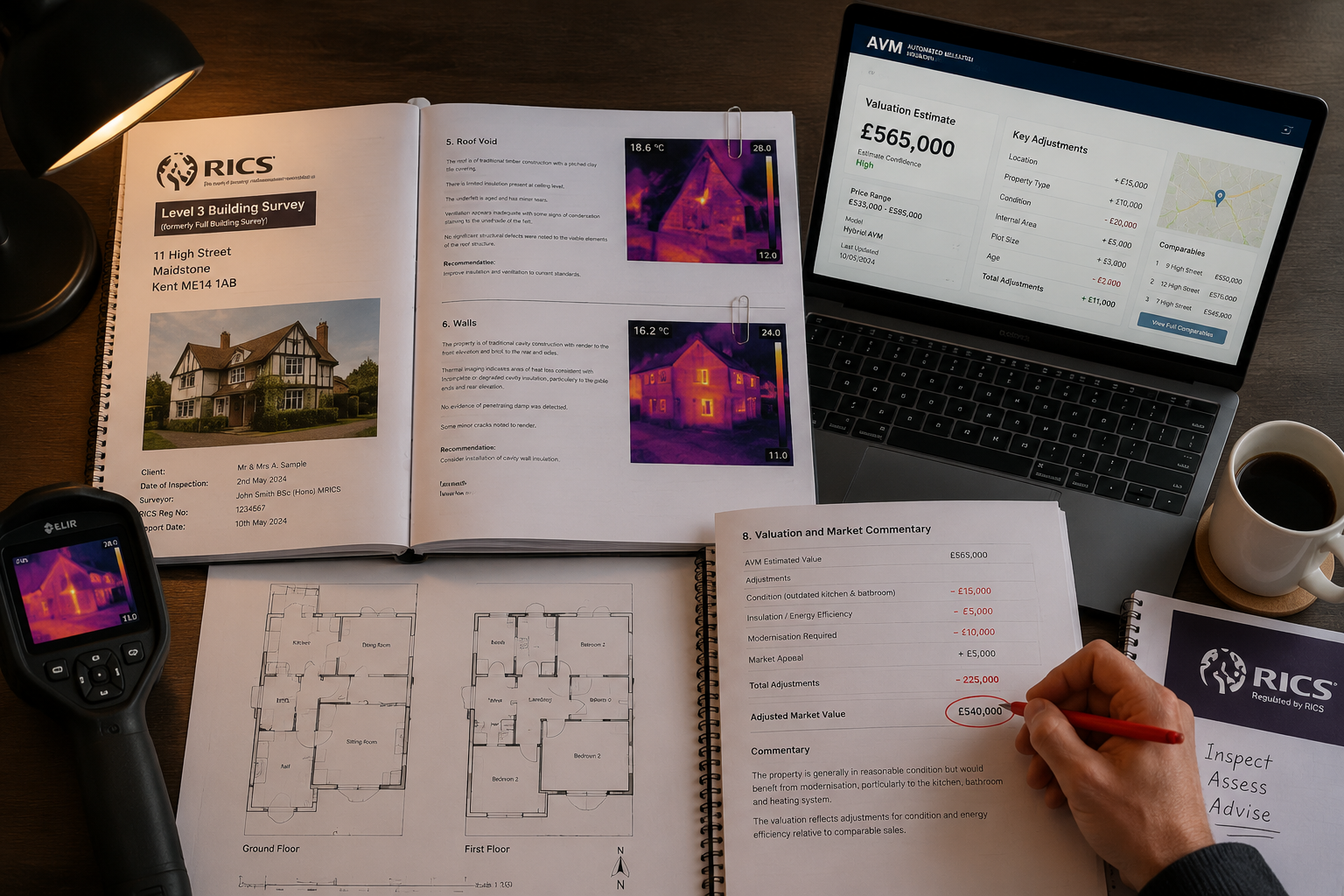
Not all thermal cameras are equal. For building survey use, a camera with a minimum resolution of 320×240 pixels and a thermal sensitivity (NETD) of 50mK or better is recommended. Higher-resolution cameras (640×480 and above) are preferred for detailed defect mapping in larger or more complex properties. The market for professional handheld thermal imagers continues to expand, with shipments projected to surpass 7.5 million units globally in the near term [2][4].
Surveyor Qualifications
Thermographic data is only as reliable as the operator interpreting it. Surveyors should hold, at minimum, a Level 1 thermography qualification from a recognised body (such as the ITC or equivalent). For complex investigations, Level 2 qualification is advisable. The interpretation of thermal images in a building survey context also requires sound knowledge of building pathology — the camera reveals anomalies, but professional expertise determines what they mean.
Report Documentation Standards
Every thermal image included in a valuation or survey report should be accompanied by:
- The corresponding visible-light photograph
- Ambient and surface temperature data at the time of capture
- Camera make, model, and settings
- A plain-language interpretation of the anomaly
- A recommended action or further investigation note
This level of documentation is essential for any report that may be used in a valuation dispute, legal proceeding, or lender review.
Limitations to Disclose
Responsible use of thermography requires honest disclosure of its limitations:
- Thermography identifies surface temperature anomalies — it does not directly measure moisture content or structural integrity.
- Findings require corroboration with other diagnostic tools (damp meters, borescopes, opening-up investigations).
- Results are condition-dependent; a survey conducted in unsuitable thermal conditions should be clearly caveated.
Conclusion
Thermal imaging for valuation adjustments in lagging markets: detecting hidden defects in South East properties 2026 represents one of the most significant advances in property survey practice of the current decade. As South East markets continue to correct and buyers exercise greater caution, the gap between what a property appears to be worth and what it is actually worth — once hidden defects are quantified — is becoming a defining issue in transactions, disputes, and lending decisions.
The technology is now accessible, the market is growing rapidly [1][3], and the professional framework for deploying it within RICS survey standards is well established. Surveyors who integrate thermographic protocols into their Level 3 reports are not merely offering a premium service — they are producing more accurate, more defensible valuations that serve their clients' interests and withstand scrutiny.
Actionable next steps for buyers, sellers, and professionals:
- Commission a Level 3 building survey with thermographic inspection on any pre-1970 South East property before exchange.
- Ensure the surveyor holds a recognised thermography qualification and documents conditions, equipment, and methodology in the report.
- Use thermographic findings to quantify remedial costs and instruct a revised valuation where defects are material.
- Cross-reference thermal findings with the property's EPC rating to assess the full energy-value liability.
- Where valuation disputes arise, treat thermographic survey evidence as primary documentation alongside comparable transaction data.
For properties across the South East — from period terraces in inner London boroughs to extended suburban stock in Hampshire and Hertfordshire — thermographic diagnostics are fast becoming the standard of care that protects buyers, informs lenders, and produces valuations that reflect reality rather than assumption.
References
[1] Thermal Imaging Market – https://www.gminsights.com/industry-analysis/thermal-imaging-market
[2] Thermal Imaging Market Shipments To Surpass 7 5 Million Units By 2026 21166491 – https://www.newswire.com/news/thermal-imaging-market-shipments-to-surpass-7-5-million-units-by-2026-21166491
[3] Thermal Imaging Market 2658 – https://www.snsinsider.com/reports/thermal-imaging-market-2658
[4] Thermal Imaging – https://www.marketsandmarkets.com/PressReleases/thermal-imaging.asp
