
Fewer than one in three commercial dilapidations claims in England and Wales reach court — yet the quantum of money at stake in those that do can run into hundreds of thousands of pounds per lease. The quality of expert witness evidence is almost always the deciding factor. For surveyors engaged in this work in 2026, the updated RICS guidance on Expert Witness in Dilapidations Disputes: RICS Guidance for Commercial Lease-End Valuations sets a clear and demanding standard that leaves little room for error.
This article guides chartered surveyors, property lawyers, and commercial landlords and tenants through the framework that governs expert evidence in lease-end dilapidations claims — from the statutory cap under section 18(1) of the Landlord and Tenant Act 1927 to CPR Part 35 compliance, quantum methodology, and the particular valuation challenges posed by the 2026 office market.
Key Takeaways
- The RICS 2024 guidance note Dilapidations in England and Wales is the current authoritative standard for expert surveyors in commercial lease-end disputes.
- Recoverable damages are generally capped at the lower of the cost of remedial works or the diminution in the value of the landlord's reversion — the section 18(1) cap.
- Expert witnesses must comply with CPR Part 35, maintain strict independence, and clearly separate fact from opinion in their reports.
- The Pre-Action Protocol imposes firm timetables: landlords must serve a schedule within 56 days of lease end; tenants have 56 days to respond.
- In 2026, the widespread shift to hybrid working has materially affected office dilapidations valuations, particularly where supersession arguments are now more frequently raised.
The Legal and Regulatory Framework Governing Expert Evidence
The Role of RICS Standards
The cornerstone document for any surveyor providing expert evidence in commercial dilapidations is the RICS guidance note Dilapidations in England and Wales, substantially updated in 2024. This replaces the earlier seventh edition and sets out the modern approach to assessing damages, preparing schedules, and advising on quantum [1]. It is the principal reference point for expert surveyors acting for either landlord or tenant in lease-end disputes [8].
Alongside this sector-specific standard, RICS maintains general practice statements on members acting as expert witnesses. These require surveyors to:
- Owe their primary duty to the court or tribunal, not to the instructing party
- Maintain independence and objectivity throughout
- Clearly distinguish between matters of fact and matters of professional opinion
- Comply with the relevant procedural rules — in England and Wales, principally CPR Part 35
Working with an experienced expert witness surveyor who understands both the RICS standards and the civil procedure requirements is therefore essential for any party entering formal dispute resolution.
CPR Part 35: What It Demands of Dilapidations Experts
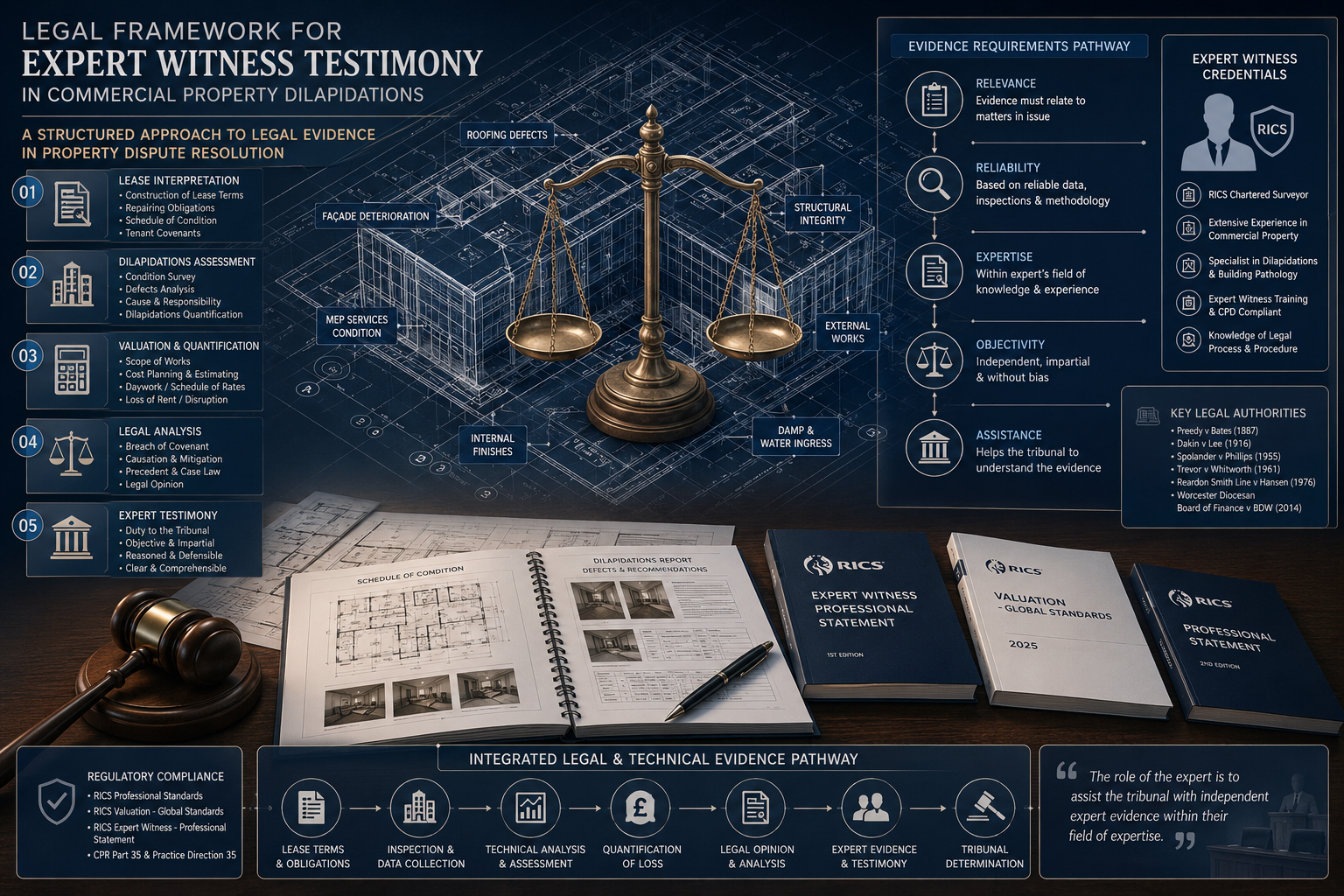
CPR Part 35 governs the use of expert evidence in civil proceedings in England and Wales. For dilapidations experts, the key obligations are:
| CPR Part 35 Requirement | Practical Implication for Dilapidations Experts |
|---|---|
| Duty to the court | Opinions must be impartial, even if they disadvantage the instructing party |
| Single joint expert option | Courts may direct one jointly instructed expert rather than two partisan ones |
| Written questions procedure | Opposing parties may submit written questions; answers form part of the evidence |
| Experts' discussions | Surveyors for each side are expected to meet and narrow issues before trial |
| Statement of truth | The expert report must include a formal declaration of compliance |
Failure to comply with CPR Part 35 can result in expert evidence being excluded — a potentially fatal outcome for a dilapidations claim. The 2024 RICS guidance formalises the expectation that surveyors providing opinion evidence comply with both RICS professional standards and these civil procedure rules [1].
An expert witness report prepared for dilapidations proceedings must therefore be structured to satisfy both the technical requirements of RICS guidance and the procedural requirements of the court.
Quantum Assessment: Cost of Works vs Diminution in Value
The Section 18(1) Cap — The Central Valuation Issue
At the heart of every terminal dilapidations dispute is a question of quantum. The 2024 RICS guidance confirms that damages are assessed to compensate the landlord's actual loss and are, as a broad rule, limited to the lower of:
(a) The reasonable cost of remedial works to cure the breaches of covenant; and
(b) The diminution in value of the reversion caused by those breaches [1].
This cap derives from section 18(1) of the Landlord and Tenant Act 1927. It has two limbs. The first limits damages to the diminution in value of the reversion. The second — sometimes called the "supersession" limb — provides that no damages are recoverable at all if the premises are to be demolished or structurally altered so that the repairs would be valueless to the landlord.
"The section 18(1) cap is not a technicality — it is the central valuation exercise in any terminal dilapidations dispute. An expert who fails to address it properly has not done the job."
For an expert witness, this means producing two parallel assessments:
- A schedule of remedial works with costed items (typically prepared by a building surveyor)
- A diminution valuation comparing the value of the reversion in its actual condition against its value if the tenant had complied with all covenants
The diminution valuation is a specialist task requiring a qualified valuer with knowledge of the local commercial property market. In 2026, this is particularly complex for office premises, as discussed below. RICS registered valuers with experience in commercial lease-end work are best placed to carry out this analysis.
Betterment and Supersession
Two concepts regularly arise in expert evidence on quantum:
Betterment occurs where the cost of like-for-like repair would leave the landlord with something better than the tenant was obliged to provide. The expert must adjust the cost of works downward to reflect any element of betterment, or the landlord risks recovering more than its true loss.
Supersession arises where the landlord intends to redevelop or significantly alter the premises. If proposed works would render the tenant's repairs valueless, the section 18(1) second limb may reduce or extinguish the claim entirely. In 2026, with many office landlords converting space to alternative uses in response to structural shifts in demand, supersession arguments are more frequently raised and more difficult to rebut.
Preparing a Robust Schedule of Condition
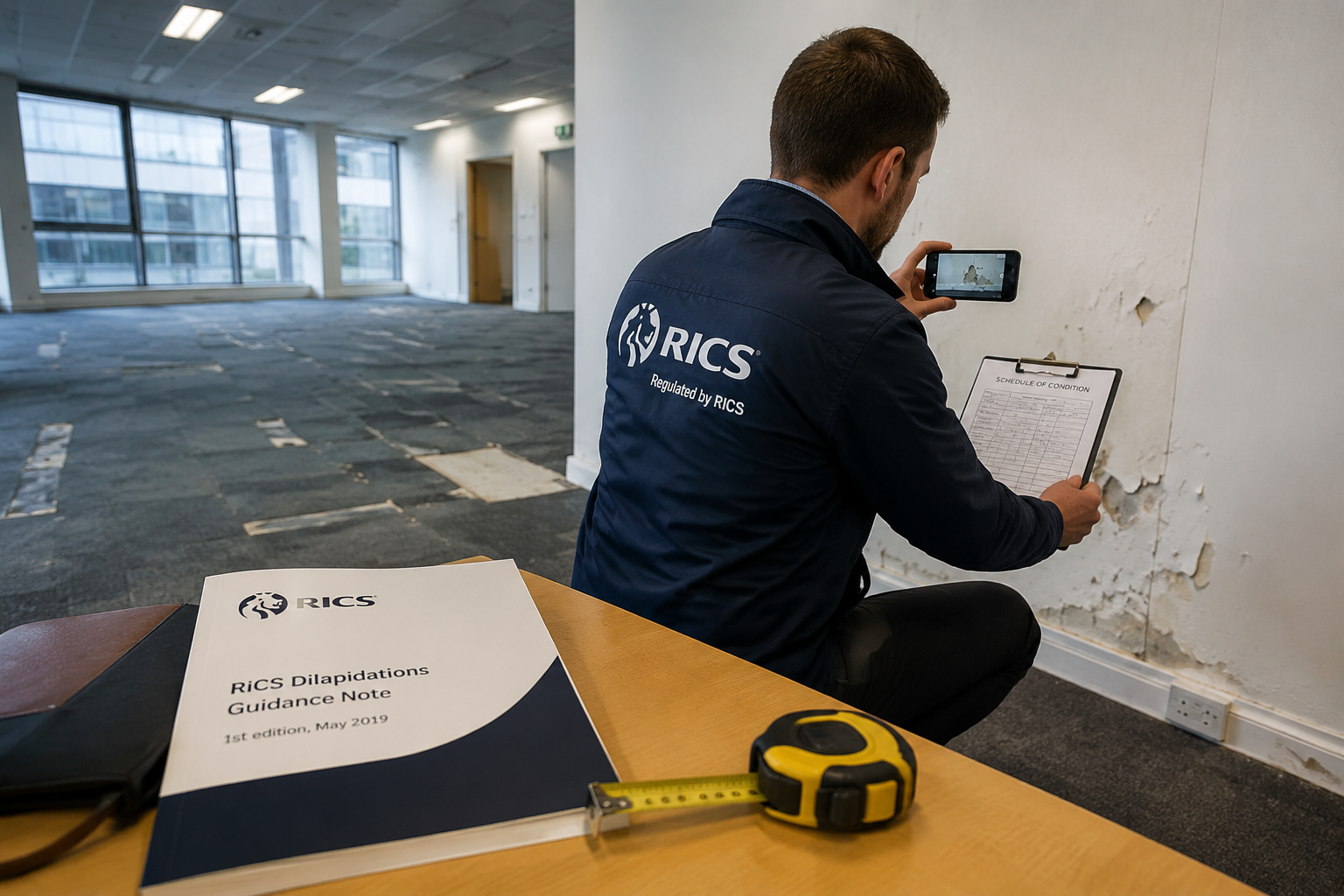
A well-prepared schedule of condition at lease commencement remains the single most effective tool for limiting dilapidations liability. When one exists, the expert's task at lease end is to compare the property's condition against the baseline record. When one does not exist, both parties' experts must work from lease obligations, historical evidence, and professional judgment — a far more contentious exercise.
The expert's site inspection should be thorough and systematic. Photographic evidence is critical. Courts expect contemporaneous photographs that document each alleged breach, its extent, and its location. A photo survey conducted without a clear methodology — or one that cherry-picks evidence — will be challenged in cross-examination.
The Pre-Action Protocol and Expert Witness Obligations
Timetable and Quantified Demand
The Pre-Action Protocol for Claims for Damages in Relation to the Physical State of Commercial Property at Termination of a Tenancy (the "Dilapidations Protocol") imposes a structured timetable that expert surveyors must work within [4]:
- Within 56 days of lease end: Landlord serves a schedule of dilapidations
- Quantified Demand: Landlord issues a monetary claim with evidential basis, confirming whether works will actually be carried out
- Within 56 days of Quantified Demand: Tenant serves a response
- Within 28 days of tenant's response: Parties' surveyors meet to narrow issues
The Protocol requires that schedules and quantified demands be "reasonable" and reflect the landlord's genuine intentions [4]. An expert who inflates a schedule, or who fails to address whether works will actually be done, risks adverse costs consequences even if the landlord ultimately succeeds on liability.
RICS guidance stresses that expert surveyors on both sides should use the Protocol timetable to narrow contentious valuation issues — betterment, supersession, and the section 18(1) cap — as early as possible [1]. This reduces the scope of any subsequent litigation and serves the overriding objective of proportionate dispute resolution.
The RICS Dilapidations Dispute Resolution Scheme
Where parties prefer to avoid court, the RICS Dilapidations Dispute Resolution Scheme offers an alternative. Surveyors appointed under the scheme are expected to act with strict impartiality and in accordance with RICS professional standards and the court rules on expert evidence [3]. The scheme is particularly suited to disputes where the facts are broadly agreed but quantum remains in issue.
For surveyors, appointment under the scheme carries the same professional obligations as court appointment. Independence is non-negotiable.
Experts' Discussions and Joint Statements
Once proceedings are issued, CPR Part 35 typically requires the parties' experts to hold a without-prejudice discussion and produce a joint statement setting out agreed and disputed matters. In dilapidations cases, this discussion commonly covers:
- Which items in the schedule are admitted or disputed
- The appropriate specification and cost of agreed remedial works
- Whether the section 18(1) cap applies and, if so, at what figure
- Whether betterment or supersession reduces the claim
The joint statement is not a negotiation document — it is a professional record of agreed expert opinion. Surveyors who allow client pressure to influence their positions in experts' discussions risk regulatory sanction and adverse judicial comment.
2026 Hybrid Work Impacts on Office Dilapidations Valuations
A Changed Market Context
The structural shift toward hybrid working, accelerated since 2020 and now embedded in 2026 occupier behaviour, has materially altered the commercial office market in ways that directly affect dilapidations valuations. Key effects include:
- Higher vacancy rates in secondary office locations, depressing rental values and capital values
- Increased landlord redevelopment intentions, strengthening supersession arguments
- Greater divergence between the cost of works and the diminution in value of the reversion
- Changing fit-out expectations, meaning that what constituted a standard reinstatement in 2019 may now be commercially obsolete
Where an office building's value has fallen significantly due to structural market changes rather than the tenant's breaches, the diminution valuation must carefully isolate the loss attributable to the breaches from the loss attributable to market conditions. This is a technically demanding exercise that requires current market evidence and a clear methodology [2].
Practical Implications for Expert Valuers
For expert witnesses instructed in office dilapidations disputes in 2026, the following practical steps are essential:
- Obtain current comparable evidence — rental and capital value comparables must reflect the post-hybrid market, not pre-pandemic assumptions
- Address market obsolescence explicitly — if the premises would require significant reconfiguration regardless of the tenant's breaches, say so and quantify the effect
- Consider the landlord's actual intentions — a landlord planning to convert offices to residential or mixed use may have a materially weaker damages claim
- Document the methodology — courts expect expert valuers to explain their approach, not just state a conclusion
A specific defect survey can assist in isolating structural or building-condition issues from dilapidations breaches, providing a cleaner evidential base for the quantum assessment.
The valuation of commercial property at lease end also intersects with broader valuation factors that any expert must consider — location, market conditions, planning constraints, and the physical state of comparable premises.

Structuring a CPR-Compliant Expert Witness Report
Essential Components
A dilapidations expert witness report that will withstand court scrutiny must include:
- Instructions received — a clear statement of what the expert was asked to do
- Documents reviewed — lease, schedules, photographs, correspondence, comparables
- Site inspection record — date, attendees, methodology, photographic log
- Statement of expertise — qualifications, experience, and RICS membership
- Factual summary — condition of the premises and relevant lease obligations
- Expert opinion — clearly labelled as opinion, not fact
- Quantum analysis — cost of works, diminution valuation, section 18(1) assessment
- Statement of truth — CPR Part 35 compliant declaration
The report must not advocate for the instructing party. Where the evidence supports a conclusion adverse to the client, the expert must say so. Selective presentation of evidence is a professional conduct matter as well as a legal one.
Common Pitfalls to Avoid
| Pitfall | Consequence |
|---|---|
| Failing to address section 18(1) | Report may be disregarded on quantum |
| Conflating fact and opinion | Credibility undermined in cross-examination |
| Inadequate photographic evidence | Disputed items harder to establish |
| Ignoring supersession evidence | Claim may fail on the second limb |
| Allowing client pressure to influence opinion | Professional conduct risk; adverse judicial comment |
For surveyors seeking to understand the broader context of their professional obligations, the chartered surveyors practice area provides useful background on the standards expected of RICS members across all dispute contexts.
Conclusion
The role of an expert witness in dilapidations disputes demands a precise combination of technical surveying skill, valuation expertise, and procedural discipline. The 2024 RICS guidance note Dilapidations in England and Wales sets the current standard, requiring experts to address the section 18(1) cap rigorously, comply with CPR Part 35, and work constructively within the Pre-Action Protocol timetable [1][8].
In 2026, the hybrid working revolution has added a new layer of complexity to office dilapidations valuations. Experts who fail to engage with current market evidence — or who apply pre-pandemic valuation assumptions — risk producing reports that are challenged on both methodology and conclusion.
Actionable next steps for surveyors and parties in dilapidations disputes:
- Instruct an expert with demonstrable experience in commercial lease-end valuations and CPR Part 35 compliance
- Ensure a schedule of condition is prepared at lease commencement for all new commercial lettings
- Engage expert surveyors early — ideally before the 56-day Protocol deadline — to allow proper site inspection and quantum analysis
- In office cases, obtain current market comparables that reflect 2026 occupier demand patterns
- Where quantum is genuinely in dispute, consider the RICS Dilapidations Dispute Resolution Scheme as a cost-effective alternative to litigation
Dilapidations disputes are won or lost on the quality of expert evidence. Investing in properly qualified, genuinely independent expert surveyors is not a cost — it is the foundation of a defensible claim or a robust defence.
References
[1] Dilapidations Rebrand 2024 – https://www.rics.org/content/dam/ricsglobal/documents/standards/Dilapidations_rebrand_2024.pdf
[2] Taken Into Account – https://ww3.rics.org/uk/en/journals/built-environment-journal/taken-into-account.html
[3] Dilapidations Dispute Resolution Scheme – https://www.rics.org/content/dam/ricsglobal/documents/dispute-resolution-service/Dilapidations_Dispute_Resolution_Scheme.pdf
[4] Dilapidations Protocol – https://www.fandt.com/guides/dilapidations-protocol/
[5] Clarity And Conduct New Rics Dilapidations Guidance Note – https://cms-lawnow.com/en/ealerts/2016/12/clarity-and-conduct-new-rics-dilapidations-guidance-note
[6] The Dilapidations Timeline And Process In Uk Commercial Property A Comprehensive Guide – https://fourthwallbc.com/blog/the-dilapidations-timeline-and-process-in-uk-commercial-property-a-comprehensive-guide/
[8] Dilapidations In England And Wales – https://www.rics.org/profession-standards/rics-standards-and-guidance/sector-standards/building-surveying-standards/dilapidations-in-england-and-wales
[9] Commercial Dilapidations – https://www.dilapsolutions.com/services/commercial-dilapidations/
[10] Dilapidations England Wales – https://www.rics.org/consumer-guides/dilapidations-england-wales
