
Roughly one in three UK homeowners who build a larger rear extension under permitted development rights are unaware that planning permission and party wall compliance are entirely separate legal obligations. Securing permitted development rights does not cancel out the requirements of the Party Wall etc. Act 1996 — and failing to serve the correct notices before work begins can result in injunctions that halt construction, costly legal disputes, and strained neighbour relationships that outlast the build itself.
This guide addresses the party wall implications for permitted development rights expansions and the survey protocols for larger home extensions in plain terms, helping homeowners, builders, and property professionals navigate both frameworks simultaneously.
Key Takeaways
- Permitted development rights and party wall obligations are independent legal frameworks; satisfying one does not remove the need to comply with the other.
- Larger rear extensions of up to 8 metres (detached) or 6 metres (other dwellings) under the prior approval process still require party wall notices if they affect a shared wall or involve excavation near a neighbour's foundations.
- The correct notice period is two months for party wall works and one month for new boundary walls; serving notices late can delay an entire project.
- A schedule of condition survey protects both the building owner and the adjoining owner by documenting the pre-works state of neighbouring properties.
- A party wall award provides the legal framework under which works proceed, setting out rights, obligations, and compensation mechanisms.
Understanding Permitted Development Rights for Larger Rear Extensions
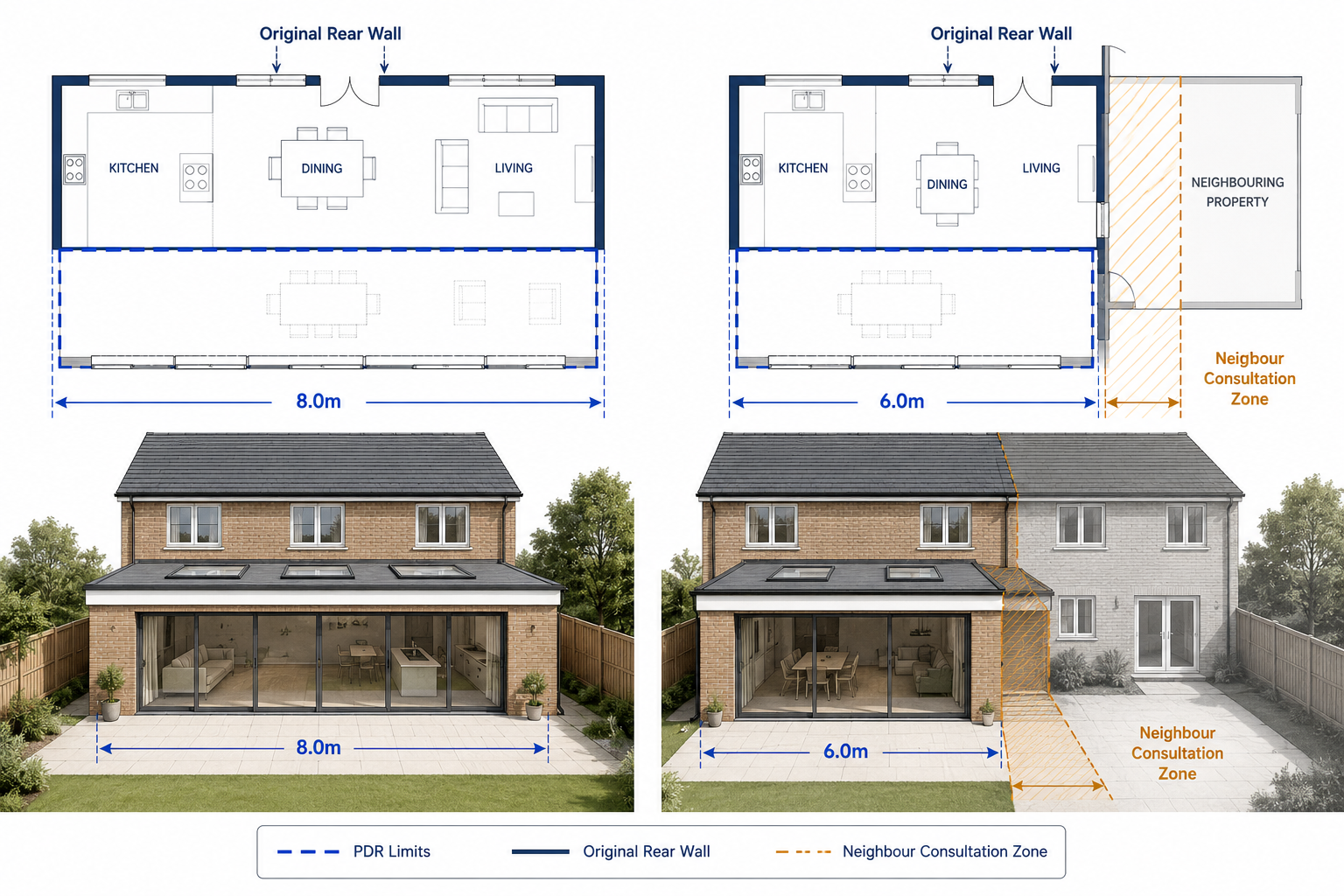
Under Part 1, Class A of the General Permitted Development Order (GPDO), homeowners in England can extend their properties without full planning permission, provided specific size limits and conditions are met [2]. The rules distinguish between property types:
| Property Type | Maximum Single-Storey Rear Extension (Prior Approval) |
|---|---|
| Detached house | Up to 8 metres |
| Semi-detached or terraced house | Up to 6 metres |
Extensions beyond 4 metres (detached) or 3 metres (other) require prior approval through the Neighbour Consultation Scheme. This is a planning process, not a party wall process — the two must not be confused [6].
A critical baseline: the "original house." Permitted development limits are always measured from the rear wall of the original house — meaning the property as it was first built, or as it stood on 1 July 1948 [3]. If a previous extension already exists, the measurement still starts from the original rear wall, not the current rear wall. This prevents incremental overdevelopment and affects how much further a homeowner can lawfully extend.
Why Prior Approval Does Not Equal Party Wall Clearance
Many homeowners assume that once the local authority raises no objection under the Neighbour Consultation Scheme, they are free to build. This is incorrect. The prior approval process only considers the impact on amenity and daylight — it does not assess structural risk to adjoining properties, which is what the Party Wall etc. Act 1996 is designed to address [4].
Even a straightforward 6-metre rear extension on a semi-detached property may involve:
- Excavation for new foundations within 3 metres of the neighbour's building
- Removal or alteration of a shared chimney breast
- Raising or underpinning of a party fence wall
Each of these triggers separate notice obligations under the Act, regardless of whether permitted development rights have been confirmed.
Party Wall Implications for Permitted Development Rights Expansions: Survey Protocols for Larger Home Extensions in Practice
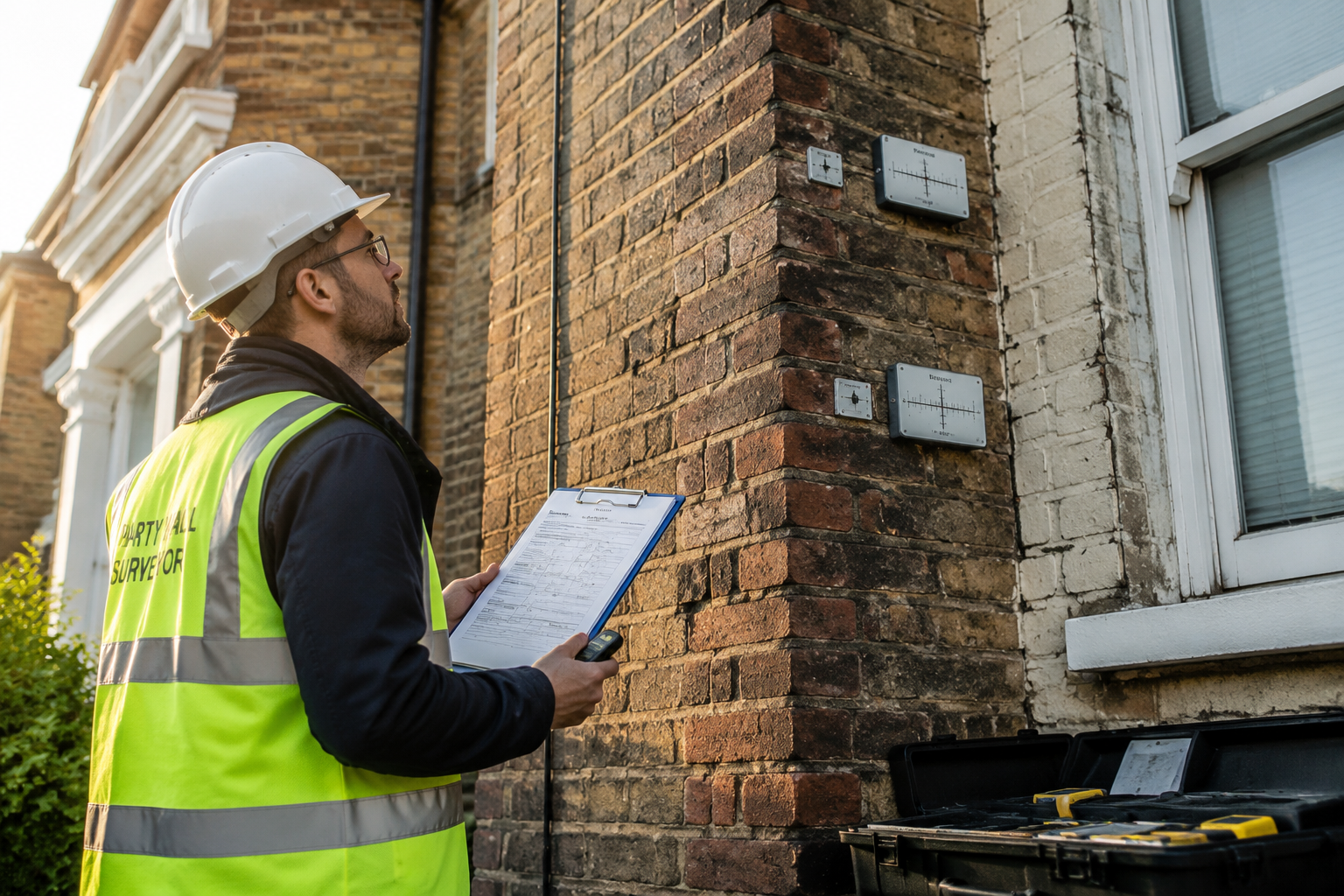
The party wall implications for permitted development rights expansions become most complex when a larger home extension sits close to or on the boundary line. Three distinct types of works trigger the Act [7]:
1. Works to an existing party wall or party structure
This includes cutting into, raising, lowering, underpinning, or demolishing and rebuilding a shared wall. A two-month notice period applies before works begin.
2. New walls built at or astride the boundary line
Constructing a new wall on the line of junction between two properties requires a one-month notice. This commonly applies to side infill extensions where the new flank wall sits on or near the shared boundary [1].
3. Excavation near a neighbouring structure
The Three Metre Rule activates when excavation for new foundations occurs within 3 metres of an adjoining building and goes deeper than the neighbour's existing foundations. The Six Metre Rule applies when excavation is within 6 metres and intersects a 45-degree line drawn from the base of the neighbour's foundations [1]. Both trigger a two-month notice period.
For a comprehensive explanation of how these rules interact with extension projects, the Party Wall etc. Act 1996 homeowner's guide provides detailed practical context.
The Schedule of Condition: A Non-Negotiable Survey Step
Before any notifiable works begin, a schedule of condition should be prepared for all adjoining properties. This is a detailed photographic and written record of the current state of the neighbour's property — walls, ceilings, floors, and any pre-existing cracks or defects.
The schedule of condition serves two purposes:
- It protects the building owner from inflated or fraudulent damage claims after works complete.
- It protects the adjoining owner by creating an accurate baseline against which post-works damage can be assessed.
For guidance on what this document should contain, the schedule of condition report resource outlines the standard components used by professional surveyors.
Serving the Correct Party Wall Notices
The type of notice served must match the type of work being undertaken. Serving the wrong notice — or serving it too late — can invalidate the process and expose the building owner to an injunction [4].
Notice types and timelines at a glance:
| Work Type | Notice Type | Minimum Notice Period |
|---|---|---|
| Works to existing party wall | Party Structure Notice | 2 months |
| New wall on boundary line | Line of Junction Notice | 1 month |
| Excavation within 3m or 6m | Notice under Section 6 | 2 months |
Once a notice is served, the adjoining owner has 14 days to respond. They may consent in writing, which allows works to proceed without a formal award. If they dissent — or fail to respond within 14 days — a dispute is deemed to have arisen, and surveyors must be appointed [7].
For a step-by-step breakdown of what happens after a notice is served, the party wall process guide is a useful reference.
Party Wall Awards, Surveyor Roles, and Compliance Protocols for Larger Extensions

When a dispute arises — whether through active dissent or simple non-response — the mechanism for resolving it is the party wall award. This is a legally binding document prepared by one or more appointed surveyors. It sets out:
- The works to be carried out
- The manner and hours in which they may be undertaken
- The rights of access for surveyors to inspect progress
- Provisions for making good any damage caused
- The party responsible for surveyor costs (usually the building owner)
"A party wall award is not a bureaucratic hurdle — it is the legal framework that allows construction to proceed with confidence on both sides of the boundary."
Understanding what a party wall award contains and how it protects all parties is essential before any larger extension project begins. The party wall award guidance resource explains the structure and enforceability of these documents in detail.
What a Party Wall Surveyor Does During a Larger Extension
A qualified party wall surveyor carries out several distinct functions during a larger home extension project [5]:
- Pre-works inspection: Conducting or reviewing the schedule of condition for adjoining properties
- Notice review: Confirming that notices served are legally valid and appropriate for the works described
- Award drafting: Preparing the party wall award document in accordance with the Act
- Monitoring: Making periodic site visits to assess whether works comply with the award
- Damage assessment: Inspecting any post-works claims and determining liability
For a detailed breakdown of the professional obligations involved, what a party wall surveyor does covers the full scope of their role and legal responsibilities.
Costs and Who Pays
In most cases, the building owner — the person carrying out the extension — pays for both their own surveyor and the adjoining owner's surveyor. This is a default position under the Act, though it can be varied in exceptional circumstances [5].
The cost of a party wall surveyor varies depending on the complexity of the works, the number of adjoining owners affected, and the location of the property. For a clear breakdown of typical fees, the party wall surveyor cost guide provides current pricing benchmarks and explains what drives costs up or down.
Side Infill Extensions and the Three Metre Rule
Side infill extensions — where a gap between a house and its boundary is filled in — present particular challenges. These extensions frequently:
- Sit directly on or near the boundary line (triggering a Line of Junction Notice)
- Involve excavation close to the neighbour's existing foundations (triggering Section 6 notices)
- Require removal of a shared or abutting fence wall
The three metre rule explained provides specific guidance on how proximity to a neighbour's foundations affects notice obligations and survey requirements for these types of projects.
When Neighbours Refuse to Engage
Occasionally, adjoining owners refuse to appoint a surveyor, fail to respond to communications, or attempt to obstruct the process. The Act provides a mechanism for this: if an adjoining owner fails to appoint their own surveyor within 10 days of a request, the building owner's surveyor may act as the agreed surveyor for both parties [4].
This does not remove the adjoining owner's rights — they can still challenge an award in the county court within 14 days of it being served. However, it prevents deliberate delay from halting a lawful project indefinitely.
Common Mistakes That Lead to Neighbour Injunctions
Injunctions are the most disruptive outcome of poor party wall compliance. They can freeze a construction site mid-build, leaving structural work exposed and contracts in breach. The most common causes include:
- Starting works before the notice period expires. Even if the neighbour has not objected, works cannot begin until the notice period has fully elapsed or consent has been given in writing.
- Serving an incorrect notice type. A Line of Junction Notice served instead of a Party Structure Notice — or vice versa — may be legally invalid.
- Failing to serve notice at all. Some building owners assume that because their extension is permitted development, no party wall process is needed. This is a frequent and costly error [4].
- Not obtaining a schedule of condition. Without this document, any damage claim made after works complete becomes a dispute about pre-existing versus new damage, with no objective baseline to refer to.
- Appointing an unqualified surveyor. The Act does not require surveyors to hold specific qualifications, but appointing someone without genuine expertise in party wall matters increases the risk of a flawed award that can be challenged.
Conclusion
The relationship between permitted development rights and party wall law is one of the most misunderstood areas of residential construction compliance in the UK. Larger rear extensions and side infill projects that fall comfortably within PDR limits can still trigger multiple notice obligations under the Party Wall etc. Act 1996 — and the consequences of ignoring those obligations range from injunctions to litigation.
Actionable next steps for homeowners planning a larger extension in 2026:
- Confirm your permitted development entitlement and measure from the original rear wall, not any existing extension.
- Commission a structural engineer or party wall surveyor to assess whether your proposed works trigger any of the three notice categories under the Act.
- Serve the correct notices at least two months (or one month for boundary wall works) before the planned start date.
- Instruct a qualified party wall surveyor to prepare a schedule of condition for all adjoining properties before any works begin.
- Obtain a party wall award if any adjoining owner dissents or fails to respond within 14 days.
- Keep all documentation — notices, consents, schedules of condition, and the award — in a secure file for the duration of the project and beyond.
Taking these steps in sequence removes the most common causes of neighbour injunctions and ensures that a larger home extension proceeds on a legally sound footing from the first day of construction.
References
[1] Party Wall Awards For Multi Generational Home Adaptations 2026 Survey Protocols For Family Extensions – https://www.canterburysurveyors.com/blog/party-wall-awards-for-multi-generational-home-adaptations-2026-survey-protocols-for-family-extensions/?utm_source=openai
[2] Part 1 Class A Of The Gpdo Large Rear Extensions – https://www.andrewransome.co.uk/part-1-class-a-of-the-gpdo-large-rear-extensions?utm_source=openai
[3] Permitted Development Rules For House Extensions – https://www.designsindetail.com/articles/permitted-development-rules-for-house-extensions?utm_source=openai
[4] Extensions And Party Walls Planning Permissions Explained – https://www.expresspartywall.com/extensions-and-party-walls-planning-permissions-explained/?utm_source=openai
[5] Party Wall Surveys For Institutional Buy To Let Expansions Compliance Strategies For 2026s Landlord Investment Surge – https://wimbledonsurveyors.com/party-wall-surveys-for-institutional-buy-to-let-expansions-compliance-strategies-for-2026s-landlord-investment-surge/?utm_source=openai
[6] How Much Can I Extend My House Without Planning – https://legalclarity.org/how-much-can-i-extend-my-house-without-planning/?utm_source=openai
[7] Do I Need Party Wall Agreement – https://www.surveyofpartywall.co.uk/do-i-need-party-wall-agreement/?utm_source=openai
