
Fewer than one in three mid-rise private rented sector blocks built before 1990 have had a formal structural condition assessment in the past decade — yet from 2026, landlords face legally binding response deadlines when tenants report suspected structural instability. Building Survey Protocols for Structural Collapse Risks Under Awaab's Law 2026: Mid-Rise PRS Due Diligence is no longer a niche compliance exercise. It is a statutory obligation with real financial and criminal consequences for landlords who fail to act within prescribed timeframes.
Key Takeaways
- Awaab's Law Phase 2, coming into force in 2026, explicitly adds structural collapse and falling elements to the list of HHSRS hazards subject to fixed statutory response deadlines.
- Emergency structural hazards must be investigated and made safe within 24 hours; significant hazards must be investigated within 10 working days and remediated within 5 working days thereafter.
- Mid-rise private rented sector (PRS) blocks require a four-stage survey protocol: rapid desktop triage, on-site chartered surveyor inspection, intrusive structural investigation, and formal HHSRS risk rating.
- Time-stamped photographic evidence, crack-width measurements, and deflection logs are essential to defend any decision that a reported defect does not meet the emergency threshold.
- Pre-purchase due diligence on mid-rise PRS assets now requires structural survey scope that is explicitly aligned to Awaab's Law hazard categories and response timelines.
What Awaab's Law Phase 2 Means for Structural Hazards in 2026
Awaab's Law was introduced through the Social Housing (Regulation) Act 2023 following the death of two-year-old Awaab Ishak from prolonged exposure to mould in a Rochdale social housing flat. Phase 1 focused primarily on damp, mould, and emergency hazards. Phase 2, coming into force in 2026, significantly widens the scope [2].
The statutory framework now brings 13 additional HHSRS hazard categories within the same fixed-deadline regime. Critically for the building survey profession, this list includes structural collapse and falling elements as well as explosions [5]. This means any credible report of structural instability in a mid-rise block — whether social or private rented sector — triggers a legal clock that landlords and their surveyors cannot ignore.
The Statutory Timeframes Surveyors Must Work Within
The GOV.UK guidance sets out the following binding timeframes [9]:
| Hazard Classification | Investigation Deadline | Remediation Deadline |
|---|---|---|
| Emergency hazard | Investigate and make safe within 24 hours | Immediate or alternative accommodation provided |
| Significant (non-emergency) hazard | Investigate within 10 working days | Safety works completed within 5 working days after investigation |
| General repairs (non-hazard) | Within 12 weeks | Within 12 weeks |
For structural collapse, this is being operationalised through internal protocols that treat progressive movement, visible shear cracking across multiple storeys, failed lintels or beams, and suspected foundation failure as automatically emergency-grade defects [3]. Isolated, non-progressive hairline cracking in non-load-bearing partitions may qualify as a significant hazard rather than an emergency — but that classification must be supported by documented evidence, not assumption.
The 24-hour clock starts from the moment a credible report is received — not from when a surveyor is eventually booked.
Although Awaab's Law was originally drafted for the social rented sector, the direction of travel is clear. Private landlords of mid-rise blocks are already being scrutinised under the Housing Health and Safety Rating System (HHSRS), and sector commentary confirms that the same hazard categories and evidential standards are being applied in PRS disrepair litigation [7]. Pre-purchase due diligence that ignores these standards creates material liability for acquiring landlords.
Core Building Survey Protocols for Structural Collapse Risks Under Awaab's Law 2026
The four-stage model now being adopted by leading survey practices provides a structured, legally defensible approach to structural collapse risk assessment in mid-rise PRS buildings [6].
Stage 1: Rapid Desktop Triage
When a structural concern is reported, the first response must happen within hours, not days. Desktop triage involves:
- Reviewing photographic evidence submitted by the tenant or managing agent
- Checking available records — original structural drawings, previous survey reports, building control sign-offs
- Assessing building age, construction type, and known risk factors (e.g., large-panel system construction, early post-war concrete frames, or converted Victorian warehouse structures)
- Making an initial emergency/significant hazard determination to set the correct response deadline
This stage does not replace an on-site inspection, but it determines whether the 24-hour or 10-working-day clock applies. A failure to conduct rapid triage is itself a compliance failure under the Awaab's Law framework [3].
For mid-rise blocks, particular attention during triage should be paid to reports involving:
- Sudden new cracking, especially diagonal or stepped cracking in masonry
- Visible deflection in floors, beams, or balconies
- Doors or windows that have suddenly become difficult to open
- Sounds of movement or cracking within the structure
Stage 2: On-Site Inspection by a Chartered Surveyor
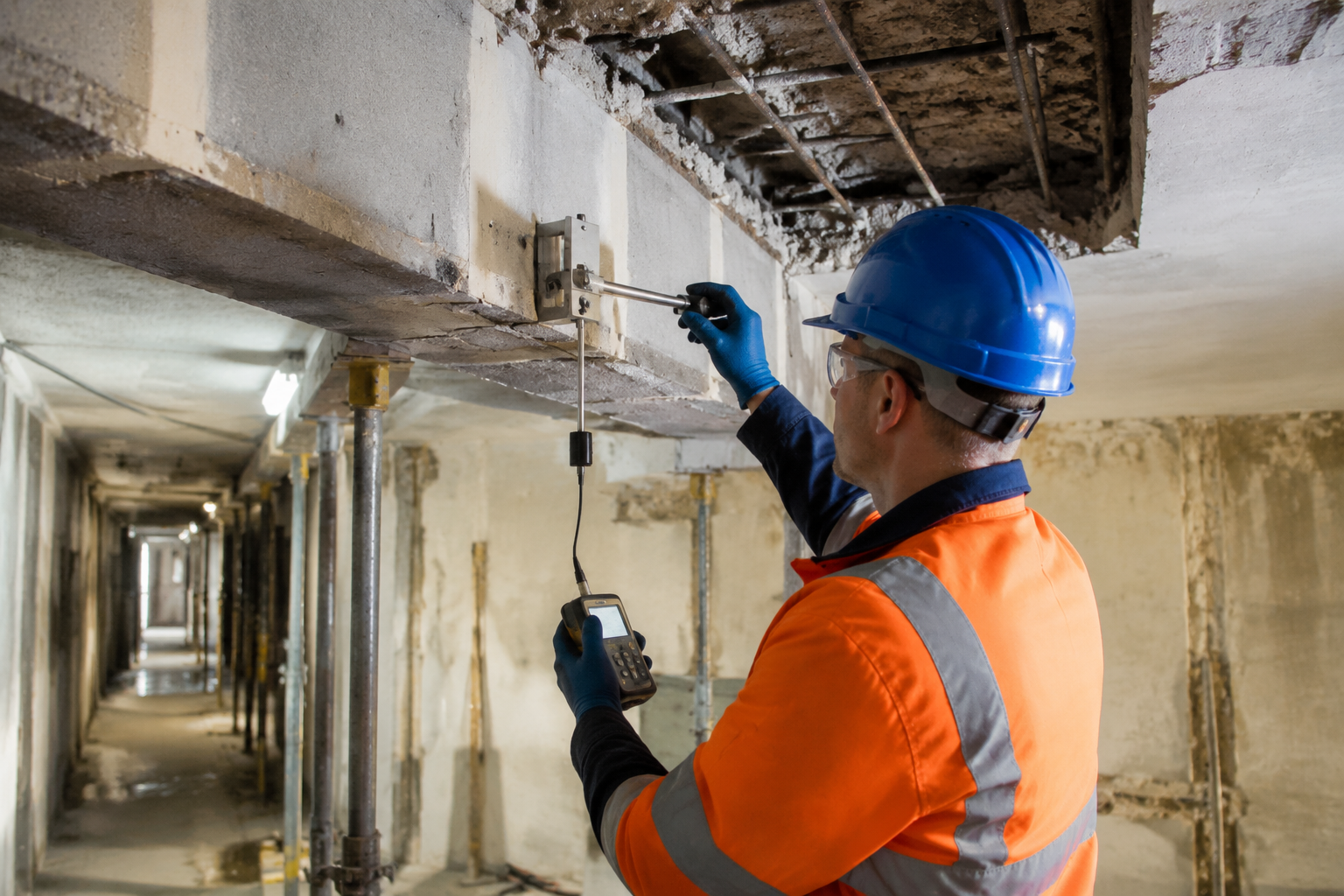
The on-site inspection must be completed within the applicable statutory window. A Level 3 building survey provides the most thorough baseline for mid-rise structural assessment, covering all accessible elements of the structure with detailed condition ratings.
The on-site inspection for structural collapse risk should include:
- Visual survey of all accessible structural elements: load-bearing walls, columns, beams, floor plates, roof structure, and foundations where visible
- Crack mapping: recording location, orientation, width, and whether cracks are live (active) or historic
- Deflection assessment: checking floors, lintels, and beams for visible sag or distortion
- Drainage and water ingress checks: water is a primary driver of foundation movement and masonry deterioration
- Neighbouring structure assessment: particularly relevant in terraced or semi-detached mid-rise blocks where party wall movement can indicate shared structural problems
Understanding what a surveyor checks during a structural inspection is essential context for landlords commissioning this work. The inspection must be conducted by a chartered surveyor with relevant structural competency, not a general property manager or maintenance operative.
Stage 3: Intrusive Structural Investigation
Where the on-site inspection identifies uncertainty about structural stability, intrusive investigation is required. This stage cannot be deferred simply because it is disruptive or expensive. Under Awaab's Law, the duty to investigate supersedes convenience [6].
Intrusive investigation methods for mid-rise structural collapse risk include:
- Opening-up works: removing finishes to expose structural connections, beam bearings, or foundation details
- Temporary propping: installing acrow props or proprietary shoring to stabilise suspect elements during investigation
- Crack monitoring: installing tell-tales or digital crack monitors to determine whether movement is progressive
- Specialist structural engineering input: engaging a Chartered Structural Engineer (MIStructE or CEng) for calculations and limit-state assessment
- Ground investigation: commissioning trial pits or boreholes where foundation failure is suspected
The structural surveys service offered by specialist firms is designed precisely for this level of investigation. A standard homebuyer report or Level 2 survey is wholly inadequate for mid-rise structural collapse risk assessment under Awaab's Law.
Stage 4: Formal Risk Rating and Repair Prioritisation
The final stage produces the documented output that satisfies both the statutory requirement and the evidential standard for any subsequent legal proceedings. This must include:
- HHSRS risk rating: formally classifying the hazard as Category 1 (serious) or Category 2 (other) under the Housing Act 2004
- BS EN 1990 limit-state reference: where structural calculations are involved, referencing the relevant Eurocode framework
- Prioritised repair schedule: distinguishing immediate safety works from longer-term remediation
- Time-stamped evidence package: photographs, crack-width measurements, deflection logs, and monitoring data
Any decision that a reported defect is not a significant hazard must be supported by documented evidence — not professional opinion alone.
This evidential standard is non-negotiable. Records may be scrutinised in Awaab's Law disrepair proceedings, Housing Ombudsman investigations, or coroner's inquests [6].
Mid-Rise PRS Due Diligence: Pre-Purchase Structural Risk Assessment
Building Survey Protocols for Structural Collapse Risks Under Awaab's Law 2026: Mid-Rise PRS Due Diligence applies not only to existing landlords managing occupied stock but also to investors acquiring mid-rise PRS assets. The 2026 regulatory environment has materially changed the risk profile of mid-rise blocks, and pre-purchase due diligence must reflect this.

Why Standard Homebuyer Reports Are Insufficient
A Level 2 survey — the standard homebuyer report — is designed for conventional residential properties and does not provide the structural depth required for mid-rise PRS due diligence. For blocks of four storeys or more, or for any building with known structural complexity, a full structural survey is the appropriate starting point.
The pre-purchase structural survey for a mid-rise PRS block should specifically address:
- Construction type and era: large-panel system (LPS) blocks from the 1960s and 1970s carry specific progressive collapse risks; early reinforced concrete frames may have carbonation or rebar corrosion issues
- Existing defect history: request all previous survey reports, building control records, and maintenance logs from the vendor
- Current HHSRS status: confirm whether any Category 1 or Category 2 hazards have been identified or are outstanding
- Awaab's Law compliance gap: assess whether the building's current condition and management systems are capable of meeting the 24-hour and 10-day response requirements from day one of ownership
RICS Checklist for Structural Collapse Risk in Mid-Rise PRS
The following checklist reflects current RICS guidance and the Awaab's Law Phase 2 framework for mid-rise structural assessment:
Pre-Survey Preparation
- Obtain original structural drawings and any subsequent structural engineer's reports
- Review planning and building control history for any structural alterations
- Check for any live enforcement notices or improvement notices from the local authority
On-Site Structural Checks
- Inspect all load-bearing elements: walls, columns, beams, floor slabs, roof structure
- Map and classify all cracking: location, pattern, width, and activity
- Check all lintels and beam bearings for adequate support and signs of failure
- Assess balconies and cantilevered elements for deflection and corrosion
- Inspect basement and ground-floor areas for signs of foundation movement or water ingress
Specific Mid-Rise Risk Factors
- Identify construction type (masonry, RC frame, LPS, steel frame, timber frame)
- Check for any evidence of previous structural alterations or load-bearing wall removal
- Assess party wall conditions where relevant — understanding party wall obligations is important in multi-occupancy conversions
- Review fire compartmentation integrity, which intersects with structural stability in multi-storey blocks
Post-Survey Documentation
- Produce time-stamped photographic record of all defects
- Issue formal HHSRS risk classification for any identified hazards
- Provide prioritised repair schedule with cost estimates
- Confirm whether any defects require immediate notification to current tenants or local authority
The Intersection of Party Wall Obligations and Structural Collapse Risk
In converted mid-rise blocks — particularly Victorian or Edwardian terraces converted to flats — structural collapse risk frequently intersects with party wall obligations. Works to address structural defects in shared walls or foundations trigger the Party Wall etc. Act 1996. Landlords and investors should understand what a party wall surveyor does in this context, as failure to serve proper notices before structural remediation works can create additional legal exposure on top of Awaab's Law obligations.
Practical Compliance for Landlords and Managing Agents in 2026
The combination of Awaab's Law Phase 2 and the existing HHSRS framework creates a demanding compliance environment for mid-rise PRS landlords. The following practical steps reduce risk:
1. Establish a structural triage protocol before a report is received. Do not wait for a tenant complaint to decide how structural concerns will be assessed. Have a named chartered surveyor on retainer who can respond within the statutory windows.
2. Audit existing stock against Awaab's Law Phase 2 hazard categories. Commission a baseline comprehensive condition survey for any mid-rise block that has not had a formal structural assessment in the past five years.
3. Train property management staff on hazard recognition. The 24-hour clock starts when a credible report is received by anyone in the management chain — not just when it reaches a director or compliance officer.
4. Maintain a live defect register with time-stamped records. This is the primary defence in any Awaab's Law enforcement action or disrepair claim.
5. Review contractor and surveyor appointment terms. Ensure that survey instructions and work orders are explicitly aligned to the statutory response timeframes, and that contractors can mobilise within 24 hours for emergency structural works.
6. Factor Awaab's Law compliance costs into acquisition pricing. For pre-purchase due diligence, the cost of bringing a mid-rise block into full structural compliance should be modelled as a day-one liability, not an optional future expenditure.
Conclusion
The extension of Awaab's Law to structural collapse and falling elements in 2026 represents a fundamental shift in the legal obligations of mid-rise PRS landlords and their professional advisers. Building Survey Protocols for Structural Collapse Risks Under Awaab's Law 2026: Mid-Rise PRS Due Diligence is now a defined, time-critical process — not a discretionary best practice.
The four-stage protocol of rapid desktop triage, on-site chartered surveyor inspection, intrusive structural investigation, and formal HHSRS risk rating provides a legally defensible framework for managing structural collapse risk within the statutory deadlines. Pre-purchase due diligence must go beyond standard homebuyer reports to include full structural assessment aligned to Awaab's Law hazard categories.
Actionable next steps for landlords and investors:
- Commission a baseline structural condition survey for every mid-rise block in the portfolio before the end of 2026
- Establish written triage protocols and surveyor retainer arrangements before a structural report is received
- Ensure all defect records are time-stamped, photographic, and formally HHSRS-classified
- Integrate Awaab's Law Phase 2 compliance costs into all mid-rise PRS acquisition models
- Consult a chartered surveyor with specific mid-rise structural competency for any complex or high-risk assessments
The cost of proactive structural due diligence is a fraction of the cost of enforcement action, disrepair litigation, or — in the worst case — a structural failure that harms tenants. In 2026, the regulatory framework leaves no room for a reactive approach.
References
[1] Awaabs Law Explained – https://firntec.com/blog/awaabs-law-explained
[2] Awaabs Law Phase 2 Changes 2026 – https://hazardclock.co.uk/blog/awaabs-law-phase-2-changes-2026/
[3] Awaabs Law Is Here The Surveyors Guide For Compliance – https://www.surventrix.com/blog/awaabs-law-is-here-the-surveyors-guide-for-compliance
[4] Part 2 Awaabs Law 2026 Landlords Must Act Wider Health Duncan – https://www.linkedin.com/pulse/part-2-awaabs-law-2026-landlords-must-act-wider-health-duncan-19xue
[5] Housing Provider's Guide to Awaab's Law – Pennington Choices 2025 – https://4364330.fs1.hubspotusercontent-na1.net/hubfs/4364330/Literature-Downloads-Resources/EBooks/Housing%20Provider%E2%80%99s%20Guide%20to%20Awaab%E2%80%99s%20Law%20-%20Pennington%20Choices%202025.pdf
[6] Building Survey Protocols For Structural Collapse Risks Awaabs Law 2026 Extensions And High Risk Property Assessments – https://nottinghillsurveyors.com/blog/building-survey-protocols-for-structural-collapse-risks-awaabs-law-2026-extensions-and-high-risk-property-assessments
[7] Explosion And Structural Collapse Hazards Under Awaabs Law Expert Witness Strategies For PRS Dispute Resolution – https://princesurveyors.co.uk/blog/explosion-and-structural-collapse-hazards-under-awaabs-law-expert-witness-strategies-for-prs-dispute-resolution/
[8] Building Survey Protocols For Bungalow Excess Cold Hazards Under Awaabs Law 2026 Level 3 Essentials – https://manchestersurveyors.com/building-survey-protocols-for-bungalow-excess-cold-hazards-under-awaabs-law-2026-level-3-essentials/
[9] Awaabs Law Guidance For Social Landlords Timeframes For Repairs In The Social Rented Sector – https://www.gov.uk/government/publications/awaabs-law-guidance-for-social-landlords/awaabs-law-guidance-for-social-landlords-timeframes-for-repairs-in-the-social-rented-sector
[10] Paulreade Awaabs Law Phase 2 Engineering Perspective – https://www.linkedin.com/posts/paulreade_awaabs-law-phase-2-engineering-perspective-activity-7452606033191026688-ElHh
