
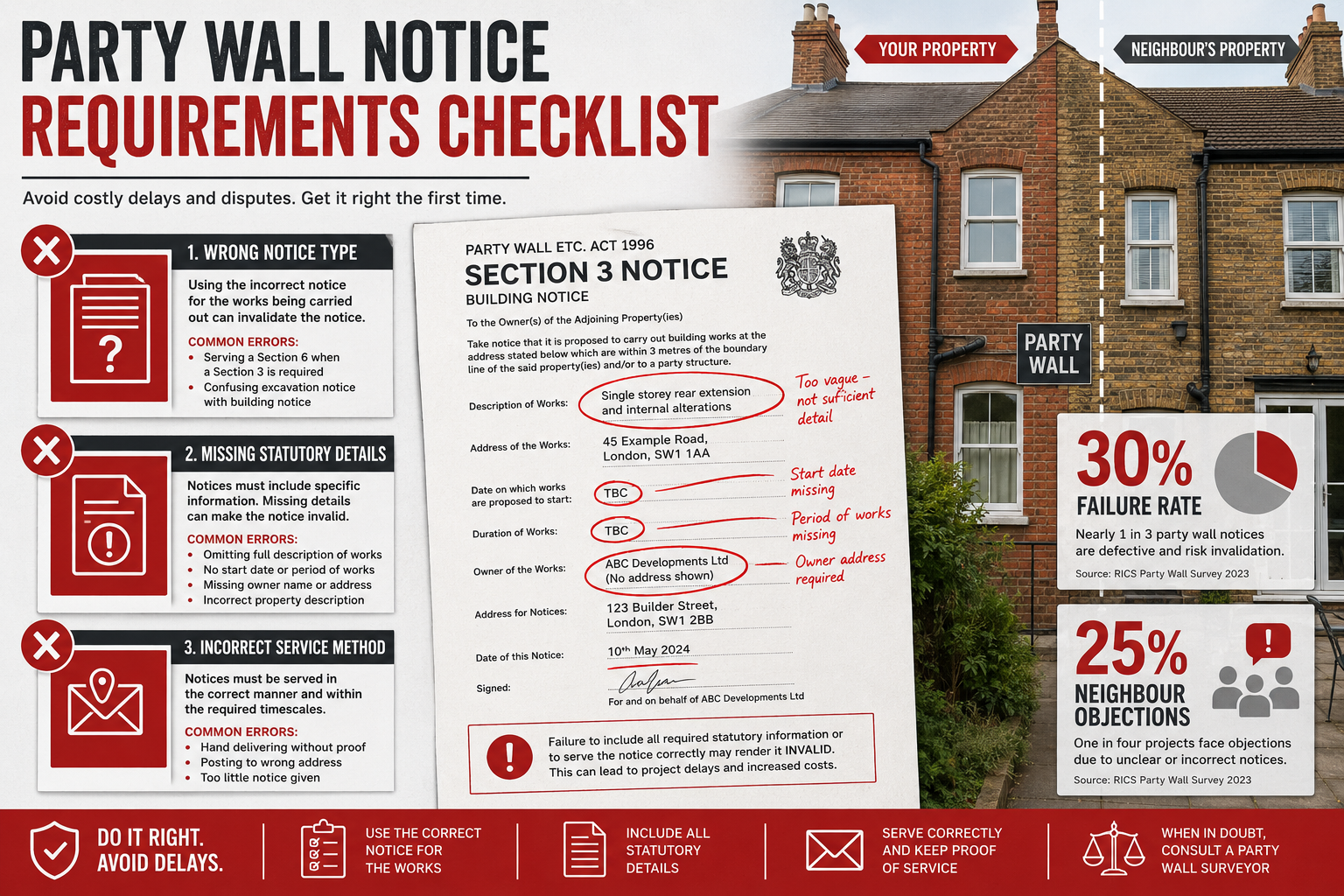
Nearly one in three party wall notices served in the UK contains a defect serious enough to delay or invalidate the entire procedure [1]. For homeowners, developers, and architects who have spent months planning a loft conversion, basement extension, or rear addition, that statistic represents thousands of pounds in wasted time — and it is entirely preventable.
The Common Party Wall Notice Mistakes That Still Derail Projects in 2026 are not new. Most have existed since the Party Wall etc. Act 1996 came into force. Yet they continue to surface on projects of every scale, from single-storey extensions in suburban semis to multi-storey commercial refurbishments in central London. Understanding exactly where notices go wrong — and how to fix those errors before they escalate — is the most practical thing any building owner can do before breaking ground.
Key Takeaways 📋
- ~30% of party wall notice failures stem from incorrect service methods alone — postal confirmation is not optional.
- Serving the wrong notice type (e.g., a Party Structure Notice instead of an Adjacent Excavation Notice) can invalidate the entire process from the start.
- Silence from a neighbour after 14 days does not mean consent — it triggers a deemed dispute automatically.
- Notices expire after 12 months; if a project is delayed, re-service is mandatory.
- A Schedule of Condition is not a luxury — without one, the building owner carries full liability for any post-works damage claims.
Why Notice Defects Are Still So Common in 2026
The Party Wall etc. Act 1996 is deceptively straightforward on the surface. In practice, it contains layered procedural requirements that vary depending on the type of work, the proximity of the boundary, and the depth of any excavation. Most notice errors occur because building owners — and occasionally their architects — treat the notice as a formality rather than a legal instrument.
"A defective notice is not just a technicality. It can expose the building owner to injunctions, damages claims, and the full cost of the adjoining owner's surveyor fees." [2]
For a full grounding in how the legislation operates, the complete guide to the Party Wall etc. Act 1996 is an essential starting point before any notice is drafted.
The Most Damaging Common Party Wall Notice Mistakes That Still Derail Projects in 2026
1. 🚫 Serving the Wrong Type of Notice
The Act provides three distinct notice types, each tied to a specific category of work:
| Notice Type | Trigger | Notice Period |
|---|---|---|
| Party Structure Notice | Works to a shared wall, floor, or structure | 2 months |
| Line of Junction Notice | Building a new wall on or at the boundary | 1 month |
| Adjacent Excavation Notice | Excavating within 3m or 6m of an adjoining structure | 1 month |
Serving a Party Structure Notice when an Adjacent Excavation Notice is required — or vice versa — invalidates the process entirely [1]. This is one of the most common errors on basement extension projects, where excavation work triggers the 3-metre rule under Section 6 of the Act [5]. The wrong notice type means the neighbour has not been properly informed of the actual risk to their property, which is the core purpose of the legislation.
Fix: Confirm the exact nature of every element of the proposed works before selecting a notice type. If a project involves both structural work to a shared wall and deep excavation nearby, multiple notices may be required simultaneously.
2. 📭 Incorrect Service Methods
Approximately 30% of party wall notice failures are attributable to improper service [1]. Common errors include:
- Sending notice by email only, without postal confirmation
- Delivering notice to a tenant or occupier rather than the legal property owner
- Using standard second-class post without any proof of delivery
- Serving notice to an outdated address for an absentee landlord
The Act permits service by hand delivery, first-class post, or recorded delivery. Email alone does not satisfy the statutory requirement unless the adjoining owner has explicitly agreed to receive notices electronically in writing. Surveyors consistently recommend tracked or recorded delivery as the minimum standard [1].
Critically, notice must be served on the legal owner of the adjoining property — not simply the person living there. If the adjoining property is leasehold, both the freeholder and the leaseholder may need to be served, depending on the length of the lease and the nature of the works [2].
Fix: Conduct a Land Registry search before serving any notice. This costs a few pounds and confirms the exact legal owner(s) of every adjoining property. For leasehold properties, check whether the lease is long enough to engage the Act.
3. 📝 Missing or Vague Statutory Information
A valid party wall notice must contain specific mandatory information. Omitting any single element can render it defective [2]:
- ✅ Full legal name and address of the building owner
- ✅ Accurate description and address of the building owner's property
- ✅ Clear description of the proposed works
- ✅ Proposed start date for the works
- ✅ For excavation notices: depth of excavation and a plan
Over 25% of neighbour objections arise directly from notices that lack sufficient detail about proposed works [1]. When a neighbour cannot understand what is being built, how deep it goes, or how long it will take, objection is the natural response. Vague phrases like "general building works" or "standard foundations" are legally insufficient and practically counterproductive.
Fix: Attach architectural drawings, cross-sectional plans, and a method statement to every notice. The more clearly the works are described, the more likely a neighbour is to consent rather than dissent.
For projects where the scope of works is complex, understanding what a party wall award covers helps building owners anticipate what level of detail surveyors will require.
4. ⏱️ Timing Errors: Too Early, Too Late, or Too Short
Timing mistakes fall into three distinct categories, all of which can derail a project:
Starting work before the notice period expires
Different sections of the Act require different waiting periods before work can begin. Starting early is a breach of the Act and can result in an injunction stopping works mid-project [2].
Serving notice too early
Notices are valid for 12 months from the date of service [2]. If a project is delayed — by planning permission issues, financing, or contractor availability — and the 12-month window lapses, the entire notice process must be repeated from scratch. This is a particularly common trap on larger developments with long pre-construction phases.
Ignoring the 14-day response window
If a neighbour does not respond to a party wall notice within 14 days, a dispute is automatically deemed to have arisen under the Act [2]. This is one of the most misunderstood aspects of the legislation. Many building owners interpret silence as passive consent and proceed without appointing surveyors. This is a serious error that can expose them to legal action and injunctions.
"No response is not the same as consent. Under the Act, silence triggers the dispute resolution procedure automatically." [2]
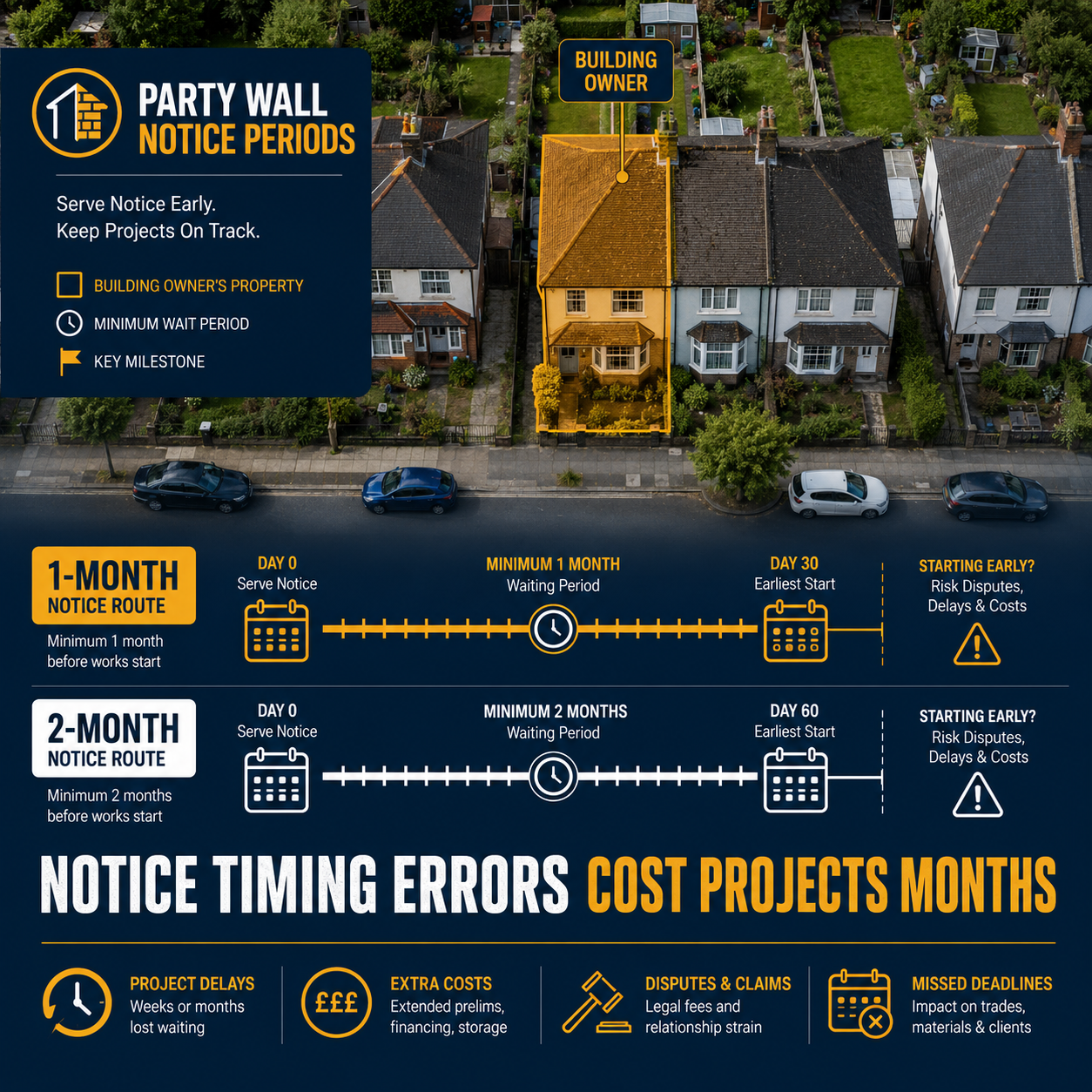
Fix: Create a notice timeline at the start of every project. Mark the service date, the response deadline, the earliest permitted start date, and the notice expiry date. Review this timeline whenever the project schedule changes.
5. 🏠 Serving Notice on the Wrong Person
This error is closely related to improper service methods but deserves separate attention because it arises from a different root cause: insufficient due diligence on ownership.
Notices served on tenants rather than freeholders, or on one co-owner rather than all co-owners, are invalid [1]. Joint ownership is common — particularly in residential property — and both owners must be served individually. Where a property is held in trust, the trustees are the correct recipients.
For properties with absent freeholders or complex ownership structures, identifying the correct recipient requires more than a simple Land Registry search. Companies House searches may be needed where the adjoining property is owned by a corporate entity.
Fix: Never assume ownership based on who answers the door or who the building owner has a neighbourly relationship with. Always verify through official records.
6. 🕳️ Insufficient Excavation Detail
For works involving excavation near an adjoining structure, vague descriptions are particularly dangerous. The 3-metre rule under Section 6 of the Act requires a notice when excavating within 3 metres of an adjoining building to a depth lower than the neighbour's foundations. The 6-metre rule applies where the excavation would cut a line drawn downward at 45 degrees from the bottom of the neighbour's foundations [5].
Notices that describe excavation as "standard foundations" without specifying depth, width, or proximity to the boundary fail to give the adjoining owner the information they need to assess the risk to their property [3]. This almost always results in dissent and the appointment of surveyors — adding cost and delay that could have been avoided.
Fix: Include detailed excavation plans with cross-sectional drawings showing the relationship between proposed foundations and existing neighbouring foundations. For basement extensions in particular, structural engineer input at the notice stage is strongly advisable.
For more on how disputes arising from excavation work are managed, the guide to resolving party wall disputes provides a clear overview of the process.
7. 📸 Failing to Commission a Schedule of Condition
While not technically part of the notice itself, the failure to arrange a Schedule of Condition before works begin is one of the costliest procedural mistakes a building owner can make [2].
A Schedule of Condition is a photographic and written record of the adjoining property's state before any works commence. Without it, there is no baseline against which post-works damage can be assessed. In the absence of this record, any crack, settlement, or defect that appears after works are complete is presumed — in the absence of contrary evidence — to have been caused by those works. The building owner then bears the cost of remediation.
Fix: Commission a Schedule of Condition as a matter of course on every notifiable project, even where the neighbour has consented. The cost is minimal compared to the potential liability it prevents.
How to Avoid These Mistakes: A Practical Checklist ✅
Before serving any party wall notice in 2026, work through the following:
- Identify all notifiable works — check against Sections 1, 2, and 6 of the Act
- Determine the correct notice type(s) — multiple notices may be needed
- Conduct Land Registry searches on all adjoining properties
- Identify all legal owners, including freeholders, leaseholders, and co-owners
- Prepare a detailed description of works with drawings and method statements
- Calculate the correct notice period and earliest permitted start date
- Serve by tracked post to every identified owner at their registered address
- Diarise the 14-day response deadline and the 12-month notice expiry
- Do not interpret silence as consent — appoint surveyors if no response is received
- Commission a Schedule of Condition before works begin
For anyone unsure whether their project triggers the Act at all, the complete guide on when a party wall agreement is legally required provides clear criteria.
When to Involve a Professional Party Wall Surveyor

The complexity of the notice process means that professional involvement is often the most cost-effective route — even at the pre-notice stage. A qualified party wall surveyor can:
- Identify all notifiable works and the correct notice types
- Draft notices that contain all required statutory information
- Serve notices correctly and maintain a paper trail
- Manage the response process and, where necessary, the appointment of surveyors
- Prepare or review a Schedule of Condition
For those wondering about the financial side, the guide to party wall surveyor costs and the guide to who pays for a party wall surveyor clarify what to expect and who is responsible for fees under different scenarios.
Where a neighbour has already refused to engage or is obstructing the process, understanding obstruction in party wall matters explains the legal remedies available.
Conclusion: Get the Notice Right Before Anything Else
The Common Party Wall Notice Mistakes That Still Derail Projects in 2026 share a common thread: they are all avoidable with the right preparation and professional guidance. A defective notice does not just create paperwork — it can halt a construction site, trigger injunctions, expose building owners to damages claims, and permanently damage neighbourly relations.
Actionable next steps for building owners and their teams:
- Before design is finalised, check whether any element of the proposed works triggers the Act — not just the main structure, but excavation, drainage, and boundary works too.
- Invest in a Land Registry search for every adjoining property before drafting a single notice.
- Use a standardised, professionally drafted notice template that incorporates all mandatory statutory information.
- Never rely on a neighbour's silence as consent — build the 14-day response window into the project programme.
- Appoint a qualified party wall surveyor for any project involving shared walls, deep excavation, or complex ownership arrangements.
The notice is the foundation of the entire party wall process. Get it right, and the rest of the procedure runs smoothly. Get it wrong, and the consequences can follow a project — and a building owner — for years.
References
[1] Common Mistakes In Party Wall Notices How Surveyors Fix Dissent And Delays – https://partywallsurveyorlondon.uk/blogs/common-mistakes-in-party-wall-notices-how-surveyors-fix-dissent-and-delays/?utm_source=openai
[2] Party Wall Notice Mistakes Basement Extensions London 2026 The Complete Guide To Avoiding Costly Disputes – https://partywallsurveyorlondon.uk/blogs/party-wall-notice-mistakes-basement-extensions-london-2026-the-complete-guide-to-avoiding-costly-disputes/?utm_source=openai
[3] Party Wall Notices For Garden Boundary Works 2026 Compliance For Fencing And Outbuildings – https://kingstonsurveyors.com/party-wall-notices-for-garden-boundary-works-2026-compliance-for-fencing-and-outbuildings/?utm_source=openai
[5] Knowledge Article Party Wall Act 3 Metre Rule – https://www.aylingassociates.com/knowledge-article-party-wall-act-3-metre-rule.html?utm_source=openai
