
An estimated 4.6 million households in England rent privately — and from late 2026, every landlord managing those properties must register on a new national database or risk losing the legal right to seek possession through the courts. For landlords planning rear extensions, loft conversions, or any structural work that triggers the Party Wall etc. Act 1996, this is not a bureaucratic footnote. It is a project-critical compliance issue that directly shapes how party wall notices are served, how surveys are structured, and how timelines are programmed.
The Party Wall Implications of Private Rented Sector Database Mandates 2026: Survey Protocols for Landlord Extension Projects sits at the intersection of two distinct legal regimes — one governing neighbour relations during construction, the other governing the rental market itself. Understanding how they interact is now essential for any landlord, surveyor, or project manager working on PRS properties in England.
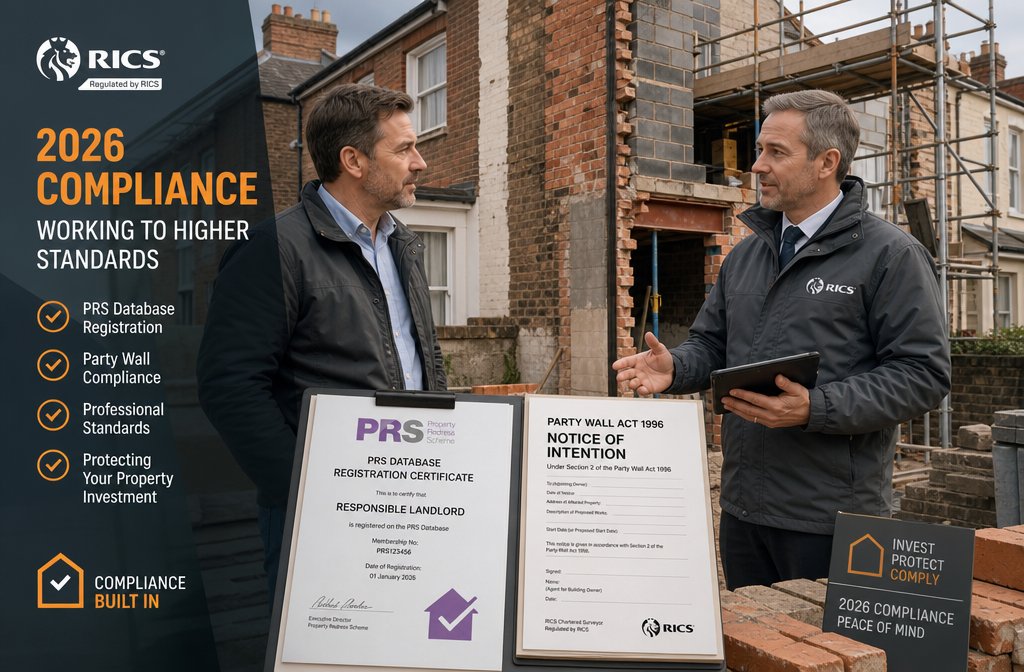
Key Takeaways 📋
- PRS Database registration is a pre-condition for serving effective Section 8 notices — unregistered landlords cannot obtain possession orders (except in serious anti-social behaviour cases), which directly affects extension project planning.
- Party Wall Act procedures remain legally separate from the PRS Database regime, but local authorities are increasingly cross-referencing the two systems during enforcement.
- Survey protocols for 2026 must now include verification of a landlord's PRS Database registration number and confirmation that Gas Safety, EICR, and EPC certificates are current before party wall notices are issued.
- Section 21 no longer exists from May 2026, meaning landlords cannot rely on no-fault evictions to secure vacant possession before major works — longer lead times are essential.
- Tenant protections are significantly stronger, with rent repayment orders now covering up to 24 months' rent for persistent registration breaches, raising the financial stakes of poorly managed extension projects.
Understanding the PRS Database and Its Mandatory Requirements
The Private Rented Sector Database is being introduced under the Renters' Rights Act 2025, with a phased regional rollout beginning in late 2026 and full national registration expected from 2027 [1]. Every PRS landlord in England must register each property, pay an annual per-property fee, and upload key safety and compliance data — including Gas Safety certificates, Electrical Installation Condition Reports (EICRs), Energy Performance Certificates (EPCs), and HMO licences where applicable [10].
💡 Pull Quote: "Registration on the PRS Database is not optional — it is the gateway to a landlord's legal rights, including the right to seek possession."
The consequences of non-registration are severe and immediate. An unregistered landlord cannot generally obtain a possession order through the courts, except on serious anti-social behaviour grounds [2]. This single restriction has profound implications for any landlord planning structural works that might require decanting tenants or ending a tenancy to enable construction.
Local authorities received expanded investigatory powers from December 2025, and rent repayment orders can now cover up to 24 months' rent for persistent registration breaches [3]. From May 2026, most tenancies converted to Assured Periodic Tenancies with no fixed-term end date, and the Section 21 no-fault eviction route was abolished entirely [7].
What Landlords Must Upload to the Database
| Certificate / Document | Requirement |
|---|---|
| Gas Safety Certificate | Annual; must be current at registration |
| Electrical Installation Condition Report (EICR) | Every 5 years; must be valid |
| Energy Performance Certificate (EPC) | Must meet minimum rating threshold |
| HMO Licence | Where applicable; must be active |
| Property address and landlord contact details | Mandatory at registration |
[Source: [1][10]]
For landlords in pilot areas from late 2026, failure to register before commencing extension works could mean being flagged by local authorities if neighbours or tenants raise complaints during construction — a scenario that intersects directly with party wall dispute procedures [4].
How the PRS Database Mandates Reshape Party Wall Survey Protocols
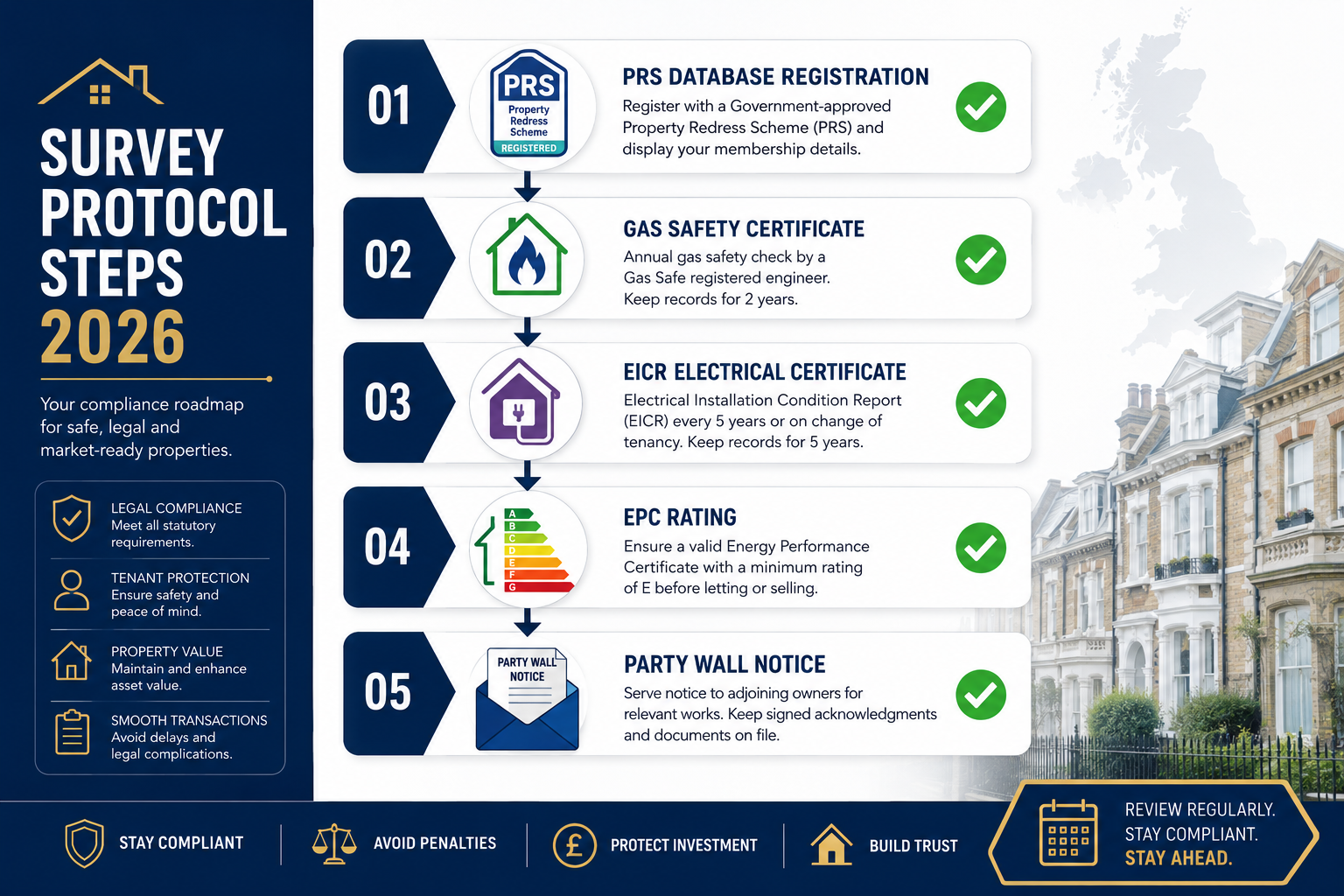
The Party Wall Implications of Private Rented Sector Database Mandates 2026: Survey Protocols for Landlord Extension Projects are most visible in the practical steps surveyors now recommend before any notice is served under the Party Wall etc. Act 1996.
Party wall procedures themselves have not changed — the Act still requires written notice to adjoining owners, the right to appoint surveyors, and the production of a party wall award before notifiable works begin. For a thorough grounding in these fundamentals, the complete guide to party wall surveyors: roles, costs and legal requirements remains an essential reference.
What has changed is the pre-works due diligence that surveyors are now expected to carry out for PRS landlord clients. Specialist surveyor commentary from early 2026 explicitly links PRS Database compliance with party wall strategy, warning that landlords who fail to register in pilot areas "will lose the legal right to serve Section 8 eviction notices," complicating any project that relies on regaining possession of flats before major works [3][4].
The Three-Step Pre-Notice Protocol
Surveyor practice notes for 2026 recommend a structured pre-notice checklist:
Step 1 — Verify PRS Database Registration
Before issuing any party wall notice, the surveyor or project manager should confirm and record the landlord's PRS Database registration number in the pre-works survey report. This creates a documented audit trail showing the landlord was compliant at the time works were initiated [3].
Step 2 — Confirm Safety Certificates Are Current
Gas Safety, EICR, and EPC documents uploaded to the Database must be in date. If any certificate is expired or missing, it should be renewed before party wall notices are served. An unregistered or non-compliant landlord who later faces a party wall dispute or tenant complaint may find that enforcement authorities use the Database to cross-check compliance, potentially triggering parallel investigations [4].
Step 3 — Enhanced Schedule of Condition
Schedules of condition — the photographic and written records of a property's state before works begin — must now be more detailed for PRS properties. This reflects the fact that tenants have strengthened rights and extended rent repayment remedies if works are mishandled [6]. Both tenant-occupied units and adjoining owners' properties should be documented comprehensively.
For guidance on what a proper schedule of condition involves, see the schedule of condition report service overview.
Why Local Authorities Are Cross-Referencing the Two Systems
There is no explicit "party wall" field in the PRS Database minimum dataset [8]. However, local authorities are using the Database to cross-check whether a landlord undertaking structural works has up-to-date safety certification and is properly registered. If a neighbour or tenant complains about construction noise, access disputes, or structural damage during an extension project, the local authority can now quickly identify whether the landlord is registered — and if not, enforcement action can follow on multiple fronts simultaneously [3].
This is a significant shift in the risk profile of extension works in PRS buildings. Poorly managed works that generate party wall disputes can now also trigger registration-related penalties. Landlords and their surveyors need to understand that the two regimes, while legally separate, are operationally linked through enforcement.
For advice on what happens when no party wall notice has been served, or when damage to property in a party wall situation arises, the stakes are now higher than ever for PRS landlords.
Practical Survey Strategies for Landlord Extension Projects in 2026
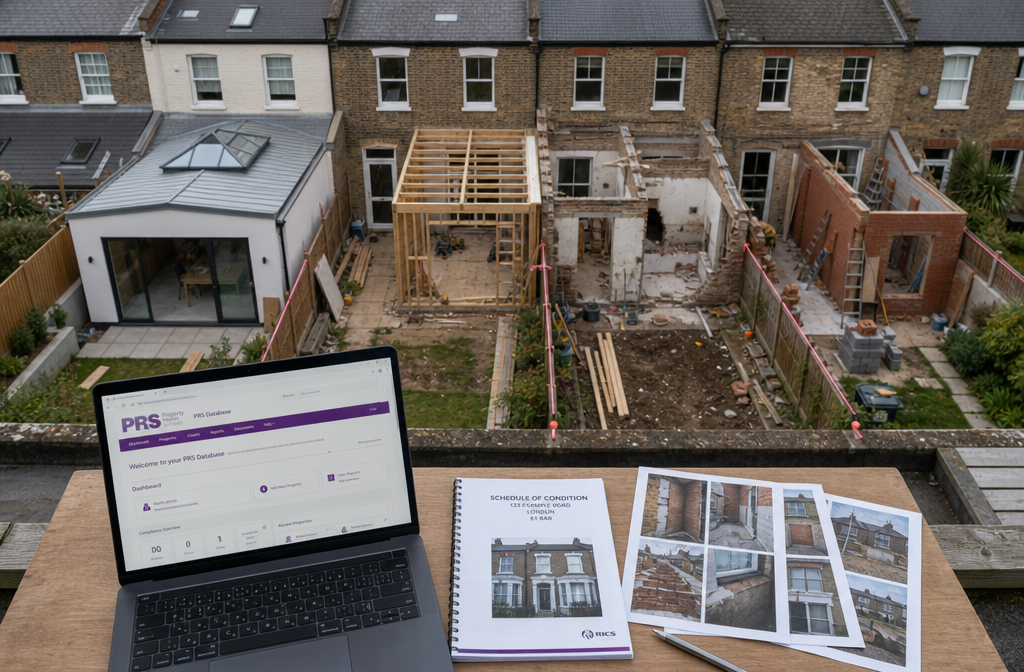
The Party Wall Implications of Private Rented Sector Database Mandates 2026: Survey Protocols for Landlord Extension Projects require surveyors to think beyond the party wall award and consider the broader compliance landscape their clients are operating in.
Aligning Party Wall Timelines with Tenancy Reforms ⏱️
From May 2026, all new and existing tenancies became Assured Periodic Tenancies with no fixed-term end date [7]. The abolition of Section 21 means landlords cannot use no-fault evictions to clear a property before works begin. Instead, vacant possession — where genuinely needed — must be obtained through Section 8 grounds, which requires a court process that can take considerably longer.
Surveyors advising on party wall matters now recommend:
- Building in longer lead times — at least 6–12 months before planned start on site if vacant possession is required
- Avoiding party wall notices that assume rapid decanting of tenants — notices should reflect realistic programming
- Confirming PRS Database registration is active before any Section 8 proceedings are initiated, since an unregistered landlord cannot proceed with a possession claim [2][4]
This is framed as a practical protocol change for project programming, not a change to the Party Wall Act itself. But its effect on extension project timelines is substantial.
Communications Protocols: Tenants and Adjoining Owners 📢
Surveyor best-practice guidance for 2026 PRS extension projects stresses clear, documented communications with both tenants and adjoining owners [6]. Landlords are advised to:
- Provide written explanations of planned works, anticipated noise levels, and access requirements
- Ensure these communications are consistent with information submitted to the PRS Database and any licensing authorities
- Keep copies of all correspondence as part of the project file, so that if disputes escalate — including party wall disputes or rent challenges — documentation demonstrates diligence and transparency
This risk-management approach is particularly important given the strengthened enforcement powers under the Renters' Rights Act. A landlord who can show they communicated proactively with tenants and neighbours, maintained current safety certificates, and was properly registered on the PRS Database is in a far stronger position if a party wall dispute or rent repayment claim arises.
For landlords working with RICS party wall surveyors, this documentation-first approach aligns with established professional standards for managing disputes and protecting all parties.
Cost Implications for Landlords 💷
The additional due diligence required by 2026 protocols does add cost. Landlords should budget for:
| Additional Cost Item | Estimated Impact |
|---|---|
| PRS Database annual registration fee | Per property; government-set fee |
| Certificate renewals (Gas, EICR, EPC) | Variable; potentially £150–£600+ per property |
| Enhanced schedule of condition | Additional surveyor time; typically 1–3 hours extra |
| Extended project programming | Financing and holding costs over longer lead times |
| Legal costs for Section 8 proceedings | Potentially £1,500–£5,000+ if possession required |
Understanding who pays for a party wall surveyor is a perennial question — and in PRS projects, the answer remains that the building owner (the landlord) typically bears the cost of their own surveyor and the adjoining owner's reasonable surveyor fees. The compliance overhead from PRS Database requirements sits on top of these existing obligations.
For a detailed breakdown of surveyor fees, the party wall surveyor cost guide provides useful benchmarks.
Looking Ahead: Possible Future Database Requirements 🔭
Industry commentary suggests that while there is currently no explicit party wall field in the PRS Database minimum dataset [8][9], future secondary legislation or guidance may encourage — or require — landlords of HMOs and larger blocks to record major structural works or enforcement notices. Analysts argue this could allow councils to identify patterns where landlords repeatedly undertake works generating complaints or non-compliant party wall practices [8].
For now, this remains a forward-looking expectation rather than a confirmed requirement. But surveyors and landlords would be wise to maintain thorough records of all party wall procedures, awards, and outcomes — both as good professional practice and as preparation for a regulatory environment that is clearly moving toward greater transparency and accountability.
Conclusion: Actionable Next Steps for Landlords and Surveyors
The convergence of PRS Database mandates and party wall obligations in 2026 creates a more complex compliance landscape — but it is entirely navigable with the right preparation.
Here are the key actions to take now:
-
✅ Register on the PRS Database immediately if operating in a pilot area, and plan registration ahead of the national rollout. Do not commence extension works or serve party wall notices until registration is confirmed and your registration number is documented.
-
✅ Audit all safety certificates — Gas Safety, EICR, and EPC — and ensure they are current and uploaded to the Database before any party wall notice is issued.
-
✅ Engage a qualified party wall surveyor early — ideally 6–12 months before planned works — to allow realistic programming that accounts for the Section 8 possession process if vacant possession is needed.
-
✅ Commission a detailed schedule of condition covering both the subject property (including tenant-occupied units) and adjoining owners' properties, with comprehensive photographic evidence.
-
✅ Document all communications with tenants and neighbours, ensuring consistency between what is communicated on-site and what is recorded with licensing and Database authorities.
-
✅ Seek specialist advice from surveyors experienced in both PRS compliance and party wall matters — the two disciplines now overlap in ways that require joined-up expertise.
The Party Wall Implications of Private Rented Sector Database Mandates 2026: Survey Protocols for Landlord Extension Projects are not a reason to delay legitimate improvement works. They are a reason to plan those works more carefully, with compliance built in from the very first step.
References
[1] Prs Database What Landlords Need To Register – https://www.llcr.uk/articles/prs-database-what-landlords-need-to-register.html
[2] Renters Rights Act Implementation 6365569 – https://www.jdsupra.com/legalnews/renters-rights-act-implementation-6365569/
[3] Private Rented Sector Database Registration And Party Wall Implications Surveyor Strategies For Landlord Compliance Under Renters Rights Act 2026 – https://www.canterburysurveyors.com/blog/private-rented-sector-database-registration-and-party-wall-implications-surveyor-strategies-for-landlord-compliance-under-renters-rights-act-2026/
[4] Prs Database Registration Impacts On Party Wall Notices Surveyor Strategies For Section 8 Compliant Extensions In 2026 – https://wimbledonsurveyors.com/prs-database-registration-impacts-on-party-wall-notices-surveyor-strategies-for-section-8-compliant-extensions-in-2026/
[6] Navigating Renters Rights Act 2026 In Building Surveys Surveyor Protocols For Pet Damage Risks And Periodic Tenancy Valuations – https://princesurveyors.co.uk/blog/navigating-renters-rights-act-2026-in-building-surveys-surveyor-protocols-for-pet-damage-risks-and-periodic-tenancy-valuations/
[7] Facebook – Torridge District Council post on PRS reforms from 1 May – https://www.facebook.com/torridgedc/posts/from-1-may-reforms-to-the-private-rented-sector-are-bringing-new-rights-and-resp/1369578001879483/
[8] Detailing The Database – https://neweconomics.org/2025/07/detailing-the-database
[9] Prs Database Registration – https://landlord-os.com/prs-database-registration
[10] Private Rented Sector Database – https://www.augustapp.com/blog/private-rented-sector-database
