
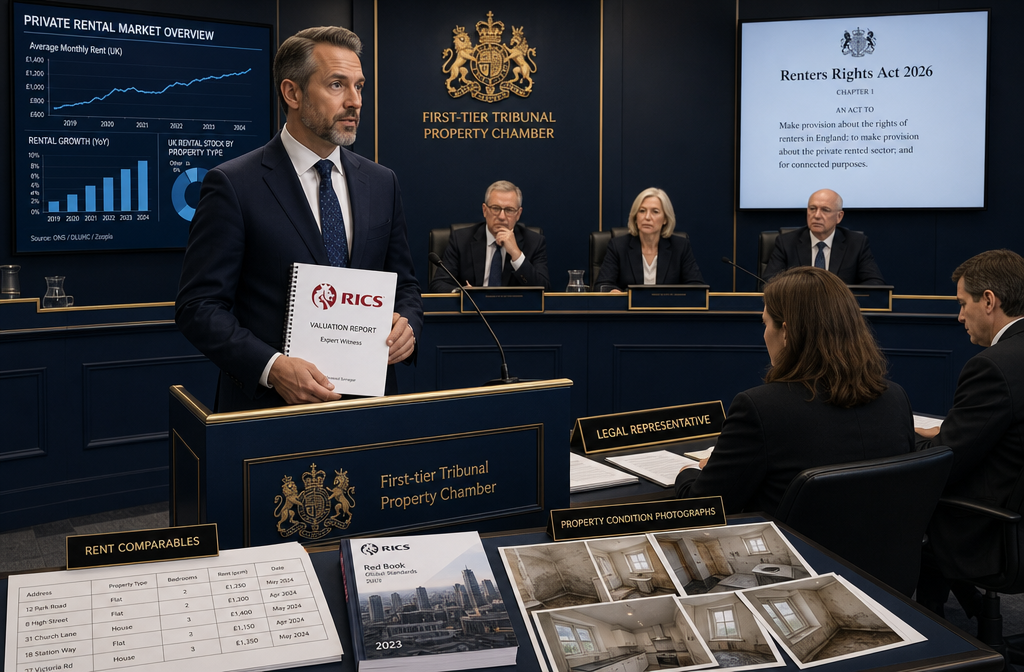
Over 11 million households in England rent their homes — yet until the Renters' Rights Act reshaped the landscape, many tenants had little effective recourse when facing unjustified rent hikes, contested damage claims, or uninhabitable conditions. For surveyors and property professionals, this legislative shift has fundamentally changed what tribunals, ombudsmen, and courts expect from valuation evidence. Understanding Expert Witness Roles in Renters' Rights Act Disputes: Preparing Valuation Evidence Post-2026 Reforms is no longer optional for practitioners who want to remain credible and effective in this new legal environment.
Key Takeaways 📋
- The Renters' Rights Act 2026 creates new grounds for tribunal disputes involving rent increases, pet damage, and habitability — all requiring robust valuation evidence.
- RICS-accredited expert witnesses must meet strict independence and methodology standards to be accepted by the First-tier Tribunal (Property Chamber).
- Comparable rental evidence, condition assessments, and reinstatement cost analyses are the three pillars of effective post-reform valuation reports.
- Section 8 eviction proceedings now demand higher evidential thresholds, placing greater weight on expert surveyor testimony.
- Ombudsman challenges require a different evidence format than tribunal proceedings — surveyors must understand both arenas.
What the Renters' Rights Act 2026 Changes for Surveyors
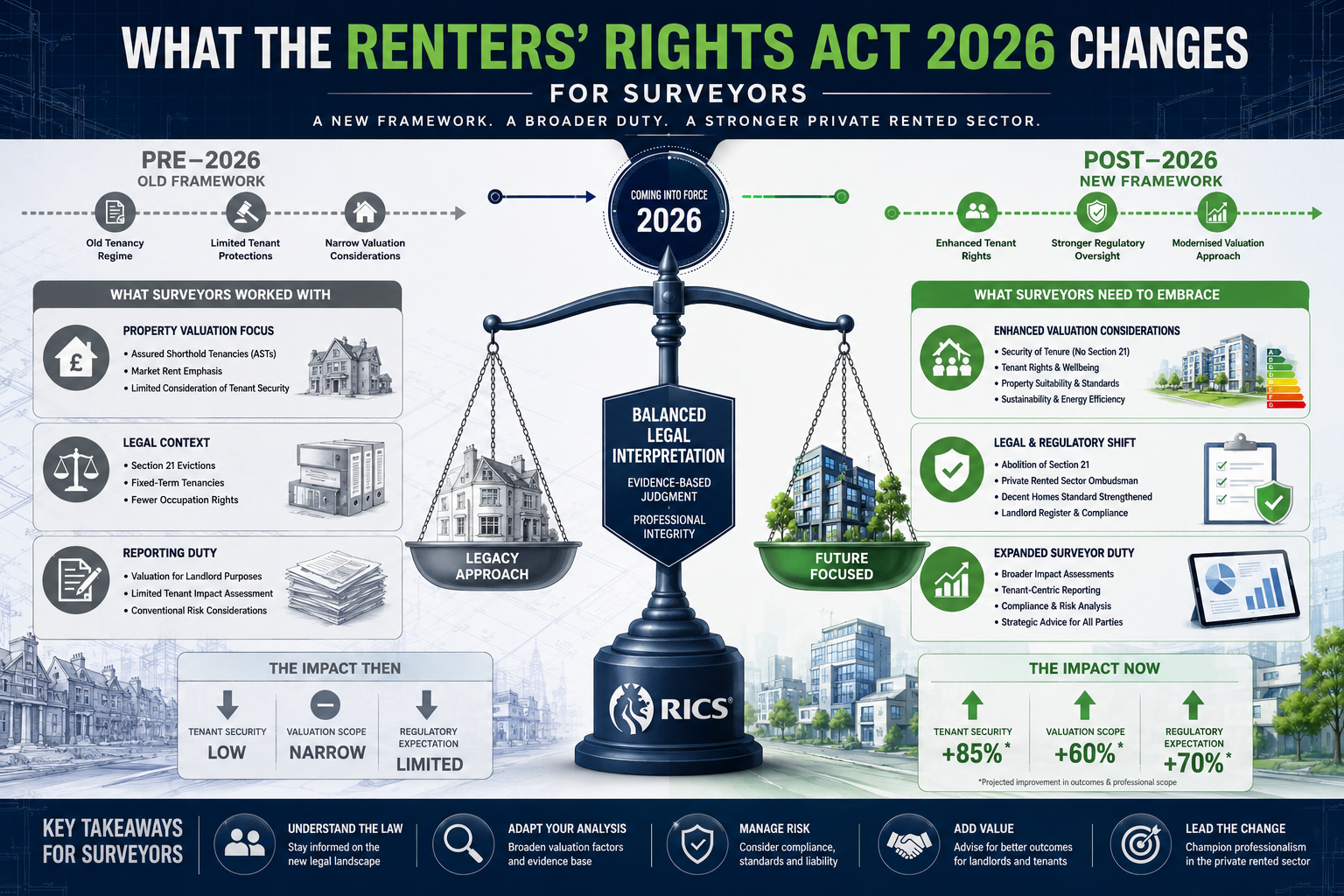
The Renters' Rights Act represents the most significant overhaul of the private rented sector in a generation. For surveyors, the practical implications are immediate and wide-ranging.
Abolition of Section 21 and the Rise of Contested Section 8
With no-fault evictions abolished, landlords must now rely exclusively on Section 8 grounds to recover possession. This means every eviction dispute is potentially a contested hearing — and contested hearings need evidence. Surveyors who previously provided informal opinions now find themselves called as formal expert witnesses to substantiate:
- Rent arrears relative to market value
- Property condition at the start and end of tenancy
- Whether a property meets the Decent Homes Standard
- The cost of alleged tenant damage versus fair wear and tear
💡 Pull Quote: "The shift from Section 21 to Section 8 has turned every eviction into an evidence-based proceeding. Surveyors are now central to the process, not peripheral to it."
Rent Increase Challenges and the Tribunal's New Role
Under the reformed system, tenants can challenge any rent increase at the First-tier Tribunal (Property Chamber). The tribunal must determine whether the proposed rent is consistent with the open market. This creates a direct and recurring demand for:
- Comparable rental evidence (CRE) compiled to RICS standards
- Market rent assessments using recognised valuation methodology
- Expert witness reports that can withstand cross-examination
For surveyors, this is familiar territory — but the volume and stakes have increased significantly. A RICS valuation prepared to Red Book standards carries far more weight than an informal agent's opinion.
Pet Damage: A New Battleground
The Act grants tenants a right to keep pets in most circumstances, subject to landlord consent (which cannot be unreasonably withheld). This creates a predictable surge in end-of-tenancy disputes around pet-related damage. Surveyors must now be prepared to:
- Distinguish between pet damage and ordinary wear and tear
- Quantify reinstatement costs to a defensible standard
- Present photographic and written evidence in a format acceptable to tribunals
The Expert Witness Framework: RICS Standards and Legal Obligations
Understanding Expert Witness Roles in Renters' Rights Act Disputes requires a firm grasp of the legal and professional framework that governs expert testimony in the UK.
Who Qualifies as an Expert Witness?
Not every surveyor qualifies to act as an expert witness. The tribunal expects individuals who:
- Hold RICS membership (MRICS or FRICS) with relevant valuation experience
- Have no material conflict of interest with either party
- Understand their overriding duty to the court/tribunal, not to the instructing party
- Can produce reports compliant with Civil Procedure Rules (CPR) Part 35 or the tribunal's equivalent procedural rules
The distinction between an advocate (arguing a client's case) and an expert witness (providing independent opinion) is critical. Crossing this line can result in evidence being disregarded entirely.
The RICS Expert Witness Practice Statement
RICS publishes specific guidance on acting as an expert witness. Key obligations include:
| Obligation | Practical Requirement |
|---|---|
| Independence | No financial interest in the outcome |
| Competence | Demonstrable expertise in the relevant property type and market |
| Transparency | Full disclosure of methodology and data sources |
| Accuracy | Evidence must be verifiable and current |
| Impartiality | Equal treatment of facts favourable and unfavourable to the instructing party |
Surveyors who regularly handle expert witness reports will recognise these principles — but the Renters' Rights Act context adds new complexity, particularly around rental market data and habitability standards.
Single Joint Experts vs. Party-Appointed Experts
In many First-tier Tribunal cases, the tribunal may direct that a Single Joint Expert (SJE) be appointed rather than allowing each party to appoint their own surveyor. This is common in lower-value disputes. Surveyors should understand:
- SJE appointments require even greater neutrality and thoroughness, as there is no opposing expert to challenge methodology
- Party-appointed experts must still comply with independence duties but can be more focused on the instructing party's specific issues
- In either role, the expert witness must be prepared to answer written questions from both parties
Preparing Valuation Evidence: A Practical RICS-Backed Methodology
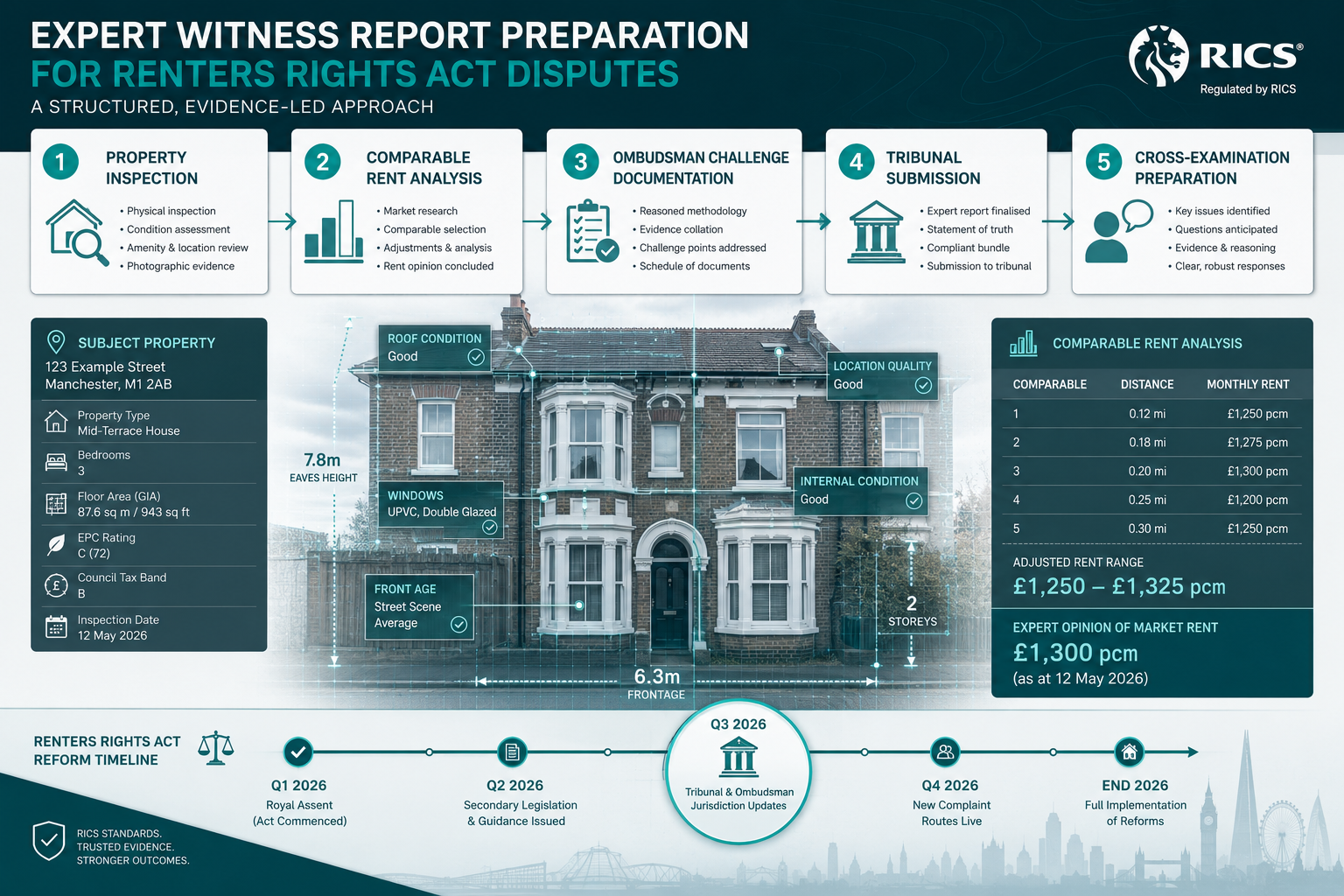
The quality of valuation evidence often determines the outcome of Renters' Rights Act disputes. Here is a structured approach to preparing robust evidence post-2026.
Step 1: Establish the Scope of Instruction Clearly
Before any site visit or data gathering, the surveyor must confirm:
- The specific dispute type (rent challenge, damage claim, habitability, Section 8 ground)
- The relevant date of valuation (market rent at a specific point in time)
- The property type, tenure, and any special characteristics
- Any restrictions on access and how these will be documented
Ambiguity at this stage leads to challenged evidence later.
Step 2: Gather Comparable Rental Evidence
For rent challenge cases, comparable evidence is the foundation of the expert opinion. Best practice requires:
- Minimum of three to five comparables from the same locality
- Comparables should be let within the previous 12 months, ideally within six months
- Adjustments must be documented for differences in size, condition, location, and specification
- Data sources should include Valuation Office Agency (VOA) data, letting agent records, and proprietary databases
⚠️ Important: Relying solely on listing prices (asking rents) rather than achieved rents is a common weakness that opposing parties will exploit.
A lease extension valuation follows similar comparable evidence principles — surveyors experienced in that area will find the methodology transferable.
Step 3: Condition and Habitability Assessments
For Section 8 cases involving disrepair or habitability disputes, the surveyor must produce a Schedule of Condition that:
- Records the property's state at the relevant date with photographic evidence
- Identifies any Category 1 or Category 2 hazards under the Housing Health and Safety Rating System (HHSRS)
- Distinguishes between landlord's repairing obligations and tenant-caused deterioration
- Quantifies the cost of remediation to a defensible standard
A thorough schedule of condition report is often the single most important document in habitability disputes. Surveyors should also be familiar with dilapidations surveys as the principles overlap significantly.
Step 4: Quantifying Pet and Tenant Damage
This is a rapidly growing area of dispute under the new Act. A defensible damage assessment must:
- Separate damage from fair wear and tear — this requires knowledge of the tenancy length, tenant profile, and property age
- Apply betterment principles — a landlord cannot claim the full cost of replacing a worn carpet with a new one if the carpet was already five years old
- Use market rates for reinstatement, not premium contractor quotes
- Support all cost estimates with at least two independent contractor quotes or reference to published price guides
For complex structural damage, a building survey may be required to establish the true extent of deterioration.
Step 5: Structuring the Expert Witness Report
The report itself must follow a clear, tribunal-ready format:
- Cover page — expert's name, qualifications, date, and instruction details
- Statement of truth — confirming independence and understanding of duties
- Executive summary — key findings in plain English
- Methodology — how the evidence was gathered and analysed
- Comparable evidence schedule — tabulated with adjustments explained
- Condition assessment — with photographic appendices
- Expert opinion — clearly distinguished from factual findings
- Declaration — confirming compliance with CPR Part 35 or tribunal rules
📌 Best Practice: Write the executive summary last, after the full analysis is complete. Summaries written first tend to bias the subsequent analysis.
Navigating Ombudsman Challenges vs. Tribunal Proceedings
Expert Witness Roles in Renters' Rights Act Disputes: Preparing Valuation Evidence Post-2026 Reforms extends beyond the tribunal. The new mandatory ombudsman scheme for landlords creates a parallel dispute resolution pathway that requires a different evidence approach.
Key Differences Between Ombudsman and Tribunal Evidence
| Feature | First-tier Tribunal | Ombudsman Scheme |
|---|---|---|
| Formality | High — quasi-judicial | Lower — administrative |
| Evidence standard | CPR-compliant expert reports | Factual documentation preferred |
| Expert witness role | Central | Supporting |
| Outcome | Legally binding | Binding on landlord, not tenant |
| Timescale | Weeks to months | Typically faster |
| Cost | Potentially significant | Free to tenant |
For ombudsman complaints about rent increases or property condition, surveyors are more likely to be asked to provide factual evidence reports rather than full expert witness opinions. However, the quality of the underlying valuation data must be equally robust.
When Surveyors Are Called to Both Arenas
In complex disputes — particularly those involving allegations of retaliatory eviction or discriminatory rent increases — the same surveyor may provide evidence to both the ombudsman and the tribunal. In these situations:
- Ensure consistency between reports prepared for different forums
- Document all communications with instructing parties carefully
- Be prepared for the ombudsman's findings to be used as evidence in subsequent tribunal proceedings
Common Pitfalls and How to Avoid Them ⚠️
Even experienced surveyors make avoidable errors when preparing evidence for Renters' Rights Act disputes. The most common include:
- Using stale comparables — rental markets move quickly; evidence more than 12 months old will be challenged
- Failing to inspect — desktop valuations without site visits carry significantly less weight
- Advocacy creep — subtly favouring the instructing party's position undermines credibility with tribunals
- Inadequate photographic evidence — photos without timestamps, scale references, or contextual descriptions are easily dismissed
- Ignoring betterment — claiming full replacement costs without accounting for age and condition of existing items
- Insufficient adjustment methodology — stating that comparables have been adjusted without explaining how and why
Surveyors who want to build a strong reputation in this area should invest in continuing professional development (CPD) specifically focused on tribunal advocacy and evidence preparation. Understanding what surveyors do across different roles helps practitioners identify where their expertise adds the most value in dispute contexts.
Building a Practice in Renters' Rights Act Expert Witness Work
For surveyors looking to develop this as a specialist area, several practical steps will accelerate credibility and instruction volume.
Accreditation and Specialist Training
- Complete the RICS Expert Witness Certificate or equivalent accredited training
- Develop familiarity with the First-tier Tribunal (Property Chamber) procedural rules
- Build knowledge of the Housing Health and Safety Rating System (HHSRS) for habitability cases
- Stay current with VOA rental market data and methodology updates
Building a Defensible Evidence File System
Systematic file management is essential. Every instruction should generate:
- A dated instruction letter confirming scope and independence
- A site visit log with timestamped photographs
- A comparables database with source documentation
- Draft and final report versions with version control
- Any written questions received and responses provided
Networking with Legal Professionals
Solicitors, barristers, and legal advisers handling Renters' Rights Act cases are the primary source of expert witness instructions. Building relationships with housing law specialists — through professional associations, legal directories, and tribunal appearances — is the most effective business development strategy.
Understanding the broader landscape of RICS registered valuers and their role in the property market provides useful context for positioning expert witness services.
Conclusion: Actionable Next Steps for Surveyors in 2026
The Renters' Rights Act has permanently elevated the role of the expert witness surveyor in residential property disputes. Rent hike challenges, pet damage claims, habitability assessments, and Section 8 eviction proceedings all now demand a higher standard of valuation evidence than the market has previously required.
Here are the most important actions for surveyors to take now:
- ✅ Review and update your expert witness credentials — ensure RICS compliance and consider specialist accreditation
- ✅ Develop a robust comparable rental evidence methodology — using VOA data, achieved rents, and documented adjustments
- ✅ Create a standard schedule of condition template — aligned with HHSRS and the Decent Homes Standard
- ✅ Establish clear betterment and fair wear and tear protocols — for pet damage and end-of-tenancy assessments
- ✅ Understand the difference between tribunal and ombudsman evidence requirements — and prepare accordingly
- ✅ Build relationships with housing law solicitors — they are the gateway to expert witness instructions
The surveyors who invest in these capabilities now will be well-positioned as the volume of Renters' Rights Act disputes grows throughout 2026 and beyond. The combination of RICS-backed methodology, tribunal-ready report formats, and genuine independence is the foundation of effective expert witness practice in this new era of renters' rights.
