
Over 28 million homes in England and Wales need significant energy upgrades to meet the UK government's net-zero targets — and a large proportion of those homes share walls, fences, or foundations with a neighbour. That single fact makes party wall surveying for green retrofits one of the most pressing compliance challenges of 2026. Yet many homeowners and contractors begin insulation, external cladding, and heat pump installations without ever considering whether the Party Wall etc. Act 1996 applies. The consequences can be costly: disputes, injunctions, and expensive remedial work.
This guide explains precisely when common decarbonisation measures trigger the Act, what surveyors must assess, and how to navigate the process smoothly.
Key Takeaways 📋
- Cavity wall insulation, external wall insulation (EWI), and solid wall insulation can all engage the Party Wall etc. Act 1996 — depending on how and where they are installed.
- External cladding systems that thicken a party wall or boundary wall almost always require a Party Wall Notice.
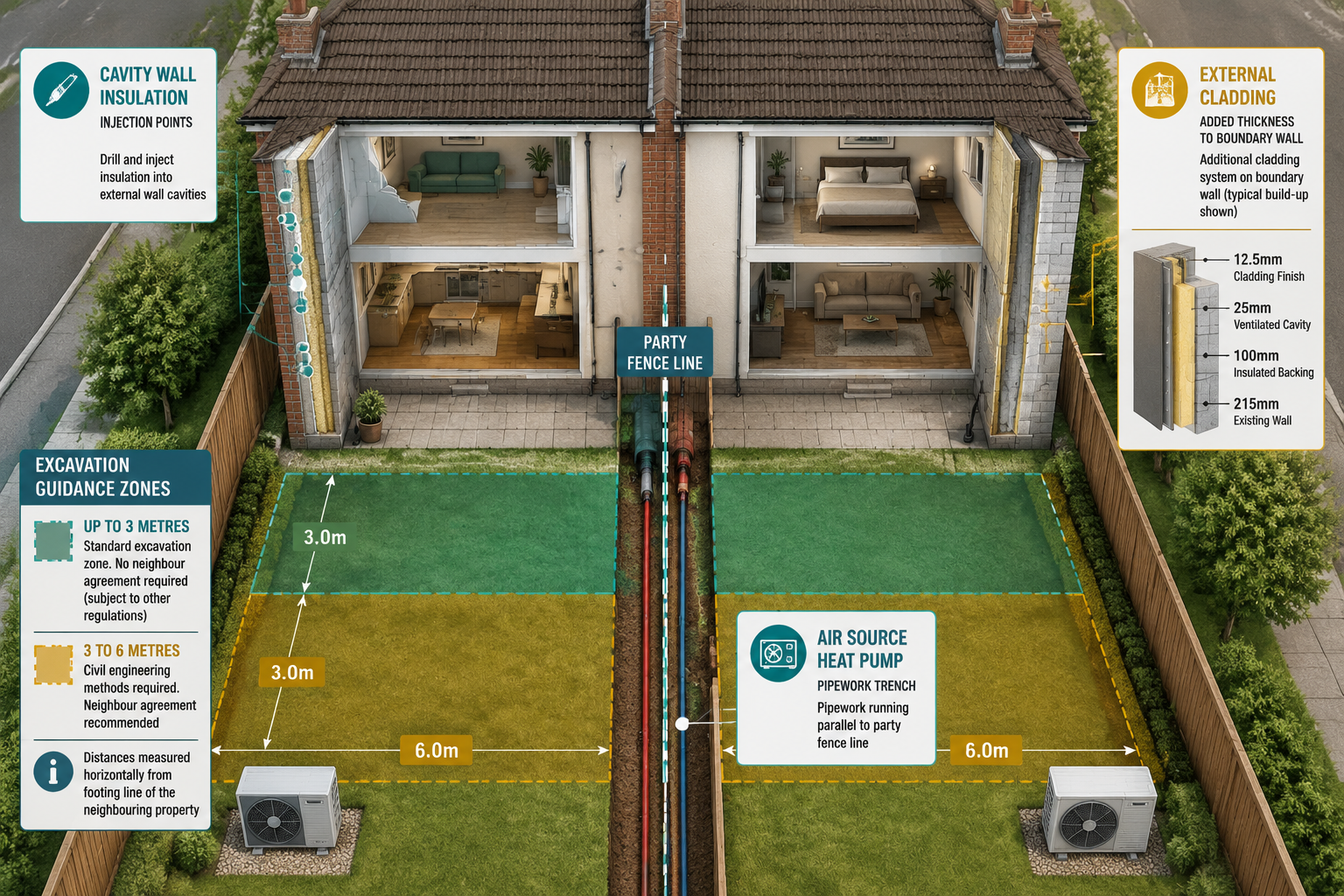
- Air source heat pump (ASHP) pipework trenches dug within 3 metres of a neighbour's building may trigger the excavation provisions of the Act.
- A Schedule of Condition is essential before retrofit works begin to protect both the building owner and the adjoining owner from disputed damage claims.
- Failing to serve a valid notice before starting work is not a minor oversight — it can result in injunctions and significant legal costs.
Why Green Retrofits and the Party Wall Act Are Colliding in 2026
The UK's retrofit boom is accelerating. Demand for building surveys related to bungalow and terraced-house retrofits has surged as homeowners chase energy efficiency grants and rising energy costs bite harder [6]. At the same time, the Party Wall etc. Act 1996 — the primary statutory framework governing works to shared walls, boundary structures, and nearby excavations — has not been amended specifically to address green retrofit works.
This creates a knowledge gap. Contractors familiar with insulation and heat pump installation often have little awareness of party wall obligations. Homeowners assume that because a retrofit is "green," it is also automatically neighbour-friendly and legally straightforward. Neither assumption is safe.
"The Act does not care why you are doing the work — only what the work involves and where it sits in relation to your neighbour's property."
The result is a growing number of disputes where insulation contractors have injected foam into cavity walls that straddle the boundary, or where EWI systems have been bolted through party walls without any notice being served. Understanding party wall surveying for green retrofits is no longer a niche specialism — it is a mainstream requirement.
Which Retrofit Works Trigger the Party Wall etc. Act 1996?
The Three Triggers Under the Act
The Act applies in England and Wales to three main categories of work:
| Category | Description | Typical Retrofit Scenario |
|---|---|---|
| Section 2 — Party Structure Works | Cutting into, raising, thickening, or underpinning a party wall or party fence wall | EWI fixed through a party wall; raising a shared wall to install a roof parapet |
| Section 1 — New Walls on the Boundary | Building a new wall astride or at the boundary line | New structural wall built to support a cladding system at the boundary |
| Section 6 — Excavations | Digging within 3 m of a neighbour's structure to a depth below their foundations; or within 6 m if the excavation cuts a 45° line from the bottom of their foundations | Trenches for ASHP pipework, ground-source heat pump loops, or drainage runs for new plant |
Each of these can be engaged by common retrofit measures. The sections below examine the most important ones in detail.
Cavity Wall Insulation and the Party Wall Act
Cavity wall insulation (CWI) is one of the most widely installed retrofit measures in the UK. For most mid-terrace properties, the cavity runs continuously across the party wall. When an installer injects insulation beads, foam, or mineral wool into that cavity, the material enters the party wall structure itself.
Does this trigger the Act?
The answer depends on the construction. Where the cavity is entirely within one owner's leaf of brickwork, the Act may not be engaged. But where the cavity straddles the centre line of the party wall — which is common in older terraced housing — injecting material into it constitutes a notifiable party structure work under Section 2.
Key risks that a party wall surveyor must assess include:
- 🧱 Moisture transfer: CWI can bridge the cavity and create a pathway for damp to migrate into the adjoining property, particularly in exposed locations.
- 🏗️ Structural integrity: Foam-based systems can exert pressure on the wall structure if incorrectly specified.
- 📋 Pre-existing defects: Any cracks or defects in the party wall before injection become a disputed liability after the work if no Schedule of Condition exists.
For a full breakdown of when a notice is required, see this complete guide to when you need a party wall agreement.
External Wall Insulation (EWI) and Cladding Systems
External wall insulation — also called external cladding or over-cladding — is the most structurally significant retrofit measure from a party wall perspective. An EWI system typically involves:
- Fixing insulation boards (mineral wool, EPS, or PIR) directly to the external face of the wall
- Applying a render, brick-slip, or panel finish over the insulation
- Detailing the system around windows, doors, and at the roof junction
Why EWI almost always triggers the Act:
When EWI is applied to a party wall (the shared wall between two properties) or to a boundary wall, the system physically thickens that wall. Thickening a party wall is explicitly listed as notifiable work under Section 2(2)(a) of the Act. There is no de minimis thickness threshold — even a 50 mm insulation board counts.
Additionally, the mechanical fixings used to attach EWI boards often penetrate through the party wall into the neighbouring property's side. This constitutes cutting into a party structure, another notifiable act under Section 2.
🔑 Pull Quote: "Applying EWI to a party wall without serving a Party Wall Notice is one of the most common — and most expensive — compliance failures in the retrofit sector."
Scaffold fixings present a further complication. Temporary scaffold brackets are routinely fixed into party walls during EWI installation. Even temporary fixings into a party structure can be notifiable, and the damage they cause — spalled brickwork, cracked render on the neighbour's side — is a frequent source of party wall disputes. Learn how party wall disputes arise and how they are resolved.
Air Source Heat Pumps and Excavation Triggers
Air source heat pumps (ASHPs) are the government's preferred replacement for gas boilers, and installations are rising sharply in 2026. Most ASHP installations involve:
- Positioning the outdoor unit against an external wall (often close to the boundary)
- Running refrigerant pipework and electrical conduit through the wall
- In some cases, excavating a trench for pipework runs or drainage
When does an ASHP trigger the Act?
| Installation Element | Potential Trigger |
|---|---|
| Unit fixed to a party wall | Section 2 — cutting through or fixing to party structure |
| Pipework penetration through a party wall | Section 2 — cutting into party structure |
| Trench within 3 m of neighbour's building, deeper than their foundations | Section 6 |
| Trench within 6 m if it cuts a 45° line from foundation base | Section 6 |
For ground-source heat pump (GSHP) installations, the excavation risks are even greater. Bore holes and horizontal collector trenches frequently come within the 3 m or 6 m zones. Surveyors should also check what the 3-metre rule means in practice before advising clients on GSHP projects.
Noise is an additional consideration. An ASHP unit positioned close to a party wall or boundary fence can generate vibration that transmits through the structure. While noise itself is not a party wall matter, vibration from installation works — particularly drilling through masonry — is a structural risk that should be documented [1].
Party Wall Surveying for Green Retrofits: The Surveyor's Role
Serving Notices Correctly
The building owner (the person carrying out the retrofit) must serve written notice on all adjoining owners before starting notifiable work. Timescales vary:
- Section 1 (new boundary wall): 1 month's notice
- Section 2 (party structure works): 2 months' notice
- Section 6 (excavations): 1 month's notice
Notices must describe the proposed works clearly. For retrofit projects, this means specifying the insulation system, fixing method, cladding thickness, and any excavation dimensions. A vague notice — "installing insulation to the external walls" — is unlikely to satisfy the Act's requirements and may be challenged.
For detailed guidance on notices, see this guide to Party Wall Act notices and how to respond.
The Schedule of Condition: Non-Negotiable for Retrofit Works
A Schedule of Condition is a detailed photographic and written record of the adjoining property's condition before works begin. For retrofit projects, this document is arguably more important than for traditional construction works, for several reasons:
- EWI and CWI works can cause moisture-related damage that may not appear for weeks or months after completion
- Scaffold fixings can cause hairline cracks that are disputed long after the scaffold is struck
- ASHP drilling can cause vibration damage to internal plasterwork on the neighbour's side
📌 A Schedule of Condition protects both parties. It gives the adjoining owner evidence if damage occurs, and it protects the building owner from spurious claims about pre-existing defects.
The RICS 8th Edition Party Wall Guidance, updated in 2026, places increased emphasis on the quality and thoroughness of Schedules of Condition, particularly for works with a higher risk of moisture or vibration-related damage [9]. Surveyors are expected to use calibrated equipment and structured reporting formats.
Assessing Structural and Moisture Risks
Party wall surveying for green retrofits demands a broader technical skill set than conventional party wall work. Surveyors must be able to evaluate:
Structural risks:
- Load path changes when EWI adds weight to a party wall
- Fixing pull-out resistance in aged or deteriorated masonry
- Foundation loading from new plant (large ASHP units on concrete pads)
Moisture risks:
- Interstitial condensation risk from changes to the wall's vapour profile
- Cold bridging at the party wall junction where EWI cannot be continued
- Cavity bridging from injected insulation materials
Thermal performance risks:
- Uninsulated party wall sections creating a flanking path that undermines the retrofit's energy savings
A building survey carried out before retrofit works can identify pre-existing defects, structural vulnerabilities, and moisture issues that will directly inform the party wall surveyor's risk assessment and the terms of any Party Wall Award.
The Party Wall Award for Retrofit Works
When an adjoining owner does not consent to the proposed works (or fails to respond within 14 days, triggering a deemed dispute), a Party Wall Award is required. This is a legally binding document prepared by one or two appointed surveyors that sets out:
- The right to carry out the notifiable works
- The method and materials to be used (critical for specifying insulation systems)
- The hours of working
- The Schedule of Condition (appended to the Award)
- Access rights for the building owner's contractors
- The surveyor's fees and who pays them
For retrofit projects, the Award should also address:
- ✅ Moisture monitoring requirements during and after works
- ✅ Vibration limits during drilling and fixing operations
- ✅ Reinstatement obligations if scaffold fixings damage the neighbour's masonry
- ✅ A post-works inspection to confirm no damage has occurred
For a comprehensive explanation of what a Party Wall Award contains and how it works, see this complete guide to Party Wall Awards for property owners.

Common Mistakes Homeowners and Contractors Make 🚫
Understanding party wall surveying for green retrofits also means knowing what goes wrong. The most frequent errors include:
-
Starting works without serving notice — contractors begin EWI installation before any notice is served, leaving the building owner exposed to injunction proceedings. Understand the risks of proceeding without a party wall agreement.
-
Serving an inadequate notice — the notice fails to describe the EWI system, fixing depths, or scaffold positions, making it impossible for the adjoining owner or their surveyor to assess the risk.
-
Assuming consent — a neighbour who says "yes, fine" verbally has not consented under the Act. Written consent is required.
-
Skipping the Schedule of Condition — without a pre-works record, any damage claim becomes a dispute about what was pre-existing.
-
Not appointing a qualified surveyor — the Act requires that surveyors be "agreed surveyors" or each party's own appointed surveyor. Using an unqualified person invalidates the Award.
-
Ignoring the 3-metre excavation rule — ASHP installers routinely dig service trenches without checking proximity to the neighbour's foundations.
Costs and Timescales: What to Expect
Party wall surveying fees for retrofit works vary depending on the complexity of the project and whether a single agreed surveyor or two separate surveyors are appointed.
| Scenario | Typical Fee Range (2026) |
|---|---|
| Simple CWI notice, neighbour consents | £300–£600 (notice preparation only) |
| EWI project, agreed surveyor, Award required | £800–£1,500 |
| Complex EWI with scaffold fixings, two surveyors | £1,500–£3,000+ |
| ASHP with Section 6 excavation, Award required | £900–£1,800 |
The building owner typically pays all reasonable surveyor fees. For a detailed breakdown of costs, see this guide to party wall surveyor costs.
Timescales add to the project programme. With a 2-month notice period for Section 2 works, a retrofit contractor who fails to factor in party wall obligations can face a significant delay before work can legally begin.
Conclusion: Act Early, Survey Properly, Retrofit Confidently
The decarbonisation of the UK's housing stock is a national priority — but the legal framework governing shared walls has not changed to accommodate it. Party wall surveying for green retrofits sits at the intersection of environmental ambition and property law, and navigating it correctly protects everyone involved.
Actionable Next Steps ✅
- Before commissioning any retrofit works, check whether the property shares a party wall, boundary wall, or is within 3–6 metres of a neighbour's foundations.
- Engage a qualified party wall surveyor early — ideally before finalising the specification — so that notice periods do not delay the project.
- Ensure a Schedule of Condition is prepared before any drilling, fixing, or excavation begins.
- Specify moisture and vibration monitoring requirements within the Party Wall Award for EWI and ASHP projects.
- Communicate with neighbours proactively — a neighbour who understands what is happening is far more likely to consent quickly, avoiding the need for a formal Award.
Green retrofits are transforming the UK's housing stock. With the right party wall process in place, they can do so without transforming a neighbour relationship into a legal dispute.
References
[1] Party Wall Awards For 2026 Net Zero Retrofits Vibration Monitoring And Schedules Of Condition Under Rics Standards – https://wimbledonsurveyors.com/party-wall-awards-for-2026-net-zero-retrofits-vibration-monitoring-and-schedules-of-condition-under-rics-standards/
[6] Building Surveys For Bungalow Retrofits In 2026 Demand Boom Assessing Value Uplifts And Compliance – https://nottinghillsurveyors.com/blog/building-surveys-for-bungalow-retrofits-in-2026-demand-boom-assessing-value-uplifts-and-compliance
[9] Rics 8th Edition Party Wall Guidance 2026 Whats Changed And How Surveyors Must Adapt – https://wimbledonsurveyors.com/rics-8th-edition-party-wall-guidance-2026-whats-changed-and-how-surveyors-must-adapt/
