
A standard building survey and a formal expert witness report may look similar on the surface — both involve a qualified surveyor inspecting a property and producing a written document. But in legal terms, they are entirely different instruments, carrying different obligations, different standards of evidence, and very different consequences if they get it wrong.
Understanding when does a building survey need to turn into an expert witness report is not just a procedural question. It is the difference between advisory information and court-admissible evidence — and getting that distinction wrong can derail a legal case or leave a property owner without the expert support they urgently need.
The 2026 homebuying reforms in the UK, which now mandate upfront building surveys, have significantly increased the volume of survey documentation entering the property transaction process [8]. More surveys mean more opportunities for disputes — and more occasions where a standard inspection must be formally upgraded into litigation-grade expert evidence.
Key Takeaways 📋
- A building survey is advisory; an expert witness report is court-admissible evidence governed by Civil Procedure Rules (CPR) Part 35.
- The transition is triggered by legal disputes, pre-action protocols, court proceedings, or formal mediation — not simply by the severity of a defect.
- Expert witness surveyors owe their primary duty to the court, not to the client who instructs them.
- CPR Part 35 compliance is non-negotiable once a case enters litigation — failure to comply can render an expert's evidence inadmissible.
- In 2026, technology including augmented reality visualisations is increasingly used in expert witness reports to present complex building defects to judges and juries [4].
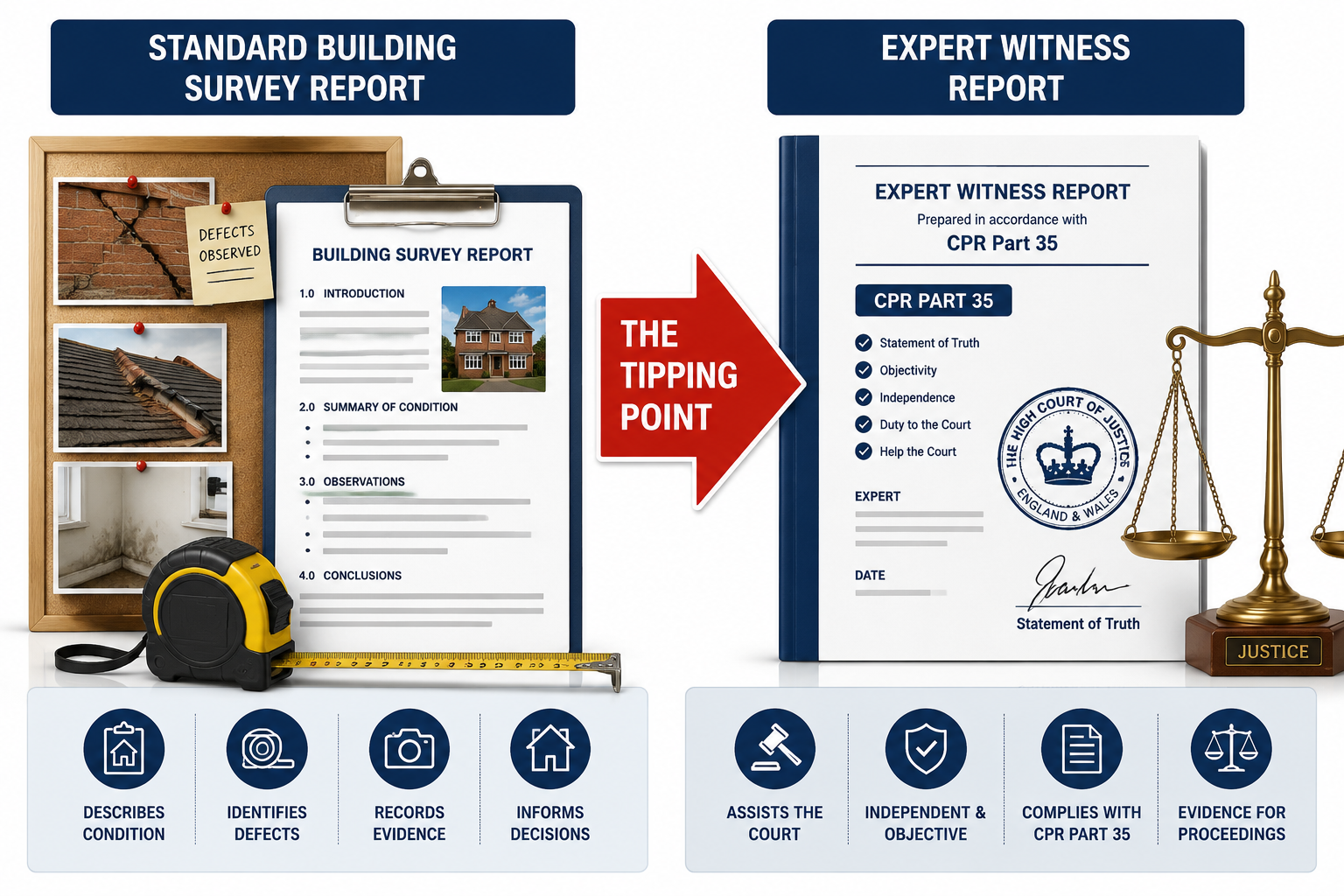
The Core Difference: Advisory Work vs. Litigation Support
What a Standard Building Survey Actually Does
A RICS Level 3 Building Survey is a comprehensive inspection of a property's condition. It identifies defects, assesses their severity, and recommends remedial action. It is written for the client — typically a buyer, seller, or property owner — and its purpose is to inform decisions.
The surveyor's duty in a standard survey is to the client alone. The report is confidential, commercially focused, and does not need to meet any formal evidential standard. A surveyor can express opinions freely, use professional shorthand, and frame findings in ways that suit the client's needs.
Common outputs from advisory survey work include:
- Pre-purchase building surveys for buyers assessing risk
- Condition reports for landlords or tenants
- Defect investigations for homeowners seeking repair advice
- Dilapidations assessments at lease end
For a deeper look at what these reports contain in practice, see this Level 3 Building Survey example and guide.
What an Expert Witness Report Must Do Differently
An expert witness report is a formal legal document. Once a surveyor is instructed as an expert witness, everything changes. The report must comply with CPR Part 35, the Practice Direction to Part 35, and the RICS guidance on expert witness services.
💬 "An expert's overriding duty is to the court and not to the party from whom the expert has received instructions." — CPR Part 35.3
This is the fundamental shift. The surveyor is no longer working for the client. They are working for the justice system. Their opinions must be:
- Objective and impartial — even if that harms the instructing party's case
- Within their proven area of expertise
- Based on sufficient facts and data
- Expressed with appropriate caveats about uncertainty
The report must include a declaration confirming the expert understands their duty to the court. Any failure to comply can result in the evidence being excluded entirely.
When Does a Building Survey Need to Turn Into an Expert Witness Report? — The Key Triggers
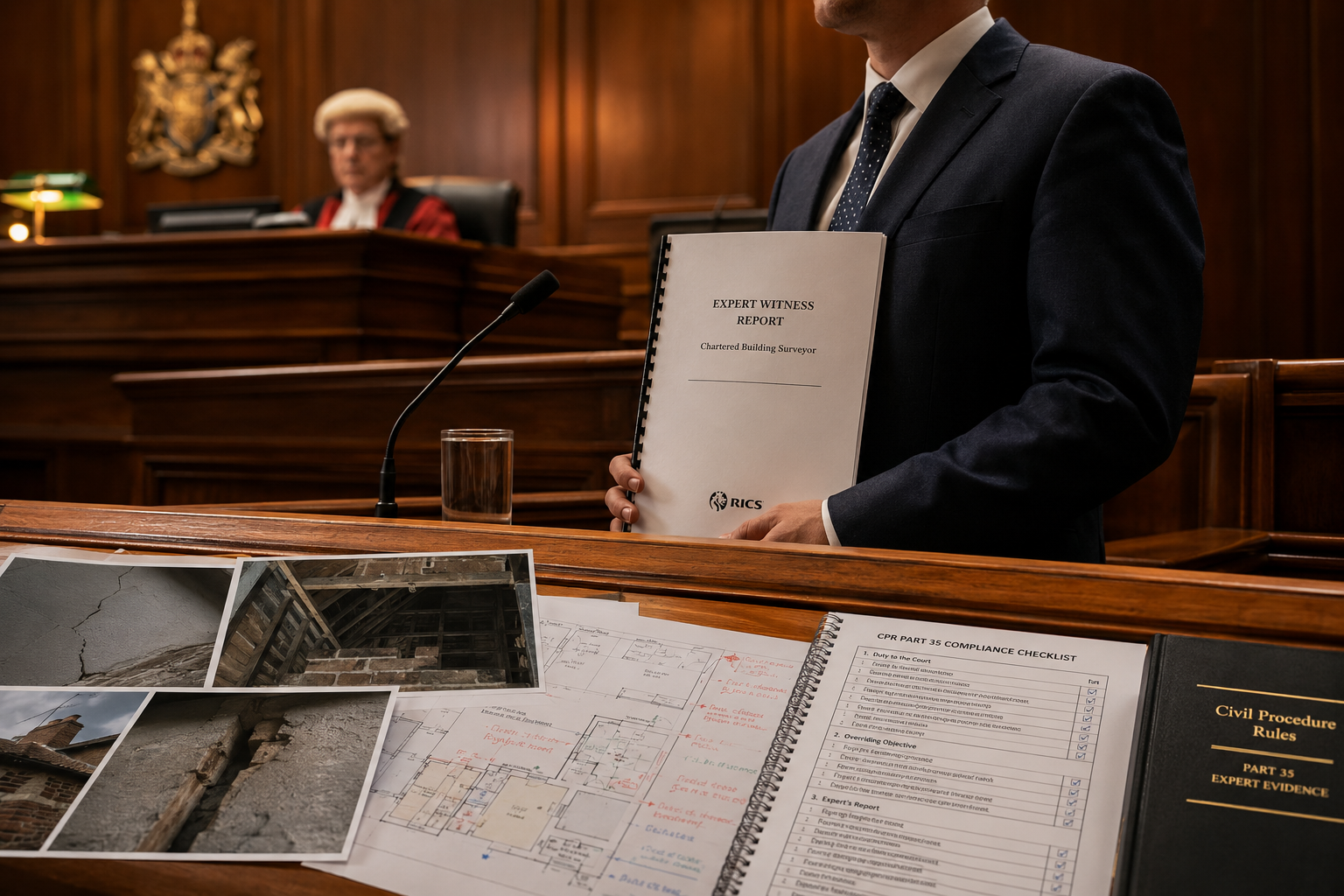
🔴 Trigger 1: Legal Proceedings Have Been Issued or Are Imminent
The clearest trigger is the commencement of litigation. Once a claimant issues proceedings — whether in the County Court, the Technology and Construction Court (TCC), or another tribunal — any survey evidence intended for use in that case must meet CPR Part 35 standards.
This applies to disputes including:
| Dispute Type | Typical Survey Evidence Needed |
|---|---|
| Structural defect claims against builders | Expert report on cause and extent of damage |
| Boundary and party wall disputes | Expert land and building survey evidence |
| Dilapidations claims | Schedule of condition and remedial cost assessment |
| Subsidence and ground movement claims | Subsidence survey and expert opinion on cause |
| Damp and timber defect disputes | Damp survey with expert causation analysis |
| Negligent survey claims | Expert opinion on the standard of the original survey |
🟡 Trigger 2: Pre-Action Protocol Requirements
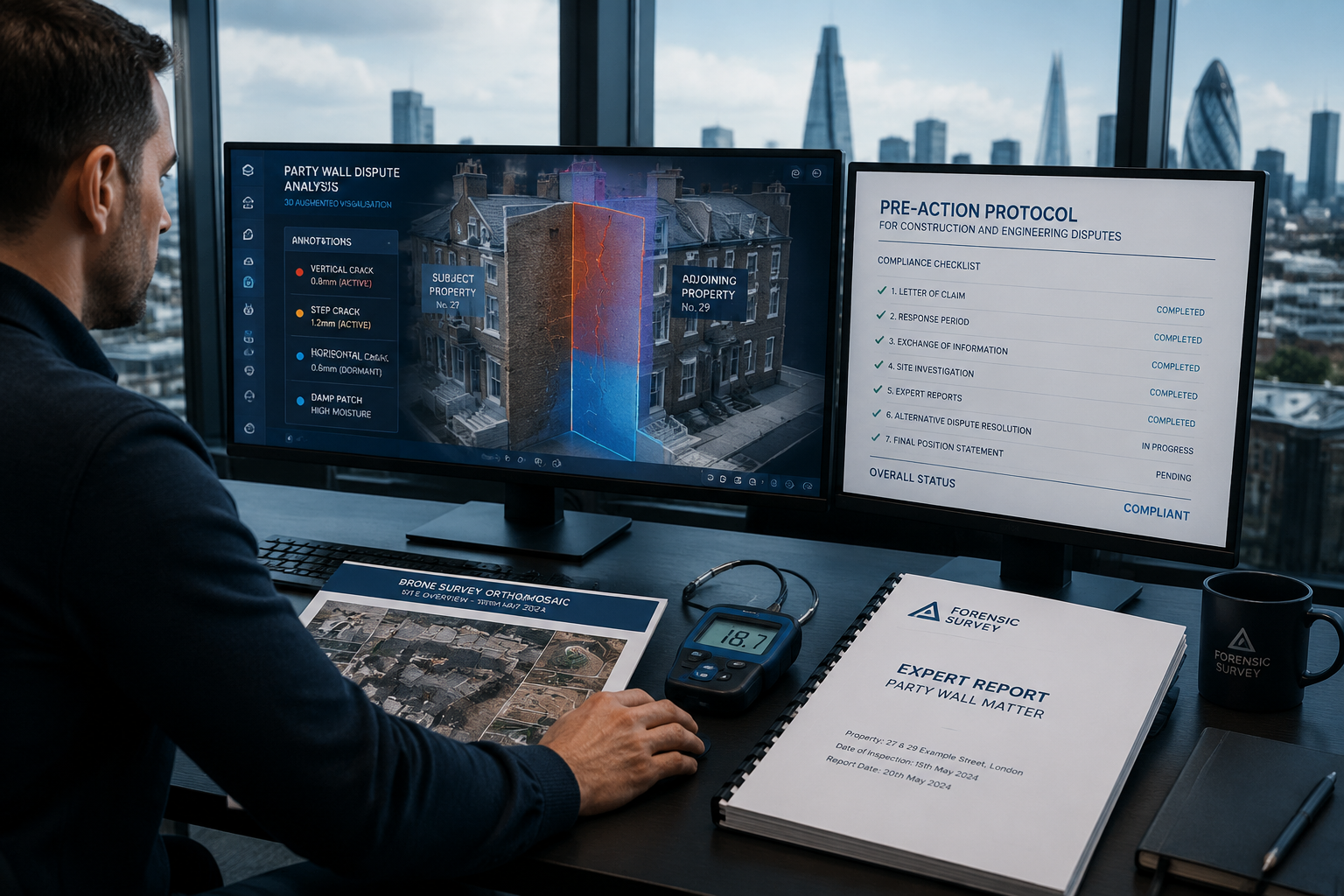
Many property disputes must follow a Pre-Action Protocol before proceedings are issued. The Pre-Action Protocol for Construction and Engineering Disputes, for example, requires parties to exchange detailed information — including expert evidence — before a claim is filed.
At this stage, even though court proceedings have not yet begun, the survey work must already meet expert witness standards. A standard advisory report will not satisfy the protocol's requirements and will not be accepted by the other side's legal team.
Key pre-action steps that signal the need for an expert witness report:
- Receipt of a Letter of Claim from a solicitor
- Instruction by a solicitor rather than directly by a property owner
- A request for a report that will be disclosed to the opposing party
- Involvement of insurers requiring formal expert evidence
🟠 Trigger 3: Dispute Resolution and Mediation
Expert witness reports are not exclusively for court proceedings. They are also required — or strongly advisable — in:
- Formal mediation where parties are represented by solicitors
- Adjudication under the Housing Grants, Construction and Regeneration Act 1996
- Arbitration proceedings
- RICS dispute resolution services
- Leasehold Valuation Tribunal hearings
In these settings, a standard building survey may be challenged as insufficiently rigorous, biased, or non-compliant with evidential standards. Upgrading to a formal expert witness report protects the instructing party's position.
🟢 Trigger 4: Joint Expert Instructions
Courts frequently order parties to instruct a single joint expert (SJE) — one surveyor appointed by both sides to provide independent evidence. When this happens, the surveyor's role is exclusively that of an expert witness. There is no advisory function whatsoever.
The SJE's report must be scrupulously neutral, and both parties are bound by its conclusions unless they obtain the court's permission to challenge it. This is a high-stakes role that requires specific expertise in expert witness work.
CPR Part 35: The Legal Framework Every Surveyor Must Understand
CPR Part 35 is the governing framework for expert evidence in civil proceedings in England and Wales. Any surveyor moving from advisory to litigation support work must understand its core requirements.
What CPR Part 35 Requires
The report must:
- Be addressed to the court, not to the client
- Contain a statement of truth signed by the expert
- Include a declaration that the expert understands their duty to the court
- State the substance of all material instructions received
- Identify any range of opinion on the matters in question and explain why the expert prefers a particular view
- Summarise the conclusions reached
- Confirm that the expert will notify the court if they change their opinion
The report must NOT:
- Advocate for the instructing party
- Omit facts that undermine the expert's conclusions
- Stray outside the expert's area of expertise
- Be drafted substantially by the instructing solicitor
The Statement of Truth
This is a legal declaration. Signing a false statement of truth in an expert witness report can constitute contempt of court — a criminal offence. This is one of the most significant differences between advisory survey work and litigation support, and it underlines why the transition must be taken seriously.
When Does a Building Survey Need to Turn Into an Expert Witness Report? — Practical Scenarios
Scenario A: Buyer Discovers Structural Defects After Purchase
A buyer commissions a pre-purchase building survey. The survey misses significant structural movement. The buyer completes the purchase and later discovers extensive underpinning is required.
At what point does the survey become an expert witness matter?
- When the buyer's solicitor sends a Letter of Claim to the original surveyor
- When the original surveyor's professional indemnity insurer appoints a loss adjuster
- When either party instructs a second surveyor to assess the original survey's adequacy
At this point, the second surveyor is not providing advisory services — they are providing expert evidence on the standard of care applied by the first surveyor.
Scenario B: Party Wall Dispute Escalates
A neighbour begins a loft conversion. A party wall dispute arises over alleged damage to the adjoining property. The parties cannot agree on the extent or cause of the damage.
The standard party wall process involves appointed surveyors producing a Schedule of Condition — an advisory document. But if the dispute escalates to the County Court, those surveyors may be required to provide formal expert witness reports that meet CPR Part 35 standards.
In 2026, attorneys and solicitors are increasingly using AI-powered tools to identify expert witnesses with specific technological capabilities, including surveyors who can prepare augmented reality visualisations of party wall disputes for courtroom presentation [4]. This reflects a growing expectation that expert evidence will be both technically rigorous and visually compelling.
Scenario C: Dilapidations Claim at Lease End
A commercial landlord serves a schedule of dilapidations on a departing tenant. The tenant disputes the quantum and causation of the claimed defects. Negotiations fail.
If the matter proceeds to the TCC or County Court, both the landlord's and tenant's surveyors will need to produce CPR Part 35-compliant expert witness reports. The advisory dilapidations schedule is a starting point — not the end product for litigation.
How Documentation Standards Are Evolving in 2026
The surveying profession is responding to increased demand for litigation-grade documentation. In 2026, the surveying industry formally recognises expert witness surveyor specialisations across land, property, and construction disputes — reflecting the growing volume of cases requiring this expertise [5].
Updated survey standards are also raising the baseline quality of documentation. The 2026 ALTA/NSPS Standards now require surveyors to provide comprehensive notes on discrepancies between recorded information and actual conditions, including explanations for differences between recorded and measured distances [2]. While these standards primarily apply to land title surveys, the principle — that surveyors must document observations that could affect conclusions — is directly relevant to building survey work that may later serve evidentiary purposes.
Construction dispute documentation is also becoming more structured. The Russell McVeagh Construction Survey Report 2026 documents established protocols for when surveys become part of dispute resolution processes [7], reflecting an industry-wide move toward standardised approaches to litigation support.
For property professionals wanting to understand the full scope of expert witness services available, the expert witness report services offered by specialist surveyors provide a clear framework for when and how to commission this type of work.
Technology Raising the Bar 🔬
Modern expert witness reports in 2026 increasingly incorporate:
- Drone survey footage providing aerial evidence of roof and structural defects
- Thermal imaging data for damp and insulation disputes
- 3D laser scanning for precise measurement evidence
- Augmented reality visualisations for courtroom presentation [4]
- Photographic schedules with GPS-tagged timestamps
These tools do not just improve the quality of evidence — they make it harder for opposing experts to challenge the factual basis of the report.
Choosing the Right Expert Witness Surveyor
Not every building surveyor is qualified or experienced to act as an expert witness. The following criteria matter:
| Criteria | Why It Matters |
|---|---|
| RICS membership | Establishes professional standing and ethical obligations |
| CPR Part 35 training | Ensures understanding of legal duties |
| Prior court experience | Demonstrates ability to withstand cross-examination |
| Specialist technical knowledge | Must match the specific defect or dispute type |
| Independence from the instructing party | Essential for credibility and court acceptance |
Surveyors who provide expert witness services should be able to demonstrate experience across the specific type of dispute in question — whether that involves structural defects, boundary issues, dilapidations, or construction quality disputes.
The Risks of Getting the Transition Wrong
Failing to recognise when a building survey needs to become an expert witness report carries real consequences:
⚠️ For property owners and claimants:
- Advisory reports may be inadmissible as evidence
- The case may be weakened or dismissed
- Costs may be wasted on non-compliant documentation
⚠️ For surveyors:
- Acting as an expert witness without understanding CPR Part 35 exposes the surveyor to professional negligence claims
- Advocacy in an expert witness role can result in the evidence being struck out
- Reputational damage within the legal community
⚠️ For solicitors:
- Relying on advisory survey reports in litigation can expose the solicitor to criticism from the court
- Pre-action protocol failures can result in cost penalties
Conclusion: Knowing When to Make the Switch
The question of when does a building survey need to turn into an expert witness report has a clear answer: the moment a dispute enters — or is likely to enter — a formal legal or quasi-legal process.
That moment can arrive earlier than many property owners and surveyors expect. A Letter of Claim, a pre-action protocol letter, an instruction from a solicitor, or the commencement of mediation can all trigger the requirement for CPR Part 35-compliant evidence.
Actionable next steps:
- ✅ If you have received a Letter of Claim — instruct a specialist expert witness surveyor immediately, before responding.
- ✅ If your dispute is heading toward formal mediation or adjudication — commission a formal expert witness report rather than relying on an advisory survey.
- ✅ If you are a surveyor asked to provide evidence in a legal matter — confirm your CPR Part 35 obligations before accepting the instruction.
- ✅ If you are a solicitor — ensure the surveyor you instruct has specific expert witness experience, not just technical surveying expertise.
- ✅ If you are in a pre-action protocol process — treat all survey evidence as if it will be scrutinised in court, because it will be.
The distinction between advisory and expert witness work is not bureaucratic formality. It is the foundation of fair, reliable property dispute resolution — and in 2026, with more surveys entering the transaction process than ever before [8], understanding that distinction has never been more important.
References
[1] 2026 MHDC Survey Guidelines – https://mhdc.com/media/v45fcfmo/2026-mhdc-survey-guidelines.pdf
[2] 2026 ALTA Survey Standards Updates – https://www.hklaw.com/en/insights/publications/2026/03/2026-alta-survey-standards-updates
[4] Augmented Reality in Expert Witness Reports Visualizing Party Wall Disputes for 2026 Courtroom Impact – https://nottinghillsurveyors.com/blog/augmented-reality-in-expert-witness-reports-visualizing-party-wall-disputes-for-2026-courtroom-impact
[5] Expert Witness Surveyor Specializations in 2026 Building Your Practice Across Land Property and Construction Disputes – https://wimbledonsurveyors.com/expert-witness-surveyor-specializations-in-2026-building-your-practice-across-land-property-and-construction-disputes/
[7] RMCV Construction Survey Report 2026 – https://www.linkedin.com/posts/michaeltaylorrussellmcveagh_rmcv-construction-survey-report-2026-activity-7432527573525348352-3hxB
[8] Mandatory Upfront Building Surveys Under 2026 Homebuying Reforms What Surveyors and Buyers Need to Know – https://kingstonsurveyors.com/mandatory-upfront-building-surveys-under-2026-homebuying-reforms-what-surveyors-and-buyers-need-to-know/
