
Over 70% of construction and property valuation disputes that reach the English courts involve at least one expert witness — yet a significant proportion of expert reports are challenged or discounted due to avoidable compliance failures. For building surveyors stepping into the expert witness role in 2026, the stakes have never been higher. Understanding Building Surveyors as Expert Witnesses in Valuation Disputes: CPR Part 35 Compliance and 2026 Courtroom Tactics is no longer optional — it is the difference between a report that shapes a judge's decision and one that is dismissed before cross-examination begins.
This guide provides a practical, step-by-step framework for surveyors testifying on property values, drawing from RICS professional standards, recent case practice, and the Civil Procedure Rules (CPR) Part 35 framework — all calibrated for today's volatile property market conditions.
Key Takeaways 📋
- The overriding duty is to the court, not the instructing party — this principle governs every aspect of expert witness conduct under CPR Part 35.
- Five mandatory content elements must appear in every compliant expert report, or the report risks rejection or reduced evidential weight.
- Single joint experts are common in lower-value disputes; higher-stakes cases allow party-appointed experts, but objectivity is always required.
- Early appointment of a building surveyor expert strengthens settlement negotiations and trial preparation significantly.
- Non-compliance with CPR 35 can result in adverse cost orders against the instructing party — making procedural rigour a financial priority.
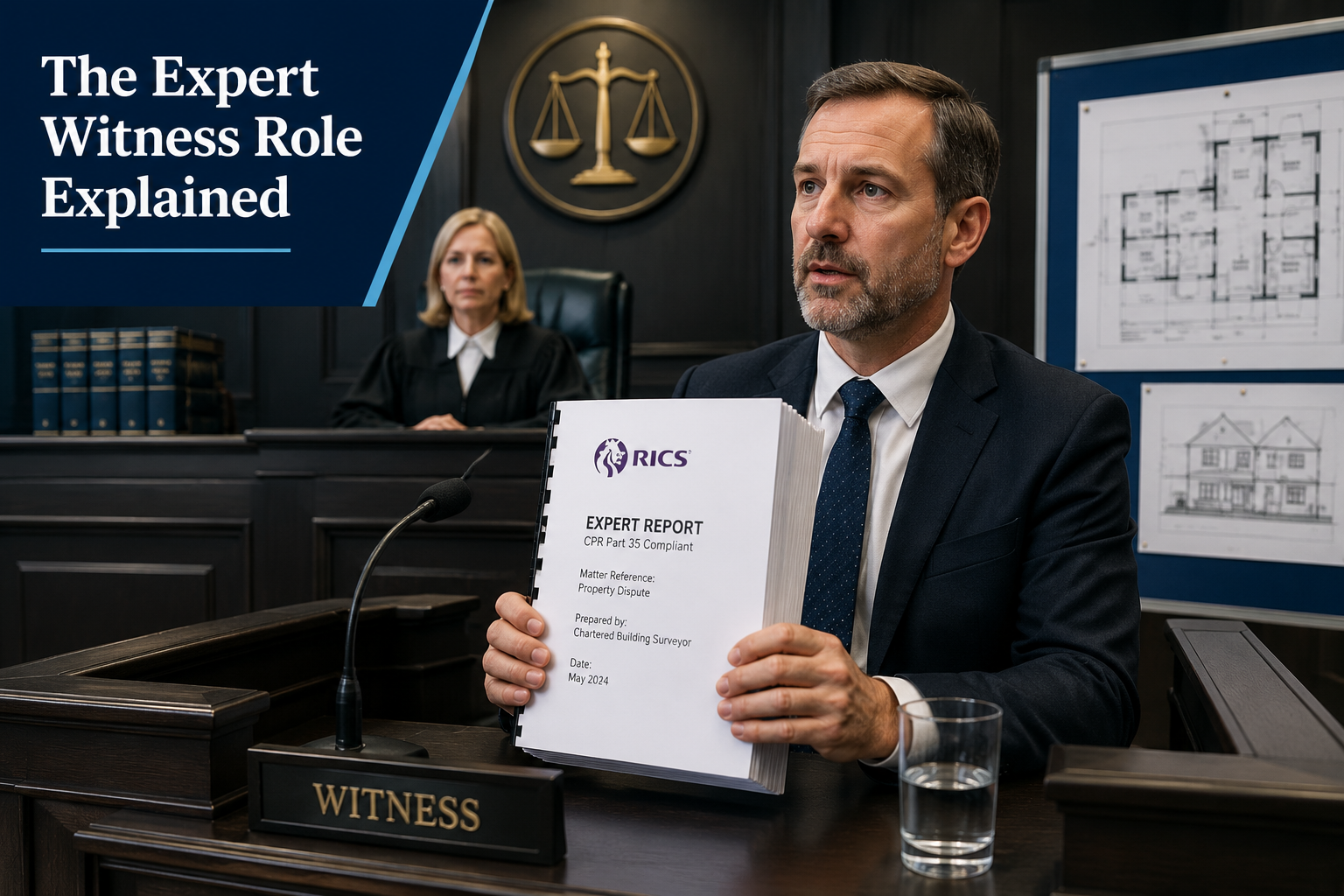
The Role of Building Surveyors as Expert Witnesses in Valuation Disputes
When property values are contested — whether in a dilapidations claim, a boundary encroachment case, a professional negligence action, or a lease extension dispute — courts rely on qualified professionals to translate technical evidence into reasoned opinion. Building surveyors occupy a uniquely powerful position in this landscape.
What Makes a Surveyor an Expert Witness?
An expert witness is not simply someone with knowledge of a subject. Under CPR Part 35, an expert is a person whose specialist knowledge or experience gives them the ability to assist the court on matters beyond the understanding of a layperson. Recognised categories of expert in property valuation disputes include [2]:
- ✅ Chartered Surveyors (MRICS / FRICS)
- ✅ Valuation Experts
- ✅ Construction Professionals
- ✅ Structural Engineers
- ✅ Architects
For building surveyors specifically, the expert witness role typically covers:
| Dispute Type | Surveyor's Expert Function |
|---|---|
| Dilapidations claims | Assessing terminal schedule costs and market impact |
| Professional negligence | Evaluating whether a prior surveyor met expected standards |
| Boundary disputes | Interpreting title plans and physical evidence |
| Lease extension valuations | Providing RICS-compliant market evidence |
| Loss of value claims | Quantifying diminution in property value |
Disagreements about remedial work costs or loss of value almost universally require specialist expert input — these are not matters resolvable through lay testimony alone [1]. For surveyors working on lease extension valuation matters or commercial valuation disputes, the expert witness pathway is frequently the route to resolution.
The Overriding Duty: Court, Not Client
"The expert's duty to the court overrides any obligation to the person from whom the expert has received instructions or by whom the expert is paid." — CPR Part 35.3
This is the foundational principle that separates an expert witness from an advocate. A surveyor instructed by a claimant must still present findings honestly, even if those findings undermine the claimant's case. Courts are acutely sensitive to "hired gun" behaviour — experts who tailor opinions to serve the instructing party — and judges will discount or reject such evidence accordingly [2].
Building surveyors who also handle party wall disputes will recognise a parallel principle: the party wall surveyor's duty is to the Award, not to the appointing owner. The expert witness role demands the same independence, applied in a courtroom context.
CPR Part 35 Compliance: A Step-by-Step Report Framework
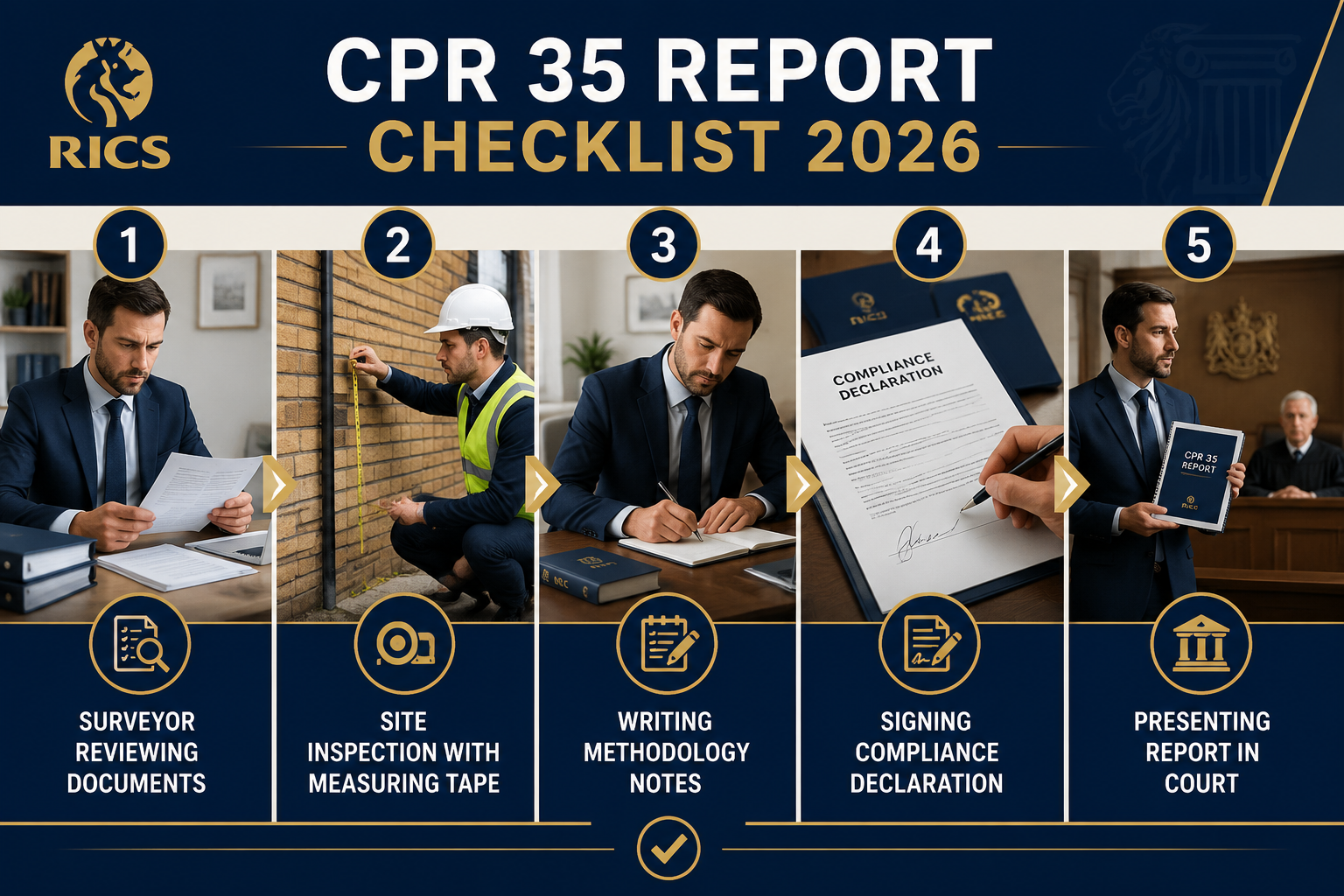
Producing a CPR-compliant expert report is the core technical skill for any building surveyor acting as an expert witness in valuation disputes. The following step-by-step framework reflects current requirements and 2026 best practice.
Step 1 — Confirm Permission and Scope
Under CPR 35.1, expert evidence is only permitted with explicit court permission [3]. Before preparing any report, confirm:
- Has the court granted permission for expert evidence in this matter?
- What is the defined scope of the expert's instructions?
- Is this a single joint expert (SJE) appointment or a party-appointed expert role?
🔑 Lower-value or less complex valuation disputes typically use a single joint expert appointed by both parties, reducing costs and duplication. Higher-stakes disputes may permit each party to appoint their own expert — but objectivity remains mandatory regardless of appointment type [3].
Step 2 — Conduct a Thorough Site Inspection and Evidence Review
A compliant expert report must include a complete record of all documents and evidence reviewed, plus details of any site inspections or measurements taken [2]. For valuation disputes in 2026, this means:
- Title plan analysis — reviewing registered boundaries and historical conveyances
- RICS site surveys — conducting physical inspections aligned with RICS professional standards [4]
- Comparable market evidence — gathering transactional data relevant to the disputed value
- Photographic records — dated, geo-referenced where possible
- Third-party documentation — planning records, building regulations approvals, previous survey reports
For surveyors preparing expert witness reports, this evidence-gathering phase is where the credibility of the final opinion is built or lost.
Step 3 — Structure the Report to Meet the Five Mandatory Elements
Every CPR Part 35-compliant expert report must contain the following five elements [2]:
| # | Required Element | What to Include |
|---|---|---|
| 1 | Qualifications & Experience | RICS membership grade, relevant specialisms, years of experience |
| 2 | Documents & Evidence Reviewed | Complete list of all materials considered |
| 3 | Site Inspections & Measurements | Dates, scope, methodology of physical inspections |
| 4 | Clear, Unbiased Opinion | Reasoned conclusions on the disputed valuation issues |
| 5 | Methodology Explanation | Full transparency on how the opinion was reached |
Missing any of these elements is a common reason reports are flagged as deficient. Courts have reduced the evidential weight of reports that omit methodology explanations or fail to demonstrate genuine independence [3].
Step 4 — Apply the Four Core Principles
Expert testimony must be governed by four core principles under CPR Part 35 [3]:
- Independent — free from bias toward the instructing party
- Objective — based on evidence, not advocacy
- Proportionate — scope matched to the value and complexity of the dispute
- Focused — directed at assisting the court, not winning the case
These principles should be actively reflected in the report's language. Avoid phrases like "my client's position is…" or "it is submitted that…" — these signal advocacy rather than independent expertise.
Step 5 — Include the Mandatory Compliance Declaration
Every properly prepared expert report must conclude with a compliance statement confirming the expert understands and has adhered to their duty to the court [1]. Reports lacking this declaration are flagged as deficient and may be rejected or assigned reduced evidentiary weight.
A standard declaration includes confirmation that:
- The expert understands their overriding duty to the court
- The report has been prepared in accordance with CPR Part 35
- The expert's opinion is independent and not influenced by the instructing party
- The expert is aware of the consequences of providing false or misleading evidence
⚠️ Cost Penalty Warning: Failure to comply with CPR 35 requirements can result in reduced evidential weight, adverse cost orders, and even cost penalties against the instructing party [3]. This makes compliance a financial priority, not just a procedural formality.
2026 Courtroom Tactics for Valuation Disputes
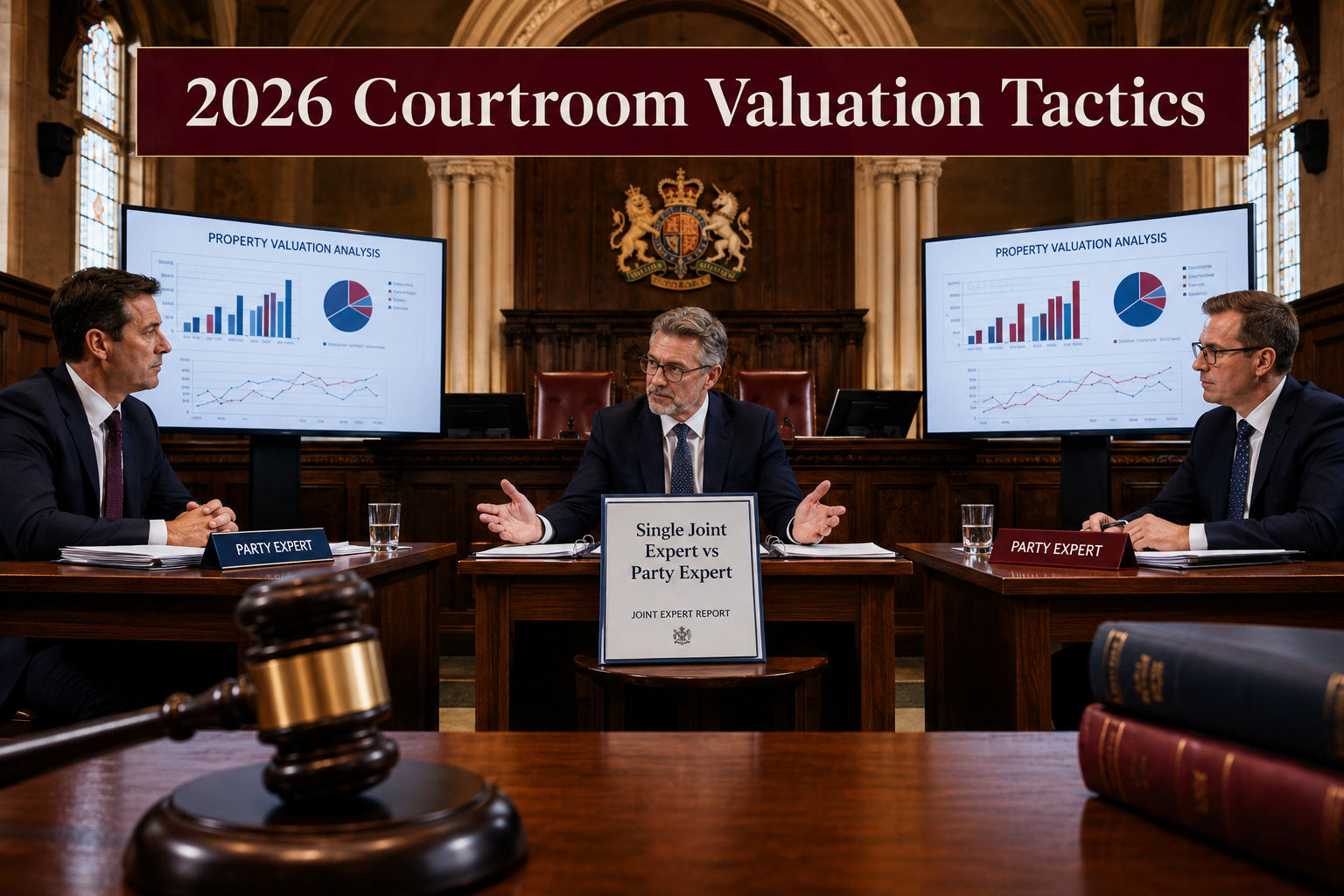
Beyond producing a compliant report, building surveyors acting as expert witnesses in valuation disputes must navigate the courtroom itself. In 2026, several strategic considerations are shaping how expert evidence is presented and challenged.
Appoint Early for Maximum Strategic Value
One of the most consistent findings from recent case practice is that early appointment of a building surveyor expert dramatically improves outcomes [2]. Early engagement allows the expert to:
- Identify technical strengths and weaknesses in the client's case before proceedings are issued
- Inform settlement negotiations with objective evidence
- Assist solicitors in framing the right questions and avoiding unwinnable arguments
- Produce a report that withstands the full scrutiny of trial preparation
Judges place substantial evidential weight on objective, well-reasoned reports from qualified, independent professionals [2]. A report produced under time pressure, late in proceedings, rarely carries the same authority.
Navigate Market Volatility in Valuation Evidence
The 2026 property market presents specific challenges for expert witnesses in valuation disputes. Interest rate fluctuations, planning reform uncertainty, and post-pandemic transaction patterns mean that comparable evidence must be carefully selected and robustly justified.
Best practice for 2026 includes:
- 📊 Using RICS Red Book valuation methodology as the baseline framework — see RICS-compliant Red Book valuations for the applicable standards
- 📅 Ensuring comparables are time-adjusted to reflect market conditions at the relevant valuation date
- 🗺️ Applying geographic weighting — comparables from significantly different micro-markets require explicit adjustment
- 📝 Documenting every adjustment with transparent reasoning that can withstand cross-examination
Handling Professional Negligence Assessments
A growing category of valuation dispute involves professional negligence claims against surveyors, architects, or other property professionals. Building surveyor expert witnesses in these cases must evaluate whether the defendant professional met the standard of a reasonably competent practitioner at the relevant time [2].
This requires:
- Knowledge of the professional standards applicable at the time of the alleged negligence (not 2026 standards applied retrospectively)
- A balanced assessment — identifying both failures and areas where the defendant acted appropriately
- Careful distinction between errors of judgement (not necessarily negligent) and departures from acceptable practice (potentially negligent)
For surveyors who regularly produce building surveys or structural engineer reports, understanding the professional standards that govern those outputs is essential preparation for the expert witness role.
Single Joint Expert vs. Party Expert: Strategic Considerations
The choice between SJE and party-appointed expert status has significant tactical implications [3]:
Single Joint Expert (SJE)
- Appointed jointly by both parties (or directed by court)
- More common in lower-value disputes
- Expert's report carries high weight — both parties are bound by it absent strong reason
- Reduces costs but limits each party's ability to shape the evidence
Party-Appointed Expert
- Each party appoints their own expert
- More common in high-value or complex valuation disputes
- Allows each party to present the most favourable legitimate interpretation of the evidence
- Requires experts to meet and prepare a joint statement identifying agreed and disputed issues
💡 In higher-stakes disputes, the joint statement produced after experts meet is often the most influential document before trial — it narrows the issues and frequently drives settlement.
Preparing for Cross-Examination
Cross-examination of expert witnesses in valuation disputes focuses on three main attack vectors:
- Qualifications — Is the expert genuinely specialist in the relevant property type or dispute category?
- Methodology — Were the right comparables used? Were adjustments logical and justified?
- Independence — Has the expert expressed opinions consistent with their instructions rather than the evidence?
Preparation strategies include:
- Re-reading the report from the perspective of opposing counsel
- Identifying every assumption and being ready to justify it
- Reviewing any previous expert reports produced in other matters — these may be used to challenge consistency
- Practising concise, direct answers — lengthy or evasive responses damage credibility
Recent 2026 guidance emphasises the importance of RICS site surveys and CPR Part 35 compliance frameworks as the twin pillars of defensible expert evidence in boundary and valuation disputes [4]. Surveyors handling complex neighbour or boundary-related valuation matters should also review guidance on resolving party wall disputes as complementary context.
Professional Negligence, Boundary Disputes, and Specialist Valuation Contexts
Building surveyors acting as expert witnesses encounter a wide range of specialist valuation contexts beyond straightforward market value disputes. These include:
- Charities Act valuations — where statutory compliance adds an additional layer of scrutiny (Charities Act valuation guidance)
- Collective enfranchisement disputes — requiring detailed knowledge of leasehold valuation methodology (collective enfranchisement)
- Help to Buy valuation challenges — where RICS-compliant methodology is mandated (RICS Help to Buy valuations)
- Boundary dispute valuations — assessing the financial impact of disputed land areas on property value [4]
In each context, the CPR Part 35 compliance framework applies equally. The specialist nature of the dispute does not create exceptions to the overriding duty to the court or the mandatory report content requirements.
Conclusion: Actionable Next Steps for Building Surveyors in 2026
Building Surveyors as Expert Witnesses in Valuation Disputes: CPR Part 35 Compliance and 2026 Courtroom Tactics represents a demanding but rewarding professional specialism. The framework is clear; the execution requires discipline, independence, and genuine expertise.
Actionable Next Steps ✅
-
Audit your existing report templates against the five mandatory CPR Part 35 content elements — update any that are missing qualifications summaries, methodology explanations, or compliance declarations.
-
Seek early instruction in any valuation dispute where your expertise is relevant — the earlier an expert is engaged, the greater the strategic and evidential value they can provide.
-
Align with RICS Red Book methodology for all valuation evidence, ensuring comparables are time-adjusted and geographic adjustments are explicitly documented.
-
Practise the independence principle actively — review draft reports for language that sounds like advocacy rather than independent opinion, and revise accordingly.
-
Prepare for cross-examination by stress-testing every assumption in the report before it is filed with the court.
-
Stay current with CPR Part 35 procedural updates and RICS professional standards — both continue to evolve, and 2026 brings renewed emphasis on proportionality and focused expert evidence.
The courts depend on qualified, independent building surveyors to make complex valuation disputes resolvable. Meeting that responsibility with rigour and integrity is both a professional obligation and a significant opportunity.
References
[1] Construction Dispute Resolution 101 – https://www.oseimc.com/construction-dispute-resolution-101
[2] How A Building Surveyor Expert Witness Can Assist With Your Court Case – https://www.expertcourtreports.co.uk/blog/how-a-building-surveyor-expert-witness-can-assist-with-your-court-case/
[3] Watch (CPR Part 35 Explained) – https://www.youtube.com/watch?v=q-VnCRyMi90
[4] Boundary Dispute Resolutions 2026 Expert Witness Strategies Using RICS Site Surveys And CPR Part 35 For Neighbour Agreements – https://nottinghillsurveyors.com/blog/boundary-dispute-resolutions-2026-expert-witness-strategies-using-rics-site-surveys-and-cpr-part-35-for-neighbour-agreements
