
Only one in three homebuyers in England and Wales commission a survey before exchanging contracts — a statistic that becomes even more alarming when you consider that the average cost of unexpected repairs discovered after purchase runs into tens of thousands of pounds. Against this backdrop, the RICS Home Survey Standard 2nd edition April 2026 update arrives at a pivotal moment, reshaping how surveyors assess, report, and communicate risk across every level of residential inspection.
For buyers, sellers, and conveyancers operating in prime central London — where a Victorian stucco terrace in Notting Hill or a Georgian townhouse in Chelsea can change hands for several million pounds — understanding these changes is not optional. It is essential due diligence.
Key Takeaways 🔑
- The RICS Home Survey Standard 2nd edition consultation ran August–October 2025, with a formal progress update published in April 2026.
- Key changes cover greater clarity on survey levels, optional valuations at all levels, AI and technology integration, and new guidance for high-risk and specialist properties.
- Energy efficiency, building safety, and climate risk reporting are all strengthened under the updated standard.
- The update supports the broader homebuying reform agenda in England and Wales.
- For high-value period properties in prime central London, a RICS Level 3 Building Survey remains the gold standard — and the new standard makes this clearer than ever.
What Is the RICS Home Survey Standard 2nd Edition April 2026 Update?
The RICS Home Survey Standard is the professional framework that governs how chartered surveyors conduct and report residential property surveys across England, Wales, and Northern Ireland. The first edition established the three-tier structure — Level 1, Level 2, and Level 3 — along with the now-familiar traffic light condition rating system (🔴 Red for serious defects, 🟡 Amber for defects needing attention, 🟢 Green for satisfactory condition).
The journey to the 2nd edition began with a public consultation running from 19 August to 14 October 2025, inviting RICS members, surveying firms, consumer groups, and organisations involved in property transactions to submit feedback. RICS then worked through the responses, publishing a formal progress update in April 2026.
The driving forces behind the revision are clear: evolving consumer expectations, new legislation, rapid technological change, and a residential market that increasingly demands transparency on issues such as energy performance, building safety, and climate-related risk.
“The feedback from members and RICS Regulation has highlighted the need to strengthen some areas of home surveys, in addition to providing further clarification to reflect consumer insights and technological changes.”
What Has Changed: The Core Updates Explained
Clearer Differentiation Between Survey Levels
One of the most significant outputs of the consultation is greater clarity on what distinguishes Level 1, Level 2, and Level 3 surveys. Previously, the boundaries between levels could feel ambiguous — both to consumers choosing a survey and to practitioners delivering them.
Under the updated standard:
| Survey Level | Scope | Best For |
|---|---|---|
| Level 1 | Condition Report — visual inspection, traffic light ratings, no advice on repairs | New-build or conventionally built homes in good condition |
| Level 2 | HomeBuyer Report — more detailed, includes advice on defects and maintenance | Conventionally built properties in reasonable condition |
| Level 3 | Building Survey — comprehensive, includes construction analysis and repair options | Older, larger, altered, or high-value properties |
For prime central London buyers considering a period conversion or listed building, our complete guide to RICS Level 2 HomeBuyer surveys and our in-depth look at whether a Level 3 survey is worth it explain exactly where each level applies.
Optional Valuation at All Survey Levels
A notable new flexibility is the option to include a market valuation at any survey level, not just Level 2 as was previously standard practice. This gives clients and surveyors greater commercial flexibility, particularly useful in high-value transactions where a standalone RICS valuation might otherwise be commissioned separately.
Guidance for ‘Additional Risk’ Dwellings
The updated standard introduces specific guidance for properties with specialised surveying needs — what RICS terms ‘additional risk’ dwellings. This category captures properties that fall outside conventional inspection parameters: listed buildings, properties with non-standard construction, those affected by previous flooding, or buildings subject to the Building Safety Act 2022 regime.
For prime central London, this is highly relevant. Many properties in W8, W11, SW3, and SW7 are Grade II listed, feature basement excavations, or sit within conservation areas — all factors that elevate surveying complexity.
Technology, AI, and Additional Services
The 2nd edition formally recognises technology and AI integration as part of modern survey practice. It also introduces additional services including:
- 🚁 Drone inspections for roofs and inaccessible elevations
- 🏠 Retrofit building surveys to assess properties for energy upgrade works
- Digital reporting tools and enhanced data capture
This is a significant modernisation. A drone inspection of a mansard roof on a Kensington townhouse, for example, can reveal defects that a ground-level inspection simply cannot detect.
Energy Efficiency, Building Safety & Climate Risk: Strengthened Reporting
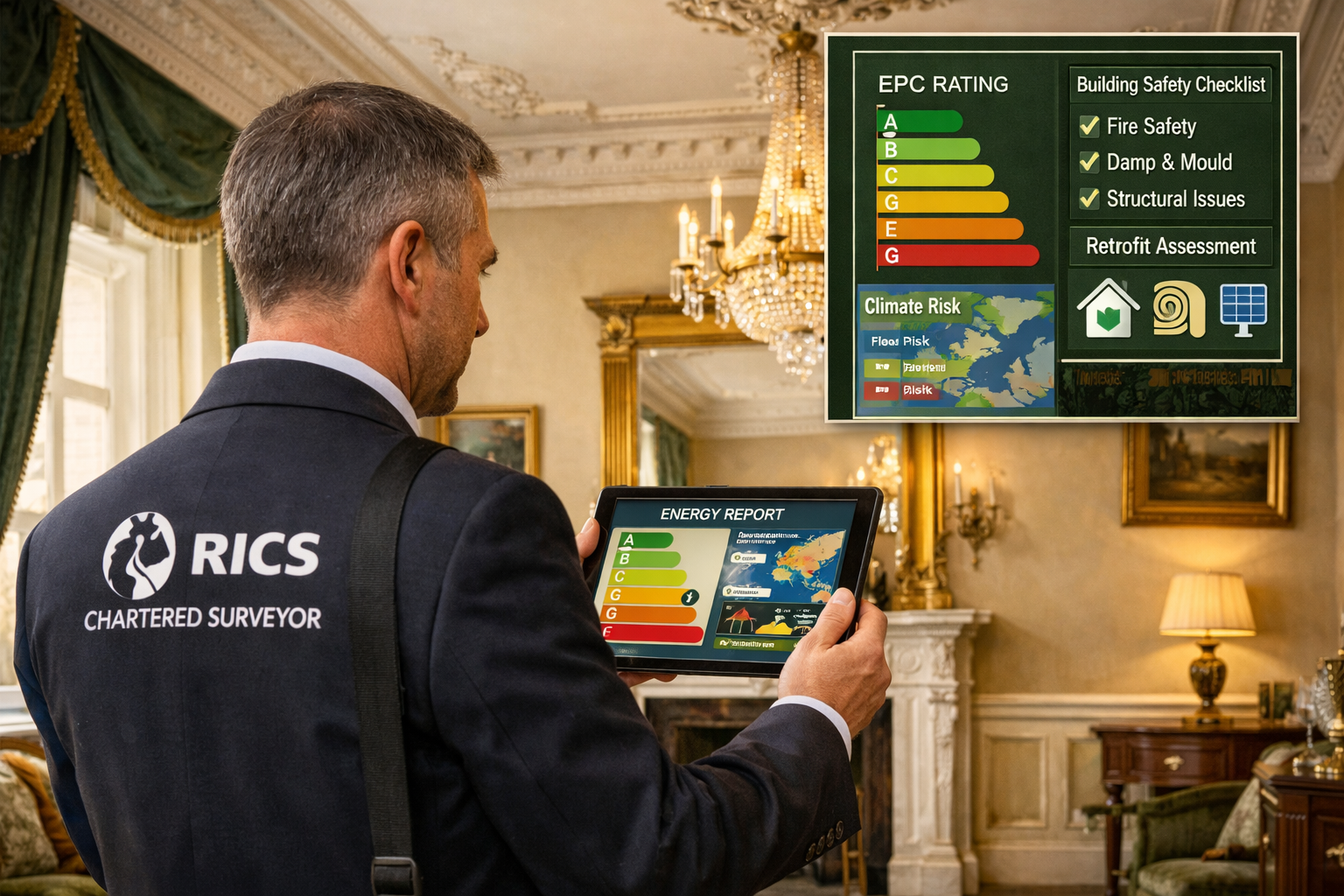
Energy Efficiency Reporting
The updated standard strengthens how surveyors report on energy performance. With the UK government’s trajectory towards EPC Band C requirements for rental properties and growing buyer awareness of running costs, surveyors are now expected to provide more meaningful commentary on energy efficiency — not simply signpost the EPC certificate.
For buyers of Victorian and Edwardian properties in Notting Hill, Holland Park, or Kensington, this matters enormously. Solid wall construction, single-glazed sash windows, and inefficient heating systems are the norm. Understanding the cost and complexity of retrofit works before exchange is now a more formal part of the surveying brief.
Building Safety
Post-Grenfell legislation has transformed the building safety landscape. The 2nd edition embeds updated legislative and regulatory requirements — including those arising from the Building Safety Act 2022 — into the survey framework. For properties in multi-storey buildings or those subject to fire safety remediation, surveyors must now address these issues with greater rigour and clarity.
Climate Risk
Climate-related risks — flooding, subsidence from soil shrinkage, and overheating — are increasingly material to property values and insurability. The updated standard expects surveyors to address these risks more explicitly, reflecting both the physical realities of a changing climate and the growing demands of mortgage lenders and insurers.
The Homebuying Reform Context
The RICS Home Survey Standard 2nd edition April 2026 update does not exist in isolation. It sits within a broader push to reform the homebuying and selling process in England and Wales — a process that remains one of the slowest and most expensive in the developed world.
Reforms under discussion include mandatory upfront property information, digital property logbooks, and greater use of pre-agreed surveys to reduce transaction fall-through rates. The updated RICS standard supports this agenda by producing clearer, more consistent, and more consumer-friendly survey reports.
For conveyancers, this means survey reports will increasingly align with the information requirements of the National Trading Standards Material Information guidance, reducing duplication and improving transaction speed.
What This Means for Prime Central London Transactions
Prime central London property is not ordinary property. A five-storey stucco townhouse in Notting Hill may have undergone basement excavation, loft conversion, and multiple changes of use over 150 years. A mansion flat in Kensington may sit within a complex leasehold structure with significant service charge liabilities and building safety obligations.
For these properties, the RICS Level 3 Building Survey — now more clearly defined under the updated standard — is the appropriate choice. It provides:
- ✅ Comprehensive inspection of structure, fabric, and services
- ✅ Detailed advice on defects, their causes, and repair options
- ✅ Commentary on energy efficiency and climate risk
- ✅ Identification of building safety obligations
- ✅ Guidance on further specialist investigations where needed
Not sure which survey level suits your purchase? Our survey selector tool walks you through the decision in minutes.
You can also explore our complete guide to home surveying for a broader overview of the process.
Why Choose Notting Hill Surveyors?
Notting Hill Surveyors are RICS-regulated chartered surveyors specialising in high-value period properties across prime central London. Our surveyors have deep expertise in the specific challenges of W8, W11, SW3, SW7, and surrounding postcodes — from listed building constraints to basement impact assessments and party wall matters.
We are fully aligned with the RICS Home Survey Standard 2nd edition April 2026 update and deliver surveys that reflect the strengthened requirements on energy efficiency, building safety, and climate risk. Our RICS Building Surveys are tailored to the complexity of prime central London stock, giving buyers the intelligence they need to negotiate, plan, and proceed with confidence.
For specific defect concerns, our RICS Specific Defect Survey provides targeted expert analysis of a single issue — ideal where a particular element of a property raises concern during the buying process.
Conclusion: Act on the Updated Standard Before You Exchange
The RICS Home Survey Standard 2nd edition April 2026 update is the most significant revision to residential surveying practice in years. It brings greater clarity, stronger consumer protection, and a more rigorous approach to the risks that matter most in 2026 — energy performance, building safety, and climate exposure.
Your actionable next steps:
- Choose the right survey level — for any prime central London period property, default to a Level 3 Building Survey.
- Commission early — instruct your surveyor as soon as an offer is accepted to avoid delays.
- Brief your surveyor specifically — flag known issues such as basement works, roof condition, or damp before the inspection.
- Share the report with your conveyancer — the updated standard produces reports that directly support the material information requirements your conveyancer needs.
- Contact Notting Hill Surveyors — speak to a specialist who understands both the updated RICS standard and the unique characteristics of prime central London property.
The survey is not a box-ticking exercise. For a multi-million pound property in one of the world’s most competitive markets, it is your single most important source of independent intelligence. Make it count.
