
The UK construction sector accounts for roughly 39% of all carbon emissions — and a significant share of that footprint is embedded in the very walls that divide our homes. As the RICS 2nd Edition Whole Life Carbon Assessment mandates carbon evaluations across construction works, the question of integrating PAS 2080:2023 Whole Life Carbon into Party Wall Awards: 2nd Edition Standards for Sustainable Boundary Works has moved from niche discussion to professional obligation. Surveyors who ignore this shift risk drafting awards that are technically compliant but strategically obsolete.
This article explains how party wall surveyors can embed PAS 2080:2023 principles into their awards without stalling the agreement process — and why doing so is now a mark of professional excellence rather than optional best practice.
Key Takeaways 📌
- PAS 2080:2023 is the UK's leading standard for managing whole life carbon in infrastructure and buildings, updated in 2023 to cover a broader range of built environment projects [3].
- Party Wall Awards can and should reference carbon assessment requirements, particularly for notifiable works involving demolition, excavation, or new boundary structures.
- The RICS 2nd Edition Whole Life Carbon Assessment framework aligns directly with PAS 2080:2023, creating a coherent pathway for surveyors.
- Embedding carbon clauses into awards does not need to delay the agreement process when handled proactively.
- Surveyors who understand sustainable boundary works are better positioned to serve clients pursuing net zero compliance in 2026 and beyond.
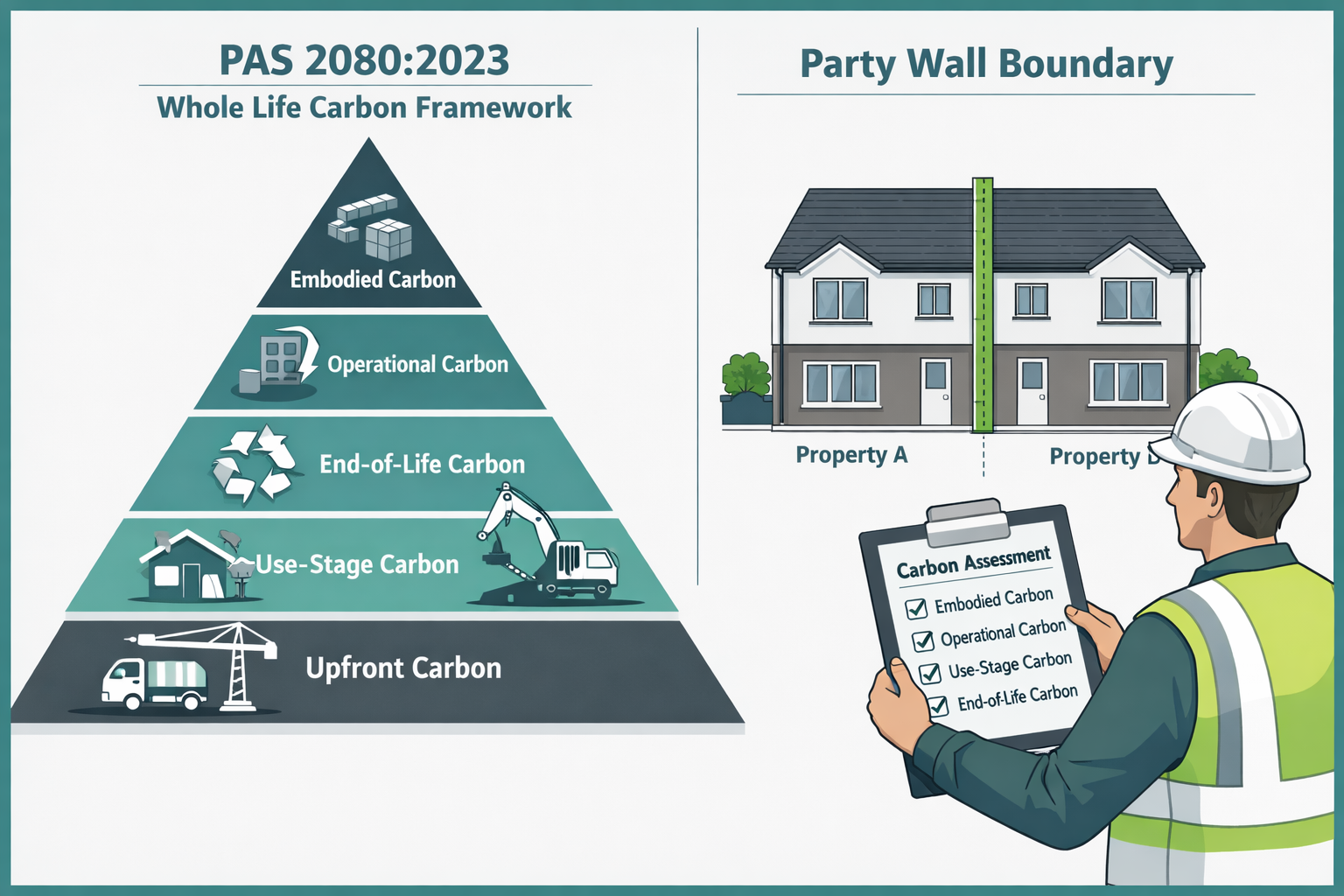
What Is PAS 2080:2023 and Why Does It Matter for Boundary Works?
PAS 2080 is a publicly available specification published by the British Standards Institution (BSI). First issued in 2016, it was substantially revised in 2023 to address whole life carbon management across both infrastructure and buildings [3]. The 2023 edition expanded its scope significantly — moving beyond roads and bridges to include residential and commercial building projects, which is where party wall works now firmly sit.
The Core Principles of Whole Life Carbon Assessment
Whole life carbon (WLC) assessment measures all carbon emissions associated with a building or structure across its entire lifespan. This includes:
| Carbon Category | What It Covers |
|---|---|
| Upfront embodied carbon | Materials manufacturing, transport, and construction |
| In-use operational carbon | Energy used to heat, cool, and power the building |
| In-use embodied carbon | Maintenance, repair, and replacement of materials |
| End-of-life carbon | Demolition, waste processing, and disposal |
| Beyond boundary carbon | Reuse, recycling, and carbon sequestration benefits |
The Global ABC's guidance on whole life carbon assessment confirms that embodied carbon — the type most relevant to party wall construction — can represent up to 50% of a new building's total lifetime carbon emissions [4]. For boundary wall works specifically, the upfront embodied carbon in materials like concrete blocks, mortar, and steel lintels is the primary concern.
Why the 2023 Update Changes Things for Surveyors
The 2023 revision of PAS 2080 introduced clearer roles and responsibilities for all parties in the supply chain, including clients, designers, and contractors [2]. Critically, it now expects carbon management plans to be produced and maintained throughout a project's lifecycle — a requirement that maps directly onto the documentation a party wall surveyor already manages.
💡 Pull Quote: "PAS 2080:2023 doesn't just set targets — it assigns accountability. For party wall surveyors, that accountability starts at the award stage."
RICS and the Institution of Civil Engineers (ICE) have harmonised their messaging on carbon assessment, reinforcing that WLC evaluation should be embedded into project governance from the earliest possible stage [1]. For party wall works, that earliest stage is the award itself.
How Integrating PAS 2080:2023 Whole Life Carbon into Party Wall Awards Works in Practice
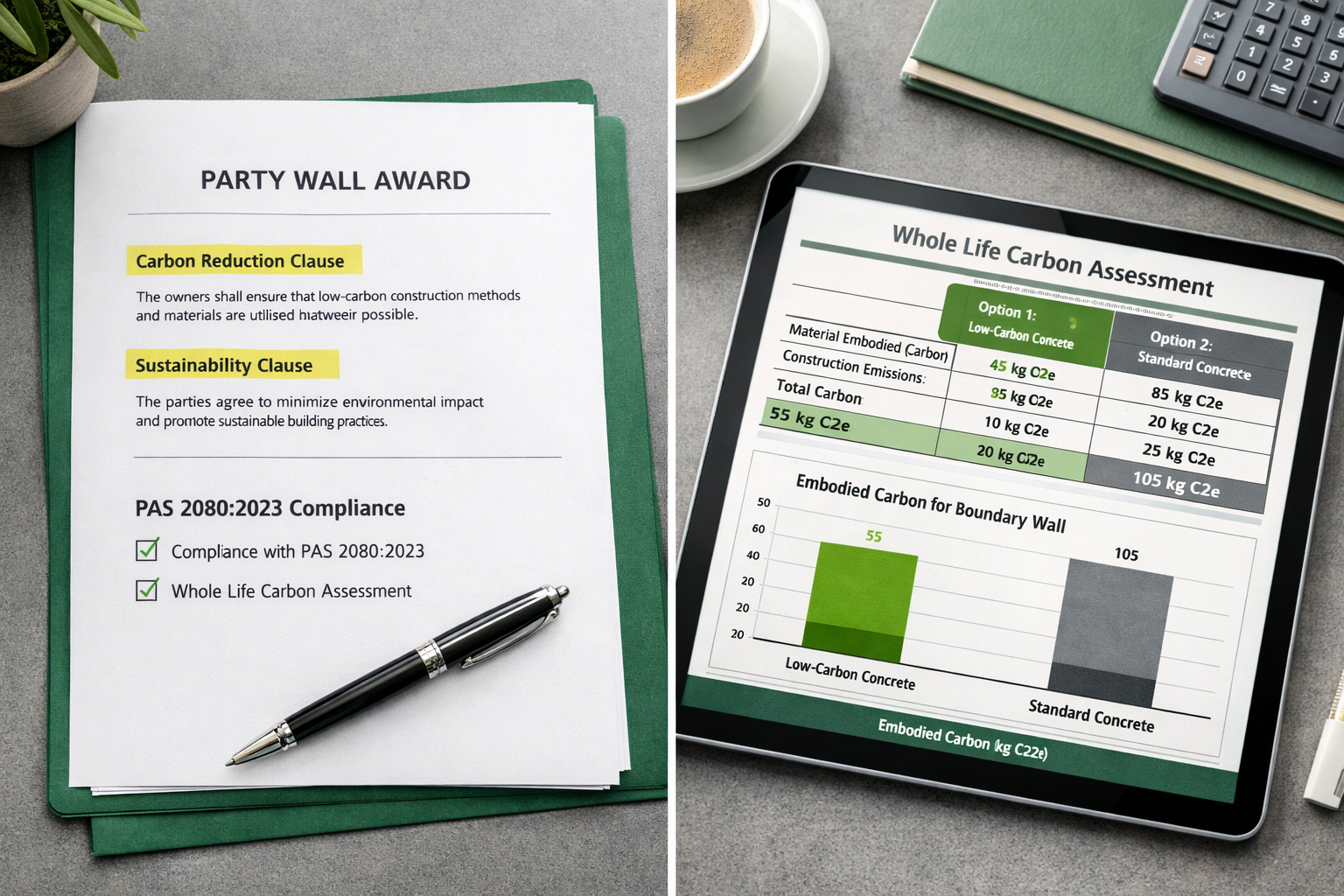
The Party Wall etc. Act 1996 governs the rights and responsibilities of building owners and adjoining owners during notifiable works. A party wall award is the legal document that defines how those works are to be carried out. Traditionally, awards focus on structural method, working hours, access rights, and damage liability. In 2026, forward-thinking surveyors are adding a fourth pillar: carbon compliance.
What Notifiable Works Trigger Carbon Considerations?
Not every party wall notice will require a full PAS 2080:2023 carbon management plan. However, the following notifiable works carry meaningful embodied carbon implications:
- 🧱 Demolition and rebuilding of a party wall or fence wall
- 🏗️ Excavation within 3 or 6 metres of an adjoining structure (Line of Junction works)
- 🔨 Cutting into a party wall to insert beams or flashing
- 🏠 Loft conversions involving steel beam installation through party structures
For loft conversions involving party wall works, the installation of steel beams is a particular concern. Steel carries one of the highest embodied carbon intensities of any common construction material — roughly 2.0 kgCO₂e per kg for virgin steel. Specifying recycled steel or engineered timber alternatives can reduce this figure by up to 70%.
Drafting Carbon Clauses Into the Award
Integrating PAS 2080:2023 whole life carbon into party wall awards: 2nd edition standards for sustainable boundary works does not require surveyors to become carbon engineers. Instead, it requires them to include proportionate carbon-aware clauses that:
- Reference the applicable standard — cite PAS 2080:2023 and the RICS 2nd Edition WLC Assessment as the governing framework for material selection decisions.
- Require a materials carbon schedule — the building owner's contractor should provide a simple schedule of materials with their associated embodied carbon values before works commence.
- Specify low-carbon alternatives where feasible — for example, specifying low-carbon concrete mixes (CEM II or CEM III blends) rather than standard Portland cement where structural requirements allow.
- Include a carbon record-keeping obligation — require the contractor to retain records of material provenance and carbon data for the project file.
- Address end-of-life considerations — where demolition of existing boundary structures is required, the award should reference waste hierarchy principles aligned with PAS 2080:2023's end-of-life carbon module.
The Construction Leadership Council's guidance on PAS 2080 confirms that even simplified carbon assessments — using industry-average carbon factors rather than product-specific Environmental Product Declarations (EPDs) — represent a meaningful step toward compliance [5].
Keeping the Process Moving ⚡
A common concern among surveyors is that adding carbon requirements will slow down the award process, potentially breaching the statutory 14-day response window or creating disputes between parties. In practice, this risk is manageable:
- Use standard clauses — develop a library of pre-drafted carbon clauses appropriate for common party wall scenarios. This adds minutes, not days, to award drafting.
- Proportionality is key — a minor works award for a small opening in a party wall does not require the same carbon rigour as a full demolition and rebuild.
- Educate clients early — understanding party wall surveyor roles and responsibilities helps building owners provide the necessary information without delay.
The RICS 2nd Edition Framework: Aligning Standards for Net Zero Compliance
The RICS 2nd Edition Whole Life Carbon Assessment professional standard (published in 2023) is the closest UK professional guidance to a mandatory WLC requirement for surveyors. While it does not yet carry the force of statute, RICS members are expected to apply it as a matter of professional competence. RICS and ICE have explicitly harmonised their approaches to ensure consistency across disciplines [1].
How the 2nd Edition Maps to PAS 2080:2023
Both frameworks use the same lifecycle modules (aligned with EN 15978 and EN 15804), the same carbon reporting units (kgCO₂e), and the same principle of transparent, verifiable carbon data [3]. This alignment means a surveyor familiar with one framework can apply the other with minimal additional training.
Key areas of overlap include:
- Module A1-A5 (upfront embodied carbon): Most relevant to party wall construction works
- Module C (end-of-life): Relevant to demolition of existing boundary structures
- Module D (beyond boundary): Credits for material reuse or recycling — increasingly important as circular economy principles enter mainstream construction
What Surveyors Need to Know About Carbon Data Sources
Surveyors do not need to calculate carbon values from scratch. Reliable, publicly available data sources include:
- ICE Carbon Database (Inventory of Carbon and Energy) — widely used industry benchmark
- Environmental Product Declarations (EPDs) — product-specific data from manufacturers
- RICS embodied carbon primer — simplified guidance for building professionals
- CIBSE TM65 — for mechanical and electrical components
The BSI's PAS 2080 documentation confirms that using recognised carbon databases is an acceptable approach for projects where full EPD data is unavailable [3].
Practical Steps for Surveyors in 2026
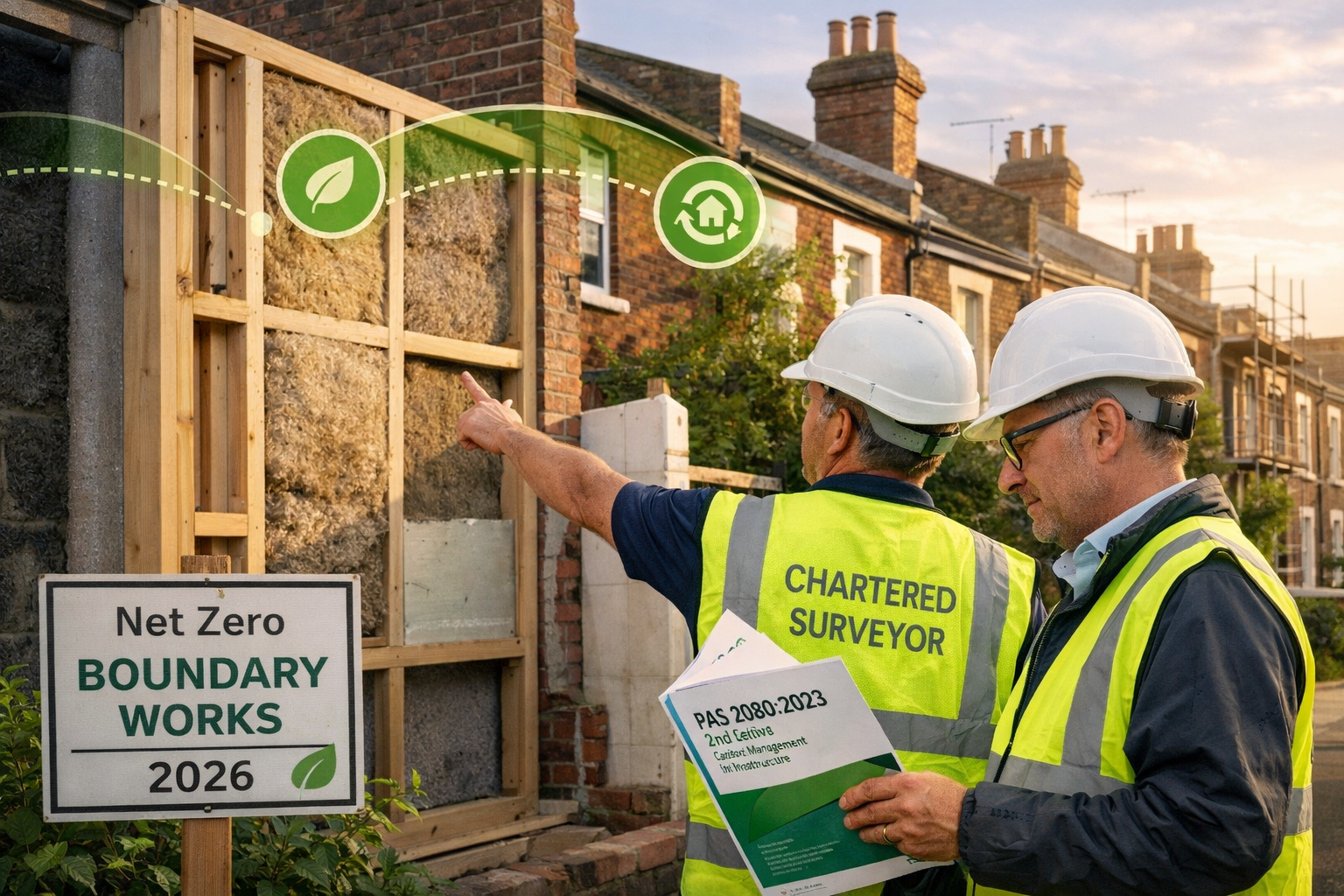
Integrating PAS 2080:2023 whole life carbon into party wall awards: 2nd edition standards for sustainable boundary works is a professional evolution, not a revolution. The following practical steps help surveyors implement this approach effectively.
Step 1: Update Your Standard Award Templates
Review existing award templates and add a Carbon Compliance Schedule as a standard appendix. This should include:
- A reference to PAS 2080:2023 and RICS 2nd Edition WLC Assessment
- A requirement for the building owner to submit a materials carbon schedule prior to works
- Clauses permitting the surveyor to review and comment on material substitutions
Step 2: Build Carbon Knowledge Into Pre-Award Consultations
When meeting with building owners to discuss what a party wall surveyor does, introduce carbon considerations as part of the standard pre-award conversation. Ask:
- What materials are specified for the works?
- Has the designer considered low-carbon alternatives?
- Is the project subject to any planning conditions related to sustainability?
Step 3: Coordinate With Structural Engineers
For complex party wall works, surveyors should liaise with the project's structural engineering team to ensure that structural specifications have been reviewed for carbon efficiency. Structural engineers increasingly carry PAS 2080:2023 competence, particularly on larger residential projects.
Step 4: Address Carbon in Schedule of Condition Reports
The schedule of condition — the photographic and written record of an adjoining owner's property before works begin — should note any existing sustainable or low-carbon features that must be preserved or replicated if damage occurs.
Step 5: Stay Current With Evolving Guidance
PAS 2080:2023 is a living standard. The BSI and RICS update their guidance periodically, and surveyors should monitor developments through professional CPD. Understanding how to verify surveyor credentials and maintain competence is as important as technical knowledge.
Common Questions and Misconceptions
❓ Does PAS 2080:2023 legally apply to party wall works?
Not directly — PAS 2080:2023 is not a statutory requirement for party wall works under the Party Wall etc. Act 1996. However, it represents current best practice, and surveyors who ignore it may face professional scrutiny as net zero obligations tighten.
❓ Will adding carbon clauses increase the cost of the award?
Marginally, in terms of surveyor time. However, the cost of a party wall surveyor is already proportionate to the complexity of the works — and carbon-aware awards represent added professional value, not unnecessary complexity.
❓ What if the adjoining owner objects to carbon requirements?
Carbon clauses in an award are a matter of professional judgment. If they are proportionate and do not impose unreasonable costs on the building owner, they are unlikely to be successfully challenged. Surveyors should document their reasoning clearly.
❓ Does this apply to shared chimneys and other party structures?
Yes — shared chimneys and party structures are subject to the same embodied carbon principles, particularly where repointing, rebuilding, or removal is involved.
Conclusion: Taking Action in 2026
The integration of PAS 2080:2023 whole life carbon principles into party wall awards is no longer a theoretical aspiration — it is a practical professional standard for 2026. The RICS 2nd Edition Whole Life Carbon Assessment has created a clear framework, and PAS 2080:2023 provides the technical backbone. Together, they equip surveyors to draft awards that are not only legally sound but genuinely aligned with the UK's net zero ambitions.
Actionable Next Steps ✅
- Audit your current award templates — identify where carbon clauses can be added without disrupting existing structure.
- Complete PAS 2080:2023 CPD training — BSI and RICS both offer relevant courses.
- Build relationships with low-carbon material suppliers — so you can advise clients on practical alternatives.
- Engage structural engineers early on complex projects to align carbon and structural specifications.
- Consult a qualified party wall surveyor who understands both the legal framework and sustainability obligations — get in touch with our team to discuss your project's specific needs.
The boundary between legal compliance and sustainable practice is narrowing. Surveyors who bridge that gap today will define the profession's standards for tomorrow.
References
[1] RICS and ICE Harmonise Messaging on Carbon Assessment and Management – https://www.rics.org/news-insights/rics-and-ice-harmonise-messaging-on-carbon-assessment-and-manage
[2] PAS 2080 Understanding the Basics – https://www.nqa.com/en-gb/resources/blog/february-2025/pas2080-understanding-the-basics
[3] PAS 2080 – https://www.bsigroup.com/siteassets/pdf/en/insights-and-media/insights/brochures/pas_2080.pdf
[4] Whole Life Carbon Assessment (WLCA) for the Built Environment – https://globalabc.org/sustainable-materials-hub/resources/whole-life-carbon-assessment-wlca-built-environment
[5] Guidance Document for PAS 2080 – https://www.constructionleadershipcouncil.co.uk/wp-content/uploads/2019/06/Guidance-Document-for-PAS2080_vFinal.pdf
[6] PAS 2080:2023 Guidance Document – https://www.scribd.com/document/780163397/PAS-2080-2023-Guidance-Document-for-PAS-2800
