

Falls on stairs and in bathrooms account for more than half of all fatal home accidents in England and Wales — yet until 2026, no single piece of legislation directly tied landlord repair obligations to these specific hazards while simultaneously triggering party wall obligations for neighbouring properties. That changed when Awaab's Law expanded its scope.
Party Wall Surveys for Bath and Stair Fall Hazards Under Awaab's Law 2026: Protecting Adjoining Owners During Retrofit Works sits at the intersection of two powerful legal frameworks: the Party Wall etc. Act 1996 and the newly extended Awaab's Law provisions. From 2026, landlords — both social and private — face mandatory obligations to investigate and remediate fall hazards associated with baths, stairs, and level changes [4]. When those remediation works touch or come close to a party wall or party structure, the rights of adjoining owners must be formally protected. This article explains exactly how.
Key Takeaways 📋
- Awaab's Law 2026 now covers bath and stair fall hazards, requiring landlords to investigate and fix these risks within defined timeframes [4].
- Retrofit works to address fall hazards — such as installing grab rails, wet-room conversions, or stair restructuring — frequently engage the Party Wall etc. Act 1996.
- Adjoining owners have the right to appoint their own surveyor and receive a formal Schedule of Condition before works begin.
- A properly drafted Party Wall Award protects both the building owner carrying out works and the adjoining owner from unresolved disputes.
- RICS-compliant notice drafting and award structures are essential to minimise disputes and ensure legal compliance.
What Awaab's Law 2026 Means for Fall Hazard Remediation
Awaab's Law originated from the tragic death of two-year-old Awaab Ishak in 2020, caused by prolonged exposure to mould in social housing. Enacted through the Social Housing (Regulation) Act 2023, the law initially focused on damp and mould. However, its scope is expanding significantly in 2026.
From 2026, the regulations explicitly include falls associated with baths, stairs, level surfaces, and between levels where these present a significant risk of harm [4]. Social landlords are already subject to strict investigation and repair timeframes [1]. Crucially, private landlords are also expected to face mandatory investigation obligations with defined timescales for action from 2026 [3].
What Counts as a Regulated Fall Hazard?
Under the 2026 framework, the following are considered regulated hazards [4]:
| Hazard Type | Examples |
|---|---|
| Bath falls | Slippery bath surfaces, absence of grab rails, unsafe bath height |
| Stair falls | Inadequate handrails, worn nosings, poor lighting, steep pitch |
| Level surface falls | Uneven flooring, threshold trips, wet-room drainage issues |
| Between-level falls | Missing balustrades, open risers, unsafe mezzanine access |
💡 Pull Quote: "From 2026, a landlord who ignores a tenant's report of a missing stair handrail faces the same legal exposure as one who ignores a damp complaint. The retrofit works that follow often affect party walls — and that is where surveyors must be ready."
Repair Timeframes Under Awaab's Law
The law imposes strict timeframes for action [4]:
- Emergency hazards: Investigation and repair within 24 hours
- Urgent hazards: Investigation within 14 days, repair within a further reasonable period
- Non-urgent hazards: Investigation within 14 days, repair plan issued within 8 weeks
These timeframes create commercial pressure on landlords to commission retrofit works quickly. That pressure, if unmanaged, can lead to works being started without proper party wall notices — a costly mistake.
How Retrofit Works Trigger Party Wall Obligations
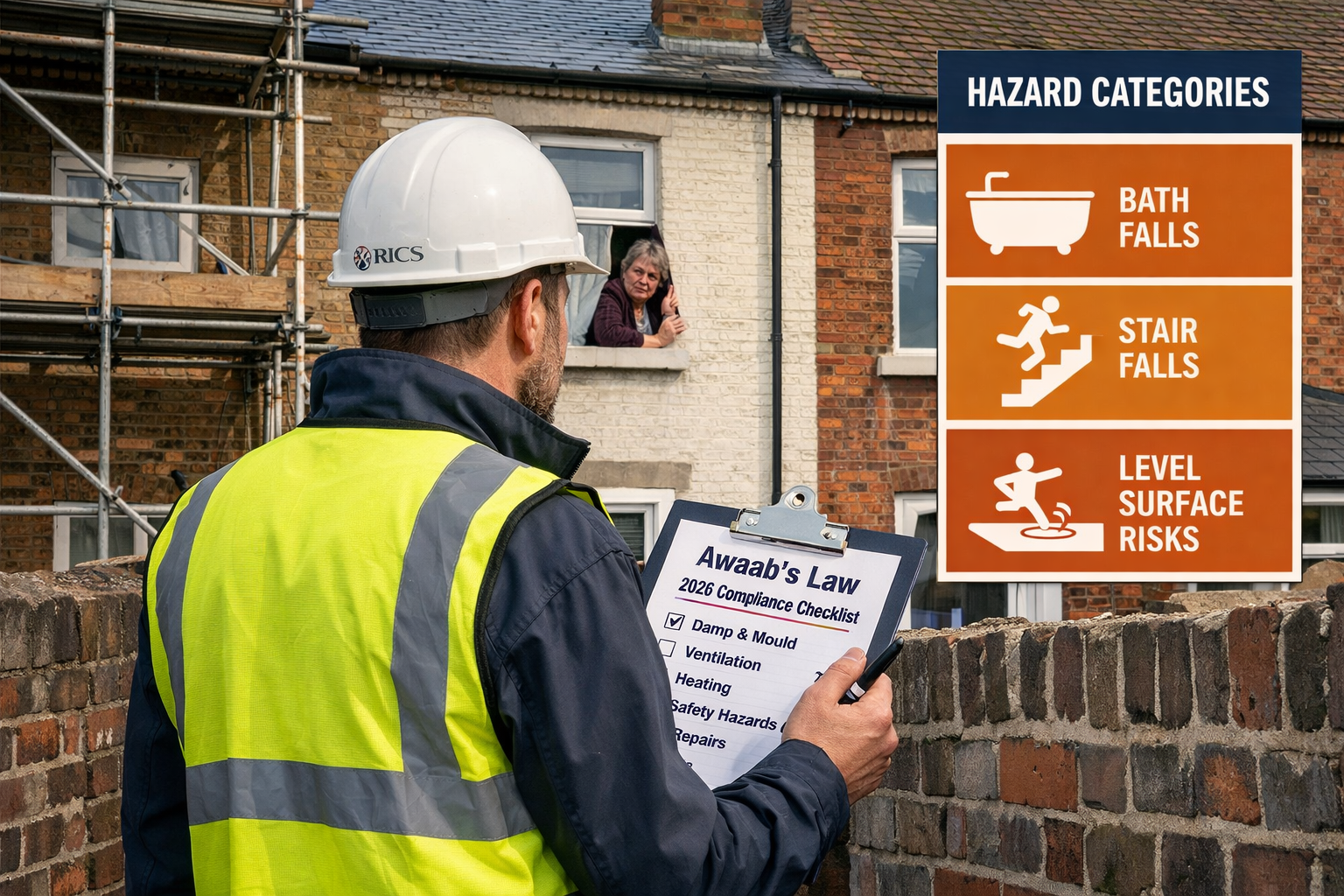
Not every fall-hazard remedy will engage the Party Wall etc. Act 1996. However, many common retrofit solutions do — particularly in the terraced and semi-detached housing stock that dominates the UK's social and private rental market.
Understanding the Party Wall Act and its requirements is the essential first step for any landlord planning safety retrofit works near a shared boundary.
Works That Commonly Trigger the Act
Bathroom retrofits that may engage the Act include:
- ✅ Wet-room conversions — cutting into a party wall to install new drainage or waterproofing membranes
- ✅ Walk-in bath or shower installation — structural alterations to floors adjacent to or supported by a party wall
- ✅ Grab rail fixings — where fixings penetrate a party structure or chimney breast shared with a neighbour
- ✅ Floor-level changes — raising or lowering floor heights near a party wall to eliminate trip hazards
Stair retrofit works that may engage the Act include:
- ✅ Staircase reconstruction — where stairs run adjacent to or are structurally connected to a party wall
- ✅ Handrail and balustrade installation — where new fixings are made into a party wall
- ✅ Loft conversion stair insertion — a common scenario where new stair access is created in a semi-detached or terraced property
For loft conversions specifically, the obligations are well established — see the dedicated guidance on party wall requirements for loft conversions.
The Three Types of Notifiable Works
The Party Wall etc. Act 1996 covers three categories of work, each requiring a different notice:
- Party Structure Notice — for works to an existing party wall or floor (Section 3)
- Line of Junction Notice — for building a new wall at or astride the boundary (Section 1)
- Adjacent Excavation Notice — for excavations within 3 or 6 metres of a neighbour's structure (Section 6)
Fall-hazard retrofit works most commonly trigger a Party Structure Notice. For a detailed breakdown of this process, the complete guide to Party Structure Notices is an essential reference.
Party Wall Surveys for Bath and Stair Fall Hazards Under Awaab's Law 2026: RICS-Compliant Protocols
The intersection of Awaab's Law urgency and Party Wall Act procedure requires surveyors to adopt adapted, RICS-compliant protocols that respect both frameworks. Rushing works without proper notices — even in response to a genuine safety emergency — does not exempt a building owner from liability under the 1996 Act.
Step 1: Serve the Correct Notice
A Party Structure Notice must be served at least two months before works begin. However, where Awaab's Law imposes a shorter repair timeframe, landlords and their surveyors face a genuine tension. The solution is to:
- Serve notice immediately upon identifying that works will affect a party structure
- Simultaneously communicate the Awaab's Law urgency to the adjoining owner in writing
- Seek the adjoining owner's written consent to an expedited timetable where possible
Where a hazard is classified as an emergency (requiring action within 24 hours), temporary safety measures — such as barrier installation or hazard warnings — can be implemented without party wall consent, provided they do not themselves affect the party structure. The substantive retrofit works still require proper notice.
For guidance on when a Party Wall Agreement is required, the key test is whether works physically affect a party wall, party fence wall, or party floor/ceiling.
Step 2: Appoint Surveyors
If the adjoining owner dissents to the notice (or fails to respond within 14 days, which counts as dissent), both parties must appoint surveyors. The options are:
| Appointment Route | Description |
|---|---|
| Agreed surveyor | One RICS-qualified surveyor acts for both parties |
| Two surveyors | Each party appoints their own; they select a third if needed |
Understanding the roles and responsibilities of party wall surveyors is critical at this stage. The surveyor's duty is to the Act, not to either party — an important distinction that protects the integrity of the process.
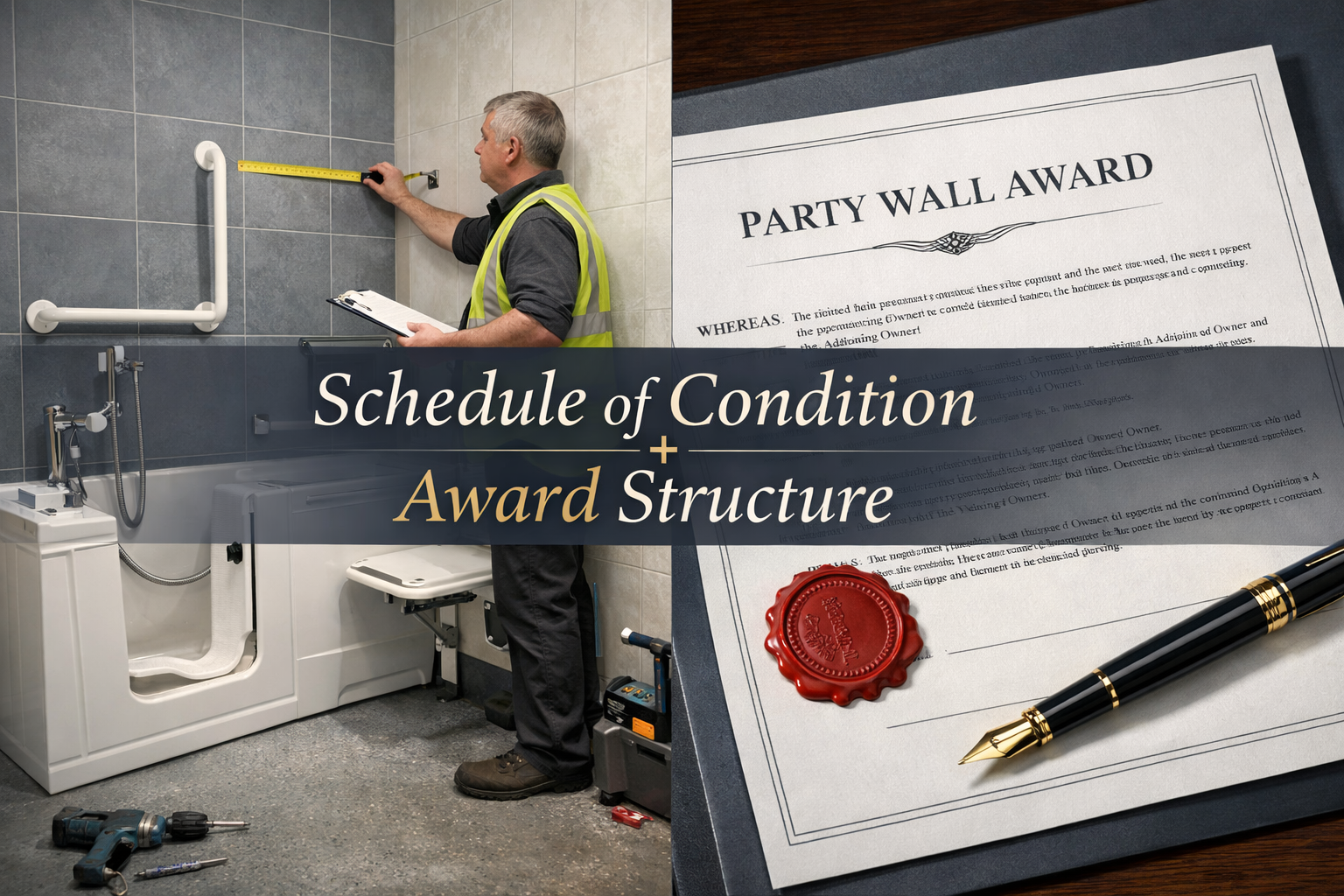
Step 3: Prepare a Schedule of Condition
Before any works begin, the surveyor(s) must prepare a Schedule of Condition of the adjoining owner's property. This document:
- Photographs and describes the existing state of walls, ceilings, floors, and finishes
- Records any pre-existing cracks, damp patches, or structural concerns
- Provides the baseline against which any damage claims will be assessed after works
For fall-hazard retrofits, the Schedule of Condition should pay particular attention to:
- Bathroom walls and floors adjacent to the party wall
- Staircase structures that share a wall with the neighbouring property
- Plasterwork and finishes in rooms immediately adjacent to proposed works
Step 4: Draft the Party Wall Award
The Party Wall Award (also called a Party Wall Agreement) is the legally binding document that governs how works are carried out. For Awaab's Law retrofit scenarios, a well-drafted Award should include [4]:
Essential Award Provisions for Fall-Hazard Retrofits:
- 📌 Description of works — precise scope of fall-hazard remediation, including materials and methods
- 📌 Working hours — restrictions to minimise disruption to the adjoining occupier
- 📌 Noise and vibration limits — particularly relevant for drilling into party walls for grab rails
- 📌 Dust and debris management — critical where elderly or vulnerable tenants occupy the adjoining property
- 📌 Access rights — the building owner's right of access to the adjoining property if needed
- 📌 Damage liability — clear allocation of responsibility for any damage caused
- 📌 Completion notification — requirement to notify the adjoining owner when works are finished
For a comprehensive understanding of what a Party Wall Award contains and how it works, including template structures, the Award must be signed by the surveyor(s) before works commence.
Protecting Adjoining Owners: Rights, Remedies, and Practical Safeguards
The adjoining owner is often the forgotten party in Awaab's Law retrofit discussions. The focus naturally falls on the landlord's compliance obligations and the tenant's safety. But the person next door has legal rights that must be actively protected.
Key Rights of the Adjoining Owner
Under the Party Wall etc. Act 1996, adjoining owners have the right to:
- Receive proper written notice of all proposed works
- Appoint their own surveyor at the building owner's expense [4]
- Receive a copy of the Party Wall Award before works begin
- Claim compensation for any damage caused by the works
- Require security for expenses where there is genuine risk of financial loss
💡 Pull Quote: "The adjoining owner's surveyor is not an obstacle to Awaab's Law compliance — they are a safeguard that protects all parties from costly disputes after works are complete."
Who Pays for the Adjoining Owner's Surveyor?
In the vast majority of cases, the building owner (i.e., the landlord carrying out the retrofit works) pays for both surveyors. This is a statutory requirement under the 1996 Act, not a matter of negotiation. For a full breakdown of who pays for a party wall surveyor, the costs are typically proportionate to the complexity of the works.
Dispute Resolution
If a dispute arises — for example, if the adjoining owner believes the works have caused damage that the building owner denies — the Award mechanism provides a built-in resolution pathway. The third surveyor (appointed in advance) can be called upon to make a binding determination.
For more complex disputes, the comprehensive guide to party wall dispute resolution outlines the escalation routes available, including appeal to the County Court within 14 days of an Award being issued.
Special Considerations for Vulnerable Occupiers
Awaab's Law retrofit works are frequently carried out in properties occupied by elderly or disabled tenants — precisely the group most at risk from bath and stair fall hazards [4]. Where the adjoining property is also occupied by vulnerable residents, the Party Wall Award should include enhanced provisions for:
- Dust suppression (respiratory risk)
- Vibration monitoring (structural sensitivity)
- Restricted working hours (noise disturbance)
- Advanced notice of particularly disruptive operations
The ventilation and environmental quality standards that underpin Awaab's Law compliance [2] are directly relevant here — surveyors should ensure that retrofit works do not inadvertently create new hazards for neighbouring occupiers.
Practical Checklist for Landlords and Surveyors in 2026
The following checklist consolidates the key actions required to achieve Party Wall Surveys for Bath and Stair Fall Hazards Under Awaab's Law 2026: Protecting Adjoining Owners During Retrofit Works compliance:
✅ Pre-Works Checklist
- Identify whether proposed works affect a party wall, party floor, or party fence wall
- Confirm the correct notice type (Party Structure Notice in most cases)
- Serve notice with at least 2 months' lead time (or seek expedited consent for urgent hazards)
- Confirm adjoining owner's response — consent or dissent
- Appoint RICS-qualified party wall surveyor(s)
- Commission Schedule of Condition of adjoining property
- Draft and agree Party Wall Award before works begin
✅ During Works Checklist
- Comply with all Award conditions (hours, noise, dust management)
- Maintain a site diary recording daily activities
- Notify adjoining owner of any changes to the works programme
- Monitor for any signs of damage to the adjoining property
✅ Post-Works Checklist
- Notify adjoining owner of completion
- Carry out post-works inspection with adjoining owner's surveyor
- Address any damage claims promptly and in accordance with the Award
- Retain all documentation for a minimum of 6 years
Conclusion: Acting Now to Protect All Parties
The expansion of Awaab's Law in 2026 to cover bath and stair fall hazards represents a significant shift in the legal landscape for landlords, tenants, and — critically — their neighbours [4]. The pressure to remediate fall hazards quickly is real and legally enforceable [3]. But speed must never come at the cost of procedural compliance under the Party Wall etc. Act 1996.
Actionable next steps for landlords and property managers:
- Audit your portfolio now — identify all properties where fall hazards exist near party walls or shared structures
- Engage a RICS-qualified party wall surveyor early — before works are designed, not after they start
- Build party wall timescales into your Awaab's Law repair programme — the 2-month notice period must be factored into compliance planning
- Communicate proactively with adjoining owners — early engagement reduces the risk of dissent and dispute
- Ensure Awards are comprehensive — a well-drafted Award protects the building owner as much as the adjoining owner
The goal of Party Wall Surveys for Bath and Stair Fall Hazards Under Awaab's Law 2026: Protecting Adjoining Owners During Retrofit Works is not bureaucratic compliance for its own sake. It is the protection of real people — tenants, neighbours, and property owners — from harm, financial loss, and legal dispute. Done well, the party wall process is an asset, not an obstacle.
For expert guidance on party wall matters, explore the complete guide to party wall surveys or contact a qualified surveyor to discuss your specific retrofit project.
References
[1] Getting Ready For Awaab's Law And What It Means For You – https://www.alliancehomes.org.uk/news/general-news/getting-ready-for-awaab-s-law-and-what-it-means-for-you/
[2] Awaab's Law Technical Compliance HVAC Ventilation – https://www.arm-environments.com/resources/awaabs-law-technical-compliance-hvac-ventilation
[3] Awaab's Law Private Landlords 2026 – https://www.idealresponse.co.uk/blog/awaabs-law-private-landlords-2026/
[4] Awaab's Law Guidance For Social Landlords: Timeframes For Repairs In The Social Rented Sector – https://www.gov.uk/government/publications/awaabs-law-guidance-for-social-landlords/awaabs-law-guidance-for-social-landlords-timeframes-for-repairs-in-the-social-rented-sector
