
Pet-friendly rental listings in England have collapsed by 39% since January 2026 — yet the Renters' Rights Act 2026 simultaneously grants tenants a legal right to request pets that landlords cannot refuse without good reason [1]. This contradiction sits at the heart of one of the most significant valuation challenges facing chartered surveyors today. The valuation impacts of new pet-friendly rules in the Renters' Rights Act 2026: surveyor adjustments for landlord risk assessments demand a structured, evidence-based response from RICS professionals working across the residential lettings sector.

Key Takeaways 📋
- The Renters' Rights Act 2026 gives tenants the right to request pets; landlords must respond within 28 days and cannot refuse "unreasonably" [3]
- Pet-related fees and mandatory pet insurance are prohibited under the Act; only the standard deposit can cover damage [5]
- Pet-friendly rental listings have dropped from 8.2% to 5.9% of England's market since January 2026, with regional declines as steep as 50% [1]
- Surveyors must now build pet-related depreciation adjustments into landlord risk assessments and rental valuations
- RICS Red Book methodology provides the framework for quantifying wear-and-tear risk in periodic tenancies
Understanding the Renters' Rights Act 2026: What Changed for Landlords?
The Renters' Rights Act 2026 represents the most sweeping reform of England's private rented sector in decades. Among its many provisions, the pet-ownership rules have generated the most immediate concern among landlords and their professional advisers [4].
The Core Pet Provisions
Under the Act, tenants in periodic tenancies now have the right to submit a written request to keep a pet. Once received, the landlord has 28 days to respond. Crucially, any refusal must be based on reasonable grounds — vague objections or blanket "no pets" policies are no longer legally enforceable [3].
Reasonable grounds for refusal may include:
- Lease restrictions imposed by a superior landlord or freeholder
- Property type unsuitable for the specific animal (e.g., a high-rise flat for a large breed dog)
- Demonstrable health and safety concerns related to the property
- Local authority licensing conditions that prohibit animals
What landlords cannot do is charge additional pet fees or require tenants to take out mandatory pet insurance [5]. The standard tenancy deposit — capped under existing rules — must absorb any pet-related damage at the end of the tenancy. This is where the valuation risk concentrates.
"The prohibition on pet fees transfers financial risk directly onto the deposit mechanism — and, by extension, onto the landlord's net yield calculation."
Valuation Impacts of New Pet-Friendly Rules in Renters' Rights Act 2026: Surveyor Adjustments for Landlord Risk Assessments
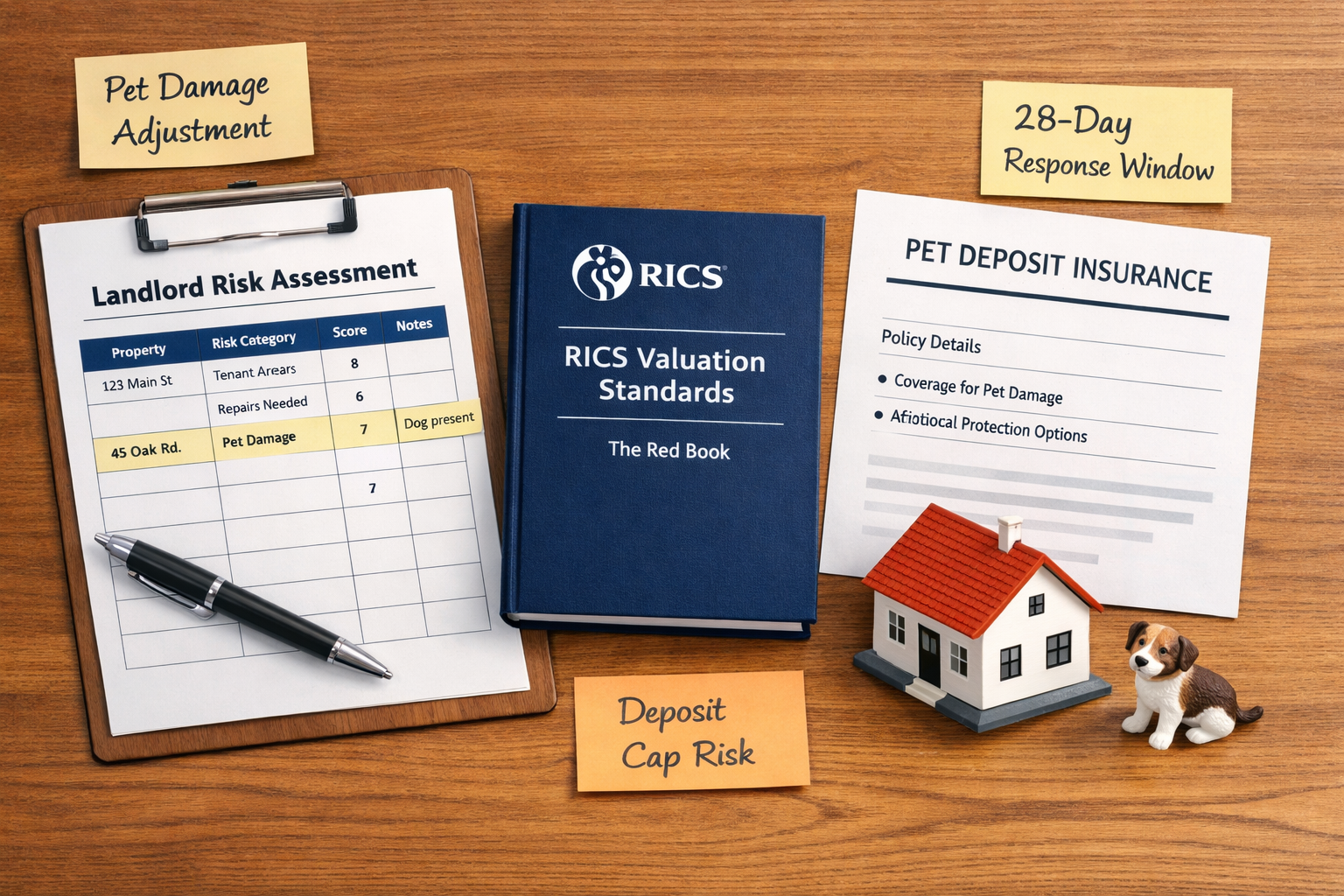
The shift in legal liability has direct consequences for how surveyors approach rental valuations and landlord risk assessments. The valuation impacts of new pet-friendly rules in the Renters' Rights Act 2026 cannot be treated as a soft qualitative footnote — they require quantifiable adjustments embedded in formal valuation reports.
How RICS Methodology Applies
RICS-registered valuers working under the Red Book valuation framework must now consider pet-related depreciation as a material factor when assessing:
- Market rental value (MRV) — Does the property command a premium or suffer a discount based on its pet-acceptance status?
- Capital value — How does increased wear-and-tear risk affect long-term asset value for landlord clients?
- Yield adjustments — What additional maintenance cost provisions should be built into gross-to-net yield calculations?
The valuation factors relevant to pet-related risk include flooring type, garden condition, property age, and the structural resilience of fixtures and fittings.
Pet-Related Depreciation: A Surveyor's Checklist
When conducting a landlord risk assessment in 2026, surveyors should inspect and document the following:
| Element | Pet Risk Factor | Typical Depreciation Range |
|---|---|---|
| Hardwood/laminate flooring | Scratching, staining | 5–20% of floor replacement cost |
| Carpeting | Odour, staining, claw damage | 15–40% of carpet replacement cost |
| Internal doors & skirting | Chewing, scratching | 3–10% of joinery value |
| Garden/outdoor areas | Digging, lawn damage | 5–25% of landscaping value |
| Walls & paintwork | Scuffing, marking | 2–8% of decoration cost |
| HVAC/ventilation systems | Pet hair, dander accumulation | 5–15% of servicing cost |
These ranges are not fixed — they depend heavily on the type, size, and number of animals, the tenancy duration, and the quality of the property's existing finishes.
Adjusting the Rental Valuation
Surveyors advising landlord clients should consider a risk-adjusted rental figure that accounts for the statistical likelihood of pet-related damage claims. A practical approach involves:
- Baseline MRV — Establish the open-market rental value without pet consideration
- Pet probability weighting — Given the Act's provisions, estimate the likelihood that a pet request will be received and granted during the tenancy
- Expected damage cost — Model average repair costs based on property type and local comparables
- Deposit gap analysis — Calculate the shortfall between capped deposit value and expected pet-related repair costs
For a professional dilapidations survey at the end of a tenancy, this baseline documentation becomes essential evidence in any deposit dispute involving pet damage.
Regional and Market-Specific Considerations

The valuation impacts of new pet-friendly rules in the Renters' Rights Act 2026: surveyor adjustments for landlord risk assessments are not uniform across England. Regional market dynamics significantly alter how these adjustments should be calibrated [1].
The Regional Picture in 2026
As of 2026, only 5.9% of England's 98,964 rental listings are marketed as pet-friendly — down from 8.2% at the start of the year [1]. The regional breakdown reveals stark differences:
- 🔴 East of England: Steepest decline, over 50% fewer pet-friendly listings since January
- 🟡 London: Smaller but still significant fall of just under 32% since January
- 🟢 Other regions: Variable declines, generally between 30–45%
This divergence matters for surveyors. In London, where high-density housing stock and leasehold restrictions are common, landlords have more legally defensible grounds for refusal — which may moderate the valuation impact. In the East of England, where suburban and semi-rural stock dominates, the risk profile differs considerably.
For surveyors operating across Central London or West London, leasehold title documents must be reviewed carefully. Many long leases contain absolute prohibitions on animals — and where such restrictions exist, a landlord's refusal of a pet request remains legally sound regardless of the Act's provisions.
Leasehold vs Freehold: A Critical Distinction
| Property Type | Pet Refusal Rights | Valuation Adjustment Approach |
|---|---|---|
| Freehold house | Limited grounds for refusal | Higher risk weighting; full depreciation modelling required |
| Leasehold flat (pet prohibition in lease) | Strong grounds for refusal | Lower risk; note restriction in valuation report |
| Leasehold flat (no pet clause) | Moderate grounds for refusal | Medium risk; assess on case-by-case basis |
| HMO/shared accommodation | Complex — room-by-room analysis | Specialist assessment recommended |
Surveyors working in areas such as Camden or Chelsea — where leasehold flats dominate — will find that the practical valuation impact is often moderated by existing lease terms. However, this must be verified on a property-by-property basis and clearly documented in the risk assessment.
Practical Surveyor Adjustments: Protecting Landlord Interests
Schedule of Condition: The First Line of Defence
One of the most important tools available to surveyors in the post-Act environment is a thorough schedule of condition prepared at the start of every tenancy. A schedule of condition report creates an objective, timestamped baseline of the property's state before any pet is introduced. Without this, landlords face an evidential gap when seeking to attribute damage to a specific animal.
Key elements to document include:
- Photographic evidence of all flooring, walls, doors, and garden areas
- Written descriptions of existing wear, marks, or damage
- Material specifications (e.g., flooring type, paint finish) to enable like-for-like replacement costing
- Condition ratings aligned with RICS guidance
Rent Review Adjustments
The Act's impact extends beyond initial valuations. At rent review stage, surveyors should factor in any documented pet-related deterioration when advising on market rental evidence. A property that has hosted pets for 24 months will typically present with greater wear than a comparable non-pet property — and this should be reflected in the evidence base used to support or challenge a rent review figure.
Insurance Reinstatement Considerations
Pet-related damage can, in some cases, affect a property's reinstatement cost valuation. Persistent moisture damage from animal waste, structural damage from burrowing, or fire risk from chewed wiring are all scenarios that may require upward revision of insurance reinstatement valuations. Surveyors should flag these risks explicitly in their reports.
What Landlords Should Do Now 🏠
The legal landscape has shifted, and landlords who fail to adapt their risk management approach face real financial exposure. Based on the Act's provisions and current RICS best practice, the following steps are recommended:
- Commission a pre-tenancy schedule of condition — non-negotiable in 2026
- Review lease documents — identify any superior landlord restrictions on pets before any tenancy begins
- Update tenancy agreements — include clear pet request procedures aligned with the 28-day response requirement [3]
- Model deposit gap risk — calculate the shortfall between the deposit cap and realistic pet damage costs for your property type
- Seek RICS-registered valuation advice — ensure rental valuations reflect the new risk environment
- Engage a surveyor at tenancy end — professional dilapidations assessment is essential when pets have been present
"Landlords who treat the Renters' Rights Act 2026 as a compliance box-ticking exercise, rather than a genuine risk management challenge, will find themselves underinsured, under-compensated, and undervalued."
Conclusion: Adapting Valuation Practice for the Pet-Friendly Era
The valuation impacts of new pet-friendly rules in the Renters' Rights Act 2026: surveyor adjustments for landlord risk assessments represent a genuine paradigm shift for RICS professionals. The combination of tenant rights, deposit caps, and the prohibition on pet fees has created a new category of unpriced risk in the residential lettings market [5].
Surveyors who embed structured pet-risk adjustments into their valuation methodology — using schedules of condition, depreciation modelling, and yield gap analysis — will provide landlords with the clearest picture of their true financial exposure. Those who ignore the issue risk producing valuations that materially understate risk.
Actionable Next Steps for Surveyors and Landlords
- ✅ Surveyors: Update your landlord risk assessment templates to include a dedicated pet-risk section aligned with RICS Red Book principles
- ✅ Landlords: Commission a schedule of condition before every new tenancy — especially where a pet request is anticipated
- ✅ Both: Review regional market data regularly, as the pet-friendly listing landscape is shifting rapidly [1]
- ✅ Landlords with leasehold properties: Verify superior lease terms before responding to any pet request within the 28-day window [3]
- ✅ Surveyors: Factor pet-related depreciation into dilapidations assessments and rent review evidence packs
The Renters' Rights Act 2026 is not going away. The surveyors and landlords who adapt their approach now will be best positioned to protect asset values and manage risk effectively in the years ahead.
References
[1] Pet Friendly Rentals Drop Renters Rights Act – https://propertyportfolioinvestor.co.uk/news/pet-friendly-rentals-drop-renters-rights-act/
[2] Watch – https://www.youtube.com/watch?v=rVat8TD4IBE
[3] How The Renters Right Act Impacts You – https://www.guildofstudents.com/news/article/website/How-the-Renters-Right-Act-Impacts-You/
[4] Guide To The Renters Rights Act – https://www.gov.uk/government/publications/guide-to-the-renters-rights-act/guide-to-the-renters-rights-act
[5] Renters Rights Bill A Letting Agents Guide – https://blog.goodlord.co/renters-rights-bill-a-letting-agents-guide
[6] Renters Rights – https://www.nrla.org.uk/resources/renters-rights
