
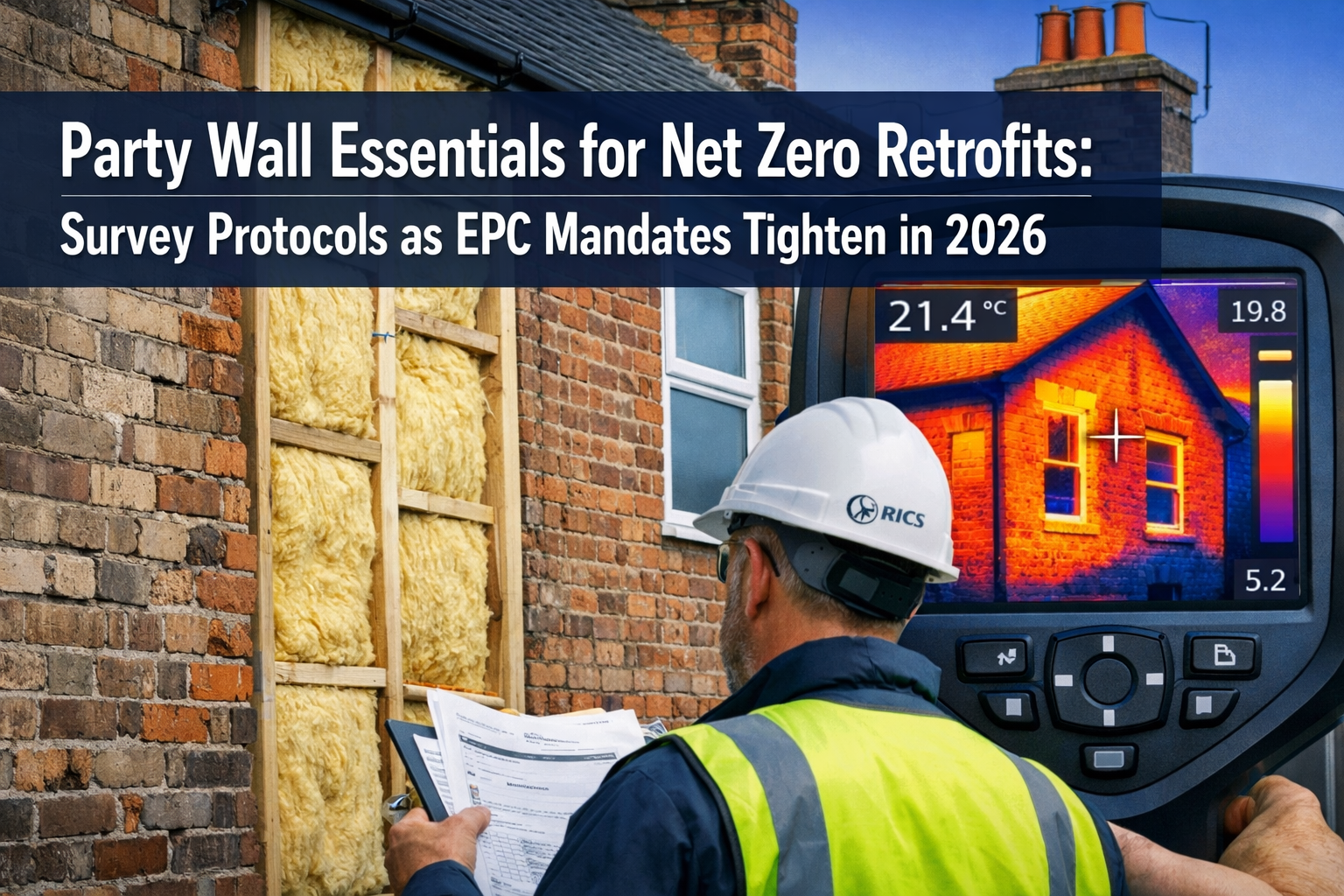
As the UK races toward ambitious net zero targets, property owners face mounting pressure to upgrade their homes' energy performance. With Energy Performance Certificate (EPC) mandates tightening significantly in 2026, millions of terraced and semi-detached properties will require substantial retrofits—many of which directly impact shared party walls. Understanding Party Wall Essentials for Net Zero Retrofits: Survey Protocols as EPC Mandates Tighten in 2026 has never been more critical for homeowners, landlords, and construction professionals navigating this complex intersection of sustainability goals and property law.
The challenge is clear: achieving net zero performance often requires deep energy retrofits that involve insulating party walls, upgrading shared structures, and implementing technologies that affect adjoining properties. Without proper party wall protocols, these essential sustainability projects can trigger costly disputes, project delays, and legal complications that undermine both environmental objectives and neighbor relationships.
Key Takeaways
- 🏠 EPC mandates in 2026 will require minimum Band C ratings for rental properties, driving unprecedented demand for party wall retrofits involving insulation and structural modifications
- 📋 RICS-compliant survey protocols are essential for documenting pre-retrofit conditions and preventing disputes when implementing net zero upgrades to shared walls
- ⚖️ Proper party wall agreements protect both building owners and adjoining owners during energy efficiency work, establishing clear responsibilities and dispute resolution mechanisms
- 🔍 Early surveyor engagement (ideally 2-3 months before retrofit work) ensures compliance with the Party Wall Act 1996 and prevents project delays
- 💰 Cost allocation clarity through professional party wall awards prevents financial disputes and ensures equitable distribution of retrofit expenses between neighbors
Understanding the 2026 EPC Mandate Landscape
The UK government's commitment to achieving net zero emissions by 2050 has created a regulatory cascade affecting millions of properties. In 2026, new EPC requirements will fundamentally reshape the rental market and property improvement landscape.
What's Changing in 2026?
Current regulations require rental properties to achieve a minimum EPC rating of Band E. However, proposed 2026 mandates will raise this threshold to Band C for most residential rental properties. This seemingly modest two-band improvement represents a substantial technical challenge for older housing stock, particularly Victorian and Edwardian terraced properties with solid walls and shared party wall structures.
The implications are staggering:
- Approximately 3.5 million rental properties currently fall below Band C ratings
- Solid-walled properties (common in terraced housing) are disproportionately represented in lower EPC bands
- Landlords face potential fines up to £30,000 for non-compliance
- Property values increasingly reflect energy performance, with Band C homes commanding premium prices
Why Party Walls Are Central to Net Zero Retrofits
Achieving Band C performance in traditional terraced housing almost always requires addressing party walls. These shared structural elements present unique challenges:
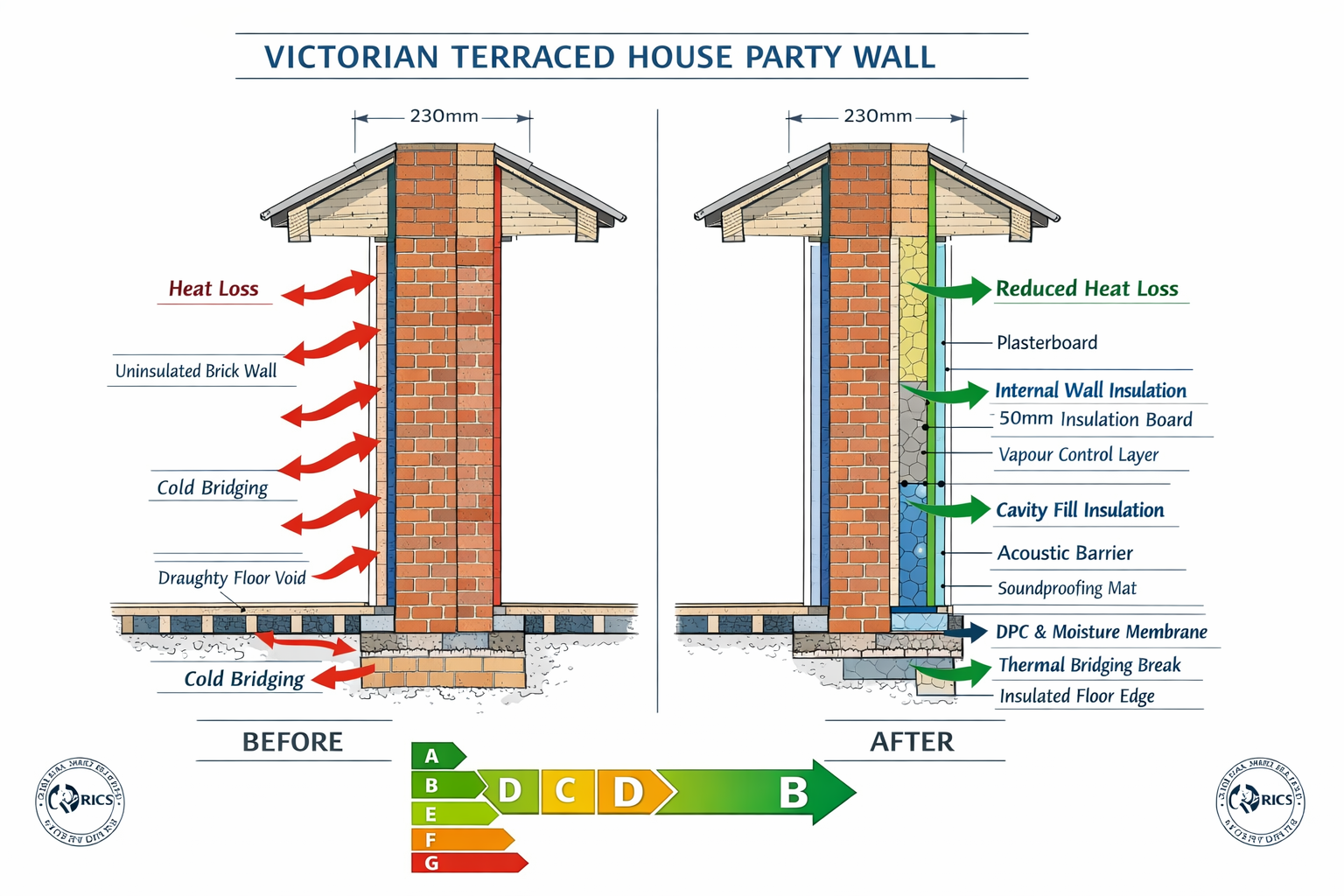
Thermal Performance: Uninsulated party walls contribute significantly to heat loss, particularly in older properties. While they separate heated spaces, temperature differentials between properties create thermal bridging and energy inefficiency.
Structural Considerations: Installing internal wall insulation (IWI) or upgrading party wall cavities involves structural modifications that fall squarely under the Party Wall Act 1996.
Acoustic Implications: Energy retrofits can inadvertently affect sound transmission between properties, creating potential disputes if not properly managed through party wall procedures.
Deep energy retrofit strategies increasingly recognize that comprehensive approaches—addressing walls, roofs, windows, and mechanical systems simultaneously—deliver superior performance compared to piecemeal improvements[2]. This integrated approach makes party wall considerations unavoidable.
Party Wall Essentials for Net Zero Retrofits: Core Survey Requirements
Implementing net zero retrofits while maintaining legal compliance and neighbor relationships requires rigorous survey protocols. Understanding Party Wall Essentials for Net Zero Retrofits: Survey Protocols as EPC Mandates Tighten in 2026 means recognizing that professional surveying isn't optional—it's foundational to project success.
The Party Wall Act 1996 Framework
The Party Wall Act 1996 establishes the legal framework governing work on shared walls, boundaries, and excavations near neighboring properties. For net zero retrofits, several sections are particularly relevant:
Section 2(2)(a) covers work to existing party walls, including:
- Installing insulation systems
- Creating chases for new services
- Upgrading damp-proof courses
- Strengthening walls for additional loads
Section 2(2)(m) addresses inserting damp-proof courses, which often accompanies retrofit insulation work to prevent interstitial condensation.
Compliance requires serving formal notices to adjoining owners at least two months before commencing work. This timeline is critical for 2026 planning, as retrofit demand will create surveyor capacity constraints.
Essential Survey Protocols for Retrofit Projects
Professional party wall surveyors follow established protocols that protect all parties during net zero upgrade projects:
1. Pre-Work Schedule of Condition
The Schedule of Condition represents the most critical protective document in retrofit projects. This comprehensive photographic and written record documents:
- Existing cracks, settlement, or structural defects in party walls
- Current decorative condition of adjoining properties
- Baseline measurements of wall alignments and verticality
- Existing moisture levels and damp indicators
- Acoustic performance baselines
For net zero retrofits involving insulation installation, thermal imaging surveys should supplement traditional schedules of condition, documenting existing thermal performance and moisture patterns that could affect retrofit design.
2. Technical Design Review
RICS-qualified surveyors assess retrofit specifications to identify potential party wall implications:
- Insulation thickness and fixing methods: Mechanical fixings penetrating party walls require specific consideration
- Vapor control layers: Ensuring moisture management doesn't create problems in adjoining properties
- Acoustic performance: Verifying that retrofit work won't degrade sound insulation below Building Regulations standards
- Structural loading: Assessing whether additional weight from insulation systems affects party wall capacity
This technical review often identifies design modifications that prevent disputes before they arise.
3. Party Wall Award Documentation
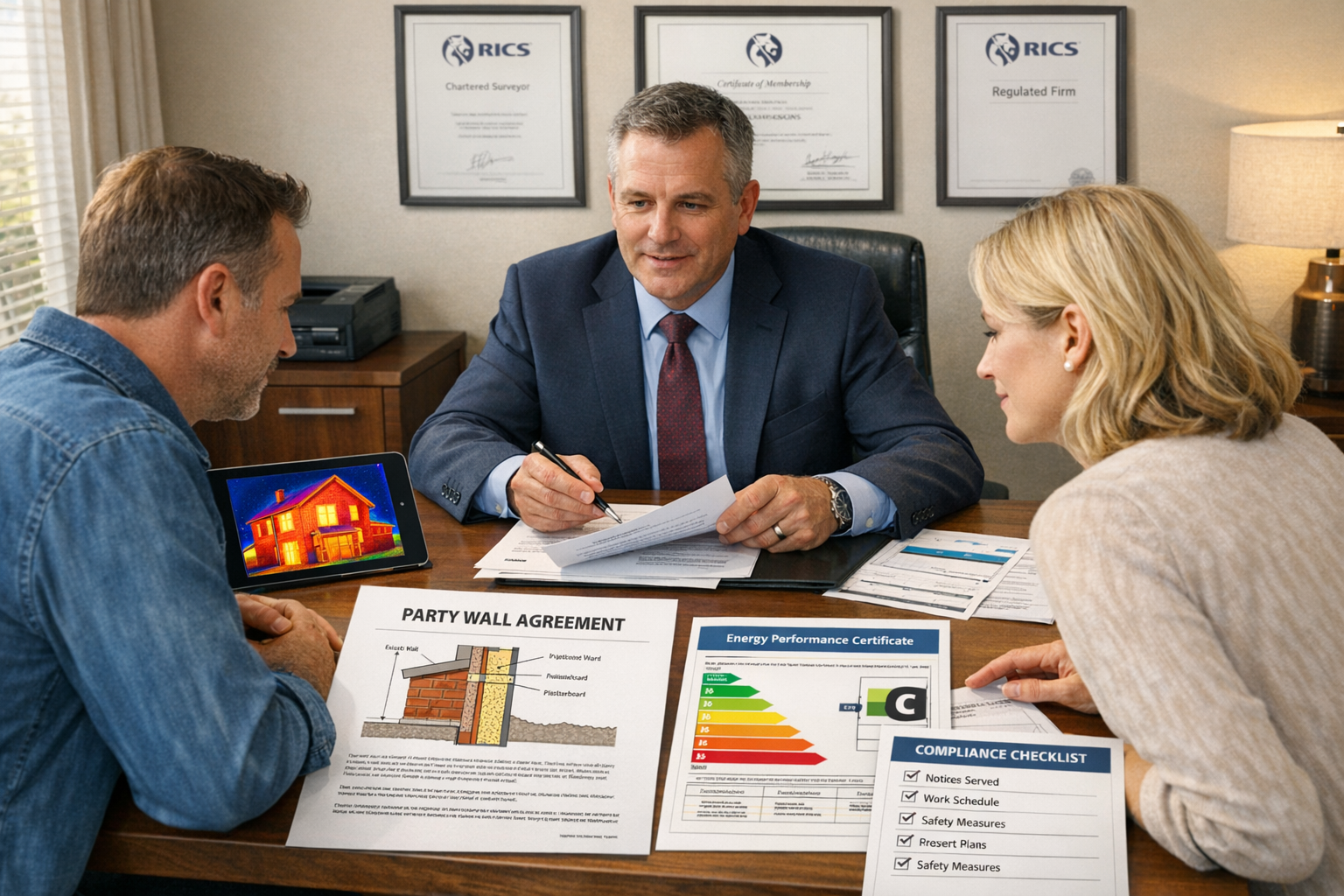
The Party Wall Award is the legally binding document that authorizes work and establishes protections. For net zero retrofits, comprehensive awards should include:
| Award Component | Retrofit-Specific Considerations |
|---|---|
| Work Description | Detailed insulation specifications, fixing methods, and thermal performance targets |
| Access Rights | Provisions for thermal imaging surveys and post-installation verification |
| Working Hours | Restrictions minimizing disruption during extended retrofit timelines |
| Protective Measures | Dust control, vibration limits, and acoustic monitoring protocols |
| Dispute Resolution | Clear procedures for addressing unforeseen issues during retrofit work |
| Cost Allocation | Transparent framework for who pays for surveyors and additional work |
Professional party wall awards provide template frameworks that can be adapted for specific retrofit scenarios, ensuring consistency and legal robustness.
4. Ongoing Monitoring and Post-Completion Inspection
Net zero retrofits often involve extended timelines and phased implementation. Effective survey protocols include:
- Progress inspections at key milestones (insulation installation, vapor barrier completion, finishing)
- Moisture monitoring during and after retrofit to verify no interstitial condensation issues
- Thermal performance verification using infrared thermography
- Final condition survey comparing post-work condition to baseline schedule
This ongoing engagement prevents small issues from escalating into major disputes and provides documentary evidence of proper execution.
RICS Guidance for Retrofit Projects
The Royal Institution of Chartered Surveyors (RICS) provides professional standards that elevate party wall practice beyond minimum legal requirements. RICS party wall surveyors bring specialized expertise in:
- Impartiality: Acting fairly between building and adjoining owners
- Technical competence: Understanding both party wall law and building physics relevant to energy retrofits
- Professional indemnity: Providing financial protection if errors occur
- Continuing professional development: Staying current with evolving retrofit technologies and EPC requirements
Engaging RICS-qualified professionals significantly reduces risk in complex retrofit scenarios where sustainability objectives intersect with property law.
Implementing Party Wall Essentials for Net Zero Retrofits: Practical Protocols
Understanding legal requirements is one thing; implementing effective protocols that keep retrofit projects on schedule while maintaining neighbor relationships requires practical expertise. The following protocols represent best practices emerging as Party Wall Essentials for Net Zero Retrofits: Survey Protocols as EPC Mandates Tighten in 2026 become industry standard.
Timeline Planning for 2026 Compliance
Effective retrofit planning integrates party wall procedures into overall project timelines:
Months 6-4 Before Work:
- Conduct initial energy assessment and retrofit design
- Identify party wall implications
- Engage party wall surveyor for preliminary consultation
- Review whether party wall agreement is needed
Months 4-3 Before Work:
- Finalize retrofit specifications
- Prepare party wall notices
- Commission baseline schedule of condition
- Begin neighbor consultation (informal, before formal notice)
Months 3-2 Before Work:
- Serve formal party wall notices (minimum 2 months required)
- Appoint surveyors if disputes arise
- Negotiate party wall award terms
- Finalize access arrangements
Months 2-0 Before Work:
- Execute party wall award
- Obtain building control approval
- Coordinate contractor mobilization
- Conduct final pre-work inspections
During Work:
- Implement monitoring protocols
- Maintain communication with adjoining owners
- Document progress with photographic records
- Address emerging issues promptly
Post-Completion:
- Conduct final condition survey
- Compare against baseline schedule
- Address any damage or defects
- Obtain formal sign-off from all parties
This timeline assumes cooperative neighbors. Disputes can extend timelines by 2-4 months, making early engagement critical for meeting 2026 compliance deadlines.
Common Retrofit Scenarios and Survey Approaches
Different retrofit strategies require tailored party wall protocols:
Internal Wall Insulation (IWI)
Party Wall Implications: Installing IWI typically involves mechanical fixings penetrating party walls, creating direct party wall work under Section 2(2)(a).
Survey Protocol:
- Document existing wall condition with particular attention to damp, cracks, and plaster integrity
- Assess structural capacity for fixing loads
- Verify adjoining owner's decorative condition (vibration from drilling can cause damage)
- Include specific fixing methods and spacing in party wall award
- Monitor moisture levels during and after installation
Dispute Prevention: Clearly communicate that IWI reduces room dimensions slightly (typically 100-150mm) but doesn't affect adjoining property space.
Cavity Wall Insulation Upgrades
Party Wall Implications: While cavity walls aren't technically party walls under the Act, work affecting shared cavities in semi-detached properties requires notice.
Survey Protocol:
- Conduct cavity inspection (borescope) to verify suitability
- Document existing cavity condition
- Assess potential for moisture bridging
- Verify adequate cavity width for proposed insulation
- Include post-installation thermal imaging verification
Dispute Prevention: Address concerns about moisture penetration with technical specifications and guarantees.
External Wall Insulation (EWI) on Gable Walls
Party Wall Implications: EWI on gable ends of terraced properties often requires access through adjoining property gardens or involves work at the boundary.
Survey Protocol:
- Document access routes and potential impact on adjoining landscaping
- Assess scaffold requirements and party wall consent needs
- Include access rights and restoration obligations in award
- Photograph adjoining property areas affected by access
Dispute Prevention: Offer to restore affected areas to equal or better condition, with specifications agreed in advance.
Roof and Loft Insulation with Party Wall Considerations
Party Wall Implications: Upgrading roof insulation in terraced properties may require work to party wall parapets or fire barriers.
Survey Protocol:
- Assess party wall parapet condition and height
- Verify fire barrier integrity
- Document roof structure connections to party walls
- Include specifications for maintaining fire separation
Dispute Prevention: Emphasize that proper fire barriers protect both properties and may be required by Building Regulations regardless of retrofit work.
Technology Integration in Modern Survey Protocols
Advanced technologies enhance traditional party wall survey methods, particularly relevant for net zero retrofits:
Thermal Imaging: Infrared thermography identifies existing thermal bridging, moisture issues, and post-retrofit performance verification. Including thermal surveys in schedules of condition provides objective evidence of improvement.
3D Laser Scanning: Creates precise digital records of existing conditions, particularly valuable for complex party wall configurations or heritage properties where traditional measurement may be insufficient.
Moisture Monitoring Systems: Wireless sensors can track moisture levels in party walls during and after retrofit, providing early warning of condensation issues before visible damage occurs.
Digital Documentation Platforms: Cloud-based systems allow real-time sharing of survey reports, photographs, and inspection records with all parties, improving transparency and reducing disputes.
Cost Management and Financial Protocols
Financial clarity prevents disputes. Professional party wall awards establish:
Building Owner Responsibilities:
- All surveyor fees (both appointed and agreed surveyors) in non-dispute scenarios
- Repair of any damage to adjoining property
- Restoration of disturbed areas to original condition
- Costs of additional protective measures required by surveyors
Adjoining Owner Protections:
- Right to independent surveyor at building owner's expense if dispute arises
- Compensation for loss of amenity during extended works
- Security for costs if building owner's financial position is uncertain
Shared Benefit Scenarios:
When retrofit work benefits both properties (e.g., party wall insulation improving thermal performance for both), cost-sharing arrangements can be negotiated. However, these require clear documentation of:
- Proportional benefit calculation methodology
- Payment schedules and mechanisms
- Ongoing maintenance responsibilities
- Future sale implications
Professional surveyors provide transparent cost frameworks that prevent financial disputes from derailing sustainability projects.
Navigating Disputes and Ensuring Compliance
Even with excellent planning, disputes can arise during retrofit projects. Understanding resolution mechanisms and compliance requirements protects project timelines and relationships.
Common Dispute Triggers in Retrofit Projects
Noise and Disruption: Extended retrofit timelines (often 4-8 weeks for comprehensive party wall work) test neighbor patience. Clear communication about schedules and progress reduces tension.
Unexpected Conditions: Opening up party walls often reveals hidden issues—previous alterations, structural defects, or moisture problems. Party wall awards should include provisions for addressing unforeseen conditions.
Performance Concerns: Adjoining owners may worry that retrofit work will cause condensation, noise transmission, or structural issues in their property. Technical specifications and monitoring protocols address these concerns.
Access Disputes: Retrofit work sometimes requires access through adjoining property. Party wall awards should specify access rights, timing, and restoration obligations.
Resolution Mechanisms
The Party Wall Act 1996 provides structured dispute resolution:
-
Agreed Surveyor Approach: Both parties appoint a single surveyor, reducing costs and streamlining decisions. This works well when relationships are good and work is straightforward.
-
Two Surveyor Approach: Each party appoints their own surveyor, who then work together to produce an agreed award. This provides independent representation but increases costs.
-
Third Surveyor: If appointed surveyors cannot agree, they select a third surveyor whose decision is binding. This is rare but provides final resolution.
-
Appeals: Parties can appeal awards to County Court within 14 days, though this is expensive and uncommon.
For net zero retrofits with sustainability urgency, early surveyor engagement and clear technical specifications minimize disputes that could delay 2026 compliance.
Compliance Verification and Documentation
Demonstrating compliance with both party wall procedures and EPC requirements requires comprehensive documentation:
Party Wall Compliance Records:
- Copies of all notices served
- Proof of delivery (recorded mail receipts)
- Party wall award with all parties' signatures
- Schedule of condition (baseline and final)
- Photographic evidence of work progression
- Correspondence with adjoining owners and surveyors
EPC Compliance Records:
- Pre-retrofit EPC certificate
- Retrofit specification and design calculations
- Building control approval and completion certificate
- Post-retrofit EPC certificate showing Band C achievement
- Installer certifications for insulation and other measures
These records protect against future claims and provide evidence of regulatory compliance if challenged by local authorities or in property transactions.
When Party Wall Notice Wasn't Served
Unfortunately, some building owners proceed with retrofit work without proper party wall procedures. If no party wall notice was served, adjoining owners have legal remedies:
- Injunction: Court order stopping work until proper procedures are followed
- Retrospective Notice: Building owner can serve notice after work begins, though this doesn't excuse the initial failure
- Damages: Adjoining owner may claim compensation for proceeding without notice
- Forced Rectification: Court can order removal of work done without proper authorization
For building owners, the risks of skipping party wall procedures far outweigh the perceived time and cost savings. Professional surveyors ensure compliance from the outset.
Strategic Considerations for 2026 and Beyond
As EPC mandates tighten and net zero targets approach, strategic planning becomes essential for property owners, landlords, and construction professionals.
Market Dynamics and Capacity Constraints
The convergence of 2026 EPC deadlines with existing construction sector capacity constraints creates predictable challenges:
Surveyor Availability: Demand for qualified party wall surveyors will surge as millions of properties require retrofit. Early engagement secures access to experienced professionals.
Contractor Capacity: Specialist retrofit contractors with party wall experience represent limited supply. Booking work 6-12 months in advance becomes standard practice.
Material Supply: Insulation materials, particularly those suitable for party wall applications with acoustic and fire performance requirements, may face supply constraints.
Cost Escalation: Basic economic principles suggest that surging demand against constrained supply will drive price increases for surveying, materials, and installation services.
Property owners who plan early gain competitive advantage in accessing professional services and controlling costs.
Portfolio Strategies for Landlords
Landlords with multiple properties face strategic decisions about retrofit sequencing and approach:
Prioritization Framework:
- Properties furthest below Band C (requiring most extensive work)
- Properties with upcoming tenancy changes (easier to schedule work)
- Properties where neighbors are also planning retrofits (coordination opportunities)
- Properties with highest rental values (maximizing return on investment)
Coordination Opportunities: When multiple terraced properties require party wall retrofits, coordinating work between neighbors can:
- Share surveyor costs through agreed surveyor appointments
- Reduce per-property costs through bulk material purchasing
- Minimize total disruption by completing work simultaneously
- Improve overall thermal performance through consistent approach
Phased Implementation: For large portfolios, phased approaches spread costs and allow learning from early projects to improve later implementations.
Future-Proofing Beyond 2026
Smart property owners look beyond immediate 2026 compliance toward longer-term sustainability goals:
2030 and Beyond: Regulatory trajectories suggest continued tightening. Work done in 2026 should anticipate future Band B or even Band A requirements where economically feasible.
Whole-House Approach: Deep energy retrofits addressing multiple building elements simultaneously deliver superior performance compared to incremental improvements[2]. Party wall work should integrate with roof, window, and mechanical system upgrades.
Zero-Carbon vs. Net-Zero: Understanding the distinction between net-zero energy (balancing consumption with generation) and zero-carbon (eliminating carbon emissions) helps inform technology choices[2]. Party wall retrofits should accommodate future renewable energy integration.
Heritage and Conservation: For listed buildings or conservation areas, party wall retrofits require additional planning consent and specialized approaches balancing heritage preservation with energy performance.
Conclusion
The intersection of tightening EPC mandates and net zero ambitions in 2026 creates unprecedented challenges and opportunities for UK property owners. Party Wall Essentials for Net Zero Retrofits: Survey Protocols as EPC Mandates Tighten in 2026 represents more than regulatory compliance—it embodies a fundamental shift toward sustainable property management that respects both environmental imperatives and neighbor relationships.
Success requires recognizing that party wall procedures aren't obstacles to sustainability goals but rather essential frameworks that enable ambitious retrofit projects while protecting all stakeholders. Professional survey protocols, RICS-compliant documentation, and early engagement with qualified surveyors transform potential conflicts into collaborative opportunities.
Actionable Next Steps
For property owners and landlords facing 2026 EPC requirements:
- Assess Current Performance: Obtain up-to-date EPC certificates for all properties to understand the retrofit gap
- Engage Professionals Early: Contact chartered surveyors with party wall and retrofit expertise 4-6 months before planned work
- Develop Comprehensive Plans: Integrate party wall procedures into overall retrofit project timelines
- Communicate Proactively: Begin informal neighbor discussions before serving formal notices
- Document Everything: Maintain comprehensive records of all surveys, notices, agreements, and work progression
- Consider Coordination: Explore opportunities to coordinate with neighbors planning similar work
- Plan for Contingencies: Build time and budget buffers for unforeseen conditions or disputes
For construction professionals and retrofit specialists:
- Develop Party Wall Expertise: Invest in training and partnerships with qualified party wall surveyors
- Create Standard Protocols: Develop RICS-compliant templates and procedures for common retrofit scenarios
- Build Capacity: Anticipate surging demand and expand team capabilities accordingly
- Integrate Technologies: Adopt thermal imaging, moisture monitoring, and digital documentation systems
- Educate Clients: Provide clear guidance on party wall requirements early in project discussions
The path to net zero runs through millions of party walls across the UK. Those who master the essentials of survey protocols, legal compliance, and professional practice will lead the sustainable retrofit revolution while those who neglect these fundamentals will face costly delays, disputes, and compliance failures.
The 2026 deadline approaches rapidly. The time to act is now—with proper planning, professional guidance, and respect for the party wall procedures that protect everyone involved in this essential transformation of the UK's housing stock.
References
[1] Top 5 Esg Trends In Real Estate – https://rhino.energy/blog/top-5-esg-trends-in-real-estate
[2] 17392 Continuing Education Net Zero Retrofits – https://www.architecturalrecord.com/articles/17392-continuing-education-net-zero-retrofits
