
The UK rental market in 2026 presents a fascinating paradox: tenant demand has declined to six-year lows, yet rental supply remains critically constrained at levels 23% below pre-pandemic baselines. For property professionals, landlords, and chartered surveyors, understanding this dynamic is essential for accurate Lettings Tenant Demand Uptick: Valuation Surveys for Constrained Rental Supply in Q1 2026 assessments. This shifting landscape demands sophisticated valuation strategies that account for reduced competition, extended letting periods, and persistent structural supply shortages that continue to support rental price growth despite cooling demand metrics.
Key Takeaways
- Tenant demand has fallen 14% year-over-year to six-year lows, with enquiries per property dropping to 4.8 compared to pandemic-era peaks, primarily driven by reduced migration patterns [1]
- Rental supply increased 11% annually but remains 23% below pre-pandemic levels, creating a persistent structural shortage that continues to support rental price growth [1]
- Average time to let has extended to 20 days, reflecting reduced tenant competition and improved negotiating conditions for renters in Q1 2026 [1]
- Rental price growth is projected at 2% for 2026, down from previous years but sustained by the fundamental supply-demand imbalance [5]
- Professional valuation surveys are critical for landlords and investors to accurately price rental properties in this transitioning market environment
Understanding the Lettings Tenant Demand Uptick: Valuation Surveys for Constrained Rental Supply in Q1 2026 Landscape
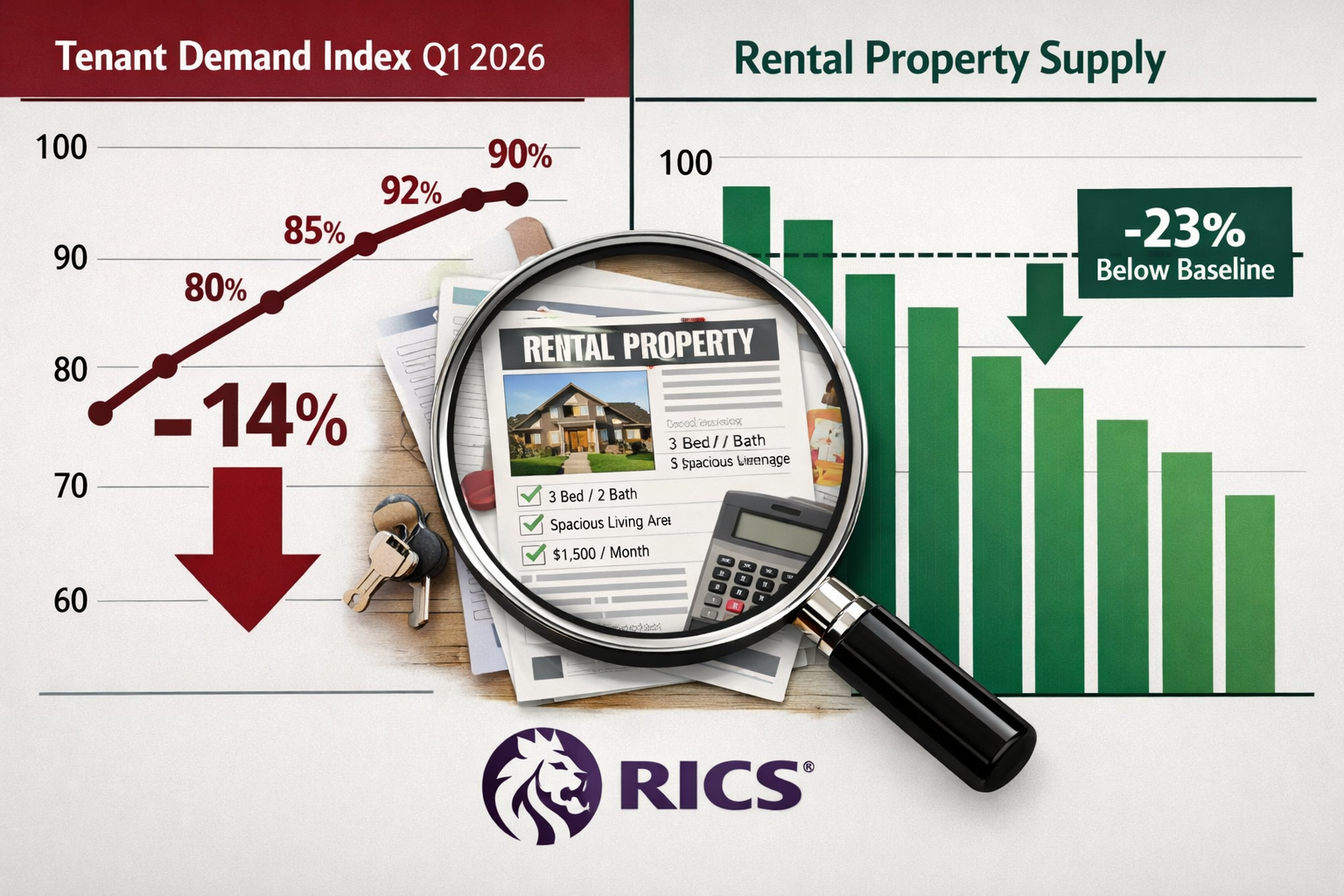
The UK rental market has entered a distinctive phase in early 2026, characterized by cooling tenant demand alongside persistent supply constraints. According to the latest industry data, tenant demand has decreased 14% compared to the same period in 2025, marking the lowest level recorded in six years [1]. This represents a significant shift from the intense competition witnessed during the pandemic period, when prospective tenants competed aggressively for limited available properties.
The Demand Decline: Key Metrics 📊
Current market indicators reveal substantial changes in tenant behavior:
- Enquiries per property: Down to 4.8 in Q1 2026, compared to pandemic peaks of 15-20 enquiries per listing [1]
- National demand baseline: Measured at 10 enquiries per rental property in 2025, declining from 14 in 2024 [6]
- Pre-pandemic comparison: Still elevated above the 2019 baseline of approximately 6 enquiries per property [6]
- Time to let: Extended to an average of 20 days, providing landlords more time for tenant selection [1]
Supply Constraints Persist Despite Growth
While demand has cooled, the supply side tells a different story. Rental property availability increased 11% year-over-year in Q1 2026, yet absolute stock levels remain severely constrained [1]. The critical statistic: rental supply sits 23% below pre-pandemic levels, creating a structural shortage that continues to underpin rental pricing power.
This supply deficit stems from multiple factors:
- Landlord exodus: Regulatory changes and tax policy adjustments have prompted many small landlords to exit the market
- Build-to-rent delays: New purpose-built rental developments have not compensated for lost private landlord stock
- Conversion restrictions: Tighter planning regulations limiting property conversions
- Economic uncertainty: Some landlords holding properties off-market awaiting clearer economic signals
"Despite tenant demand falling to six-year lows, the fundamental supply shortage means the rental market remains structurally tight, requiring careful valuation approaches that balance reduced competition with persistent scarcity." — UK Rental Market Report March 2026
For property professionals conducting valuation surveys, this paradox creates unique challenges. Traditional valuation methodologies must adapt to account for both reduced tenant urgency and sustained supply-side pricing pressure.
Regional Variations in Demand Patterns
The Lettings Tenant Demand Uptick: Valuation Surveys for Constrained Rental Supply in Q1 2026 phenomenon varies significantly across UK regions. London and the South East have experienced more pronounced demand cooling, while regional cities like Manchester, Birmingham, and Leeds maintain relatively stronger tenant interest [6]. These geographical disparities require location-specific valuation approaches rather than blanket national assumptions.
Understanding these nuanced market dynamics is essential for accurate rental property valuations that reflect true market conditions in Q1 2026.
Valuation Survey Strategies for the Q1 2026 Rental Market

Chartered surveyors and property professionals must recalibrate their valuation methodologies to accurately reflect the transformed rental landscape of 2026. The traditional approaches that worked during the high-demand pandemic period require significant adjustment to account for extended letting periods, reduced competition, and evolving tenant expectations.
RICS-Compliant Valuation Approaches 🏠
When conducting Lettings Tenant Demand Uptick: Valuation Surveys for Constrained Rental Supply in Q1 2026, professionals should employ these evidence-based strategies:
1. Comparative Market Analysis (CMA) Adjustments
The foundation of rental valuation remains comparative analysis, but with critical modifications:
- Expand the time window: Use comparable lettings from the past 90 days rather than 30-60 days to capture sufficient data points in the slower market
- Weight recent transactions more heavily: Properties let in Q1 2026 provide more relevant pricing signals than those from late 2025
- Account for time-on-market differentials: Properties that let quickly may have been underpriced; those with extended marketing periods may reflect overpricing
- Regional adjustment factors: Apply location-specific multipliers reflecting local demand variations
2. Supply-Demand Equilibrium Modeling
Professional valuations must incorporate both sides of the market equation:
| Market Factor | Q1 2026 Status | Valuation Impact |
|---|---|---|
| Tenant Demand | -14% YoY, 6-year low | Downward pressure on achievable rents |
| Property Supply | +11% YoY, but -23% vs. pre-pandemic | Upward support for rental pricing |
| Time to Let | 20 days average | Reduced urgency premium |
| Enquiries per Property | 4.8 (down from 10+ in 2025) | Lower competition factor |
| Projected Rent Growth | +2% for 2026 | Modest appreciation expectation |
3. Property Condition and Presentation Premium
With reduced tenant competition, property quality differentiation becomes more pronounced. Surveyors should apply enhanced value adjustments for:
- Energy efficiency ratings: EPC ratings of B or above command measurable rent premiums as tenants become more cost-conscious
- Modern amenities: Updated kitchens, bathrooms, and smart home features attract quality tenants faster
- Maintenance standards: Well-maintained properties with recent structural surveys documenting sound condition
- Flexible spaces: Properties offering home office capabilities maintain stronger demand
For comprehensive property assessment, consider conducting a Level 2 or Level 3 survey to identify any condition issues that might impact rental valuation.
Pricing Strategy Recommendations
Based on current market conditions, valuation surveys should guide landlords toward these pricing approaches:
Competitive Positioning Strategy 💰
Rather than maximizing headline rent, focus on optimizing total return:
- Price 2-5% below comparable properties to generate multiple quality enquiries within the first week
- Emphasize value proposition: Highlight included amenities, flexible lease terms, or included utilities
- Reduce void periods: A property let at 5% below peak rent with no void period outperforms one at peak rent with 30+ days vacancy
Tenant Quality Over Maximum Rent
The extended time-to-let environment allows for more selective tenant screening:
- Price to attract 6-8 quality enquiries rather than 15-20 mixed-quality prospects
- Target professional tenants with stable employment and strong references
- Consider longer lease terms (18-24 months) at modest rent discounts to reduce turnover costs
Flexible Lease Structures
Innovative lease arrangements can differentiate properties in the Q1 2026 market:
- Graduated rent schedules: Lower initial rent with scheduled increases
- Break clauses: Mutual break options after 12 months provide flexibility for both parties
- Incentive packages: First month reduced rent or professional cleaning included
Technology-Enhanced Valuation Tools
Modern valuation surveys for rental properties should leverage:
- Automated Valuation Models (AVMs): Use as supporting data but not primary valuation method
- Rental yield calculators: Incorporate realistic void period assumptions (15-25 days)
- Market trend analytics: Real-time data feeds showing local demand shifts
- Comparative dashboards: Visual tools presenting multiple comparable properties with adjustment factors
For landlords considering property improvements before letting, a comprehensive building survey can identify value-enhancing renovation opportunities.
Strategic Implications for Landlords and Investors in Q1 2026
The Lettings Tenant Demand Uptick: Valuation Surveys for Constrained Rental Supply in Q1 2026 environment requires landlords and property investors to recalibrate their strategies for optimal returns. While the market has cooled from pandemic-era intensity, fundamental supply constraints continue to support rental investment viability for well-positioned properties.
Investment Decision Framework 📈
Investors evaluating rental property acquisitions or portfolio retention should consider these factors:
Capital Growth vs. Rental Yield Balance
The 2026 rental market presents a yield-focused opportunity rather than aggressive capital appreciation:
- Projected rental growth: 2% annually for 2026, down from 4-6% in previous years [5]
- Capital value stability: Property prices showing modest growth in most regions [2]
- Total return focus: Emphasis on consistent rental income rather than speculative gains
- Risk-adjusted returns: Rental property remains competitive with other income-generating assets
Portfolio Optimization Strategies
Existing landlords should conduct portfolio reviews using current valuation surveys:
Hold Strategy Indicators:
- Properties in high-demand locations with sustained tenant interest
- Well-maintained assets requiring minimal capital expenditure
- Properties achieving market-rate rents with minimal void periods
- Assets with strong energy efficiency ratings (EPC B or above)
Disposal Strategy Indicators:
- Properties requiring significant capital investment for compliance or maintenance
- Assets in oversupplied micro-markets with extended void periods
- Properties consistently achieving below-market rents
- High-maintenance properties with problematic tenant histories
Acquisition Opportunity Criteria:
- Properties priced below replacement cost in supply-constrained areas
- Assets requiring cosmetic improvements that can be completed economically
- Locations with strong employment growth and limited new supply pipeline
- Properties suitable for professional tenants (near transport, amenities)
Regulatory Compliance and Valuation Impact
The Q1 2026 rental landscape includes evolving regulatory requirements that directly impact property valuations:
Energy Efficiency Standards
- Minimum EPC ratings: Properties must achieve minimum standards for legal letting
- Improvement costs: Factor £5,000-£15,000+ for upgrading older properties to compliant standards
- Rental premium: EPC B-rated properties command 8-12% rent premiums over C-rated equivalents
- Future-proofing: Anticipate further regulatory tightening requiring proactive upgrades
For properties with potential structural concerns, conducting subsidence surveys or roof surveys before purchase can prevent costly surprises.
Tenant Protection Legislation
Recent and pending legislation affects landlord-tenant dynamics:
- Deposit limitations: Capped at 5 weeks' rent for most properties
- Notice period requirements: Extended notice periods for tenant evictions
- Rent increase restrictions: Limitations on frequency and magnitude of rent increases
- Property condition standards: Enhanced requirements for property maintenance and safety
Financial Modeling for Rental Investments
Accurate financial projections require realistic assumptions based on Q1 2026 market conditions:
Updated Assumption Parameters:
Gross Rental Yield: 4.5-6.0% (location dependent)
Void Period Allowance: 20-25 days annually (up from 10-15 days)
Maintenance Reserve: 10-15% of gross rent
Management Fees: 10-12% of gross rent (if using agents)
Rental Growth Rate: 2% annually for 2026-2027
Tenant Turnover Cycle: 24-30 months average
Example Investment Analysis:
Consider a £300,000 rental property in a regional city:
- Monthly Rent: £1,400 (5.6% gross yield)
- Annual Gross Income: £16,800
- Void Period (20 days): -£933
- Maintenance (12%): -£2,016
- Management (11%): -£1,848
- Insurance & Other: -£600
- Net Operating Income: £11,403
- Net Yield: 3.8%
This realistic modeling demonstrates the importance of accurate valuation surveys that account for actual market conditions rather than optimistic projections.
Tenant Retention Strategies
With extended time-to-let periods, retaining quality tenants becomes increasingly valuable:
Retention Best Practices:
- Responsive maintenance: Address repair requests promptly to maintain tenant satisfaction
- Reasonable rent increases: Limit annual increases to 2-3% to avoid triggering tenant turnover
- Lease renewal incentives: Offer minor upgrades or rent freezes for lease extensions
- Professional communication: Maintain courteous, businesslike landlord-tenant relationships
The cost of tenant turnover in Q1 2026 includes:
- Void period: 20 days average = £933 lost rent (using example above)
- Marketing and letting fees: £500-£1,000
- Property preparation: £300-£800
- Reference checking and administration: £100-£300
- Total turnover cost: £1,800-£3,000+
Retaining a good tenant through modest rent concessions often proves more economical than seeking maximum rent increases and facing turnover.
Professional Valuation: When to Commission Surveys
Landlords should obtain professional RICS valuation reports in these circumstances:
- Portfolio refinancing: Lenders require current valuations reflecting Q1 2026 market conditions
- Partnership disputes: Independent valuations provide objective property values
- Tax planning: Capital gains tax valuations for disposal planning
- Acquisition decisions: Pre-purchase valuations to validate asking prices
- Rent review disputes: Expert opinions on market rent levels
Understanding what survey you need depends on your specific circumstances and property type.
Conclusion: Navigating the Constrained Supply Rental Market
The Lettings Tenant Demand Uptick: Valuation Surveys for Constrained Rental Supply in Q1 2026 landscape presents both challenges and opportunities for property professionals, landlords, and investors. While tenant demand has cooled to six-year lows with enquiries per property dropping to 4.8 [1], the persistent structural supply shortage—with rental stock remaining 23% below pre-pandemic levels [1]—continues to provide fundamental support for rental values.
Key Strategic Takeaways
For Property Professionals and Surveyors:
- Adapt valuation methodologies to account for extended letting periods (20 days average) and reduced competition
- Incorporate both demand cooling and supply constraints into comprehensive market assessments
- Utilize expanded comparable timeframes and regional adjustment factors for accurate valuations
- Emphasize property quality differentiation as a key value driver in the less competitive environment
For Landlords:
- Price properties competitively (2-5% below peak comparables) to minimize void periods
- Focus on tenant quality and retention rather than maximum headline rents
- Invest in property improvements that command measurable rent premiums (energy efficiency, modern amenities)
- Consider flexible lease structures to differentiate properties in the Q1 2026 market
For Investors:
- Evaluate opportunities through a yield-focused lens with realistic 2% rental growth projections [5]
- Conduct thorough due diligence including professional valuation surveys before acquisitions
- Factor realistic void periods (20-25 days) and maintenance reserves (10-15%) into financial models
- Target supply-constrained locations with strong employment fundamentals
Actionable Next Steps
-
Commission a Professional Valuation: Obtain an up-to-date RICS-compliant valuation reflecting Q1 2026 market conditions for accurate pricing decisions
-
Assess Property Condition: Conduct necessary building surveys to identify maintenance requirements and value-enhancing improvement opportunities
-
Review Pricing Strategy: Adjust rental expectations to reflect the cooled demand environment while recognizing persistent supply constraints
-
Optimize Property Presentation: Invest in cost-effective improvements that differentiate your property in a less competitive market
-
Develop Tenant Retention Plans: Implement strategies to retain quality tenants and minimize costly turnover in the extended time-to-let environment
The UK rental market in Q1 2026 requires sophisticated analysis that recognizes the nuanced interplay between cooling demand and constrained supply. Professional valuation surveys provide the critical foundation for informed decision-making in this transitioning landscape. By understanding these dynamics and adapting strategies accordingly, landlords and investors can continue to achieve solid returns while navigating the evolving rental market environment.
For expert guidance on rental property valuations and comprehensive survey services tailored to the Q1 2026 market conditions, consult with qualified RICS chartered surveyors who understand the complexities of the current lettings landscape.
References
[1] UK Rental Market Report March 2026 – https://assets.ctfassets.net/2zc2pc2uwamh/4ytGOrzcBHJCz2biMu14Ea/aead7412968a18fcf1123c37e8ece446/UK_Rental_Market_Report_March_2026.pdf
[2] UK Real Estate Market Outlook Q1 2026 – https://www.aberdeeninvestments.com/en-gb/professional/insights-and-research/uk-real-estate-market-outlook-q1-2026
[5] UK Average Advertised Rents Up 2% in 2025 With 2% Rise Eyed in 2026 – https://www.morningstar.com/news/alliance-news/1768435319421453900/uk-average-advertised-rents-up-2-in-2025-with-2-rise-eyed-in-2026
[6] UK Rental Market Outlook 2026: National Trends & North West Growth Analysis – https://www.farrellheyworth.co.uk/blog/uk-rental-market-outlook-2026-national-trends-north-west-growth-analysis/
