
The artificial intelligence revolution has triggered an unprecedented surge in data centre construction across the United Kingdom, fundamentally transforming how Building Surveys for Data Centre Expansions: Structural Assessments Amid 2026 AI Infrastructure Boom must be conducted. As AI workloads demand exponentially more computing power, the structural requirements for these facilities have evolved beyond traditional parameters, challenging surveyors to adapt their assessment protocols while maintaining rigorous RICS compliance standards in increasingly fast-track development environments.
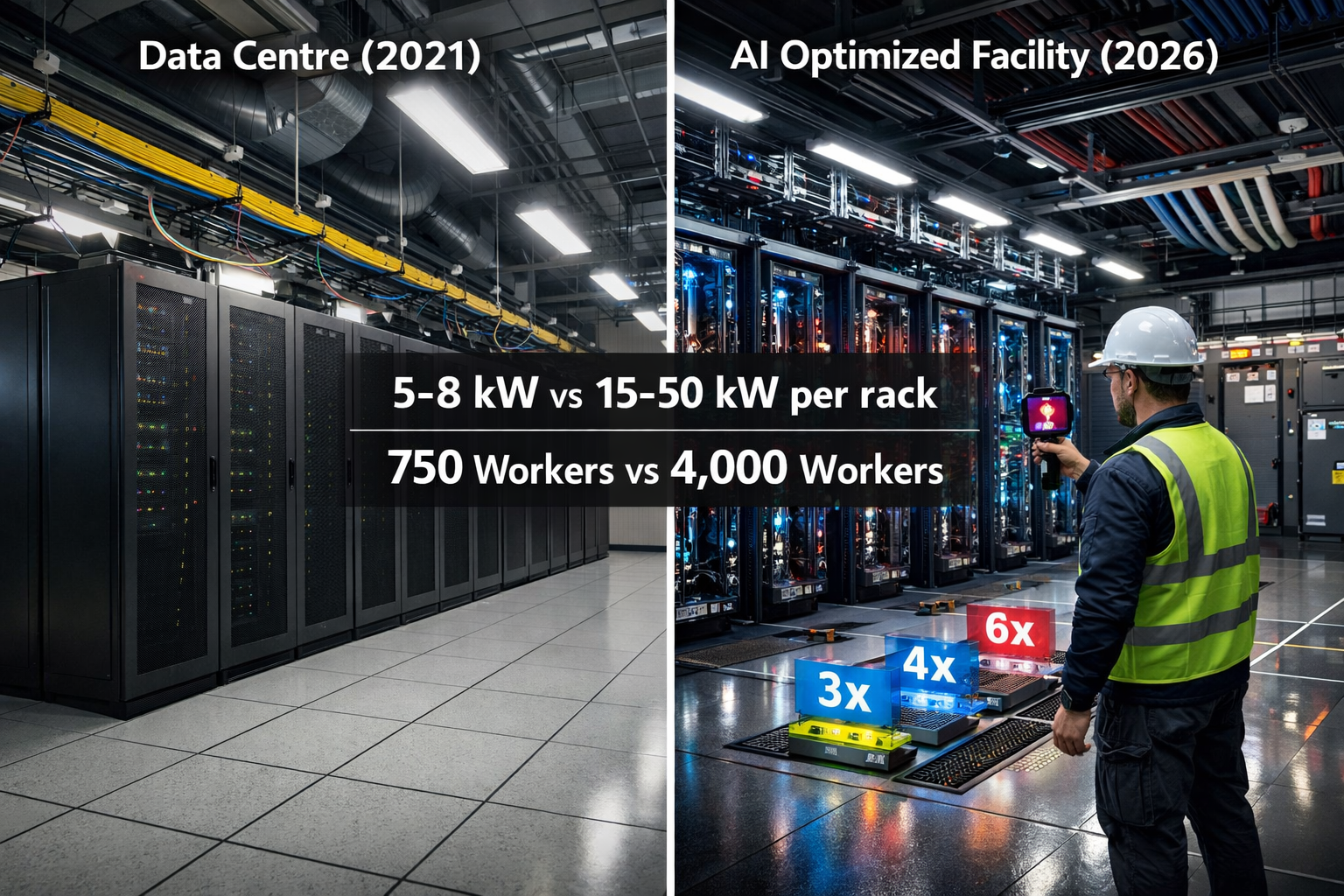
The scale of this transformation is staggering. Modern campus-scale data centres now require approximately 4,000 workers per site, compared to just 750 workers five years ago [5], creating complex coordination challenges that directly impact structural assessment workflows. Meanwhile, rack power density has increased three to six times in the same period, with facilities now designed for 15 to 50 kilowatts per rack compared with 5 to 8 kilowatts previously [1]. These dramatic shifts necessitate a complete rethinking of how building surveys address load-bearing capacity, electrical infrastructure integration, and cooling system demands.
Key Takeaways
- 🏗️ Structural load requirements have tripled: Modern AI data centres demand floor loading capacities of 15-50 kW per rack, requiring comprehensive structural assessments that go far beyond traditional commercial building surveys
- ⚡ Power infrastructure drives construction timelines: Lead times of 12-18 months for transformers and switchgear necessitate early structural planning and site readiness evaluations
- 👷 Workforce complexity impacts survey protocols: Sites now require 4,000+ workers compared to 750 five years ago, creating sequencing challenges that surveyors must account for in phased assessments
- 📋 RICS compliance remains non-negotiable: Despite accelerated timelines, chartered surveyors must maintain rigorous standards while adapting methodologies for high-density electrical and cooling infrastructure
- 🔄 Adaptive reuse assessments are critical: Converting existing industrial or commercial buildings requires specialized surveys evaluating structural capacity for dramatically increased loads and utility demands
Understanding Building Surveys for Data Centre Expansions in the 2026 Context
The current landscape of Building Surveys for Data Centre Expansions: Structural Assessments Amid 2026 AI Infrastructure Boom represents a convergence of technological advancement and construction urgency. Traditional commercial building surveys focused primarily on structural integrity, moisture ingress, and general building condition. However, today's data centre assessments must incorporate highly specialized evaluations of electrical load capacity, thermal management infrastructure, and foundation systems capable of supporting equipment that weighs substantially more than conventional office or warehouse installations.
The AI Infrastructure Demand Surge
The explosion in generative AI applications, machine learning workloads, and cloud computing services has created an insatiable appetite for data centre capacity. According to industry analysis, power infrastructure components now carry lead times of 12 to 18 months [1], forcing developers and surveyors to work in unprecedented parallel workflows where structural assessments must anticipate equipment specifications that may not be finalized until months after foundation work begins.
This timeline compression affects every aspect of the survey process. Where traditional Level 3 building surveys might allow for sequential evaluation and remediation, data centre projects increasingly require surveyors to provide conditional assessments with multiple contingency scenarios based on varying equipment configurations.
Key Structural Considerations
Modern data centre structural surveys must evaluate several critical parameters:
Floor Loading Capacity 📊
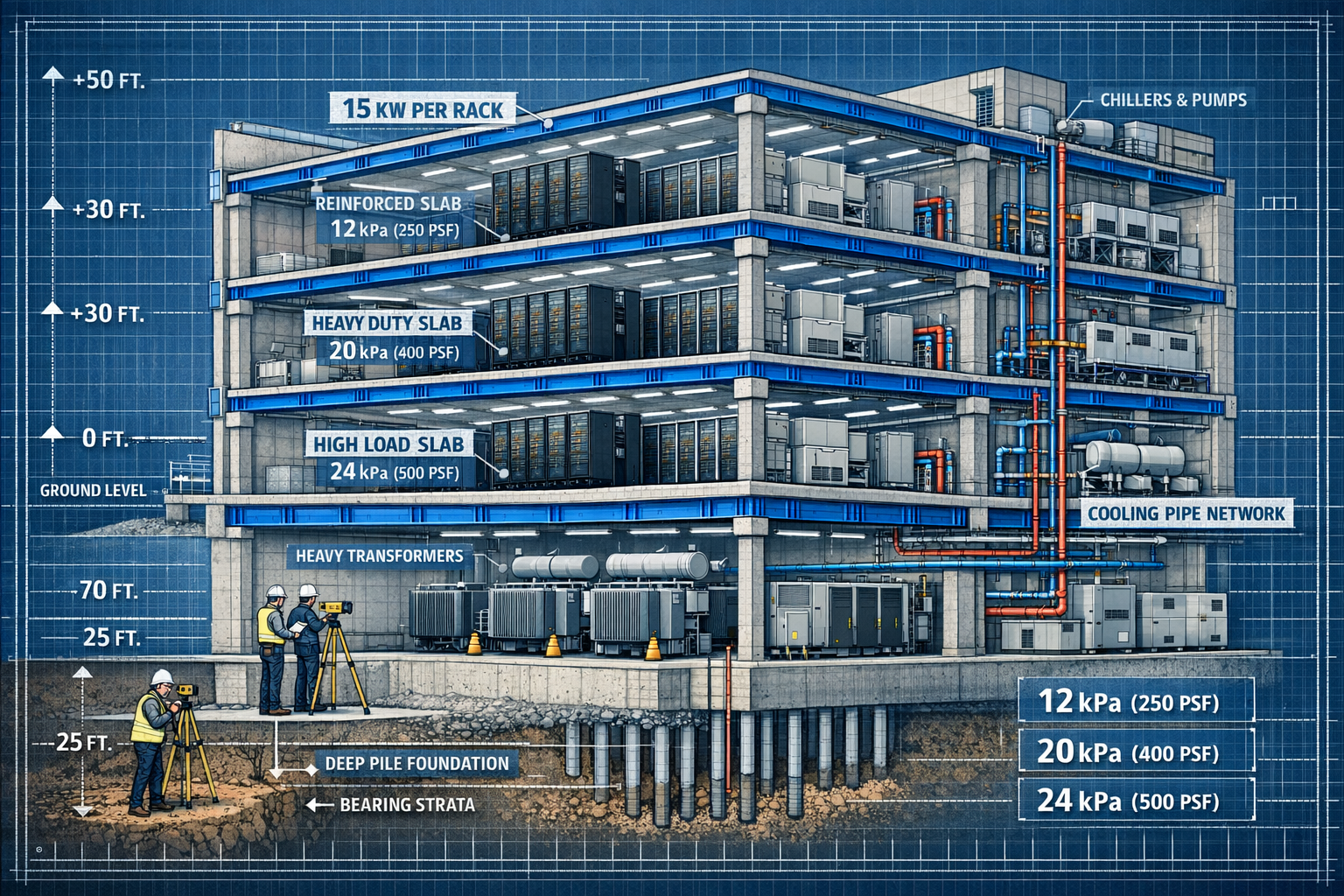
- Standard office buildings: 2.5-4.0 kN/m²
- Traditional data centres: 7.5-12.0 kN/m²
- AI-optimized facilities: 15.0-24.0 kN/m² or higher
Electrical Infrastructure Integration
- Primary transformer locations and foundation requirements
- Secondary distribution pathways through structural elements
- Emergency generator placement and vibration isolation
- Cable tray routing and structural support systems
Cooling System Demands
- Chilled water pipe routing and structural penetrations
- Air handling unit floor loading and vibration considerations
- Outdoor cooling tower foundations and structural connections
- Liquid cooling infrastructure for high-density racks
The essential guide to commercial building surveys provides foundational knowledge, but data centre assessments require additional specialized expertise in mechanical and electrical systems integration that goes well beyond traditional surveying scope.
Structural Assessment Protocols for High-Density AI Infrastructure
Conducting comprehensive structural assessments for data centre expansions in 2026 requires a methodical approach that balances thoroughness with the accelerated timelines demanded by market conditions. The assessment protocol must address both the existing building envelope and the anticipated loads from next-generation computing equipment.
Phase 1: Pre-Survey Documentation and Planning
Before conducting on-site assessments, surveyors must gather extensive documentation:
Essential Documentation Checklist ✅
- Original structural drawings and calculations
- Previous building survey reports and structural assessments
- Electrical single-line diagrams and load calculations
- HVAC system layouts and equipment specifications
- Geotechnical reports and soil bearing capacity data
- Local planning authority requirements and restrictions
- Utility provider capacity confirmations
This documentation phase is particularly critical for adaptive reuse projects, where existing industrial or commercial buildings are being converted to data centre use. Understanding the original design parameters allows surveyors to accurately assess whether structural upgrades will be feasible within project budget and timeline constraints.
Phase 2: Structural Load Path Analysis
The core of any data centre structural assessment involves tracing load paths from equipment racks through floor systems, columns, and foundations to the underlying soil. This analysis has become significantly more complex as rack densities have increased.
Critical Load Path Components:
-
Raised Floor Systems: Most data centres utilize raised access floors for cable routing and air distribution. These systems must support not only the static weight of equipment but also dynamic loads from maintenance activities and seismic considerations. Modern AI infrastructure may require raised floors rated for 2,000-3,000 pounds per square foot in high-density zones.
-
Structural Slab Capacity: The concrete slab beneath the raised floor must distribute concentrated loads to the supporting structure. Surveyors must evaluate existing slab thickness, reinforcement patterns, and concrete strength through core sampling and non-destructive testing methods.
-
Column and Beam Systems: Vertical load transfer through columns becomes critical when equipment rooms contain rows of high-density racks. Assessment must include column spacing, load distribution patterns, and potential for localized overloading.
-
Foundation Systems: Ultimate load transfer to soil requires evaluation of foundation type (spread footings, piles, mat foundations), soil bearing capacity, and settlement potential under increased loads.
Similar to the rigorous approach outlined in our comprehensive guide to Level 3 building surveys, data centre assessments demand detailed investigation of every structural element, but with additional focus on concentrated load scenarios that rarely occur in conventional buildings.
Phase 3: Electrical and Mechanical Integration Assessment
A distinguishing feature of Building Surveys for Data Centre Expansions: Structural Assessments Amid 2026 AI Infrastructure Boom is the need to evaluate how massive electrical and mechanical systems integrate with the building structure. This goes well beyond traditional building surveys.
Transformer and Switchgear Considerations:
Large data centres may require multiple transformers, each weighing 40,000 to 100,000 pounds or more. These units often need to be located on ground floors or dedicated equipment pads, requiring surveyors to assess:
- Adequate floor loading capacity or need for reinforced equipment pads
- Structural penetrations for electrical conduit runs
- Vibration isolation requirements
- Access routes for equipment delivery and future replacement
- Clearance requirements per electrical codes
Cooling Infrastructure Integration:
Modern AI workloads generate extreme heat densities, requiring sophisticated cooling approaches. Surveyors must evaluate structural implications of:
- Overhead pipe routing for chilled water systems
- Floor penetrations for liquid cooling distribution
- Roof loading for cooling towers and air handling units
- Structural support for in-row cooling units between rack rows
Phase 4: Seismic and Resilience Evaluation
Data centres are critical infrastructure requiring high levels of resilience. Structural assessments must evaluate seismic performance, particularly in regions with seismic activity or where buildings were constructed before modern seismic codes were adopted.
Resilience Assessment Components:
- Seismic bracing for mechanical and electrical systems
- Structural redundancy and load path alternatives
- Foundation performance under seismic loading
- Non-structural element anchorage (cable trays, piping, equipment)
RICS Compliance and Fast-Track Development Challenges
Maintaining RICS professional standards while accommodating the compressed timelines of 2026 data centre development presents significant challenges for chartered surveyors. The fundamental principles of thorough investigation and accurate reporting remain unchanged, but the methodology must adapt to project realities.
Balancing Speed and Thoroughness
The market pressure to accelerate data centre delivery creates tension with the methodical approach required for comprehensive structural assessment. According to recent construction industry analysis, the dramatic increase in workforce requirements—from 750 to 4,000 workers per site [5]—reflects not only larger facilities but also the need to compress construction schedules through parallel work streams.
For surveyors, this means:
Phased Assessment Approaches 🔄
Rather than completing a single comprehensive survey before construction begins, many projects now require staged assessments:
- Stage 1: Initial feasibility assessment evaluating whether the site can accommodate target loads
- Stage 2: Detailed structural evaluation of priority areas where construction will begin first
- Stage 3: Ongoing assessments as design details are finalized and construction progresses
- Stage 4: Final verification surveys confirming as-built conditions match design assumptions
This phased approach requires clear communication with clients about the scope and limitations of each assessment stage, ensuring RICS professional standards are maintained even when complete information isn't available at project outset.
Documentation and Reporting Standards
Despite accelerated timelines, RICS-compliant reports must maintain comprehensive documentation standards. For data centre projects, this includes:
Enhanced Reporting Elements:
- Detailed load capacity analysis with equipment-specific scenarios
- Electrical and mechanical system integration assessments
- Photographic documentation of critical structural elements
- Recommendations for monitoring during construction
- Conditional statements where final equipment specifications remain uncertain
The reporting approach should mirror the thoroughness described in our full structural survey sample guide, but with additional technical sections addressing the unique aspects of data centre infrastructure.
Professional Liability Considerations
The complexity and financial scale of data centre projects—often representing investments of hundreds of millions of pounds—create significant professional liability exposure for surveyors. Several risk management strategies are essential:
Risk Mitigation Approaches:
-
Clear Scope Definition: Explicitly define what is and isn't included in the structural assessment, particularly regarding specialized systems outside traditional surveying expertise.
-
Assumption Documentation: When equipment specifications or loading conditions aren't finalized, clearly document assumptions underlying the structural assessment.
-
Collaboration with Specialists: Engage structural engineers, electrical engineers, and MEP consultants where assessment requirements exceed traditional surveying scope.
-
Limitation Statements: Include appropriate limitations regarding concealed conditions, future equipment changes, or areas not accessible during survey.
Understanding structural survey costs for conventional projects provides a baseline, but data centre assessments typically command premium fees reflecting the specialized expertise and liability exposure involved.
Regulatory Compliance and Planning Considerations
Data centre developments face increasingly stringent regulatory scrutiny, particularly regarding:
Energy and Environmental Standards 🌱
- Power consumption disclosure requirements
- Cooling water usage limitations
- Noise pollution from generators and cooling equipment
- Carbon emissions and sustainability commitments
Planning and Building Control
- Structural alterations requiring building control approval
- Change of use applications for adaptive reuse projects
- Grid connection capacity and utility infrastructure upgrades
- Local planning authority concerns about energy consumption
Surveyors conducting assessments must be aware of these regulatory dimensions, as structural modifications may trigger additional approval requirements that impact project timelines.
Adaptive Reuse and Conversion Projects
A significant portion of 2026 data centre expansion involves converting existing buildings rather than ground-up construction. This trend—driven by site availability constraints and accelerated delivery timelines—creates unique assessment challenges.
Evaluating Existing Buildings for Data Centre Conversion
Industrial buildings, warehouses, and even retail spaces are increasingly being evaluated for data centre conversion. The structural assessment for these projects must determine:
Conversion Feasibility Factors:
| Assessment Area | Key Evaluation Criteria | Typical Challenges |
|---|---|---|
| Floor Loading | Can existing structure support 15-50 kW/rack densities? | Reinforcement often required; may be cost-prohibitive |
| Ceiling Height | Minimum 4.5-5.5 meters for equipment and infrastructure | Older buildings may have insufficient height |
| Column Spacing | Ideally 9-12 meters for efficient rack layout | Irregular spacing complicates design |
| Power Access | Proximity to high-voltage transmission infrastructure | Remote locations may lack adequate utility capacity |
| Floor Condition | Level, crack-free surface for raised floor installation | Remediation costs can be substantial |
The assessment methodology shares similarities with construction surveys but requires additional focus on capacity upgrades rather than new construction quality control.
Structural Upgrade Strategies
When existing buildings require structural reinforcement, surveyors must evaluate various upgrade approaches:
Common Reinforcement Methods:
-
Slab Strengthening: Carbon fiber reinforcement, additional concrete topping, or structural steel grid systems can increase floor load capacity without complete reconstruction.
-
Column Reinforcement: Steel jacketing or concrete encasement can increase vertical load capacity of existing columns.
-
Foundation Upgrades: Underpinning, micropiles, or load distribution systems can address inadequate foundation capacity.
-
Selective Demolition: Removing portions of existing structure to accommodate new high-capacity elements may be more cost-effective than wholesale reinforcement.
Each approach has implications for project cost, timeline, and feasibility. The surveyor's role includes providing realistic assessments of upgrade requirements and associated costs, enabling informed decision-making by developers and investors.
Emerging Technologies in Data Centre Structural Assessment
The 2026 landscape includes several technological advances that enhance the accuracy and efficiency of structural surveys for data centre projects.
Advanced Diagnostic Tools
Non-Destructive Testing Methods 🔬
- Ground Penetrating Radar (GPR): Identifies rebar location, void spaces, and subsurface conditions without destructive investigation
- Ultrasonic Testing: Evaluates concrete quality, thickness, and integrity
- Infrared Thermography: Detects moisture intrusion, insulation defects, and thermal bridging
- 3D Laser Scanning: Creates precise as-built models for structural analysis and design integration
These technologies enable more comprehensive assessments in less time, supporting the accelerated timelines characteristic of current data centre development. The approach aligns with modern monitoring survey techniques that provide ongoing verification throughout construction.
Digital Twin Integration
Progressive data centre operators are implementing digital twin technology—virtual replicas of physical facilities that enable real-time monitoring and predictive maintenance. Structural surveys increasingly feed into these digital twins, with as-built documentation becoming part of an ongoing facility management system rather than a static report.
Digital Twin Benefits for Structural Management:
- Real-time load monitoring and capacity management
- Predictive maintenance for structural systems
- Scenario planning for equipment upgrades
- Integration with building management systems
Surveyors who can deliver assessment data in formats compatible with digital twin platforms provide enhanced value to clients operating at the forefront of facility management practice.
Cost Considerations and Investment Protection
The financial stakes in data centre development make accurate structural assessment critical for investment protection. Construction costs for these facilities have escalated significantly, with some projects exceeding £1 billion for large campus developments [6].
Assessment Investment vs. Risk
While comprehensive structural surveys represent a significant upfront investment, the cost pales in comparison to potential consequences of inadequate assessment:
Risk Scenarios from Inadequate Assessment:
- Structural deficiencies discovered mid-construction, requiring costly redesign
- Equipment installation delays due to unforeseen load capacity issues
- Operational restrictions limiting rack density below design targets
- Catastrophic structural failure resulting in equipment damage and downtime
The investment in thorough assessment—typically representing 0.1-0.3% of total project cost—provides substantial risk mitigation relative to project value.
Long-Term Operational Considerations
Structural assessments should consider not only initial construction but also long-term operational flexibility:
Future-Proofing Elements:
- Capacity for increased rack densities as technology evolves
- Structural provisions for equipment replacement and upgrades
- Expansion capability for adjacent phases
- Adaptability for alternative cooling technologies
This forward-looking approach ensures that structural investments support operational flexibility over the facility's 20-30 year design life.
Regional Variations and Market Dynamics
The Building Surveys for Data Centre Expansions: Structural Assessments Amid 2026 AI Infrastructure Boom manifests differently across UK regions, influenced by local market conditions, available sites, and regulatory environments.
London and Southeast England
The concentration of connectivity infrastructure and enterprise customers makes the London region highly attractive for data centre development. However:
Regional Challenges:
- Limited available sites with adequate power capacity
- Higher land costs favoring adaptive reuse over new construction
- Stringent planning requirements and community concerns
- Aging building stock requiring extensive structural upgrades
Surveyors working in this region must be particularly skilled at evaluating conversion potential of existing buildings, often working with structures built to outdated codes and standards.
Northern Powerhouse and Midlands
These regions are experiencing significant data centre investment growth, driven by:
Regional Advantages:
- More available land for campus-scale developments
- Generally lower construction costs
- Supportive local authorities seeking economic development
- Proximity to renewable energy sources (particularly wind power)
Structural assessments in these regions more frequently involve new construction or conversion of relatively modern industrial buildings, potentially simplifying the evaluation process compared to London's older building stock.
Professional Development and Specialized Expertise
The specialized nature of data centre structural assessment creates opportunities for surveyors to develop niche expertise. Professional development should focus on:
Key Competency Areas 📚
- Advanced understanding of electrical and mechanical systems
- Familiarity with data centre design standards (ASHRAE, Uptime Institute)
- Seismic design principles and resilience engineering
- High-density load analysis and structural dynamics
- Regulatory frameworks specific to critical infrastructure
Collaboration with structural engineering specialists and ongoing professional education ensure surveyors maintain competency in this rapidly evolving field.
Conclusion
The Building Surveys for Data Centre Expansions: Structural Assessments Amid 2026 AI Infrastructure Boom represents one of the most dynamic and technically demanding segments of the surveying profession. As artificial intelligence continues driving unprecedented demand for computing infrastructure, the role of chartered surveyors in evaluating structural capacity, ensuring regulatory compliance, and protecting client investments becomes increasingly critical.
The dramatic shifts in data centre design—with rack power densities increasing three to six times in just five years [1] and construction workforce requirements expanding from 750 to 4,000 workers per site [5]—have fundamentally transformed assessment requirements. Traditional commercial building survey methodologies must be enhanced with specialized evaluation of electrical infrastructure integration, cooling system demands, and high-density load scenarios that rarely occur in conventional construction.
Key Success Factors
Surveyors operating effectively in this space must:
✅ Maintain RICS Standards: Despite compressed timelines, professional standards and thorough documentation remain non-negotiable
✅ Embrace Phased Approaches: Staged assessments aligned with construction sequencing enable progress while maintaining assessment quality
✅ Collaborate with Specialists: Complex electrical and mechanical systems require multidisciplinary expertise beyond traditional surveying scope
✅ Leverage Advanced Technology: Non-destructive testing, 3D scanning, and digital documentation enhance assessment accuracy and efficiency
✅ Understand Market Dynamics: Regional variations, regulatory requirements, and emerging technologies shape project-specific assessment strategies
Actionable Next Steps
For surveyors looking to develop expertise in this specialized field:
-
Pursue Targeted Education: Seek CPD opportunities focused on critical infrastructure, electrical systems, and data centre design standards
-
Build Specialist Networks: Develop relationships with structural engineers, MEP consultants, and data centre operators who can provide project collaboration opportunities
-
Invest in Technology: Acquire or partner with firms offering advanced diagnostic tools like GPR, laser scanning, and thermal imaging
-
Study Case Examples: Review completed data centre projects to understand successful assessment approaches and common challenges
-
Engage with Industry Organizations: Participate in data centre industry associations to stay current with evolving standards and market trends
The AI infrastructure boom shows no signs of slowing, with industry forecasts predicting continued strong growth through at least 2028 [2]. For surveyors willing to develop specialized expertise, this represents a significant professional opportunity—one that combines traditional structural assessment skills with cutting-edge technology evaluation in projects of substantial scale and complexity.
As the built environment continues evolving to support digital transformation, the surveyor's role as trusted advisor ensuring structural integrity, regulatory compliance, and investment protection remains as vital as ever. Those who adapt their methodologies to address the unique demands of data centre infrastructure while maintaining unwavering professional standards will find themselves at the forefront of one of the construction industry's most dynamic sectors.
References
[1] Data Center Construction Trends – https://cmicglobal.com/resources/article/data-center-construction-trends
[2] 2026 Data Center Outlook What Actually Changes Next – https://www.areadevelopment.com/data-centers/q1-2026/2026-data-center-outlook-what-actually-changes-next.shtml
[5] constructiondive – https://www.constructiondive.com/news/data-centers-construction-2026-trends/810016/
[6] Data Center Construction Predictions For 2026 – https://www.databank.com/resources/blogs/data-center-construction-predictions-for-2026/
