
Scotland's property market is experiencing unprecedented growth in 2026, with homeowners rushing to extend their properties to maximize value. Yet this boom brings a complex challenge: Party Wall Challenges in Scotland's 2026 Property Surge: RICS Protocols for Cross-Border Extension Projects require careful navigation. Unlike England and Wales, Scotland operates without the Party Wall etc. Act 1996, creating unique complications for property owners, developers, and surveyors working across UK borders. 🏴
Understanding these differences has never been more critical. As extension projects multiply across Scottish cities and cross-border property portfolios expand, professionals must adapt England's established RICS protocols to Scotland's distinct legal landscape.

Key Takeaways
- Scotland has no Party Wall Act equivalent – property boundary disputes rely on common law and the Building (Scotland) Act, not statutory frameworks
- RICS protocols must be adapted for Scottish projects, as standard Party Wall etc. Act 1996 procedures don't apply north of the border
- Cross-border portfolios face dual compliance – developers working in both jurisdictions need separate strategies for England/Wales versus Scotland
- Professional surveyor guidance remains essential even without statutory requirements, helping prevent costly disputes and construction delays
- 2026's property surge intensifies risks – increased extension activity means more potential boundary conflicts requiring proactive management
Understanding Party Wall Challenges in Scotland's 2026 Property Surge
The Scottish property market has surged dramatically in 2026, with house prices climbing and homeowners seeking to add value through extensions, loft conversions, and basement excavations. This growth creates a perfect storm for boundary and party wall disputes.
Why Scotland's Legal Framework Differs
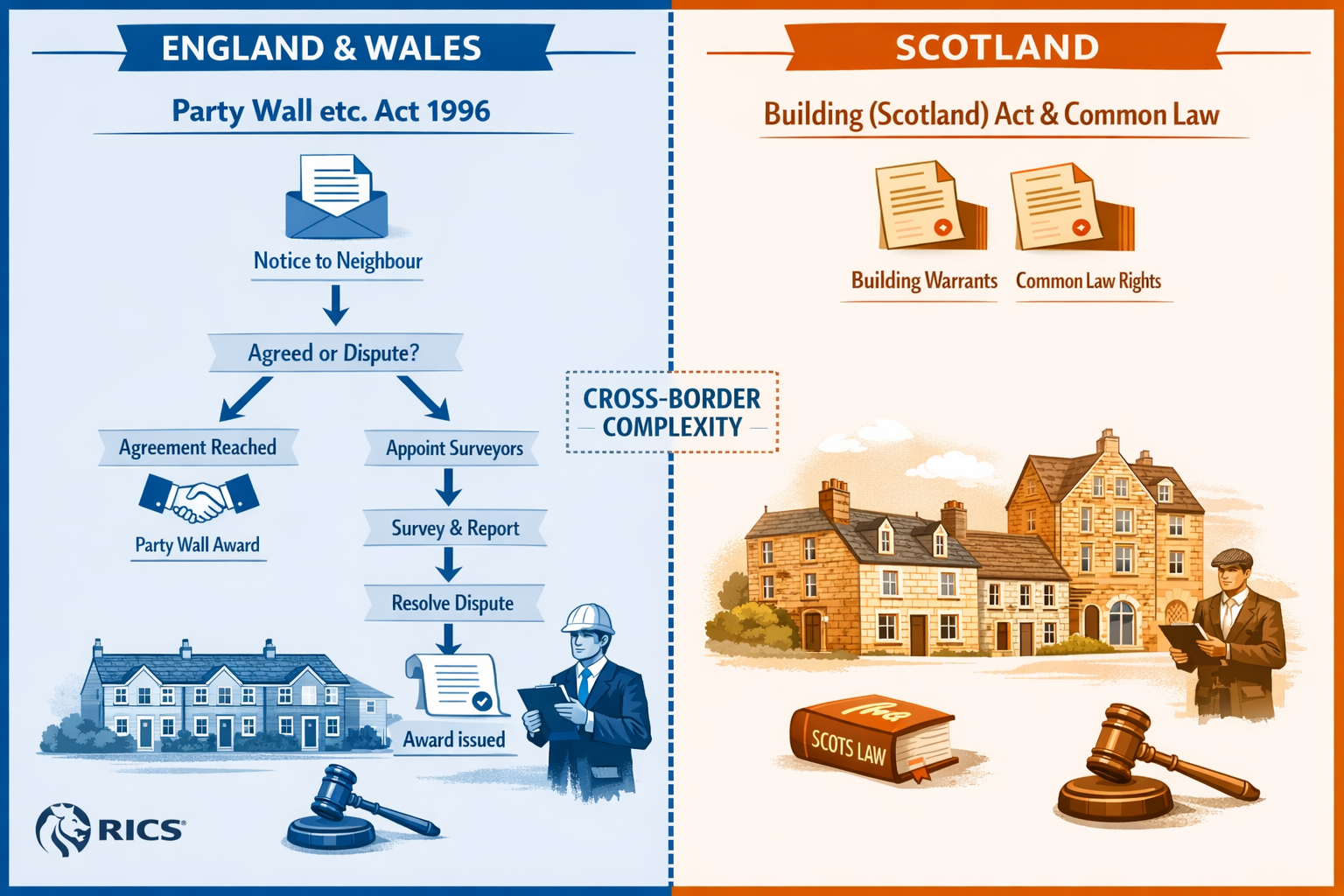
The Party Wall etc. Act 1996 governs party wall matters exclusively in England and Wales. Scotland never adopted this legislation, instead relying on:
- Common law principles governing property boundaries and rights
- Building (Scotland) Act 2003 for construction standards and regulations
- Title deeds and servitude rights defining property boundaries
- Scots property law traditions dating back centuries
This fundamental difference means that understanding the party wall process requires completely different approaches depending on which side of the border your project sits.
The 2026 Property Extension Boom
Several factors drive Scotland's current extension surge:
📈 Market Pressures
- Rising property values making extensions more cost-effective than moving
- Limited housing stock in desirable areas like Edinburgh and Glasgow
- Remote work trends increasing demand for home office space
- Sustainability goals encouraging renovation over new builds
🏗️ Construction Activity
- Record numbers of planning applications for residential extensions
- Increased loft conversion and basement excavation projects
- Garden room and side-return extensions becoming standard
- Multi-unit conversion projects in traditional tenement buildings
This activity level creates more opportunities for boundary disputes, making professional guidance crucial.
Scotland's Legal Approach to Party Wall Challenges in 2026
Common Law Foundations
Without statutory party wall legislation, Scottish property owners must navigate common law principles that have evolved over centuries. These include:
Support Rights: Every property owner has a right to support from adjoining land and buildings. Removing or weakening this support without consent can constitute legal nuisance or damage.
Access Rights: Unlike the Party Wall Act's access provisions, Scottish property owners must negotiate access separately, often through temporary servitude agreements or court orders.
Notification Requirements: No statutory notice periods exist. Instead, property owners should provide "reasonable notice" – typically interpreted as sufficient time for neighbors to seek advice and respond.
Building (Scotland) Act Compliance
The Building (Scotland) Act 2003 provides the regulatory framework for construction work, including:
- Building warrant requirements for most extension projects
- Structural integrity standards ensuring work doesn't compromise neighboring properties
- Completion certificates verifying regulatory compliance
- Building standards technical handbooks providing detailed guidance
However, these regulations focus on construction standards rather than neighbor relations, leaving a gap that RICS-adapted protocols can fill.
Title Deed Considerations
Scottish property titles often contain specific provisions affecting extension projects:
Burdens and Servitudes: Historical restrictions on property use, building heights, or structural alterations that may limit extension options.
Common Property: Shared walls, roofs, or foundations with defined maintenance responsibilities and alteration restrictions.
Real Burdens: Conditions attached to property ownership that may require neighbor consent for certain works.
Property owners must review their title deeds carefully before commencing any extension work that might affect shared structures.
Adapting RICS Protocols for Cross-Border Extension Projects

RICS Professional Standards in Scotland
While RICS publishes comprehensive guidance on the Party Wall etc. Act 1996, these standards don't directly apply in Scotland. However, RICS members working on Scottish projects can adapt these professional principles to create robust neighbor agreement frameworks.
Core RICS Principles to Adapt:
✅ Professional independence – surveyors acting impartially between parties
✅ Thorough documentation – detailed records of property condition before works
✅ Clear communication – transparent processes for all stakeholders
✅ Technical competence – proper assessment of structural implications
✅ Dispute prevention – proactive measures to avoid conflicts
The RICS Scotland Manifesto 2026, published in January, emphasizes housing delivery and retrofit programmes, highlighting the profession's commitment to supporting Scotland's property sector growth while maintaining high standards.
Creating Voluntary Party Wall Agreements
Without statutory requirements, Scottish property owners benefit from voluntary agreements modeled on Party Wall Act procedures. These agreements should include:
Pre-Work Documentation
- Professional condition surveys of neighboring properties
- Photographic evidence of existing structures
- Structural engineer assessments where relevant
- Clear scope of proposed works with detailed drawings
Agreed Procedures
- Construction methodology and timeline
- Access arrangements if required
- Monitoring and inspection protocols
- Damage resolution mechanisms
Financial Protections
- Insurance requirements and coverage details
- Indemnity provisions for potential damage
- Cost-sharing arrangements for shared structures
- Dispute resolution procedures
While not legally mandated, these agreements provide clarity and protection similar to formal party wall awards in England and Wales.
Cross-Border Portfolio Management
Developers and property companies operating across the England-Scotland border face unique compliance challenges. Effective management requires:
Dual-System Expertise
| England & Wales | Scotland |
|---|---|
| Statutory Party Wall Act notices required | Voluntary neighbor agreements recommended |
| Defined notice periods (2 months for structural work) | Reasonable notice based on project scope |
| Appointed party wall surveyors with statutory powers | Professional surveyors acting under contract law |
| Formal dispute resolution through awards | Court proceedings or mediation if disputes arise |
| Standard templates and procedures | Customized agreements for each project |
Operational Strategies
🔄 Separate Compliance Teams: Dedicated specialists for each jurisdiction ensuring appropriate procedures
📋 Jurisdiction-Specific Checklists: Tailored workflows preventing confusion between regulatory regimes
🤝 Unified Quality Standards: Consistent professional standards regardless of legal framework differences
💼 Professional Indemnity Coverage: Insurance policies covering both statutory and common law obligations
The Role of Chartered Surveyors
Professional surveyors remain essential in Scotland despite the absence of statutory party wall requirements. What does a party wall surveyor do in Scotland differs from their England and Wales counterparts, but their value remains high.
Scottish Surveyor Responsibilities:
Technical Assessment
- Evaluating structural implications of proposed works
- Identifying potential impacts on neighboring properties
- Recommending construction methods to minimize disruption
- Specifying monitoring requirements during construction
Documentation Services
- Preparing detailed condition surveys before works commence
- Creating photographic and written records of existing structures
- Documenting agreed procedures and responsibilities
- Providing expert evidence if disputes reach court
Negotiation and Mediation
- Facilitating discussions between property owners
- Explaining technical matters in accessible language
- Finding practical solutions to neighbor concerns
- Preventing minor disagreements from escalating
Quality Assurance
- Monitoring construction work for compliance with agreements
- Conducting interim inspections at critical stages
- Verifying completion against agreed specifications
- Certifying final condition compared to pre-work surveys
Practical Guidance for 2026 Extension Projects in Scotland

Step-by-Step Process for Scottish Extensions
Following a structured approach helps prevent disputes and ensures smooth project delivery:
Phase 1: Planning and Assessment (Weeks 1-4)
- Review property title deeds for burdens, servitudes, or restrictions
- Consult planning authority regarding permitted development and planning permission requirements
- Engage structural engineer to assess feasibility and neighbor impacts
- Commission pre-work condition survey of your property and visible neighboring areas
- Identify affected neighbors who share walls, boundaries, or could be impacted by excavation
Phase 2: Neighbor Engagement (Weeks 5-8)
- Provide informal notification to neighbors about your intentions
- Share outline plans showing proposed work scope and methodology
- Offer professional survey access to document neighbor property condition
- Address concerns through design modifications where reasonable
- Negotiate voluntary agreement covering procedures, access, and protections
Phase 3: Formal Documentation (Weeks 9-12)
- Finalize construction drawings incorporating agreed modifications
- Obtain building warrant from local authority
- Execute formal neighbor agreement signed by all parties
- Arrange appropriate insurance including contractor liability coverage
- Establish communication protocol for construction phase updates
Phase 4: Construction Phase (Project Duration)
- Notify neighbors of actual start date with reasonable advance notice
- Conduct baseline monitoring where agreed (crack monitoring, vibration sensors)
- Maintain regular communication with neighbors about progress and any issues
- Allow agreed inspections by neighbor's surveyor at key stages
- Document any incidents immediately with photographs and written records
Phase 5: Completion and Sign-Off (Final 2-4 Weeks)
- Conduct final condition survey comparing to pre-work documentation
- Address any damage claims promptly through agreed procedures
- Obtain completion certificate from building control
- Secure neighbor sign-off confirming satisfaction with completed works
- Archive all documentation for future reference and property records
Common Pitfalls and How to Avoid Them
Assuming English Law Applies ❌
Many property owners and even some professionals mistakenly believe Party Wall Act procedures apply in Scotland. This can lead to:
- Serving invalid statutory notices that have no legal effect
- Expecting statutory rights to access that don't exist
- Misunderstanding cost responsibilities and dispute resolution mechanisms
Solution: Engage Scotland-qualified professionals familiar with local property law and Building (Scotland) Act requirements.
Inadequate Pre-Work Documentation ❌
Without statutory survey requirements, some developers skip thorough condition documentation, leading to:
- Disputed damage claims with no baseline for comparison
- Costly litigation over whether defects existed before works
- Neighbor relationships damaged by unresolved disagreement
Solution: Commission comprehensive condition surveys even when not legally required, treating them as essential project insurance.
Poor Communication ❌
Failing to keep neighbors informed creates unnecessary anxiety and conflict:
- Surprise construction activities generating complaints
- Misunderstandings about work scope and duration
- Escalating disputes that could have been prevented
Solution: Establish clear communication channels with regular updates, even when work progresses smoothly.
Ignoring Title Deed Restrictions ❌
Scottish title deeds often contain historical burdens requiring neighbor consent:
- Real burdens prohibiting certain alterations
- Servitude rights limiting building locations
- Common property provisions requiring unanimous agreement
Solution: Obtain professional legal review of title deeds before finalizing extension designs.
Cost Considerations
Understanding financial implications helps with project budgeting:
Professional Fees
- Condition surveys: £500-£1,500 depending on property complexity
- Structural engineer assessments: £800-£2,500 for extension evaluation
- Legal advice on title deeds: £500-£1,200 for review and opinion
- Surveyor negotiation services: £1,000-£3,000 for agreement facilitation
Unlike England and Wales, who pays for a party wall surveyor in Scotland is entirely negotiable, though building owners typically cover initial assessment costs.
Risk Mitigation Costs
- Additional insurance: £300-£800 annual premium increase for construction period
- Monitoring equipment: £500-£2,000 for crack monitors or vibration sensors if required
- Contingency fund: 10-15% of construction budget for unexpected neighbor issues
Potential Dispute Costs
Without statutory dispute resolution, Scottish property disputes can become expensive:
- Mediation services: £1,500-£5,000 for professional mediation
- Court proceedings: £10,000-£50,000+ for litigation if agreements fail
- Expert witness fees: £2,000-£8,000 for technical evidence in court cases
These potential costs make upfront investment in proper procedures and documentation highly cost-effective.
Technology and Innovation in 2026
Modern technology offers new tools for managing party wall challenges:
Digital Documentation
- 360-degree photographic surveys creating comprehensive baseline records
- Drone surveys for roof and upper-level condition assessment
- Cloud-based document sharing for transparent record-keeping
Monitoring Systems
- IoT-enabled crack monitoring with real-time alerts
- Vibration sensors detecting construction impacts beyond safe thresholds
- Environmental monitoring for dust, noise, and other nuisance factors
Communication Platforms
- Project management apps keeping neighbors informed of progress
- Digital signature systems for agreement execution
- Video conferencing for remote consultations and inspections
These technologies enhance traditional professional services, making processes more efficient and transparent.
Cross-Border Regulatory Challenges
Working Across Jurisdictions
Property professionals operating in both Scotland and England/Wales must maintain separate compliance frameworks. Key challenges include:
Staff Training Requirements
Teams need jurisdiction-specific knowledge:
- Scottish property law fundamentals for Scotland-based work
- Party Wall etc. Act 1996 procedures for England and Wales projects
- Clear protocols determining which framework applies to each project
Documentation Management
Different jurisdictions require different paperwork:
- Party Wall Act notices and awards for England/Wales
- Voluntary neighbor agreements for Scotland
- Building warrant applications versus building control notices
- Separate professional indemnity considerations
Client Education
Many clients with cross-border portfolios need guidance:
- Explaining why procedures differ between jurisdictions
- Managing expectations about timelines and costs
- Clarifying when statutory rights exist versus voluntary arrangements
- Highlighting risks specific to each legal framework
Brexit and Future Regulatory Divergence
Post-Brexit regulatory evolution creates additional complexity. While construction standards remain aligned in 2026, future divergence between Scottish and English building regulations could affect:
- Technical standards for structural work near boundaries
- Environmental and sustainability requirements
- Professional qualification recognition
- Insurance and liability frameworks
Staying current with regulatory developments in both jurisdictions becomes increasingly important for cross-border practitioners.
Dispute Prevention and Resolution Strategies
Proactive Dispute Prevention
The best disputes are those that never happen. Effective prevention strategies include:
Early Engagement
- Discussing plans with neighbors before finalizing designs
- Inviting neighbor input on construction timing and methods
- Building positive relationships before potential conflicts arise
Professional Mediation
- Engaging neutral third-party surveyors to facilitate discussions
- Using professional expertise to find technical solutions to concerns
- Creating formal agreements that protect all parties' interests
Transparent Processes
- Sharing detailed information about proposed works
- Explaining construction methods and expected impacts
- Providing regular updates throughout the project
Reasonable Accommodations
- Modifying designs to address legitimate neighbor concerns
- Adjusting construction schedules for special circumstances
- Offering additional protections beyond minimum requirements
For comprehensive guidance on preventing conflicts, review our complete guide to resolving party wall disputes.
Resolution Options When Disputes Arise
Despite best efforts, disputes sometimes occur. Scottish property owners have several resolution pathways:
Negotiation and Compromise
- Direct discussions between property owners
- Professional surveyor facilitation
- Modified construction approaches addressing concerns
- Financial compensation for inconvenience or minor impacts
Formal Mediation
- Independent mediator helping parties reach agreement
- Structured process with defined timelines
- Legally binding settlement agreements
- Significantly less expensive than court proceedings
Court Proceedings
- Sheriff Court for most property disputes
- Court of Session for complex or high-value cases
- Interdict (injunction) applications to stop unauthorized work
- Damages claims for property harm
Alternative Dispute Resolution
- Expert determination by agreed technical specialist
- Arbitration under Scottish Arbitration Rules
- Adjudication for construction-related disputes
- Faster and more flexible than traditional litigation
Understanding when damage to property occurs in party wall situations helps determine appropriate resolution pathways.
Future Outlook: Party Wall Challenges Beyond 2026
Potential Legislative Developments
Discussions continue about whether Scotland should adopt party wall legislation similar to England and Wales. Potential developments include:
Arguments for Scottish Party Wall Legislation
- Providing clarity and certainty for property owners
- Reducing litigation costs through statutory procedures
- Aligning with rest of UK for cross-border consistency
- Creating defined rights and responsibilities
Arguments Against
- Scots property law traditions functioning adequately
- Additional regulatory burden on homeowners
- Implementation costs for new statutory framework
- Existing common law flexibility serving Scottish context
The Scottish Parliament's 2026 term may see renewed debate on this issue, particularly as extension activity continues growing.
Market Trends Affecting Party Wall Matters
Several trends will influence party wall challenges in coming years:
Densification Pressures
- Urban land scarcity driving more intensive property use
- Increased vertical extensions and basement excavations
- Higher-density developments creating more shared boundaries
- Greater potential for neighbor conflicts
Sustainability Initiatives
- Retrofit programmes requiring structural modifications
- Insulation upgrades affecting shared walls
- Renewable energy installations on party structures
- Energy efficiency regulations driving renovation activity
Demographic Shifts
- Aging population requiring home adaptations
- Multi-generational living increasing extension demand
- Remote work creating need for home office space
- Changing household sizes affecting property requirements
Technology Evolution
- Building Information Modeling (BIM) improving design coordination
- Prefabrication reducing on-site construction impacts
- Advanced monitoring systems detecting issues earlier
- Digital platforms streamlining neighbor communication
Professional Development Needs
As party wall challenges evolve, professionals need ongoing development:
Technical Skills
- Understanding modern construction methods and materials
- Assessing complex structural interactions
- Evaluating environmental and sustainability impacts
- Using digital tools for documentation and monitoring
Legal Knowledge
- Staying current with Scottish property law developments
- Understanding cross-border regulatory differences
- Navigating dispute resolution procedures
- Managing professional liability risks
Soft Skills
- Effective communication with diverse stakeholders
- Negotiation and conflict resolution abilities
- Cultural sensitivity in neighbor relations
- Project management and coordination
Conclusion
Party Wall Challenges in Scotland's 2026 Property Surge: RICS Protocols for Cross-Border Extension Projects present unique complexities requiring specialized knowledge and careful management. While Scotland's legal framework differs fundamentally from England and Wales, professional surveying principles adapted from RICS protocols provide robust solutions for managing boundary and shared structure issues.
The key to successful Scottish extension projects lies in understanding these differences and proactively addressing neighbor concerns through voluntary agreements, thorough documentation, and professional guidance. Property owners who invest in proper procedures at the outset avoid costly disputes and construction delays later.
Actionable Next Steps
For property owners planning extensions in Scotland:
- Engage qualified professionals early – consult Scotland-experienced surveyors and structural engineers before finalizing designs
- Review your title deeds – identify any burdens, servitudes, or restrictions affecting your plans
- Communicate with neighbors proactively – discuss intentions before submitting planning applications
- Commission condition surveys – document property condition before works commence
- Create formal agreements – negotiate voluntary neighbor agreements covering procedures and protections
- Maintain transparency – keep neighbors informed throughout the construction process
For cross-border property professionals:
- Develop jurisdiction-specific expertise – ensure teams understand both Scottish and English/Welsh frameworks
- Implement separate compliance systems – create distinct workflows for each legal regime
- Invest in ongoing training – keep current with regulatory developments in both jurisdictions
- Build specialist networks – connect with local professionals in each market
- Document processes thoroughly – maintain clear records demonstrating appropriate procedures
The Scottish property market's continued growth in 2026 and beyond makes professional party wall management increasingly valuable. Whether you're a homeowner planning a single extension or a developer managing cross-border portfolios, understanding and applying adapted RICS protocols ensures projects proceed smoothly while protecting all stakeholders' interests.
For additional guidance on party wall matters, explore our resources on when party wall agreements are legally required and party wall excavation notices. Professional support makes the difference between successful projects and costly disputes.
