
}
The urban landscape of 2026 presents a unique opportunity for property investors and developers. With traditional offices and shopping centres experiencing significant undervaluation, savvy investors are pivoting toward value-add opportunities in retail-residential hybrid developments. However, these mixed-use projects introduce complex challenges that extend far beyond conventional construction planning. Party Wall Surveys for Mixed-Use Developments: Tackling Zoning and Neighbour Disputes in 2026 Urban Revivals have become essential tools for navigating the intricate web of legal requirements, neighbour relations, and zoning complications that characterize today's urban regeneration projects.
As cities transform vacant commercial spaces into vibrant communities combining retail, residential, and commercial uses, the technical and legal complexities multiply exponentially. A single mixed-use development might involve multiple property owners, diverse occupancy types, and overlapping regulatory frameworks—all requiring careful coordination through proper party wall procedures.
Key Takeaways
- Early specialist engagement from RIBA Stage 2 or 3 is now standard practice for mixed-use developments, protecting construction programmes and ensuring cost certainty[1]
- Party wall matters extend beyond shared walls to include oversailing agreements, access licences, rights of light, and vibration monitoring—all critical for retail-residential hybrids[1]
- Legal compliance under the Party Wall etc. Act 1996 is mandatory, with failure to serve proper notices potentially resulting in legal challenges, insurance complications, and construction delays[1]
- Proactive party wall management reduces unplanned professional fees, identifies mitigation needs early, and demonstrates professional risk management to investors[1]
- Mixed-use developments require specialized neighbourly agreements to maintain operational continuity for adjoining retail occupiers, residents, local authorities, and utility providers[1]
Understanding Party Wall Surveys for Mixed-Use Developments in 2026
What Makes Mixed-Use Developments Different?
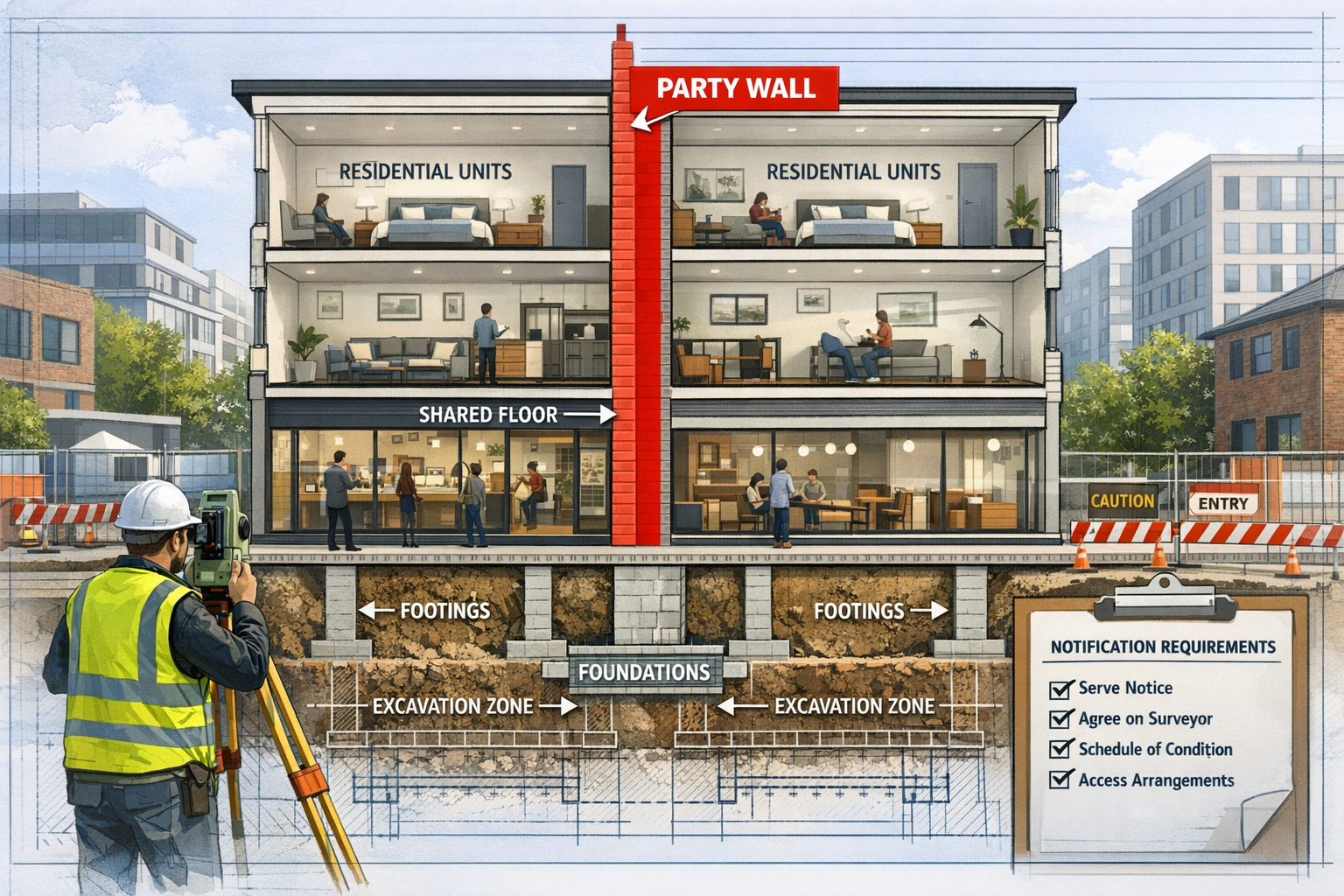
Mixed-use developments combine residential, commercial, and retail spaces within a single building or development site. Unlike single-use properties, these projects create unique party wall challenges because they involve:
- Multiple occupancy types with different operational hours and noise tolerance levels
- Diverse ownership structures including commercial leaseholders, residential tenants, and freehold owners
- Complex building systems serving different purposes (retail HVAC, residential services, commercial utilities)
- Varied regulatory requirements spanning residential building codes, commercial fire safety, and retail accessibility standards
The Party Wall etc. Act 1996 provides the legal framework for managing construction work involving shared walls between properties.[1] This legislation requires property owners to notify neighbours before undertaking specific types of work, including:
✅ Building on or near a party wall (shared walls between two or more properties)
✅ Excavating foundations within three or six metres of neighbouring buildings
✅ Making changes to party or boundary fence walls
For mixed-use developments, these requirements become exponentially more complex when a single project might affect multiple neighbours with different property types and usage patterns.
The 2026 Urban Revival Context
Current market conditions have created unprecedented opportunities for mixed-use development. Traditional office buildings and shopping centres are experiencing significant undervaluation as work-from-home trends and e-commerce continue reshaping commercial real estate. This has opened doors for value-add investors to acquire underperforming assets and transform them into mixed-use properties that better serve modern urban needs.
However, these opportunities come with heightened scrutiny from:
- Planning authorities managing zoning transitions from single-use to mixed-use designations
- Existing neighbours concerned about construction impacts on their businesses or homes
- Investors and lenders requiring robust risk management protocols
- Regulatory bodies enforcing updated building codes and safety standards
Understanding party wall disputes and their resolution has become a critical competency for development teams working on these complex projects.
The Legal Framework: Party Wall Surveys for Mixed-Use Developments and Regulatory Compliance
Party Wall etc. Act 1996: Core Requirements
The Party Wall etc. Act 1996 establishes three main categories of notifiable work[1]:
1. New Building on the Line of Junction (Section 1)
When constructing a new wall exactly on the boundary line between properties, developers must serve notice on adjoining owners.
2. Work to Existing Party Walls (Section 2)
This includes cutting into party walls, raising party walls, demolishing and rebuilding party walls, or underpinning party walls.
3. Excavation Near Neighbouring Buildings (Section 6)
Foundation work within three metres of a neighbour's structure and going deeper than their foundations, or within six metres and cutting a line at 45 degrees down from the bottom of their foundations.
For mixed-use developments, Section 6 excavation work frequently triggers notice requirements because these projects often involve significant foundation work to support additional floors or accommodate underground parking.
Zoning Complications in Mixed-Use Contexts
Beyond party wall legislation, mixed-use developments must navigate complex zoning regulations that vary by jurisdiction. In 2026, several jurisdictions have introduced new constraints on mixed-use development:
Recent California legislation demonstrates the evolving regulatory landscape. SB 92 limits state density bonus law benefits to commercial floor area ratios not exceeding 2.5 times the base zoning allowance, while SB 838 removes Housing Accountability Act protections from hotel portions of mixed-use projects.[2] These changes require separate approvals for different components of mixed-use developments, complicating party wall planning timelines.
Conversely, AB 507 now allows streamlined processing for adaptive reuse projects where at least 50% of square footage is residential, with additional units permitted on undeveloped areas and parking lots.[2] This creates opportunities but requires careful coordination with neighbouring property owners who may be affected by increased density.
Consequences of Non-Compliance
Failure to properly manage party wall requirements carries significant consequences for mixed-use developments[1]:
⚠️ Legal Challenges: Adjoining owners can seek injunctions to halt construction
⚠️ Insurance Complications: Policies may not cover damage arising from improper notice procedures
⚠️ Warranty Issues: Structural warranties may be invalidated
⚠️ Dispute Resolution Difficulties: Lack of proper documentation complicates damage claims
⚠️ Investment Risk: Due diligence failures can derail financing or acquisition transactions
For developers working on retail-residential hybrids, these risks are amplified because commercial tenants often have lease provisions requiring uninterrupted business operations, creating potential liability if construction is halted due to party wall disputes.
Understanding what a party wall award entails helps developers appreciate the formal documentation required to protect all parties' interests.
Neighbourly Matters Beyond Party Walls: Critical Considerations for Mixed-Use Projects
Expanded Scope of Neighbourly Agreements
Modern mixed-use developments require neighbourly agreements that extend far beyond traditional party wall considerations[1]:
🏗️ Oversailing Agreements
Crane booms and scaffolding frequently need to oversail neighbouring properties during construction. For mixed-use projects in dense urban areas, securing these rights requires careful negotiation, particularly when neighbours include operating retail businesses that cannot tolerate construction disruption during peak trading hours.
🚪 Access Licences
Construction teams often require temporary access through neighbouring properties for equipment delivery, waste removal, or emergency egress. Retail-residential hybrids may need to coordinate access schedules around shop opening hours and residential quiet periods.
☀️ Rights of Light
Adding residential floors above existing retail spaces can impact neighbouring properties' natural light access. Rights of light assessments have become increasingly sophisticated in 2026, with digital modelling tools enabling precise impact predictions.
📊 Vibration and Noise Monitoring
Mixed-use developments must manage construction impacts on both residential neighbours (concerned about quality of life) and commercial neighbours (concerned about business disruption). Baseline condition surveys and continuous monitoring protocols protect all parties.
📋 Boundary Alignment
Precise boundary surveys prevent encroachment disputes, particularly important when converting single-use buildings where historical boundary assumptions may not align with current legal descriptions.
The Importance of Early Specialist Engagement
Early specialist engagement has evolved from best practice to standard requirement for mixed-use developments in 2026.[1] Ideally, party wall specialists should be involved from RIBA Stage 2 or 3 of development to:
✅ Map site boundary constraints comprehensively
✅ Serve valid notices within required timeframes
✅ Manage neighbour negotiations professionally and diplomatically
✅ Coordinate temporary works with project delivery schedules
✅ Identify mitigation requirements before cost plans are finalized
This early involvement delivers three critical business drivers for developers and investors[1]:
1. Programme Protection
Unresolved party wall disputes can trigger stop notices, legal challenges, or injunctions that halt construction entirely. For mixed-use developments with phased delivery (retail opening before residential completion), programme delays cascade through the entire project timeline, jeopardizing pre-leasing agreements and revenue projections.
2. Cost Certainty
Proactive party wall management reduces unplanned professional fees and identifies structural mitigation needs (underpinning, temporary supports, vibration isolation) early enough to incorporate them into cost plans and contingency budgets.
3. Investor Confidence
Institutional investors and lenders increasingly require evidence of professional risk management in due diligence processes. Comprehensive party wall strategies demonstrate that development teams have identified and mitigated potential construction risks, de-risking assets for investment decisions.
For guidance on selecting qualified professionals, review our resource on how to find a reliable party wall surveyor.
Common Neighbour Disputes in Party Wall Surveys for Mixed-Use Developments: Tackling Zoning and Neighbour Disputes in 2026 Urban Revivals
Residential-Commercial Interface Conflicts
The interface between residential and commercial uses creates unique friction points:
🔊 Noise Complaints
Retail operations (delivery trucks, customer traffic, HVAC systems) generate noise that may be acceptable in commercial zones but problematic for residential neighbours. Party wall surveys must assess sound transmission through shared structures and recommend acoustic isolation measures.
🕐 Operating Hours Disputes
Late-night restaurants or early-morning deliveries conflict with residential quiet enjoyment. Construction schedules must balance retail business hours (avoiding peak trading times) with residential preferences (avoiding early mornings and evenings).
🚗 Access and Parking Conflicts
Converting retail spaces to residential units changes parking demand patterns. Neighbours may object to increased residential parking pressure or delivery vehicle movements, requiring careful planning and sometimes formal access agreements.
Structural Concerns and Damage Claims
Mixed-use developments often involve substantial structural modifications:
- Adding floors to existing buildings (increasing loads on party walls)
- Creating new openings for retail storefronts or residential entrances
- Underpinning to accommodate basements or underground parking
- Façade retention while rebuilding interiors
Each of these interventions carries risk of damage to neighbouring properties. Comprehensive condition schedules documenting pre-construction conditions are essential for resolving subsequent damage claims fairly.
When neighbours can refuse a party wall agreement, understanding their rights and the dispute resolution process becomes critical for maintaining project momentum.
Zoning Transition Objections
Neighbours frequently object to zoning changes associated with mixed-use conversions:
- Increased density concerns (more residents or customers)
- Character preservation arguments (protecting neighbourhood identity)
- Infrastructure capacity worries (schools, utilities, transportation)
- Property value impacts (perceived or actual)
While party wall legislation doesn't directly address zoning objections, the party wall consultation process often becomes a forum where neighbours raise these broader concerns. Effective party wall surveyors recognize this dynamic and help developers address legitimate concerns while maintaining focus on statutory party wall matters.
Case Study: Retail-to-Residential Conversion Challenges
Consider a typical 2026 scenario: A developer acquires a three-storey former department store in a city centre, planning to convert the ground floor to retail units and upper floors to residential apartments.
Party wall challenges include:
- Adjoining Victorian terrace houses sharing party walls on both sides
- Neighbouring commercial building with basement extending beneath the boundary
- Public right of way along one boundary requiring oversailing agreements for scaffolding
- Historic rights of light enjoyed by the terrace houses
The developer's party wall surveyor must:
- Serve Section 6 notices for foundation work near the Victorian terraces
- Negotiate Section 2 agreements for modifications to shared walls
- Secure oversailing licences from the local authority
- Commission rights of light assessments and negotiate compensatory agreements
- Establish vibration monitoring protocols to protect the historic terrace structures
- Coordinate access arrangements for construction vehicles through the commercial neighbour's service yard
This complexity demonstrates why Party Wall Surveys for Mixed-Use Developments: Tackling Zoning and Neighbour Disputes in 2026 Urban Revivals require specialized expertise beyond standard residential party wall work.
Best Practices for Managing Party Wall Surveys in Mixed-Use Developments
Strategic Planning and Timeline Management
Successful party wall management for mixed-use developments requires strategic planning well before construction commences:
📅 Timeline Considerations
| Project Stage | Party Wall Actions | Typical Duration |
|---|---|---|
| RIBA Stage 2 (Concept Design) | Engage party wall specialist, preliminary boundary survey | 2-4 weeks |
| RIBA Stage 3 (Spatial Coordination) | Identify all affected neighbours, prepare notice strategy | 4-6 weeks |
| RIBA Stage 4 (Technical Design) | Serve party wall notices, begin negotiations | 2-3 months |
| Pre-Construction | Finalize party wall awards, establish monitoring protocols | 1-2 months |
| Construction | Ongoing monitoring, dispute resolution, condition updates | Project duration |
| Post-Construction | Final condition surveys, damage remediation, close-out | 1-3 months |
Notice that the party wall process can extend 4-6 months before construction begins. For mixed-use developments with complex phasing, this timeline must be carefully integrated with planning approvals, lease negotiations, and construction procurement.
Stakeholder Communication Strategies
Effective communication differentiates successful mixed-use projects from those mired in neighbour disputes:
🤝 Neighbour Engagement Tactics
- Pre-notice consultation: Informal discussions before formal notices help identify concerns early
- Plain language explanations: Translate technical party wall requirements into accessible terms
- Visual presentations: Use 3D models and renderings to illustrate proposed work and mitigation measures
- Regular updates: Scheduled progress reports maintain transparency throughout construction
- Dedicated contact person: Single point of contact for neighbour questions and concerns
- Responsive problem-solving: Address issues promptly before they escalate to formal disputes
For retail neighbours, emphasize business continuity measures:
- Construction schedules avoiding peak trading periods
- Dust and noise control protocols
- Maintained customer access routes
- Advance notice of disruptive activities
For residential neighbours, focus on quality of life protection:
- Restricted construction hours
- Vibration and noise monitoring
- Parking and access management
- Dust suppression and site cleanliness
Technical Documentation Requirements
Comprehensive documentation protects all parties and facilitates dispute resolution:
📋 Essential Documents
- Boundary surveys with precise legal descriptions
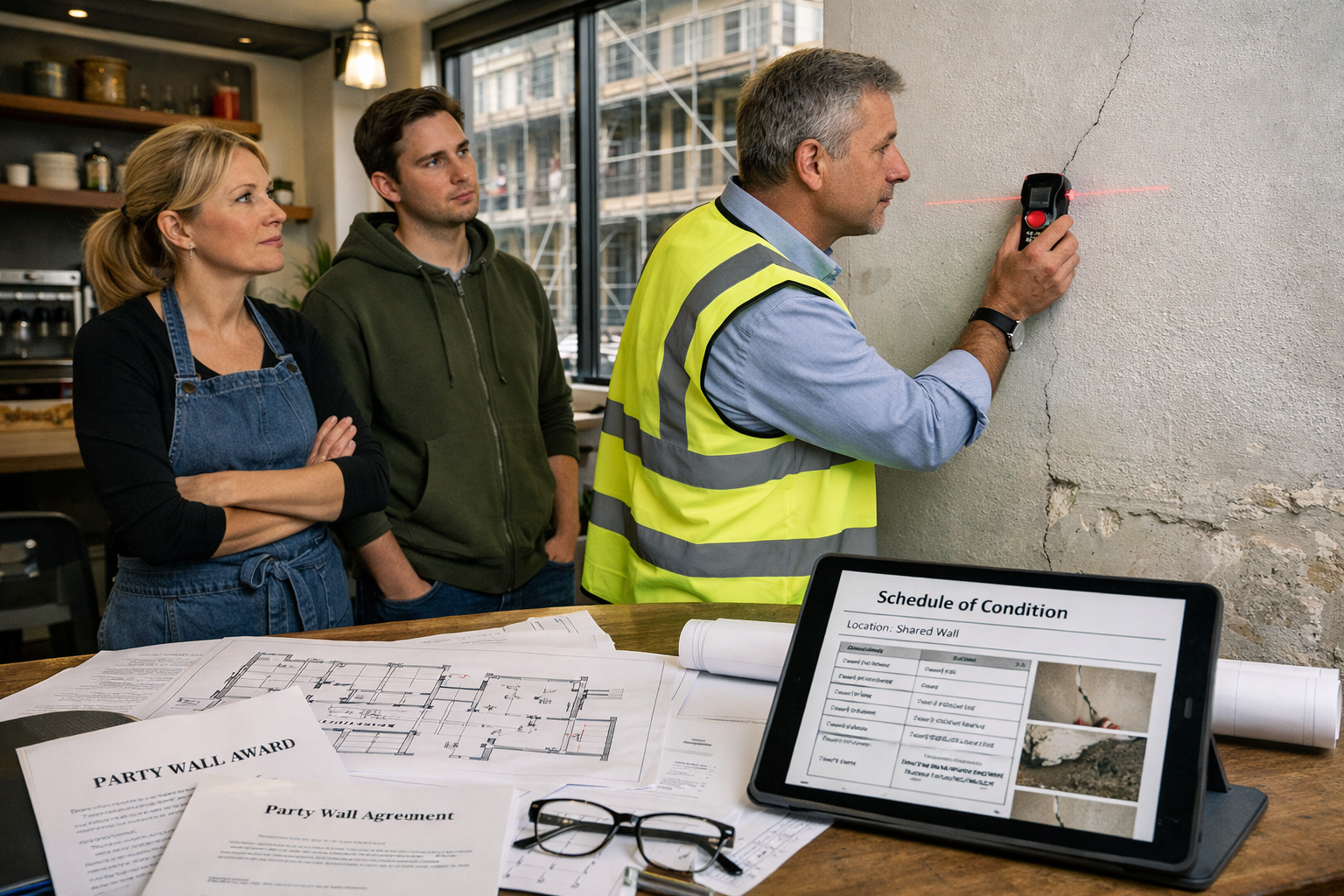
- Condition schedules with photographic and written records of pre-construction conditions
- Structural calculations demonstrating load transfer and stability
- Method statements detailing construction sequences and temporary works
- Monitoring protocols specifying vibration limits, crack monitoring, and settlement observations
- Party wall awards formally documenting agreed-upon procedures and protections
- Insurance certificates demonstrating adequate coverage for party wall work
Understanding what party wall surveyors do helps developers appreciate the comprehensive documentation these professionals prepare.
Dispute Resolution Mechanisms
Despite best efforts, disputes sometimes arise. Structured resolution mechanisms minimize delays:
⚖️ Resolution Hierarchy
- Direct negotiation between party wall surveyors (fastest, least costly)
- Third surveyor appointment when building owner and adjoining owner surveyors disagree
- Mediation for complex multi-party disputes
- Arbitration for technical disagreements requiring expert determination
- Litigation as last resort (most expensive, most time-consuming)
For mixed-use developments, early dispute resolution is particularly critical because construction delays affect multiple revenue streams simultaneously—retail lease commencement dates, residential pre-sales completion deadlines, and investor return projections.
Technology and Innovation in 2026
Modern party wall practice leverages advanced technologies that weren't available in previous decades:
🔬 Digital Tools
- 3D laser scanning for precise condition documentation
- BIM integration allowing party wall constraints to inform design directly
- Vibration monitoring sensors with real-time alerts and cloud data storage
- Drone surveys for roof and façade inspections without scaffolding
- AI-powered damage detection comparing baseline and progress photography[4]
- Digital service platforms streamlining notice service and record-keeping
These technologies improve accuracy, reduce disputes, and provide objective evidence if disagreements arise. The integration of AI-driven precision in property surveying has revolutionized workflows in 2026, making party wall surveys more efficient and reliable.[4]
Financial Considerations: Budgeting for Party Wall Surveys in Mixed-Use Projects
Cost Components and Budget Planning
Party wall costs have historically been underestimated in development budgets, leading to unpleasant surprises during construction.[1] Comprehensive budgeting should include:
💰 Direct Party Wall Costs
- Building owner's surveyor fees: £2,000-£8,000+ depending on project complexity
- Adjoining owner's surveyor fees: £1,500-£6,000+ per affected neighbour (building owner typically pays)
- Third surveyor fees: £3,000-£10,000+ if disputes require resolution
- Monitoring costs: £500-£2,000 per property for vibration and settlement monitoring
- Condition survey costs: £800-£3,000 per property for detailed pre-construction documentation
💰 Indirect Costs
- Structural mitigation: Underpinning, temporary supports, vibration isolation measures
- Programme delays: Holding costs if disputes delay construction commencement
- Damage remediation: Repairs to neighbouring properties if damage occurs despite precautions
- Legal fees: If disputes escalate to formal proceedings
- Insurance premiums: Increased costs for party wall-specific coverage
For a typical mixed-use development affecting 3-5 neighbouring properties, total party wall costs might range from £15,000 to £50,000+, representing 0.5-2% of construction costs for a £2-5 million project.
Value Engineering and Cost Control
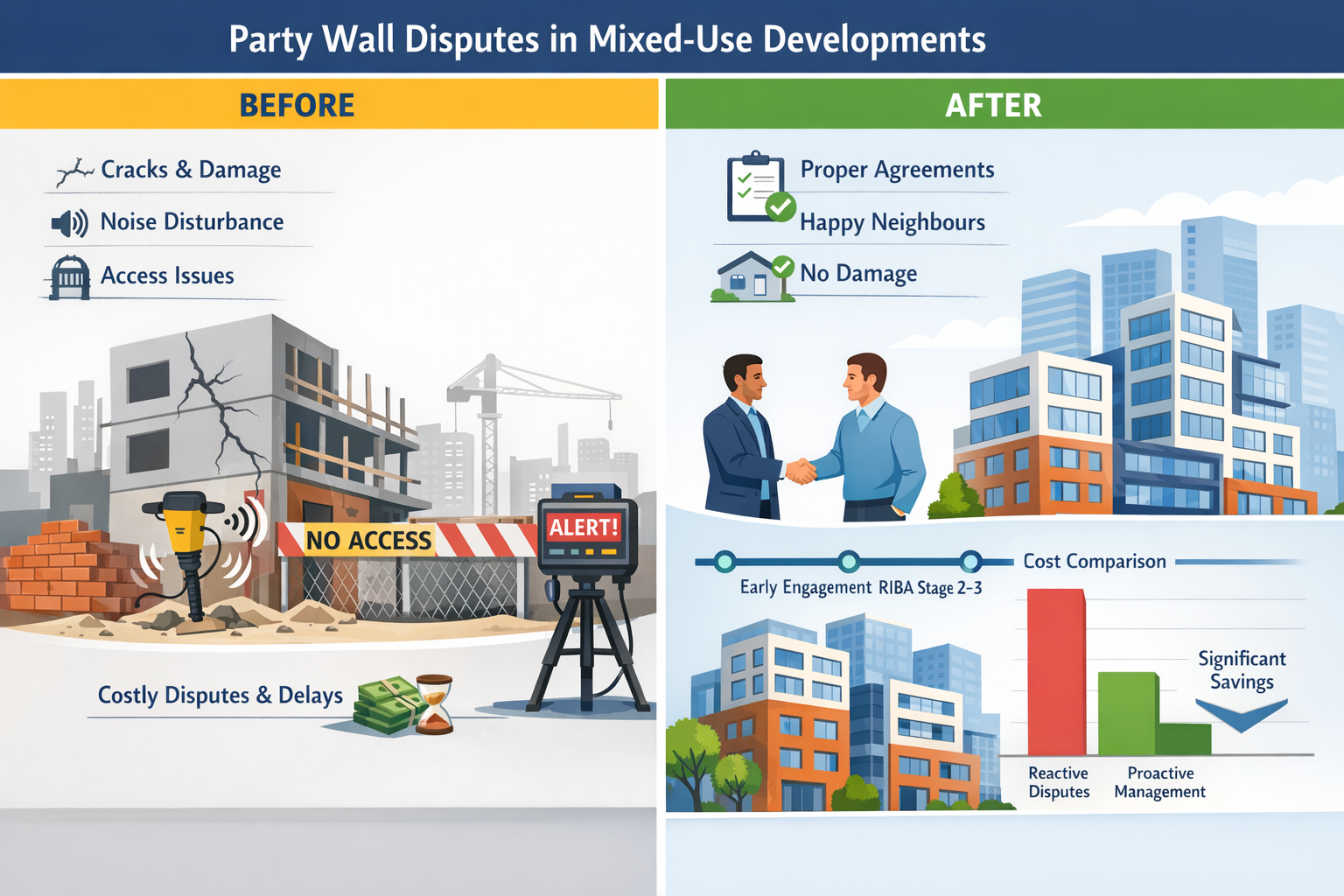
Proactive management consistently delivers better cost outcomes than reactive approaches[1]:
📊 Cost Comparison: Proactive vs. Reactive
| Approach | Timing | Typical Cost Range | Programme Impact |
|---|---|---|---|
| Proactive (early engagement) | RIBA Stage 2-3 | £15,000-£35,000 | Minimal (incorporated in schedule) |
| Reactive (issues arise during construction) | Post-commencement | £35,000-£100,000+ | Significant (2-6 month delays possible) |
The cost differential reflects:
- Higher professional fees for urgent dispute resolution
- Construction delays incurring holding costs and contractor standby charges
- Remedial work costs addressing damage that could have been prevented
- Legal expenses if disputes escalate
Return on Investment for Proper Party Wall Management
Investor confidence represents the most significant but least quantifiable benefit of professional party wall management.[1] Institutional investors conducting due diligence on value-add mixed-use opportunities increasingly require:
✅ Evidence of comprehensive risk assessment including party wall considerations
✅ Documentation of neighbour consultation and agreement status
✅ Professional third-party validation of construction feasibility
✅ Clear mitigation strategies for identified risks
Developments demonstrating these elements command better financing terms, achieve faster investment committee approvals, and support higher exit valuations because they represent lower execution risk.
For developers focused on retail-residential conversions in 2026's competitive market, professional party wall management isn't merely a compliance exercise—it's a strategic investment that protects programme, controls costs, and enhances asset value.
Regional Variations and Jurisdiction-Specific Considerations
England and Wales: Party Wall etc. Act 1996 Application
The Party Wall etc. Act 1996 applies throughout England and Wales, providing consistent statutory framework for party wall matters.[1] However, local planning authorities may impose additional requirements for mixed-use developments:
- Conservation areas: Enhanced scrutiny of external alterations affecting shared walls
- Listed buildings: Separate listed building consent required alongside party wall procedures
- Article 4 directions: Removal of permitted development rights affecting party wall work scope
Scotland: Different Legal Framework
Scotland operates under different common law principles rather than the Party Wall etc. Act 1996. Mixed-use developers in Scotland must navigate:
- Common interest principles governing shared structures
- Servitude rights affecting access and support
- Building Standards compliance through local authorities
- Neighbour notification under different statutory frameworks
London and Dense Urban Contexts
London and other dense urban centres present unique party wall challenges for mixed-use developments:
- Terraced properties with party walls on multiple sides
- Basement developments requiring deep excavation near neighbours
- Historic buildings with complex existing party wall arrangements
- Multiple ownership structures complicating consent processes
The concentration of value-add opportunities in underutilized London commercial properties makes understanding these complexities particularly important for investors targeting the capital's retail-residential conversion market.
International Considerations
For developers working on mixed-use projects in international jurisdictions, party wall equivalents vary significantly:
- United States: No federal party wall legislation; state and local ordinances vary widely
- Australia: State-based party wall legislation (e.g., Victoria's Fences Act, NSW Property and Stock Agents Act)
- European Union: Country-specific civil code provisions governing shared walls
- Middle East: Sharia law principles may influence party wall arrangements
Developers expanding mixed-use strategies internationally should engage local specialists familiar with jurisdiction-specific requirements.
Future Trends: Party Wall Surveys for Mixed-Use Developments Beyond 2026
Regulatory Evolution
Regulatory frameworks continue evolving to address modern development patterns:
Anticipated Changes:
- Streamlined processes for adaptive reuse projects converting commercial to mixed-use
- Enhanced neighbour protections for residential occupiers affected by commercial construction
- Technology integration requirements (digital notices, online dispute resolution platforms)
- Sustainability considerations incorporated into party wall awards (shared renewable energy systems, green walls)
The California precedent of separate approval tracks for different components of mixed-use projects[2] may influence UK planning policy, potentially requiring more sophisticated party wall coordination across phased approvals.
Technology Integration
Digital transformation will continue reshaping party wall practice:
🔮 Emerging Technologies
- Blockchain-based party wall awards providing immutable records
- Virtual reality neighbour consultations enabling remote stakeholder engagement
- IoT sensor networks providing continuous structural monitoring
- Machine learning algorithms predicting dispute probability based on project characteristics
- Automated notice generation integrated with BIM models
These innovations promise to make party wall processes more efficient, transparent, and evidence-based, reducing friction in mixed-use development delivery.
Sustainability and Shared Infrastructure
Mixed-use developments increasingly incorporate shared sustainability infrastructure:
- Combined heat and power systems serving multiple occupancy types
- Rainwater harvesting and greywater recycling across uses
- Green roofs and walls on party structures
- Shared EV charging infrastructure
These shared systems require enhanced party wall agreements addressing:
- Maintenance responsibilities and cost allocation
- Access rights for repairs and upgrades
- Performance standards and monitoring
- Decommissioning and replacement protocols
Market Dynamics and Investment Trends
The value-add opportunity in underutilized commercial properties will likely persist through the late 2020s as structural shifts in retail and office demand continue. This creates sustained demand for party wall expertise in mixed-use conversions.
Investment trends supporting this outlook include:
📈 Institutional capital allocation to urban regeneration strategies
📈 ESG mandates favoring adaptive reuse over new construction
📈 Housing policy incentivizing residential density in urban cores
📈 Retail evolution toward experiential formats requiring residential foot traffic
Developers and surveyors who master Party Wall Surveys for Mixed-Use Developments: Tackling Zoning and Neighbour Disputes in 2026 Urban Revivals will be well-positioned to capitalize on these trends.
Practical Guidance: Implementing Effective Party Wall Strategies
For Developers and Investors
🎯 Action Steps for Development Teams:
- Budget appropriately: Allocate 0.5-2% of construction costs for party wall matters
- Engage specialists early: Bring party wall surveyors into the team at RIBA Stage 2-3
- Conduct boundary surveys: Obtain precise legal descriptions before design finalization
- Map all affected neighbours: Identify every property potentially requiring notice
- Develop communication plans: Create stakeholder engagement strategies before serving notices
- Integrate with programme: Build party wall timelines into critical path schedules
- Document everything: Maintain comprehensive records of all consultations and agreements
- Secure appropriate insurance: Ensure coverage addresses party wall-specific risks
- Plan for contingencies: Include time and cost buffers for potential disputes
- Monitor continuously: Implement condition monitoring throughout construction
For Surveyors and Construction Professionals
🎯 Professional Best Practices:
- Maintain independence: Party wall surveyors must act impartially even when appointed by one party
- Communicate clearly: Translate technical requirements into accessible language for property owners
- Document thoroughly: Comprehensive condition schedules prevent disputes
- Coordinate with design teams: Ensure party wall constraints inform design decisions
- Establish monitoring protocols: Define clear thresholds and response procedures
- Respond promptly: Address neighbour concerns quickly before they escalate
- Stay current: Keep abreast of regulatory changes and case law developments
- Leverage technology: Use modern tools for documentation, monitoring, and communication
- Build relationships: Develop networks with other party wall professionals for complex cases
- Pursue continuous education: Attend training on mixed-use-specific challenges
For those seeking professional guidance, understanding party wall surveyor roles and responsibilities provides essential foundation knowledge.
For Adjoining Owners and Neighbours
🎯 Protecting Your Interests:
- Understand your rights: Familiarize yourself with Party Wall etc. Act 1996 protections
- Respond to notices promptly: Timely responses preserve your rights
- Appoint your own surveyor: Independent professional representation protects your interests
- Document existing conditions: Photograph and note any existing defects before construction
- Communicate concerns clearly: Raise specific issues rather than blanket objections
- Be reasonable: Courts expect proportionate responses to legitimate development
- Request monitoring: Ensure vibration and settlement monitoring protects your property
- Review awards carefully: Understand what you're agreeing to before signing
- Maintain records: Keep all correspondence and documentation
- Seek professional advice: Consult solicitors for complex situations
Understanding when you need a party wall agreement helps adjoining owners recognize situations requiring professional involvement.
Conclusion: Mastering Party Wall Surveys for Mixed-Use Developments in 2026's Urban Revival
The transformation of undervalued commercial properties into vibrant mixed-use developments represents one of 2026's most significant urban regeneration opportunities. However, successfully executing these value-add strategies requires mastering the complex intersection of party wall legislation, zoning regulations, and neighbour relations that characterize Party Wall Surveys for Mixed-Use Developments: Tackling Zoning and Neighbour Disputes in 2026 Urban Revivals.
The evidence is clear: early specialist engagement, comprehensive stakeholder communication, and proactive risk management deliver superior outcomes compared to reactive approaches.[1] Developers who integrate party wall considerations from RIBA Stage 2-3 protect construction programmes, achieve cost certainty, and build investor confidence—all critical success factors in competitive urban markets.
As mixed-use development continues reshaping city centres, the professionals who understand both the technical requirements of party wall legislation and the diplomatic skills required for neighbour negotiation will be invaluable to development teams. The complexity of retail-residential hybrids, with their diverse occupancy types and overlapping regulatory frameworks, demands specialized expertise that goes beyond traditional residential party wall work.
Next Steps: Taking Action
For developers and investors planning mixed-use projects:
✅ Engage a qualified party wall surveyor with mixed-use development experience
✅ Conduct preliminary boundary surveys to map constraints early
✅ Develop comprehensive stakeholder engagement strategies before serving notices
✅ Integrate party wall timelines into project critical paths
✅ Budget appropriately for both direct and indirect party wall costs
For adjoining owners receiving party wall notices:
✅ Respond within the statutory timeframe (14 days for most notices)
✅ Appoint your own surveyor to protect your interests
✅ Document existing conditions thoroughly before construction begins
✅ Communicate concerns clearly and specifically
✅ Remain engaged throughout the construction process
For construction professionals delivering mixed-use projects:
✅ Coordinate with party wall surveyors from project inception
✅ Implement robust monitoring protocols to detect issues early
✅ Maintain transparent communication with all affected neighbours
✅ Document compliance with party wall award requirements
✅ Address issues promptly before they escalate to formal disputes
The urban revival of 2026 offers tremendous opportunities for those who approach mixed-use development with professional rigor and respect for the complex web of rights and responsibilities that party wall legislation protects. By mastering these principles, development teams can transform underutilized commercial assets into thriving mixed-use communities while maintaining positive neighbour relations and protecting all parties' legitimate interests.
The future of urban development is mixed-use, and the future of mixed-use development success is comprehensive party wall management.
References
[1] Party Walls And Neighbourly Matters A Guide For Commercial Developers And Investors – https://www.thelandsite.co.uk/articles/party-walls-and-neighbourly-matters-a-guide-for-commercial-developers-and-investors
[2] Californias 2026 Housing Laws What You Need To Know – https://www.hklaw.com/en/insights/publications/2025/12/californias-2026-housing-laws-what-you-need-to-know
[3] Party Wall Faqs – https://jdmsurveyors.com/party-wall-faqs/
[4] Ai Driven Precision In Property Surveying How Artificial Intelligence Is Revolutionizing Workflows In 2026 – https://nottinghillsurveyors.com/blog/ai-driven-precision-in-property-surveying-how-artificial-intelligence-is-revolutionizing-workflows-in-2026
