
A tyre that is slowly deflating does not explode. It just keeps losing air, quietly, until someone finally checks the pressure. That is the image Camilla Dell, Managing Partner at buying agency Black Brick, chose to describe prime central London property right now. Her verdict landed in early October 2026 alongside two very different sets of numbers: one showing prices still as much as 25% below their peak, another showing the first quarterly price growth in four years. Both are true. Neither tells the whole story alone.
For owners in Notting Hill, W2 and W8, this is not academic. It is the difference between pricing a sale with confidence and guessing in the dark. The prime London property market October 2026 Black Brick Knight Frank data set is being read in wildly different ways across the press, and sellers deserve a clearer explanation than a headline allows.
Key Takeaways
- Black Brick's Camilla Dell says prime London is "off the critical list" but still deflating slowly, not bouncing back.
- PropertyWire reports prices up to 25% below peak, while Knight Frank recorded the first quarterly rise (+0.3%) in four years, alongside an annual fall of just 2%.
- These figures are not contradictory; they measure different time horizons and use different sample sets.
- The UBS Global Real Estate Bubble Index 2026 now rates London as low risk, after roughly five years in the high-risk category.
- The Autumn Budget on 28 October 2026 carries speculative risk around capital gains tax and council tax, with nothing confirmed yet.
- An independent RICS Red Book valuation, not an agent's guide price or a portal estimate, is the most reliable way to navigate conflicting data.
Prime London Property Market October 2026: Black Brick, Knight Frank and the Numbers Behind the Noise
Three figures are circulating right now, and each one is accurate in its own context. Knight Frank's latest index recorded quarterly growth of 0.3%, the first positive quarter in four years. The same data set showed an annual decline of 2%, described as the smallest fall in 18 months. Meanwhile, PropertyWire's reporting on 3 October 2026 put cumulative price falls at up to 25% from the market's peak.
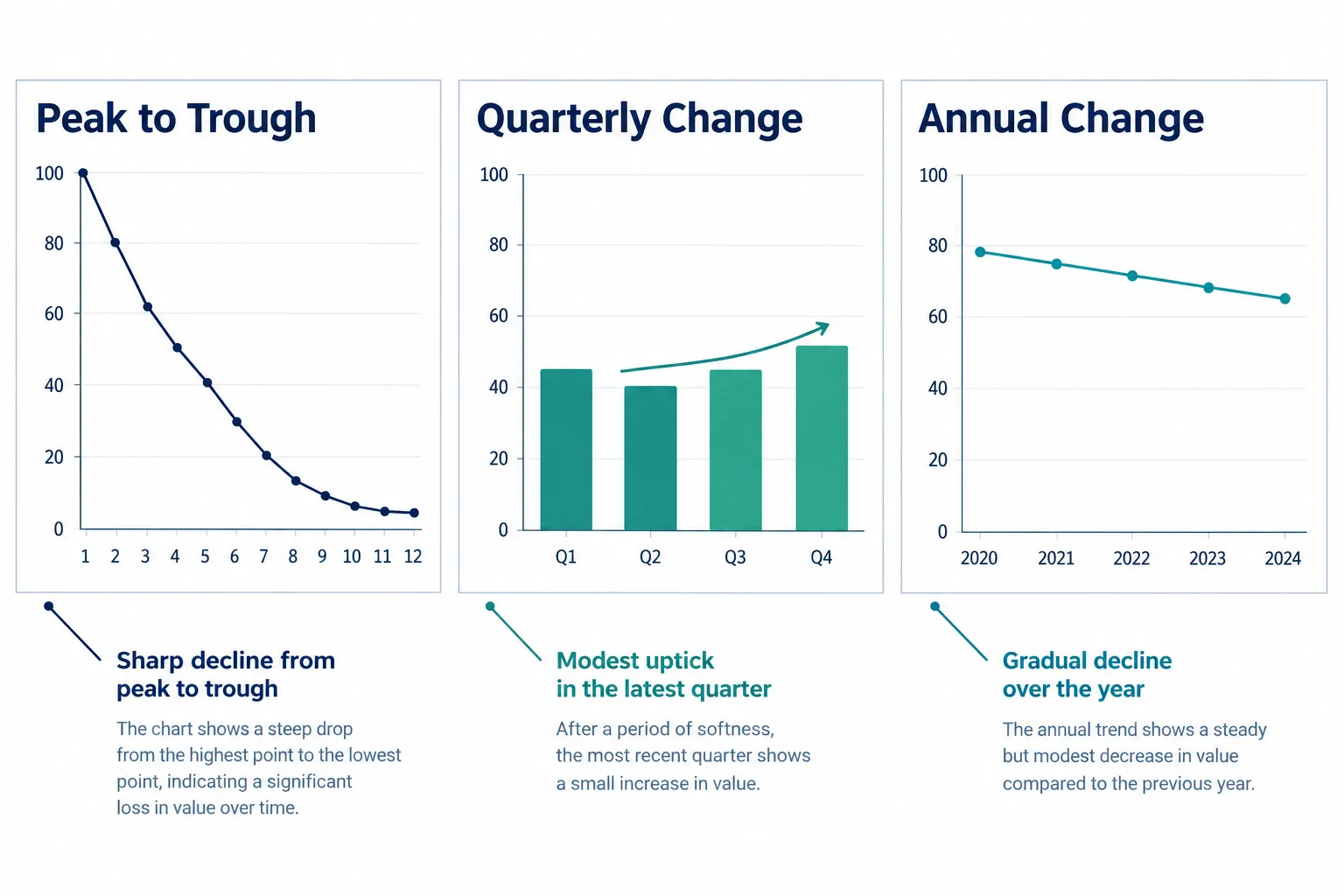
None of this is a typo or a data error. Peak-to-trough measures the full distance travelled since prices were at their highest point, several years ago. Quarterly change measures only the most recent three months. Annual change sits between the two. A market can be deeply discounted against its historic peak while still showing short-term stabilisation. That is precisely what appears to be happening in prime central London.
| Measure | What It Shows | October 2026 Reading |
|---|---|---|
| Peak-to-trough | Total fall since the market's highest point | Up to 25% below peak |
| Annual change | Change over the last 12 months | Down 2%, smallest fall in 18 months |
| Quarterly change | Change over the last 3 months | Up 0.3%, first rise in four years |
Why the Headlines Contradict Each Other: Peak-to-Trough vs Quarterly Growth
Indices also disagree because they sample differently. Knight Frank's prime central London index tracks a defined basket of postcodes and property types. Other reports drawing on wider PropertyWire-style commentary may blend different areas, price bands, or transaction volumes. A handful of high-value sales in one quarter can move an index noticeably, especially in a thin market where transaction numbers are low compared with the mainstream market.
This is why Black Brick's language matters more than any single statistic. "Off the critical list" suggests the market has stopped deteriorating sharply. "Slowly deflating" suggests it has not yet started reinflating. Both can be correct at once, and together they describe something more useful than either number alone: a market finding a floor, not one springing back to its previous highs.
"Stabilisation, Not Recovery": What It Means for W11, W2 and W8
For owners across Notting Hill and neighbouring prime postcodes, the practical message is restraint rather than optimism. A 0.3% quarterly rise is not a recovery. It is a sign that further falls may be slowing. The UBS Global Real Estate Bubble Index 2026 reinforces this cautious read: London has moved from high risk of a price crash, where it sat for roughly five years, to low risk. That shift reflects reduced vulnerability to a sudden correction, not a return to boom conditions.
"The market is off the critical list, but it is behaving like a tyre slowly deflating.", Camilla Dell, Black Brick
What does stabilisation actually mean day to day?
- Sellers should expect realistic offers closer to current market evidence, not peak-era comparables from several years ago.
- Buyers should not assume prices will keep falling indefinitely; the pace of decline has clearly slowed.
- Both sides benefit from pricing based on recent, verified transactions rather than headline percentages.
- Negotiations are likely to remain detailed and evidence-led, particularly on condition, lease length, and service charges.
The Autumn Budget Wildcard: Capital Gains Tax and Council Tax Speculation
Any read of the prime London property market October 2026 Black Brick Knight Frank picture has to account for timing. The Autumn Budget, due on 28 October 2026, sits just weeks after these figures were published. Speculation has focused on possible changes to capital gains tax and council tax bands affecting higher-value homes.

It is important to be precise here: nothing has been confirmed. No draft legislation, rate, or threshold has been announced at the time of writing. However, speculation alone can affect behaviour. Some owners may bring forward sale decisions to avoid uncertainty; others may pause until the Budget detail is known. Either response is understandable, but neither should be based on rumour. Decisions made now should rest on independently verified property evidence, not assumptions about what the Chancellor might do.
Why an Independent RICS Red Book Valuation Matters When Indices Disagree
When national indices disagree by 25 percentage points depending on the time frame chosen, a single agent's asking price or an automated portal estimate cannot resolve the gap. Agents are incentivised to win instructions; portal algorithms rely on broad postcode averages that cannot capture a specific property's condition, lease structure, or outlook.
A RICS Red Book valuation is different. It is produced by a chartered surveyor bound by strict professional standards, using comparable evidence, inspection findings, and recognised valuation methodology. It does not chase an index headline. It answers one specific question: what is this property worth today, based on verifiable evidence.
For owners in Notting Hill considering a sale, remortgage, probate matter, or tax planning decision ahead of the Budget, this independence carries real weight. It is also the only valuation type typically accepted by lenders, courts, and HMRC without challenge.
Practical Steps for Notting Hill Owners and Buyers Right Now
- Commission an independent RICS Red Book valuation before setting an asking price or making an offer.
- Treat peak-to-trough figures as historical context, not a current price guide.
- Watch for confirmed Budget announcements on 28 October 2026 rather than acting on speculation.
- Compare any agent guide price against recent, genuinely comparable sales evidence.
- Revisit valuations periodically; a market described as "slowly deflating" can shift month to month.
FAQ
Is the prime London property market crashing in October 2026?
No. The UBS Global Real Estate Bubble Index 2026 now rates London as low risk, and Knight Frank recorded quarterly growth for the first time in four years. The market is stabilising, not collapsing.
Why do reports say prices are both up and down 25% below peak?
Different measures cover different time periods. Peak-to-trough compares today with the market's historic high several years ago. Quarterly and annual figures look only at recent months. Both can be accurate simultaneously.
Should Notting Hill owners sell now or wait for the Budget?
No Budget changes have been confirmed yet. Decisions should be based on independent valuation evidence rather than speculation about capital gains tax or council tax changes.
Why not just use an estate agent's valuation?
Agent valuations can be influenced by the desire to win instructions and may not reflect formal RICS methodology. A Red Book valuation is independent and evidence-based.
What does "off the critical list" actually mean for pricing?
It means the sharpest period of decline appears to have passed, but it does not mean prices are rising strongly. Expect gradual stabilisation, not a rebound.
Conclusion
The prime London property market October 2026 Black Brick Knight Frank data tells a layered story, not a contradictory one. Prices remain well below their historic peak, yet the pace of decline has clearly slowed, and London's risk profile has improved markedly according to UBS. For owners and buyers in Notting Hill, W2 and W8, the sensible response is neither panic nor premature celebration. It is precision. Before listing, buying, or making a tax-related decision ahead of the 28 October Budget, commission an independent RICS Red Book valuation from a chartered surveyor who can weigh the evidence specific to the property, not the headline of the day.