
Only 32% of homebuyers in the UK report that they fully understood the credentials of the surveyor they instructed before commissioning a report. That gap between assumption and verification is where costly mistakes happen. Understanding what "professional" really means in chartered surveying, the standards, ethics and how buyers can check quality, is not a bureaucratic exercise. It is a practical safeguard that protects one of the largest financial decisions most people will ever make.
Key Takeaways
- The title "chartered surveyor" is legally protected and can only be used by individuals who hold active RICS membership, having passed the rigorous Assessment of Professional Competence (APC).
- RICS-regulated firms must comply with a formal Rules of Conduct framework covering integrity, competence, transparency and client care, obligations that go far beyond general trade standards.
- Continuous Professional Development (CPD) is mandatory, meaning a qualified chartered surveyor's knowledge must be kept current, not frozen at the point of qualification.
- In 2026, a new RICS global standard on responsible AI use added a further layer of professional obligation, requiring human oversight and transparency with clients when technology assists in surveying work.
- Buyers can verify both individual surveyors and regulated firms through official RICS directories, and should always do so before signing any engagement letter or making payment.
The Foundations: What Makes a Chartered Surveyor Genuinely Professional
The word "professional" is used loosely in the property industry. Builders, tradespeople and independent consultants may all describe themselves as professionals, and in a general sense they are right to do so. But in chartered surveying, the term carries a specific, enforceable meaning that sets it apart from almost every other property-related service.
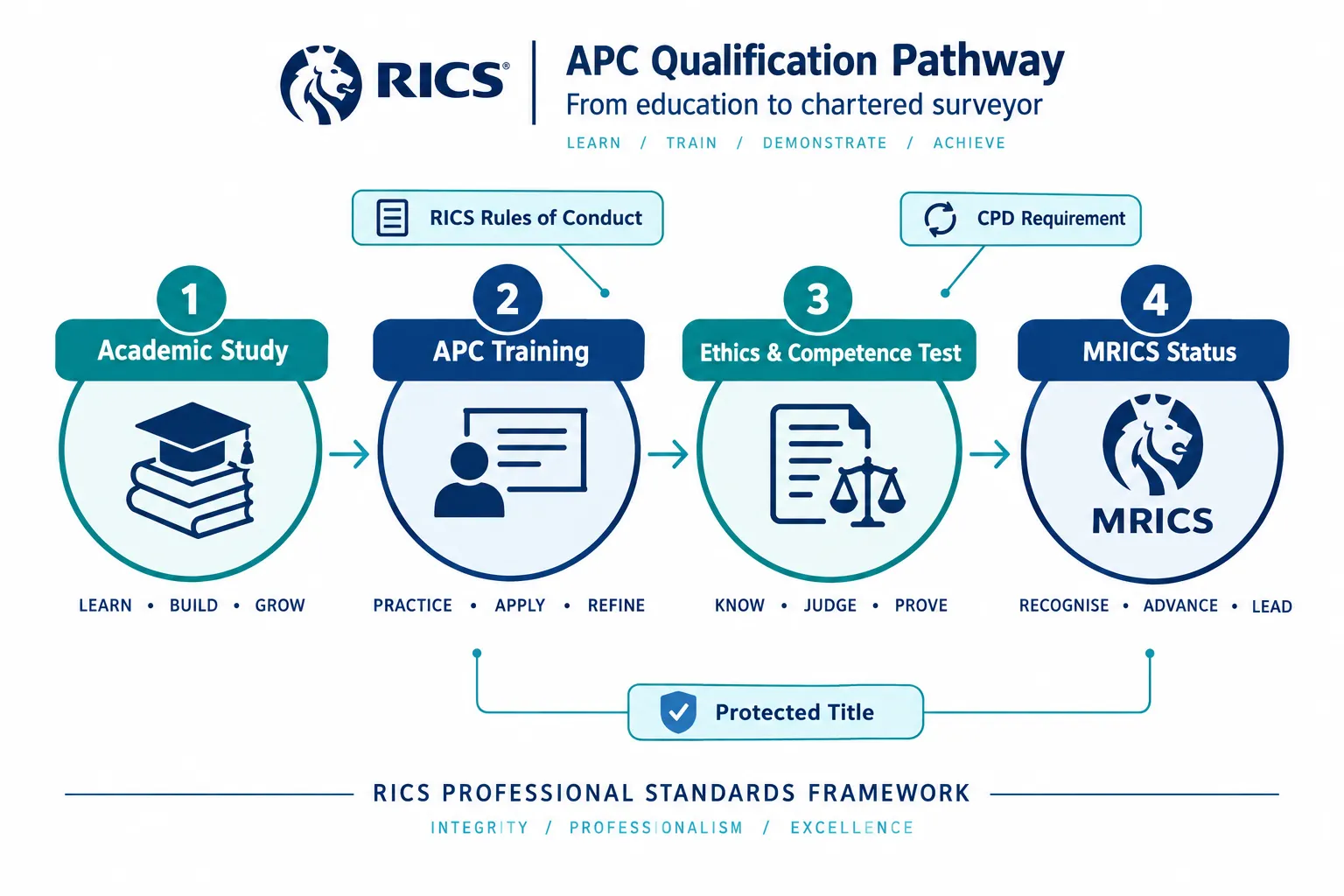
A chartered surveyor is an individual who holds a current qualification from the Royal Institution of Chartered Surveyors (RICS), the globally recognised professional body for the built and natural environment. RICS describes its role as developing and enforcing leading international standards to ensure the highest levels of professionalism across property, land and construction [1]. Entry into the profession is controlled through the Assessment of Professional Competence (APC), a structured assessment process that tests whether a candidate meets the required levels of both technical knowledge and ethical conduct before they are permitted to use protected titles such as MRICS (Member) or FRICS (Fellow) [2].
This matters for buyers because it means the title cannot be self-awarded. A builder can call themselves experienced; a property consultant can claim expertise. Only someone who has passed RICS' qualification standards and remains in good standing with the institution can legally describe themselves as a chartered surveyor [2].
The APC: More Than an Exam
The APC is not a single written test. It is a structured period of supervised professional practice, typically two years for graduates, during which candidates must demonstrate competency across a range of technical and ethical areas. Candidates must show they understand and apply the RICS Rules of Conduct, that they can exercise professional judgment, and that they are capable of serving clients with integrity. The final assessment includes a professional interview before an independent panel.
This rigorous entry requirement is one of the reasons that instructing a chartered surveyor differs fundamentally from hiring a general property inspector or contractor.
RICS Standards and Ethics: The Rulebook Behind the Title
Holding an RICS qualification is not a one-time achievement. It comes with ongoing obligations that define what "professional" really means in chartered surveying: standards, ethics and how buyers can check quality all connect back to a living framework of rules that members must follow throughout their careers.
The Rules of Conduct
The RICS Rules of Conduct are the core ethical and professional rulebook for all members and regulated firms. The current version has been in effect since 2 February 2022, with regulatory rules updated as recently as August 2026 [15]. The Rules set out five principal obligations:
| Obligation | What It Requires |
|---|---|
| Integrity | Act honestly and avoid conflicts of interest |
| Competence | Only undertake work within your skill level |
| Service | Act in clients' best interests and communicate clearly |
| Transparency | Disclose relevant information and fees upfront |
| Responsibility | Uphold the reputation of the profession |
Compliance with these rules is a condition of RICS membership. Breaches can lead to regulatory outcomes, including suspension or removal from the register, which are published publicly by RICS [5]. This transparency is itself a professional standard: it means buyers can check whether a surveyor has a disciplinary history before they instruct them.
Continuous Professional Development (CPD)
Professional knowledge does not stand still, and neither do the obligations of a chartered surveyor. RICS requires all members to complete mandatory CPD each year, ensuring that their technical knowledge reflects current standards, legislation and best practice. A surveyor who qualified a decade ago and has done nothing since would not meet this requirement and would risk losing their membership.
This is a meaningful distinction from unregulated property inspectors, who face no equivalent obligation to keep their knowledge current. For buyers commissioning a Level 2 home survey or a more detailed Level 3 building survey, the CPD requirement provides an important assurance that the report reflects up-to-date professional judgment.
Technical Standards: The Red Book and Beyond
Beyond ethics, RICS maintains a comprehensive suite of technical standards that govern how surveyors carry out specific types of work [7]. The RICS Valuation, Global Standards, commonly known as the "Red Book," set out mandatory requirements for property valuations and came into effect on 31 January 2025. These standards ensure that valuations are conducted consistently and reliably, regardless of which RICS member carries them out.
For buyers seeking a RICS valuation, this means the report they receive follows a globally recognised methodology, not a subjective estimate shaped by individual preference.
The 2026 AI Standard: A New Dimension of Professional Obligation
In March 2026, RICS introduced its first global professional standard for the responsible use of artificial intelligence in surveying, a landmark development that added a significant new layer to what professional practice entails [3].
The standard, which became mandatory for all RICS members and regulated firms from 9 March 2026, imposes four core requirements:
- Governance and risk management, firms must have clear policies for how AI tools are selected, deployed and monitored.
- Professional judgment and human oversight, AI outputs must be reviewed by a qualified professional; automation cannot replace chartered judgment.
- Transparency with clients, surveyors must disclose when AI tools have been used in preparing a report or recommendation.
- Responsible development and deployment, members must not use AI in ways that could mislead clients or undermine the integrity of their advice.
"Professional judgment and human oversight are non-negotiable. AI can assist; it cannot replace the chartered surveyor's accountability to the client."
This standard is directly relevant to buyers in 2026. As AI-generated content and automated property reports become more common, the RICS framework ensures that a report from a chartered surveyor remains a product of qualified human judgment, with the professional's reputation and regulatory standing on the line.
Firm-Level Regulation: Why the Business Matters, Not Just the Individual
Understanding what "professional" really means in chartered surveying requires looking beyond the individual surveyor to the firm they work for. RICS regulates not only individual members but also the businesses through which surveying services are delivered.
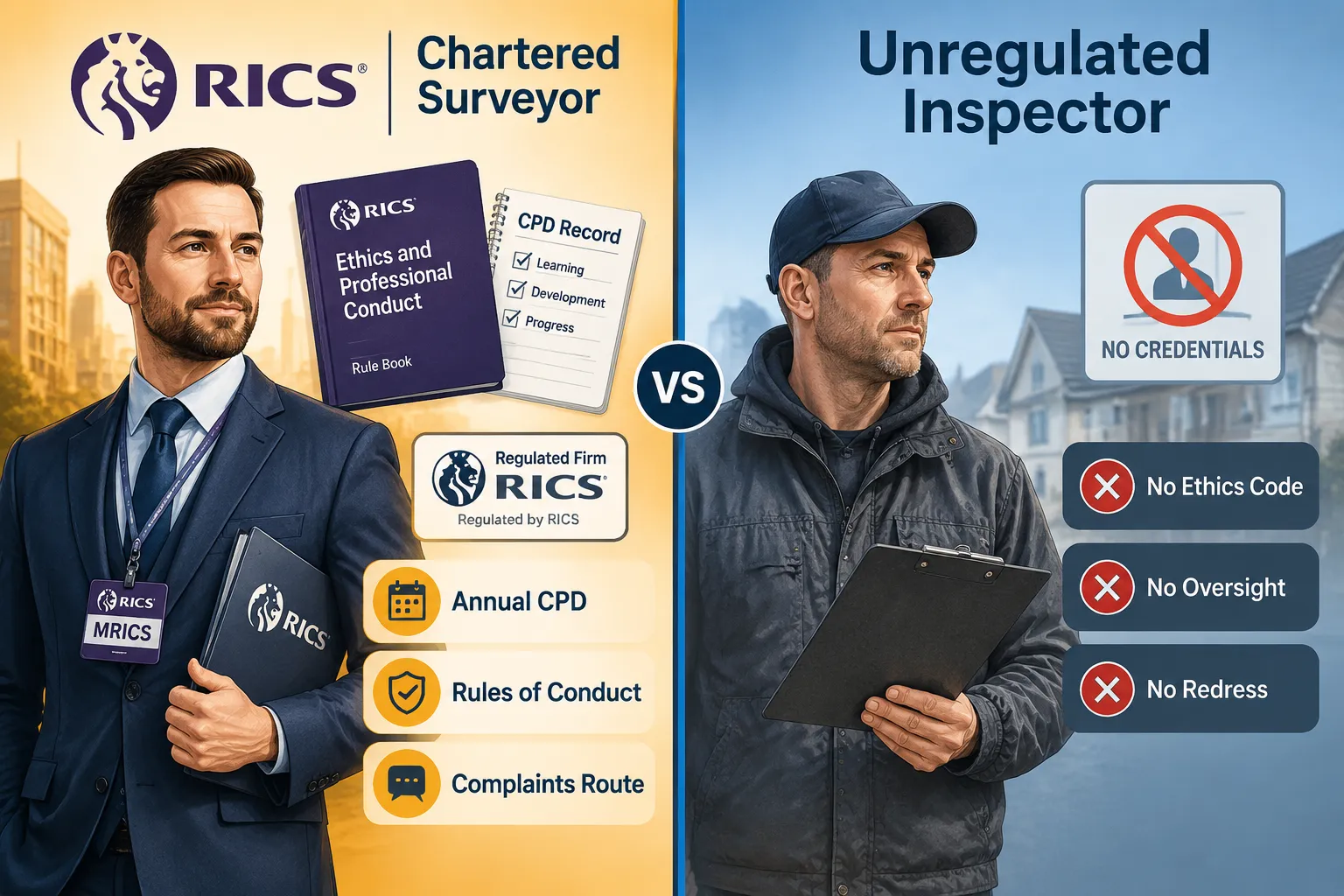
RICS-regulated firms must meet eligibility criteria, comply with the Rules of Conduct at a business level, and demonstrate that their managers are suitable persons to run a regulated practice [4]. This gives buyers an additional layer of protection that simply does not exist when instructing an unregulated provider.
What Firm Regulation Means in Practice
A regulated firm must:
- Display the "Regulated by RICS" logo on its website, business literature and terms of engagement [4]
- Maintain professional indemnity insurance to protect clients if something goes wrong
- Have a complaints-handling procedure that meets RICS requirements
- Provide access to redress, if a complaint cannot be resolved internally, clients can escalate to an independent redress scheme
This complaints and redress pathway is one of the most practically important distinctions between a chartered surveyor and an unregulated tradesperson. If a general contractor produces a poor property report, the buyer's options are limited to civil litigation. If a RICS-regulated firm produces a substandard survey, the buyer has a structured route to formal complaint, regulatory investigation and, where appropriate, compensation.
For buyers in specific locations, working with a locally regulated firm, such as chartered surveyors in Surrey or chartered surveyors in North West London, means that both the individual and the business are subject to RICS oversight.
How Buyers Can Check Quality: A Practical Verification Guide
Knowing the standards exist is useful. Knowing how to verify them before signing a contract is essential. In 2026, RICS has issued specific guidance warning buyers that AI-generated or misleading websites may display RICS logos without any genuine regulatory standing [9]. A logo on a website is not proof of regulation. Buyers must check directly.
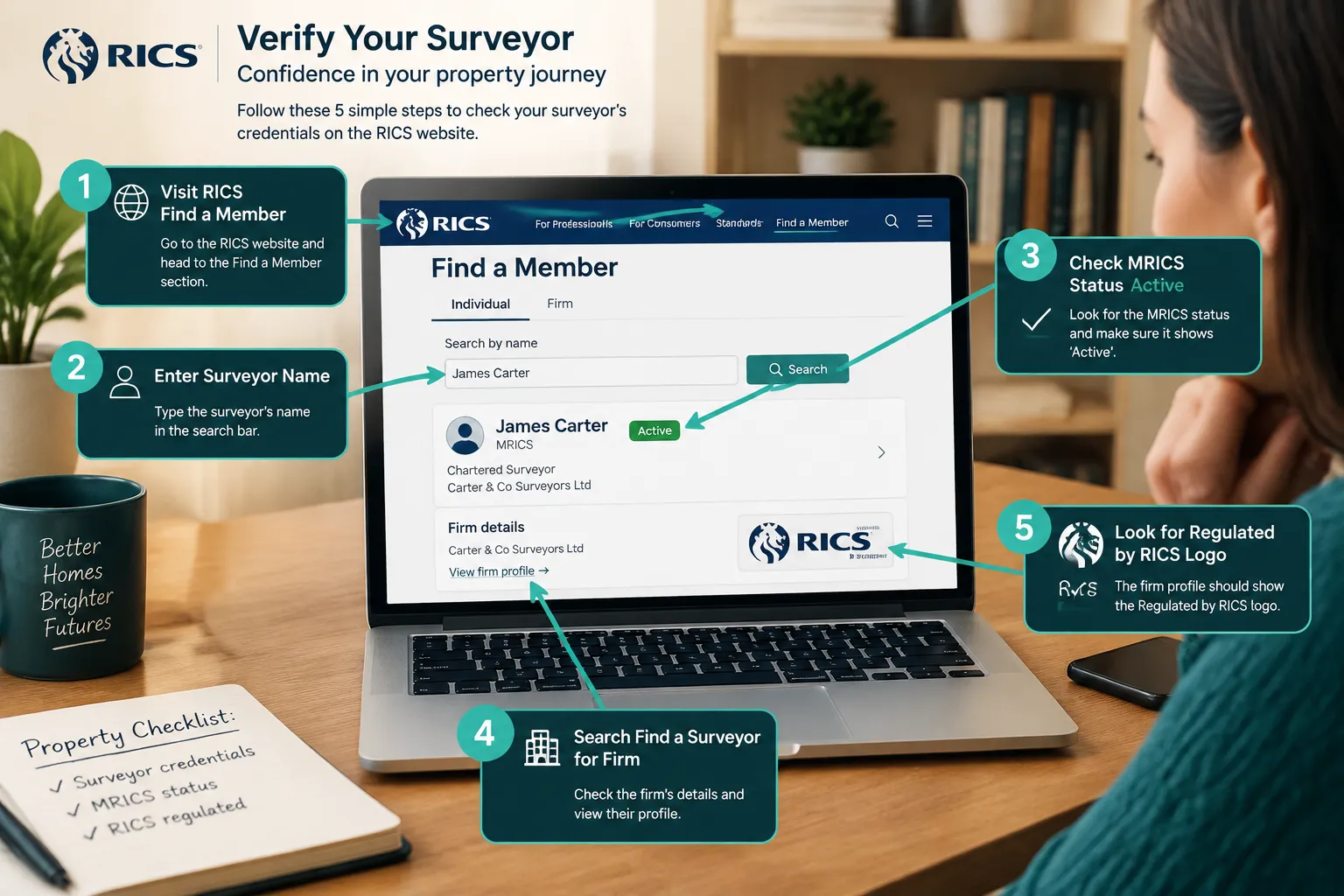
Step 1: Search the RICS "Find a Member" Directory
The official RICS "Find a Member" directory allows buyers to confirm whether an individual surveyor holds active, current RICS membership [5]. The search returns the member's status, their membership grade (MRICS or FRICS), and any interim measures or disciplinary sanctions recorded against them. RICS memberships renew annually on 1 January, so it is worth checking that the status shown is current [8].
Step 2: Search the "Find a Surveyor" Directory for the Firm
RICS operates a separate directory listing only RICS-regulated firms [4]. This is distinct from the individual member search and confirms that the business itself, not just one employee, is subject to RICS regulatory oversight. Industry guidance notes that buyers should use both directories, since a regulated firm may employ unqualified staff, and a qualified individual may work for an unregulated business [6].
Step 3: Ask for a Membership Number
Genuine RICS members can provide their unique membership number. Buyers should ask for this before instructing any surveyor and cross-reference it against the Find a Member directory [8][10]. If a surveyor is reluctant to provide this information, that reluctance is itself a warning sign.
Step 4: Check the Engagement Letter
A legitimate RICS-regulated firm will state its regulatory status clearly in its terms of engagement. The engagement letter should reference RICS regulation, confirm the type of survey being commissioned, and set out the complaints procedure [4]. Buyers who are unsure about which survey level is appropriate should ask the surveyor to explain the options before signing.
Step 5: Check for Published Regulatory Outcomes
RICS publishes the outcomes of disciplinary hearings and forthcoming panel hearings on its website, enabling clients to check whether a professional has a disciplinary history [5]. This level of public accountability is not available for unregulated property inspectors or contractors.
- Search the surveyor’s name on RICS Find a Member, confirm status is active
- Search the firm name on RICS Find a Surveyor, confirm firm is regulated
- Ask for the surveyor’s RICS membership number and verify it
- Check the engagement letter for “Regulated by RICS” wording
- Review RICS published regulatory outcomes for any disciplinary history
- Confirm the firm has a complaints procedure and access to redress
Distinguishing a Chartered Surveyor from a Basic Tradesperson or Contractor
The practical question many buyers face is not abstract: it is whether the person they are about to pay several hundred pounds to is genuinely qualified or simply experienced in property. The distinction matters enormously.
A contractor or tradesperson may have years of hands-on experience with buildings. They may produce a written report. They may even use professional-sounding language. But they are not subject to:
- A regulated entry qualification tested by an independent professional body
- Mandatory CPD requirements to keep knowledge current
- An enforceable code of ethics with disciplinary consequences
- Firm-level regulation requiring professional indemnity insurance
- A structured complaints and redress pathway for clients
For buyers considering a Level 2 survey on a standard property or a full structural assessment on an older or more complex home, the difference between a chartered surveyor's report and an unregulated inspection is not merely one of price or depth. It is a difference in accountability, recourse and professional obligation.
This distinction is especially relevant for specialist work. A party wall surveyor, for example, operates within a specific legal framework under the Party Wall etc. Act 1996. The legal weight of their awards and notices depends entirely on their professional standing and competence, not simply their familiarity with construction.
Conclusion
What "professional" really means in chartered surveying is not a marketing claim. It is a structured system of qualification, ethics, ongoing competence and regulated accountability that distinguishes chartered surveyors from every other category of property advisor or inspector.
For buyers, the practical takeaways are clear:
- Always verify the individual surveyor on the RICS Find a Member directory before instructing them, check that their status is current and that no disciplinary sanctions are recorded.
- Always verify the firm on the RICS Find a Surveyor directory, firm-level regulation provides protections that individual membership alone does not.
- Ask for a membership number and confirm it independently. Do not rely on logos displayed on a website.
- Read the engagement letter carefully, a regulated firm will reference RICS oversight and set out a complaints procedure.
- Understand the survey type you are commissioning, a qualified chartered surveyor should be able to explain the differences between survey levels and recommend the most appropriate option for your property.
In 2026, with AI-generated websites and misleading credentials becoming a genuine consumer risk, the ability to verify professional standing through official channels is more important than ever. The RICS framework exists to protect buyers. Using it takes five minutes and costs nothing.
References
[1] Profession Standards – https://www.rics.org/profession-standards
[2] Qualification Standards – https://www.rics.org/profession-standards/standards-of-qualification/qualification-standards
[3] RICS Launches Landmark Global Standard On Responsible Use Of AI In Surveying – https://www.rics.org/news-insights/rics-launches-landmark-global-standard-on-responsible-use-of-ai-in-surveying
[4] RICS Regulated Protection – https://www.rics.org/consumer-guides/rics-regulated-protection
[5] Find A Member – https://www.rics.org/find-a-member
[6] Who Will Carry Out My House Survey – https://fourthwallbc.com/blog/who-will-carry-out-my-house-survey/
[7] RICS Standards And Guidance – https://www.rics.org/profession-standards/rics-standards-and-guidance
[8] What Is RICS A Home Buyers Guide To The Royal Institution Of Chartered Surveyors – https://southsurveyors.co.uk/2026/02/10/what-is-rics-a-home-buyers-guide-to-the-royal-institution-of-chartered-surveyors/
[9] AI Generated Surveying Websites – https://www.rics.org/news-insights/ai-generated-surveying-websites
[10] Verify Surveyor Credentials UK – https://www.surveymerchant.com/blog/verify-surveyor-credentials-uk