
More than 1,400 UK homeowners gave feedback on the RICS Home Survey Standard, a figure that reveals just how much consumers care about what a "professional" building surveyor actually does on their behalf. Yet for most homebuyers, the word "professional" remains vague: a job title, a suit, perhaps a clipboard. Understanding what does 'professional' mean in UK building surveying, and how standards and ethics protect homebuyers, is not an abstract question. It has direct, practical consequences for every property purchase.
This article unpacks the real meaning of professionalism in chartered building surveying, from ethical duties and independence obligations to the evolving regulatory framework that is reshaping how surveyors serve consumers in 2026.
Key Takeaways
- RICS membership and compliance with its standards are the foundation of professional status in UK building surveying, with consumer protection as a core purpose [1]
- The RICS Home Survey Standard is the definitive benchmark for residential survey practice; a 2nd edition is under development following extensive consultation with professionals and homebuyers [3][4]
- A proposed Home Survey Regulatory Scheme could make professional standards effectively mandatory for anyone conducting home surveys in the UK [5]
- Professionalism encompasses ethical duties, independence, impartiality, and public interest, not just technical competence
- New standards covering AI use, cladding valuations, and measurement transparency show that "professional" is a continuously evolving standard, not a fixed credential [6][12]
The Foundation: What RICS Membership Actually Means
When a surveyor holds RICS (Royal Institution of Chartered Surveyors) membership, they are not simply displaying a qualification. They are operating under a framework explicitly designed to protect consumers and businesses by developing and enforcing leading international standards across the built environment [1]. That is the institutional definition of "professional" in UK building surveying.
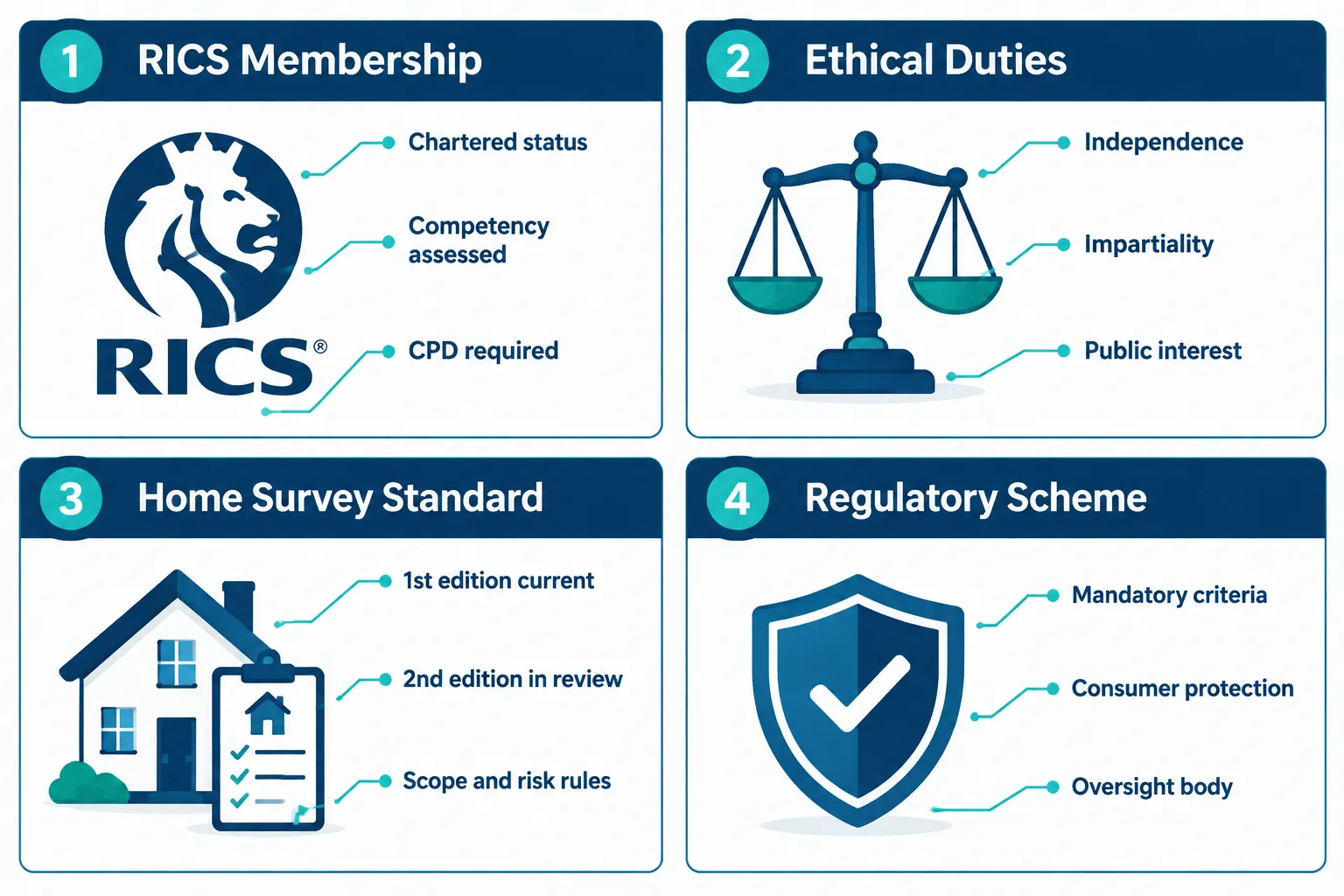
RICS membership requires demonstrated competency across technical and ethical domains, ongoing continuing professional development (CPD), and adherence to sector-specific standards and guidance. For building surveyors, this includes dedicated documents covering home surveys, reinstatement cost assessments, and other core services [8]. The RICS career literature published in December 2025 reinforces that membership and compliance with these standards are central to professional status in the discipline [10].
What this means for homebuyers: When a surveyor carries the RICS designation, AssocRICS, MRICS, or FRICS, they are accountable to a regulatory body with disciplinary powers. That accountability is the structural difference between a "professional" and an unregulated practitioner.
To understand what a qualified surveyor actually examines during an inspection, see this guide on what a surveyor checks: key responsibilities and inspection areas explained.
The Ethical Core: Independence, Impartiality, and Public Interest
Professionalism in surveying is not reducible to technical skill. Three ethical obligations define how a chartered surveyor must operate:
| Ethical Obligation | What It Means in Practice |
|---|---|
| Independence | The surveyor's opinion must not be influenced by the interests of sellers, agents, or lenders |
| Impartiality | In roles such as party wall surveying, the surveyor must act fairly between both parties, not just their appointing owner |
| Public Interest | The surveyor's duty extends beyond the immediate client to the broader housing market and society |
RICS commentary on the Home Survey Standard proposals explicitly states that any updated standard must "uphold public interest" and provide rules that are both robust and achievable [5]. This public-interest framing distinguishes a profession from a trade: a tradesperson's duty ends with the client; a professional's duty extends further.
How the Home Survey Standard Defines Professional Practice
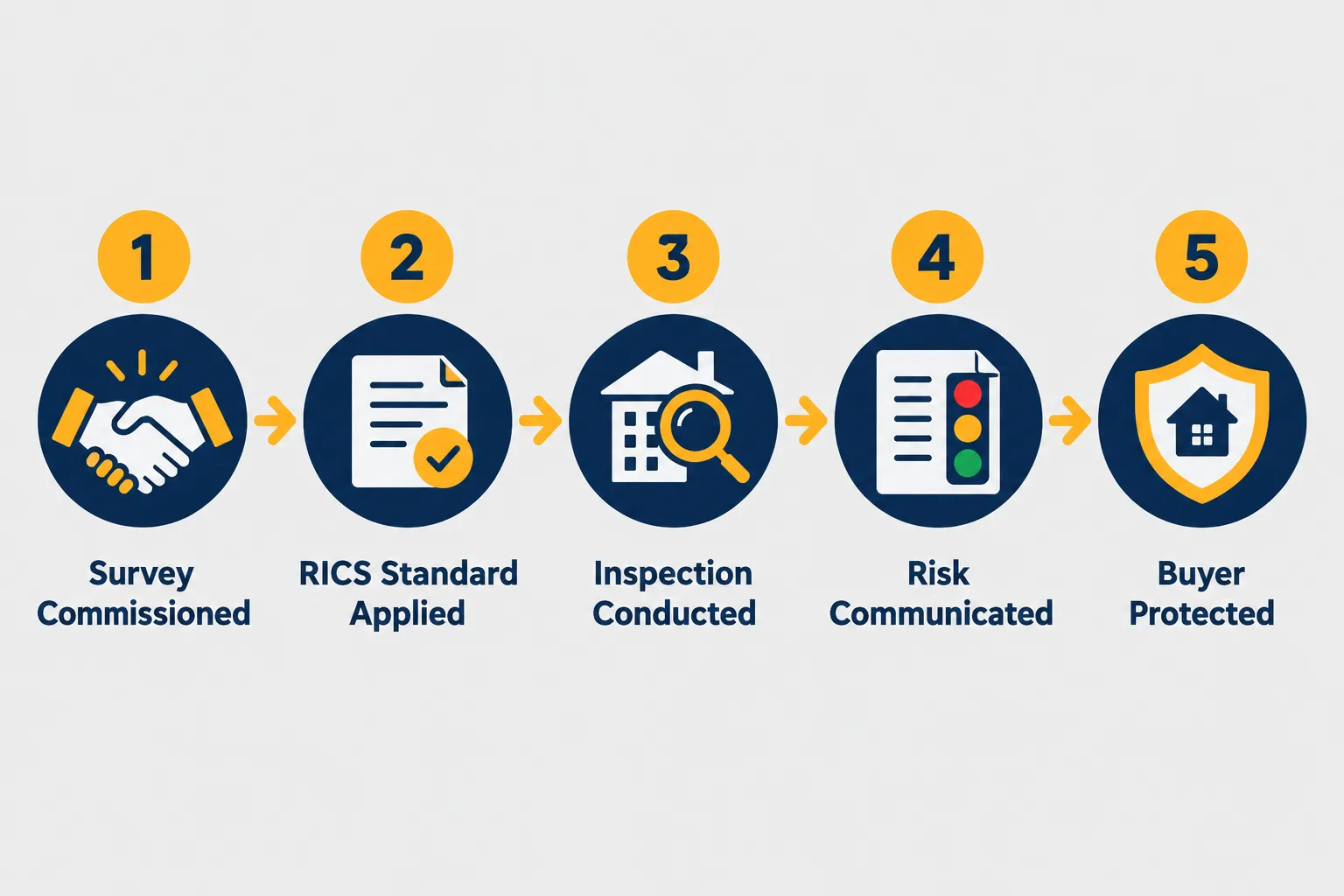
The RICS Home Survey Standard is described as "the definitive framework for residential property surveys across the UK," setting consistent requirements for survey scope, reporting, and risk communication [5]. It is the document that translates ethical principles into operational requirements, telling surveyors not just what to inspect, but how to communicate findings in a way that homebuyers can understand and act on.
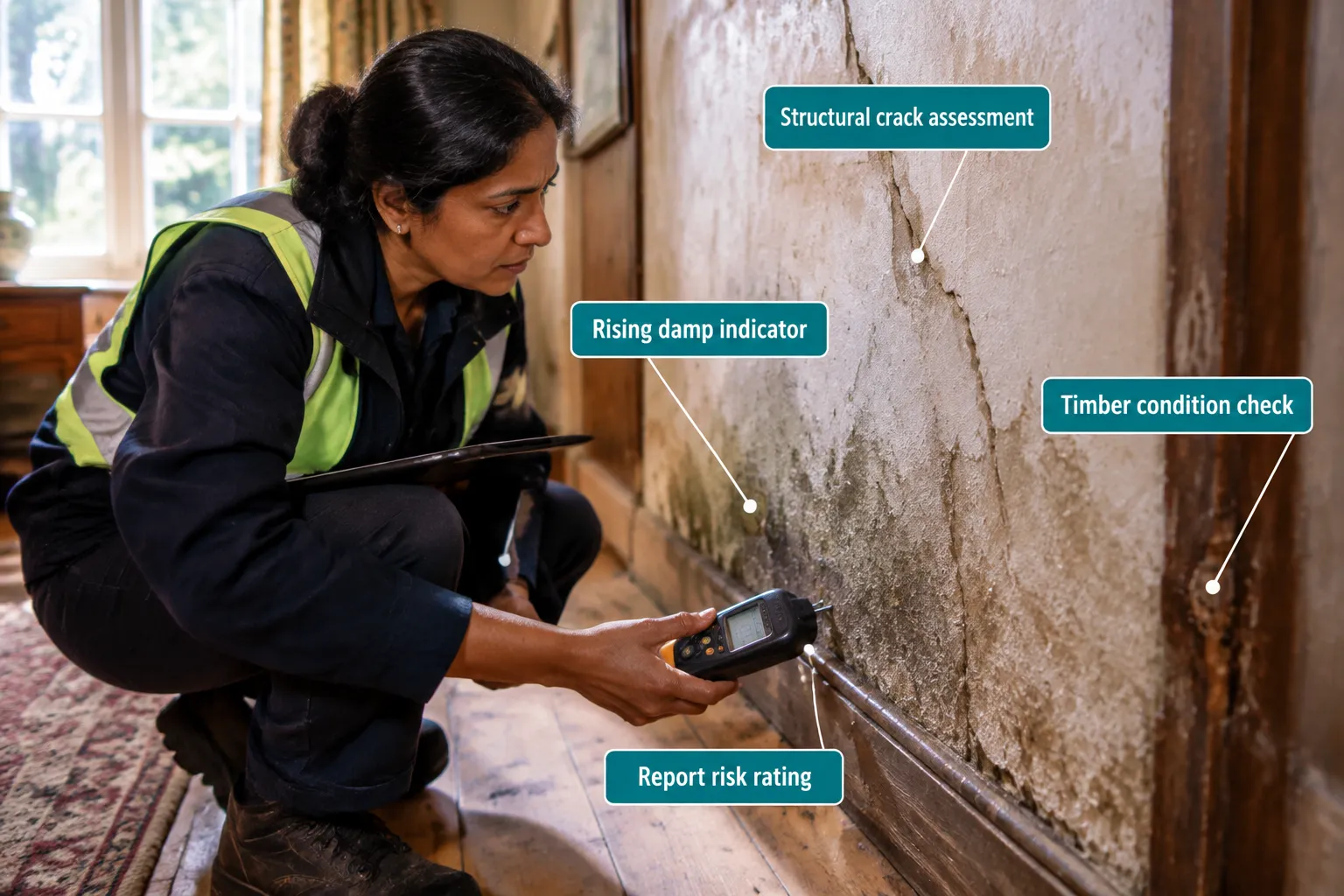
As of 2026, the 1st edition remains in force. RICS has confirmed that members must continue using it until the 2nd edition takes full effect, with the review process still working through consultation responses [3][4]. The delay beyond the original Q1 2026 expectation reflects the complexity of the task: getting the standard right matters more than getting it published quickly [4].
What the 2nd Edition Proposes to Change
The proposed 2nd edition was shaped by feedback from more than 325 RICS professionals and 1,400 UK homeowners on the existing standard. Key proposed changes include:
- Updated legislative and regulatory references to reflect current law
- Clearer distinctions between survey levels (Level 1, Level 2, and Level 3) to reduce consumer confusion
- Optional valuations at all levels, giving surveyors flexibility and buyers clearer condition-focused reports
- Specific guidance for "additional risk" dwellings, non-traditional construction, significant structural defects, or legally complex properties, ensuring surveyors explain unusual risks in accessible language [13]
For homebuyers choosing between survey types, understanding these levels is essential. The Level 2 vs Level 3 Survey key differences guide explains when each is appropriate.
Pull quote: "A professional building surveyor does not merely identify defects, they translate technical findings into information a homebuyer can act on. That is the public-interest obligation at the heart of the RICS standard."
The Proposed Home Survey Regulatory Scheme
Running in parallel with the technical standard, RICS consulted on a Home Survey Regulatory Scheme between August and October 2025. This scheme would require RICS members conducting home surveys in the UK to meet specified regulatory requirements, effectively creating a regulated regime for home survey practice [5].
Critically, RICS has been explicit that insights from the regulatory consultation do not influence the content of the Home Survey Standard itself; the two workstreams are separate [14]. Together, however, they signal a direction of travel: a future in which "professional" home surveyors must satisfy both rigorous practice standards and formal regulatory criteria.
The practical implication for buyers: Over the next one to two years, lenders, estate agents, and potentially government guidance are likely to increasingly favour or require RICS-regulated surveyors for pre-purchase surveys. This is an informed expectation based on the trajectory of both consultations, not a formal policy announcement, but it aligns with RICS' move toward a more consumer-protection-focused model [1][5].
Ethics in Action: Independence, Cladding, AI, and Measurement
Understanding what does 'professional' mean in UK building surveying, and how standards and ethics protect homebuyers, requires looking beyond the survey report itself. Professionalism is tested in specific, high-stakes scenarios where ethical failure would cause real harm to buyers.
Party Wall Impartiality: A Concrete Example of Professional Ethics
When a building surveyor is appointed under the Party Wall etc. Act 1996, they take on a quasi-judicial role. An agreed surveyor, or a surveyor appointed by one owner, must act impartially between both parties, not as an advocate for the person who appointed them. This is a direct expression of the public-interest obligation.
Failure to maintain impartiality in party wall matters is not just an ethical lapse; it can expose the surveyor to professional sanctions and the award to legal challenge. For a full explanation of these responsibilities, see what a party wall surveyor does: roles, responsibilities, and legal requirements.
Cladding and Fire Risk: Where Technical Standards Meet Ethics
In May 2026, RICS published the 2nd edition of its professional standard for secured lending valuation of properties in multi-storey, multi-occupancy residential buildings with cladding, effective from 1 November 2026 [12]. This standard defines when an EWS1 form should be requested during valuations of domestic residential properties, including mixed-use blocks of flats.
The standard is a direct response to the post-Grenfell reality that buyers of flats in high-rise buildings can be exposed to significant, undisclosed fire-safety liabilities. By requiring consistent, risk-based handling of cladding issues, RICS is using its standards-setting power to ensure that professional surveyors give buyers and lenders clearer information, reducing the chance that a buyer unknowingly inherits a financial liability measured in tens of thousands of pounds [12].
AI Ethics: The Newest Dimension of Professional Conduct
RICS has launched a global standard on the responsible use of AI in surveying, effective from 9 March 2026 [6]. This standard sets mandatory requirements and best-practice expectations for RICS members and regulated firms worldwide, governing how AI tools are used in data analysis, reporting, and potentially image-based property inspections.
For building surveyors, adherence to this AI standard is now part of professional conduct. The requirement for algorithmic decisions to be transparent, fair, and accountable protects homebuyers from a specific modern risk: opaque or biased AI-driven assessments that a buyer cannot interrogate or challenge [6][1].
Key professional obligations under the AI standard include:
- Transparency about when and how AI tools have been used in a report
- Human accountability for AI-generated outputs, the surveyor cannot delegate professional responsibility to an algorithm
- Fairness requirements to prevent systematic bias in AI-assisted assessments
Measurement Transparency: A Mandatory Professional Obligation
Industry analysis from May 2026 notes that the RICS Property Measurement 2nd Edition has been officially archived and should only be used as a historical reference [15]. During the current transition period, RICS members must use either the Code of Measuring Practice (6th edition) or IPMS: All Buildings, and the basis of measurement must be formally documented in all reports, described as a mandatory transparency requirement [7][9].
A 7th edition of the Code of Measuring Practice is expected later in 2026 following consultation. For homebuyers, this matters because inconsistent measurement methods can produce materially different floor area figures, affecting both valuation and the scope of what a survey covers.
Choosing a Professional Surveyor: What Homebuyers Should Look For
Given everything above, what practical steps should a homebuyer take to ensure they are engaging a genuinely professional surveyor?
Verification checklist before commissioning a survey:
- Confirm RICS membership, check the RICS Find a Surveyor tool; the designation (AssocRICS, MRICS, FRICS) should be verifiable online
- Ask about professional indemnity insurance, a professional surveyor carries PI insurance; an unregulated practitioner may not
- Confirm the survey level is appropriate, a Level 2 survey is suitable for standard modern properties; a Level 3 is recommended for older, larger, or non-standard homes
- Ask how the report will communicate risk, a professional report should use clear condition ratings and explain what action each finding requires
- Check for conflicts of interest, a surveyor recommended by an estate agent may have a commercial relationship that affects independence
For guidance on selecting the right survey type, the ultimate house survey checklist: what to inspect before buying or selling provides a practical framework. Buyers uncertain about which level of survey they need can also use the what survey do you need tool.
For buyers of older or complex properties, a Level 3 building survey: essential guide for property buyers explains why the most detailed inspection level is often the most cost-effective choice in the long run.
Conclusion
What does 'professional' mean in UK building surveying, and how do standards and ethics protect homebuyers? The answer is multi-layered but consistent: professionalism means operating under enforceable standards set by RICS, maintaining independence and impartiality as ethical obligations, and serving a public-interest function that extends beyond the immediate client relationship.
In 2026, that definition is actively evolving. The forthcoming 2nd edition of the Home Survey Standard, shaped by input from over 1,400 homeowners, will sharpen how surveyors communicate risk. The proposed Home Survey Regulatory Scheme will tighten oversight of who can call themselves a professional home surveyor. New standards on AI use, cladding valuations, and measurement transparency are expanding the ethical perimeter of professional practice.
Actionable next steps for homebuyers:
- Always verify RICS membership before commissioning any survey
- Match the survey level to the property's age, condition, and complexity, do not default to the cheapest option
- Read the survey report critically: a professional report will explain not just what was found, but what it means and what action is needed
- If purchasing a flat in a multi-storey building, ask specifically about cladding assessment and EWS1 requirements
- Stay informed: as the 2nd edition Home Survey Standard comes into effect, the scope and clarity of professional surveys will improve further
The standards framework that governs UK building surveying exists precisely because property transactions are high-stakes decisions. A professional surveyor is the buyer's independent expert in a process where almost every other party has a financial interest in the sale completing. That independence, backed by enforceable standards and ethical obligations, is what the word "professional" genuinely means.
References
[1] Profession Standards – https://www.rics.org/profession-standards
[3] Home Survey Standards – https://www.rics.org/profession-standards/rics-standards-and-guidance/sector-standards/building-surveying-standards/home-surveys/home-survey-standards
[4] Home Survey Standard 2nd Edition April 2026 Update – https://www.rics.org/news-insights/home-survey-standard-2nd-edition-april-2026-update
[5] Rics Launches Consultation Updated Home Survey Standard – https://www.rics.org/news-insights/rics-launches-consultation-updated-home-survey-standard
[6] Rics Launches Landmark Global Standard On Responsible Use Of Ai In Surveying – https://www.rics.org/news-insights/rics-launches-landmark-global-standard-on-responsible-use-of-ai-in-surveying
[7] Rics Standards And Guidance – https://www.rics.org/profession-standards/rics-standards-and-guidance
[8] Building Surveying Standards – https://www.rics.org/profession-standards/rics-standards-and-guidance/sector-standards/building-surveying-standards
[9] Rics Standards – https://www.isurv.com/downloads/176/rics_standards
[10] Building Surveying December 2025 – https://www.rics.org/content/dam/ricsglobal/documents/join-rics/Building-surveying_December-2025.pdf