
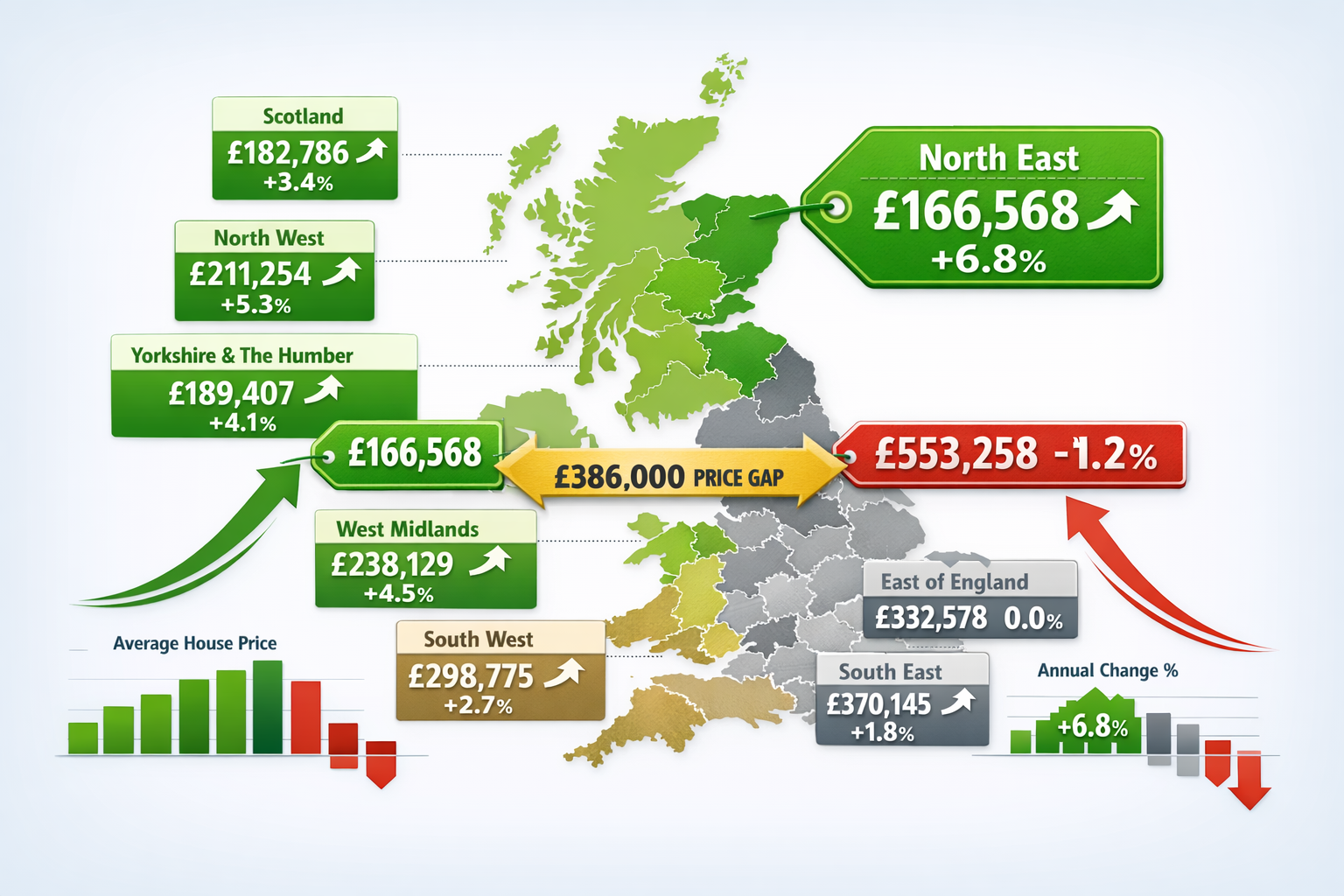
The UK property market in 2026 tells two very different stories. While London homeowners watch values decline by -1.2% annually, buyers in the North East celebrate +6.8% growth[1]. This dramatic divergence—unprecedented in recent decades—creates complex challenges for property valuers who must navigate a market where regional location now matters more than ever. Understanding how surveyors adapt their methodologies to reflect these stark north-south price gaps and localised trends has become essential for buyers, sellers, and lenders operating across England's increasingly fragmented property landscape.

Key Takeaways
- Regional growth disparity: London experiences negative growth (-1.2%) while the North East surges (+6.8%), creating over £386,000 average price differences between regions[1]
- Surveyor methodology adaptation: Valuers now prioritize hyper-local comparables and regional economic indicators over national trends when assessing property worth
- Lender risk assessment changes: Mortgage providers increasingly require region-specific valuation approaches, particularly for northern properties showing rapid appreciation
- Buyer and seller implications: Understanding local market dynamics and securing qualified regional surveyors has become critical for accurate property transactions
- 2026 market outlook: Modest 2% national growth masks continued regional divergence, requiring sophisticated valuation strategies across different UK markets[1]
Understanding the Two-Speed UK Property Market in 2026
The concept of Valuations in a Two-Speed UK Market: How Surveyors Handle North–South Price Gaps and Localised Trends reflects a fundamental shift in how property professionals assess value across different regions. The traditional assumption that UK property moves in unified cycles has been thoroughly challenged by 2026 data.
The Numbers Behind the North-South Divide
Recent statistics paint a striking picture of regional disparity:
| Region | Average Price | Annual Growth | 5-Year Change |
|---|---|---|---|
| London | £553,258 | -1.2% | Lower growth |
| South East | Higher baseline | +1.0% | Modest appreciation |
| North West | Mid-range | +4.1% | Strong growth |
| Yorkshire & Humber | Mid-range | +3.7% | Solid performance |
| North East | £166,568 | +6.8% | Exceptional growth |
| Northern Ireland | Regional variation | +7.1% | Strongest UK performance |
Source: HomeOwners Alliance 2026 data[1]
This £386,000+ price gap between London and the North East represents more than just affordability differences—it signals fundamentally different market dynamics that require distinct valuation approaches.
What's Driving Regional Divergence?
Several interconnected factors fuel this two-speed market:
📊 Economic migration patterns: Remote work flexibility has enabled professionals to relocate from expensive southern markets to affordable northern cities with strong infrastructure
💷 Affordability thresholds: First-time buyers priced out of London increasingly target northern regions, driving demand and price growth
🏭 Regional investment: Government levelling-up initiatives and private sector investment in northern cities create employment opportunities supporting property demand
📉 Southern market saturation: Years of exceptional growth in London and the South East have created affordability ceilings limiting further appreciation
As Paula Higgins, CEO of HomeOwners Alliance, notes in 2026 forecasts, UK house prices are expected to rise around 2% nationally[1]—but this modest average conceals the dramatic regional variations that surveyors must navigate daily.
How Surveyors Adapt Valuation Methodologies for Regional Price Gaps
Professional valuers face unprecedented challenges when Valuations in a Two-Speed UK Market: How Surveyors Handle North–South Price Gaps and Localised Trends become the norm rather than the exception. Traditional valuation methods require significant adaptation to reflect these divergent markets accurately.

Comparative Market Analysis in Fragmented Markets
The cornerstone of property valuation—comparative market analysis (CMA)—becomes exponentially more complex in a two-speed market. Surveyors must now:
Prioritize hyper-local comparables 🎯
Rather than drawing comparables from broader regional areas, valuers increasingly focus on properties within immediate neighbourhoods, sometimes limiting searches to specific postcodes to ensure accuracy.
Apply regional growth adjustments 📈
When recent comparables are scarce, surveyors apply region-specific appreciation rates rather than national averages. A property in the North East might receive a +6.8% annual adjustment, while a London property receives a -1.2% adjustment[1].
Weight recent transactions more heavily ⚖️
In rapidly changing markets like the North East, comparables older than three months may be discounted or adjusted more aggressively than in stable markets.
Consider cross-regional migration patterns 🚚
Surveyors increasingly factor in buyer demographics—particularly London-to-North relocations—when assessing demand and future value trajectories.
For those seeking professional valuation services, understanding these regional nuances is essential. RICS valuations must now incorporate sophisticated local market knowledge that goes beyond traditional methodologies.
The Role of Economic Indicators in Regional Valuations
Beyond comparable sales data, surveyors in 2026 increasingly incorporate regional economic indicators into their assessments:
- Local employment growth rates: Northern cities showing job creation receive positive valuation adjustments
- Wage growth trajectories: Regional salary increases directly impact affordability and sustainable price levels
- Infrastructure investment: Planned transport links, regeneration projects, and commercial development influence future value projections
- Rental yield differentials: Investment property valuations increasingly reflect regional rental market strength
According to ONS data, average UK house prices reached £271,000 with 2.5% annual growth to November 2025[2]—but England's £293,000 average masks significant internal variation that surveyors must account for when providing accurate assessments.
Mortgage Lender Requirements and Regional Risk Assessment
Valuations in a Two-Speed UK Market: How Surveyors Handle North–South Price Gaps and Localised Trends has forced mortgage lenders to reconsider their risk assessment frameworks. This directly impacts surveyor instructions and valuation approaches.
Lender-Specific Regional Policies
Major mortgage providers now implement region-specific lending criteria:
✅ Northern market caution: Despite strong growth, some lenders apply conservative loan-to-value ratios in rapidly appreciating northern markets, concerned about sustainability
✅ Southern market stability assumptions: Conversely, established southern markets may receive favorable lending terms based on historical stability, despite current negative growth
✅ Comparable evidence requirements: Lenders increasingly demand more extensive comparable evidence for properties in high-growth regions to validate valuations
✅ Revaluation triggers: Some lenders require updated valuations more frequently in volatile markets, particularly when significant regional price movements occur
Jeremy Leaf, former RICS residential chair, highlights that falling mortgage rates are driving renewed market activity[1], which affects the availability and relevance of comparable evidence across different regions.
Practical Valuation Challenges for Chartered Surveyors
Chartered surveyors across different regions face distinct operational challenges when conducting valuations in this fragmented market:
Challenge 1: Limited comparable evidence in rapid-growth markets 🔍
In areas like the North East with +6.8% annual growth[1], recent sales may not reflect current market conditions, requiring surveyors to make informed adjustments based on market momentum.
Challenge 2: Client expectation management 💬
Sellers in declining markets like London may struggle to accept valuations below their expectations, requiring surveyors to provide comprehensive market evidence and clear communication.
Challenge 3: Cross-regional instruction complexity 🗺️
Surveyors operating across multiple regions must maintain current knowledge of divergent local markets, often requiring specialized regional expertise or partnerships.
Challenge 4: Balancing optimism with professional caution ⚖️
In high-growth markets, surveyors must distinguish between sustainable appreciation and speculative bubbles, protecting lender and buyer interests.
For comprehensive property assessments, many buyers combine valuations with detailed building surveys to understand both market value and physical condition—particularly important in northern markets where older housing stock may require renovation.
Regional Breakdown: Valuation Approaches Across UK Markets
London and the South East: Navigating Negative and Minimal Growth
London's -1.2% decline[1] and the South East's modest +1.0% growth[1] present unique valuation challenges:
Key valuation considerations:
- Micro-market analysis: London's diverse boroughs show vastly different performance, requiring postcode-level expertise
- Property type differentiation: Flats versus houses, period properties versus new builds show divergent trends
- Transport infrastructure impact: Crossrail and other developments create localized value pockets within broader declining markets
- International buyer influence: Currency fluctuations and global economic conditions affect prime London valuations differently than domestic markets
Chartered surveyors in South West London must balance historical price premiums against current market realities, often providing context about long-term value retention despite short-term declines.
Understanding the cost of valuation services becomes particularly important in southern markets where property values remain high despite negative growth trends.
The North: Capturing Growth in Emerging Markets
Northern regions showing exceptional performance require different valuation approaches:
North East (+6.8% growth, £166,568 average)[1]:
- Focus on regeneration areas and infrastructure investment
- Account for London-to-North migration patterns
- Consider employment growth in tech and creative sectors
- Assess sustainability of rapid appreciation rates
North West (+4.1% growth)[1]:
- Manchester and Liverpool submarkets show distinct characteristics
- Strong rental yields influence investment property valuations
- University towns demonstrate resilient demand
- Transport connectivity increasingly drives value
Yorkshire & Humber (+3.7% growth)[1]:
- Leeds financial sector growth supports professional housing demand
- Historic market towns attract lifestyle relocations
- Affordability relative to southern markets drives first-time buyer activity
Surveyors in these regions must balance optimism about growth trajectories with professional caution about market sustainability, particularly when advising mortgage lenders on security values.
Scotland, Wales, and Northern Ireland: Distinct Market Dynamics
Scotland (£193,000 average, +4.5% growth)[2] demonstrates strong performance requiring specialized knowledge:
- Different legal framework affects transaction timelines and valuation approaches
- Edinburgh and Glasgow show divergent trends from rural Scotland
- Energy efficiency standards increasingly influence valuations
- Home Report system creates different valuation context than England
Wales (+0.7% growth)[2] shows more modest appreciation:
- Second-home ownership restrictions affect certain markets
- Coastal and rural areas show different dynamics than urban centers
- Cardiff market differs significantly from broader Welsh trends
Northern Ireland (+7.1% growth)[1] leads UK performance:
- Recovery from historical undervaluation drives current growth
- Belfast regeneration creates strong urban demand
- Cross-border dynamics with Republic of Ireland influence markets
- Distinct regulatory environment requires specialized expertise
What This Means for Buyers, Sellers, and Property Professionals
For Property Buyers: Strategic Considerations
Understanding Valuations in a Two-Speed UK Market: How Surveyors Handle North–South Price Gaps and Localised Trends empowers informed purchasing decisions:
🏠 Northern market buyers should:
- Secure valuations from surveyors with current local market knowledge
- Verify comparable evidence reflects recent market momentum
- Consider growth sustainability when planning long-term ownership
- Ensure mortgage valuations align with purchase price expectations
- Combine valuations with comprehensive Level 2 or Level 3 building surveys to assess property condition
🏙️ Southern market buyers should:
- Recognize potential negotiation opportunities in declining markets
- Avoid overpaying based on historical rather than current values
- Focus on properties with unique characteristics that resist broader trends
- Consider longer-term value retention despite short-term declines
- Verify surveyor uses current comparables, not outdated market data
For Property Sellers: Maximizing Value
In high-growth northern markets:
- Obtain professional valuations from RICS-qualified surveyors to justify asking prices
- Present recent comparable evidence to support pricing decisions
- Time sales to capitalize on market momentum
- Highlight regional investment and infrastructure improvements
- Consider whether rapid appreciation justifies waiting or selling now
In static or declining southern markets:
- Set realistic expectations based on current market conditions
- Emphasize property-specific features that differentiate from comparables
- Consider pricing slightly below valuation to generate competitive interest
- Be prepared to negotiate and demonstrate flexibility
- Highlight long-term value retention and location benefits
For Mortgage Lenders: Risk Management Strategies
Lenders must adapt their valuation requirements to reflect regional disparities:
✓ Implement region-specific lending criteria that recognize different risk profiles across markets
✓ Require enhanced comparable evidence in high-growth markets to validate rapid appreciation
✓ Engage surveyors with proven regional expertise rather than relying solely on national panel members
✓ Monitor regional economic indicators beyond property prices to assess sustainable lending
✓ Adjust loan-to-value ratios based on market volatility and growth sustainability concerns
✓ Consider revaluation requirements for properties in rapidly changing markets
For specialized property types, commercial valuation approaches must similarly account for regional economic performance and business environment differences.
For Professional Surveyors: Maintaining Standards and Expertise
Chartered surveyors navigating this complex landscape must:
📚 Invest in continuous regional market education:
- Attend regional property market briefings and seminars
- Subscribe to local market data services and reports
- Develop networks with local estate agents and property professionals
- Monitor regional economic development and infrastructure projects
🔍 Enhance valuation methodologies:
- Develop region-specific comparable adjustment frameworks
- Incorporate broader economic indicators into valuation reports
- Provide clear explanations of regional market context to clients
- Document assumptions and limitations transparently
⚖️ Balance professional obligations:
- Maintain objectivity despite client pressure in declining markets
- Apply appropriate caution in rapidly appreciating markets
- Adhere to RICS Red Book standards while adapting to regional realities
- Communicate limitations of comparables in volatile markets
Those wondering what surveyors look for in a house survey should understand that regional market knowledge now complements technical property assessment skills.
The Future of Regional Valuations: 2026 and Beyond
Predicted Market Trajectories
Current forecasts suggest Valuations in a Two-Speed UK Market: How Surveyors Handle North–South Price Gaps and Localised Trends will continue throughout 2026 and potentially beyond:
National outlook: Paula Higgins forecasts approximately 2% overall growth for 2026[1], supported by:
- Easing mortgage rates making borrowing more accessible
- Steady wage growth improving affordability
- Stable employment supporting buyer confidence
- Avoiding sharp rebounds or dramatic corrections
Regional divergence persistence: The north-south divide shows no signs of rapid convergence:
- Northern growth may moderate but likely remains positive
- Southern markets may stabilize but unlikely to return to historical growth rates
- Regional economic policies continue supporting northern development
- Affordability constraints limit southern market rebounds
Long-term context: Properties are 26% higher than five years ago[3], indicating sustained appreciation that surveyors must contextualize when assessing current values and future trajectories.
Emerging Valuation Technologies and Data Sources
Technology increasingly supports regional valuation accuracy:
🤖 Automated Valuation Models (AVMs):
- Machine learning algorithms incorporating regional growth differentials
- Real-time market data integration for current comparable analysis
- Risk assessment tools identifying market volatility and sustainability concerns
- Enhanced accuracy through hyper-local data granularity
📊 Big data integration:
- Economic indicators from multiple sources informing regional assessments
- Migration pattern analysis tracking buyer movement between regions
- Infrastructure investment databases predicting future value impacts
- Rental market data providing investment value context
🗺️ Geographic Information Systems (GIS):
- Mapping regional price variations with visual clarity
- Identifying micro-market boundaries within broader regions
- Analyzing transport connectivity and accessibility impacts
- Overlaying multiple data layers for comprehensive market understanding
Despite technological advances, professional surveyor judgment remains essential—particularly when assessing unique properties or interpreting complex regional dynamics that algorithms cannot fully capture.
Regulatory and Professional Standards Evolution
The RICS and other professional bodies continue adapting standards to reflect market realities:
Red Book updates: Valuation standards increasingly emphasize:
- Regional market context and comparable selection criteria
- Uncertainty disclosure in volatile markets
- Enhanced reporting of assumptions and limitations
- Client education about market condition impacts
Professional development requirements:
- Mandatory regional market knowledge updates
- Specialized credentials for complex market valuations
- Enhanced comparable evidence documentation standards
- Ethics training for managing client expectations in challenging markets
For those evaluating surveyor credentials, understanding how to verify qualifications in the UK becomes increasingly important when selecting professionals with appropriate regional expertise.
Conclusion
Valuations in a Two-Speed UK Market: How Surveyors Handle North–South Price Gaps and Localised Trends represents one of the most significant challenges facing property professionals in 2026. With London experiencing -1.2% decline while the North East surges at +6.8%[1], and price gaps exceeding £386,000 between regions, the traditional assumption of unified UK property cycles has been thoroughly disrupted.
Professional surveyors have responded by adapting methodologies to prioritize hyper-local comparables, incorporating regional economic indicators, and providing enhanced context about market conditions. Buyers, sellers, and lenders must recognize that location now matters more than ever—not just at the city or county level, but at the regional level that determines fundamental market dynamics.
Actionable Next Steps
For buyers and sellers:
- Engage RICS-qualified surveyors with proven expertise in your specific region
- Request detailed comparable evidence and regional market context in valuation reports
- Understand that national property trends may not reflect your local market reality
- Consider combining valuations with comprehensive building surveys for complete property assessment
- Review multiple recent sales in your immediate area to verify valuation accuracy
For property professionals:
- Invest in continuous regional market education and data sources
- Develop specialized expertise in your operating regions rather than claiming universal coverage
- Enhance communication with clients about regional market dynamics and limitations
- Adopt technology tools that support regional analysis while maintaining professional judgment
- Network with local property professionals to maintain current market intelligence
For mortgage lenders:
- Implement region-specific lending criteria reflecting different risk profiles
- Engage surveyors with demonstrated regional expertise for accurate security valuations
- Monitor regional economic indicators beyond property prices for comprehensive risk assessment
- Consider enhanced comparable evidence requirements in volatile markets
- Maintain flexibility to adapt policies as regional dynamics evolve
The two-speed UK property market shows no signs of rapid convergence in 2026. Success in this environment requires sophisticated understanding of regional dynamics, professional expertise from qualified surveyors, and realistic expectations based on local rather than national market conditions. Whether buying in a high-growth northern market or navigating declining southern values, informed decision-making supported by expert regional valuation analysis remains the foundation of successful property transactions.
For comprehensive surveying services across different UK regions, explore our locations page to find qualified professionals with the regional expertise your property transaction requires.
References
[1] House Price Forecast – https://hoa.org.uk/advice/guides-for-homeowners/i-am-buying/house-price-forecast/
[2] January2026 – https://www.ons.gov.uk/economy/inflationandpriceindices/bulletins/privaterentandhousepricesuk/january2026
[3] Uk Property Market Forecast – https://millerrose.co.uk/news-insight/uk-property-market-forecast/
