
Homes located within 100 metres of a major road sell, on average, for measurably less than comparable properties set back from traffic, and in some cases, removing through-traffic via a bypass has delivered an average house price uplift of around 15.3%. Yet many buyers complete a purchase without understanding how a chartered surveyor formally measures and records these traffic-related risks. Understanding Traffic Around Your Home: How UK Surveyors Assess Noise, Pollution and Safety in Valuation Reports is not just useful background knowledge, it can directly affect the price you pay, the mortgage a lender will offer, and the safety of the home you move into.
This article explains exactly what UK surveyors look for, how they record it, and why the rules governing this process have become significantly more rigorous since the RICS Red Book 2025 came into force.
Key Takeaways
- UK chartered surveyors are now formally required to record traffic noise, air pollution, and road safety as environmental factors in valuation reports under RICS Red Book 2025 standards effective January 2025.
- Traffic-related factors, including noise, vibration, and exhaust pollution, are recognised by the UK government as physical factors that can reduce property value and trigger compensation rights.
- There is no single statutory noise limit for roads, but planning policy, local authority regimes, and RICS ESG guidance all shape how surveyors treat traffic exposure.
- A well-documented surveyor's report can give buyers and lenders a clear picture of how traffic risk affects the value and liveability of a property.
- Buyers should request a Level 2 or Level 3 RICS Home Survey to ensure traffic-related environmental factors are fully assessed, not just a basic mortgage valuation.
Why Traffic Around Your Home Matters More Than Ever in Valuation Reports
For decades, traffic noise and pollution sat in a grey zone of property assessment, acknowledged informally, but rarely documented with rigour. That changed when the RICS Red Book 2025 made environmental, social, and governance (ESG) factors a formal valuation requirement, effective 31 January 2025 [7]. Surveyors operating under RICS standards are now expected to consider and record environmental impacts, including those generated by road traffic, as part of their inspection and reporting process [6].
The shift reflects a broader recognition that the physical environment around a home is inseparable from its value. RICS site notes and valuation reasoning guidance published in 2025 explicitly lists "pollution" and "traffic" among the community-impact factors that valuers must record when assessing commercial and residential properties [2]. The same principles flow through to residential valuation work via RICS standards and guidance [10].
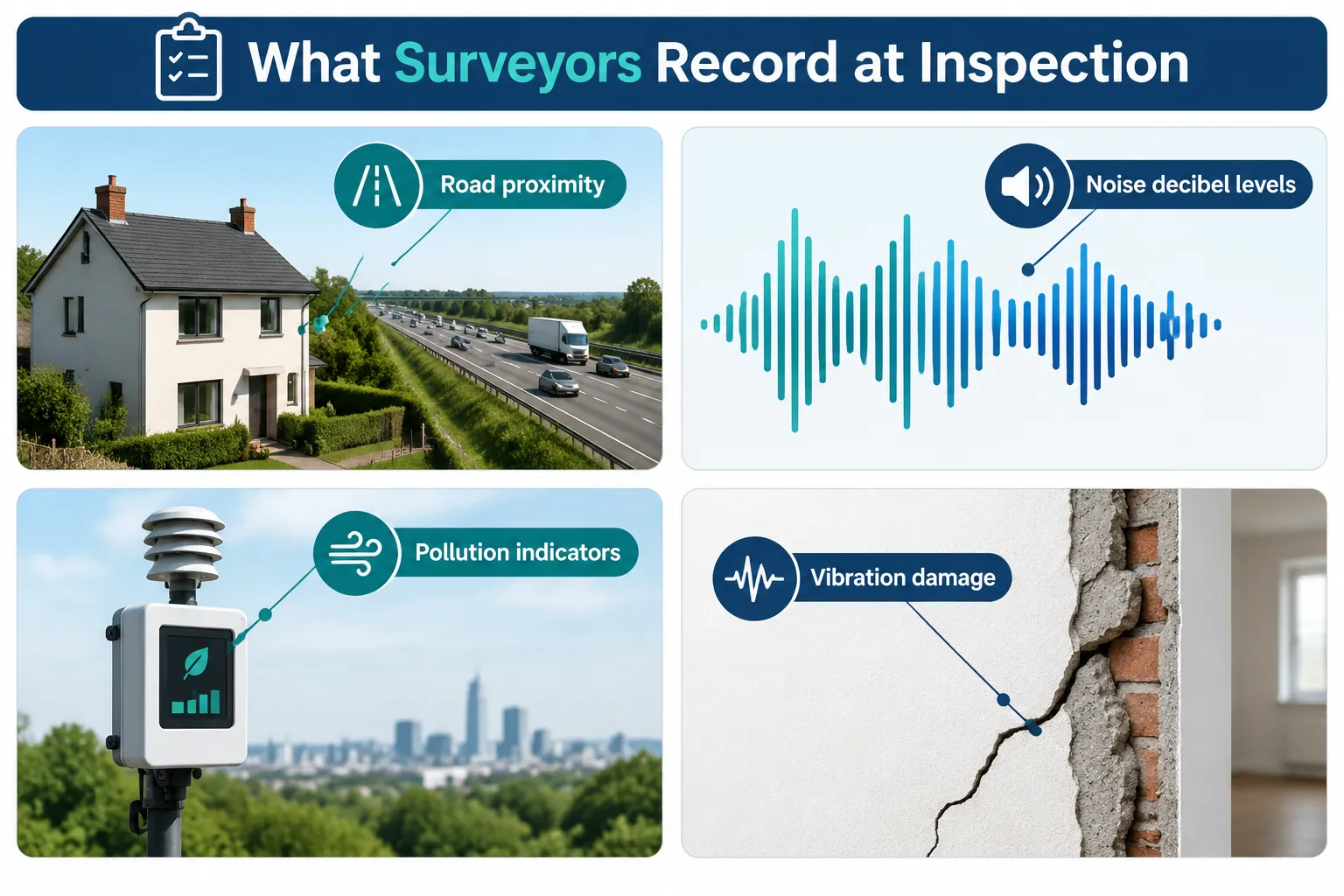
For buyers and homeowners, this means that a modern RICS valuation report should no longer treat a busy road as a passing observation. It should systematically assess:
- Noise levels from road traffic, including peak-hour and overnight exposure
- Air quality and exhaust pollution indicators near the property
- Vibration from heavy goods vehicles and its effect on the building fabric
- Road safety risks, including pedestrian access, sight lines, and proximity to junctions
The UK government separately recognises traffic noise, pollution, and vibration as "physical factors" that reduce property value and can entitle owners to compensation in certain circumstances, for example, when a new or altered road causes a measurable reduction in value [4]. This statutory framework reinforces why surveyors treat traffic exposure as a material valuation factor, not a lifestyle preference.
How UK Surveyors Assess Traffic Noise, Pollution and Safety During Inspection
What the Surveyor Observes On-Site
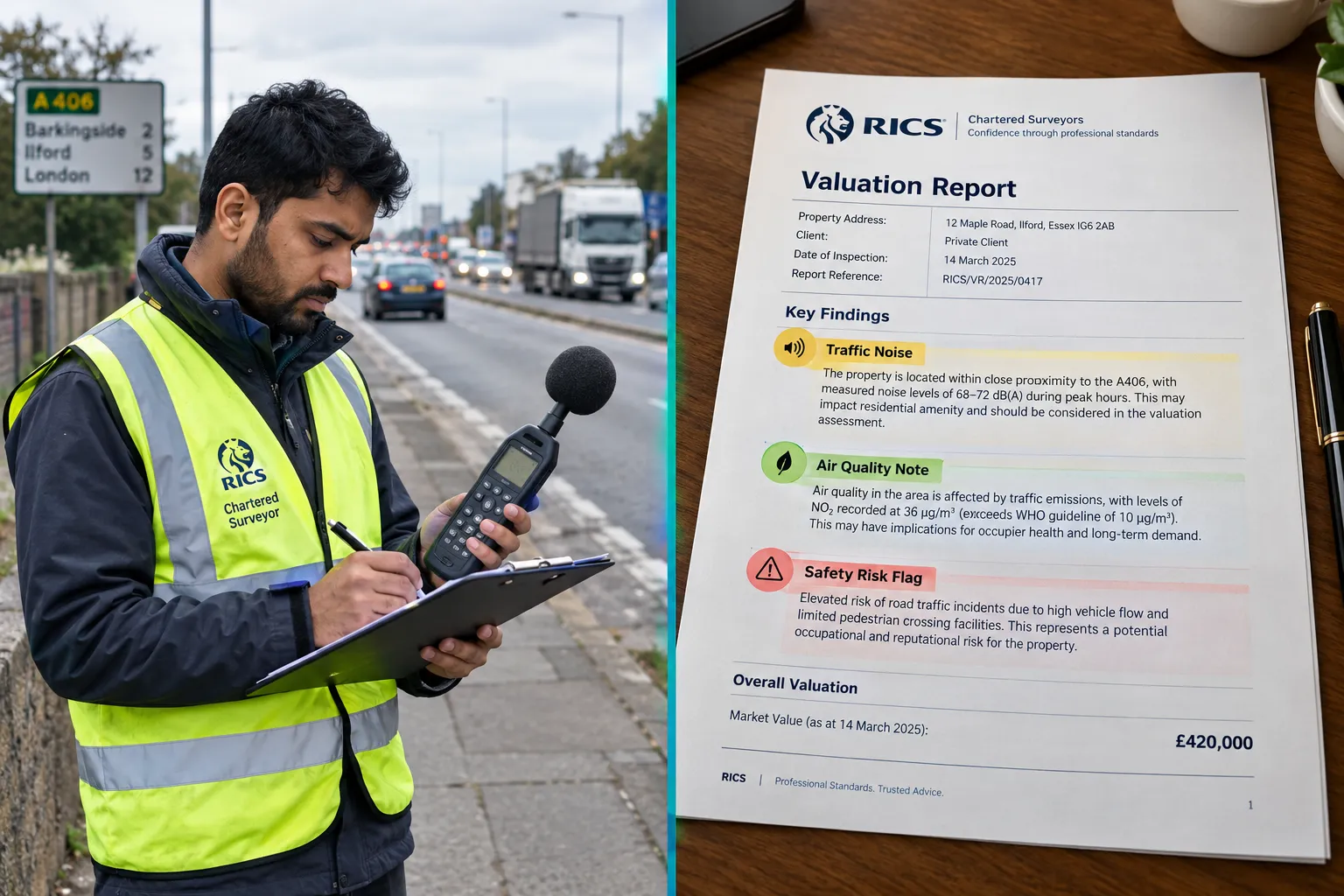
When a chartered surveyor visits a property near a busy road, their inspection goes well beyond a visual check of the building fabric. Under current RICS guidance, the surveyor is expected to make and record site notes that capture environmental conditions at the time of inspection and consider their likely ongoing impact [2].
For a property with significant road frontage or proximity to a major route, a thorough surveyor will typically assess the following:
| Factor | What the Surveyor Looks For |
|---|---|
| Noise | Audibility inside and outside the property; evidence of double or triple glazing installed to mitigate noise; proximity to motorways, A-roads, or bus routes |
| Air Quality | Visible pollution deposits on windows, sills, and external surfaces; proximity to congested junctions; prevailing wind direction |
| Vibration | Cracking patterns in plaster, render, or masonry consistent with repeated vibration; loose fittings; evidence of settlement near the road edge |
| Road Safety | Pedestrian access to the property; visibility splays at the driveway or gate; proximity to junctions, crossings, or high-speed sections |
| Planning Context | Whether the property sits within a noise-sensitive zone designated by the local planning authority |
The UK government's own guidance on road noise confirms that there is no single statutory noise limit for roads in England, but local authorities and planning bodies use noise exposure categories to manage development near busy routes [9]. Surveyors draw on this planning context when forming their assessment.
How ESG Standards Shape the Modern Valuation Report
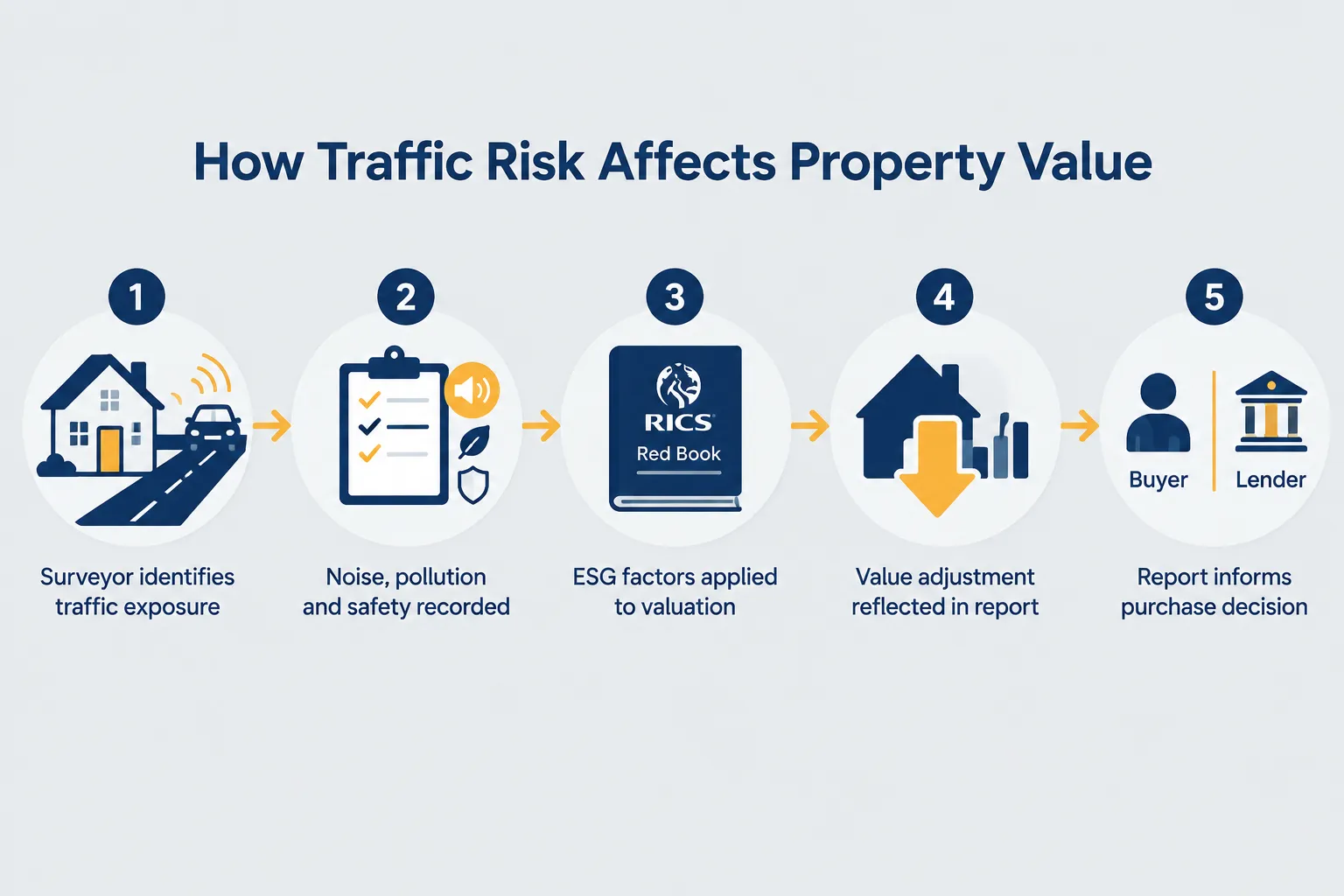
The introduction of the RICS Red Book 2025 and the updated global ESG standard for property valuation has fundamentally changed the weight given to environmental factors [1]. Where a valuer might previously have noted a busy road in passing, current standards require a more structured approach: environmental and sustainability factors must be considered as inputs that can directly affect market value, not merely as background commentary [3].
RICS and the World Built Environment Forum (WBEF) have specifically highlighted air quality and climate-related risks as core environmental inputs for valuers [1]. In practice, this means:
- A property on a heavily trafficked urban road may carry a formal notation about air quality that influences the valuer's comparable selection and final figure.
- Lenders reviewing the valuation report can see clearly whether traffic-related environmental risks have been considered.
- Buyers using the report have documented evidence of any material traffic risks, evidence that may support price negotiation or inform a decision to commission further specialist noise or air quality surveys.
For properties in areas with particularly complex traffic environments, such as those near major motorways, airport approach roads, or large logistics hubs, a RICS Home Survey will typically provide far more useful detail than a basic mortgage valuation, which is conducted primarily for the lender's benefit.
Traffic Around Your Home: How UK Surveyors Assess Noise, Pollution and Safety in Valuation Reports, The Methodology in Detail
Noise: Measurement, Evidence and Reporting
Road traffic noise is measured in decibels (dB), and the World Health Organisation recommends that outdoor noise from road traffic should not exceed 53 dB Lden (day-evening-night level) to protect public health. UK planning policy uses noise exposure categories, ranging from Category A (noise unlikely to be a problem) to Category D (development should not normally be permitted), to guide decisions about residential development near roads [9].
A surveyor does not typically carry a calibrated sound level meter to every inspection. Instead, they use a combination of:
- Direct observation, audibility of traffic inside the property with windows closed and open
- Physical evidence, the presence of acoustic glazing, secondary glazing, or solid-core doors installed specifically to reduce noise ingress
- Mapping data, strategic noise maps published by local authorities and Highways England under the Environmental Noise Directive, which identify properties in high-noise corridors
- Planning records, any conditions attached to the property's planning permission relating to noise mitigation
Where noise is identified as a material concern, the surveyor will note it in the report and may recommend a specialist acoustic survey. This recommendation can be significant: a formal acoustic report may reveal that noise levels inside the property exceed thresholds that affect mortgage lender appetite or insurance terms.
Pollution: Air Quality and Surface Contamination
Air quality near busy roads is a growing concern in UK property valuation. The RICS sustainable real estate survey for Europe (2025) shows that ESG factors, including air quality, are rising in importance for both valuers and investors [1]. Nitrogen dioxide (NO2) and particulate matter (PM2.5) concentrations are highest within approximately 150 metres of major roads, and local authorities in England are required to designate Air Quality Management Areas (AQMAs) where legal limits are breached.
A surveyor assessing a property in or near an AQMA will record this as a material environmental factor. Beyond air quality, surveyors also look for:
- Surface deposits, soot, grime, or chemical residue on external walls, window frames, and roof surfaces consistent with high traffic pollution
- Drainage issues, road runoff contaminating surface water drainage or affecting garden soil quality
- Proximity to fuel stations or vehicle repair premises, potential ground contamination risks that may require an environmental search
The environmental and sustainability valuation guidance published by iSurv (the RICS knowledge platform) links property value directly to these environmental and sustainability impacts, confirming that pollution indicators are legitimate valuation inputs [3].
Vibration: Structural Implications
Heavy goods vehicles, buses, and high-frequency traffic can transmit vibration through the ground into building foundations and superstructures. For older properties, particularly Victorian and Edwardian terraces common in UK cities, repeated vibration can accelerate the development of cracks in plasterwork, render, and masonry.
A surveyor inspecting a property near a heavily used road will look for:
- Diagonal cracking at window and door openings (a classic vibration signature)
- Loose or rattling window frames and sash mechanisms
- Settlement cracking at the base of external walls near the road edge
- Evidence of previous repair work to cracks that have recurred
Where vibration damage is suspected, the surveyor may recommend a specific defect report to investigate the cause and extent of any structural movement before exchange of contracts.
Road Safety: Access, Visibility and Pedestrian Risk
Road safety is an often-overlooked element of traffic assessment in valuation reports, but it carries real implications for both insurers and lenders. A surveyor will consider:
- Driveway visibility splays, whether a vehicle exiting the property has adequate sight lines in both directions
- Pedestrian access, the safety of the route from the property to the nearest pavement, crossing, or public transport stop
- Speed environment, whether the road outside is subject to a speed limit appropriate to the residential context, or whether it carries fast-moving traffic inconsistent with safe pedestrian use
- Proximity to junctions, corner properties near busy junctions face elevated risk from vehicle encroachment, noise, and pollution
The National Infrastructure Commission's property value uplift tool demonstrates that transport-related changes, including road improvements and bypasses, have a quantifiable effect on residential values [5]. Surveyors working near proposed or recently completed road schemes will reference this kind of evidence when explaining value adjustments in their reports.
How Traffic Factors Affect Property Value and What Buyers Should Do
The Value Impact: What the Evidence Shows
The empirical evidence on traffic and property values is clear. Research cited by the National Infrastructure Commission shows that bypasses removing through-traffic from residential areas deliver an average house price uplift of approximately 15.3% [5]. Conversely, properties exposed to high traffic volumes, noise, and pollution consistently trade at a discount relative to comparable homes in quieter locations.
The UK government's compensation regime for road-related property value reduction confirms this relationship at a statutory level: owners whose properties lose value as a direct result of a new or altered public road may be entitled to claim compensation under Part 1 of the Land Compensation Act 1973 [4]. The physical factors that can trigger a claim include noise, vibration, smell, fumes, smoke, artificial lighting, and the discharge onto land of any solid or liquid substance, all of which can originate from road traffic.
"The physical environment around a home is inseparable from its value. Under RICS Red Book 2025, surveyors must now formally record traffic noise, pollution, and road safety as environmental inputs, not optional commentary."
Practical Steps for Buyers and Homeowners
Understanding how traffic is assessed in a valuation report gives buyers and homeowners practical tools to protect their interests. The following steps are recommended:
-
Commission the right level of survey. A basic mortgage valuation will not provide the detail needed to assess traffic-related risks. A Level 2 or Level 3 RICS Home Survey is far more likely to capture noise, pollution, vibration, and safety issues in meaningful detail.
-
Check for Air Quality Management Areas. Before making an offer, check whether the property falls within a local authority AQMA using the UK-AIR database. This information can be raised with the surveyor before the inspection.
-
Request strategic noise mapping data. Local authorities publish strategic noise maps under the Environmental Noise Directive. These maps show whether a property sits in a high-noise corridor and can inform the surveyor's assessment.
-
Ask about planned road schemes. The National Highways annual report and local transport plans detail proposed road improvements or new routes that may affect the property's future noise and pollution exposure [8]. A surveyor with local knowledge, such as chartered surveyors in Hounslow, an area significantly affected by airport and motorway traffic, will be well-placed to advise on local schemes.
-
Consider a specialist acoustic or environmental survey. Where the surveyor flags noise or air quality as a material concern, a specialist survey provides the quantified data needed to negotiate on price or require mitigation works as a condition of purchase.
-
Review the valuation report carefully. Under RICS Red Book 2025, the valuer is required to record their reasoning, including any environmental factors that influenced the final figure [7]. Buyers should read this section carefully and ask their surveyor to explain any traffic-related adjustments.
For those buying in areas with complex traffic environments, working with experienced chartered surveyors in London or chartered surveyors in West London, where motorway proximity, flight paths, and dense urban traffic converge, can make a significant difference to the quality of the assessment received.
It is also worth reviewing why hiring a residential surveyor could save you thousands on your property purchase before committing to a survey level, particularly for properties near major roads.
Conclusion
Traffic Around Your Home: How UK Surveyors Assess Noise, Pollution and Safety in Valuation Reports is no longer a niche concern for buyers near motorways. The formalisation of ESG requirements in the RICS Red Book 2025, the updated global standard for environmental factors in valuation, and the UK government's own recognition of traffic as a value-reducing physical factor have together made this a mainstream element of professional property assessment.
For buyers, the actionable message is straightforward: do not rely on a basic mortgage valuation to assess traffic-related risks. Commission a Level 2 or Level 3 RICS Home Survey, check local noise maps and air quality data before the inspection, and read the environmental reasoning section of the valuation report carefully. Where a surveyor flags noise, pollution, or vibration as material concerns, treat that as a prompt to negotiate on price, request specialist surveys, or require mitigation works before exchange.
For homeowners considering a sale, understanding how traffic factors are formally assessed, and taking steps to mitigate them where possible, such as installing acoustic glazing or improving driveway sight lines, can protect value and reduce the risk of a buyer renegotiating after survey.
The road outside your home has always affected how you live in it. Under current RICS standards, it now formally affects how much it is worth.
References
[1] Rics Publishes Updated Global Standard Esg Sustainability Commercial Property Valuation – https://www.rics.org/news-insights/rics-publishes-updated-global-standard-esg-sustainability-commercial-property-valuation
[2] Site Notes And Valuation Reasoning Offices 2025 – https://www.rics.org/content/dam/ricsglobal/documents/standards/Site_Notes_and_Valuation_Reasoning_Offices_2025.pdf
[3] Environmental And Sustainability Valuation – https://www.isurv.com/info/108/environmental_and_sustainability_valuation
[4] Compensation Road Property Value – https://www.gov.uk/compensation-road-property-value
[5] Uplift Tool – https://nic.org.uk/studies-reports/national-infrastructure-assessment-old/uplift-tool/
[6] Rics Standards And Guidance – https://www.rics.org/profession-standards/rics-standards-and-guidance
[7] Global Red Book 2025 Clean For Consultation – https://www.scribd.com/document/777696028/Global-Red-Book-2025-clean-for-consultation
[8] National Highways Ar24 – https://nationalhighways.co.uk/media/fm1kq1hb/national_highways_ar24.pdf
[9] Noise From Roads – https://www.gov.uk/noise-pollution-road-train-plane/noise-from-roads
[10] Valuation Standards – https://www.rics.org/profession-standards/rics-standards-and-guidance/sector-standards/valuation-standards