
By 2026, 87% of institutional investors — controlling $6.3 trillion in real estate assets — now require third-party verified sustainability data before completing any acquisition [2]. That single figure reshapes what a surveyor's job actually means. No longer confined to measuring boundaries and assessing structural defects, the modern surveyor has become a frontline environmental intelligence officer. Sustainability-driven surveying: how modern surveys guide environmentally conscious development is not a future concept — it is the operating standard right now, and the profession is adapting at pace.
This article examines how surveyors capture ecological data, forecast environmental impacts before a single shovel breaks ground, and position their findings as indispensable tools for responsible land development.
Key Takeaways
- RICS mandated carbon footprint calculations and climate risk assessments in all commercial property surveys from mid-2026 onward.
- Technologies including drones, LiDAR, thermal imaging, and AI platforms now enable surveyors to collect detailed ecological data with minimal site disturbance.
- Ecological Impact Assessments (EcIAs) integrate biodiversity mapping, soil health analysis, and hydrological data to guide sustainable land decisions.
- Institutional investor demand for verified sustainability metrics has fundamentally changed the value of a comprehensive survey report.
- Net-zero surveying initiatives — using electric vehicles, vessels, and low-emission equipment — are reducing the carbon cost of the survey process itself.
The Regulatory Shift Driving Sustainable Surveying Practice
The surveying profession has always responded to regulatory pressure, but the pace of change in 2026 is unprecedented. On 16 June 2026, the Royal Institution of Chartered Surveyors (RICS) released its "Sustainability Practice for Surveyors" guide, a comprehensive framework requiring practitioners to balance economic, environmental, and social objectives within every engagement [1]. This was not a voluntary guidance note — it signalled a structural shift in professional expectations.
Most significantly, RICS now mandates that all commercial property surveys include carbon footprint calculations and climate risk assessments [2]. This requirement places surveyors at the centre of climate accountability for the built environment. A chartered surveyor reviewing a commercial asset must now assess:
- Embodied carbon in existing materials and structures
- Operational energy performance metrics
- Flood, subsidence, and heat stress risk under future climate scenarios
- Alignment with net-zero transition pathways
For property buyers, developers, and investors, this means that RICS building surveys now carry environmental intelligence that directly informs acquisition decisions, planning applications, and long-term asset management strategies.
The regulatory shift also touches residential practice. Level 3 building surveys — the most detailed residential inspection available — are increasingly expected to flag energy inefficiency, damp risks linked to climate exposure, and material conditions that affect a property's long-term sustainability. Buyers who understand the difference between Level 2 and Level 3 surveys are better placed to choose the right level of environmental scrutiny for their investment.
Why Compliance Alone Is Not Enough
Meeting regulatory minimums is a starting point, not a destination. Developers and landowners who commission sustainability-focused surveys only to satisfy planning requirements miss the commercial advantage. Properties with verified low-carbon credentials command measurable valuation premiums, attract institutional capital more easily, and face fewer planning objections. The survey report, when structured around sustainability principles, becomes a strategic asset rather than a compliance document.
How Technology Powers Sustainability-Driven Surveying
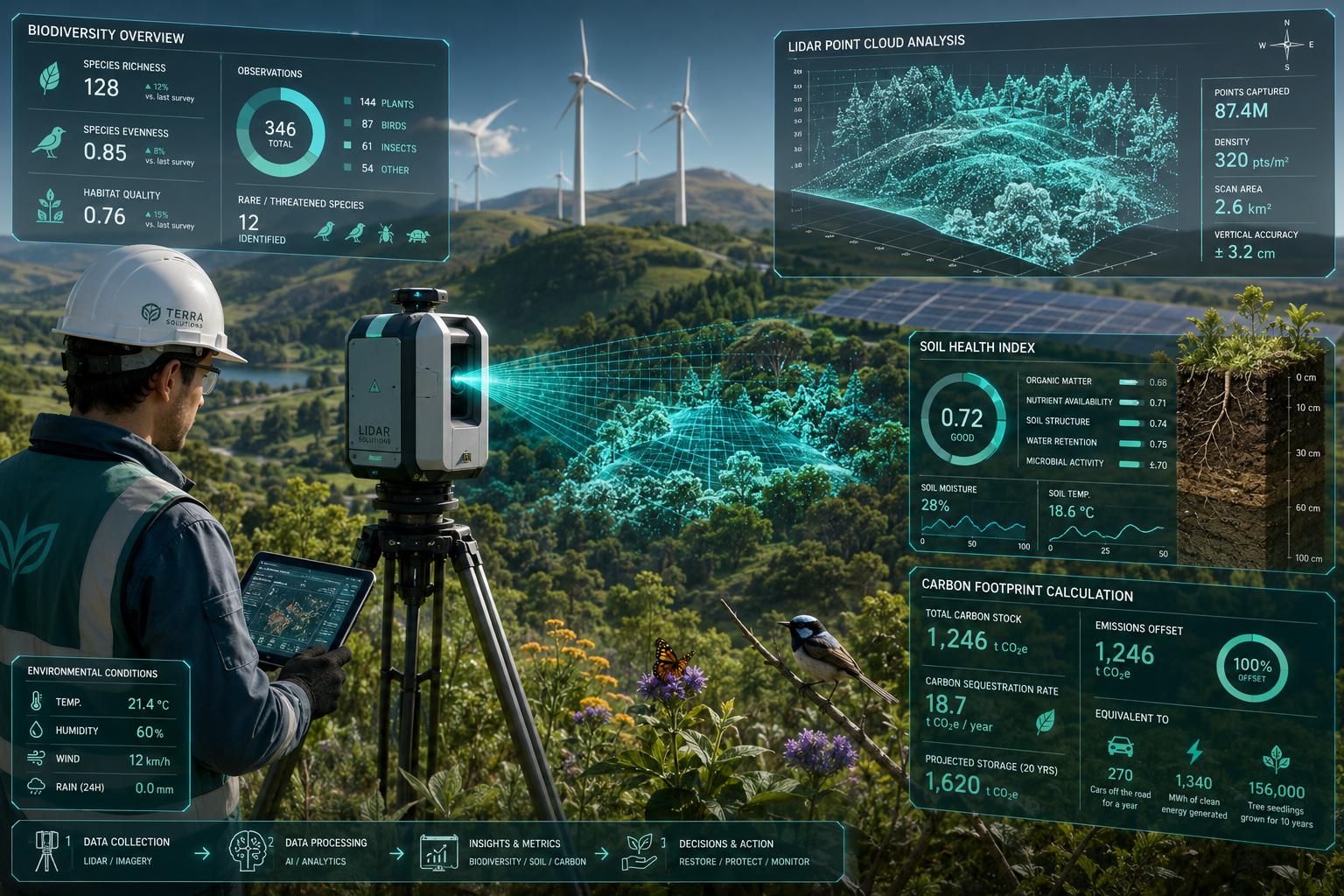
The tools available to surveyors in 2026 bear little resemblance to those used a decade ago. Modern surveying employs drones, LiDAR (Light Detection and Ranging), thermal imaging, and AI-powered data platforms to collect environmental data at a scale and resolution that was previously impossible without significant ecological disturbance [3].
Drones and Aerial Data Collection
Unmanned aerial vehicles (UAVs) allow surveyors to map large sites quickly, safely, and with minimal ground-level interference. For ecologically sensitive land — wetlands, ancient woodland margins, or protected habitat corridors — this is transformative. Drone surveys can capture high-resolution photogrammetry, multispectral imagery for vegetation health analysis, and thermal data revealing subsurface water movement, all in a single flight.
For renewable energy projects such as large-scale solar farms and wind installations, drone-based spatial data is essential for efficient planning and construction sequencing [6]. Surveyors providing precise topographic models reduce material waste, optimise panel orientation, and identify ground conditions that affect foundation design — all before any earthworks begin.
LiDAR and Hydrological Mapping
LiDAR scanning generates dense three-dimensional point clouds of terrain and structures. In an environmental context, this technology enables:
| Application | Environmental Benefit |
|---|---|
| Floodplain modelling | Identifies drainage risk before development |
| Canopy height mapping | Protects mature tree root zones |
| Subsidence risk analysis | Prevents unnecessary excavation |
| Coastal erosion monitoring | Informs long-term site viability |
When combined with hydrological mapping, LiDAR data allows surveyors to predict how surface water will behave across a proposed development site under both current and future rainfall scenarios. Drainage surveys that incorporate this level of analysis provide developers with actionable intelligence that reduces flood risk, protects neighbouring land, and satisfies Environment Agency requirements.
Thermal Imaging and Energy Performance
Thermal cameras detect heat loss through building envelopes, identify cold bridging, and locate moisture ingress — all conditions with direct sustainability implications. A building leaking heat through poorly insulated walls or a compromised roof is not only expensive to operate; it represents unnecessary carbon output. Thermal imaging integrated into a Level 3 building survey gives buyers a precise picture of energy performance deficiencies before purchase, enabling targeted retrofit planning.
AI-Powered Environmental Platforms
Artificial intelligence is accelerating the analysis of complex environmental datasets. AI platforms can cross-reference biodiversity records, soil classification data, climate projections, and planning history to produce risk-weighted site assessments in hours rather than weeks. This speed advantage is critical in competitive land acquisition scenarios where environmental due diligence must be thorough but timely [3].
Ecological Impact Assessments: The Core of Environmentally Conscious Development
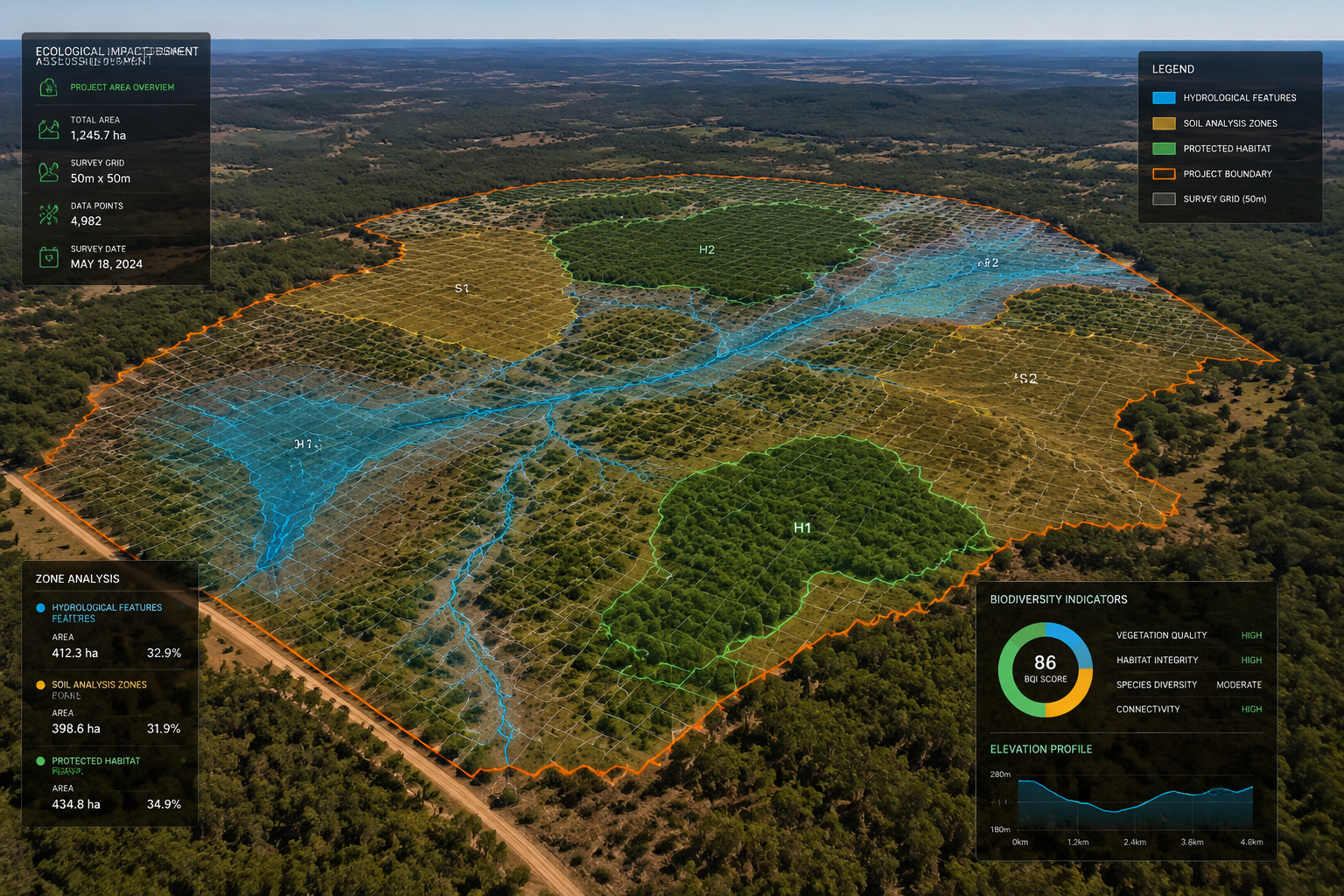
Sustainability-driven surveying: how modern surveys guide environmentally conscious development reaches its most sophisticated expression in the Ecological Impact Assessment (EcIA). These assessments have evolved well beyond basic habitat surveys to become comprehensive environmental intelligence exercises that integrate biodiversity data, soil health analysis, and hydrological mapping into a single coherent picture of a site's ecological value and vulnerability [4].
What an EcIA Captures
A well-executed EcIA addresses multiple environmental dimensions simultaneously:
Biodiversity and Habitat Mapping
Surveyors document protected species, habitat connectivity corridors, and the presence of priority habitats as defined under national biodiversity frameworks. This data directly informs planning applications and determines whether a Biodiversity Net Gain (BNG) requirement applies — and by how much.
Soil Health Analysis
Soil is a living system. Its carbon sequestration capacity, drainage characteristics, and microbial health all affect how a development site will perform over time. Surveyors assessing soil health can identify contamination risks, compaction issues, and areas where topsoil preservation during construction will be critical to post-development ecological recovery [8].
Hydrological Mapping
Water movement across and beneath a site connects directly to flood risk, habitat quality, and the long-term stability of any structures built there. Hydrological mapping within an EcIA ensures that development proposals do not inadvertently redirect surface water onto neighbouring land or damage wetland habitats downstream.
Net Gain and the Surveyor's Role
The Biodiversity Net Gain requirement — now embedded in planning policy across England — means that new developments must leave biodiversity in a measurably better state than before construction. Surveyors who can accurately baseline ecological conditions before groundbreaking are essential to this process. Without a credible pre-development ecological survey, there is no reliable way to calculate net gain or demonstrate compliance [4].
This positions the surveyor not merely as an inspector but as an environmental baseline authority whose data underpins planning permissions, legal obligations, and post-construction monitoring programmes.
Net-Zero Surveying: Reducing the Environmental Cost of the Survey Itself
An important development in 2026 is the emergence of net-zero surveying operations. Companies such as Deep Hydrography and Geophysics have introduced the "Deep Green" initiative, conducting inland surveys using electric vehicles and vessels to eliminate direct emissions from the survey process itself [5]. This approach acknowledges that environmental credibility must extend to the methods used to collect data, not only the findings reported.
For clients commissioning surveys as part of a sustainability strategy, choosing a firm that operates with low-emission methods is increasingly a procurement consideration rather than an optional extra.
Sustainability Data and the Investment Landscape
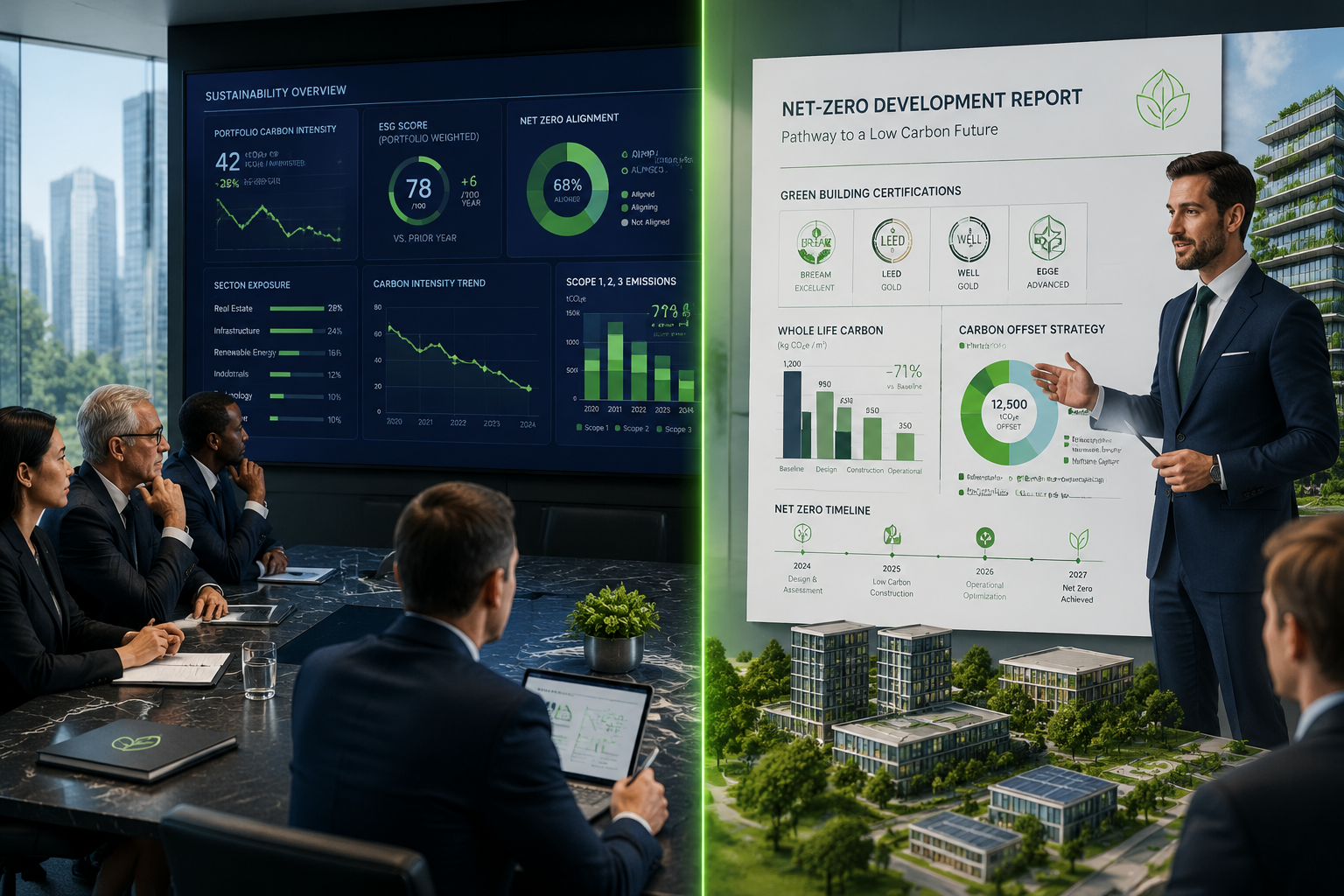
The commercial case for sustainability-driven surveying is now inseparable from investment fundamentals. As noted earlier, 87% of institutional investors require verified sustainability data before completing real estate acquisitions [2]. This demand has created a direct link between survey quality and asset liquidity.
Properties with comprehensive sustainability assessments — covering carbon performance, climate risk, biodiversity impact, and energy efficiency — move through due diligence faster and attract a broader pool of capital. Conversely, assets without credible environmental data face increased scrutiny, delayed transactions, and potential valuation discounts.
For commercial property owners, the implications are clear. Commercial building surveys that incorporate sustainability metrics are no longer a premium add-on — they are a baseline expectation for any asset entering the institutional investment market.
Sustainability Metrics That Investors Prioritise
The following data points are most frequently requested by sustainability-focused investors and lenders:
- Energy Performance Certificate (EPC) rating and pathway to improvement
- Whole-life carbon assessment covering embodied and operational emissions
- Physical climate risk score under 1.5°C and 2°C warming scenarios
- Biodiversity Net Gain status and any outstanding ecological liabilities
- Flood and subsidence risk under projected 2050 climate conditions
- Green building certification status (BREEAM, LEED, WELL, etc.)
Surveyors who can deliver verified data across these dimensions add measurable value to the transaction process. Understanding topographic survey costs in the context of this broader sustainability value proposition helps clients see specialist survey investment as risk mitigation rather than overhead.
Practical Applications Across Development Types
Sustainability-driven surveying: how modern surveys guide environmentally conscious development applies across a wide spectrum of project types. The principles remain consistent; the specific tools and emphasis shift with context.
Residential Development
For housing schemes, ecological surveys identify protected species constraints early, preventing costly planning delays. Energy performance assessments of existing structures on brownfield sites inform demolition versus retrofit decisions — a calculation with significant carbon implications. Stock condition surveys of existing housing portfolios provide the baseline data needed to plan large-scale retrofit programmes efficiently.
Commercial and Mixed-Use Development
Commercial schemes face the most direct regulatory pressure under the new RICS mandatory carbon assessment requirements. Surveyors working on office, retail, and industrial projects must integrate climate risk modelling, energy performance data, and biodiversity assessments into reports that satisfy both planning authorities and investor due diligence requirements.
Renewable Energy Infrastructure
Solar and wind projects represent some of the most ecologically complex surveying challenges. Sites are typically large, often in rural or semi-rural locations with significant habitat value, and subject to detailed environmental impact assessment requirements. Specialist ecology surveying services — capturing accurate geospatial and ecological data — are essential for informed decision-making in these contexts [7]. Surveyors supporting renewable energy development provide the spatial precision that optimises infrastructure layout while minimising ecological footprint [6].
Brownfield Regeneration
Contaminated and previously developed land presents specific environmental challenges. Ground investigation surveys, combined with ecological assessments, identify contamination plumes, assess remediation requirements, and establish whether ecological colonisation of brownfield sites has created unexpected biodiversity value that must be protected or offset.
Conclusion: Actionable Steps for Environmentally Conscious Development
The evidence is unambiguous. Sustainability-driven surveying has moved from a specialist niche to a professional standard. The combination of RICS regulatory mandates, institutional investor expectations, and advanced ecological survey technologies has created a new baseline for what responsible land development requires before groundbreaking.
For property developers and landowners, the actionable priority is commissioning ecological and environmental assessments at the earliest possible stage — ideally before site acquisition. Early ecological data prevents planning delays, identifies constraints that affect site value, and enables proactive Biodiversity Net Gain planning.
For property buyers and investors, understanding the environmental credentials of any asset requires a survey that goes beyond structural condition. Requesting carbon performance data, climate risk assessments, and energy efficiency analysis as part of due diligence is now standard practice among sophisticated market participants.
For built environment professionals, engaging with the RICS "Sustainability Practice for Surveyors" framework [1] and investing in technology-enabled survey capabilities — drones, LiDAR, thermal imaging, AI analysis — positions firms to meet growing client demand and regulatory requirements simultaneously.
The surveyor who captures ecological intelligence before a single foundation is laid is not performing an administrative function. That professional is shaping the environmental outcome of the project, protecting biodiversity, reducing carbon liability, and creating the verified data that underpins responsible investment. That is what sustainability-driven surveying looks like in practice — and its importance will only grow.
References
[1] Sustainability Practice For Surveyors – https://www.rics.org/news-insights/current-topics-campaigns/sustainability/sustainability-practice-for-surveyors?utm_source=openai
[2] Sustainability In Property Surveying Tools For Eco Impact Assessment And Green Development – https://kingstonsurveyors.com/sustainability-in-property-surveying-tools-for-eco-impact-assessment-and-green-development/?utm_source=openai
[3] Sustainability Driven Surveying Using Tech To Assess Environmental Impacts – https://www.canterburysurveyors.com/blog/sustainability-driven-surveying-using-tech-to-assess-environmental-impacts/?utm_source=openai
[4] Ecological Impact Assessments In Surveys Guiding Sustainable Land Development Beyond Basics – https://wimbledonsurveyors.com/ecological-impact-assessments-in-surveys-guiding-sustainable-land-development-beyond-basics/?utm_source=openai
[5] Deep Green – https://www.deepbv.nl/deep-green?utm_source=openai
[6] Renewable Energy – https://www.gmcsurveying.com/renewable-energy/?utm_source=openai
[7] Ecology Surveys – https://murphygs.com/ecology-surveys/?utm_source=openai
[8] Environmental Surveying – https://www.hensonarchitect.com/environmental-surveying/?utm_source=openai
