
Nearly 400,000 people in England live in homes that have received Disabled Facilities Grant adaptations, yet fewer than 10% of UK housing stock meets even the most basic accessibility standards. When a property is modified to accommodate live-in care support or intensive elderly care needs, it crosses into territory where standard building surveys and conventional valuations can fall dangerously short. Senior and elderly carer accommodation represents one of the most technically demanding intersections of property surveying, regulatory compliance, and specialist valuation in the UK market today, and the risks for buyers, sellers, lenders, and care providers who underestimate this complexity are significant.
This article examines the structural, regulatory, and financial risks that arise when UK homes are adapted for care, and explains what surveyors, property owners, and care arrangers need to know in 2026.
Key Takeaways
- Homes adapted for elderly or live-in carer use introduce structural, regulatory, and valuation risks that standard surveys are not always designed to capture.
- Care Quality Commission environmental standards now apply wherever regulated care is delivered, including domestic settings, creating compliance obligations that affect property condition assessments.
- Partially adapted homes, where Disabled Facilities Grant works are incomplete, present particular survey and valuation uncertainty.
- Once a property operates as a care business, specialist trade-related valuation methods replace standard residential approaches, with significant implications for lenders and owners.
- Choosing the correct survey level and a surveyor experienced in care-adapted properties is essential before purchasing, remortgaging, or insuring these homes.
What Makes Care-Adapted Homes Different for Surveyors
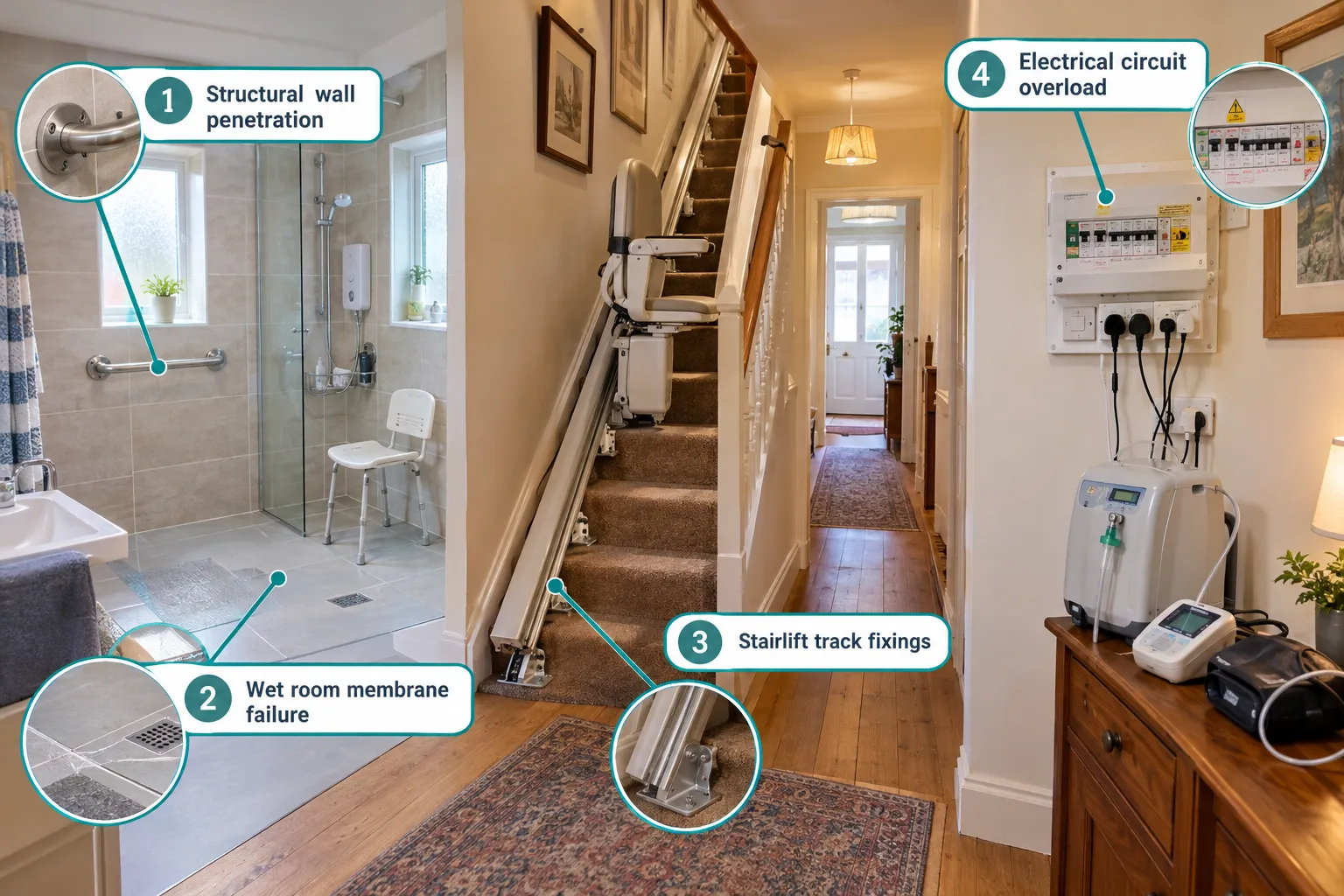
A standard domestic property survey focuses on structural integrity, damp, drainage, and condition. When a home has been adapted for elderly care or to accommodate a live-in carer, the scope of risk expands considerably. Adaptations that appear cosmetic, grab rails, ramp installations, widened doorways, can conceal significant structural interventions. A through-wall handrail bracket, for example, may have been installed without adequate lintel support. A level-access wet room conversion can introduce waterproofing failures that damage subfloor joists over years before becoming visible.
Common adaptations that introduce surveying risk include:
- Stairlift and through-floor lift installations (structural fixings, electrical circuits, load-bearing implications)
- Wet room and level-access shower conversions (membrane integrity, drainage falls, subfloor moisture)
- Widened doorways and removed partition walls (load-bearing assessment required)
- Ramp construction at entrances (drainage, DPC bridging, foundation proximity)
- Overhead hoist track systems (ceiling and joist loading)
- Dedicated medical equipment circuits (consumer unit capacity, earthing)
For any of these, a Level 2 home survey may not provide sufficient depth. A RICS Level 3 building survey, the most comprehensive residential inspection, is strongly recommended for properties where significant structural adaptations have been made. Understanding the key differences between Level 2 and Level 3 surveys is a practical first step for anyone dealing with a care-adapted property.
Regulatory Compliance and the CQC Environmental Framework
Where regulated care is delivered in a domestic setting, whether by a registered domiciliary care provider or within a small residential care arrangement, the Care Quality Commission's Fundamental Standards apply [2]. These are not limited to large care homes. The CQC's environmental risk expectations cover fire safety, legionella control, COSHH storage, falls prevention, and pressure area management, and they apply wherever a registered provider delivers care [7].
"The physical environment of any setting where care is delivered must support safe, effective, and dignified care, regardless of whether that setting is purpose-built or a converted domestic property."
This creates a direct link between building condition and regulatory compliance. A surveyor inspecting a home where domiciliary care is delivered should consider whether the property's condition would satisfy CQC scrutiny [4]. Recent CQC inspection commentary has highlighted increased scrutiny of smaller, non-clinical environments, including adapted domestic buildings, signalling that regulatory risk in this sector is rising [10].
Regulation 9A, which governs visiting rights and infection control in care settings, also has design and layout implications [6]. Adequate space for safe visiting, separation of clinical waste storage, and hygienic surface finishes in care areas are considerations that go beyond a standard domestic survey checklist.
Valuation Risks in Senior and Elderly Carer Accommodation
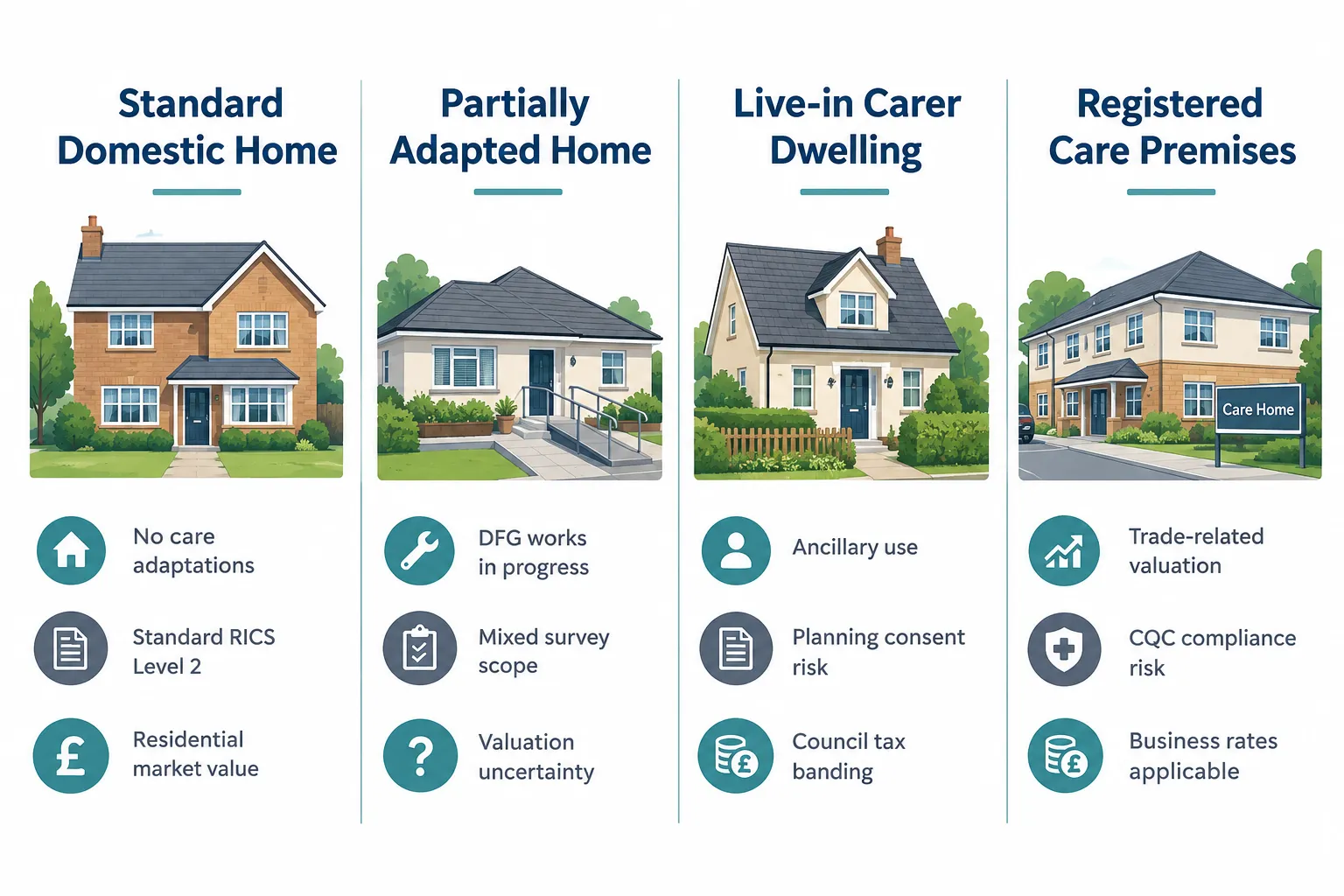
The valuation of homes adapted for senior and elderly carer accommodation is one of the most nuanced areas in UK residential property. The core challenge is that adaptations can either add value, reduce value, or fundamentally change the valuation methodology, depending on the nature and extent of the works and how the property is used.
When Standard Residential Valuation Applies
For a property where adaptations are minor, a few grab rails, a walk-in shower, a ramp, standard residential valuation methods generally apply. The surveyor will compare the property with similar homes in the area. Minor adaptations rarely add market value because the pool of buyers who specifically require them is limited, while buyers who do not need them may perceive the property as less desirable.
Valuation adjustments surveyors commonly consider:
| Adaptation Type | Typical Market Impact | Key Valuation Risk |
|---|---|---|
| Grab rails and minor aids | Neutral to slight negative | Stigma with general buyers |
| Wet room conversion | Neutral to slight negative | Waterproofing defect risk |
| Stairlift installation | Neutral (reversible) | Condition of fixings |
| Through-floor lift | Potential negative | Structural alteration evidence |
| Significant structural remodelling | Variable | Planning and building regs compliance |
| Purpose-configured carer's room | Variable | Planning use class implications |
When Trade-Related Valuation Applies
Once a property begins operating as a care business, even a small one, the valuation methodology changes fundamentally. Care homes and similar premises are treated as trade-related properties under RICS valuation standards. This means the property is valued by reference to its trading potential rather than its bricks-and-mortar characteristics alone. The updated RICS Red Book standards have reinforced this distinction, with implications for how adapted homes that have crossed into business use are inspected and valued.
For smaller adapted homes operating as registered care settings, this shift can be dramatic. A property that might be worth £350,000 as a family home could be valued at a very different figure as a trade-related care premises, higher if the business is profitable, but potentially lower if CQC compliance issues exist or if the building requires significant investment to meet regulatory standards.
This is also relevant to tax and rating classification. Properties providing care may be subject to business rates rather than council tax, and the boundary between the two is not always clear for partially adapted homes. Owners and lenders who have not sought specialist advice on this point face classification risk that can affect both financing and ongoing costs.
For properties where the carer's accommodation forms part of a larger dwelling, a self-contained annexe, for example, questions of freehold valuation and planning use class become relevant. An annexe used exclusively for a live-in carer may have different valuation and tax treatment than one used as a general letting.
The Disabled Facilities Grant Problem
Long DFG timescales create a specific category of risk: the partially adapted home. When grant-funded works are approved but not yet completed, a property may be in a state of disrepair, walls opened, bathrooms stripped, doorways widened but not finished. For a buyer or lender commissioning a survey during this period, the condition assessment is complicated by works in progress, and the valuation must account for the cost and uncertainty of completion.
Evidence from UK-wide reviews points to systemic delays in the DFG system, with some applicants waiting 18 months or more for works to be completed. This creates real risk of avoidable harm in homes where care is being delivered in substandard conditions, and it creates valuation uncertainty that lenders and buyers need to manage carefully.
Commissioning the Right Survey for Care-Adapted Properties
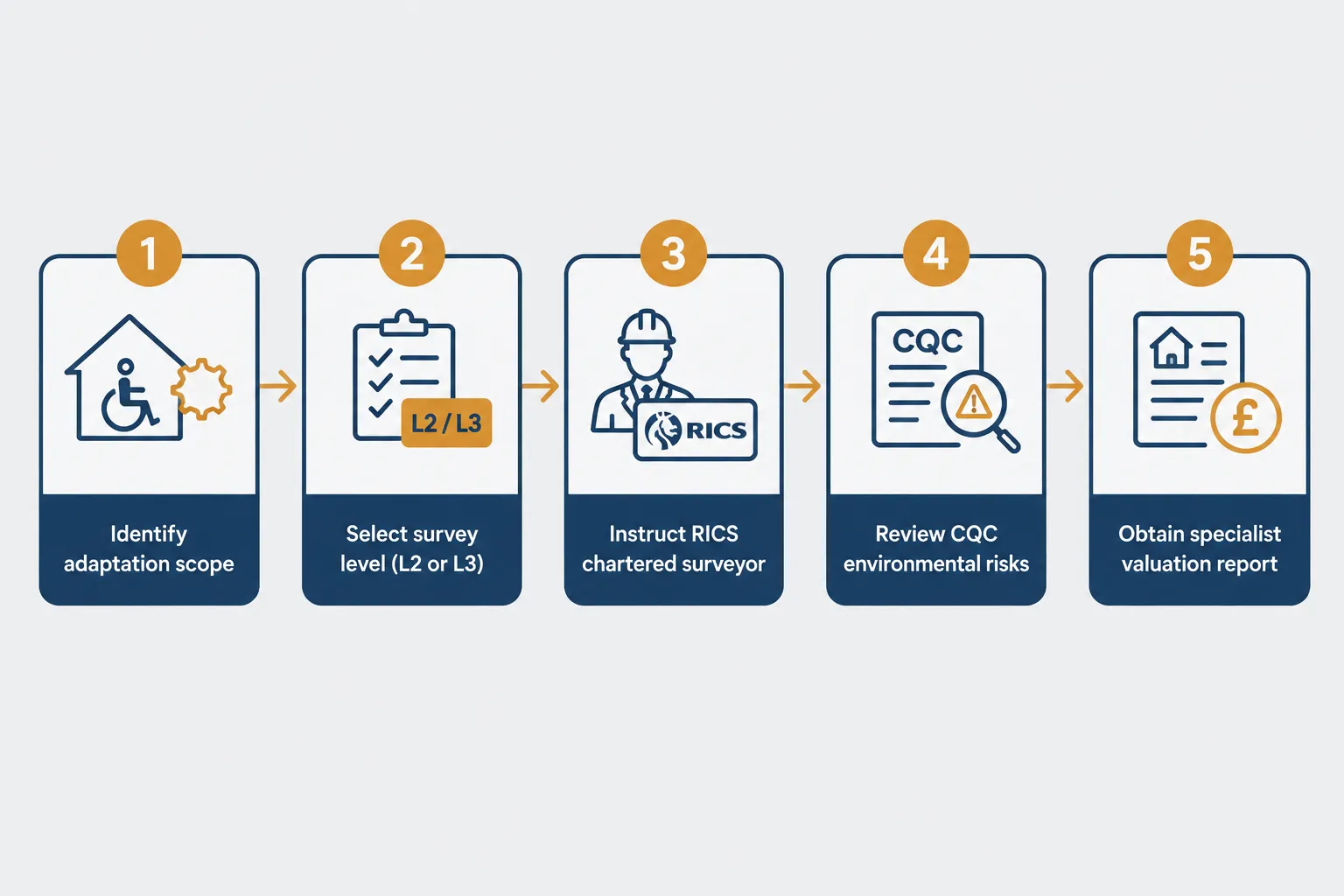
Selecting the appropriate survey type and a surveyor with relevant experience is the single most important step when dealing with senior and elderly carer accommodation and its associated building survey and valuation risks. A general-purpose survey from a surveyor unfamiliar with care adaptations may miss critical defects or fail to flag regulatory compliance issues.
Choosing the Survey Level
For most care-adapted properties, a RICS Level 3 building survey is the appropriate starting point. This provides the most thorough inspection of the building's structure and condition, including assessment of non-standard construction and alterations. The surveyor should be briefed on the nature of the adaptations before the inspection so that specific risk areas receive appropriate attention.
A full structural survey may be warranted where significant structural alterations have been made, for example, where load-bearing walls have been removed or ceiling hoists installed.
For lenders, a RICS home survey combined with a specialist valuation report may be required, particularly where the property is used for regulated care.
What the Survey Should Cover
A thorough survey of a care-adapted property should address:
Structural integrity of adaptations
- Evidence of building regulations approval for structural works
- Condition of fixings for hoists, stairlifts, and rails
- Adequacy of lintels and supports where walls have been modified
Wet room and bathroom adaptations
- Waterproofing membrane condition
- Drainage falls and outlet capacity
- Subfloor moisture levels beneath wet areas
Electrical systems
- Consumer unit capacity for medical equipment loads
- Condition of dedicated circuits
- Earthing and bonding adequacy
Fire safety
- Compartmentation integrity where walls have been altered
- Adequacy of fire detection for care use
- Means of escape for occupants with mobility impairments
Legionella and water hygiene
- Water system configuration and temperature management
- Dead legs and infrequently used outlets (common in adapted bathrooms)
CQC environmental risk indicators [3]
- Falls risk features (floor surfaces, lighting, thresholds)
- COSHH storage provision
- Infection control surface finishes
The Role of Specialist Surveyors
Not all chartered surveyors have experience with care-adapted properties. When instructing a surveyor, it is worth asking directly about their experience with properties used for elderly care, live-in carer arrangements, or registered care settings. A surveyor who understands both the building condition risks and the regulatory framework will produce a far more useful report.
For properties that may require trade-related valuation, a surveyor with experience in healthcare property is essential. Standard residential valuers are not equipped to assess the trading potential of a care business or to apply the RICS methodology for trade-related premises.
Those unsure which survey type is appropriate can use a what survey do you need tool to identify the right starting point, or consult directly with chartered surveyors experienced in adapted and specialist properties.
Practical Checklist for Buyers and Owners
Before commissioning a survey on a care-adapted property, consider the following:
- Obtain all available documentation for adaptations: building regulations certificates, planning permissions, DFG completion certificates, and any CQC inspection reports if the property is registered.
- Confirm whether the property is currently subject to business rates or council tax, this signals its regulatory classification.
- Ask the estate agent or vendor whether any adaptations were installed under a DFG and whether works are fully completed.
- Check whether any care-related planning conditions apply to the property.
- Brief the surveyor fully on the care use and adaptation history before the inspection.
- Consider whether a specialist asbestos survey is needed, particularly in pre-2000 properties where adaptations may have disturbed original materials. Asbestos surveys are a separate but important consideration in older adapted homes.
Policy Direction and Future Risk
The UK government's policy trajectory in 2026 is towards age-friendly design codes and care-ready mainstream housing. As these standards become embedded in planning policy and building regulations, properties that fall short of them will face increasing valuation pressure. Conversely, homes that genuinely meet emerging care-ready standards may attract a premium from an ageing population seeking to age in place.
The falls prevention evidence base is also increasingly cited in policy discussions. Adaptations that prevent falls are substantially cheaper than the health and social care costs that result from falls, a fact that is beginning to influence how local authorities and NHS commissioners think about home adaptation investment. This cost-benefit framing may, over time, influence how surveyors and valuers assess the contribution of well-executed adaptations to a property's condition rating and value.
For those involved in care-adapted property, whether as owners, buyers, lenders, or care providers, staying informed about these policy shifts is important. The regulatory and valuation landscape for senior and elderly carer accommodation is evolving, and the risks of being caught out by outdated assumptions are real.
Conclusion
Senior and elderly carer accommodation presents a genuinely complex set of building survey and valuation risks in UK homes adapted for care. From structural alterations that require specialist inspection to CQC environmental compliance obligations that affect property condition assessments, the risks are layered and interconnected. Partially adapted homes, trade-related valuation triggers, and the tax and rating classification of care premises add further complexity for buyers, lenders, and owners.
Actionable next steps for anyone dealing with a care-adapted property:
- Always commission a RICS Level 3 building survey, not a Level 2, for properties with significant structural adaptations.
- Brief the surveyor fully on the care use, adaptation history, and any regulatory registrations before the inspection.
- Obtain all building regulations and planning documentation for adaptations before exchange of contracts.
- Seek specialist trade-related valuation advice if the property operates, or has operated, as a registered care setting.
- Check the property's council tax versus business rates status to understand its regulatory classification.
- Consider asbestos and drainage surveys as additional investigations in older adapted properties.
- Monitor emerging age-friendly design standards, as these will increasingly shape what is considered adequate condition and best practice.
For expert guidance on surveying and valuing care-adapted properties, consulting a RICS chartered surveyor with specialist experience in this sector is the most reliable first step.
References
[1] Blog – https://inspectready.co.uk/blog/
[2] Fundamental Standards – https://www.cqc.org.uk/about-us/fundamental-standards
[3] Care Home Risk Assessment Guide – https://inspectready.co.uk/blog/care-home-risk-assessment-guide/
[4] Care Quality Commission – https://www.gov.uk/government/organisations/care-quality-commission
[5] CQC Inspection Checklist – https://safework.place/guides/cqc-inspection-checklist/
[6] Regulation 9A – https://www.cqc.org.uk/guidance-regulation/providers/regulations-service-providers-and-managers/health-social-care-act/regulation-9a
[7] cqc.org.uk – https://www.cqc.org.uk/
[10] 40b7806 – https://content.govdelivery.com/accounts/UKCQC/bulletins/40b7806