
{"cover":"Professional landscape format (1536×1024) hero image with bold text overlay 'Professional Damp Investigation Services' in crisp white modern sans-serif on a deep navy semi-transparent overlay panel, centered with 8% safe margins from every edge, no character touches the edge, two balanced lines. Background: editorial daylight photograph of a RICS-accredited surveyor in a navy jacket using a professional moisture meter on a damp-stained interior wall of a residential home, with an elderly person seated nearby in a wheelchair, warm interior lighting, shallow depth of field on the wall surface, magazine-quality composition, teal and navy color palette, high-contrast editorial aesthetic.","content":["Four-panel labelled infographic guide (1536×1024), clean white background, teal-and-navy palette, editorial quality. Panel 1 heading: 'Condensation', labels: 'Surface moisture', 'Cold wall junctions', 'Ventilation gaps'. Panel 2 heading: 'Rising Damp', labels: 'Ground-level staining', 'Salt deposits', 'Failed DPC'. Panel 3 heading: 'Penetrating Damp', labels: 'Roof or wall breach', 'Lateral water ingress', 'Window seal failure'. Panel 4 heading: 'Leak-Related Damp', labels: 'Pipe or waste source', 'Ceiling spread pattern', 'Structural saturation'. Thin callout lines to each feature, short panel headings in bold teal, bullet labels in dark navy, small moisture-meter icon per panel, professional surveying guide aesthetic.","Numbered step-by-step process flow diagram (1536×1024), landscape format, bright clinical white background with teal accent lines. Six sequential steps shown left to right with connecting arrows: Step 1 'Vulnerability Screening', icon of a checklist; Step 2 'Appointment Scheduling', icon of a calendar with accessibility symbol; Step 3 'On-Site Moisture Survey', icon of a handheld meter; Step 4 'Root Cause Diagnosis', icon of a magnifying glass on a wall cross-section; Step 5 'Evidence Bundle Compiled', icon of a folder with photos; Step 6 'Resident Action Plan', icon of a document with a handshake. Each step has a 3-word caption beneath it, bold teal step numbers, navy captions, clean sans-serif typography, professional housing survey workflow aesthetic.","Split-screen editorial comparison image (1536×1024), high-contrast magazine composition. Left panel: warm-lit scene of a professional female surveyor of South Asian descent kneeling to inspect a skirting board with a thermal imaging camera, elderly male occupant seated in background with carer standing nearby, labels 'Level 3 Building Survey', 'Thermal imaging included', 'Carer present protocol'. Right panel: a male surveyor of Black African descent standing at a doorway with a tablet and moisture meter, reviewing findings with a middle-aged female home carer, labels 'Specialist Damp Survey', 'Vulnerability flag recorded', 'Written report issued'. Dividing line in bold teal, panel headings in white on dark overlay bars, editorial daylight interior lighting, professional property surveying aesthetic."]
Damp and mould contribute to an estimated 10,000 GP consultations per year in England alone, yet the households most severely affected, those occupied by elderly, disabled, or chronically ill residents, are frequently the last to receive a thorough, professionally documented investigation. For home carers and family advocates navigating this landscape in 2026, choosing the right surveyor is not simply a technical decision; it is a safeguarding one.
This guide to Professional Damp Investigation Services: Comparing Home Carer-Friendly Surveyor Options for Vulnerable Occupants sets out the regulatory backdrop, the key service features that distinguish a genuinely carer-friendly survey from a box-ticking visit, and the practical steps carers can take to secure the right investigation for the people in their care.
Key Takeaways
- New legal duties introduced from October 2025 require social landlords to investigate and resolve damp within set timeframes, creating enforceable standards for professional surveys in vulnerable households [11].
- UK government guidance and Awaab's Law (Scotland) both identify older adults, people with health conditions, and those who are housebound as priority groups requiring faster investigation and clearer communication [1][6].
- A carer-friendly surveyor goes beyond moisture readings, they screen for vulnerability, adapt appointment logistics, produce a documented evidence bundle, and communicate findings in plain language to residents and their advocates [3][10].
- The Housing Ombudsman's 2026 decisions set a clear best-practice benchmark: every survey should result in a root-cause diagnosis, a written action plan with timescales, and a resident-confirmation step before a case is closed [3][7].
- Home carers should request a Level 3 Building Survey or a specialist damp investigation for older or complex properties, and should verify that the surveyor holds RICS accreditation before booking.
Why Vulnerable Occupants Require a Different Standard of Damp Survey
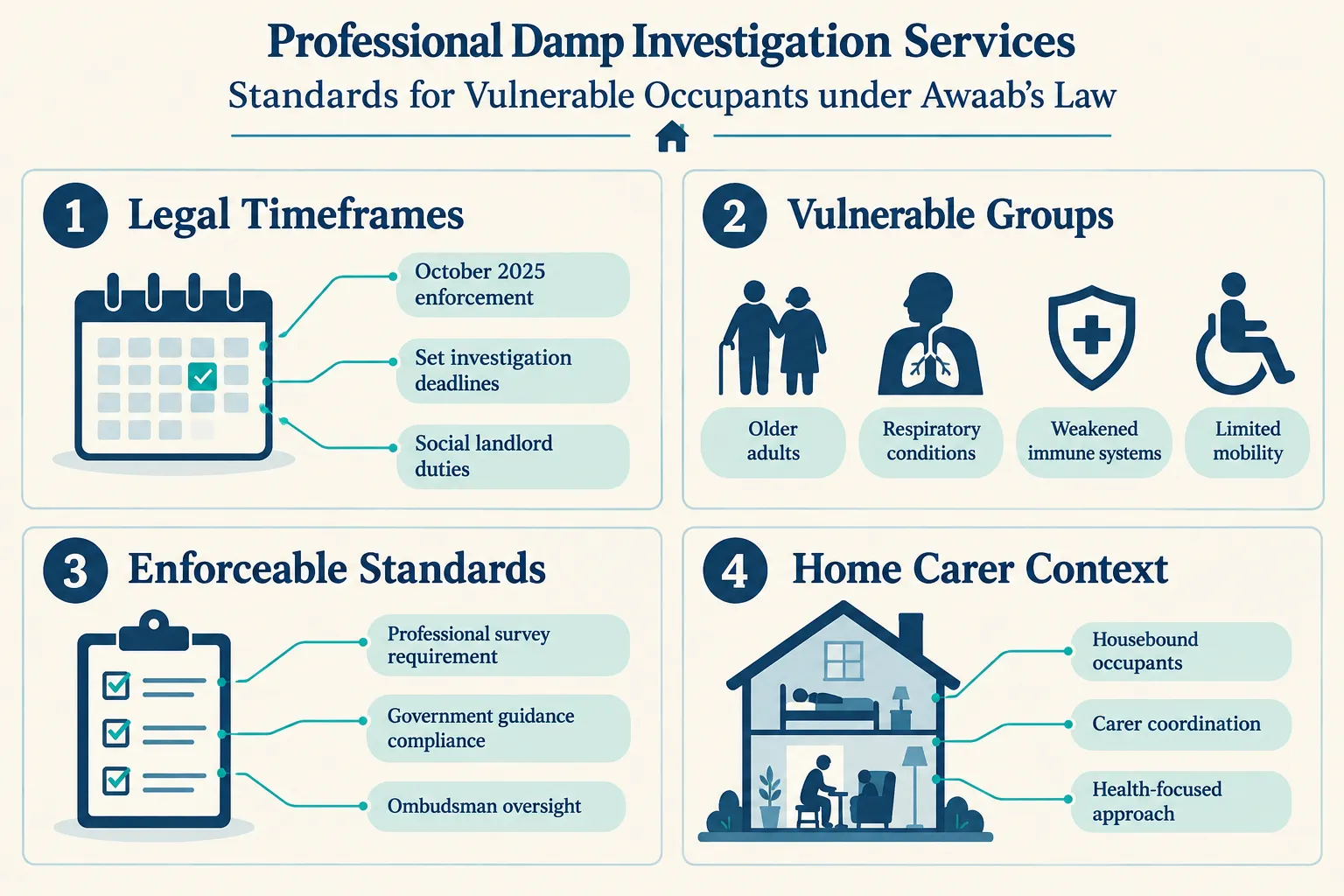
Not every damp survey is equal, and for households where occupants have respiratory conditions, weakened immune systems, limited mobility, or are entirely housebound, the gap between a standard inspection and a thorough professional investigation can have serious health consequences.
UK government guidance, updated through April 2026, makes explicit that damp and mould can seriously affect both physical and mental health, and that landlords must act with urgency when health concerns are raised [1][2]. The guidance identifies higher-risk groups, people with certain health conditions, children, and older adults, as requiring faster investigation and clearer communication about risks and timescales [1][4].
Scotland's Awaab's Law guidance, updated in September 2026, goes further by introducing a formal "heightened vulnerability" assessment. It lists groups including people with pre-existing health conditions, weakened immune systems, pregnant women, babies and children, older people, and those who are bedbound or housebound. Where damp and mould affects any of these groups, landlords and their appointed surveyors must act "as soon as possible" [6].
The Public Services Ombudsman for Wales has also launched systemic investigations into how social housing providers respond to damp and mould affecting vulnerable tenants, signalling that scrutiny of professional investigation standards is intensifying across all UK nations [5].
What this means in practice: a professional damp investigation for a vulnerable household must go beyond a single moisture reading. It must establish the source of damp, distinguish between condensation, rising damp, penetrating damp, and leak-related ingress, photograph and document mould locations before any cleaning takes place, and produce a written report accessible to the resident and their carer or advocate [2][10].
Understanding the Types of Professional Damp Investigation Services
Before comparing surveyor options, it is important to understand what different investigation types actually deliver, and which are appropriate for homes with vulnerable occupants.
Level 2 vs Level 3 Surveys
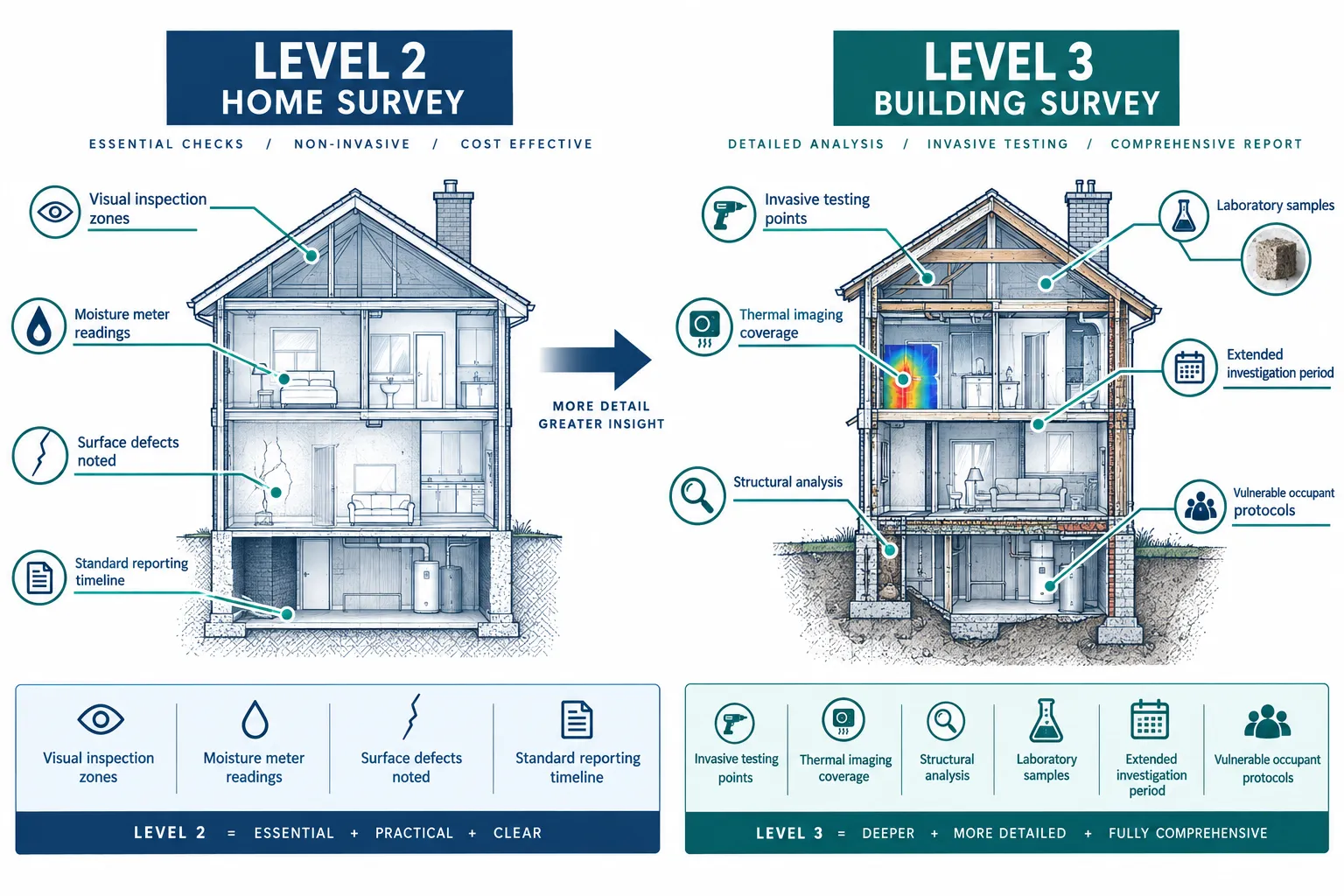
A Level 2 Home Survey provides a condition rating for visible defects, including damp, but does not typically include specialist moisture testing equipment or a detailed diagnosis of root causes. For a property where a vulnerable person lives and where damp has already been identified, this level is generally insufficient.
A Level 3 Building Survey provides a comprehensive structural assessment and is the appropriate starting point for older properties, those with complex damp histories, or any home where a carer is managing an occupant's health around damp-related conditions. It includes detailed investigation of roof structures, wall construction, subfloor conditions, and drainage, all common sources of persistent damp.
Specialist Damp Investigations
A standalone specialist damp investigation, carried out by a RICS-accredited chartered surveyor, focuses exclusively on diagnosing moisture-related defects. It typically includes:
- Calibrated moisture meter readings at multiple wall heights and locations
- Thermal imaging to identify cold bridges and hidden moisture pathways
- Hygrometer readings to assess relative humidity and condensation risk
- Visual inspection of roof, gutters, external walls, and drainage
- Photographic evidence log of all affected areas
This type of survey is the most appropriate for homes where a vulnerable occupant has already reported health symptoms linked to damp, or where previous remedial works have failed to resolve the problem.
Condition Surveys for Social Housing
For social housing residents, a comprehensive condition survey provides a systematic record of the property's physical state, including damp and mould. These surveys are increasingly used by landlords to meet the proactive inspection duties introduced under Awaab's Law and the October 2025 social housing regulations [8][10].
Comparing Home Carer-Friendly Surveyor Options for Vulnerable Occupants
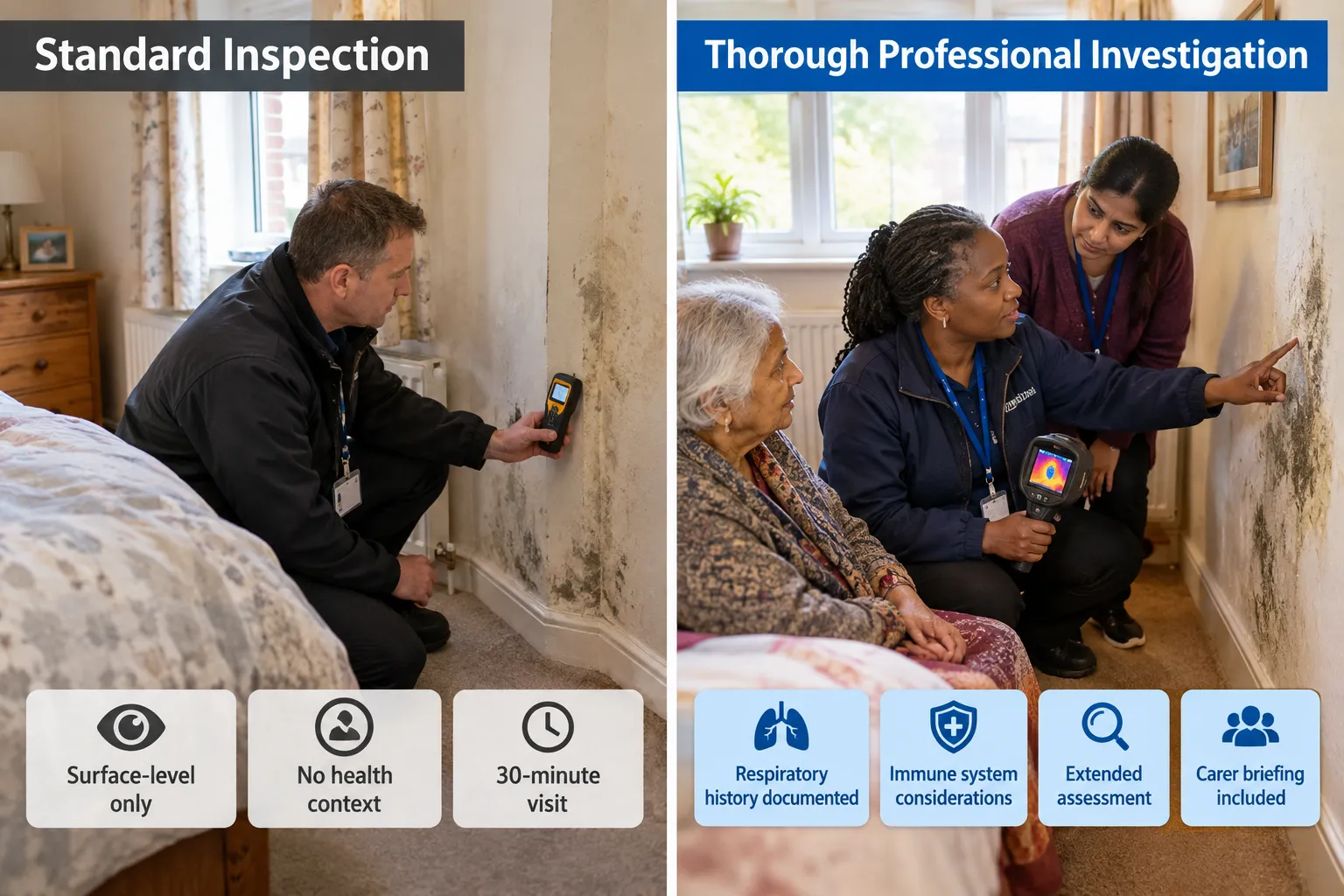
The term "home carer-friendly" describes a set of service features that go beyond technical competence. A surveyor working in a home where an elderly or disabled person lives, often with a carer present, must adapt their communication, scheduling, and reporting to the specific circumstances of that household.
The Housing Ombudsman's April 2026 wider-order decision involving Onward Homes provides the clearest public benchmark for what good practice looks like. The order required the landlord to introduce: a contractor checklist for every damp inspection, a "single evidence bundle" recording all visits and decisions, a vulnerability flag for high-risk households, and a resident-confirmation step before closing any case [3]. These requirements effectively define the minimum standard that a professional damp investigation service should meet when working in a home with a vulnerable occupant.
Key Features to Compare When Selecting a Surveyor
| Feature | Standard Survey | Carer-Friendly Survey |
|---|---|---|
| Vulnerability screening | Not typically conducted | Completed before appointment is booked |
| Appointment flexibility | Standard business hours | Adapted to carer and occupant schedules |
| Communication of findings | Written report to landlord only | Plain-language summary to resident and carer |
| Evidence documentation | Basic moisture readings | Full photographic log, thermal images, humidity data |
| Root cause diagnosis | May not distinguish damp types | Formal diagnosis of condensation, rising, or penetrating damp |
| Action plan with timescales | Rarely provided | Agreed in writing with resident or carer |
| Escalation route if unresolved | Not communicated | Clearly explained, including Ombudsman referral |
Pull quote: "Landlords must not simply clean mould but must identify and rectify underlying causes through proper investigation.", Housing Ombudsman, February 2026 [11]
Surveyor Accreditation: What to Look For
When comparing surveyor options, accreditation is the single most important quality indicator. RICS (Royal Institution of Chartered Surveyors) membership requires surveyors to maintain professional indemnity insurance, follow a code of conduct, and undertake continuing professional development. For vulnerable households, this matters because it provides a formal complaints and redress route if the survey is inadequate.
Surveyors who are also members of the Property Care Association (PCA) or the Residential Property Surveyors Association (RPSA) have additional specialist training in damp diagnosis, which is particularly relevant for complex or long-standing moisture problems.
Costs and What They Include
Professional damp investigation costs in 2026 vary by property type, location, and the scope of the survey. As a general guide:
- Specialist damp survey (single property, up to 3 bedrooms): approximately £200,£400
- Level 3 Building Survey with damp focus: approximately £600,£1,200 depending on property size and location
- Thermal imaging add-on: approximately £100,£200 additional
For a more detailed breakdown of survey costs, the complete pricing guide for home reports provides useful context on what different survey levels include and how costs are structured.
Social housing tenants should note that, under the October 2025 regulations, landlords are required to fund professional investigations, tenants should not be asked to pay for surveys when reporting damp as a significant hazard [10][11].
How Professional Damp Investigation Services Should Work in Practice for Vulnerable Households
The practical workflow for a professional damp investigation in a home with a vulnerable occupant should follow a clear sequence. Drawing on the Housing Ombudsman's 2026 decisions and government guidance, the following steps represent current best practice.
Step 1: Pre-Visit Vulnerability Screening
Before any appointment is made, the surveyor or their commissioning landlord should conduct a vulnerability screening. This involves asking whether the occupant has any health conditions, mobility limitations, or care needs that would affect how the visit is conducted or how findings should be communicated [6][14].
A 2026 training document from housing provider GSA emphasises that surveyors must avoid responses that make residents feel blamed for damp, a common failure when condensation is present in homes where energy costs limit heating and ventilation [14][2]. This is particularly important in households where a home carer is managing a resident's environment, as carers may face implicit criticism about ventilation habits.
Step 2: Scheduling and Access Arrangements
For housebound or bedbound occupants, appointment scheduling must accommodate the carer's timetable, not just standard surveyor availability. A carer-friendly surveyor will:
- Offer morning or afternoon slots that align with care routines
- Confirm in advance which rooms will be accessed and for how long
- Agree a contact point (the carer or a named family member) for follow-up questions
- Minimise disruption to medical equipment or mobility aids during the inspection
Step 3: On-Site Investigation and Evidence Gathering
The on-site investigation must produce a documented evidence bundle. The Housing Ombudsman's April 2026 Onward Homes order specifically required a "single evidence bundle" recording all visits, surveys, contact, and decisions [3]. For a professional damp survey, this bundle should include:
- Calibrated moisture meter readings with location references
- Photographs of all mould and damp-affected areas taken before any cleaning
- Thermal imaging results where cold bridges or hidden moisture are suspected
- Hygrometer readings showing relative humidity levels
- Notes on ventilation, heating usage, and occupant behaviour, recorded without blame
Step 4: Root Cause Diagnosis and Written Report
The Housing Ombudsman's February 2026 damp and mould expectations make clear that landlords, and by extension their appointed surveyors, must not simply clean mould but must identify and rectify underlying causes [11]. The written report must therefore distinguish between:
- Condensation: caused by insufficient heating or ventilation, often exacerbated in homes where energy costs are a barrier
- Rising damp: caused by a failed or absent damp-proof course, requiring structural remediation
- Penetrating damp: caused by a defect in the building envelope (roof, walls, windows)
- Leak-related damp: caused by a plumbing or drainage failure
A March 2026 Southwark Council decision ordered the landlord to provide evidence that repairs addressed root causes and to agree an action plan with timescales, reinforcing that the survey report is not the end of the process but the beginning of a documented remediation pathway [7].
Step 5: Communication with Residents and Carers
A carer-friendly investigation concludes with a plain-language summary of findings, communicated directly to the resident and their carer or named advocate. The April 2026 Sovereign Network Group decision, in which the Ombudsman ordered £620 compensation for an unsympathetic approach to vulnerability, makes clear that technical competence alone is insufficient, surveyors must engage empathetically and adapt their communication to the occupant's circumstances [12].
The written report should include:
- A clear statement of the damp type identified
- The recommended remedial works and their urgency rating
- Agreed timescales for works to begin and complete
- Contact details for escalation if works are not carried out
- Information about the Housing Ombudsman or relevant complaints body [10]
Understanding what surveyors look for in a house survey can help carers and residents prepare for the visit and ask informed questions about the findings.
Red Flags: When a Damp Survey Falls Short of the Standard for Vulnerable Households
The Housing Ombudsman's March 2026 hazards report highlighted that landlords frequently miss early warning signs, with damp and mould cases used as a primary example of systemic failure [8]. Carers and residents should be alert to the following warning signs that a survey has not met the required standard:
- No written report provided, verbal findings are not sufficient for a vulnerable household
- Mould cleaned before the source was identified, this removes evidence and does not address the root cause [11]
- No moisture meter readings recorded, a visual inspection alone is not a professional damp investigation
- Resident or carer not informed of findings, the report should always be shared with the occupant or their representative [10]
- No timescales agreed for remedial works, a survey without an action plan leaves the household in limbo
- Vulnerability not acknowledged, if the surveyor has not asked about the occupant's health or care needs, the investigation has not met the 2026 standard [6][3]
If any of these failures occur, carers should formally request a copy of the survey report in writing, escalate to the landlord's complaints team, and, if unresolved, refer the case to the Housing Ombudsman or the relevant devolved complaints body.
For carers managing properties in social housing, understanding the surveyor's role in social housing provides valuable context on the professional duties and accountability structures that apply.
Conclusion
The regulatory landscape for damp investigations in homes with vulnerable occupants has changed substantially in 2026. New legal duties, Ombudsman enforcement decisions, and updated government guidance have together created a clear, enforceable standard: professional damp investigation services must be rapid, evidence-based, root-cause-focused, and genuinely responsive to the needs of the people living in affected homes.
For home carers and family advocates, the practical steps are clear:
- Request a specialist damp survey or Level 3 Building Survey, not a visual inspection, for any property where a vulnerable occupant is affected by damp or mould.
- Verify RICS accreditation before booking any surveyor, and ask specifically whether the firm has experience working in homes with vulnerable occupants.
- Insist on a written evidence bundle, including moisture readings, photographs, and a root-cause diagnosis, before any remedial works begin.
- Agree a written action plan with timescales and retain a copy; this is now an expected output of any professional damp investigation [3][7].
- Use the escalation routes, the Housing Ombudsman, the Public Services Ombudsman for Wales, or the relevant devolved body, if the landlord fails to act on survey findings within agreed timescales [10][5].
To discuss a professional damp investigation for a property where a vulnerable person lives, contact a RICS-accredited surveyor who can advise on the most appropriate survey type and confirm their approach to working with home carers and vulnerable occupants.
References
[1] Damp And Mould Understanding And Addressing The Health Risks For Rented Housing Providers – https://www.gov.uk/government/publications/damp-and-mould-understanding-and-addressing-the-health-risks-for-rented-housing-providers
[2] Understanding And Addressing The Health Risks Of Damp And Mould In The Home 2 – https://www.gov.uk/government/publications/damp-and-mould-understanding-and-addressing-the-health-risks-for-rented-housing-providers/understanding-and-addressing-the-health-risks-of-damp-and-mould-in-the-home–2
[3] Onward Homes Wider Order – https://www.housing-ombudsman.org.uk/2026/04/30/onward-homes-wider-order/
[4] Letter From The Secretary Of State To Social Landlords On Damp And Mould Guidance – https://www.gov.uk/government/publications/letter-from-the-secretary-of-state-to-social-landlords-on-damp-and-mould-guidance
[5] Public Services Ombudsman For Wales Proposes Investigations Into Social Housing Disrepair Damp And Mould – https://www.ombudsman.wales/blog/2026/02/18/public-services-ombudsman-for-wales-proposes-investigations-into-social-housing-disrepair-damp-and-mould/
[6] Awaabs Law Guidance Landlords Scotland – https://www.gov.scot/binaries/content/documents/govscot/publications/advice-and-guidance/2026/09/awaabs-law-guidance-landlords-scotland/documents/awaabs-law-guidance-landlords-scotland/awaabs-law-guidance-landlords-scotland/govscot:document/awaabs-law-guidance-landlords-scotland.pdf
[7] Southwark Council 202525126 – https://landlordrecord.co.uk/decisions/southwark-council-202525126
[8] Call For Focus On Early Warning Signs In Hazards Report – https://www.housing-ombudsman.org.uk/2026/03/26/call-for-focus-on-early-warning-signs-in-hazards-report/
[9] Housing Oi Consultation Outcome V3 – https://www.ombudsman.wales/wp-content/uploads/2026/02/Housing-OI-consultation-outcome-v3.pdf
[10] Damp And Mould – https://www.housing-ombudsman.org.uk/centre-for-learning/key-topics/damp-and-mould/