
Offsite construction now accounts for a growing share of new UK housing delivery, with the government's target of 1.5 million new homes by 2029 placing enormous pressure on build programmes to accelerate. Yet one legal obligation has not accelerated alongside the technology: the Party Wall etc. Act 1996 still governs every build that touches, approaches, or excavates near a shared boundary — regardless of whether the structure arrives by lorry in flat-packed panels or is poured in situ. Understanding Party Wall Surveys for Modular and Offsite Construction: 2026 Compliance in Accelerated UK Builds is no longer optional for developers, self-builders, or contractors who want to avoid injunctions, neighbour disputes, and costly programme delays.
Key Takeaways
- The Party Wall etc. Act 1996 applies fully to modular and offsite construction — the method of build does not create an exemption.
- Notice periods under the Act can run from one to two months, which must be factored into accelerated modular programme schedules from day one.
- A schedule of condition survey of adjoining properties before any work begins is critical for protecting all parties when vibration and crane operations are involved.
- Appointing a specialist party wall surveyor early reduces the risk of disputes that could halt a modular crane lift or foundation pour.
- In 2026, digital delivery of notices and awards is increasingly accepted in practice, but the statutory framework remains unchanged.
Why Modular Construction Creates Unique Party Wall Challenges
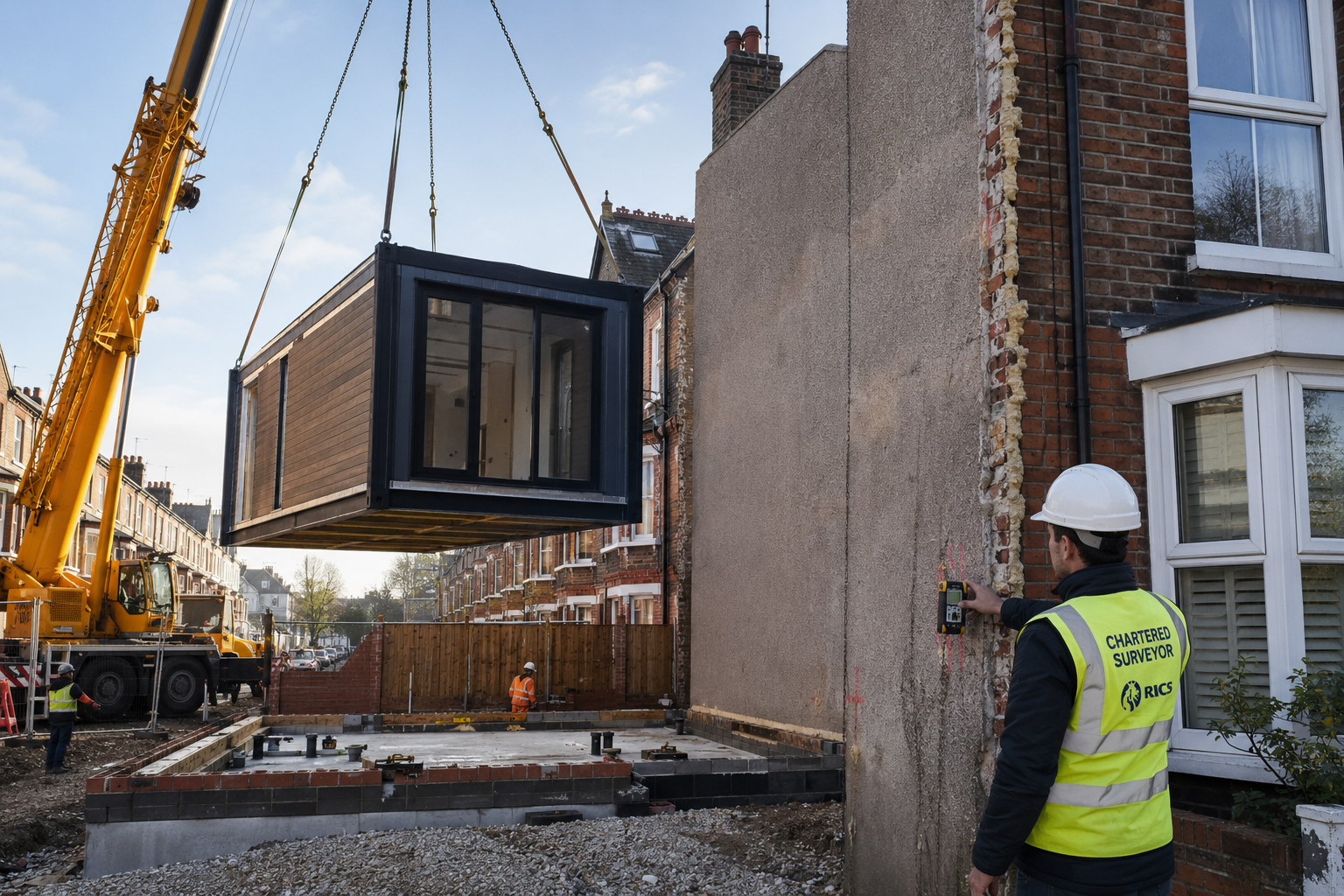
Modular and offsite construction is often marketed as a frictionless process: modules are manufactured in a controlled factory environment, delivered to site, and craned into position within days rather than months. That speed is the entire commercial proposition. However, the compressed on-site programme does not compress the statutory obligations that protect neighbouring property owners.
The Party Wall etc. Act 1996 defines a party wall as a wall that stands on the lands of two or more owners and forms part of a building, or a wall on one owner's land that is used by two or more owners to separate their buildings [1]. This definition catches a surprisingly wide range of situations in dense urban areas where modular schemes are increasingly being deployed — infill plots, rear-garden developments, and urban regeneration sites where the new structure sits immediately adjacent to an existing terrace or semi-detached property.
The core tension in modular builds is timing. A traditional masonry build unfolds over many months, giving surveyors and neighbours time to respond to notices within the statutory windows. A modular scheme may complete its above-ground structure in a matter of weeks. If the party wall process has not been initiated and concluded before the crane arrives on site, the entire delivery schedule can be halted by a neighbour's objection or, worse, a court injunction.
Three categories of work trigger the Act's requirements [1]:
| Trigger Category | Typical Modular Scenario |
|---|---|
| New building on or at the boundary | Modular unit placed on or adjacent to the boundary line |
| Work to an existing party wall or structure | Attaching new modular elements to a shared wall |
| Excavation near neighbouring foundations | Pile foundations or ground beams within 3-6 metres of adjoining buildings |
For a detailed overview of what the Act covers and how it affects property owners, the complete guide to party wall surveys provides a solid foundation before diving into the modular-specific complexities.
The Statutory Framework: What Has Not Changed in 2026
Despite rapid evolution in construction technology, the legislative framework governing party walls in England and Wales remains the Party Wall etc. Act 1996. No amendments specific to modular or offsite construction have been enacted. This means that all standard notice requirements, dispute resolution mechanisms, and surveyor appointment procedures apply in full [1].
Notice Periods That Can Derail a Modular Programme
The Act sets out two principal notice periods that developers must observe:
- Two months' notice is required before work begins on an existing party wall or party structure.
- One month's notice is required before new building at or on the boundary line, and before excavation works.
For a modular developer who has factory slots booked and a crane hire confirmed, discovering that the two-month notice clock has not yet started ticking is a serious commercial problem. The solution is straightforward but requires discipline: party wall notices must be served at the very outset of project planning, not as an afterthought once planning permission is granted.
Adjoining owners who receive a notice have 14 days to respond. If they do not respond, or if they dissent, a dispute is deemed to have arisen and surveyors must be appointed [1]. Understanding whether you need a party wall agreement at the earliest stage of a modular project prevents this scenario from catching developers off guard.
The Party Wall Award and Its Role in Modular Projects
When a dispute arises — or is deemed to have arisen — the appointed surveyor or surveyors produce a Party Wall Award. This is a legally binding document that sets out:
- The manner and timing of the notifiable works
- Hours of working (particularly relevant for crane operations)
- Access rights for inspection
- Security for expenses if required
- A schedule of condition of the adjoining property
For modular builds, the Award's working hours provisions are especially significant. A crane lift is a noisy, disruptive operation. Neighbours have legitimate interests in restricting these activities to reasonable hours. A well-drafted Award negotiated in advance gives the modular contractor certainty about the operational window for each lift.

Party Wall Surveys for Modular and Offsite Construction: 2026 Compliance in Accelerated UK Builds — Practical Steps
Achieving compliance in an accelerated modular programme requires a structured approach that integrates party wall obligations into the project programme from the outset. The following steps reflect best practice in 2026.
Step 1: Boundary and Adjacency Assessment at Feasibility Stage
Before any design work is commissioned, a boundary and adjacency assessment should identify every adjoining owner who may be affected by the proposed works. This includes owners of properties that share a party wall, owners of land adjoining the excavation zone, and — in some cases — owners of properties up to six metres away where deep excavations are planned [1].
A boundary survey at this stage provides the precise information needed to determine which notices must be served and to whom.
Step 2: Serve Notices at the Earliest Opportunity
Notices should be served as soon as the design is sufficiently advanced to describe the proposed works accurately. In practice, this means serving notices in parallel with the planning application process rather than waiting for planning consent to be granted. While there is a risk that the design may change, notices can be re-served if necessary — and the cost of doing so is far lower than the cost of a delayed crane hire.
The notice must be in writing and must include specific information about the proposed works [1]. For guidance on drafting compliant notices, the resource on how to write a party wall letter covers the legal requirements in detail.
Step 3: Appoint a Specialist Party Wall Surveyor
Not all surveyors have experience with modular and offsite construction. The unique characteristics of this build method — crane operations, temporary propping, vibration from pile driving, and the speed of above-ground assembly — require a surveyor who understands both the statutory framework and the practical realities of the construction process.
Understanding what a party wall surveyor does helps building owners ask the right questions when selecting a professional. Key questions for a modular-focused appointment include:
- Has the surveyor dealt with crane lift operations in party wall awards before?
- Can the surveyor produce a schedule of condition that accounts for pre-existing vibration sensitivity in the adjoining structure?
- Is the surveyor familiar with the temporary works implications of modular installation?
Step 4: Commission a Schedule of Condition Survey
A schedule of condition is a photographic and written record of the state of the adjoining property before works begin. It is the primary evidence used to determine whether any damage caused during construction was pre-existing or was caused by the notifiable works.
For modular builds, the schedule of condition is particularly important because:
- Crane operations can transmit vibration through the ground to adjoining structures.
- Pile driving or ground beam installation generates significant vibration and ground movement.
- Temporary propping of party walls during foundation work can cause differential settlement.
A thorough schedule of condition protects both the building owner and the adjoining owner. It is not a legal requirement under the Act, but it is standard professional practice and is almost always included in a Party Wall Award for works of any significance.
Step 5: Maintain Communication Throughout the Build
Even with a Party Wall Award in place, ongoing communication with adjoining owners reduces the risk of disputes escalating during the build. For modular projects, this means notifying neighbours in advance of crane lift days, confirming working hours, and providing a direct contact for any concerns.
Cost and Programme Implications for Modular Developers
One of the persistent misconceptions about party wall compliance is that it is a minor administrative overhead. For modular developers operating on tight margins and compressed programmes, the financial and programme implications of getting it wrong are substantial.
Costs to budget for:
- Party wall surveyor fees (building owner's surveyor and, if applicable, adjoining owner's surveyor)
- Schedule of condition survey costs
- Potential security for expenses if required by the Award
- Legal costs if an injunction is sought by a non-compliant neighbour
The question of who pays for a party wall surveyor is a common source of confusion. As a general rule, the building owner bears the cost of the process, including the reasonable fees of an adjoining owner's surveyor if one is appointed. For modular projects with multiple adjoining owners, these costs can accumulate quickly.
Programme implications:
| Risk Event | Potential Programme Impact |
|---|---|
| Notice not served — injunction obtained | 4-12 weeks delay |
| Dispute deemed to arise — surveyors appointed | 4-8 weeks to Award |
| Damage claim post-completion — no schedule of condition | Months of dispute resolution |
| Award challenged in County Court | 6-18 months |
Building these contingencies into the programme from the outset is far less expensive than encountering them mid-build.
Party Wall Surveys for Modular and Offsite Construction: 2026 Compliance in Accelerated UK Builds — Addressing Common Disputes
The most frequent disputes in modular and offsite construction contexts arise from three sources: vibration damage claims, access disputes, and working hours conflicts.
Vibration Damage Claims
Modular builds often require driven or bored pile foundations, which generate ground vibration. Adjoining owners may claim that this vibration caused cracking to their property. Without a pre-works schedule of condition, it is extremely difficult to establish whether cracks were pre-existing. The party wall dispute resolution process provides a structured mechanism for resolving these claims, but the process is far smoother when good records exist.
Access Disputes
The Act grants building owners a right of access to adjoining land for the purpose of executing notifiable works, subject to giving 14 days' notice [1]. In practice, modular builds may require temporary scaffold or hoarding on adjoining land during crane operations. This access right must be clearly set out in the Party Wall Award to avoid confrontation on the day of the lift.
Working Hours Conflicts
Crane hire is expensive and is typically booked for specific days. If an adjoining owner objects to early-morning or weekend crane operations after the Award has been made, the building owner has a strong position — provided the Award clearly specifies the permitted working hours. This underscores the importance of a well-drafted Award that anticipates the specific operational requirements of a modular build.

Digital Tools and 2026 Practice
In 2026, the practical delivery of party wall notices and awards has evolved considerably. Many surveyors now serve notices by email, with electronic signatures accepted in practice by the majority of adjoining owners and their advisers. However, the statutory requirement for written notice remains, and building owners should ensure that electronic service is documented and acknowledged.
Digital schedules of condition — using high-resolution photography, video walkthroughs, and in some cases drone footage of accessible roof areas — provide a far richer evidential record than traditional paper-based reports. For modular builds adjacent to older properties, this level of documentation is strongly advisable.
Building information modelling (BIM) data from the modular manufacturer can also be shared with the party wall surveyor to provide precise information about module placement, crane radii, and temporary load paths. This level of detail supports the drafting of a more precise and enforceable Party Wall Award.
Conclusion
Party Wall Surveys for Modular and Offsite Construction: 2026 Compliance in Accelerated UK Builds demands a proactive, programme-integrated approach that treats statutory obligations as a core project deliverable rather than a regulatory afterthought. The Party Wall etc. Act 1996 applies fully to all modular and offsite methods, and the speed advantages of prefabricated construction are quickly eroded by neighbour disputes, injunctions, or damage claims that could have been prevented by early and competent party wall management [1].
Actionable next steps for developers and building owners:
- Appoint a specialist party wall surveyor at feasibility stage — before factory slots are booked or crane hire is confirmed.
- Serve party wall notices in parallel with the planning application, not after consent is granted.
- Commission a thorough schedule of condition survey of all adjoining properties before any ground works begin.
- Ensure the Party Wall Award specifically addresses crane lift hours, access requirements, and vibration monitoring if pile foundations are involved.
- Maintain open communication with adjoining owners throughout the build programme.
- Budget for party wall costs — including potentially the adjoining owner's surveyor fees — from the outset of the financial appraisal.
For any modular or offsite project in England or Wales where shared boundaries or excavations are involved, professional party wall advice is not optional. The cost of getting it right is a fraction of the cost of getting it wrong.
References
[1] Party Wall Etc Act 1996 Guidance – https://www.gov.uk/party-wall-etc-act-1996-guidance.?utm_source=openai
