
Buying a property in 2026 feels like navigating a complex maze where one wrong turn can cost thousands of pounds and weeks of delays. The moment your offer is accepted, the clock starts ticking—but what many buyers don't realize is that the building survey sitting in the middle of this timeline holds extraordinary power over whether you'll get the keys on schedule or face costly renegotiations and completion delays.
Understanding from offer to completion: how a building survey can make or break your 2026 purchase timeline isn't just about scheduling an inspection—it's about recognizing how survey findings interact with mortgage lenders, solicitors, and sellers to either smooth your path forward or create unexpected roadblocks. With new regulatory changes taking effect in 2026, including updates to RICS standards and heightened building safety requirements, the surveyor's role has become more critical than ever.
Key Takeaways
- Building surveys directly impact your completion date through their influence on mortgage approvals, price renegotiations, and legal proceedings—delays at the survey stage cascade through the entire transaction.
- 2026 regulatory changes including RICS Home Survey Standard updates and Building Safety Act requirements mean surveys now involve more thorough assessments and potentially longer reporting times[1].
- Survey findings trigger three possible outcomes: smooth progression to completion, price renegotiation that extends timelines by 2-4 weeks, or deal collapse requiring you to start the entire process again.
- Booking your survey within 48-72 hours of offer acceptance and choosing the right survey level for your property type are the two most powerful actions to protect your timeline.
- Proactive communication between your surveyor, solicitor, and mortgage broker can identify and resolve potential issues before they derail your completion date.
The Modern UK Property Purchase Timeline in 2026
What Happens Between Offer Acceptance and Completion?
The journey from accepted offer to holding the keys typically spans 8-16 weeks in the UK property market, though this timeline can stretch considerably when complications arise. Here's what the standard process looks like:
Week 0-1: Immediate Post-Offer Actions
- Offer accepted and memorandum of sale issued
- Instruct solicitor/conveyancer
- Arrange mortgage application (if needed)
- Book building survey 📋
Week 1-3: Survey and Valuation Phase
- Lender arranges basic valuation
- Building survey conducted (Level 2 or Level 3)
- Survey report delivered
- Review findings and decide on next steps
Week 3-6: Legal Work and Due Diligence
- Solicitors exchange contracts and conduct searches
- Review survey report with legal team
- Potential price renegotiations based on survey findings
- Mortgage offer finalized (subject to satisfactory survey)
Week 6-12: Pre-Completion
- Final negotiations and amendments
- Additional specialist surveys if required
- Insurance arrangements
- Final mortgage approval
Week 12+: Exchange and Completion
- Exchange of contracts (legally binding)
- Completion date set
- Final checks and fund transfers
- Keys handed over 🔑
This timeline assumes everything proceeds smoothly—but in reality, the building survey often introduces critical decision points that can accelerate or significantly delay the process.
How 2026 Regulatory Changes Affect Transaction Timelines
The surveying landscape has evolved considerably in 2026, with several regulatory developments directly impacting purchase timelines. RICS is actively updating its Home Survey Standard with reviews focused on maintaining consistency and improving reporting clarity[1]. These updates may introduce new procedural steps that extend the time between survey completion and report delivery.
Additionally, survey capacity constraints are emerging due to increased regulatory demand across the housing sector. Housing associations and councils must expand inspection capacity to meet regulatory response times, which can delay survey appointments for individual property transactions[1]. Buyers in 2026 should expect potential scheduling delays of 1-2 weeks beyond pre-pandemic norms, particularly in high-demand areas.
The Building Safety Act enforcement continues to reshape survey roles and responsibilities, with duty-holder accountability requirements sometimes extending approval stages beyond expected timelines[1]. For properties classified as higher-risk buildings (18 meters or taller, 7+ storeys, with 2+ residential units), additional survey documentation and certification may be required before purchase completion can proceed[4].
Understanding Building Surveys and Their Critical Role
Types of Building Surveys Available in 2026
Choosing the right survey level is the first decision that influences your timeline. The three main options each serve different purposes:
| Survey Type | Best For | Timeline Impact | Typical Cost Range |
|---|---|---|---|
| RICS Level 1 (Condition Report) | New-build properties, modern homes in good condition | Fastest (3-5 days) | £300-£500 |
| RICS Level 2 (HomeBuyer Report) | Conventional properties in reasonable condition, built post-1900 | Moderate (5-7 days) | £400-£800 |
| RICS Level 3 (Building Survey) | Older properties, unusual construction, properties requiring renovation | Longer (7-14 days) | £600-£1,500+ |
For most buyers, understanding Level 2 vs Level 3 survey key differences is essential to making an informed choice. Level 3 building surveys now provide far more thorough examinations of properties, reflecting heightened professional standards in 2026[3].
The survey you choose directly affects your timeline in two ways: the time required for the surveyor to complete the inspection and produce the report, and the likelihood of discovering issues that require further investigation or renegotiation.
What Surveyors Examine and Why It Matters
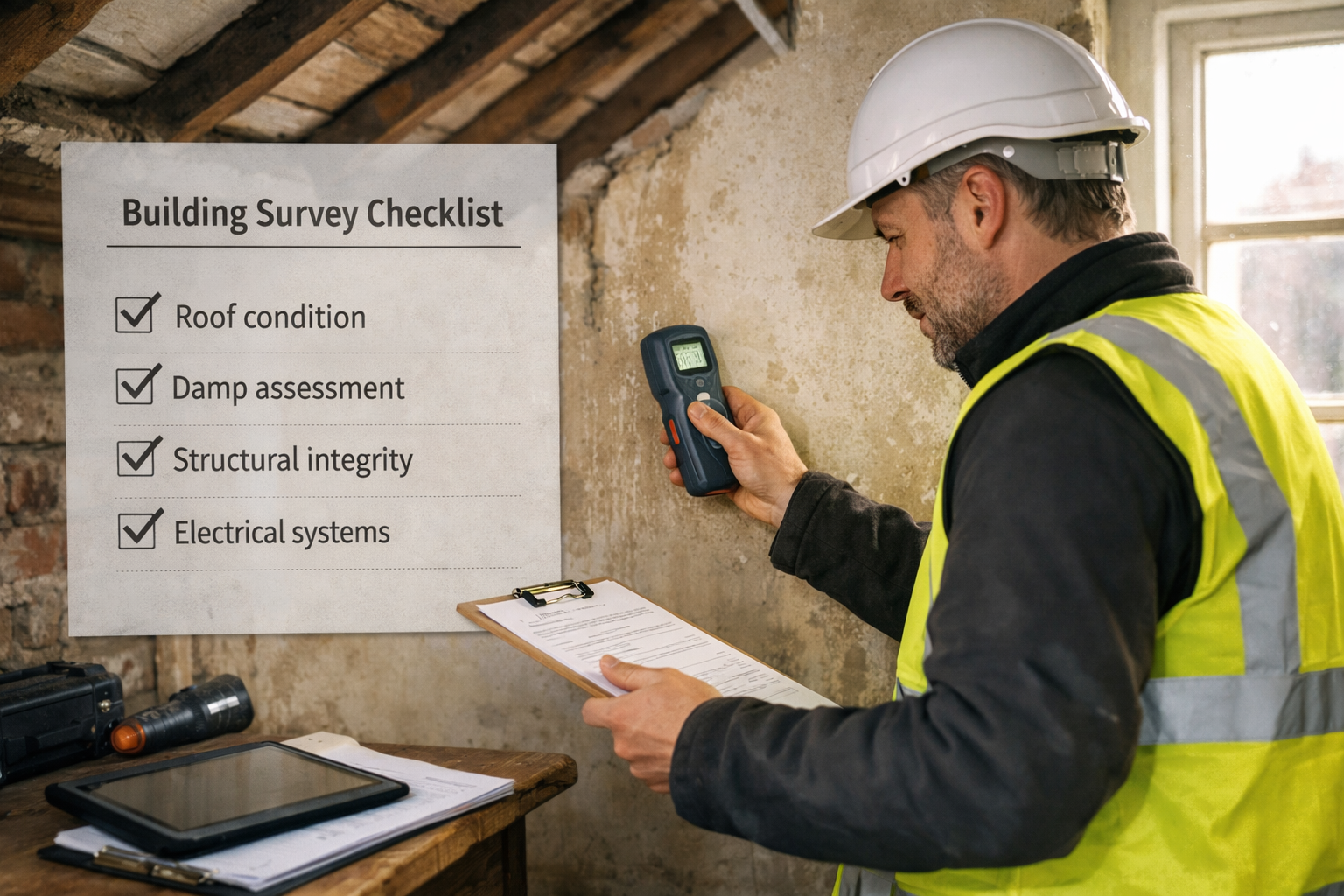
A comprehensive building survey examines every accessible part of the property, from foundations to roof space. Surveyors assess:
- Structural integrity: walls, floors, ceilings, roof structure
- Damp and moisture issues: using specialist equipment to detect hidden problems
- Roofing condition: tiles, flashing, guttering, chimneys
- Windows and doors: condition, operation, security
- Services: visible aspects of electrical, plumbing, heating systems
- Drainage: external inspection of drains and waste systems
- External elements: walls, paths, boundaries, outbuildings
For buyers wondering what surveyors look for in a house survey, the answer is comprehensive: anything that could affect the property's value, safety, or future maintenance costs.
In 2026, surveyors must also assess mandatory fire safety strategies for multi-occupancy residential buildings, which can add time to survey completion[3]. For higher-risk buildings, Building Safety Regulator oversight requirements may necessitate additional documentation.
How Survey Findings Influence Mortgage Approvals
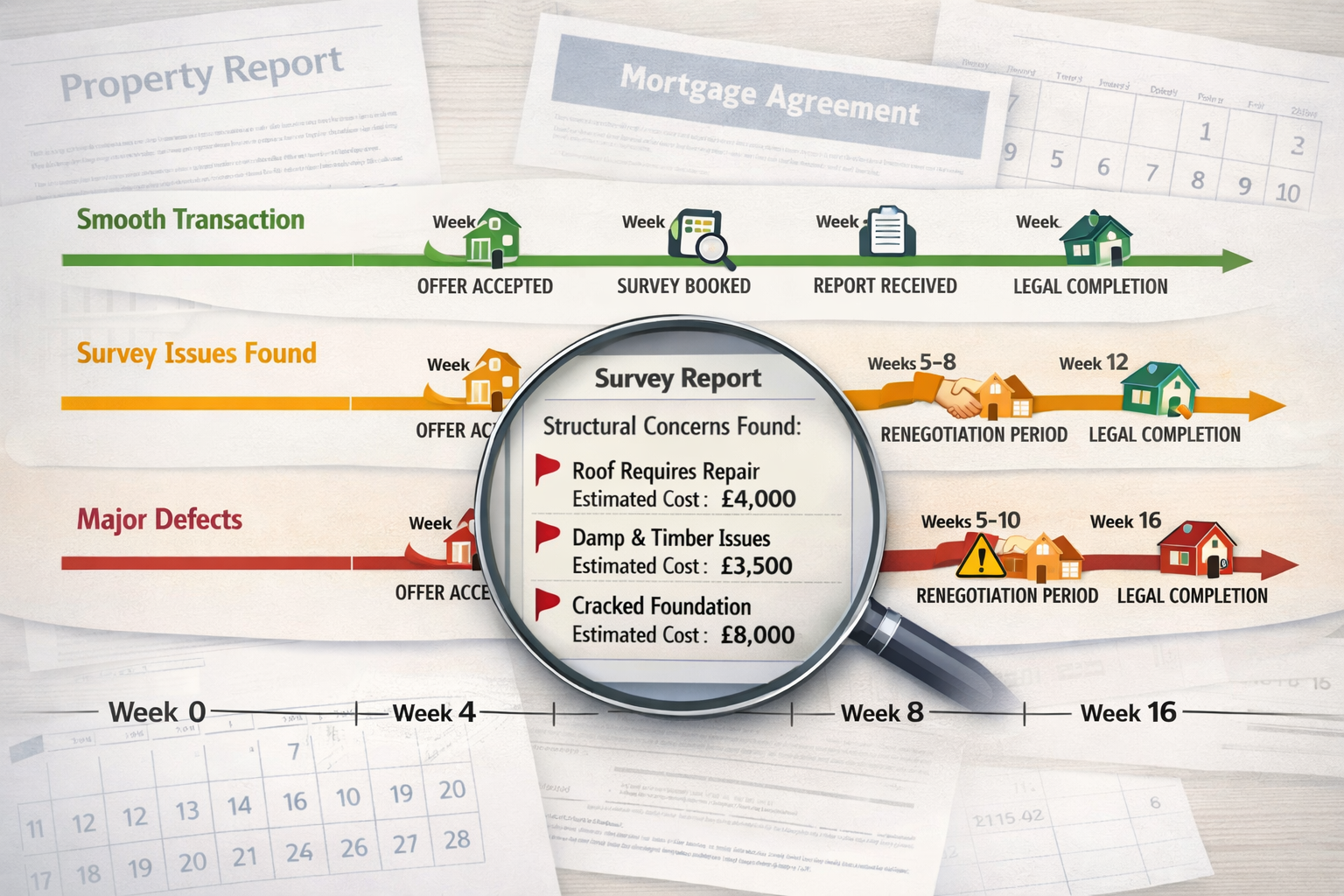
Here's where the survey's impact on your timeline becomes critical: mortgage lenders rely heavily on survey findings to determine whether they'll release funds. Three scenarios commonly emerge:
Scenario 1: Clean Survey ✅
- No significant issues identified
- Lender proceeds with mortgage offer
- Timeline remains on track
- Completion proceeds as planned
Scenario 2: Issues Requiring Attention ⚠️
- Survey identifies problems (damp, structural concerns, roof repairs needed)
- Lender may require specialist reports or retention (holding back funds until repairs completed)
- Buyer negotiates price reduction or repair commitment
- Timeline extends by 2-4 weeks for renegotiation and additional assessments
Scenario 3: Major Defects 🚨
- Serious structural issues, subsidence, or safety concerns identified
- Lender refuses mortgage or requires extensive remedial work before approval
- Buyer faces decision: proceed with cash, renegotiate significantly, or withdraw
- Timeline severely impacted (4-8+ weeks) or transaction collapses
Understanding why hiring a residential surveyor could save you thousands becomes clear when you consider these scenarios—the survey isn't just an inspection; it's a critical risk assessment that protects both you and your lender.
From Offer to Completion: How Survey Timing Impacts Your Transaction
The Optimal Survey Booking Strategy
Timing is everything when it comes to protecting your purchase timeline. The most successful transactions follow this pattern:
Day 0-2 After Offer Acceptance:
- Immediately instruct your solicitor
- Book building survey within 48-72 hours
- Confirm surveyor availability and report delivery timeline
- Notify your mortgage broker of survey date
This aggressive timeline ensures the survey happens during Week 1-2, giving you maximum flexibility to respond to findings before legal work progresses too far. Delays in booking the survey create a domino effect: later survey means later report, later mortgage decision, later exchange, later completion.
For those experiencing house survey anxiety, remember that early action provides more time to address any issues discovered and reduces the pressure on all parties involved.
Understanding Survey Report Delivery Times
Survey report delivery times vary based on survey type and surveyor workload. In 2026, expect:
- Level 1 reports: 3-5 working days after inspection
- Level 2 reports: 5-7 working days after inspection
- Level 3 reports: 7-14 working days after inspection
However, capacity constraints in the surveying profession mean these timelines can extend during busy periods[1]. When booking your survey, explicitly confirm:
- Inspection date
- Expected report delivery date
- Format (digital/printed)
- Whether preliminary findings can be shared by phone
Some surveyors offer expedited services for an additional fee—worth considering if you're working to a tight completion deadline.
How Survey Findings Trigger Renegotiation
When the survey report arrives, you enter a critical decision window. Survey findings typically fall into three categories:
Category 1: Cosmetic/Minor Issues
- Decorative repairs, minor maintenance
- Action: Proceed without renegotiation
- Timeline impact: None
Category 2: Significant but Repairable Issues
- Damp problems, roof repairs, rewiring needed
- Action: Request price reduction or seller remediation
- Timeline impact: 2-4 weeks for negotiation and agreement
Category 3: Structural/Major Defects
- Subsidence, serious structural movement, major safety issues
- Action: Substantial renegotiation or withdrawal
- Timeline impact: 4-8+ weeks or transaction collapse
The renegotiation process itself follows a pattern:
- Review report with surveyor (1-2 days): Understand severity and estimated repair costs
- Consult with solicitor (1-2 days): Determine legal position and negotiation strategy
- Obtain specialist quotes (3-7 days): Get accurate repair cost estimates
- Submit renegotiation request (1 day): Formal request to seller
- Seller consideration and response (3-10 days): Seller reviews and responds
- Counter-negotiation (variable): May involve multiple rounds
- Agreement or withdrawal (1-2 days): Final decision
This process easily adds 2-4 weeks to your timeline even with cooperative parties. Understanding how long house surveys take helps you build realistic expectations into your purchase plan.
Coordinating Survey Results with Conveyancing
Your solicitor needs the survey report to complete their due diligence effectively. Smart coordination involves:
Immediate sharing: Send your survey report to your solicitor as soon as received—don't wait to review it yourself first. Parallel processing saves time.
Flagging concerns: Highlight any issues that might affect legal searches or require specific contractual protections.
Alignment with searches: Survey findings should be cross-referenced with local authority searches, environmental reports, and other due diligence documents.
Mortgage conditions: Ensure your solicitor understands any conditions the lender has imposed based on the survey (retention, required repairs, etc.).
For properties requiring structural surveys, the coordination becomes even more critical as structural engineers may need to visit the property and provide additional reports before legal work can conclude.
Protecting Your Timeline: Proactive Strategies

Pre-Survey Preparation to Avoid Delays
Taking proactive steps before the survey can prevent timeline disruptions:
1. Request seller disclosure: Ask sellers to provide information about known issues, previous repairs, and maintenance history before the survey. This helps your surveyor focus on key areas.
2. Ensure property access: Confirm the seller will provide full access to all areas including loft spaces, basements, and outbuildings. Access restrictions delay surveys and may require rescheduling.
3. Arrange simultaneous lender valuation: Where possible, coordinate your building survey with the lender's valuation to avoid duplicate visits and delays.
4. Pre-book specialist surveyors: If you suspect specific issues (damp, subsidence, timber defects), have specialist surveyors on standby to conduct follow-up inspections immediately if needed.
5. Establish communication protocols: Create a group chat or email chain with your solicitor, mortgage broker, and surveyor to ensure rapid information sharing.
What to Do When Survey Results Threaten Your Timeline
When survey findings threaten to derail your completion date, swift action is essential:
Immediate Response (Day 1):
- Schedule call with surveyor to understand findings in detail
- Obtain estimated repair costs for identified issues
- Notify your solicitor and mortgage broker immediately
- Request seller's disclosure of any knowledge about identified issues
Short-Term Actions (Days 2-5):
- Obtain specialist quotes for major repairs
- Consult with your mortgage broker about lender's likely response
- Develop negotiation strategy with solicitor
- Consider whether to request price reduction, seller repairs, or retention
Medium-Term Strategy (Week 2+):
- Submit formal renegotiation request with supporting evidence
- Maintain open communication with seller's agent
- Prepare contingency plans if negotiation fails
- Keep lender informed of progress
For comprehensive guidance, review our complete guide to Level 3 building surveys which covers how to interpret findings and respond strategically.
Working with Lenders When Survey Issues Arise
Mortgage lenders have specific protocols when surveys reveal problems. Understanding these helps you navigate the process efficiently:
Minor Issues: Lenders typically proceed with the mortgage offer unchanged, noting issues for information only.
Moderate Issues: Lenders may:
- Request specialist reports (damp survey, structural engineer assessment)
- Impose retention (holding back 10-15% of funds until repairs completed)
- Reduce the loan-to-value ratio offered
- Require evidence of repair quotations
Major Issues: Lenders may:
- Decline the mortgage application
- Require repairs before completion
- Significantly reduce property valuation
- Request indemnity insurance for specific risks
Your response strategy:
- Obtain specialist reports quickly: Don't wait for the lender to request them—commission immediately when survey flags concerns
- Provide comprehensive documentation: Give lenders detailed repair quotes, specialist assessments, and proposed solutions
- Negotiate retention release terms: If retention is imposed, agree clear terms for release after completion
- Consider alternative lenders: Some lenders are more flexible with certain property types or issues
For properties with specific concerns, specialized assessments like damp surveys can provide the detailed information lenders need to make informed decisions.
Building Contingency Time into Your Purchase Plan
Experienced buyers build buffer time into their purchase timeline to accommodate survey-related delays:
Realistic Timeline Planning:
- Add 2-4 weeks to standard timelines if buying older properties
- Build in 4-6 weeks extra for properties with known issues or unusual construction
- Avoid setting immovable completion dates until survey results are known
Contractual Protection:
- Negotiate flexible completion dates in initial offer
- Include survey-contingent clauses where possible
- Avoid committing to onward purchases until survey cleared
Financial Buffers:
- Maintain access to additional funds for unexpected repairs
- Arrange bridging finance options if completion delays threaten chain
- Budget for potential specialist survey costs
Expert Insight: "In 2026, the most successful transactions are those where buyers treat the survey as a critical milestone rather than a formality. Building 3-4 weeks of contingency time specifically for survey-related issues has become standard practice for experienced buyers." – Senior Chartered Surveyor
Special Considerations for 2026 Property Purchases
New Build Properties and Snagging Surveys
New build properties require a different approach to surveys and timeline management. While many buyers assume new builds don't need surveys, snagging surveys have become essential in 2026 to identify construction defects before completion.
The new build timeline differs significantly:
Pre-Completion Stage:
- Professional snagging survey 2-3 weeks before completion
- Developer remediation period (1-4 weeks)
- Re-inspection to confirm fixes
- NHBC/warranty documentation review
Understanding snagging survey costs helps budget appropriately for this additional step. New build timelines are often more compressed, making early survey booking even more critical.
Higher-Risk Buildings and Additional Requirements
Properties classified as higher-risk buildings under the Building Safety Act face additional scrutiny in 2026. Buildings 18 meters or taller with 7+ storeys and 2+ residential units remain subject to strict Building Safety Regulator oversight[4].
Additional timeline considerations include:
- Building Safety Certificate verification: Solicitors must confirm valid certificates exist
- Fire safety documentation: Comprehensive fire safety strategies must be reviewed[3]
- Duty-holder information: Accountability chain must be established and documented
- Additional survey time: Surveyors need extra time to assess safety compliance
These requirements can add 2-4 weeks to standard timelines, particularly for the first transactions in buildings newly subject to regulations.
Period Properties and Listed Buildings
Older properties and listed buildings require specialist survey approaches that impact timelines:
Extended Survey Times:
- Listed buildings may require conservation-accredited surveyors
- Period properties need more thorough examination of traditional construction methods
- Additional specialist surveys often needed (timber, damp, structural)
Regulatory Considerations:
- Listed building consent requirements affect potential repairs
- Conservation area restrictions may limit remediation options
- Local authority involvement extends negotiation periods
For comprehensive coverage of older property surveys, consult our essential guide for property buyers which addresses period property-specific concerns.
Real-World Timeline Scenarios
Case Study: Smooth Transaction with Early Survey
Property: Victorian terrace, £650,000, London
Timeline: 10 weeks offer to completion
- Week 0: Offer accepted Friday, survey booked Monday
- Week 1: Level 3 survey conducted Wednesday
- Week 2: Report received Monday, minor issues only (£3,000 estimated repairs)
- Week 2: Report shared with solicitor and lender same day
- Week 3: Mortgage offer issued with no conditions
- Week 4-8: Standard conveyancing proceeds smoothly
- Week 9: Exchange of contracts
- Week 10: Completion
Key success factors: Immediate survey booking, appropriate survey level chosen, proactive communication, no significant issues discovered.
Case Study: Delayed Transaction Due to Survey Findings
Property: 1930s semi-detached, £425,000, Surrey
Timeline: 18 weeks offer to completion (8 weeks over standard)
- Week 0-1: Offer accepted, survey booked after 10-day delay
- Week 3: Level 2 survey conducted
- Week 4: Report received revealing damp issues and roof concerns
- Week 5: Specialist damp survey commissioned
- Week 6: Damp report received, estimated repairs £12,000
- Week 7: Renegotiation begins, requesting £15,000 reduction
- Week 8-9: Seller rejects, counter-offers £7,500 reduction
- Week 10: Agreement reached at £10,000 reduction
- Week 11: Revised mortgage application submitted
- Week 13: New mortgage offer received with retention clause
- Week 14-17: Conveyancing continues with amended terms
- Week 18: Completion with £5,000 retention pending damp repairs
Key delay factors: Late survey booking, unexpected issues, extended renegotiation, mortgage reapplication, retention requirements.
Case Study: Transaction Collapse and Restart
Property: 1960s flat, £380,000, Buckinghamshire
Timeline: 8 weeks to collapse, 14 weeks with new property
- Week 0-2: Offer accepted, Level 2 survey booked and conducted
- Week 3: Report reveals potential structural movement
- Week 4: Structural engineer commissioned for specialist assessment
- Week 6: Engineer's report confirms progressive subsidence, estimated repairs £45,000+
- Week 7: Lender withdraws mortgage offer
- Week 8: Buyer withdraws from purchase
- New search begins: Different property identified
- Week 1-14 (new property): Standard transaction with clean survey
Key lessons: Specialist surveys sometimes reveal deal-breaking issues, early discovery prevents wasted legal costs, survey protects buyer from catastrophic purchase.
For buyers working with chartered surveyors in Buckinghamshire or other regions, local expertise can help identify area-specific issues before they derail transactions.
Conclusion: Taking Control of Your 2026 Purchase Timeline
Understanding from offer to completion: how a building survey can make or break your 2026 purchase timeline empowers you to navigate one of life's most significant financial transactions with confidence and control. The survey isn't merely a procedural step—it's the critical checkpoint that determines whether your purchase proceeds smoothly, requires renegotiation, or should be abandoned entirely.
The evidence is clear: early survey booking, choosing the appropriate survey level, and proactive communication are the three pillars that protect your timeline. With 2026's regulatory landscape introducing new requirements and potential capacity constraints, these strategies become even more essential.
Your Action Plan for Timeline Protection
Before Making an Offer:
- Research appropriate survey levels for your target property type
- Identify qualified surveyors and check availability
- Budget for survey costs and potential specialist reports
- Build 3-4 weeks contingency into your ideal completion timeline
Within 48 Hours of Offer Acceptance:
- Instruct solicitor immediately
- Book building survey with confirmed report delivery date
- Notify mortgage broker of survey timing
- Request seller disclosure of known issues
When Survey Report Arrives:
- Review with surveyor by phone for immediate clarification
- Share with solicitor and lender same day
- Obtain specialist quotes for any significant issues within 48 hours
- Make renegotiation decisions within 5 working days
Throughout the Process:
- Maintain active communication with all parties
- Address issues immediately rather than waiting
- Keep detailed records of all survey-related communications
- Stay flexible on completion dates until survey cleared
Getting Professional Support
The complexity of modern property transactions demands professional expertise. Whether you need a comprehensive RICS building survey, specialist assessment, or expert guidance on survey findings, working with qualified chartered surveyors protects both your timeline and your investment.
Don't let survey delays or unexpected findings derail your property purchase. Take control of your timeline today by booking your building survey early, choosing the right survey level, and maintaining proactive communication throughout the process. Your future home—and your peace of mind—depend on it.
References
[1] Surveying Regulations In 2026 What Uk Employers And Surveyors Need To Know About Compliance Skills And Hiring Trends – https://www.jarsolutions.co.uk/blog/2026/02/surveying-regulations-in-2026-what-uk-employers-and-surveyors-need-to-know-about-compliance-skills-and-hiring-trends
[2] January 2026 Welcome To Our New Building Safety Newsletter – https://assets.publishing.service.gov.uk/media/696f638c5b6060ca6736a085/January_2026_-_Welcome_to_our_new_Building_Safety_Newsletter.pdf
[3] Things About Building Surveying You Need To Know In 2026 – https://mcessex.co.uk/2026/01/23/things-about-building-surveying-you-need-to-know-in-2026/
[4] Uk Construction 2026 What Are The Policy Shifts And Developments You Need To Know – https://gowlingwlg.com/en/insights-resources/articles/2026/uk-construction-2026-what-are-the-policy-shifts-and-developments-you-need-to-know
