
Scotland's construction sector presents a unique landscape in 2026, where price stability contrasts sharply with the volatility experienced south of the border. This market firmness has created a heightened environment for construction defect litigation, as property owners and developers seek to protect substantial investments in an otherwise stable market. When disputes arise, the role of the expert witness becomes paramount, particularly for chartered surveyors navigating Scotland's devolved regulatory framework and recently updated RICS professional standards.
Expert Witness Preparation for Construction Defect Claims in Scotland: RICS Guidance Amid 2026 Stable Market Conditions requires a thorough understanding of both technical building pathology and the stringent professional obligations that govern expert testimony. The RICS consultation process completed in late 2025 has resulted in enhanced standards that directly impact how surveyors prepare, document, and present evidence in Scottish construction defect cases.[2][3]

Key Takeaways
- 🏴 Scotland's stable 2026 property market increases the financial stakes in construction defect claims, making expert witness preparation more critical than ever
- 📋 Updated RICS professional standards (consultation closed October 2025) introduce strengthened requirements for conflicts of interest, full evidence disclosure, and ongoing duty declarations
- ⚖️ Scottish devolved regulations require expert witnesses to navigate distinct legal frameworks, building standards, and court procedures that differ from English practice
- 🔍 Impartiality and integrity remain paramount, with professional consequences including cost awards and misconduct charges for improper conduct
- 📊 Complete evidence disclosure before report exchange is now emphasized as professional best practice, eliminating tactical withholding of information
Understanding the Scottish Construction Defect Landscape in 2026
Market Stability Creates Litigation Pressure
Scotland's construction market has demonstrated remarkable resilience throughout 2026, with property prices maintaining stability even as other UK regions experience fluctuations. This price firmness means that construction defects represent a more significant proportion of property value, incentivizing owners to pursue claims rather than absorb losses. The stable market conditions also mean that comparable evidence for valuation purposes is more readily available and reliable, strengthening the evidentiary basis for defect claims.
The Scottish housing stock continues to face challenges related to both historic construction methods and modern building failures. From traditional stone tenements in Edinburgh and Glasgow to contemporary timber-frame developments across the Highlands, defects span the full spectrum of building types and ages. Common issues include:
- Water ingress and dampness problems
- Structural movement and settlement
- Render and external wall system failures
- Roof defects and weatherproofing issues
- Timber decay and insect infestation
- Modern methods of construction (MMC) failures
Devolved Regulatory Framework
Scotland's devolved building standards system creates a distinct regulatory environment that expert witnesses must navigate competently. The Scottish Building Standards, administered through local authority building standards departments, differ substantively from English Building Regulations. Expert witnesses must demonstrate familiarity with:
- Technical Handbooks (Domestic and Non-Domestic)
- Scottish building warrant and completion certificate processes
- Historic Scottish building practices and traditional materials
- Climate-specific performance requirements for Scottish conditions
The Scottish court system also operates independently, with construction defect claims typically proceeding through the Sheriff Courts or Court of Session depending on claim value and complexity. Expert witnesses must understand Scottish civil procedure rules and the specific expectations of Scottish judges regarding expert evidence.
RICS Professional Standards for Expert Witness Preparation in Scotland
Updated Guidance Following 2025 Consultation
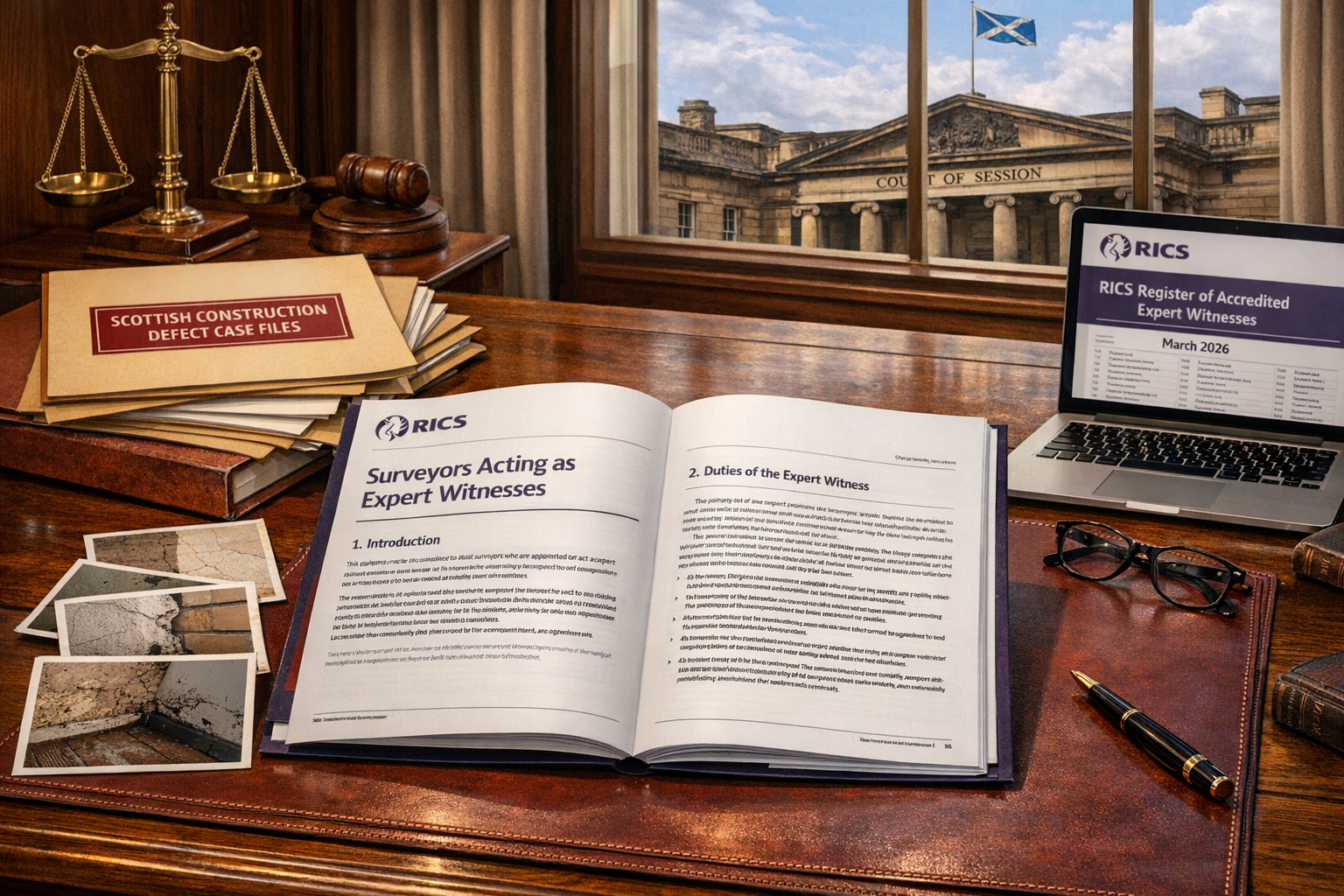
The RICS professional standard "Surveyors acting as Expert Witnesses" underwent significant revision in 2025, with a consultation period running from late August through October 7, 2025.[2][3] This updated standard applies to all RICS members instructed to act as expert witnesses across various settings, including construction defect claims in Scotland.
The revised standard addresses several critical areas that directly impact Expert Witness Preparation for Construction Defect Claims in Scotland: RICS Guidance Amid 2026 Stable Market Conditions:
Conflicts of Interest: Enhanced scrutiny of potential conflicts, including previous relationships with parties, financial interests in outcomes, and repeat appointments that might compromise impartiality. The April 2025 RICS practice alert specifically warned members about risks when accepting repeated appointments in housing disrepair cases, noting that such patterns can affect perceived witness impartiality.[2]
Terms of Engagement: Clear documentation requirements for expert witness appointments, including scope of work, fee arrangements, and acknowledgment of duties to the court that override duties to the instructing party.
Fee Structures: Specific guidance on acceptable fee arrangements, with heightened attention to conditional fee arrangements and their potential to compromise independence. The updated standard emphasizes that expert witness fees must not be contingent on case outcomes.[3]
Written Expert Reports: Detailed requirements for report structure, content, and declarations, ensuring reports meet both RICS professional standards and Scottish court expectations.
For those seeking comprehensive guidance on preparing expert reports, our expert witness report services provide detailed templates and support aligned with current RICS standards.
Core Principles of Expert Witness Practice
The updated RICS guidance reinforces fundamental principles that underpin credible expert witness testimony:
🎯 Impartiality: The expert's primary duty is to the court, not to the instructing party. This principle requires witnesses to present balanced, objective analysis regardless of which party engaged their services.
📚 Competence: Experts must work strictly within their areas of genuine expertise. The updated standard strengthens requirements for demonstrating qualifications, experience, and continuing professional development relevant to the specific defect issues in question.
🔍 Integrity: Professional honesty in all aspects of evidence preparation and presentation. The standard explicitly states that withholding evidence as a tactical approach "is regarded as unprofessional."[2]
⚖️ Independence: Freedom from conflicts of interest and undue influence. Experts must disclose any circumstances that might reasonably be perceived to affect their independence.
These principles align with Scottish legal expectations for expert evidence and form the foundation for effective expert witness practice in construction defect claims.
Full Evidence Disclosure Requirements
One of the most significant developments in the updated RICS guidance concerns evidence disclosure. The new standard emphasizes that expert witnesses should provide complete evidence to both the instructing client and the opposing party before expert reports are formally exchanged.[2]
This requirement represents a shift from previous practice where some experts might strategically withhold certain evidence. The updated guidance makes clear that such tactical approaches are unprofessional and inconsistent with the expert's duty to the court. For construction defect claims in Scotland, this means:
- All inspection findings must be fully documented and disclosed
- Photographic evidence should be comprehensive, not selective
- Technical test results must be provided in full
- Calculations and analysis must show complete working
- Any evidence that contradicts the expert's opinion must be acknowledged
This transparency requirement enhances the credibility of expert evidence and facilitates more efficient dispute resolution, as parties have access to the complete factual picture before trial.
Preparing Construction Defect Evidence Under Scottish Conditions
Initial Instruction and Conflict Checks
Proper Expert Witness Preparation for Construction Defect Claims in Scotland: RICS Guidance Amid 2026 Stable Market Conditions begins with the initial instruction. Before accepting an appointment, chartered surveyors must conduct thorough conflict checks to identify any circumstances that might compromise independence or create perceived bias.
Key considerations include:
- Previous professional relationships with parties or their advisors
- Prior involvement with the property or development in question
- Financial interests in similar properties or developments
- Repeat appointments from the same instructing party
- Personal relationships with individuals involved in the dispute
The RICS guidance requires these conflicts to be identified early and disclosed transparently. In some cases, potential conflicts may be manageable through appropriate safeguards; in others, the surveyor should decline the instruction.
Terms of Engagement Documentation
Once conflicts are cleared, the expert witness should establish clear terms of engagement in writing. This documentation should specify:
- Scope of work: Precise definition of what the expert is instructed to investigate and opine upon
- Fee structure: Hourly rates, fixed fees, or other arrangements, with confirmation that fees are not conditional on outcomes
- Timeline: Expected timeframes for inspections, report delivery, and potential court attendance
- Duties acknowledgment: Clear statement that the expert's primary duty is to the court
- Limitation of liability: Appropriate professional indemnity insurance coverage
These terms protect both the expert and the instructing party by establishing clear expectations from the outset.
Site Inspection and Evidence Gathering
The foundation of credible expert evidence is thorough site inspection and meticulous evidence gathering. For construction defect claims in Scotland, this process must account for:
Scottish Climate Factors: Scotland's wet, windy climate creates specific defect patterns. Experts must understand how Scottish weather conditions contribute to water ingress, condensation, and weathering failures. Inspection timing may need to account for seasonal variations in defect visibility.
Traditional Scottish Construction: Many Scottish properties employ traditional construction methods including:
- Stone masonry with lime mortar
- Traditional slate roofing
- Timber sash and case windows
- Solid wall construction without cavity insulation
Experts must distinguish between inherent characteristics of traditional construction and actual defects requiring remediation. Understanding historic Scottish building practices is essential for accurate defect diagnosis.
Modern Scottish Building Standards: Contemporary properties must be assessed against current Scottish Building Standards, which include specific requirements for:
- Energy efficiency (Section 6)
- Moisture control and condensation (Section 3)
- Structural stability (Section 1)
- Fire safety (Section 2)
The inspection process should be systematic and comprehensive, employing appropriate diagnostic tools including:
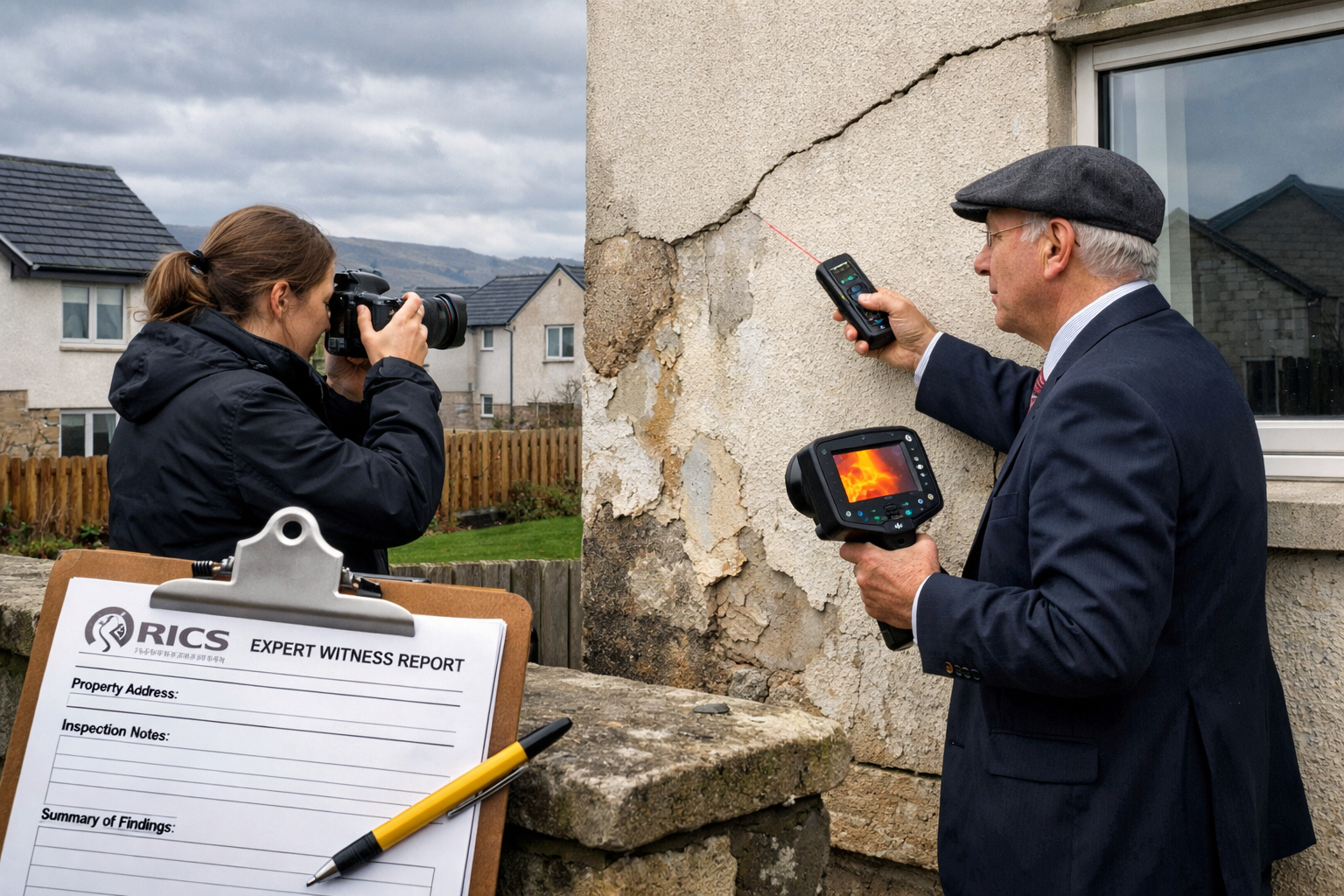
- Moisture meters and thermal imaging cameras
- Borescopes for concealed space inspection
- Structural monitoring equipment where movement is suspected
- Laboratory testing of materials where appropriate
For properties with complex structural concerns, coordination with structural engineer reports may be necessary to provide comprehensive evidence.
Photographic and Documentary Evidence
High-quality photographic evidence is essential for construction defect claims. The updated RICS guidance emphasizes complete disclosure, which means photographic records should be comprehensive rather than selective. Best practices include:
- Overall context photographs showing property location and setting
- Elevation photographs of affected building facades
- Detailed close-up images of specific defects
- Photographs with measurement scales for size reference
- Sequential photographs showing defect progression where available
- Annotated photographs identifying specific issues
Documentary evidence should include:
- Building warrant documentation and approved plans
- Completion certificates and building standards compliance certificates
- Previous survey reports and inspection records
- Maintenance records and correspondence
- Relevant building standards guidance and technical handbooks
This comprehensive approach to evidence gathering ensures that the expert's opinion is founded on a complete factual basis, consistent with the RICS requirement for full evidence disclosure.
Technical Analysis and Opinion Formation
With evidence gathered, the expert must conduct rigorous technical analysis to form professional opinions on:
Causation: What caused the defects? This may involve distinguishing between design failures, construction defects, material failures, and maintenance issues. Scottish construction defect claims often involve multiple contributing factors that must be carefully analyzed.
Standard of Work: Did the construction meet the applicable Scottish Building Standards at the time of construction? Were industry best practices followed? This analysis requires detailed knowledge of historic and current Scottish building regulations.
Remediation Requirements: What works are necessary to remedy the defects? Experts must specify appropriate remedial approaches that comply with Scottish Building Standards and are technically sound for Scottish conditions.
Valuation Impact: How do the defects affect property value? This requires understanding of the Scottish property market and comparable evidence from similar properties. The stable 2026 Scottish market provides good comparable data for this analysis.
Cost Assessment: What is the reasonable cost of remedial works? This should be based on Scottish construction costs and realistic specifications for the work required.
Opinions must be formed independently and objectively, acknowledging uncertainties and alternative interpretations where appropriate. The expert should clearly distinguish between established facts, professional opinion, and speculation.
Drafting RICS-Compliant Expert Witness Reports for Scottish Claims
Report Structure and Content Requirements
An effective expert witness report for construction defect claims in Scotland must satisfy both RICS professional standards and Scottish court requirements. The updated RICS guidance specifies detailed content requirements that ensure reports are comprehensive, balanced, and useful to the court.
Essential report components include:
1. Executive Summary: A concise overview of key findings and opinions, allowing readers to quickly grasp the essential conclusions.
2. Expert's Qualifications and Experience: Detailed CV demonstrating relevant expertise in construction defect diagnosis, Scottish building practices, and expert witness work. This section establishes the expert's credibility and competence.
3. Instructions and Scope: Clear statement of what the expert was instructed to investigate and opine upon, including any limitations on scope.
4. Methodology: Description of inspection procedures, diagnostic techniques employed, and analytical approaches used. This transparency allows the court to assess the reliability of the expert's methods.
5. Factual Findings: Objective description of what was observed during inspections, supported by photographic and documentary evidence. This section should be purely factual, without opinion or interpretation.
6. Technical Analysis: Application of professional knowledge to interpret the factual findings, including discussion of causation, building standards compliance, and defect severity.
7. Opinions and Conclusions: Clear statement of professional opinions on the key issues in dispute, with reasoning explained and alternative interpretations acknowledged where appropriate.
8. Remediation Recommendations: Specification of appropriate remedial works, with consideration of Scottish Building Standards requirements and practical implementation issues.
9. Cost Assessment: Reasonable cost estimates for remedial works, based on Scottish construction costs and realistic specifications.
10. Declarations: The required RICS declarations confirming duties to the court, independence, and competence.
For comprehensive guidance on property condition assessment that underpins expert reports, our comprehensive condition survey reports provide detailed methodologies applicable to defect investigations.
Updated Declaration Requirements
The revised RICS standard modifies the six declarations previously required in written expert reports. Experts must now confirm:[2]
-
Duty to the Court: "I confirm that I have made clear which facts and matters referred to in this report are within my own knowledge and which are not. Those that are within my own knowledge I confirm to be true. The opinions I have expressed represent my true and complete professional opinions on the matters to which they refer."
-
Expertise Confirmation: "I confirm that I have the appropriate expertise and experience to provide this expert opinion."
-
Independence: "I confirm that I am aware of my duty to the Court and that I have complied with that duty."
-
Impartiality: "I confirm that I have no conflict of interest of any kind, other than any which I have disclosed in my report."
-
Completeness: "I confirm that this report is complete and that it includes all matters relevant to the questions on which my opinion has been sought."
-
Ongoing Duty: "I recognize an ongoing duty and will forthwith advise the party instructing me if between the date of the report and the trial there is any change in the circumstances which alters the above declarations."[2]
This sixth declaration represents a new requirement emphasizing the expert's continuing obligation to update the instructing party if circumstances change before trial. For construction defect claims, this might include discovery of new evidence, changes in building standards guidance, or developments in the expert's personal circumstances affecting independence.
Addressing Scottish Legal and Regulatory Context
Expert Witness Preparation for Construction Defect Claims in Scotland: RICS Guidance Amid 2026 Stable Market Conditions requires specific attention to the Scottish legal and regulatory framework. Expert reports should:
- Reference applicable Scottish Building Standards rather than English Building Regulations
- Cite Scottish Technical Handbooks and guidance documents
- Consider Scottish case law on construction defects where relevant
- Use terminology consistent with Scottish legal practice
- Address Scottish-specific issues such as common property maintenance obligations in tenement buildings
- Consider Scottish climate and environmental factors in defect analysis
Experts unfamiliar with Scottish building standards should undertake appropriate research or decline instructions outside their competence. The RICS standard emphasizes that experts must work strictly within their areas of genuine expertise.[3]
Quality Assurance and Peer Review
Before finalizing an expert report, thorough quality assurance is essential. Best practices include:
- Internal peer review by another qualified surveyor
- Verification of all factual statements and measurements
- Cross-checking of calculations and cost estimates
- Proofreading for clarity, grammar, and professional presentation
- Ensuring all photographic references are correctly labeled
- Confirming all required declarations are included
This quality assurance process reduces errors and enhances report credibility, supporting the expert's professional reputation and the reliability of their evidence.
Professional Consequences and Risk Management
Misconduct and Cost Awards
The updated RICS guidance makes clear that misconduct in expert witness services can result in serious professional consequences. These include:[2]
Cost Awards Against Clients: Courts may award costs against the instructing party if their expert witness fails to comply with professional duties or provides inadequate evidence. Such awards can be substantial, potentially exceeding the value of the underlying claim.
Formal Misconduct Charges: RICS members who breach professional standards may face formal misconduct proceedings, which can result in:
- Formal warnings or reprimands
- Conditions on practice
- Fines
- Suspension or expulsion from RICS membership
These consequences emphasize the seriousness with which RICS views expert witness obligations and the importance of strict compliance with professional standards.
Insurance and Indemnity Considerations
Chartered surveyors acting as expert witnesses must maintain appropriate professional indemnity insurance (PII) covering expert witness work. Key considerations include:
- Adequate coverage limits for potential claims arising from expert witness services
- Confirmation that PII policy covers expert witness work (some policies exclude or limit this coverage)
- Understanding of policy excesses and reporting requirements
- Consideration of supplementary expert witness insurance where appropriate
The stable Scottish property market in 2026 means that construction defect claims often involve substantial property values, increasing potential exposure if expert evidence is found to be negligent.
Housing Disrepair Practice Alert
The April 2025 RICS practice alert on housing disrepair cases provides important guidance relevant to construction defect work.[2] The alert warns members about risks associated with:
- Accepting repeated appointments from the same instructing party
- Fee arrangements that might compromise independence
- Pressure to provide opinions favorable to the instructing party
- Inadequate time or resources to conduct proper investigations
While focused on housing disrepair, these warnings apply equally to construction defect claims. Experts must maintain robust boundaries to protect their independence and professional integrity, even when this means declining lucrative repeat instructions.
Accessing RICS Support and Resources
RICS Dispute Resolution Service
The RICS Dispute Resolution Service provides valuable support for expert witness appointments. The service can nominate qualified expert witnesses in specialist areas, ensuring they are suitably experienced, impartial, and free from conflicts of interest.[4]
Parties seeking to instruct an expert witness can contact the service at:
- Telephone: 020 7334 3806
- Email: drs@rics.org
This service is particularly valuable when parties cannot agree on expert selection or when specialist expertise in specific construction defect areas is required.
Register of Accredited Expert Witnesses
RICS maintains a Register of Accredited Expert Witnesses that is updated monthly. The March 2026 register provides current listings of RICS members who have demonstrated appropriate qualifications and experience for expert witness work.[4]
Parties instructing expert witnesses are advised to:
- Obtain current CVs directly from prospective experts
- Request references from previous instructing parties
- Confirm availability for the required timeframe
- Verify that the expert's specific experience matches the defect issues in question
The register provides a starting point for identifying suitable experts, but thorough due diligence remains essential before making appointments.
Continuing Professional Development
Expert witnesses must maintain current knowledge through continuing professional development (CPD). Relevant CPD activities for construction defect expert witnesses include:
- Updates on Scottish Building Standards and regulatory changes
- Technical training on building pathology and diagnostic techniques
- Legal training on expert witness duties and court procedures
- Case law updates on construction defect litigation
- Professional ethics and conduct training
The updated RICS guidance strengthens expectations that experts will maintain demonstrable competence through regular CPD relevant to their expert witness practice.[3]
For surveyors expanding their expertise in building assessment, our guidance on RICS building surveys provides comprehensive frameworks applicable to defect investigation work.
Practical Considerations for 2026 Scottish Market Conditions
Valuation Evidence in Stable Markets
Scotland's stable property market in 2026 creates both opportunities and challenges for expert witnesses providing valuation evidence in construction defect claims. The stability means:
Reliable Comparables: Consistent pricing allows for more accurate comparable evidence when assessing diminution in value caused by defects. Experts can identify truly comparable properties with greater confidence.
Reduced Speculation: Less market volatility reduces the need for speculative adjustments and increases the reliability of valuation opinions.
Higher Stakes: Price stability means defects represent a more significant proportion of property value, increasing the financial importance of accurate expert evidence.
Expert witnesses must ensure their valuation methodologies are robust and well-documented, as the stable market conditions mean that valuation disputes will focus on technical accuracy rather than market uncertainty.
Technology and Modern Diagnostic Tools
The 2026 construction defect investigation landscape benefits from advanced diagnostic technology that enhances evidence quality:
- Thermal imaging: Identifies moisture ingress, insulation defects, and air leakage patterns
- Drone surveys: Provides safe access to roof areas and high-level building elements
- 3D laser scanning: Creates accurate as-built records for comparison with design documentation
- Moisture mapping: Tracks moisture distribution patterns to identify defect sources
- Structural monitoring: Electronic monitoring systems track movement over time
The updated RICS guidance acknowledges modern technology challenges and emphasizes that experts must be competent in the technologies they employ.[3] Experts should:
- Maintain current training on diagnostic equipment
- Understand the limitations and potential errors of technological tools
- Provide clear explanations of technology-based evidence in reports
- Retain raw data and calibration records to support evidence reliability
Coordination with Other Experts
Complex construction defect claims often require multiple expert disciplines. The lead building surveyor expert witness may need to coordinate with:
- Structural engineers for stability and movement issues
- Mechanical and electrical engineers for services defects
- Architects for design-related issues
- Quantity surveyors for cost assessment
- Timber specialists for decay and infestation issues
- Damp specialists for moisture-related defects
Effective coordination ensures comprehensive evidence coverage while avoiding duplication or contradictions between expert opinions. The lead expert should establish clear boundaries of responsibility and facilitate information sharing between disciplines.
Our structural surveys service demonstrates the importance of coordinated multi-disciplinary investigation for complex building defects.
Conclusion
Expert Witness Preparation for Construction Defect Claims in Scotland: RICS Guidance Amid 2026 Stable Market Conditions demands rigorous professional standards, technical competence, and unwavering commitment to independence and integrity. The updated RICS professional standard, following consultation in late 2025, has strengthened requirements for conflicts of interest management, full evidence disclosure, and ongoing duty declarations that directly impact how chartered surveyors prepare and present expert evidence.[2][3]
Scotland's devolved regulatory framework and stable property market create a unique environment where construction defect claims carry significant financial stakes and require expert witnesses who understand both Scottish building standards and the specific challenges of Scottish construction. The emphasis on complete evidence disclosure before report exchange represents a significant shift toward transparency that enhances the credibility of expert evidence and facilitates more efficient dispute resolution.
Key Action Steps for Expert Witnesses
Chartered surveyors preparing to act as expert witnesses in Scottish construction defect claims should:
✅ Review Updated RICS Guidance: Ensure thorough familiarity with the revised professional standard and its implications for practice
✅ Strengthen Conflict Checking: Implement robust procedures for identifying and managing potential conflicts of interest before accepting instructions
✅ Enhance Evidence Protocols: Adopt comprehensive evidence gathering and disclosure practices consistent with the full transparency requirements
✅ Maintain Scottish Competence: Ensure current knowledge of Scottish Building Standards, legal frameworks, and construction practices through targeted CPD
✅ Verify Insurance Coverage: Confirm that professional indemnity insurance adequately covers expert witness work with appropriate limits
✅ Implement Quality Assurance: Establish peer review and quality checking processes for all expert reports before finalization
✅ Document Everything: Maintain meticulous records of instructions, methodologies, findings, and opinion formation to support evidence credibility
The professional consequences of expert witness misconduct—including cost awards and formal misconduct charges—underscore the importance of strict compliance with RICS standards.[2] However, the rewards of competent, ethical expert witness practice include enhanced professional reputation, valuable contribution to justice, and the satisfaction of resolving complex construction disputes through credible technical evidence.
As Scotland's construction sector continues to navigate the stable market conditions of 2026, the demand for qualified expert witnesses who can provide reliable, impartial evidence on construction defects will remain strong. Chartered surveyors who invest in developing their expert witness capabilities while maintaining the highest professional standards will find themselves well-positioned to serve this important professional role.
For surveyors seeking to develop their expert witness practice or parties requiring expert assistance with construction defect claims, accessing the RICS Dispute Resolution Service and consulting the Register of Accredited Expert Witnesses provides a strong foundation for quality expert appointments that serve the interests of justice and uphold the profession's highest standards.[4]
References
[1] 16 Expert Witness Services Scotland May 2022 – https://www.rics.org/content/dam/ricsglobal/documents/standards/building-surveying-standards/standard-forms-of-consultation/16-expert-witness-services_scotland_may-2022.pdf
[2] New Expert Witness Guidance For Rics Members – https://www.nmrk.com/en-gb/perspectives/new-expert-witness-guidance-for-rics-members
[3] Surveyors Acting As Expert Witnesses – https://www.rics.org/profession-standards/rics-standards-and-guidance/sector-standards/dispute-resolution-standards/surveyors-acting-as-expert-witnesses
[4] Rics Register Of Accredited Expert Witnesses March 2026 – https://www.rics.org/content/dam/ricsglobal/documents/surveying/RICS-Register-of-Accredited-Expert-Witnesses_March-2026.pdf
[5] Expert Witness Preparation For 2026 Rental Regulation Disputes Surveyor Evidence Amid Stricter Landlord Compliance – https://nottinghillsurveyors.com/blog/expert-witness-preparation-for-2026-rental-regulation-disputes-surveyor-evidence-amid-stricter-landlord-compliance
[6] Building Survey Protocols For Uk Construction Recovery Rics Checklists From Q4 2025 Monitor Into 2026 – https://nottinghillsurveyors.com/blog/building-survey-protocols-for-uk-construction-recovery-rics-checklists-from-q4-2025-monitor-into-2026
[7] Uk Influence And Advocacy Update January 2026 – https://www.rics.org/news-insights/uk-influence-and-advocacy-update-january-2026
