
The private rental sector in the UK stands at a pivotal crossroads. As May 1, 2026 approaches, landlords and property investors face the most significant regulatory overhaul in decades. The Renters' Rights Act 2026 promises to fundamentally reshape how rental properties are managed, maintained, and valued. For those unprepared, the consequences could be severe—from financial penalties to diminished property values. Understanding Building Surveys Under Renters' Rights Act 2026: Assessing Compliance for Private Landlords and Investors has never been more critical for protecting your investment portfolio.
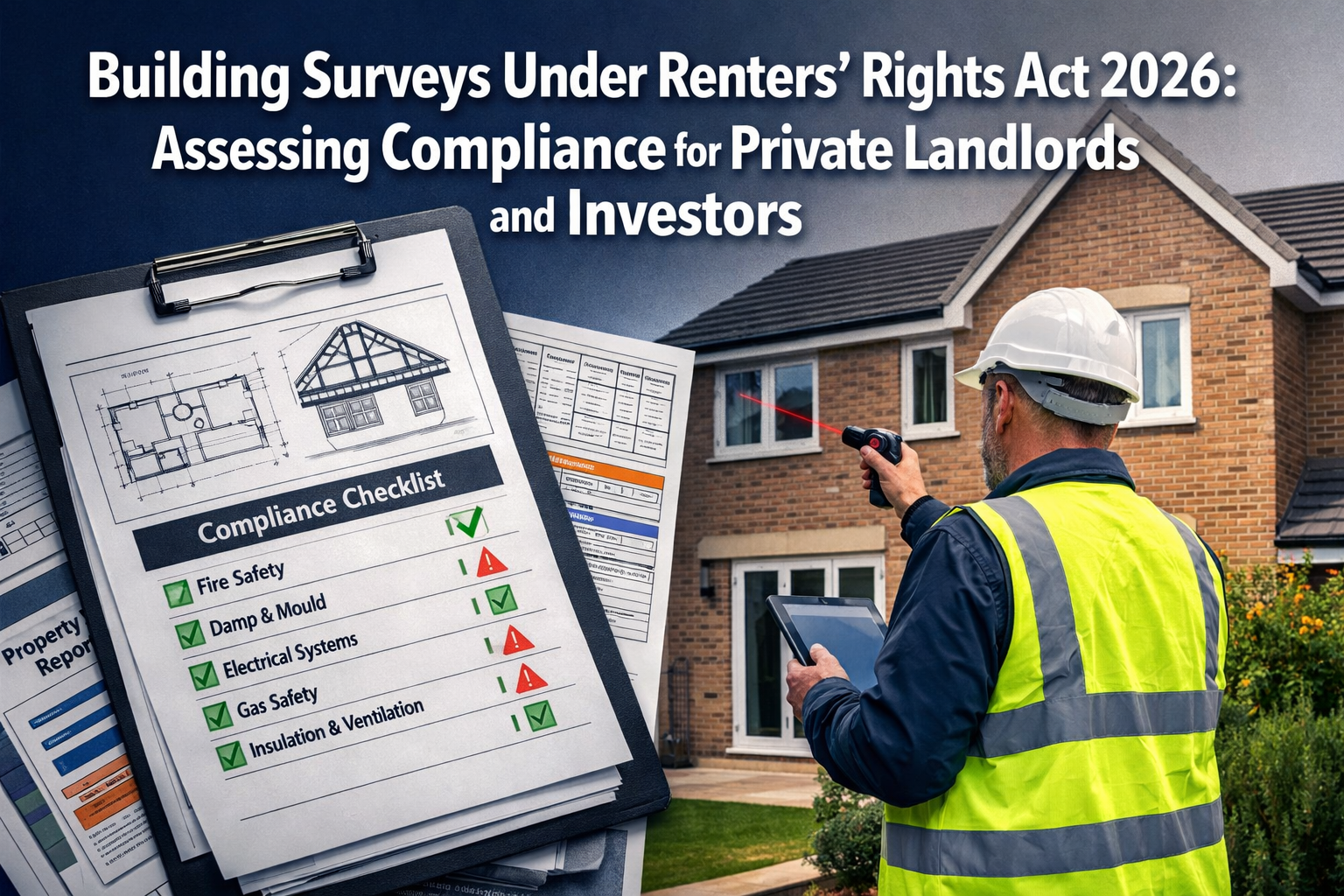
The stakes are high. With the elimination of Section 21 "no-fault" evictions, stricter maintenance standards, and enhanced tenant rights, property owners must proactively assess their portfolios for compliance risks[6]. This comprehensive guide explores how building surveys—particularly Level 3 surveys—serve as essential tools for navigating these regulatory changes and safeguarding your rental property investments.
Key Takeaways
- May 1, 2026 deadline: The Renters' Rights Act takes full effect, eliminating Section 21 evictions and introducing stricter property standards that require comprehensive building assessments[6]
- Level 3 surveys are essential: Detailed building surveys help landlords identify compliance gaps related to Decent Homes Standards, structural integrity, and pet accommodation requirements
- Proactive risk mitigation: Early surveyor engagement enables strategic planning for remedial works, accurate lettings valuations, and investment protection
- Financial implications: Non-compliance penalties can accumulate rapidly—similar California regulations show daily fines ranging from $100-$500, potentially exceeding $180,000 annually[1]
- Portfolio revaluation necessary: Properties failing to meet new standards may experience significant valuation decreases, affecting refinancing and investment returns
Understanding the Renters' Rights Act 2026: Key Compliance Requirements
The Renters' Rights Act 2026 represents the most comprehensive reform of the private rental sector in recent UK history. Taking effect on May 1, 2026, this legislation fundamentally alters the landlord-tenant relationship by prioritizing tenant security and property standards[6].
Elimination of Section 21 "No-Fault" Evictions
The abolition of Section 21 evictions means landlords can no longer remove tenants without providing specific grounds for possession. This change dramatically increases the importance of property condition documentation. When eviction becomes more complex, maintaining properties to high standards becomes the primary defense against problematic tenancies.
Building surveys now serve as critical evidence in possession proceedings. A comprehensive Level 3 building survey provides documented proof of property condition at tenancy commencement, protecting landlords who need to pursue legitimate possession claims based on property damage or maintenance breaches.
Decent Homes Standards for the Private Rental Sector
While traditionally applied to social housing, the Decent Homes Standards are increasingly referenced in private rental sector compliance discussions. These standards require properties to meet four criteria:
- Free from Category 1 hazards under the Housing Health and Safety Rating System (HHSRS)
- Reasonable state of repair with building components and services
- Reasonably modern facilities including kitchens and bathrooms
- Adequate thermal comfort through effective heating and insulation
A thorough building survey assesses compliance across all four dimensions, identifying deficiencies before they become enforcement issues or tenant complaints.
Enhanced Pet Accommodation Policies
The 2026 Act introduces provisions requiring landlords to consider pet requests more favorably, with refusals requiring justifiable grounds. This seemingly minor change has significant building survey implications:
- Structural wear assessment: Properties must be evaluated for their ability to withstand additional wear from pet occupation
- Damage mitigation planning: Surveys should identify vulnerable areas requiring protection or reinforcement
- Ventilation and odor control: Building systems must adequately manage additional moisture and air quality concerns
For investors evaluating Building Surveys Under Renters' Rights Act 2026: Assessing Compliance for Private Landlords and Investors, pet accommodation represents a new valuation and maintenance planning factor.
Building Surveys Under Renters' Rights Act 2026: Why Level 3 Surveys Are Essential
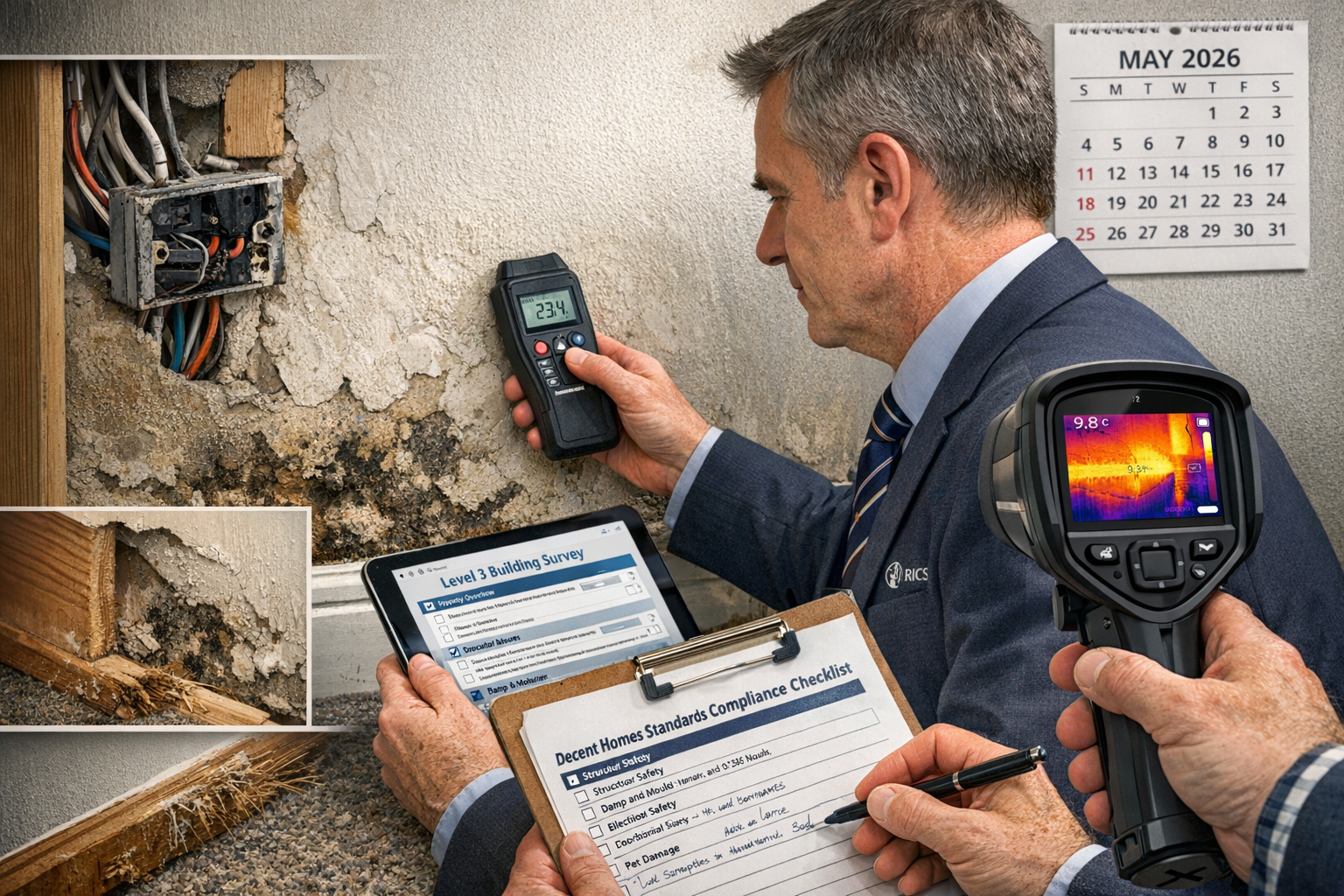
Not all building surveys provide the depth of analysis required for comprehensive compliance assessment. While Level 2 home surveys offer adequate information for standard residential purchases, the regulatory complexity of the Renters' Rights Act 2026 demands the thoroughness of a Level 3 survey.
What Level 3 Surveys Reveal for Compliance
A Level 3 building survey provides exhaustive analysis of property condition, including:
Structural integrity assessment 🏗️
- Foundation stability and subsidence indicators
- Load-bearing wall condition and structural movement
- Roof structure integrity and weatherproofing
- Damp penetration and moisture management systems
Building services evaluation ⚡
- Electrical installation safety and capacity
- Heating system efficiency and compliance
- Plumbing infrastructure and water pressure
- Drainage systems and waste management
HHSRS hazard identification ⚠️
- Category 1 hazards requiring immediate remediation
- Category 2 hazards affecting property valuation
- Fire safety compliance and escape route adequacy
- Environmental health concerns including mold and ventilation
Maintenance planning 📋
- Short-term repair priorities (0-2 years)
- Medium-term replacement schedules (3-5 years)
- Long-term capital expenditure forecasting (6-10 years)
- Cost estimates for compliance-related works
Comparing Survey Types for Rental Property Assessment
| Survey Type | Compliance Coverage | Cost Range | Best For |
|---|---|---|---|
| Level 1 (Condition Report) | Basic visual inspection only | £250-£400 | New-build rentals only |
| Level 2 (HomeBuyer Report) | Standard condition assessment | £400-£800 | Modern properties in good condition |
| Level 3 (Building Survey) | Comprehensive compliance analysis | £800-£1,500+ | All rental properties under new Act |
| Specific Defect Survey | Targeted issue investigation | £300-£600 | Follow-up to identified concerns |
For landlords assessing Building Surveys Under Renters' Rights Act 2026: Assessing Compliance for Private Landlords and Investors, the comprehensive nature of Level 3 surveys justifies the additional investment. The detailed reporting provides defensible documentation for regulatory compliance and informed investment decision-making.
Timing Your Building Survey for Maximum Protection
Strategic timing of building surveys maximizes their protective value:
Pre-acquisition surveys: Before purchasing rental properties, comprehensive surveys identify compliance costs that should be factored into negotiated purchase prices. Properties requiring extensive remediation to meet 2026 standards represent significant hidden liabilities.
Portfolio review surveys: Existing landlords should commission surveys across their entire portfolio before May 2026. This proactive approach enables prioritized remediation planning and accurate budget forecasting.
Pre-tenancy condition surveys: Documenting property condition immediately before new tenancies commence protects against dilapidation disputes. Combined with a schedule of condition, these surveys provide irrefutable evidence of baseline property status.
Post-remediation verification surveys: After completing compliance-related works, follow-up surveys confirm that remediation meets required standards and provides certification for regulatory purposes.
Understanding what surveyors look for in a house survey helps landlords prepare properties for inspection and anticipate potential compliance issues.
Assessing Compliance for Private Landlords and Investors: Risk Mitigation Strategies
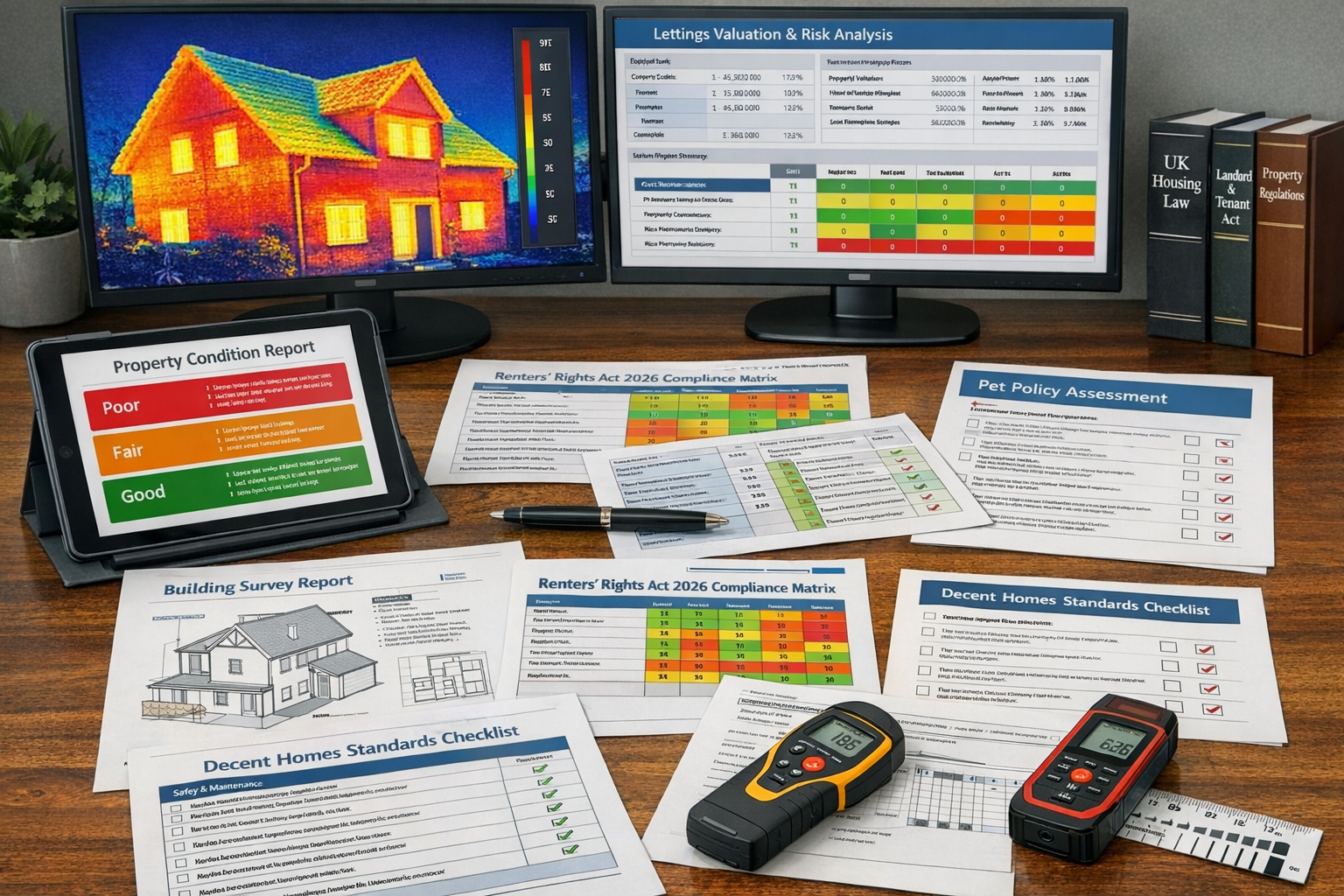
The regulatory landscape created by the Renters' Rights Act 2026 introduces multiple risk vectors that building surveys help mitigate. Sophisticated investors are developing comprehensive compliance strategies built on thorough property assessments.
Financial Risk Assessment Through Building Surveys
Penalty exposure calculation: While UK-specific penalty structures for the Renters' Rights Act remain under development, parallel legislation provides instructive precedents. California's SB 721, which mandates inspection of exterior elevated elements, imposes penalties of $100-$500 daily for non-compliance—potentially accumulating to over $180,000 annually[1]. UK enforcement may follow similar frameworks, making early compliance assessment financially prudent.
Valuation impact analysis: Properties failing to meet enhanced standards face significant market value reductions. Building surveys enable accurate assessment of remediation costs, allowing investors to:
- Calculate net present value of compliance investments
- Determine whether remediation or disposal represents the optimal strategy
- Negotiate purchase price adjustments reflecting compliance obligations
- Support refinancing applications with documented property condition
Insurance implications: Insurers increasingly require evidence of property maintenance and compliance. Comprehensive building surveys support insurance applications and may reduce premium costs by demonstrating proactive risk management.
Portfolio Prioritization Matrix
For landlords with multiple properties, building surveys enable data-driven prioritization of compliance investments:
High Priority (Immediate Action Required)
- Properties with identified Category 1 HHSRS hazards
- Buildings with structural integrity concerns
- Properties facing imminent tenant complaints or enforcement action
- High-value properties where non-compliance significantly impacts valuation
Medium Priority (Action Within 12 Months)
- Properties with Category 2 hazards
- Buildings requiring heating or insulation upgrades
- Properties with aging building services approaching failure
- Properties in areas with active enforcement programs
Lower Priority (Monitoring and Planning)
- Properties meeting current standards with minor deficiencies
- Buildings with cosmetic issues not affecting habitability
- Properties with long-term maintenance planning already established
This prioritization approach, informed by comprehensive building surveys, optimizes capital allocation and minimizes regulatory risk exposure.
Surveyor Selection for Compliance Assessment
Not all surveyors possess equal expertise in rental property compliance. When commissioning Building Surveys Under Renters' Rights Act 2026: Assessing Compliance for Private Landlords and Investors, seek professionals with:
✅ RICS accreditation: Chartered surveyors adhere to professional standards ensuring thorough, defensible reporting
✅ Rental sector experience: Familiarity with HHSRS assessment and landlord-specific compliance requirements
✅ Local authority knowledge: Understanding of regional enforcement priorities and interpretation variations
✅ Expert witness capability: Surveyors qualified to provide expert witness reports offer additional protection if disputes arise[8]
✅ Multi-disciplinary expertise: Structural, mechanical, and electrical assessment capabilities within a single survey
The RICS home survey framework ensures standardized reporting that facilitates comparison across portfolio properties and provides consistent compliance documentation.
Integration with Property Management Systems
Building survey findings should integrate seamlessly with broader property management strategies:
Maintenance planning alignment: Survey recommendations should populate preventive maintenance schedules, ensuring identified issues receive timely attention before escalating to compliance breaches.
Tenant communication protocols: Transparent communication about planned remediation works demonstrates commitment to property standards and may prevent tenant complaints escalating to enforcement action.
Financial forecasting: Survey-based cost estimates should inform annual budgets, reserve fund allocations, and long-term investment return projections.
Disposal decision frameworks: Properties requiring disproportionate compliance investment relative to rental yield may warrant disposal, with survey findings supporting this strategic decision.
Lettings Valuations Under the New Regulatory Framework
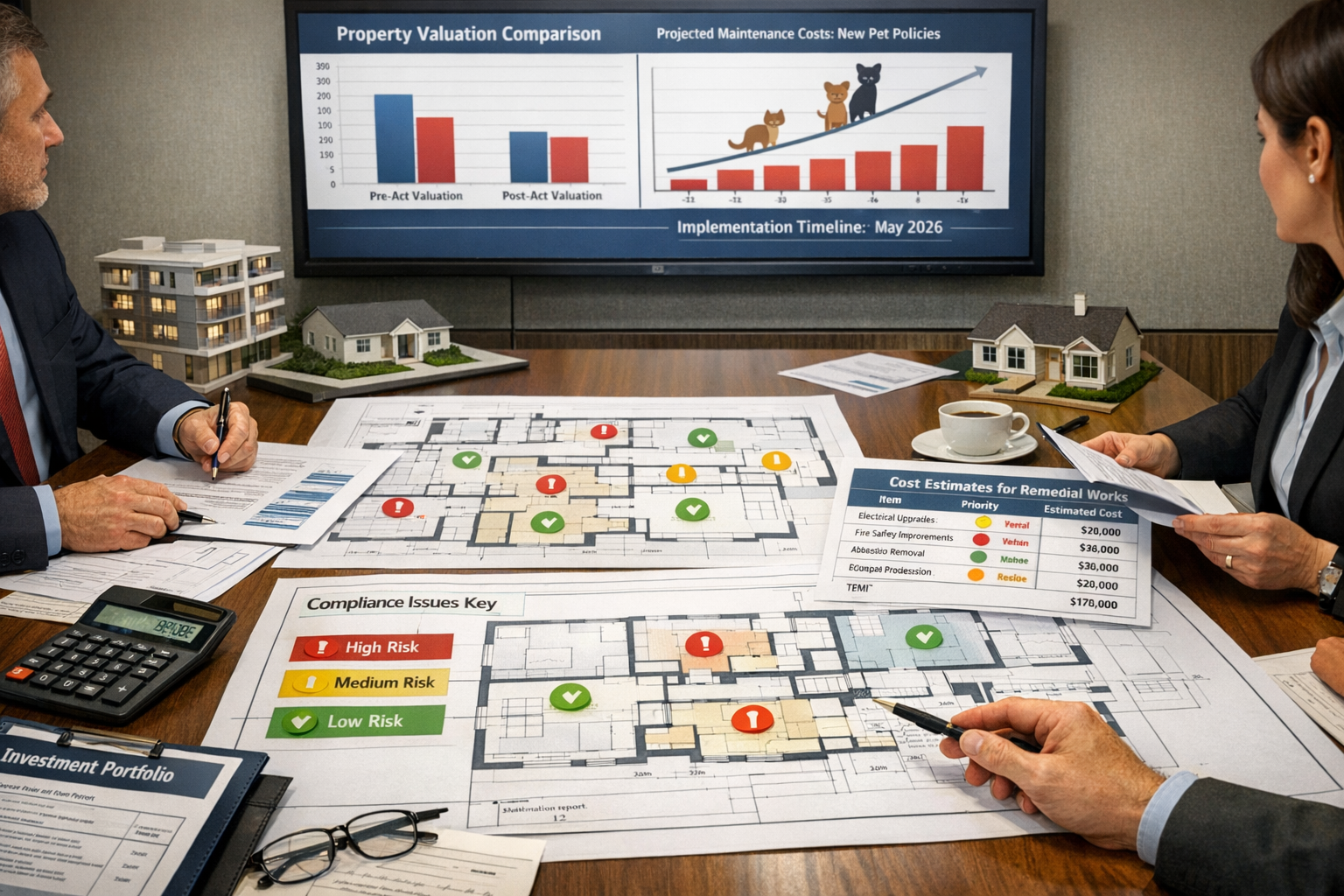
The Renters' Rights Act 2026 fundamentally alters lettings valuation methodologies. Traditional approaches focusing primarily on comparable rental evidence must now incorporate compliance risk assessment and remediation cost analysis.
Compliance-Adjusted Valuation Methodology
Building Surveys Under Renters' Rights Act 2026: Assessing Compliance for Private Landlords and Investors require valuers to adopt enhanced methodologies:
Traditional Valuation Approach:
Market Rental Value = Comparable Evidence × Location Adjustment × Condition Factor
Compliance-Adjusted Valuation Approach:
Adjusted Rental Value = Market Rental Value - (Compliance Costs / Expected Holding Period) - Risk Premium
Where:
- Compliance Costs = Survey-identified remediation expenses
- Expected Holding Period = Investment timeframe for cost amortization
- Risk Premium = Additional return required to compensate for regulatory uncertainty
This adjusted methodology ensures investment decisions reflect the total cost of regulatory compliance rather than solely current rental income.
Case Study: Compliance Impact on Property Valuation
Property Profile:
- Victorian terraced house, 3 bedrooms
- Current market rent: £1,800 per month (£21,600 annually)
- Purchase price: £450,000
- Gross yield: 4.8%
Level 3 Survey Findings:
- Rising damp requiring chemical injection and replastering: £8,500
- Electrical rewiring for current regulations: £6,200
- Boiler replacement (inefficient system): £3,800
- Roof repairs (minor leaks): £2,400
- Window draught-proofing and thermal improvement: £4,100
- Total remediation cost: £25,000
Compliance-Adjusted Valuation:
- Amortized compliance cost (5-year holding): £5,000 annually
- Effective net rent: £16,600 (£21,600 – £5,000)
- Adjusted yield: 3.7% (£16,600 / £450,000)
- Valuation adjustment: -£25,000 to -£40,000 depending on local market conditions
This example demonstrates how comprehensive building surveys reveal hidden compliance costs that significantly impact investment returns. Investors who fail to commission proper surveys before acquisition may discover their actual yields fall substantially below projections.
Rent Review Strategies Under Section 21 Abolition
With Section 21 evictions eliminated, landlords lose the ability to remove tenants who refuse reasonable rent increases. This power shift makes initial rent setting and review mechanisms more critical:
Survey-supported rent positioning: Setting initial rents at market rates supported by building survey evidence of superior property condition justifies premium pricing and reduces pressure for above-inflation increases.
Documented maintenance investment: Regular surveys demonstrating ongoing property improvement provide objective justification for rent reviews that reflect enhanced property value.
Comparative market analysis: Building surveys across comparable properties enable evidence-based rent positioning that tenants and tribunals are more likely to accept as reasonable.
The commercial building surveys approach to rent review—emphasizing objective condition assessment and market positioning—increasingly applies to residential lettings under the new regulatory framework.
Investment Strategy Implications
Building survey findings should inform strategic investment decisions:
Acquisition strategy refinement 🎯
- Target properties requiring minimal compliance investment
- Negotiate purchase price reductions reflecting survey-identified remediation costs
- Avoid properties with fundamental structural issues requiring disproportionate expenditure
Portfolio optimization 📊
- Dispose of properties with unfavorable compliance cost-to-value ratios
- Consolidate holdings in areas with favorable enforcement environments
- Invest in properties with inherent compliance advantages (newer construction, recent renovation)
Development and conversion opportunities 🏗️
- Purpose-built rental developments designed for compliance from inception
- Conversion of commercial properties to residential with integrated compliance features
- Renovation projects transforming non-compliant stock into premium rental properties
Alternative tenure strategies 🔄
- Consider build-to-rent institutional models with professional management
- Explore rent-to-buy schemes reducing long-term landlord obligations
- Evaluate short-term letting alternatives where regulatory burden differs
Practical Implementation: Your Compliance Roadmap
Translating building survey findings into actionable compliance strategies requires systematic implementation:
Phase 1: Portfolio Assessment (Immediate – 3 Months)
Action Steps:
- Commission Level 3 building surveys across entire portfolio
- Compile comprehensive defect and compliance gap register
- Obtain cost estimates for all identified remediation works
- Calculate compliance-adjusted valuations for each property
- Identify properties warranting disposal versus remediation
Deliverables:
- Complete survey reports for all properties
- Prioritized remediation schedule
- Capital expenditure budget forecast
- Strategic disposition recommendations
Phase 2: Priority Remediation (3-12 Months)
Action Steps:
- Address all Category 1 HHSRS hazards immediately
- Complete structural and building services upgrades
- Implement heating and insulation improvements
- Document all remediation works with photographic evidence
- Commission post-remediation verification surveys
Deliverables:
- Compliance certification for priority properties
- Updated property condition documentation
- Contractor invoices and warranty documentation
- Revised lettings valuations reflecting improvements
Phase 3: Ongoing Compliance Management (12+ Months)
Action Steps:
- Establish annual survey inspection program
- Implement preventive maintenance schedules based on survey recommendations
- Maintain comprehensive property condition records
- Update compliance documentation as regulations evolve
- Review and adjust investment strategy based on market response to new regulations
Deliverables:
- Annual compliance status reports
- Updated maintenance schedules
- Regulatory change impact assessments
- Portfolio performance analysis
Budgeting for Compliance
Realistic budget allocation for Building Surveys Under Renters' Rights Act 2026: Assessing Compliance for Private Landlords and Investors includes:
Survey costs:
- Level 3 building survey: £800-£1,500 per property
- Specialist investigations (damp, structural, electrical): £300-£800 each
- Annual follow-up inspections: £400-£600 per property
Remediation costs (typical ranges per property):
- Minor compliance works: £5,000-£15,000
- Moderate remediation: £15,000-£40,000
- Major structural or systems upgrades: £40,000-£100,000+
Professional fees:
- Project management for remediation: 10-15% of works cost
- Expert witness services if disputes arise: £150-£300 per hour
- Legal advice on compliance interpretation: £200-£400 per hour
These investments, while substantial, pale in comparison to potential enforcement penalties, tenant compensation claims, and property value erosion from non-compliance.
Emerging Compliance Technologies and Tools
Technological innovation is transforming building survey practice and compliance management:
Digital Survey Platforms
Modern surveying increasingly employs digital tools that enhance accuracy and reporting:
- Thermal imaging cameras identify insulation deficiencies and moisture ingress invisible to visual inspection
- Moisture meters provide objective damp readings supporting remediation decisions
- Laser measuring devices ensure dimensional accuracy for space standards compliance
- Drone photography enables safe roof and chimney inspection without scaffolding costs
These technologies produce more comprehensive data supporting compliance assessment and providing defensible evidence if disputes arise.
Property Condition Databases
Sophisticated landlords are developing centralized property condition databases integrating:
- Historical survey reports and condition assessments
- Maintenance work records and contractor invoices
- Tenant complaint logs and resolution documentation
- Regulatory correspondence and inspection reports
- Financial performance data and compliance cost tracking
This integrated approach enables portfolio-wide compliance monitoring and data-driven investment decisions.
Predictive Maintenance Analytics
Advanced property management systems now incorporate predictive analytics that:
- Forecast building component failure based on survey condition ratings
- Optimize maintenance timing to prevent emergency repairs
- Identify portfolio-wide patterns requiring systematic intervention
- Generate automated compliance reporting for regulatory submissions
These tools transform building surveys from periodic snapshots into continuous compliance monitoring systems.
Conclusion: Protecting Your Investment Through Proactive Compliance
The Renters' Rights Act 2026 represents a fundamental shift in the private rental sector regulatory landscape. As the May 1, 2026 implementation date approaches, landlords and investors face a clear choice: proactive compliance assessment or reactive crisis management.
Building Surveys Under Renters' Rights Act 2026: Assessing Compliance for Private Landlords and Investors provide the foundation for informed decision-making. Comprehensive Level 3 surveys identify compliance gaps before they become enforcement issues, enable accurate investment valuation, and support strategic portfolio optimization.
The financial implications are substantial. Properties failing to meet enhanced standards face valuation decreases, rental income pressure, and potential penalty exposure. Conversely, properties demonstrably compliant with new regulations command premium rents, attract quality tenants, and deliver superior investment returns.
Your Next Steps
Immediate actions for landlords and investors:
- Commission comprehensive building surveys across your portfolio before May 2026
- Engage RICS-accredited surveyors with rental sector compliance expertise
- Develop prioritized remediation plans based on survey findings and risk assessment
- Allocate capital budgets for compliance works and ongoing maintenance
- Review investment strategy considering disposal of properties with unfavorable compliance economics
- Establish documentation systems maintaining comprehensive property condition records
- Consult legal and tax advisors regarding compliance investment structuring
The landlords who thrive under the new regulatory framework will be those who view compliance not as a burden but as an investment protection strategy. Comprehensive building surveys provide the intelligence necessary for this strategic approach.
Don't wait until enforcement action forces reactive compliance. Take control of your portfolio's future through proactive assessment and strategic planning. The investment you make in comprehensive building surveys today protects the value you've built over years of property ownership.
For expert guidance on comparing different types of surveys and determining what survey you need for your specific circumstances, consult qualified professionals who understand both building assessment and rental sector compliance requirements.
References
[1] Preparing Socal Landlords 2026 Laws – https://allviewrealestate.com/preparing-socal-landlords-2026-laws/
[2] New 2026 Alta Nsps Survey Standards What Developers And Counsel Should Know – https://hallrender.com/2026/02/23/new-2026-alta-nsps-survey-standards-what-developers-and-counsel-should-know/
[3] New California Rent Laws 2026 – https://marinacciolaw.com/new-california-rent-laws-2026/
[4] Major Property Management Company To Review And Revise Tenant Screening Policies Statewide After Fair Housing Complaint – https://calcivilrights.ca.gov/2026/01/13/major-property-management-company-to-review-and-revise-tenant-screening-policies-statewide-after-fair-housing-complaint/
[5] Caa Legal Team Outlines Key Compliance Changes Coming In 2026 – https://caanet.org/caa-legal-team-outlines-key-compliance-changes-coming-in-2026/
[6] Renters Rights Act 2026 – https://www.davidcosby.co.uk/renters-rights-act-2026/
[7] What California Property Owners Need To Know About Key Compliance Changes Coming In 2026 – https://www.jamico.com/what-california-property-owners-need-to-know-about-key-compliance-changes-coming-in-2026/
[8] Expert Witness Preparation For 2026 Rental Regulation Disputes Surveyor Evidence Amid Stricter Landlord Compliance – https://nottinghillsurveyors.com/blog/expert-witness-preparation-for-2026-rental-regulation-disputes-surveyor-evidence-amid-stricter-landlord-compliance
