
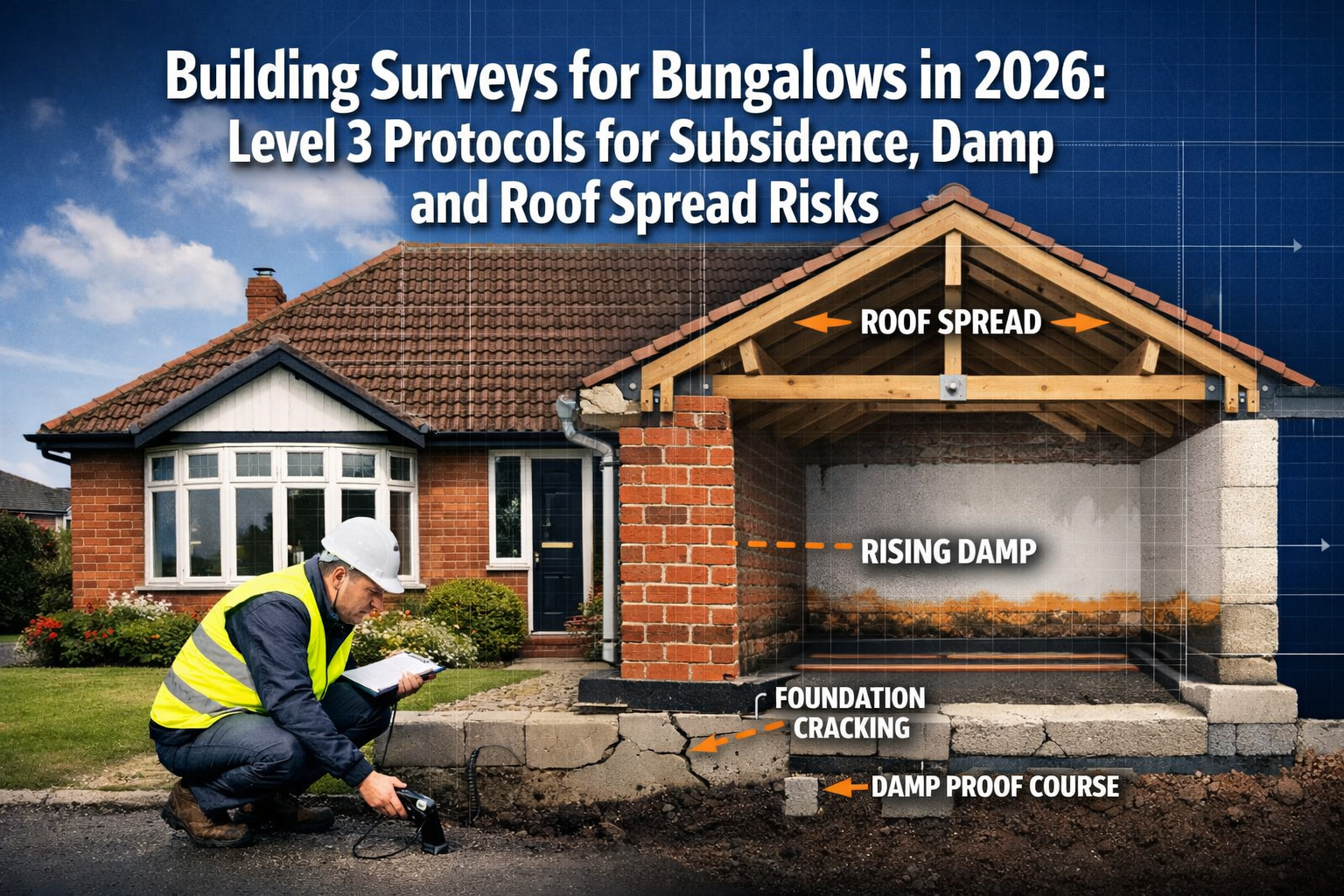
Bungalows now account for nearly 9% of the UK housing stock, with demand surging 34% among retirees during the 2026 housing market recovery. Yet these single-story properties harbour unique structural vulnerabilities that standard surveys often miss. Building Surveys for Bungalows in 2026: Level 3 Protocols for Subsidence, Damp and Roof Spread Risks have become essential tools for identifying hidden defects before purchase, particularly as many bungalows were constructed during the post-war building boom with materials and techniques that have aged poorly.
Unlike multi-story properties, bungalows face disproportionate structural stresses from their wide roof spans, lower ground clearance, and foundation loading patterns. The RICS Level 3 survey provides the comprehensive assessment necessary to detect subsidence, damp penetration, and roof spread—three interconnected defects that can devastate property values and safety. With average bungalow prices reaching £285,000 in 2026, investing £800-£1,200 in a thorough Level 3 survey protects buyers from catastrophic repair bills that can exceed £30,000.
Key Takeaways
- Level 3 surveys are essential for bungalows built before 1980 or with extensions, providing detailed structural assessment beyond basic Level 2 inspections
- Subsidence risk is heightened in bungalows due to large roof spans creating excessive foundation pressure, requiring specific crack pattern analysis and drainage evaluation
- Damp problems affect bungalows disproportionately because of lower ground clearance, making rising damp and penetrating moisture critical survey focus areas
- Roof spread is a common bungalow defect where inadequate bracing causes walls to deflect outward under roof load, identifiable through Level 3 loft space inspection
- Comprehensive protocols in 2026 include moisture meter readings, crack monitoring recommendations, and thermal imaging to detect hidden structural deterioration
Understanding Level 3 Building Surveys for Bungalows in 2026
A Level 3 building survey represents the most comprehensive inspection available for residential properties. Previously known as a "full structural survey," this RICS-regulated assessment examines every accessible part of a bungalow's structure, materials, and condition. The survey is specifically recommended for older properties, those with extensions, or buildings constructed with non-standard materials—categories that encompass the majority of UK bungalows [2].
What Makes Level 3 Surveys Different
The key distinction between Level 2 and Level 3 surveys lies in depth and detail. While a Level 2 HomeBuyer Report provides a traffic-light condition rating system, Level 3 surveys deliver detailed descriptions of defects, their causes, and remediation options [1]. For bungalows, this comprehensive approach is crucial because:
- Roof space access is mandatory – Surveyors physically enter loft spaces to inspect roof timbers, insulation, and structural bracing [3]
- Material assessment is thorough – Every structural component receives individual evaluation for deterioration and performance [3]
- Defect analysis includes causation – Reports explain why problems have occurred, not just what exists
- Repair cost guidance is provided – Detailed estimates help buyers negotiate purchase prices or budget for remediation
When Bungalows Require Level 3 Protocols
The RICS standards specify several scenarios where Level 3 surveys become necessary rather than optional. For bungalows, these criteria frequently apply:
✅ Properties built before 1980 – Construction standards and materials have evolved significantly, with older bungalows often lacking modern damp-proofing and structural bracing
✅ Extended or altered bungalows – Non-compliant extensions create stress points and hide underlying defects, requiring detailed structural assessment [2]
✅ Properties showing visible defects – Cracks, damp patches, or roof sagging indicate problems that demand comprehensive investigation
✅ Unusual construction methods – Concrete frame, timber frame, or non-standard materials need specialist evaluation
✅ Properties in subsidence-prone areas – Clay soil regions, areas with mining history, or locations with mature trees warrant enhanced foundation assessment
The comprehensive guide to Level 3 building surveys provides additional context for when this survey level becomes essential for property purchases.
The 2026 Survey Process for Bungalows
Modern Level 3 surveys incorporate technological advances alongside traditional inspection methods. In 2026, chartered surveyors typically employ:
🔍 Moisture meters – Electronic detection of hidden dampness within walls, floors, and timber elements
🔍 Thermal imaging cameras – Infrared technology reveals insulation deficiencies, thermal bridging, and moisture patterns invisible to visual inspection
🔍 Endoscopic cameras – Inspection of cavity walls and inaccessible voids without destructive opening
🔍 Digital measurement tools – Laser levels and electronic distance meters provide precise crack width and deflection measurements
🔍 Drone surveys – Aerial inspection of roof coverings, chimneys, and high-level elements without scaffolding access
The typical inspection duration for a bungalow ranges from 3-5 hours, depending on size and complexity. Surveyors examine both external and internal elements, with particular attention to areas prone to deterioration. The resulting report typically spans 40-80 pages with photographs, diagrams, and detailed condition descriptions.
Subsidence Detection Protocols in Building Surveys for Bungalows in 2026
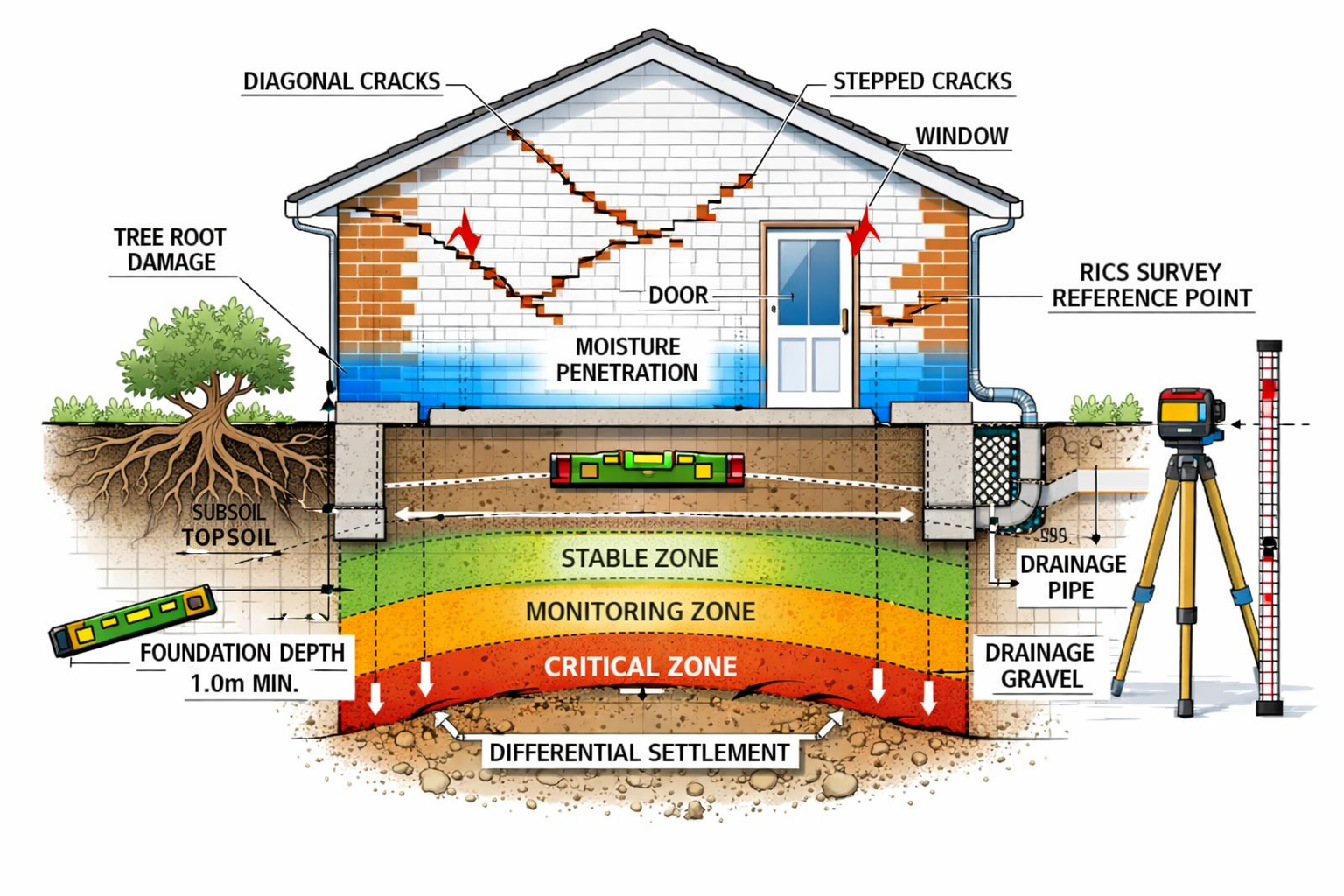
Subsidence represents one of the most serious structural defects affecting bungalows, with repair costs averaging £15,000-£50,000 depending on severity. Bungalows face elevated subsidence risk because their large roof spans place concentrated loads on foundation perimeters, creating stress patterns different from multi-story properties [2]. Level 3 surveys employ systematic protocols to identify subsidence indicators before they escalate into catastrophic failures.
Crack Pattern Analysis
Not all cracks indicate subsidence, but certain patterns provide diagnostic evidence of foundation movement. Chartered surveyors assess cracks using established criteria:
Subsidence-Indicative Crack Characteristics:
| Crack Feature | Subsidence Pattern | Non-Structural Pattern |
|---|---|---|
| Direction | Diagonal, typically at 45° angles | Vertical or horizontal |
| Width | Progressive widening (>3mm concerning) | Uniform width |
| Location | Near windows, doors, building corners | Random distribution |
| Pattern | Stepped along mortar joints | Straight through bricks |
| Seasonality | Worsens in summer (clay shrinkage) | Stable year-round |
| Internal/External | Appears both inside and outside | Often internal only |
The RICS guidance specifies that cracks exceeding 5mm width require immediate structural investigation, while those between 3-5mm warrant monitoring [5]. During subsidence surveys, surveyors document crack locations, dimensions, and characteristics using calibrated measuring tools and photography.
Foundation and Drainage Assessment
Subsidence rarely occurs without underlying causes. Level 3 protocols require surveyors to investigate potential triggers:
Primary Subsidence Causes in Bungalows:
- Clay soil shrinkage – Seasonal moisture changes cause clay soils to expand and contract, with tree roots accelerating moisture extraction during dry periods
- Inadequate foundation depth – Many post-war bungalows have shallow foundations (600-900mm) insufficient for clay soil conditions
- Drainage defects – Leaking drains erode soil beneath foundations, creating voids and settlement
- Tree proximity – High water-demand species (oak, willow, poplar) within 1.5x their mature height create subsidence risk
- Soil compaction issues – Poorly compacted fill or disturbed ground provides unstable foundation support
Surveyors examine drainage systems for functionality, inspect manholes for evidence of leakage, and assess vegetation proximity to the structure. The specific defect survey option allows focused investigation when subsidence concerns arise from initial inspections.
Monitoring Recommendations
When surveyors identify cracks of uncertain age or severity, they typically recommend monitoring protocols:
📊 Tell-tale crack monitors – Glass or plastic strips bonded across cracks to detect ongoing movement
📊 Photographic records – Dated images with measurement scales for comparison over 6-12 month periods
📊 Professional monitoring – Structural engineers install precise measuring points for quantitative movement tracking
📊 Seasonal assessment – Evaluation during both wet and dry seasons to identify moisture-related movement patterns
The 2026 insurance market increasingly requires monitoring evidence before providing subsidence cover for properties with historical movement. Level 3 survey reports document baseline conditions and provide recommendations for appropriate monitoring duration, typically 12 months for suspected subsidence cases.
Bungalow-Specific Subsidence Vulnerabilities
The single-story configuration creates unique structural dynamics that surveyors must understand:
⚠️ Roof load concentration – Unlike two-story properties where upper floor loads distribute through walls, bungalow roof loads concentrate at wall head level, creating outward thrust and foundation stress [2]
⚠️ Wide span requirements – Open-plan bungalow layouts require longer structural spans, increasing deflection potential and foundation loading
⚠️ Perimeter loading – All structural loads transfer through external walls directly to foundations, with no internal load-bearing walls in many designs
⚠️ Ground floor proximity – Minimal clearance between floor slabs and ground level increases moisture exposure and frost heave risk
Understanding these factors allows surveyors to target inspection efforts on high-risk areas, particularly at building corners where stress concentration and movement typically manifest first.
Damp Assessment Protocols in Building Surveys for Bungalows in 2026
Damp problems plague bungalows more severely than multi-story properties due to their low ground clearance and extensive ground-floor perimeter exposure. Bungalows are significantly more susceptible to rising damp because their single-story construction maximizes ground contact area while minimizing natural ventilation and thermal mass [2]. Level 3 surveys employ multi-faceted protocols to identify all damp types and their underlying causes.
Types of Damp in Bungalows
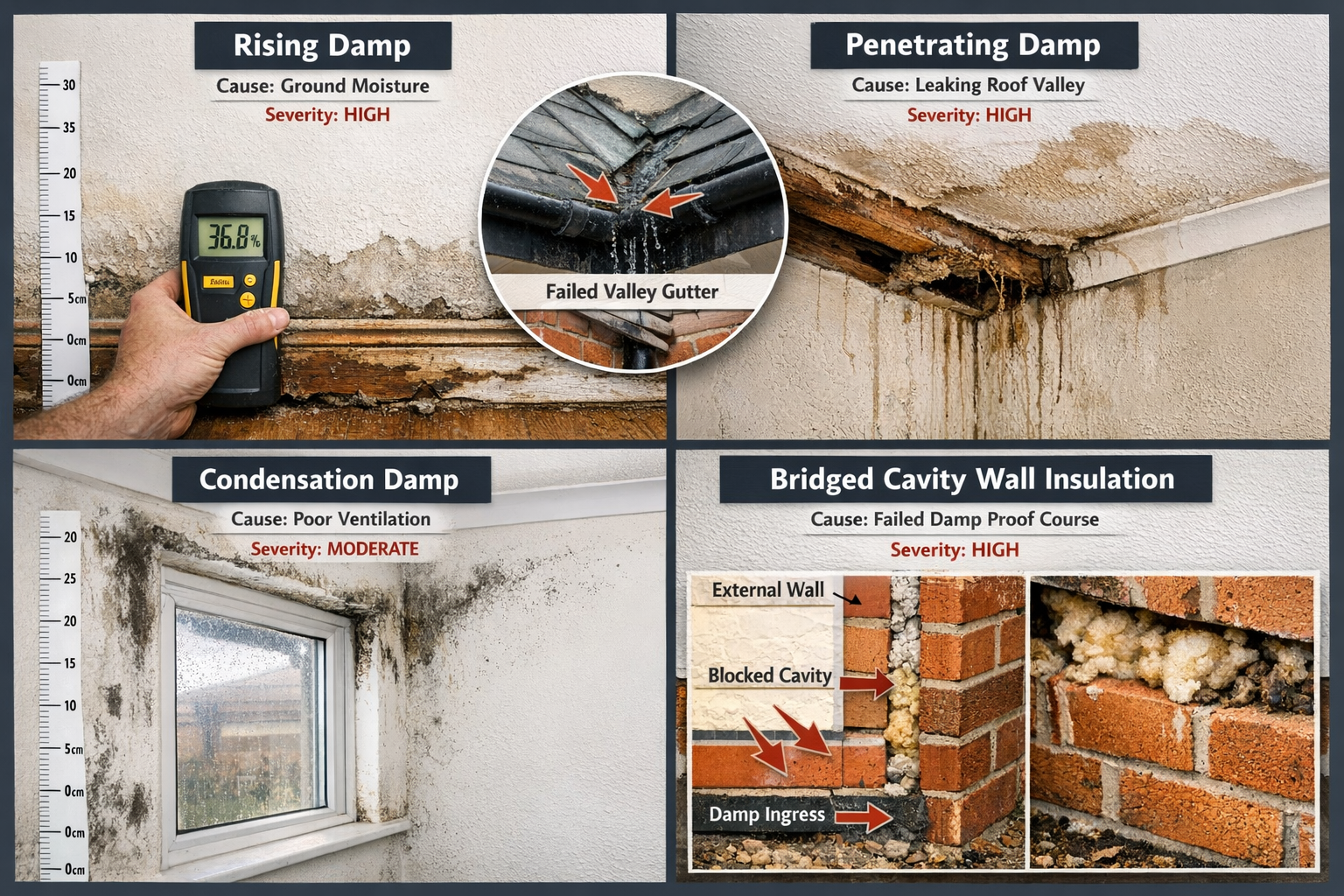
Surveyors distinguish between three primary damp categories, each requiring different remediation approaches:
Rising Damp
Rising damp occurs when groundwater travels upward through porous masonry via capillary action. In bungalows, this manifests as:
- Tide marks on internal walls, typically 300-1000mm above floor level
- Salt efflorescence – White crystalline deposits on wall surfaces
- Deteriorating plaster – Crumbling or blown plaster at low level
- Damaged skirting boards – Rot, decay, or paint failure on timber elements
- Musty odours – Characteristic damp smell in affected rooms
Level 3 protocols require surveyors to use calibrated moisture meters to measure wall moisture content at multiple heights and locations. Readings above 20% on the moisture meter scale indicate problematic dampness requiring investigation [1].
Common Rising Damp Causes:
- Failed or absent damp proof course (DPC)
- Bridged DPC from external ground levels raised above DPC height
- Porous or damaged masonry allowing moisture bypass
- Defective cavity wall construction with debris bridging
Penetrating Damp
Penetrating damp results from water ingress through defective building elements. Bungalows experience this through:
- Roof defects – Slipped tiles, damaged flashing, defective valleys allowing rainwater penetration [4]
- Wall defects – Cracked render, failed pointing, damaged brickwork permitting water entry
- Window and door defects – Deteriorated seals, failed mastic joints, rotten timber frames
- Plumbing leaks – Failed pipes, radiator leaks, or sanitary fitting failures
Surveyors trace damp patterns to identify entry points, examining roof spaces for evidence of water staining on timbers and checking external elevations for pathway routes [1]. The RICS building surveys include comprehensive roof covering assessment as standard protocol.
Condensation Damp
Condensation occurs when warm, moisture-laden air contacts cold surfaces, creating surface dampness and mold growth. Bungalows are particularly vulnerable because:
- Single-story construction provides less thermal mass
- Roof space insulation creates cold ceiling surfaces
- Limited natural ventilation in modern sealed construction
- Bathroom and kitchen moisture has fewer escape routes
Surveyors identify condensation through:
✓ Mold growth patterns – Typically on cold surfaces (external walls, window reveals, corners)
✓ Surface moisture – Dampness on non-porous surfaces (tiles, glass, painted walls)
✓ Ventilation assessment – Inadequate trickle vents, blocked airbricks, or absent extraction fans
✓ Thermal imaging – Cold spots indicating thermal bridging or insulation deficiencies
Moisture Detection Technology
Modern 2026 survey protocols incorporate advanced detection methods beyond visual inspection:
Electronic Moisture Meters:
- Resistance meters – Measure electrical resistance between two probes inserted into material
- Capacitance meters – Non-invasive scanning of surface moisture content
- Calibration requirements – Different materials (brick, stone, timber, plaster) require adjusted readings
Thermal Imaging Cameras:
- Reveal hidden moisture patterns through temperature differentials
- Identify insulation defects contributing to condensation
- Detect active water ingress routes during or after rainfall
- Provide visual evidence for reports and insurance claims
Hygrometers:
- Measure relative humidity levels in rooms
- Identify condensation-prone environments
- Assess ventilation effectiveness
Damp Proof Course Evaluation
The damp proof course represents the primary defense against rising damp. Level 3 surveys include detailed DPC assessment:
🔎 Visual inspection – Identifying DPC location (typically two brick courses above ground level), material type (slate, bitumen felt, plastic), and condition
🔎 Bridging assessment – Checking for external ground levels, render, or debris bridging across the DPC barrier
🔎 Continuity verification – Ensuring DPC extends around entire building perimeter without gaps
🔎 Cavity tray inspection – Confirming cavity trays exist above windows, doors, and other openings to prevent cavity water descending
Many bungalows constructed in the 1950s-1970s have deteriorating DPCs that have reached the end of their design life. Surveyors note DPC condition and recommend remedial injection or replacement when failure is evident.
Damp-Related Timber Decay
Persistent dampness creates conditions for timber decay, a serious structural concern in bungalows:
Wet Rot:
- Occurs in timber with moisture content above 20%
- Causes softening, darkening, and cracking of timber
- Typically localized to the moisture source
- Common in window frames, floor joists near external walls, and roof timbers
Dry Rot:
- Fungal attack requiring initial moisture content above 20%
- Spreads through masonry to attack dry timber
- Produces characteristic mushroom fruiting bodies and cotton-wool mycelium
- Requires specialist eradication and extensive timber replacement
Level 3 protocols require surveyors to probe accessible timbers with a bradawl or screwdriver to assess soundness, particularly in areas showing damp evidence. The comprehensive nature of what surveyors look for in a house survey includes detailed timber condition assessment in all accessible locations.
Roof Spread Detection in Building Surveys for Bungalows in 2026
Roof spread represents one of the most common yet underestimated structural defects in bungalows. This occurs when the roof structure exerts excessive outward thrust on supporting walls, causing them to deflect and potentially leading to structural failure. Roof spread is particularly prevalent in bungalows because their wide roof spans lack adequate internal support, placing enormous lateral forces on perimeter walls [2]. Level 3 survey protocols specifically target this defect through loft space inspection and wall deflection assessment.
Understanding Roof Spread Mechanics
Traditional pitched roofs create both vertical loads (downward) and horizontal thrust (outward). In properly designed structures, this thrust is contained by:
- Ceiling joists – Acting as tension members to tie opposite walls together
- Collar ties – Horizontal members connecting opposing rafters
- Purlins and struts – Intermediate support reducing rafter span
- Ridge beam – Providing support at roof apex
When these elements are absent, inadequate, or have failed, the roof structure pushes walls outward. Bungalows are especially vulnerable because:
🏠 Greater roof spans – Single-story construction requires wider roof coverage without intermediate support
🏠 Weaker wall structures – Cavity walls have less lateral resistance than solid masonry
🏠 Aging timber connections – Original fixings deteriorate over decades, reducing structural integrity
🏠 DIY modifications – Ceiling joists cut or removed during loft conversions compromise structural restraint
Visual Indicators of Roof Spread
Chartered surveyors identify roof spread through multiple observable signs during Level 3 inspections:
External Indicators:
- Outward bulging of walls, particularly at eaves level
- Cracks at wall-to-roof junctions
- Displaced or slipped roof tiles due to structural movement
- Separation between walls and fascia boards
- Leaning or tilted walls when viewed along their length
Internal Indicators:
- Cracks in ceilings, especially running parallel to walls
- Separation between walls and ceilings at junctions
- Doors and windows binding or failing to close properly
- Diagonal cracks from ceiling corners toward floor level
- Visible deflection when sighting along wall surfaces
Loft Space Indicators:
- Spread or displaced ceiling joists
- Broken or missing rafter connections
- Inadequate or absent collar ties
- Timber splitting at connection points
- Displaced wall plates
Loft Space Inspection Protocols
RICS Level 3 standards mandate physical entry into loft spaces where safely accessible [3]. Surveyors conduct systematic inspections examining:
Structural Assessment:
- Rafter size, spacing, and condition
- Ceiling joist size, spacing, and continuity
- Purlin support and positioning
- Ridge beam presence and adequacy
- Strut and brace configuration
- Connection integrity at all joints
Timber Condition:
- Evidence of decay, rot, or insect infestation
- Moisture staining indicating roof leaks
- Structural cracks or splits in load-bearing members
- Adequacy of timber sections for span and loading
Roof Covering Condition:
- Underside of roof covering for gaps or damage
- Roofing felt condition and continuity
- Ventilation provision and effectiveness
- Insulation type, depth, and placement
Surveyors lift small sections of insulation to inspect ceiling construction and assess structural timber condition [3]. This hands-on approach distinguishes Level 3 surveys from lower-level inspections that rely solely on visual observation from loft hatches.
Measurement and Documentation
When roof spread is suspected, surveyors employ precise measurement techniques:
📏 Wall deflection measurement – Using string lines or laser levels to quantify outward bulging, typically measured in millimeters per meter of height
📏 Crack width measurement – Calibrated crack width gauges document existing damage severity
📏 Photographic evidence – Detailed images showing defect locations, extent, and relationship to structural elements
📏 Comparative assessment – Measurements at multiple wall locations to identify differential movement patterns
Deflection exceeding 10mm per meter of height typically warrants structural engineer involvement for detailed assessment and remediation design.
Remediation Recommendations
Level 3 survey reports provide guidance on addressing roof spread, typically including:
Immediate Actions:
- Structural engineer consultation for severe cases
- Temporary propping if significant deflection exists
- Monitoring protocols to track ongoing movement
Remedial Solutions:
- Installation of steel tie rods to restrain walls
- Addition or reinforcement of ceiling joists
- Installation of collar ties at appropriate spacing
- Wall rebuilding in extreme cases
- Roof structure reinforcement with additional purlins or struts
The cost implications vary dramatically based on severity, ranging from £2,000-£5,000 for tie rod installation to £15,000-£40,000 for significant structural work including wall rebuilding. These estimates help buyers negotiate purchase prices or decide whether to proceed with property acquisition.
Prevention and Early Detection
Understanding roof spread mechanisms allows property owners to monitor for early warning signs:
⚠️ Regular visual checks – Annual inspection of wall-to-roof junctions for separation or cracking
⚠️ Loft space inspection – Periodic examination of structural timbers and connections
⚠️ Movement monitoring – Documenting any progressive cracking or deflection
⚠️ Professional assessment – Engaging chartered surveyors when concerns arise
Early detection significantly reduces remediation costs and prevents progression to dangerous structural instability. The comprehensive protocols in understanding Level 3 building surveys ensure these critical defects receive appropriate attention during pre-purchase inspections.
Integrated Risk Assessment for Bungalow Surveys in 2026
The three primary defects—subsidence, damp, and roof spread—rarely exist in isolation. Understanding their interconnections enables more effective assessment and remediation planning.
Defect Interaction Patterns
Subsidence and Damp:
- Foundation movement creates cracks that permit water ingress
- Drainage defects causing subsidence also create damp conditions
- Structural movement damages damp proof courses, allowing rising damp
Roof Spread and Damp:
- Wall deflection creates gaps in roof-to-wall junctions, permitting rain penetration
- Displaced roof tiles from structural movement allow water entry
- Roof spread damage to ceilings creates condensation-prone cold spots
Roof Spread and Subsidence:
- Excessive roof thrust can contribute to foundation overloading
- Subsidence-induced wall movement exacerbates roof spread effects
- Both defects create similar crack patterns, requiring careful diagnosis
Prioritizing Survey Findings
Level 3 reports categorize defects by urgency and risk:
Category 1 – Urgent (Immediate Action Required):
- Active subsidence with progressive cracking
- Severe roof spread with significant wall deflection (>20mm)
- Extensive dry rot with structural timber compromise
- Major roof defects causing internal water damage
Category 2 – Significant (Action Required Soon):
- Moderate subsidence requiring monitoring
- Roof spread with measurable deflection (<20mm)
- Widespread damp affecting multiple areas
- Failed damp proof courses with rising damp evidence
Category 3 – Minor (Monitor or Address During Routine Maintenance):
- Historic movement with no recent progression
- Localized damp from minor defects
- Superficial roof covering deterioration
- Minor timber decay in non-structural elements
This categorization helps buyers understand which issues require immediate attention versus those manageable through planned maintenance.
Cost Implications for Buyers
Understanding potential repair costs informs negotiation strategies:
| Defect Type | Minor Repair Cost | Moderate Repair Cost | Severe Repair Cost |
|---|---|---|---|
| Subsidence | £5,000-£10,000 | £15,000-£25,000 | £30,000-£75,000+ |
| Damp (Rising) | £1,500-£3,000 | £4,000-£8,000 | £10,000-£20,000 |
| Damp (Penetrating) | £500-£2,000 | £3,000-£7,000 | £10,000-£25,000 |
| Roof Spread | £2,000-£5,000 | £8,000-£15,000 | £20,000-£50,000 |
| Roof Replacement | £8,000-£12,000 | £15,000-£22,000 | £25,000-£40,000 |
These figures represent 2026 typical costs for bungalows of 80-120 square meters. Actual costs vary based on property size, access, regional pricing, and specification choices.
Insurance and Mortgage Implications
Survey findings directly impact property insurability and mortgage availability:
Subsidence History:
- Properties with subsidence claims face higher premiums (typically 20-50% increase)
- Some insurers exclude subsidence cover for affected properties
- Mortgage lenders may require structural engineer certification before lending
Severe Damp:
- Extensive damp can result in mortgage offer withdrawal
- Lenders typically require remediation completion before advancing funds
- Insurance may exclude damage from pre-existing damp conditions
Structural Defects:
- Significant roof spread may render property unmortgageable until repaired
- Retention of mortgage funds pending remediation completion is common
- Building insurance may be declined for properties with active structural movement
Understanding these implications helps buyers make informed decisions about proceeding with purchases or negotiating appropriate price reductions.
Selecting Qualified Surveyors for Bungalow Assessments
The quality of a Level 3 survey depends entirely on surveyor competence and experience. Choosing appropriately qualified professionals ensures comprehensive assessment.
Essential Qualifications
Look for surveyors with:
✓ RICS membership – Royal Institution of Chartered Surveyors accreditation (MRICS or FRICS designation)
✓ Building surveying specialism – Not all chartered surveyors specialize in building pathology
✓ Professional indemnity insurance – Minimum £1 million coverage for negligence protection
✓ Local knowledge – Familiarity with regional construction methods, soil conditions, and common defects
✓ Bungalow experience – Specific understanding of single-story property vulnerabilities
The RICS home survey framework ensures standardized inspection protocols, but individual surveyor expertise varies significantly.
Questions to Ask Prospective Surveyors
Before commissioning a survey, ask:
- How many bungalow surveys have you completed in the past year?
- What specific equipment do you use (moisture meters, thermal imaging, etc.)?
- Will you personally conduct the inspection, or will it be delegated?
- What is your typical report turnaround time?
- Do you provide follow-up consultation to discuss findings?
- Can you provide example reports for review?
- What are your fees, and what exactly do they include?
Transparent, detailed answers indicate professional competence and client-focused service.
Survey Costs in 2026
Level 3 survey fees for bungalows typically range:
- Small bungalow (60-80m²): £800-£1,000
- Medium bungalow (80-120m²): £1,000-£1,400
- Large bungalow (120-180m²): £1,400-£2,000
- Extended/complex bungalow: £1,800-£2,500+
Additional services may incur extra fees:
- Thermal imaging: £150-£300
- Drone roof inspection: £200-£400
- Specialist timber/damp reports: £250-£500
While costs seem significant, they represent less than 0.5% of typical bungalow purchase prices—minimal insurance against discovering £20,000+ repair requirements after completion.
Conclusion
Building Surveys for Bungalows in 2026: Level 3 Protocols for Subsidence, Damp and Roof Spread Risks provide essential protection for buyers entering the increasingly popular bungalow market. The comprehensive assessment protocols outlined—from systematic crack pattern analysis for subsidence detection, through multi-faceted damp assessment using modern technology, to detailed loft space inspection for roof spread identification—ensure buyers understand exactly what they're purchasing.
The single-story construction that makes bungalows attractive to retirees and those with mobility concerns also creates unique structural vulnerabilities. Wide roof spans generate lateral thrust that can push walls outward. Low ground clearance increases damp penetration risk. Concentrated foundation loading creates subsidence susceptibility. Only Level 3 surveys provide the depth of investigation necessary to identify these interconnected defects before they become catastrophic failures.
Actionable Next Steps
For prospective bungalow buyers in 2026:
-
Commission a Level 3 survey for any bungalow built before 1980, with extensions, or showing visible defects—don't settle for basic Level 2 inspections
-
Choose RICS-qualified surveyors with specific bungalow experience and appropriate technology (moisture meters, thermal imaging)
-
Review reports thoroughly and request clarification on any unclear findings—surveyors should provide accessible explanations
-
Obtain repair quotations for identified defects before completing purchase to inform negotiations or decision-making
-
Consider specialist follow-up surveys when Level 3 reports identify concerns requiring structural engineer or damp specialist assessment
-
Factor remediation costs into purchase negotiations, typically seeking price reductions of 100-150% of estimated repair costs to account for disruption and contingency
-
Verify insurance availability for properties with subsidence history or significant structural defects before proceeding
The £800-£1,400 investment in a comprehensive Level 3 survey provides invaluable protection against the financial and emotional stress of discovering major structural defects after purchase. With bungalow values averaging £285,000 in 2026 and repair costs potentially exceeding £50,000 for severe subsidence or roof spread, this due diligence represents essential risk management for what will likely be one of life's largest financial transactions.
Understanding the specific protocols for subsidence detection, damp assessment, and roof spread identification empowers buyers to make informed decisions, negotiate effectively, and ultimately secure safe, structurally sound homes for their retirement years.
References
[1] Level 3 Survey What Does It Cover And When To Get One – https://www.cornerstonesurveyors.co.uk/post/level-3-survey-what-does-it-cover-and-when-to-get-one
[2] Survey For Bungalows 2025 – https://surveymatch.co.uk/survey-for-bungalows-2025/
[3] Scope Of Inspection Home Survey Level Three – https://www.rics.org/profession-standards/rics-standards-and-guidance/sector-standards/building-surveying-standards/home-surveys/scope-of-inspection-home-survey-level-three
[4] Advice Hub – https://collier-stevens.co.uk/advice-hub/
[5] How Do Surveyors Check For Subsidence Expert Advice From Subsidence Surveyors – https://www.surveymerchant.com/blog/how-do-surveyors-check-for-subsidence-expert-advice-from-subsidence-surveyors
