
The Welsh property market is experiencing unprecedented attention in 2026, with Building Survey Protocols for Wales Housing Boom: RICS Standards Amid 2026 Regional Price Surge becoming a critical concern for property professionals across the region. While recent RICS data reveals a complex picture—with construction activity showing signs of fragility and affordability challenges persisting—the demand for rigorous building surveys has never been more essential. As Wales navigates evolving market conditions and prepares for potential growth, surveyors must adapt their protocols to meet the unique challenges of Welsh housing stock, from Victorian terraces in Cardiff to rural stone cottages in Snowdonia. 🏴
The Royal Institution of Chartered Surveyors (RICS) continues to set the gold standard for property inspection protocols, and understanding these frameworks is crucial for anyone involved in Welsh property transactions in 2026. Whether you're a buyer navigating the market, a surveyor refining your practice, or a property professional advising clients, mastering current RICS standards ensures compliance, protects investments, and maintains professional excellence.
Key Takeaways
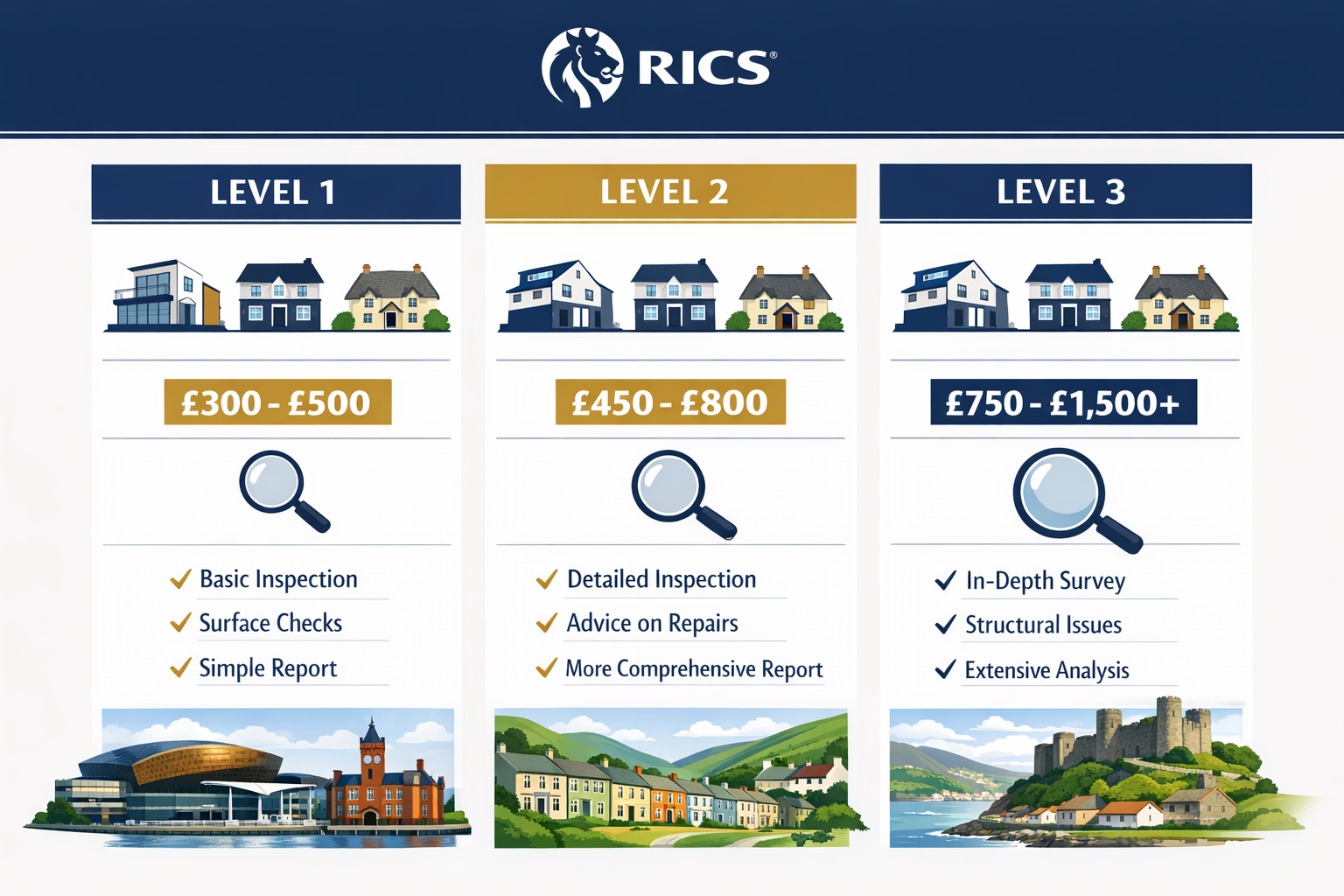
- RICS maintains three distinct survey levels in 2026: Level 1 (£300-£500), Level 2 (£450-£800), and Level 3 (£750-£1,500+), each tailored to different property types and buyer needs[2]
- Wales faces market complexity with declining construction activity and affordability challenges, despite increased attention to the region's housing sector[1]
- Updated RICS Home Survey Standard introduces clearer level descriptions ('basic,' 'intermediate,' 'advanced') and expanded scope definitions to improve consumer understanding[4]
- Professional accreditation matters: RICS-qualified surveyors provide independent advice, carry professional indemnity insurance, and follow strict quality protocols[2]
- Strategic survey selection based on property age, condition, and transaction value can prevent costly post-purchase surprises in Wales's diverse housing stock
Understanding RICS Survey Standards for Wales Housing Market in 2026
The Three-Tier RICS Survey Framework
The foundation of Building Survey Protocols for Wales Housing Boom: RICS Standards Amid 2026 Regional Price Surge rests on understanding RICS's comprehensive three-level survey system. This framework, which remains current throughout 2026, provides structured inspection protocols designed to match property characteristics with appropriate assessment depth[2].
Level 1: RICS Condition Report (£300-£500)
The most basic inspection tier, Level 1 surveys suit newer properties in good condition. This streamlined assessment provides:
- Visual inspection of accessible areas only
- Traffic light rating system (red, amber, green)
- No advice on repairs or ongoing maintenance
- Quick turnaround time (typically 24-48 hours)
- Ideal for new builds or properties less than 10 years old
For Welsh housing stock, Level 1 surveys rarely suffice given the prevalence of period properties and traditional construction methods throughout the region.
Level 2: RICS Home Buyer Report (£450-£800)
The most popular choice, Level 2 surveys strike a balance between cost and comprehensiveness. Key features include:
- More detailed visual inspection
- Identification of urgent defects and potential issues
- Advice on repairs and ongoing maintenance
- Market valuation included
- Suitable for conventional properties in reasonable condition
This level works well for standard Welsh terraced houses, semi-detached properties, and modern estates built within the last 50 years.
Level 3: RICS Building Survey (£750-£1,500+)
The most thorough option, Level 3 building surveys provide comprehensive analysis essential for complex Welsh properties. This detailed assessment includes:
- In-depth inspection of all accessible areas
- Detailed defect analysis with technical descriptions
- Advice on repairs, maintenance, and future considerations
- No market valuation (unless separately commissioned)
- Essential for period properties, unusual construction, or properties requiring renovation
Given Wales's rich architectural heritage—from Georgian townhouses to Victorian terraces and traditional stone cottages—Level 3 surveys often represent the most appropriate choice for Welsh property transactions[2].
Recent Updates to RICS Home Survey Standards
RICS actively revises its Home Survey Standard to maintain relevance amid evolving market conditions. The 2026 updates introduce several significant enhancements that directly impact Building Survey Protocols for Wales Housing Boom: RICS Standards Amid 2026 Regional Price Surge[4].
Enhanced Level Descriptions
The revised standard employs clearer terminology:
- Basic (Level 1): Entry-level inspection for low-risk properties
- Intermediate (Level 2): Standard inspection for typical properties
- Advanced (Level 3): Comprehensive inspection for complex properties
This simplified language helps Welsh property buyers understand which survey level matches their needs, reducing confusion and improving decision-making.
Expanded Scope Definitions
Section 4 of the updated standard now provides detailed progression showing how reporting builds from level to level. Appendix A differentiates inspection depth requirements, clarifying what surveyors must examine at each tier[4].
For Welsh properties, this means:
- Clearer expectations around what surveyors will and won't inspect
- Standardized reporting across different surveying firms
- Better value assessment when comparing survey quotes
- Improved consumer protection through consistent quality standards
RICS Accreditation and Professional Assurance
Understanding what chartered surveyors do and why their credentials matter forms a crucial component of survey protocol compliance. RICS-accredited surveyors provide several essential assurances[2]:
✅ Professional Training: Rigorous education and continuous professional development requirements
✅ Independent Advice: Impartial assessments free from conflicts of interest
✅ Insurance Protection: Professional indemnity insurance covering potential errors
✅ Ethical Standards: Adherence to RICS Code of Conduct and disciplinary procedures
✅ Quality Assurance: Regular audits and peer review processes
Before commissioning any survey in Wales, buyers should verify surveyor credentials through the RICS directory, ensuring the professional holds current membership and relevant specializations.
Wales Housing Market Context: Challenges and Opportunities in 2026
Current State of Welsh Construction and Property Sectors
Contrary to assumptions of a straightforward "boom," the Welsh housing market in 2026 presents a nuanced picture requiring careful analysis. Recent RICS data reveals several concerning trends that impact Building Survey Protocols for Wales Housing Boom: RICS Standards Amid 2026 Regional Price Surge[1].
Construction Activity Challenges
The RICS Wales Manifesto 2026, launched ahead of Senedd elections, identifies several critical issues:
- Lost momentum: Construction activity has slowed rather than accelerated
- Commercial softening: Demand in commercial property sectors has weakened
- Skills shortages: Persistent gaps in qualified construction professionals constrain growth
- Fragile confidence: RICS members report increasingly uncertain market sentiment[1]
These factors create a complex environment where survey protocols must account for potential quality variations in recent construction, delayed maintenance due to economic pressures, and properties that may have been on the market longer than typical.
Affordability Barriers Persist
Despite Welsh Government investment in social housing, affordability remains a significant barrier for both renters and buyers[1]. This creates several implications for building surveys:
| Affordability Impact | Survey Consideration |
|---|---|
| Buyers stretching budgets | Greater need for comprehensive defect identification |
| Deferred maintenance | Increased likelihood of hidden issues |
| First-time buyer dominance | Higher demand for survey education and guidance |
| Limited renovation budgets | Critical importance of accurate repair cost estimates |
Grid Capacity and Infrastructure Constraints
RICS identifies grid capacity constraints as a major barrier not only to housing delivery but also to Wales's green energy ambitions[1]. For surveyors, this means:
- Properties may lack adequate electrical infrastructure for modern demands
- EV charging installation potential requires assessment
- Solar panel viability depends on grid connection capacity
- Future-proofing considerations become more critical
RICS Wales Manifesto 2026: Policy Priorities
The bilingual RICS Maniffesto Cymru 2026 outlines three core themes directly relevant to survey protocols[1][3]:
1. Homes and Places That Work
RICS calls for development of a comprehensive housing delivery strategy through:
- Cross-tenure targets balancing social, affordable, and market housing
- Clear development ambitions with realistic timelines
- Functional planning systems with specialist skills in developer contributions
- Biodiversity net gain expertise integrated into planning processes
For surveyors, this policy focus suggests increased scrutiny of planning compliance and environmental considerations in survey reports.
2. Wales's Green Transformation
The manifesto emphasizes Wales's potential as a global leader in green energy, requiring:
- Enhanced assessment of energy efficiency in existing stock
- Evaluation of renewable energy installation potential
- Consideration of retrofit requirements for older properties
- Understanding of Welsh Government's decarbonization targets
Survey protocols must increasingly incorporate energy performance considerations and sustainability assessments.
3. Skills for the Future Built Environment
With the sector contributing over £17 billion annually to the Welsh economy[5], skills development remains paramount. This includes:
- Continued professional development for existing surveyors
- Training in emerging technologies (thermal imaging, drone surveys)
- Specialization in Welsh building types and construction methods
- Understanding of bilingual reporting requirements
Regional Variations Across Wales
Wales's diverse geography creates distinct regional survey considerations:
South Wales Valleys
- Terraced housing predominance
- Historic mining subsidence risks
- Traditional stone and slate construction
- Damp and drainage challenges in valley locations
Cardiff and Urban Centers
- Mix of Victorian, Edwardian, and modern stock
- Apartment and flat conversions
- Leasehold considerations
- Higher transaction volumes
North Wales Coastal
- Exposure to harsh weather conditions
- Salt air corrosion concerns
- Tourism property conversions
- Seasonal occupancy issues
Rural Mid-Wales
- Traditional stone cottages
- Agricultural building conversions
- Septic tank systems
- Access and services limitations
Understanding these regional variations ensures survey protocols address location-specific risks effectively.
Implementing Effective Building Survey Protocols for Welsh Properties
Pre-Survey Preparation and Property Assessment
Effective Building Survey Protocols for Wales Housing Boom: RICS Standards Amid 2026 Regional Price Surge begin before the surveyor arrives on-site. Comprehensive preparation ensures thorough, efficient inspections that capture all relevant defects and considerations.
Initial Property Research
Before scheduling the survey, gather essential information:
- Property age and construction type: Victorian terraces require different protocols than 1960s estates
- Previous survey reports: If available, review historical assessments
- Planning history: Check for extensions, conversions, or alterations
- Local authority records: Identify listed building status or conservation area restrictions
- Environmental data: Review flood risk, radon, and mining reports
This research phase helps surveyors anticipate likely issues and allocate appropriate inspection time. For Welsh properties, particular attention to traditional construction methods and local building materials proves essential.
Selecting the Appropriate Survey Level
Choosing between survey types requires careful consideration of multiple factors:
| Property Characteristic | Recommended Survey Level | Rationale |
|---|---|---|
| New build (under 10 years) | Level 1 or 2 | NHBC warranty coverage, modern construction |
| Standard home (1950s-1990s) | Level 2 | Conventional construction, predictable issues |
| Period property (pre-1950) | Level 3 | Traditional methods, hidden defects likely |
| Unusual construction | Level 3 | Specialist knowledge required |
| Visible defects present | Level 3 | Comprehensive investigation needed |
| Listed building | Level 3 | Conservation requirements, specialist materials |
For the majority of Welsh housing stock—which skews older and includes substantial Victorian and Edwardian heritage—Level 3 surveys typically represent the most prudent investment[2].
Critical Defect Identification Checklists for Welsh Properties
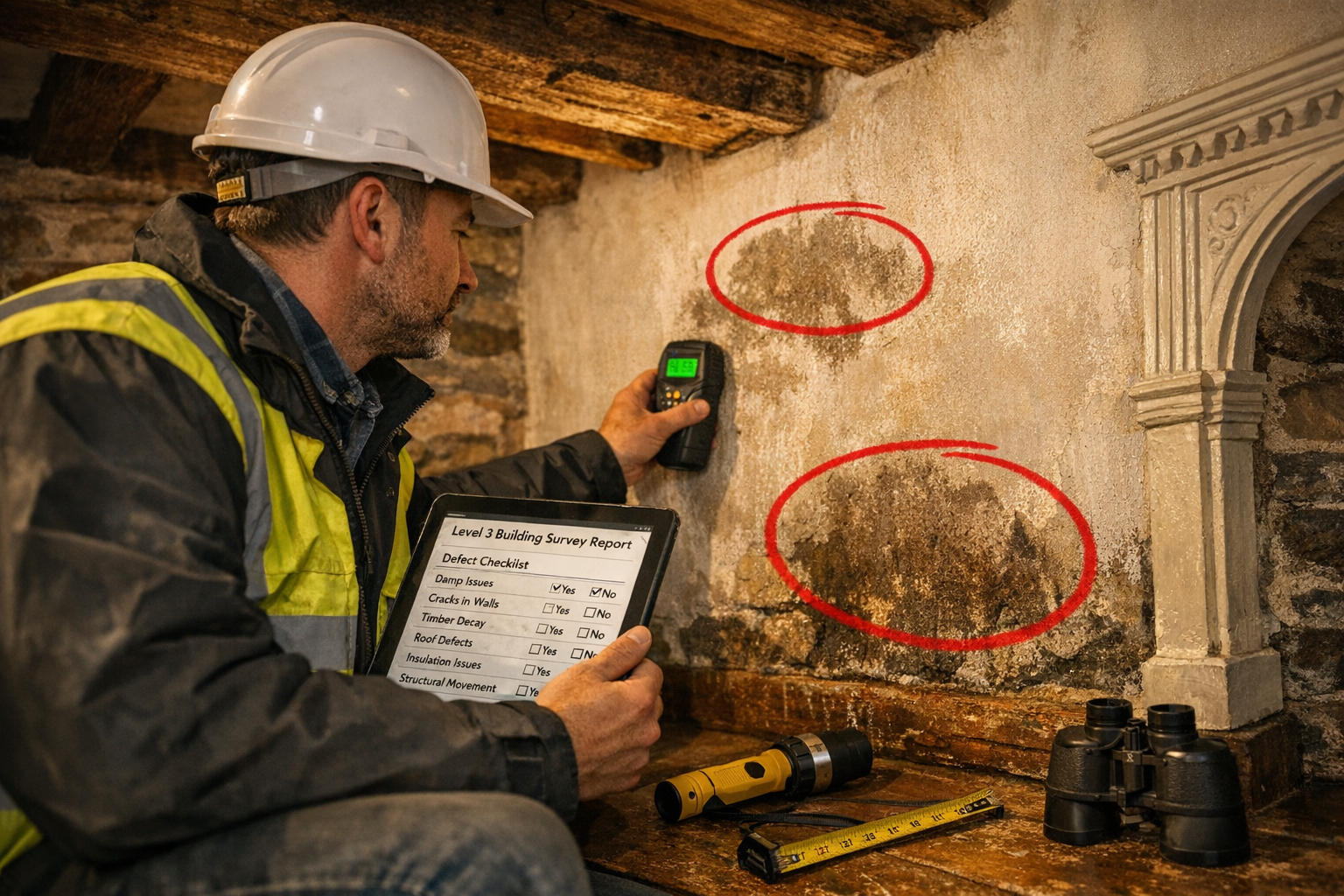
Comprehensive building surveys follow systematic checklists ensuring no critical elements escape scrutiny. The following protocols address common Welsh property concerns:
Structural Elements
✔️ Foundations and Subsidence
- Crack pattern analysis (width, direction, location)
- Settlement indicators around doors and windows
- Differential movement between building sections
- Subsidence risk factors including clay soils and tree proximity
- Mining subsidence considerations in former coalfield areas
✔️ Walls and Masonry
- Stone pointing condition and mortar type
- Cavity wall tie corrosion (1920s-1980s properties)
- Solid wall construction moisture penetration
- Render condition and detachment risks
- Bulging or leaning walls indicating structural movement
✔️ Roof Structure
- Welsh slate condition and delamination
- Timber roof structure (rafters, purlins, ridge boards)
- Sarking board condition in older properties
- Roof spread indicators
- Valley and flashing integrity
Building Services
✔️ Electrical Systems
- Consumer unit age and type
- Wiring condition and earthing arrangements
- Adequacy for modern electrical demands
- Evidence of DIY modifications
- Compliance with current regulations
✔️ Heating and Plumbing
- Boiler age, type, and service history
- Radiator system condition
- Water pressure and flow rates
- Pipe materials (lead, copper, plastic)
- Hot water cylinder condition
✔️ Drainage
- Foul and surface water drainage systems
- Soakaway functionality
- Septic tank condition (rural properties)
- Gulley and downpipe condition
- Evidence of blocked or collapsed drains
Moisture and Weatherproofing
✔️ Damp Issues
- Rising damp indicators and DPC presence
- Penetrating damp from defective rainwater goods
- Condensation and ventilation adequacy
- Moisture meter readings in suspect areas
- Previous damp-proofing work effectiveness
✔️ Windows and Doors
- Frame condition (timber rot, metal corrosion)
- Glazing integrity and thermal performance
- Opening mechanism functionality
- Weathersealing condition
- Listed building compliance for replacements
Technology Integration in Modern Survey Protocols
Contemporary building surveys increasingly incorporate advanced technologies that enhance defect identification and reporting quality:
Thermal Imaging
- Identifies hidden moisture penetration
- Reveals insulation gaps and thermal bridging
- Detects heating system inefficiencies
- Provides visual evidence for reports
- Safe inspection of high-level elements
- Comprehensive roof surveys without scaffolding
- Detailed photographic evidence
- Particularly valuable for Welsh properties with steep slate roofs
Moisture Detection Equipment
- Non-invasive moisture meters
- Deep-wall probes for solid wall construction
- Hygrometers for relative humidity assessment
- Thermal hygrometers combining temperature and moisture data
Digital Reporting Platforms
- Tablet-based on-site data capture
- Integrated photography with automatic location tagging
- Standardized templates ensuring consistency
- Client portals for report delivery and queries
Compliance Considerations Specific to Wales
Survey protocols in Wales must account for several jurisdiction-specific requirements:
Bilingual Considerations
- Welsh Language Standards may apply to some reports
- Property marketing materials often bilingual
- Local authority communications in Welsh and English
- Understanding of Welsh place names and terminology
Building Regulations Differences
- Wales operates separate Building Regulations from England
- Part L (Conservation of fuel and power) has distinct Welsh requirements
- Approved Document 7 applies specifically to Wales
- Different notification and certification processes
Planning Policy Context
- Future Wales: The National Plan 2040 shapes development
- Strategic Development Plans for specific regions
- Local Development Plans at authority level
- Technical Advice Notes (TANs) provide detailed guidance
Environmental and Heritage Protections
- Cadw (Welsh historic environment service) listed building controls
- Special Landscape Areas unique to Wales
- Welsh Government environmental designations
- Natural Resources Wales flood risk data
Practical Applications: Survey Protocols in Welsh Property Transactions
Case Study Scenarios: Applying RICS Standards
Understanding how Building Survey Protocols for Wales Housing Boom: RICS Standards Amid 2026 Regional Price Surge apply in real-world situations helps illustrate their practical value.
Scenario 1: Victorian Terraced House in Valleys Town
Property: 1890s three-bedroom terraced house, Merthyr Tydfil
Survey Type: Level 3 Building Survey
Key Findings:
- Slate roof nearing end of serviceable life (£12,000-£15,000 replacement)
- Rising damp due to absent DPC (£3,000-£4,000 chemical injection)
- Single-glazed sash windows requiring replacement (£8,000-£10,000)
- Outdated electrical system needing rewire (£4,000-£5,000)
Protocol Application: The comprehensive Level 3 survey identified £27,000-£34,000 in essential works, enabling the buyer to renegotiate the purchase price by £25,000. Without this detailed assessment, these costs would have created significant financial strain post-purchase.
Scenario 2: 1960s Semi-Detached House in Cardiff Suburb
Property: 1967 three-bedroom semi-detached, Whitchurch
Survey Type: Level 2 Home Buyer Report
Key Findings:
- Cavity wall insulation causing damp issues (£2,000 remediation)
- Original boiler requiring replacement (£2,500-£3,000)
- Minor roof tile slippage (£500-£800)
- Adequate for property type and age
Protocol Application: The Level 2 survey appropriately matched the property's standard construction and condition, identifying necessary works without excessive cost. The buyer proceeded with purchase, budgeting £5,000 for immediate repairs.
Scenario 3: Listed Stone Cottage in Snowdonia
Property: 1780s Grade II listed cottage, Betws-y-Coed
Survey Type: Level 3 Building Survey with specialist heritage input
Key Findings:
- Lime mortar repointing required (£8,000-£10,000)
- Traditional slate roof in good condition
- Single-skin stone walls with no DPC (characteristic of age)
- Septic tank system requiring upgrade (£5,000-£7,000)
- Listed building consent required for any alterations
Protocol Application: The specialist Level 3 survey distinguished between defects requiring urgent attention and characteristics typical of the property's age and protected status. The surveyor's understanding of traditional Welsh construction methods and conservation requirements proved essential, guiding the buyer toward sympathetic maintenance approaches.
Survey Report Interpretation and Action Planning
Receiving a comprehensive survey report can feel overwhelming, particularly for first-time buyers. Understanding how to interpret findings and prioritize actions proves crucial:
Traffic Light System
Most RICS surveys employ a condition rating system:
🔴 Condition 3 (Red): Urgent defects requiring immediate attention
- Structural issues affecting stability
- Active water ingress
- Hazardous electrical or gas installations
- Serious safety concerns
🟠 Condition 2 (Amber): Defects requiring repair or replacement
- Aging building components nearing end of life
- Minor structural movement requiring monitoring
- Maintenance items that will worsen if neglected
- Efficiency improvements recommended
🟢 Condition 1 (Green): No repair currently needed
- Elements in satisfactory condition
- Normal wear appropriate to age
- Routine maintenance sufficient
Creating a Prioritized Action Plan
After receiving your comprehensive survey report, develop a structured response:
-
Pre-Purchase Negotiations (Red items)
- Request price reduction reflecting urgent repair costs
- Require vendor to complete critical repairs before completion
- Consider withdrawing if issues exceed acceptable risk
-
Year One Priorities (Amber items with deterioration risk)
- Budget for repairs within first 12 months
- Obtain specialist quotes for major works
- Schedule interventions to prevent further damage
-
Medium-Term Planning (Amber items with stable condition)
- Plan for replacement within 3-5 years
- Set aside maintenance reserves
- Monitor condition through regular inspections
-
Long-Term Maintenance (Green items)
- Establish routine maintenance schedule
- Budget for eventual replacement
- Keep records of all works completed
Cost-Benefit Analysis: Survey Investment vs. Risk Exposure
Many buyers question whether comprehensive surveys justify their cost. The financial analysis consistently demonstrates their value:
Survey Cost vs. Hidden Defect Exposure
| Survey Level | Typical Cost | Defects Identified | Potential Savings | ROI |
|---|---|---|---|---|
| No Survey | £0 | Unknown | -£15,000 (average hidden costs) | -100% |
| Level 1 | £400 | Limited | £2,000-£5,000 | 400-1,150% |
| Level 2 | £600 | Moderate | £5,000-£15,000 | 730-2,400% |
| Level 3 | £1,200 | Comprehensive | £10,000-£40,000 | 730-3,230% |
Note: ROI calculated as (Potential Savings – Survey Cost) / Survey Cost × 100
Real-World Financial Impact
Consider a typical Welsh property purchase:
- Purchase price: £250,000
- Level 3 survey cost: £1,200 (0.48% of purchase price)
- Defects identified: £18,000 in necessary repairs
- Price renegotiation: £15,000 reduction
- Net benefit: £13,800
The survey investment represents less than half of one percent of the purchase price while delivering a return exceeding 1,000%. Even if no price reduction proves possible, the buyer gains essential knowledge for budgeting and planning.
Working with RICS Surveyors: Best Practices for Clients
Maximizing the value of your building survey requires effective collaboration with your chosen surveyor:
Before the Survey
📋 Provide Complete Information
- Share any concerns or specific areas of interest
- Disclose previous survey reports or known issues
- Provide access to all areas including lofts and cellars
- Ensure utilities are connected for testing
📋 Ask the Right Questions
- Confirm surveyor's RICS membership status
- Verify relevant experience with similar Welsh properties
- Clarify what is and isn't included in the survey scope
- Understand the reporting timeline and format
During the Survey
📋 Attendance Considerations
- Attend the survey if the surveyor permits (not always possible)
- Avoid interfering with the inspection process
- Take the opportunity to ask questions about the property
- Note any areas of particular concern for discussion
After the Survey
📋 Report Review and Follow-Up
- Read the entire report carefully, not just the summary
- Highlight areas requiring clarification
- Request a follow-up call to discuss findings
- Obtain recommendations for specialist investigations if needed
Future-Proofing Welsh Property Investments Through Rigorous Survey Protocols
Emerging Trends in Welsh Property Surveying
The landscape of Building Survey Protocols for Wales Housing Boom: RICS Standards Amid 2026 Regional Price Surge continues evolving in response to technological advances, regulatory changes, and environmental priorities.
Sustainability and Energy Efficiency Integration
Modern surveys increasingly incorporate:
- EPC rating implications and improvement pathways
- Renewable energy installation potential (solar, heat pumps)
- Retrofit requirements for older properties
- Whole-life carbon considerations
- Welsh Government decarbonization target alignment
Digital Transformation
Technology reshapes survey delivery:
- Virtual reality property walkthroughs with annotated defects
- AI-assisted defect identification and categorization
- Blockchain-verified survey credentials and reports
- Real-time client portals for survey progress tracking
- Integration with property transaction platforms
Climate Resilience Assessment
Wales's exposure to climate change impacts requires new survey considerations:
- Flood risk assessment and resilience measures
- Coastal erosion implications for properties near the sea
- Extreme weather resistance (wind, rain, temperature)
- Natural Resources Wales data integration
- Future insurability considerations
The RICS Wales Conference 2026: Shaping Professional Standards
The RICS Wales Conference 2026 examines how the profession responds to political, economic, and environmental change[5]. Key themes directly relevant to survey protocols include:
Project Delivery Excellence
- Maintaining quality standards amid market pressures
- Efficient survey processes without compromising thoroughness
- Technology adoption for improved accuracy and consistency
- Client communication and expectation management
Skills Development Priorities
- Continuous professional development in emerging areas
- Welsh building type specialization
- Heritage property expertise
- Sustainability assessment competencies
Sustainability Leadership
- Positioning surveyors as sustainability advisors
- Integrating environmental considerations throughout survey processes
- Supporting Wales's net-zero ambitions
- Educating clients on energy efficiency opportunities
The conference reinforces that the built and natural environment contributes over £17 billion annually to the Welsh economy[5], underscoring the critical importance of maintaining rigorous professional standards.
Regulatory Outlook: Anticipated Changes Affecting Survey Protocols
Several regulatory developments on the horizon will impact Building Survey Protocols for Wales Housing Boom: RICS Standards Amid 2026 Regional Price Surge:
Enhanced Energy Performance Requirements
- Stricter minimum EPC ratings for rental properties
- Potential extension of standards to owner-occupied homes
- Survey protocols must assess compliance pathways
- Cost implications for bringing properties to standard
Building Safety Act Implementation
- Continued rollout of enhanced safety standards
- Higher-risk building registration and oversight
- Surveyor responsibilities for identifying safety concerns
- Accountability frameworks for professional advice
Planning Reform in Wales
- Future Wales: The National Plan 2040 implementation
- Regional Strategic Development Plans
- Biodiversity net gain requirements
- Survey protocols must consider planning compliance
Welsh Language Standards Extension
- Potential expansion of bilingual requirements
- Survey report accessibility in Welsh
- Professional terminology standardization
- Cultural competency expectations
Conclusion
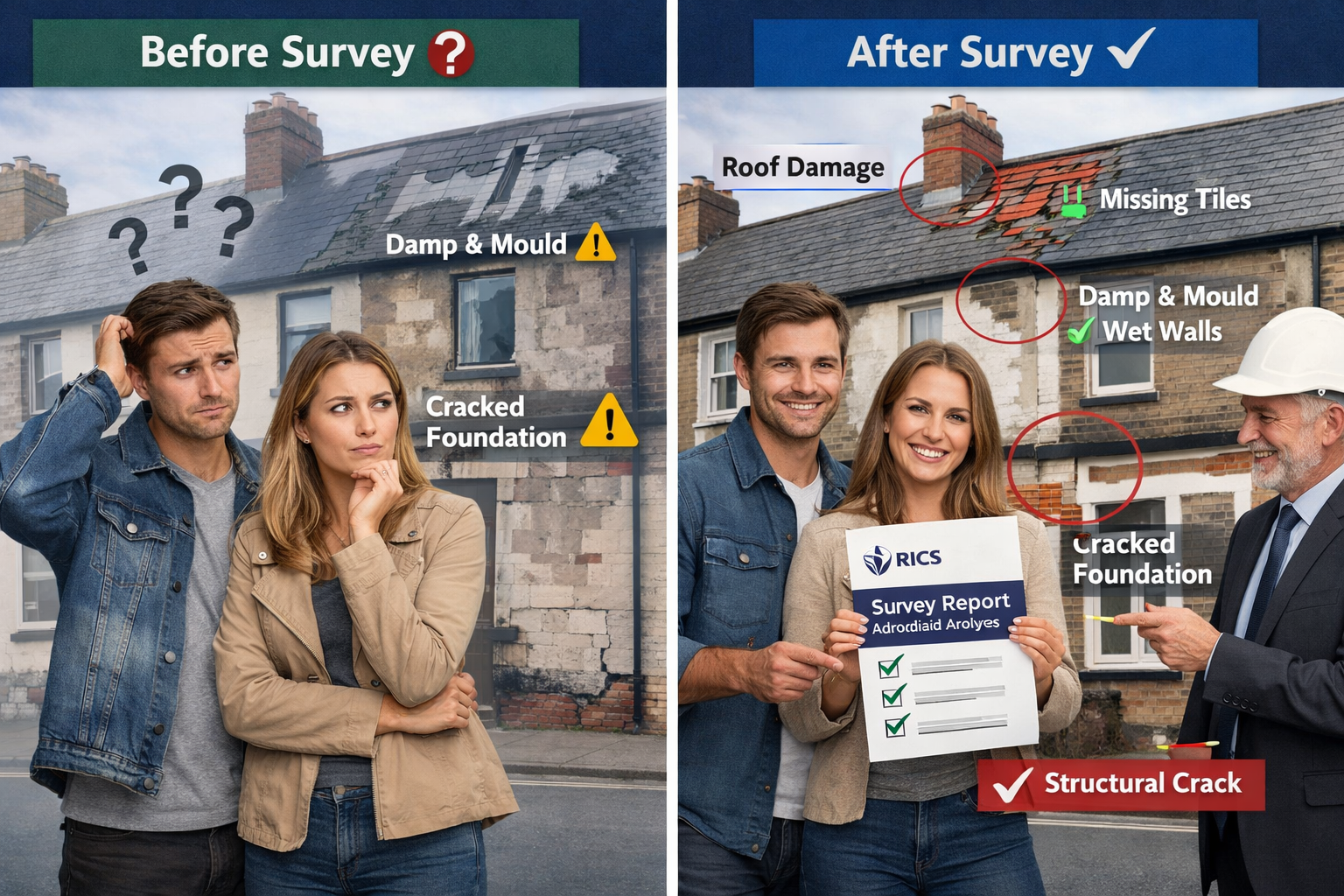
Building Survey Protocols for Wales Housing Boom: RICS Standards Amid 2026 Regional Price Surge represents far more than a technical compliance exercise—it forms the foundation of informed property investment decisions in one of the UK's most distinctive housing markets. While Wales faces complex challenges including construction momentum loss, affordability barriers, and infrastructure constraints, rigorous adherence to RICS survey standards provides essential protection for buyers, sellers, and investors navigating these conditions.
The three-tier RICS survey framework—Level 1 for low-risk properties, Level 2 for standard homes, and Level 3 for complex or period properties—offers structured approaches tailored to different risk profiles. For Wales's predominantly older housing stock, comprehensive Level 3 building surveys frequently represent the most prudent investment, identifying defects that could otherwise cost tens of thousands of pounds in unexpected repairs.
Recent updates to RICS Home Survey Standards enhance clarity and consistency, with clearer level descriptions and expanded scope definitions improving consumer understanding. As RICS continues refining professional standards through initiatives like the Wales Manifesto 2026 and Wales Conference 2026, surveyors must maintain continuous professional development to deliver the expertise Welsh property transactions demand.
Actionable Next Steps
For Property Buyers:
- Select the appropriate survey level based on property age, condition, and construction type—when in doubt, choose the more comprehensive option
- Verify surveyor credentials through the RICS directory, ensuring relevant Welsh property experience
- Review the complete report carefully, not just the summary, and request clarification on any unclear findings
- Develop a prioritized action plan addressing urgent defects before purchase and planning for medium-term maintenance
- Use survey findings to negotiate purchase price reductions or request vendor-completed repairs
For Property Professionals:
- Stay current with RICS standard updates and Welsh regulatory developments affecting survey requirements
- Invest in technology including thermal imaging, drone surveys, and digital reporting platforms
- Develop Welsh property specialization understanding traditional construction methods and regional variations
- Enhance sustainability expertise to advise clients on energy efficiency and decarbonization pathways
- Participate in professional development through RICS Wales events and continuing education programs
For Policymakers and Stakeholders:
- Support surveyor skills development addressing the critical shortages identified in the RICS Wales Manifesto
- Ensure planning system functionality with specialist expertise in areas like biodiversity net gain
- Address infrastructure constraints particularly grid capacity limitations affecting property development
- Maintain professional standards through adequate regulatory oversight and enforcement
- Promote survey awareness educating buyers about the value of comprehensive property assessments
The Welsh housing market's future depends on maintaining rigorous professional standards that protect all parties in property transactions. By embracing comprehensive RICS survey protocols, leveraging emerging technologies, and prioritizing continuous improvement, surveyors can navigate market complexities while delivering the expert guidance that Welsh property buyers, sellers, and investors deserve.
Whether you're purchasing a Victorian terrace in the Valleys, a modern apartment in Cardiff, or a traditional stone cottage in rural Wales, investing in a thorough RICS survey conducted by a qualified professional remains the single most effective way to protect your property investment and ensure long-term satisfaction with your purchase decision.
References
[1] Wales Manifesto 2026 Launch – https://www.rics.org/news-insights/wales-manifesto-2026-launch
[2] What Is A Rics Survey 2025 – https://surveymatch.co.uk/what-is-a-rics-survey-2025/
[3] Uk Influence And Advocacy Update January 2026 – https://www.rics.org/news-insights/uk-influence-and-advocacy-update-january-2026
[4] Understanding The Rics Home Survey Standard Proposal – https://www.rics.org/news-insights/understanding-the-rics-home-survey-standard-proposal
[5] Wales Conference – https://www.rics.org/training-events/conferences/wales-conference
