
More than 100 severe maladministration findings have been recorded by the Housing Ombudsman in cases involving damp and mould, the majority linked directly to poor-quality inspections and inadequate diagnosis [5]. That single statistic exposes a systemic failure in how moisture problems are investigated across the UK. When a building survey flags serious damp, the next step matters enormously. Choosing between a contractor-led assessment and a chartered surveyor-led investigation is not a minor administrative decision, it is the difference between a lasting fix and a costly cycle of failed remediation. This article explains why the best professional damp investigation services: why chartered surveyors beat contractors for complex UK moisture problems is a distinction that regulators, landlords, and homeowners can no longer afford to ignore.
Key Takeaways
- Chartered surveyors provide independent, evidence-based damp investigations that are not influenced by a financial interest in selling remediation products.
- RICS guidance and the Housing Ombudsman both expect qualified, independent professionals to lead complex or disputed damp assessments [1][2].
- Awaab's Law, effective from October 2025, creates time-bound legal duties around damp investigation that make professional-standard documentation essential [7].
- Over 100 severe maladministration findings by the Housing Ombudsman are directly linked to inadequate damp inspections, a trend now driving a clear shift toward surveyor-led diagnosis [5].
- The emerging best-practice model for 2026 and beyond is surveyor diagnosis first, contractor remediation second.
Why the Damp Investigation Gap Matters in 2026
The UK housing stock is ageing. Millions of properties, Victorian terraces, post-war flats, converted period buildings, carry inherent vulnerabilities to moisture ingress, condensation, and rising damp. Yet for decades, the default response to a damp complaint has been to call a specialist contractor. That contractor arrives, identifies a problem that their product or service can treat, and issues a quote. The structural cause of the moisture is rarely interrogated independently.
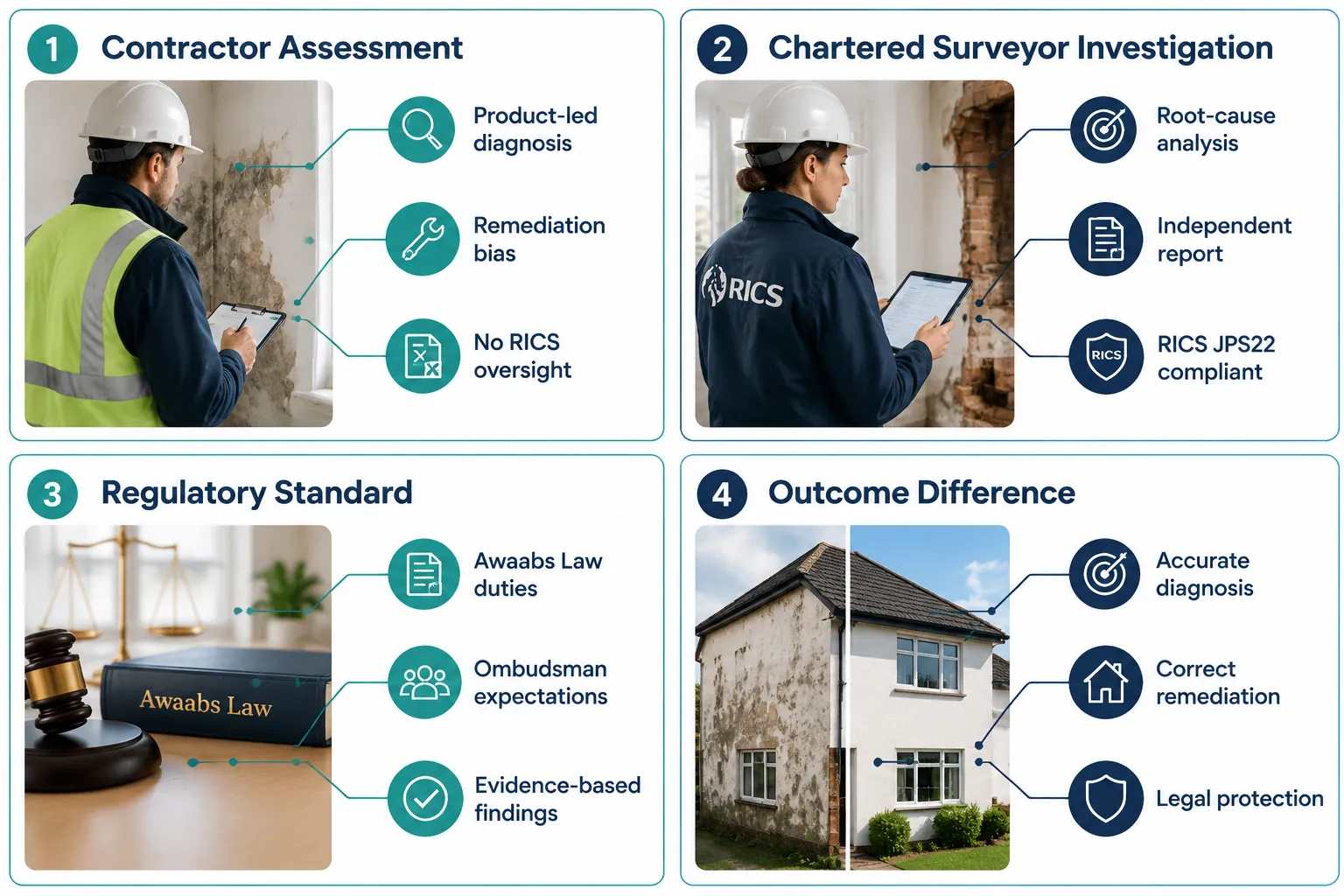
This model is now under serious regulatory pressure. The Housing Ombudsman's Spotlight on Damp and Mould report identified a persistent pattern: landlords and property managers relying on contractors whose assessments lacked independence, lacked technical rigour, and failed to distinguish between different moisture pathologies [2]. RICS, the professional body for chartered surveyors, has been equally direct, its consumer guidance explicitly advises against relying on assessments carried out by contractors who have a financial interest in selling a specific remedy [1].
The result is a growing consensus across the industry: for complex, recurring, or disputed damp problems, a chartered surveyor-led investigation is not a luxury. It is the professionally appropriate standard.
What Makes a Damp Problem "Complex"
Not every damp patch requires a full professional investigation. Surface condensation on a bathroom ceiling, for instance, is typically straightforward. Complexity arises when:
- Damp recurs after previous contractor treatment
- Multiple moisture types appear to be present simultaneously (rising damp, penetrating damp, and condensation can all present similarly)
- A building survey has flagged damp as a significant defect requiring specialist investigation
- The property is a period building with solid walls, a basement, or a flat roof
- A dispute exists between a landlord and tenant, or between a buyer and seller
- Legal proceedings or an insurance claim are involved
In each of these scenarios, the best professional damp investigation services: why chartered surveyors beat contractors for complex UK moisture problems becomes a practical question with real financial and legal consequences.
How Chartered Surveyors Approach Damp Investigation Differently
The fundamental difference between a contractor assessment and a chartered surveyor investigation is not equipment, it is objectivity and methodology.
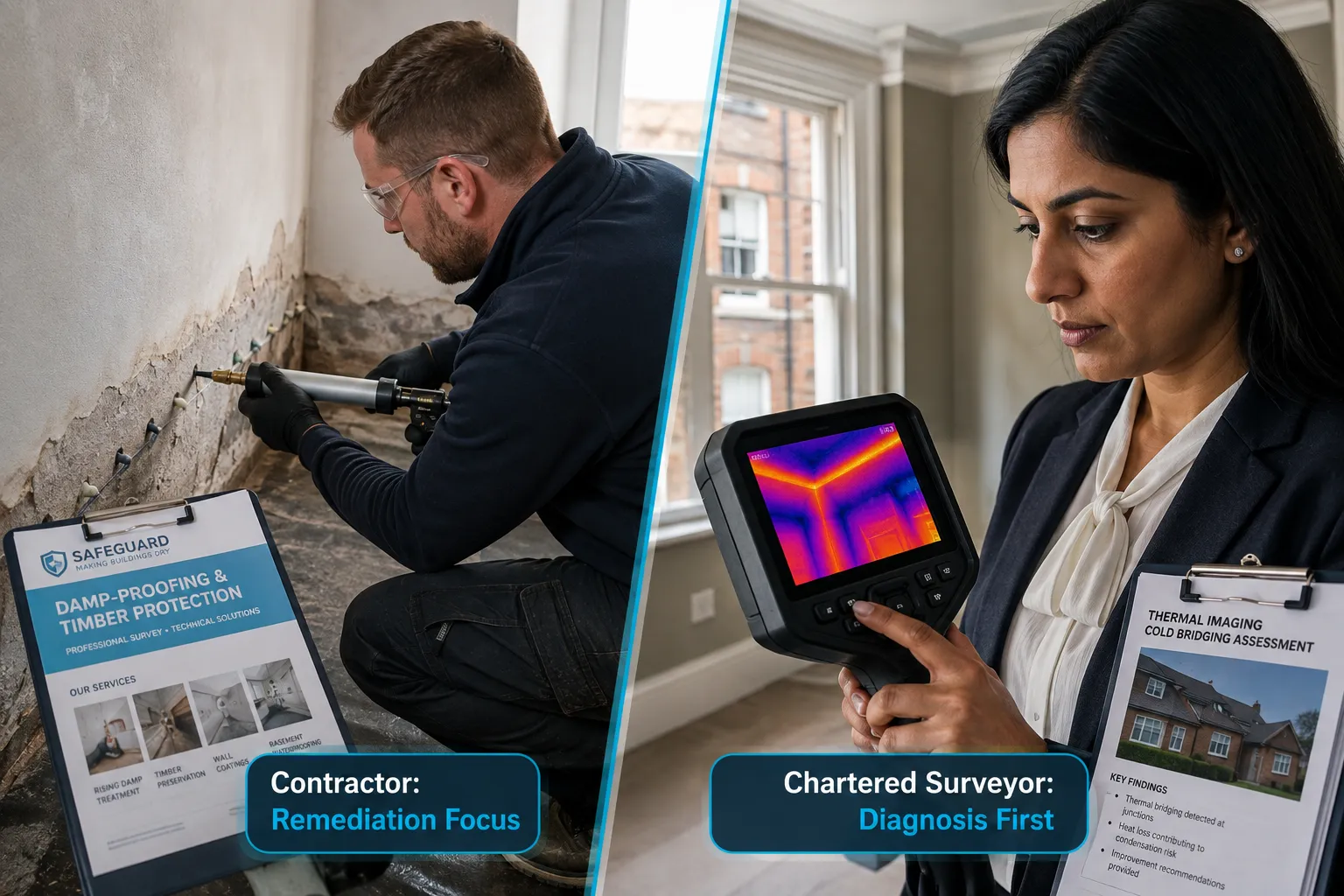
A damp-proofing contractor's business model depends on identifying problems that their products and services can resolve. That is not a criticism of individual contractors, it is a structural conflict of interest. RICS guidance is explicit that consumers should seek independent professional advice before commissioning any remediation work [1][6]. An independent chartered surveyor, by contrast, has no financial interest in any particular remedy. Their fee is for diagnosis, not treatment.
The Surveyor's Diagnostic Toolkit
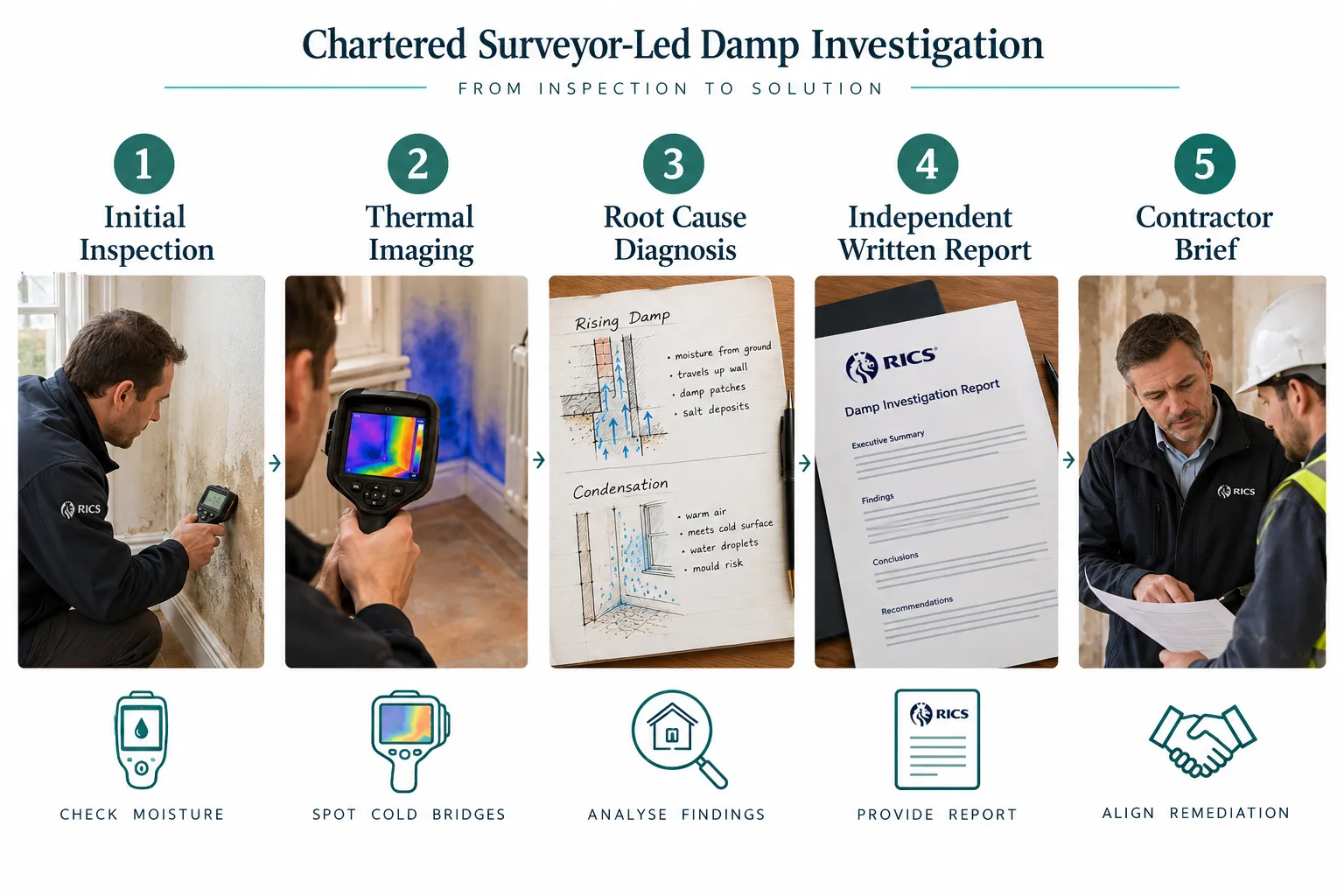
A chartered surveyor conducting a professional damp investigation will typically deploy:
- Calibrated moisture meters, measuring moisture content at multiple depths and locations to map the extent of dampness accurately
- Hygrometers and relative humidity monitoring, distinguishing condensation risk from structural moisture ingress
- Thermal imaging cameras, identifying cold bridges, insulation failures, and concealed moisture pathways invisible to the naked eye
- Borescopes, inspecting concealed cavities, wall ties, and subfloor voids without destructive opening-up
- Detailed visual inspection, examining roof drainage, external render, pointing, ground levels, and ventilation
Critically, the surveyor interprets these data points within the context of the building's construction, age, and exposure. A moisture reading of 20% in a Victorian solid brick wall means something entirely different from the same reading in a 1970s cavity wall. Contractors rarely possess, or apply, this level of building pathology knowledge.
Root-Cause Diagnosis vs Symptom Treatment
The most important distinction is this: chartered surveyors identify the cause; contractors treat the symptom.
"Independent, evidence-based investigation by a suitably qualified professional is the foundation of effective damp remediation. Without accurate diagnosis, remediation will fail."
Rising damp, for example, is frequently misdiagnosed. Research and RICS guidance both note that true rising damp, caused by a failed or absent damp-proof course, is far less common than is often claimed by contractors [6]. Condensation and interstitial moisture are far more prevalent, particularly in poorly ventilated modern homes and converted period properties. A contractor with a chemical injection product to sell has an incentive to diagnose rising damp. A chartered surveyor has an incentive to get the diagnosis right.
For homeowners who have already had a building survey and want to understand what a Level 3 assessment covers in terms of defect investigation, the guide to Level 3 Building Survey: a comprehensive example and guide provides useful context on how surveyors approach significant defects including moisture.
Regulatory Drivers: Awaab's Law and the Housing Ombudsman
The regulatory landscape in 2026 has shifted decisively in favour of professional-standard damp investigation. Two developments in particular are reshaping expectations.
Awaab's Law: Time-Bound Investigation Duties
Awaab's Law, named after two-year-old Awaab Ishak, who died in 2020 from a respiratory condition linked to mould in his social housing flat, came into force for social landlords from October 2025. It imposes strict statutory timeframes on landlords to investigate and remediate damp and mould hazards [7].
Under these duties, landlords must:
- Acknowledge a damp or mould complaint within a defined period
- Complete an investigation within a specified timeframe
- Begin remediation promptly where a hazard is identified
- Maintain documented evidence of the investigation process
The documentation requirement is critical. A contractor's quote is not an investigation report. Meeting Awaab's Law duties requires evidence of a structured, professional assessment. Chartered surveyor reports, with their calibrated measurements, photographic evidence, root-cause analysis, and remediation specifications, provide exactly that evidential standard.
Housing Ombudsman Expectations
The Housing Ombudsman has been unambiguous. Its published expectations for damp and mould cases state that investigations should be carried out by someone who is "suitably qualified and independent" [10]. Where a contractor carries out both the investigation and the remediation, that independence is absent.
The Ombudsman's learning from complaints, published in early 2025, reinforced this position, noting that weak investigations, failure to identify root causes, and over-reliance on contractor assessments were recurring factors in maladministration findings [9]. With over 100 severe maladministration cases now on record, the financial and reputational cost of inadequate investigation is no longer theoretical [5].
The Ombudsman's guidance on pre-action protocol for housing conditions claims further underscores the expectation that professional, documented investigation will precede any legal proceedings [8].
For landlords and property managers seeking to understand the legal framework around property defects and professional obligations, the overview of RICS Party Wall Surveyors: expert guidance for property disputes illustrates how RICS-regulated professionals operate within legal frameworks, a parallel that applies equally to damp investigation.
Comparing Chartered Surveyors and Contractors: A Practical Framework
The table below summarises the key differences between contractor-led and chartered surveyor-led damp assessments across the criteria that matter most for complex cases.
| Criterion | Contractor Assessment | Chartered Surveyor Investigation |
|---|---|---|
| Independence | Conflict of interest, sells the remedy | Fully independent, fee for diagnosis only |
| Regulatory recognition | Not recognised as independent by Ombudsman | Meets Housing Ombudsman independence standard [10] |
| Root-cause diagnosis | Typically symptom-focused | Full pathology analysis, building-type context |
| Report standard | Quote or survey report (variable quality) | RICS-compliant professional report |
| Awaab’s Law compliance | Unlikely to satisfy documentation duty | Provides required evidential standard [7] |
| Legal/insurance use | Limited weight in disputes | Accepted in legal proceedings and claims |
| Professional accountability | Trade body membership (variable) | RICS regulated, mandatory professional standards |
When to Commission a Chartered Surveyor for Damp Investigation
The surveyor-first model is now the emerging industry standard for 2026 and beyond. The practical question is when to apply it. The following situations call for a chartered surveyor investigation rather than a contractor assessment:
Post-building-survey referrals. When a Level 2 or Level 3 building survey identifies damp as a significant defect requiring further investigation, the next step should be a specialist surveyor report, not a contractor quote. A complete guide to building surveyors in London: services, costs and how to choose explains how building surveyors operate and when specialist referrals are appropriate.
Recurring or treatment-resistant damp. If a property has been treated by a contractor and the problem has returned, independent diagnosis is essential before any further remediation spend.
Disputed cases. Where a landlord-tenant dispute, insurance claim, or property purchase negotiation turns on the nature or cause of damp, a chartered surveyor's independent report carries evidential weight that a contractor's assessment does not.
Period and complex buildings. Victorian, Edwardian, and inter-war properties have construction details, solid walls, lime mortar, suspended timber floors, that require building pathology expertise to assess correctly. For properties in areas with high concentrations of period housing, local chartered surveyors with relevant experience are the appropriate resource. Those in South West London, for instance, can access Chartered Surveyors South West London, while homeowners in the Home Counties can find specialist support through Chartered Surveyors Sussex and Chartered Surveyors Hertfordshire.
Pre-legal proceedings. The Housing Ombudsman's guidance on pre-action protocol makes clear that professional investigation should precede any formal complaint or legal action [8]. Commissioning a chartered surveyor at this stage protects all parties.
The RICS Specific Defect Survey
For cases where damp is the primary concern, a targeted professional assessment rather than a full building survey may be the most cost-effective route. The RICS Specific Defect Survey is designed precisely for this scenario, focusing the surveyor's expertise on a defined defect, producing a professional report that meets regulatory and legal standards without the cost of a comprehensive building survey.
The Cost of Getting It Wrong
The financial argument for professional damp investigation is compelling. The Housing Ombudsman's maladministration findings have resulted in compensation awards to residents, alongside the cost of remediation work that failed because the diagnosis was wrong [5]. For homeowners, the consequences are equally stark: a misdiagnosed damp problem can lead to thousands of pounds spent on chemical injection, tanking, or replastering, none of which will work if the root cause is condensation from inadequate ventilation.
The RICS consumer guide on damp, mould, and moisture movement is explicit that the most common and costly error is treating the wrong type of damp [6]. Independent professional diagnosis eliminates that risk.
For homeowners weighing whether a professional survey represents good value, the analysis in why hiring a residential surveyor could save you thousands on your property purchase provides a broader financial case for professional assessment.
Conclusion
The question of who investigates damp in a UK property is no longer a matter of convenience or cost-cutting. Regulatory change, legal accountability, and a mounting record of failed contractor-only assessments have made the answer clear. The best professional damp investigation services: why chartered surveyors beat contractors for complex UK moisture problems is not an abstract debate, it is a practical framework that protects property owners, landlords, and residents from the consequences of misdiagnosis.
Actionable next steps for property owners and landlords in 2026:
- If a building survey has flagged damp, commission a chartered surveyor for specialist investigation before accepting any contractor quote.
- For recurring or treatment-resistant moisture problems, seek an independent RICS-regulated assessment to identify the true root cause.
- For social landlords, ensure your damp investigation process meets Awaab's Law documentation requirements, contractor quotes alone will not suffice.
- In any disputed or legally sensitive damp case, instruct a chartered surveyor whose report will carry weight with the Housing Ombudsman and in legal proceedings.
- Use the RICS Specific Defect Survey route for targeted, cost-effective professional diagnosis where a full building survey is not required.
To discuss a damp investigation with a RICS-regulated chartered surveyor, contact Notting Hill Surveyors for a free survey quote.
References
[1] Damp And Mould – https://www.rics.org/consumer-guides/damp-and-mould
[2] Spotlight On Damp And Mould – https://www.housing-ombudsman.org.uk/reports/spotlight-reports/spotlight-on-damp-and-mould/
[3] Housing Ombudsman Issues Call For Evidence On Investigation Into Damp And Mould – https://www.housing-ombudsman.org.uk/2021/04/13/housing-ombudsman-issues-call-for-evidence-on-investigation-into-damp-and-mould/
[4] Damp And Mould – https://www.housing-ombudsman.org.uk/centre-for-learning/support-guides/damp-and-mould/
[5] Over 100 Severe Maladministration Cases On Damp And Mould – https://www.housing-ombudsman.org.uk/2024/10/16/over-100-severe-maladministration-cases-on-damp-and-mould/
[6] Damp Mould Moisture Movement Consumer Guide – https://ww3.rics.org/uk/en/journals/built-environment-journal/damp-mould-moisture-movement-consumer-guide.html
[7] Awaabs Law – https://www.housing-ombudsman.org.uk/centre-for-learning/key-topics/awaabs-law/
[8] Guidance On Pre Action Protocol For Housing Conditions Claims And Service Complaints – https://www.housing-ombudsman.org.uk/landlords-info/guidance-notes/guidance-on-pre-action-protocol-for-housing-conditions-claims-and-service-complaints/
[9] Latest Learning From Complaints – https://www.housing-ombudsman.org.uk/2025/02/25/latest-learning-from-complaints/
[10] Damp And Mould Expectations – https://www.housing-ombudsman.org.uk/centre-for-learning/key-topics/damp-and-mould/damp-and-mould-expectations/