
More than £16 billion in remediation costs are estimated to be outstanding across England's unsafe-cladding estate — and west London, with its dense concentration of post-1980s high-rise residential blocks, sits squarely at the centre of the crisis. The May 2026 King's Speech introduced the proposed Remediation Bill, a landmark piece of draft legislation designed to force construction product manufacturers to foot the bill for unsafe cladding on buildings above 11 metres. For flat owners, leaseholders, buyers, and the 2026 Remediation Bill cladding EWS1 valuations west London surveyors community, this shift is seismic — and understanding it now is not optional.
Key Takeaways 🔑
- The proposed Remediation Bill (2026) aims to make product manufacturers — not leaseholders — pay for cladding remediation on buildings above 11 m.
- The Building Safety Act 2022 is already enacted law; the Remediation Bill is draft legislation and may still change.
- EWS1 forms remain a critical tool for mortgage lending decisions on high-rise flats in west London.
- PAS 9980:2022 is the current gold-standard framework for fire-risk appraisals of external walls.
- Mortgage lenders are cautiously re-engaging with affected buildings, but valuation uncertainty persists until remediation is complete.
Table of Contents
- Background: From Grenfell to the 2026 Remediation Bill
- What the Proposed Remediation Bill Actually Says
- The Building Safety Act vs the Remediation Bill: Key Differences
- EWS1 Forms in 2026: What West London Surveyors Must Know
- PAS 9980 and Fire-Risk Appraisals: The Current Framework
- Valuation Approaches for Buildings Awaiting or Undergoing Remediation
- How Mortgage Lenders Are Responding
- Practical Implications for West London Flat Owners and Buyers
- FAQ
- Conclusion
1. Background: From Grenfell to the 2026 Remediation Bill {#background}
The Grenfell Tower fire of June 2017 killed 72 people and exposed catastrophic failures in building safety regulation across the UK. In the years that followed, the government introduced a series of escalating measures: the Building Safety Act 2022, the Developer Remediation Contract, the Building Safety Levy, and leaseholder protections preventing qualifying leaseholders from being charged for cladding removal.
Yet by early 2026, thousands of buildings remained unremediated. According to government data published on gov.uk, fewer than half of all residential buildings above 18 metres with unsafe cladding had completed remediation as of early 2026. The government's Remediation Acceleration Plan, published in December 2024, set two headline targets:
| Building Height | Target Completion |
|---|---|
| 18 m and above | End of 2029 |
| 11 m to 18 m | Scheduled completion by end of 2029 |
The May 2026 King's Speech then introduced the proposed Remediation Bill — a new draft law specifically targeting construction product manufacturers who supplied non-compliant cladding materials. This is distinct from the developer-focused remediation already embedded in the Building Safety Act.
💬 "The Remediation Bill represents a fundamental shift in liability — moving the financial burden upstream to those who manufactured and sold unsafe products." — Property Week, 2026
2. What the Proposed Remediation Bill Actually Says {#what-bill-says}
The draft Remediation Bill — as announced in the May 2026 King's Speech — proposes to:
- Establish manufacturer liability for the cost of remediating unsafe cladding on residential buildings above 11 metres where their products are found to have been non-compliant or mis-sold.
- Create a new civil cause of action allowing building owners, freeholders, and the government to recover remediation costs directly from product manufacturers.
- Strengthen enforcement powers for the Building Safety Regulator to compel manufacturers to contribute to remediation funds.
- Extend limitation periods, so that claims relating to historical cladding failures are not time-barred.
⚠️ Important: The Remediation Bill is proposed legislation as of mid-2026. It has not yet received Royal Assent. Its provisions may change during parliamentary scrutiny. Surveyors and leaseholders should not treat it as enacted law.
The government has framed the Bill as complementary to — not a replacement for — the existing Building Safety Act framework. Developers who have already signed the Developer Remediation Contract remain bound by those obligations regardless of the Bill's progress.
3. The Building Safety Act vs the Remediation Bill: Key Differences {#bsa-vs-bill}
It is essential that surveyors and leaseholders understand the distinction between what is already law and what is proposed.
| Feature | Building Safety Act 2022 ✅ (Enacted) | Proposed Remediation Bill 2026 ⏳ (Draft) |
|---|---|---|
| Legal status | Enacted — in force | Draft — not yet law |
| Primary target | Developers and landlords | Construction product manufacturers |
| Leaseholder protections | Yes — qualifying leaseholders protected from cladding costs | Proposed extension of protections |
| Remediation funding | Developer-funded via contracts | Manufacturer-funded via new liability |
| Building height threshold | 11 m and above | 11 m and above |
| Enforcement body | Building Safety Regulator | Building Safety Regulator (enhanced powers proposed) |
For west London surveyors advising clients, this distinction matters enormously. A building's remediation pathway — and therefore its valuation and mortgageability — may look very different depending on whether the responsible party is a developer (already bound by law) or a manufacturer (awaiting the Bill's passage).
4. EWS1 Forms in 2026: What West London Surveyors Must Know {#ews1-surveyors}
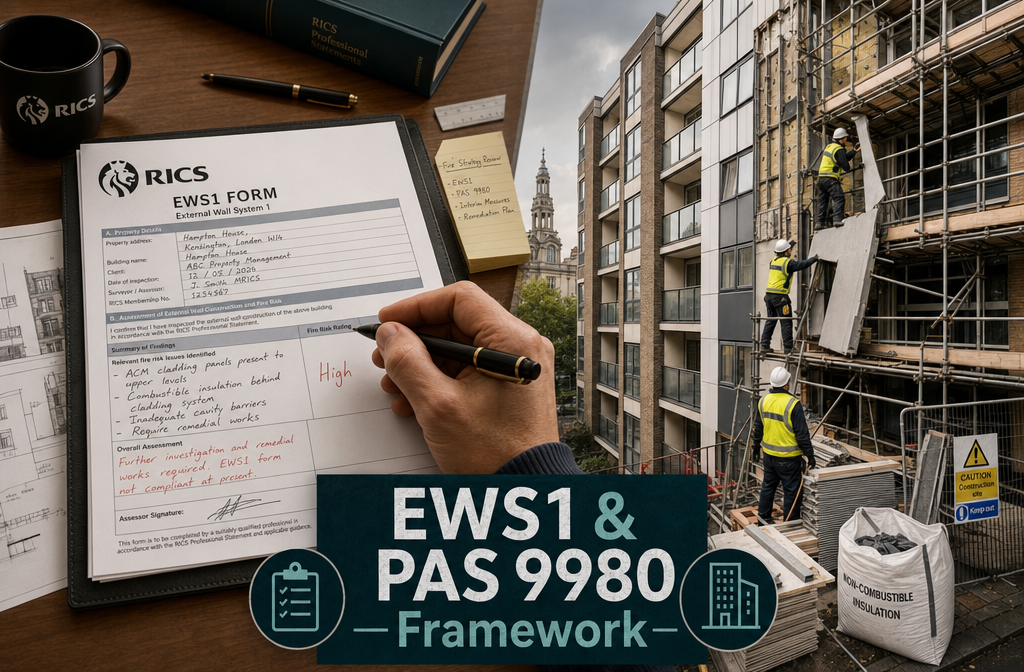
The External Wall System (EWS1) form was introduced by UK Finance and the Royal Institution of Chartered Surveyors (RICS) in December 2019. It allows mortgage lenders to assess the fire safety of a building's external wall before approving lending on individual flats.
In 2026, EWS1 forms remain a live requirement for many buildings in west London — particularly those between 11 m and 18 m that have not yet completed remediation. Here is what 2026 Remediation Bill cladding EWS1 valuations west London surveyors need to keep front of mind:
Who Can Complete an EWS1 Form?
Only competent professionals with demonstrable expertise in fire engineering or external wall systems can sign off an EWS1. RICS guidance specifies that signatories must have relevant qualifications and professional indemnity insurance. This has created a significant bottleneck — particularly in west London, where the volume of affected buildings is high.
EWS1 Outcomes and Their Valuation Impact
| EWS1 Outcome | Meaning | Valuation/Mortgage Impact |
|---|---|---|
| A1 | No combustible materials present | Lenders can proceed normally |
| A2 | Combustible materials present but low risk | Lenders may proceed; some restrictions |
| A3 | Combustible materials present; remediation needed | Significant valuation discount; many lenders decline |
| B1 | Cladding present; no remediation needed | Lenders can proceed with caveats |
| B2 | Cladding present; remediation required | Severe valuation impact; most lenders decline |
For our chartered surveyors in west London, navigating EWS1 outcomes on buildings caught between the Building Safety Act and the proposed Remediation Bill requires careful, up-to-date knowledge of both the legal landscape and lender appetite.
The 2023 RICS Guidance Update
RICS updated its EWS1 guidance in 2023 to reflect PAS 9980:2022, narrowing the circumstances in which an EWS1 is required. Buildings below 18 m are no longer automatically required to have an EWS1 — but lenders retain discretion to request one. In practice, many west London lenders still request EWS1 forms for buildings between 11 m and 18 m where there is any doubt about external wall composition.
5. PAS 9980 and Fire-Risk Appraisals: The Current Framework {#pas9980}
PAS 9980:2022 (Fire Risk Appraisal of External Wall Construction and Cladding of Existing Blocks of Flats) is the British Standards Institution's code of practice for assessing fire risk in external wall systems. It replaced earlier ad hoc guidance and provides a structured, proportionate methodology.
Key principles of PAS 9980 that surveyors must understand:
- 🔥 Risk-based, not prescriptive: PAS 9980 requires a holistic assessment of fire risk — not a simple pass/fail based on material type alone.
- 📋 Competence requirements: The appraisal must be carried out by a suitably qualified fire engineer or building professional.
- 🏗️ Consideration of mitigating factors: Sprinkler systems, compartmentation, alarm systems, and building management all affect the overall risk rating.
- 📐 Height matters, but is not the only factor: A 12-storey building with excellent compartmentation may present lower risk than a 7-storey building with poor fire stopping.
For surveyors completing EWS1 forms, PAS 9980 is now the mandatory underpinning framework. Any EWS1 assessment that does not reference PAS 9980 methodology is likely to be rejected by lenders and RICS alike.
Our team of RICS-qualified surveyors in south-west London regularly supports clients navigating PAS 9980 appraisals alongside EWS1 requirements, particularly in the Hammersmith, Fulham, and Putney corridors.

6. Valuation Approaches for Buildings Awaiting or Undergoing Remediation {#valuation}
Valuing a flat in a building with an outstanding EWS1 issue — or one that is mid-remediation — is one of the most technically demanding tasks a RICS valuer faces in 2026. The proposed 2026 Remediation Bill cladding EWS1 valuations west London surveyors landscape adds further complexity.
The Core Valuation Challenge
Standard "market value" methodology assumes a willing buyer and seller in an open market. But for buildings with unresolved cladding issues, the pool of willing buyers is dramatically reduced — often to cash buyers only. This suppresses market evidence and makes comparable analysis unreliable.
Three Valuation Approaches in Use
1. Adjusted Comparable Method
Valuers identify comparable sales in similar buildings without cladding issues, then apply a discount to reflect:
- The cost and timeline of remediation
- Uncertainty about funding (developer, manufacturer, or leaseholder)
- Reduced mortgage availability
2. Residual/Cost Approach
For buildings where remediation costs are known (e.g., a developer has committed to a schedule), valuers may calculate:
Market Value (post-remediation) − Estimated Remediation Cost − Risk Premium = Current Value
3. Existing Use Value with Special Assumptions
RICS Red Book guidance allows valuers to report on a "special assumption" basis — for example, assuming remediation is complete — alongside the actual market value. This dual reporting helps lenders and buyers understand the value gap.
💬 "Valuers must be transparent about the assumptions underpinning their figures. A valuation that ignores cladding risk is not just professionally negligent — it may be legally actionable." — RICS Valuation — Global Standards (Red Book)
For complex cases, our RICS valuations service provides detailed, defensible reports that meet lender requirements and reflect the current regulatory environment.
You may also find our guide on understanding the difference between Level 2 and Level 3 surveys useful when deciding what level of inspection a cladding-affected building requires.
7. How Mortgage Lenders Are Responding {#lenders}
Mortgage lender policy on cladding-affected buildings has evolved considerably since 2019, and 2026 brings further nuance.
Current Lender Positions (Mid-2026)
According to reporting by Mortgage Solutions and Inside Housing, the broad picture is:
- Major high-street lenders (Halifax, Nationwide, Barclays) will lend on buildings with an EWS1 A1 or B1 rating without restriction.
- Buildings with A2 ratings are accepted by most lenders, though some apply loan-to-value restrictions.
- Buildings with A3 or B2 ratings — indicating remediation is needed — remain largely unmortgageable with mainstream lenders. Specialist lenders may consider these at higher rates.
- Buildings mid-remediation with a confirmed developer or government funding commitment are increasingly being considered by some lenders, particularly where a remediation completion date is confirmed and the developer is a signatory to the Developer Remediation Contract.
The Impact of the Proposed Remediation Bill
The proposed Remediation Bill has created cautious optimism among lenders. If manufacturers are successfully pursued for costs, the funding gap that currently makes many buildings unmortgageable may close. However, lenders are not yet pricing in the Bill's passage — they are waiting for Royal Assent and, crucially, for the first successful manufacturer liability claims to be resolved.
As Property Week noted in mid-2026, lenders remain "watchful but not yet willing to move the needle on policy until the Bill is law and tested in the courts."
8. Practical Implications for West London Flat Owners and Buyers {#practical}
If you own or are buying a flat in west London, here is what the current landscape means for you in plain terms:
✅ If You Are a Leaseholder in a Remediated Building
- Ensure your building has a completed EWS1 form with an A1 or B1 outcome.
- Check that your landlord or freeholder has registered with the Building Safety Regulator.
- You should not be charged for cladding remediation costs if you are a qualifying leaseholder under the Building Safety Act 2022.
⏳ If Your Building Is Awaiting Remediation
- Ask your building manager or freeholder whether a developer or manufacturer has accepted liability.
- Request a copy of any remediation schedule and funding confirmation.
- Speak to a chartered surveyor in north-west London or your local area about obtaining a current EWS1 assessment.
- Be aware that selling or re-mortgaging will be difficult until remediation is confirmed or complete.
🏠 If You Are Buying a Flat in West London
- Always commission a full building survey — our Level 3 building survey is the most thorough option for high-rise or complex buildings.
- Ask the seller to provide the current EWS1 form and any correspondence with the freeholder about remediation.
- Check whether the building is registered on the government's cladding remediation database.
- Factor in the risk that your chosen lender may not be willing to lend until remediation is complete.
Our chartered surveyors in Chelsea and Ealing regularly assist buyers navigating these exact scenarios.
FAQ {#faq}
Q1: Is the Remediation Bill already law in 2026?
No. The Remediation Bill was announced in the May 2026 King's Speech and is proposed draft legislation. It has not yet received Royal Assent. The Building Safety Act 2022 is the currently enacted law governing building safety and leaseholder protections.
Q2: Do I still need an EWS1 form if my building is under 18 metres?
Possibly. RICS guidance updated in 2023 means EWS1 forms are not automatically required for buildings below 18 m, but individual mortgage lenders retain the right to request one. In practice, many west London lenders still ask for EWS1 forms on buildings between 11 m and 18 m.
Q3: Can I sell my flat if it has a B2 EWS1 rating?
Yes, but your buyer pool will be largely limited to cash buyers. Most mainstream mortgage lenders will not lend on a B2-rated building. You may need to price your flat at a significant discount to reflect this.
Q4: Who pays for the EWS1 assessment?
This varies. In some cases, the freeholder or building owner commissions and pays for the EWS1 as part of their building safety obligations. In others, costs may be shared among leaseholders — though qualifying leaseholders under the Building Safety Act 2022 have protections against being charged for cladding-related costs.
Q5: What is PAS 9980 and why does it matter for my building?
PAS 9980:2022 is the British Standards Institution's framework for assessing fire risk in external wall systems. It is the methodology that competent professionals must use when completing EWS1 assessments. It ensures that risk is assessed proportionately — so a building is not automatically deemed unsafe just because it has some combustible materials present.
Q6: How does the proposed Remediation Bill affect my landlord's duty to remediate?
The Building Safety Act 2022 already places duties on landlords and freeholders to remediate unsafe cladding. The proposed Remediation Bill adds a new avenue — pursuing manufacturers for costs — but does not remove existing landlord duties. Your landlord remains obligated to remediate under current law, regardless of whether the Bill passes.
Conclusion {#conclusion}
The intersection of the proposed 2026 Remediation Bill, cladding liability, EWS1 assessments, and property valuations represents one of the most complex challenges facing the west London property market today. For flat owners, leaseholders, buyers, and the community of 2026 Remediation Bill cladding EWS1 valuations west London surveyors, staying informed is not just good practice — it is essential for protecting your financial interests.
Actionable Next Steps
- Leaseholders: Confirm your building's EWS1 status and remediation timeline with your freeholder. Keep records of all correspondence.
- Buyers: Always commission a professional survey before exchanging on any high-rise or medium-rise flat in west London.
- Surveyors: Ensure all EWS1 assessments reference PAS 9980:2022 methodology and that your professional indemnity insurance covers fire-risk appraisals.
- All parties: Monitor the Remediation Bill's progress through Parliament — its passage (or failure) will materially affect valuation and lending decisions.
- Seek specialist advice: Engage a RICS-qualified surveyor in west London who has direct experience of cladding-affected buildings and EWS1 assessments.
The cladding crisis is not over — but the legislative direction of travel is clear. Those who understand the framework now will be best placed to act decisively when the Remediation Bill becomes law.
References
- UK Government. Building Safety Act 2022. legislation.gov.uk.
- UK Government. Remediation Acceleration Plan. gov.uk, December 2024.
- UK Government. King's Speech 2026: Remediation Bill announcement. gov.uk, May 2026.
- RICS. EWS1 External Wall Fire Review — Guidance Note. rics.org, 2023.
- British Standards Institution. PAS 9980:2022 — Fire Risk Appraisal of External Wall Construction. bsigroup.com, 2022.
- Property Week. "Manufacturers in the firing line as Remediation Bill lands". propertyweek.com, 2026.
- Mortgage Solutions. "Lender policy on cladding: where are we in 2026?". mortgagesolutions.co.uk, 2026.
- Inside Housing. "Remediation tracker: how many buildings are still waiting?". insidehousing.co.uk, 2025.
