
A net balance reading of -10% on UK residential price expectations signals something counterintuitive: not a collapsing market, but a stabilising one where modest 2-5% annual price growth is becoming the defining feature of 2026. For chartered surveyors, this narrow growth band is arguably the most technically demanding environment in which to operate. When prices surge 15% or fall sharply, valuation errors are masked by momentum. When growth is measured, precise and methodical, every percentage point of inaccuracy carries real financial consequences for buyers, sellers, lenders, and landlords alike.
Achieving valuation accuracy for 2-5% price growth properties: RICS tactics for modest 2026 market expansion requires a deliberate toolkit, one that draws on updated global standards, refined comparable evidence techniques, and an increasingly important role for technology. This article examines the specific strategies RICS-qualified surveyors are deploying in 2026 to deliver defensible, accurate valuations in a market that rewards precision over guesswork.
Key Takeaways
- A 2-5% annual price growth environment demands higher technical precision than volatile markets, where momentum can obscure valuation errors.
- RICS Red Book Global Standards are being aligned with IVSC updates ahead of the 2028 edition, directly shaping how surveyors approach modest-growth valuations in 2026. [1]
- AI and data analytics tools, governed by RICS's Responsible Use of AI standard effective March 2026, are improving comparable market analysis in stabilising conditions. [5]
- Location micro-analysis and granular comparable evidence selection are the two most impactful tactical adjustments surveyors can make in a 2-5% growth market. [8]
- Easing construction cost inflation across European markets in 2026 is improving the reliability of reinstatement and replacement cost approaches. [6]

Why a 2-5% Growth Market Is the Hardest to Value Accurately
The assumption that a calm market is an easy market to value is one of the most persistent misconceptions in the surveying profession. In reality, modest price growth compresses the margin for error to almost nothing.
Consider the arithmetic. On a property valued at £450,000 in a market growing at 3% annually, the difference between an accurate valuation and one that is 2% high or low is £9,000. That gap can determine whether a mortgage is approved, whether a Help to Buy equity loan calculation is correct, or whether a shared ownership staircasing transaction proceeds fairly. For context on how these schemes interact with valuation standards, the process for RICS Help to Buy valuations and RICS shared ownership valuations both require a level of precision that a buoyant market might otherwise forgive.
Three core challenges define the 2-5% growth environment:
- Comparable evidence becomes stale faster. In a stable market, a comparable sale from six months ago may have appreciated by only 1-2%, but that gap still matters when lenders require valuations within tight tolerance bands.
- Micro-location divergence widens. National averages mask significant street-by-street variation. One road may be growing at 5%; the next at 1%. Relying on broad area data produces systematic errors.
- Sentiment indicators diverge from transaction data. RICS net balance readings, which reflect surveyor sentiment rather than completed sales, can lag or lead actual price movements by several months, requiring careful interpretation.
The RICS Global Valuation Conference scheduled for June 2026 specifically addresses valuation challenges in uncertain economic environments, with sessions focused on global standards, emerging risks, and the integration of new technologies to sharpen accuracy. [2] This institutional focus reflects a profession-wide recognition that the 2026 market conditions require upgraded methodology, not just experience.
Core RICS Tactics for Valuation Accuracy in Modest Growth Conditions
Enhanced Comparative Market Analysis
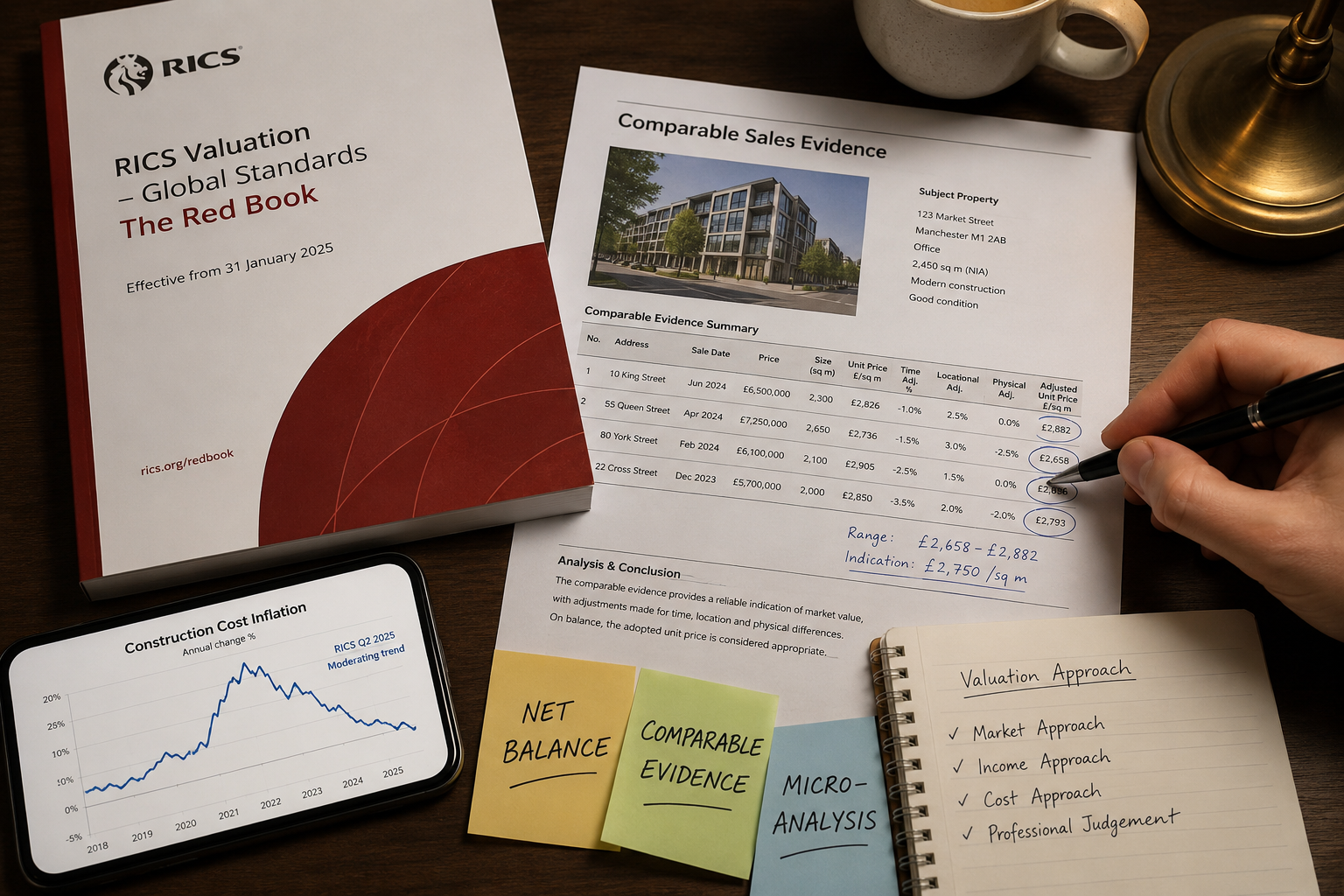
The foundation of residential valuation remains the sales comparison approach, but in a 2-5% growth market, the quality of comparable selection becomes critical. RICS guidance emphasises that surveyors should apply time adjustments to comparable evidence with greater rigour than in a static or rapidly rising market. [8]
Practical steps for enhanced CMA in 2026:
| Step | Action | Why It Matters in 2-5% Growth |
|---|---|---|
| Time adjustment | Apply monthly growth rate to each comparable | Prevents undervaluation from stale data |
| Condition weighting | Score each comparable on condition match | Small condition differences have outsized impact at low growth rates |
| Distance filtering | Prioritise sub-0.5 mile radius where possible | Micro-location divergence is amplified in stable markets |
| Transaction type | Exclude distressed sales and auction results | These skew downward and distort the narrow growth band |
| Volume check | Note if fewer than 5 comparables exist | Low transaction volumes increase uncertainty; widen the range accordingly |
RICS's January 2026 response to the UK Government's consultation on home buying and selling reform specifically recommended improvements to upfront information availability, which directly supports better comparable evidence gathering at the point of instruction. [9] When more reliable transaction data is available earlier in the process, surveyors can build stronger CMA frameworks from the outset.
Location Micro-Analysis
National and regional price indices are useful context, but they are a poor substitute for granular local knowledge in a modest-growth market. The RICS Wales Manifesto 2026, launched in January 2026, highlights the importance of cross-tenure housing delivery strategies and high-standard retrofit programmes. [3] Both initiatives affect micro-location values in ways that aggregate data cannot capture.
Effective micro-analysis in 2026 involves:
- School catchment boundary mapping: Properties within high-performing catchment areas consistently outperform their immediate neighbours by 3-8%, a premium that persists even in flat markets.
- Transport infrastructure scoring: Proximity to confirmed infrastructure improvements (not merely proposed ones) adds a measurable and defensible premium.
- Retrofit and energy performance uplift: With EPC ratings increasingly influencing buyer decisions, properties with recent retrofit investment command premiums that must be identified and quantified separately from general market movement.
- Planning pipeline awareness: Approved developments within 500 metres can suppress or enhance values depending on their nature.
For surveyors operating across London and the South East, the granularity required is particularly acute. A valuation in Notting Hill, for example, requires street-level analysis rather than borough-level data, given the significant price variation across short distances in prime urban markets.
The Role of the RICS Red Book in Stabilising Valuation Standards
In April 2026, RICS submitted a formal response to the International Valuation Standards Council's (IVSC) consultation, with the goal of aligning the forthcoming Red Book 2028 with updated global valuation standards. [1] This alignment process is directly relevant to surveyors working in modest-growth markets because it reinforces the requirement for transparent, evidence-based methodology over market-sentiment-driven judgement.
Key Red Book principles with heightened importance in 2-5% growth conditions:
- Basis of value clarity: The distinction between Market Value, Investment Value, and Fair Value becomes more consequential when price differences between bases are small but financially significant.
- Assumptions and special assumptions: Surveyors must be explicit about what conditions are assumed, particularly regarding planning, condition, and tenure, in a market where these factors can swing a valuation by more than the annual growth rate.
- Valuation uncertainty disclosure: Where comparable evidence is thin or time-adjusted comparables carry significant uncertainty, the Red Book requires this to be communicated clearly to the client.
Technology and AI: Sharpening Accuracy in the 2026 Stabilising Market
The RICS AI Standard and Its Practical Implications
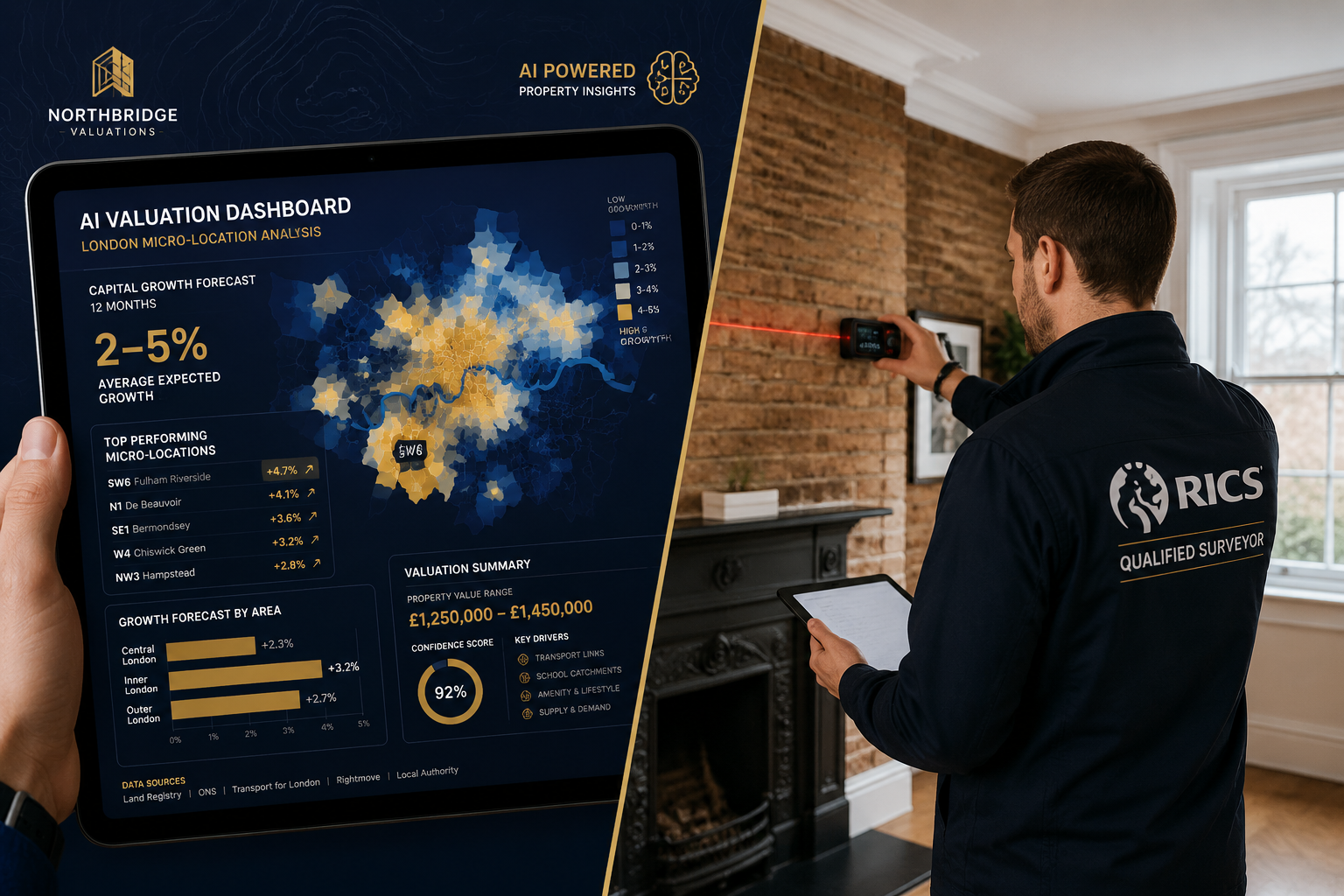
Effective 9 March 2026, RICS published its Responsible Use of AI in Surveying Practice standard, providing structured guidance on the ethical and effective deployment of artificial intelligence in valuation work. [5] This standard is not a theoretical framework; it has immediate practical implications for how surveyors approach data analysis, comparable selection, and automated valuation model (AVM) outputs.
The standard establishes that AI tools must be used as decision-support instruments, not decision-making replacements. A surveyor cannot delegate professional judgement to an algorithm, but they can use AI-generated insights to:
- Flag comparable sales that a manual search might miss
- Identify micro-location price trends across large datasets
- Cross-check time-adjusted valuations against AVM outputs to identify outliers
- Analyse EPC and planning data at scale to inform condition and location adjustments
A critical point for 2-5% growth markets: AVM outputs are calibrated on historical transaction data and tend to perform well in stable conditions. However, they can lag turning points by several months. The RICS AI standard requires surveyors to understand the limitations of any tool they use, which means treating AVM outputs as one data point among many rather than a primary valuation driver.
RICS President Nick Maclean OBE, who took office on 1 January 2026 as the 144th President of RICS, has made embracing new technologies while closing the skills gap a central theme of his tenure. [4] His emphasis on lifelong learning within the profession is directly relevant here: surveyors who understand how AI tools work, and where they fail, will produce more accurate valuations than those who either reject or uncritically accept algorithmic outputs.
Construction Cost Data and the Reinstatement Approach
For properties where the sales comparison approach is limited by low transaction volumes, the reinstatement cost approach provides an important cross-check. As of March 2026, the European construction market is experiencing easing cost inflation, with pressures moderating from post-pandemic peaks. [6] This stabilisation improves the reliability of cost-based valuations, particularly for specialist or non-standard properties.
Surveyors using the reinstatement approach in 2026 should note:
- Building cost indices are now updating more predictably than during 2022-2024, reducing the risk of using outdated cost data
- Labour cost inflation remains elevated in certain trades, particularly electrical and heat pump installation, reflecting retrofit demand
- Material costs for standard construction have broadly stabilised, though supply chain disruptions remain possible
For clients requiring insurance reinstatement valuations, the improved predictability of construction costs in 2026 means that reinstatement figures can be set with greater confidence, reducing the risk of under-insurance in a period when rebuild costs and market values are moving at different rates.
Structural and Condition Factors: Their Amplified Role in Modest Growth Markets
In a rapidly rising market, buyers often accept condition risks because capital growth will offset remediation costs. In a 2-5% growth environment, that calculation changes fundamentally. A £15,000 damp remediation requirement on a property growing at 3% per year represents approximately four years of price appreciation. Buyers and lenders are therefore more sensitive to condition issues than they were during the 2020-2022 boom.
This has two direct implications for valuation accuracy:
1. Condition adjustments must be more precise. A surveyor who applies a broad "condition discount" without specifying the nature, extent, and estimated cost of defects is providing a valuation that will not withstand scrutiny. Detailed damp surveys and structural assessments feed directly into the valuation narrative, not just the survey report.
2. Expert witness valuations face greater scrutiny. Recent cases in Northern markets have demonstrated that independent expert testimony on construction defects and their financial impact on property values is increasingly tested in dispute proceedings. [7] In a 2-5% growth market, the financial stakes of a defect-related valuation dispute are proportionally higher relative to overall capital growth, making the quality of expert evidence more consequential. Surveyors providing expert witness services must ensure their valuation methodology is fully documented and defensible under cross-examination.
Condition factors requiring explicit valuation adjustment in 2026:
- Structural movement (active versus historic)
- Damp penetration and rising damp
- Roof covering condition and remaining life expectancy
- EPC rating relative to local comparables
- Non-standard construction materials
- Cladding and fire safety compliance status
For buyers considering whether a full structural assessment is warranted before committing to a purchase, the full structural survey cost guide provides a useful framework for understanding the investment relative to the valuation risk being managed.
Workforce, Standards, and the Future of Valuation Accuracy
Accurate valuations do not emerge solely from methodology; they require skilled, well-trained professionals applying that methodology consistently. RICS is actively addressing the pipeline of qualified surveyors, with initiatives launched in early 2026 to improve the profession's visibility and attract new talent. [10] The skills gap identified by RICS President Nick Maclean is particularly acute in specialist valuation disciplines, where experienced practitioners are retiring faster than new entrants are qualifying. [4]
For clients seeking valuation services, this context reinforces the importance of verifying that their surveyor holds current RICS membership and relevant specialist accreditation. The chartered surveyors designation remains the benchmark for professional competence in the UK market.
What clients should look for in a valuation professional for 2026 conditions:
- Current RICS membership (MRICS or FRICS)
- Demonstrable local market knowledge in the specific sub-market
- Familiarity with RICS AI standard and use of technology in practice
- Clear methodology statement in the valuation report
- Explicit treatment of comparable evidence with time adjustments disclosed
The RICS Global Valuation Conference in June 2026 will further develop professional standards around sustainability, emerging risks, and technology integration. [2] Surveyors who engage with continuing professional development in these areas will be better equipped to deliver the precision that a 2-5% growth market demands.
Conclusion
Valuation accuracy for 2-5% price growth properties: RICS tactics for modest 2026 market expansion is not a passive exercise in applying standard methodology. It requires active adaptation to a market environment where the margin for error is narrow, micro-location factors are amplified, and condition issues carry proportionally greater weight than in boom conditions.
Actionable next steps for surveyors and property professionals in 2026:
- Review and update time-adjustment protocols for comparable evidence to reflect current monthly growth rates in each sub-market.
- Integrate RICS AI standard guidance into practice workflows, using AI tools as decision-support rather than decision-making instruments.
- Invest in micro-location data sources, including EPC databases, planning portals, and school catchment mapping, to build more granular valuation narratives.
- Ensure condition-related adjustments are fully costed and documented, not applied as broad percentage discounts.
- Monitor RICS Red Book 2028 consultation outputs and begin aligning current practice with anticipated standard changes.
- Engage with RICS CPD opportunities, including the June 2026 Global Valuation Conference, to stay current with emerging valuation challenges.
For buyers, sellers, and lenders operating in the 2026 market, the message is equally clear: commission valuations from RICS-qualified professionals who can demonstrate local expertise and a transparent methodology. In a market growing at 2-5%, the quality of the valuation is not a secondary consideration. It is the primary one.
References
[1] Red Book Global – https://www.rics.org/profession-standards/rics-standards-and-guidance/sector-standards/valuation-standards/red-book/red-book-global?utm_source=openai
[2] Global Valuation Conference 2026 – https://academy.rics.org/global-valuation-conference-2026?utm_source=openai
[3] Wales Manifesto 2026 Launch – https://www.rics.org/news-insights/wales-manifesto-2026-launch?utm_source=openai
[4] Nick Maclean Becomes Rics President 2026 – https://www.rics.org/news-insights/nick-maclean-becomes-rics-president-2026?utm_source=openai
[5] Ai Responsible Use Standard – https://ww3.rics.org/uk/en/journals/construction-journal/ai-responsible-use-standard.html?utm_source=openai
[6] European Market Forecast – https://ww3.rics.org/uk/en/journals/construction-journal/european-market-forecast.html?utm_source=openai
[7] Expert Witness Valuations For New Build Defects Rics Standards In 2026s 2 5 Price Growth Era – https://www.canterburysurveyors.com/blog/expert-witness-valuations-for-new-build-defects-rics-standards-in-2026s-2-5-price-growth-era/?utm_source=openai
[8] Valuation Techniques For Modest 2 5 Price Growth Properties Rics Tools For 2026 Stabilising Markets – https://wimbledonsurveyors.com/valuation-techniques-for-modest-2-5-price-growth-properties-rics-tools-for-2026-stabilising-markets/?utm_source=openai
[9] Uk Influence And Advocacy Update January 2026 – https://www.rics.org/news-insights/uk-influence-and-advocacy-update-january-2026?utm_source=openai
[10] Inspire Next Generation Surveyors – https://ww3.rics.org/uk/en/modus/business-and-skills/better-business/inspire-next-generation-surveyors.html?utm_source=openai
