
The UK data centre colocation market is forecast to reach £11.08 billion by 2030, driven by surging AI workloads and hyperscaler expansion [10]. That single figure reframes everything a chartered surveyor thought they knew about valuing industrial and commercial property. Valuing Data Centre Developments in 2026: Surveyor Challenges for High-Density UK Sites and Infrastructure Impacts is no longer a niche specialism confined to a handful of London-fringe operators. It has become one of the most technically demanding and commercially consequential areas of UK property practice, demanding new skills, new methodologies, and a willingness to challenge conventional comparable evidence.

Key Takeaways
- Grid capacity has replaced location alone as the primary determinant of data centre site value in 2026, fundamentally redefining what surveyors are actually valuing.
- High-density AI-optimised facilities now routinely exceed 50 kW per rack, creating structural, mechanical, and electrical complexity that standard building surveys cannot adequately capture.
- The absence of mature comparable evidence forces surveyors to blend income, cost, and residual valuation approaches, each carrying significant margin for error.
- Planning constraints, National Grid connection queues, and environmental obligations are now material valuation factors that must be quantified, not merely noted.
- RICS guidance and specialist due diligence frameworks are evolving rapidly, and surveyors who do not keep pace risk producing reports that fail professional standards.
Why the Data Centre Boom Is Straining Traditional Valuation Models
The speed of the UK data centre market's expansion has outpaced the development of accepted valuation methodology. In a single week during early 2026, more than £10 billion of data centre deals were transacted in the UK alone [8]. Knight Frank's Q2 2026 data centre report confirms that demand continues to outstrip supply across all major UK markets, with London remaining the dominant European hub [4]. CBRE's 2026 outlook similarly identifies data centres as one of the highest-conviction real estate sectors in the UK [1].
For surveyors, this creates an immediate problem. Traditional commercial property valuation relies heavily on comparable transactions. When a market moves this fast, and when the assets being traded are this technically complex, comparable evidence becomes thin, stale, or simply inapplicable. A data centre valued on 2023 comparables may be significantly undervalued in 2026 market conditions, or, conversely, overvalued if its power infrastructure is inadequate for current tenant requirements.
The core challenge is definitional. What is a surveyor actually valuing when they assess a data centre? The shell and core? The fit-out? The power capacity? The grid connection? The answer, increasingly, is all of these simultaneously, and the weighting between them has shifted dramatically toward power infrastructure.
Power Density as the New Primary Value Driver
Grid capacity has become the primary determinant of site value, redefining what surveyors are valuing. A site with planning consent for a 100 MW data centre but without a confirmed grid connection is worth materially less than an identical site with a live connection agreement. JLL's 2026 data centre outlook notes that power availability constraints are now the single greatest limiting factor on new supply across major markets [5].
For UK surveyors, this means that a commercial property survey of a data centre site must now incorporate a detailed assessment of:
- Confirmed grid connection capacity (MW available and contracted)
- Connection queue position with National Grid ESO
- Substation proximity and upgrade requirements
- Power Purchase Agreement (PPA) status and renewable energy obligations
- Cooling infrastructure capacity relative to IT load density
High-density AI-optimised facilities are now routinely designed to deliver 50 kW to 100 kW per rack, compared to the 5-10 kW per rack that characterised legacy colocation facilities. This density difference has profound implications for structural loading, floor slab specifications, cooling system design, and fire suppression requirements, all of which affect reinstatement cost and therefore insurance valuation. Surveyors undertaking reinstatement cost valuations for data centres must account for these elevated specifications explicitly.
"The question is no longer simply where the building is, but how much power it can reliably deliver and at what density. Location remains important, but it is now a secondary filter."
Core Surveyor Challenges When Valuing Data Centre Developments in 2026
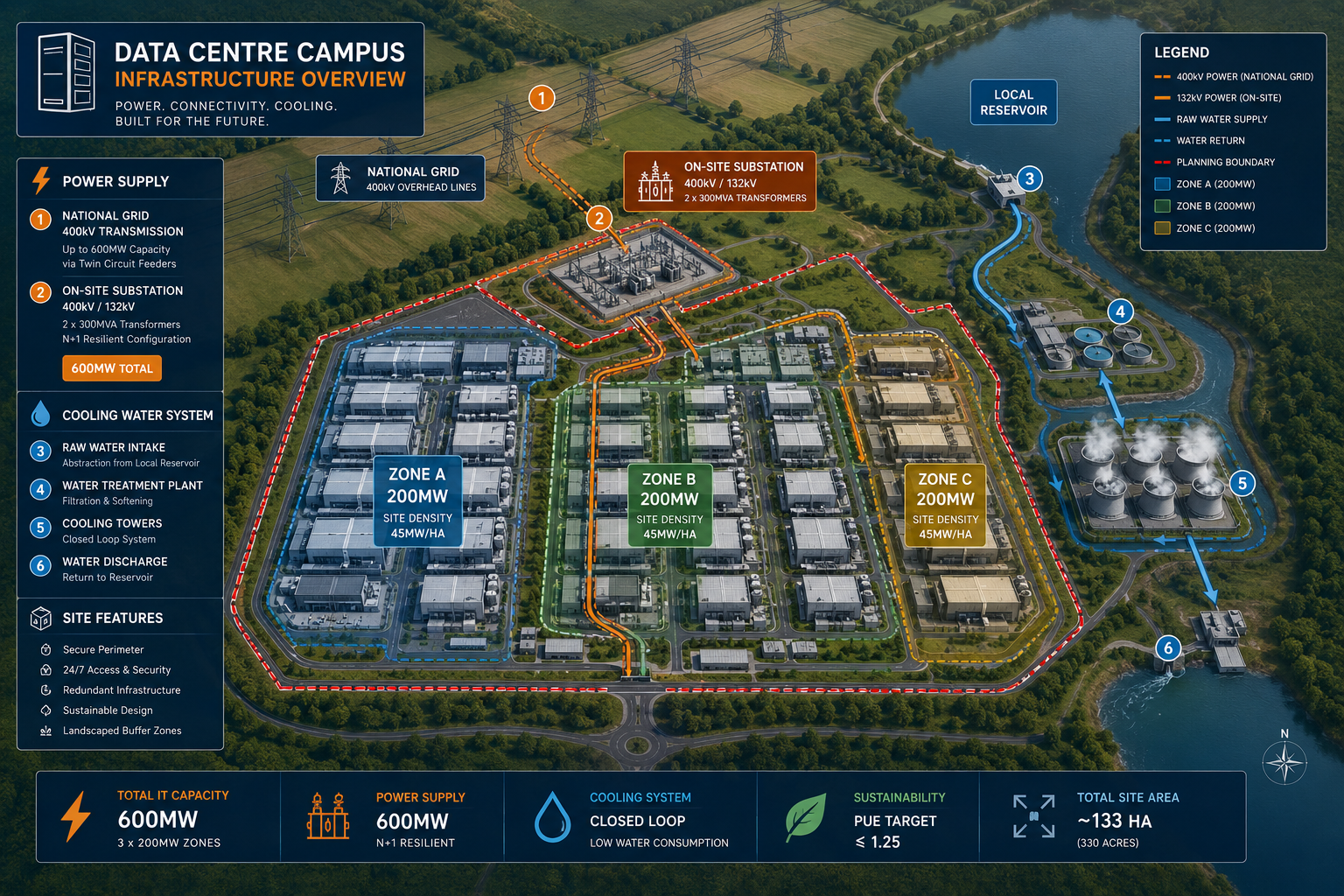
Surveyors approaching high-density UK data centre sites in 2026 face a cluster of interrelated challenges that do not arise in conventional commercial property work. Understanding each challenge is essential to producing a defensible and accurate valuation report.
1. Absence of Directly Comparable Evidence
The data centre investment market in the UK is dominated by off-market transactions between institutional investors, hyperscalers, and specialist operators [8]. Many deals are structured as forward-funding arrangements, sale-and-leaseback transactions, or joint ventures, none of which generate the transparent comparable evidence that surveyors rely upon for market value assessments.
Where comparable sales do exist, the headline price per square foot or per megawatt is rarely sufficient. Two facilities with identical floor areas can have vastly different values depending on their contracted power capacity, their PUE (Power Usage Effectiveness) rating, their cooling architecture, and the remaining term on their grid connection agreements.
Surveyors must therefore triangulate between multiple valuation approaches:
| Valuation Approach | Application in Data Centre Context | Key Limitations |
|---|---|---|
| Income Capitalisation | Stabilised assets with long leases to creditworthy operators | Lease terms vary widely; rent reviews complex |
| Depreciated Replacement Cost | Specialist assets with limited market evidence | High sensitivity to assumed obsolescence rates |
| Residual / Development Appraisal | Development sites and forward-funded schemes | Significant margin for error in build cost assumptions |
| Discounted Cash Flow | Hyperscale and campus assets | Requires detailed operational assumptions |
2. Technical Due Diligence Complexity
A chartered surveyor working on a data centre instruction will typically need to coordinate with or commission reports from mechanical and electrical engineers, structural engineers, planning consultants, and environmental specialists. The surveyor's role shifts toward that of a technical coordinator as much as a valuer.
Key technical factors that must be assessed and quantified include:
- Tier classification (Uptime Institute Tier I through IV) and its impact on rental value and covenant strength
- PUE rating and its effect on operating costs and tenant attractiveness
- Cooling system type (air-cooled, water-cooled, liquid immersion, rear-door heat exchangers) and associated infrastructure costs
- Generator and UPS capacity relative to critical IT load
- Fire suppression system specification (inert gas, water mist, or FM-200)
- Security infrastructure (physical access controls, CCTV, perimeter security)
Each of these factors affects both the income potential of the asset and its reinstatement cost. Surveyors who lack familiarity with these systems risk producing valuations that are technically inaccurate and professionally exposed.
3. Planning and Environmental Constraints as Material Value Factors
Planning for data centres in 2026 has become significantly more complex than in prior years [7]. Local planning authorities are increasingly scrutinising data centre applications on grounds of energy consumption, water usage, visual impact, and employment generation. Several London Borough councils and authorities in the South East have introduced specific data centre policies that restrict development in certain zones or impose conditions relating to waste heat recovery and renewable energy supply.
For surveyors, these planning constraints are not merely background context. They are material valuation factors that must be quantified. A site with an extant planning consent for a 40 MW facility is worth more than an identical site where consent has not yet been granted, and the quantum of that difference must be reflected in the valuation.
Environmental, Social, and Governance (ESG) obligations are also increasingly embedded in financing agreements and lease structures. Data centre development finance in the UK now routinely includes green loan conditions tied to PUE targets, renewable energy procurement, and carbon reporting [6]. Surveyors must understand how these conditions affect cash flow projections and therefore capitalised value.
The UK government's designation of data centres as Critical National Infrastructure (CNI) in 2024 has added a further layer of regulatory consideration [2]. CNI status provides certain protections and may facilitate planning approvals, but it also imposes security and resilience obligations that affect both capital expenditure and operating costs.
4. Infrastructure Impact on Surrounding Property Values
High-density data centre developments do not exist in isolation. Their infrastructure requirements, particularly high-voltage power lines, substations, cooling towers, and HGV access routes, can have material impacts on surrounding property values. Surveyors instructed on neighbouring properties must be alert to these impacts and reflect them appropriately in their assessments.
Conversely, data centre campuses can generate positive externalities for surrounding commercial and industrial property, including improved road infrastructure, increased local employment, and enhanced digital connectivity. The net effect on surrounding values is site-specific and requires careful analysis.
Methodological Approaches and RICS Guidance for Accurate Reporting
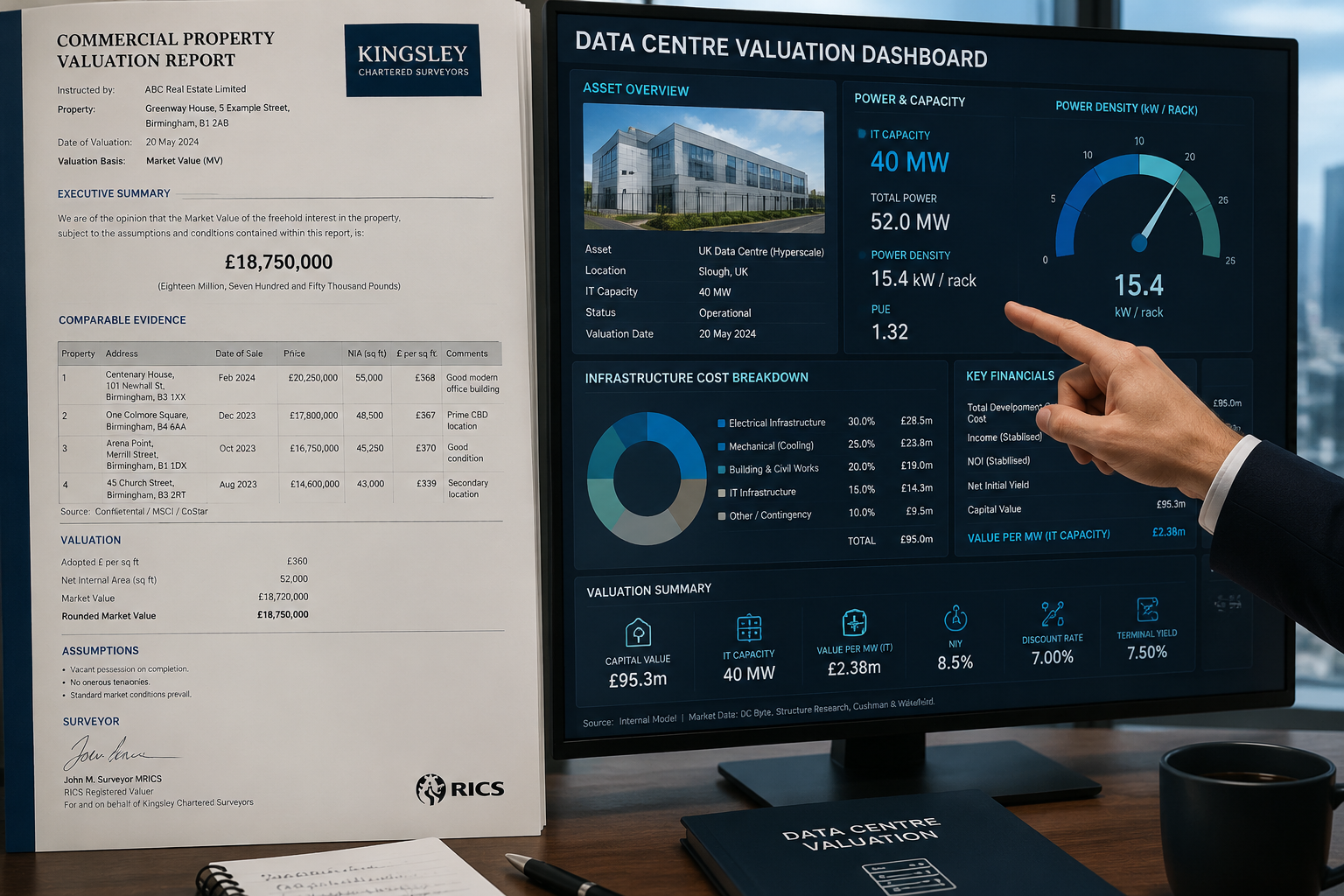
The Royal Institution of Chartered Surveyors (RICS) has recognised the growing importance of data centre valuation through updates to its professional standards and guidance notes. Surveyors producing RICS-compliant valuations of data centre assets must adhere to the Red Book Global Standards and any applicable UK national supplements, while also drawing on sector-specific technical guidance.
Applying the Red Book to High-Density Assets
The Red Book's requirement for surveyors to identify and reflect all material factors in a valuation is particularly demanding when applied to data centres. The following factors are now considered material for RICS reporting purposes:
- Contracted power capacity and the legal status of grid connection agreements
- Remaining useful economic life of mechanical and electrical plant
- Lease structure including any break options, rent review mechanisms, and tenant improvement obligations
- Environmental performance including PUE, water usage effectiveness (WUE), and carbon intensity
- Planning status and any conditions or obligations attached to consents
Surveyors should also consider whether a stock condition survey of the mechanical and electrical plant is required to support the valuation, particularly for older or repurposed facilities where the condition of critical infrastructure may be uncertain.
Specialist Due Diligence Frameworks
Given the complexity of data centre assets, leading valuers in 2026 are adopting structured due diligence frameworks that mirror those used in infrastructure and energy asset valuation. These frameworks typically include:
- Technical audit of mechanical, electrical, and structural systems
- Power capacity verification including grid connection documentation review
- Planning and regulatory review including CNI implications
- Lease and covenant analysis including operator creditworthiness assessment
- Market positioning analysis comparing the asset's specifications against current tenant requirements
- ESG compliance review against financing conditions and investor mandates
For development sites, a residual valuation approach remains appropriate, but the assumptions feeding into the residual model must be stress-tested against a range of power capacity scenarios. The difference between a site that can achieve 40 MW and one that can achieve 80 MW is not linear in value terms, because larger capacity sites attract a different class of hyperscale tenant and command significantly higher rents per MW [4].
The Role of Structural and Specialist Reports
Data centres frequently occupy repurposed industrial buildings or purpose-built structures with non-standard specifications. Structural engineer reports are often essential to confirm that floor loading capacities are adequate for high-density rack deployments, and that the building envelope can accommodate the penetrations required for cooling and power infrastructure.
Similarly, asbestos surveys are a standard requirement for any data centre occupying a building constructed before 2000, given the potential for asbestos-containing materials in plant rooms, roof structures, and service ducts.
Surveyors should also be aware that data centre fit-out costs are substantial and highly variable. JLL estimates that the cost of fitting out a high-density AI-optimised facility in the UK can exceed £15 million per MW of IT load [5]. These costs must be reflected in depreciated replacement cost valuations and in any assessment of reinstatement value for insurance purposes.
Market Dynamics and Investment Outlook
The UK data centre market is attracting significant inward investment from North American, Middle Eastern, and Asian capital sources [9]. This international demand is placing upward pressure on land values in established data centre clusters, particularly in the M25 corridor, Slough, and the East London/Docklands area.
Several new entrants are expanding their presence in the UK market to address increasing demand for data centre infrastructure [9]. This competitive dynamic is creating valuation complexity, as assets that might previously have been valued on the basis of a limited pool of domestic comparable transactions are now being priced against international benchmarks.
For surveyors operating in regions with emerging data centre activity, including parts of the Midlands, the North West, and Scotland, the challenge is even greater. Comparable evidence is almost non-existent, and valuers must rely more heavily on cost-based approaches and discounted cash flow analysis, supported by market intelligence from specialist data centre brokers and operators.
Surveyors working across the South East, where data centre activity is most concentrated, will find that chartered surveyors in Surrey, Buckinghamshire, and Oxfordshire are increasingly encountering data centre-related instructions as the M25 corridor expands its digital infrastructure footprint.
Conclusion
Valuing Data Centre Developments in 2026: Surveyor Challenges for High-Density UK Sites and Infrastructure Impacts is a subject that demands both technical depth and methodological rigour. The UK market's explosive growth, combined with the structural shift toward AI-driven high-density computing, has created a valuation environment where conventional approaches are insufficient and professional exposure is real.
Actionable next steps for surveyors and property professionals include:
- Invest in technical education covering mechanical and electrical systems, power infrastructure, and data centre operational metrics before accepting data centre instructions.
- Build relationships with specialist M&E engineers, planning consultants, and data centre brokers who can provide the technical intelligence that underpins defensible valuations.
- Adopt structured due diligence frameworks that explicitly address grid capacity, planning status, ESG obligations, and lease structure as primary value drivers.
- Engage with RICS guidance updates and sector-specific working groups to ensure valuation methodology remains current and professionally compliant.
- Treat power capacity as the headline metric in any data centre valuation, and ensure that all reports clearly document the basis on which contracted and available capacity has been assessed.
- For development appraisals, stress-test residual valuations against multiple power capacity scenarios to reflect the material uncertainty inherent in grid connection timelines.
The surveyors who will add the most value in this market are those who combine traditional RICS professionalism with a genuine understanding of the infrastructure that makes data centres function and the market forces that determine what they are worth. The opportunity is significant, but so is the responsibility to get it right.
References
[1] Data Centres – https://www.cbre.co.uk/insights/books/uk-real-estate-market-outlook-2026/data-centres
[2] London Data Centre Cni Market Report – https://www.constructionmagazine.uk/p/london-data-centre-cni-market-report.html
[3] millichronicle – https://millichronicle.com/2026/04/65738.html
[4] Datacentrescq2026 – https://www.knightfrank.co.uk/content-assets/211eb9c4e9e44027a77942ade93d66b0/datacentrescq2026.pdf
[5] Data Center Outlook – https://www.jll.com/en-us/insights/market-outlook/data-center-outlook
[6] Data Centre Development Finance Uk – https://www.fdcommercial.co.uk/finance-guide/data-centre-development-finance-uk/
[7] Planning For Data Centres In 2026 Whats Changed And What Will Matter Most – https://pwaplanning.co.uk/planning-for-data-centres-in-2026-whats-changed-and-what-will-matter-most/
[8] One Week 10b Of Data Centre Deals In The Uk 131705 – https://www.bisnow.com/london/news/data-center-capital-markets/one-week-10b-of-data-centre-deals-in-the-uk-131705
[9] Uk Data Center Market Investment Analysis Report 2026 2031 Several New Entrants Are Expanding Their Presence To Address The Increasing Demand For Data Center Infrastructure – https://www.globenewswire.com/news-release/2026/04/27/3281404/0/en/uk-data-center-market-investment-analysis-report-2026-2031-several-new-entrants-are-expanding-their-presence-to-address-the-increasing-demand-for-data-center-infrastructure.html
[10] United Kingdom Data Center Colocation Databook Report 2026 Market To Reach 11 08 Billion By 2030 Driven By Surging Ai And Gpu Workload Demand Accelerating Hyperscaler Capacity Buil – https://www.globenewswire.com/news-release/2026/04/30/3284527/0/en/united-kingdom-data-center-colocation-databook-report-2026-market-to-reach-11-08-billion-by-2030-driven-by-surging-ai-and-gpu-workload-demand-accelerating-hyperscaler-capacity-buil.html
