
The national average for a land survey in 2026 sits at approximately $2,300 — yet the actual range stretches from as little as $475 to well over $25,000, depending on the type of survey, site conditions, and where the property is located [1][2]. That gap is not a pricing error. It reflects a profession that has grown more technically complex, more operationally expensive, and more in demand at exactly the same time. For anyone planning a property purchase, boundary dispute resolution, or development project, understanding land survey costs in 2026 is no longer optional — it is a core part of responsible financial planning.
This article breaks down what is driving price increases, what different survey types cost, and how to budget accurately for the specialized surveying services available in today's market.
Key Takeaways
- The 2026 national average land survey cost is roughly $2,300, with a range of $475 to $25,000 depending on survey type and complexity [1][2].
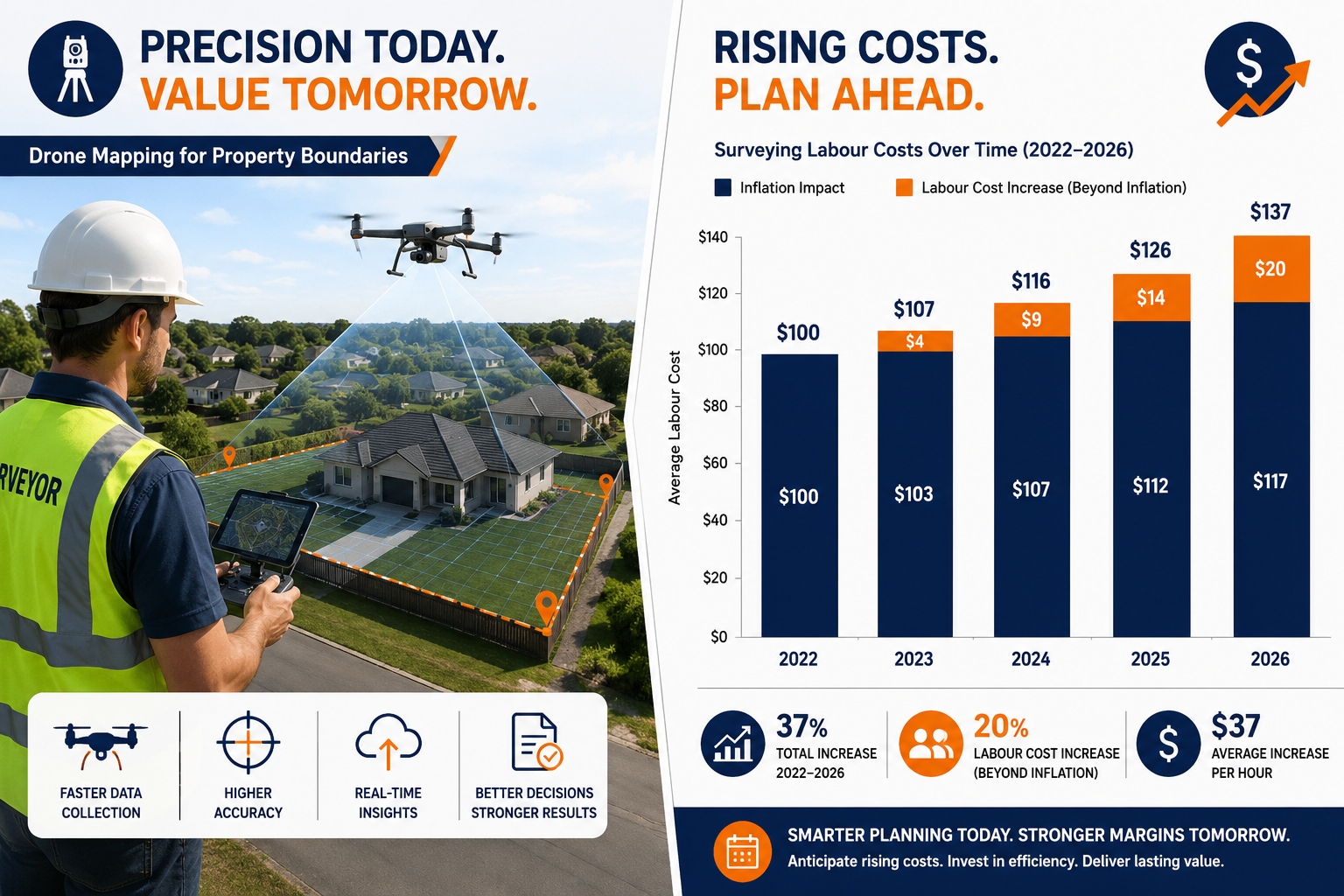
- Inflation, rising labour costs, technology investment, and a shortage of qualified surveyors are the primary drivers of price increases.
- Survey type, property size, terrain difficulty, and geographic location are the four biggest variables affecting your final quote.
- Getting multiple quotes, understanding what is included in a fee, and choosing the right survey type for your needs are the most effective ways to control costs.
- Skipping a survey to save money often costs significantly more in legal fees, boundary disputes, or undiscovered defects later.
Understanding the Current Landscape of Land Survey Costs in 2026
Before examining what has pushed prices upward, it helps to establish a clear baseline. The term "land survey" covers a wide range of services, and conflating them is one of the most common reasons people are surprised by quotes.
Common Survey Types and Their 2026 Price Ranges
| Survey Type | Typical 2026 Cost Range |
|---|---|
| Boundary Survey | $475 – $1,800 |
| Topographic Survey | $1,000 – $4,000 |
| ALTA/NSPS Survey | $2,000 – $10,000+ |
| Construction Survey | $1,500 – $5,000 |
| Subdivision Survey | $2,500 – $10,000+ |
| Flood Elevation Certificate | $600 – $2,000 |
| Mortgage/Location Survey | $300 – $700 |
Sources: [1][2][7]
A boundary survey — the most commonly requested type — confirms the legal boundaries of a parcel. An ALTA/NSPS survey is the gold standard required by commercial lenders and title insurance companies, covering far more detail and therefore commanding a much higher fee [2]. A topographic survey maps the physical features of land and is essential for planning construction or drainage works.
Understanding which type of survey you actually need is the first step toward budgeting accurately. Many clients pay for more survey than their project requires — or, conversely, commission a cheaper survey that does not satisfy their lender or local authority.
"The most expensive survey is the wrong one — either because it does not meet the legal requirement, or because it was never commissioned at all."
For guidance on matching the right survey to your situation, the survey selection guide provides a clear framework.
What's Driving Price Increases: The Key Cost Factors Behind Land Survey Costs in 2026
Several converging forces have pushed surveying fees upward over the past three to four years. None of them is likely to reverse quickly.
1. Inflation and Operational Costs
General inflation has increased the cost of virtually every input a surveying firm relies on — fuel for site visits, vehicle maintenance, office overheads, professional indemnity insurance, and software licences. According to industry data, operational costs for surveying firms rose by an estimated 18–22% between 2021 and 2025 [6][10]. Those increases are now embedded in 2026 pricing.
Professional indemnity insurance deserves particular mention. As property disputes have become more litigious, insurers have raised premiums for surveyors significantly. That cost is passed on to clients through higher base fees.
2. Labour Shortages and Rising Wages
The surveying profession faces a well-documented skills shortage. Fewer graduates are entering the field than are retiring from it, and the pipeline of qualified professionals has not kept pace with demand from construction, infrastructure, and real estate sectors [8][10].
In practical terms, this means:
- Surveyors can charge more because demand exceeds supply
- Firms are paying higher salaries to attract and retain qualified staff
- Wait times for appointments have lengthened, adding indirect costs for time-sensitive projects
The shortage is particularly acute for licensed land surveyors who can sign off on legal boundary determinations — a credential that takes years to obtain and cannot be easily substituted.
3. Technology Investment
Modern surveying has been transformed by technology. Drone-based aerial mapping, LiDAR (Light Detection and Ranging) scanners, GPS/GNSS receivers, and sophisticated CAD software have made surveys faster and more accurate — but the equipment and training required represent significant capital investment [6][7].
A professional-grade drone mapping system can cost $15,000–$40,000. A terrestrial LiDAR scanner can exceed $80,000. Firms amortise these costs across their projects, which is reflected in fees. Clients benefit from higher accuracy and faster turnaround, but the technology premium is real.
4. Site Complexity and Access Conditions
Beyond macro-economic factors, the physical characteristics of a specific site remain one of the strongest determinants of cost. Factors that increase complexity — and therefore price — include:
- Dense vegetation or heavily wooded terrain requiring manual clearing
- Steep or uneven topography that limits equipment access
- Urban sites with underground utilities, existing structures, or restricted access
- Large acreage requiring more time and equipment in the field
- Disputed boundaries that require extensive title research and legal documentation [3][6][9]
A straightforward half-acre suburban lot might be surveyed in a few hours. A rural parcel with unclear historical boundaries and difficult terrain could require days of fieldwork and weeks of research.
5. Geographic Location
Where a property sits has a substantial effect on cost. Urban markets — particularly major metropolitan areas — carry higher labour rates, higher travel costs, and higher overheads for surveying firms [2][3]. A boundary survey in a high-cost city can cost two to three times more than the same survey in a rural area.
State and local regulatory requirements also vary. Some jurisdictions require more documentation, additional sign-offs, or specific survey standards that add time and cost to every project [3].
How to Budget Accurately for Land Survey Costs in 2026
Knowing that prices have risen is useful. Knowing how to plan and manage those costs is what protects your project budget.

Step 1: Identify the Exact Survey Type You Need
Do not request a generic "land survey." Specify the purpose: boundary confirmation, mortgage requirement, construction planning, flood zone determination, or something else. Different purposes require different survey products, and the right match avoids paying for unnecessary scope.
If you are buying a property, consulting a property surveyor early in the process helps clarify which surveys are legally required versus simply advisable.
Step 2: Get at Least Three Quotes
Surveying fees are not standardised. Two firms quoting on the same parcel can differ by 30–50% based on their overhead structure, current workload, and how they assess site complexity. Getting multiple quotes is the single most effective way to ensure competitive pricing [6][8].
When comparing quotes, check what is included:
- Is the fee for fieldwork only, or does it include research, drafting, and final deliverables?
- What format will the survey be delivered in (paper, digital CAD file, georeferenced PDF)?
- Are there additional charges for travel, access permits, or title research?
Step 3: Understand the Deliverables
A survey fee covers more than time on site. The final deliverable — whether a plat, a report, a set of coordinates, or a certified map — is often the most legally significant output. Make sure the deliverable meets the specific requirements of your lender, local authority, or legal counsel before commissioning the work.
For construction-related surveys, the complete guide to construction surveys outlines what different deliverable formats mean in practice.
Step 4: Plan for Contingencies
Site conditions discovered during fieldwork can increase costs beyond the original quote. Common contingencies include:
- Discovery of encroachments that require additional legal research
- Access issues requiring specialist equipment
- Discrepancies between historical records and physical evidence on the ground
A prudent budget adds 10–15% above the quoted fee as a contingency allowance. On a $2,500 survey, that means reserving an additional $250–$375 — a small buffer that prevents project delays if complications arise.
Step 5: Factor In Related Costs
A land survey rarely exists in isolation. Depending on the project, related professional fees may include:
- Title search and legal review of boundary findings
- Planning or building permit applications that require survey documentation
- Party wall matters if construction work affects shared boundaries
If your project involves work near a shared boundary or party wall, understanding those obligations early is important. The complete guide to party wall surveys explains how party wall requirements interact with boundary surveys and what costs to anticipate.
Regional Price Variations and What They Mean for Your Budget
Geographic pricing differences are significant enough to warrant their own consideration. In high-demand urban markets, surveying costs reflect both higher wages and the complexity of dense, built-up environments.
Urban vs. Rural Cost Comparison
| Location Type | Boundary Survey (Typical Range) | Topographic Survey (Typical Range) |
|---|---|---|
| Major metropolitan area | $1,200 – $3,500 | $2,500 – $6,000 |
| Mid-size city | $800 – $2,000 | $1,500 – $4,000 |
| Suburban/rural | $475 – $1,200 | $1,000 – $2,500 |
Sources: [1][2][3]
For property owners in London and the surrounding areas, the same dynamics apply. Dense urban environments, complex title histories, and high professional wage rates combine to push surveying costs above national averages. Chartered surveyors operating in central London and north-west London reflect these market realities in their fee structures.
Why Cheaper Is Not Always Better
The temptation to select the lowest quote is understandable, particularly when budgets are tight. However, a survey that does not meet the required standard — whether because the surveyor lacked the appropriate licence, used inadequate equipment, or produced a deliverable that does not satisfy the lender — will need to be redone. That means paying twice.
A reliable rule: verify that any surveyor commissioned holds the appropriate professional credentials for the survey type and jurisdiction. In the UK, this means RICS (Royal Institution of Chartered Surveyors) membership. In the US, it means a state-licensed Professional Land Surveyor (PLS) credential.
Specialist Survey Costs: Boundary, Topographic, and Construction Surveys
While the average figures provide a useful baseline, specialist surveys warrant individual attention because their cost drivers differ meaningfully.

Boundary Surveys
Boundary surveys are the most frequently commissioned type and the most likely to be affected by historical record discrepancies. When title records are incomplete, ambiguous, or contradictory, the surveyor must conduct additional research — sometimes involving historical deeds, aerial photographs, and physical evidence of old boundary markers. This research phase can double or triple the cost of a straightforward boundary determination [9].
In 2026, expect to pay $475–$1,800 for a standard residential boundary survey, with complex or disputed cases running $3,000–$8,000 or more [1][2].
Topographic Surveys
Topographic surveys are driven by acreage and terrain complexity more than any other factor. A flat one-acre site is far less expensive to survey than a five-acre hillside with dense vegetation. Drone technology has reduced costs for open, accessible sites, but steep or obstructed terrain still requires traditional ground-based methods [6][7].
Construction Surveys
Construction surveys — which include staking, as-built surveys, and monitoring surveys — are typically billed on a phased basis tied to construction milestones. Budgeting for these requires coordination with the construction timeline, as delays in construction can affect survey scheduling and cost.
Practical Strategies to Reduce Land Survey Costs Without Compromising Quality
Cost management does not require compromising on quality. Several practical strategies can reduce fees while maintaining the standard of work required.
Provide existing documentation. If you have previous surveys, title deeds, or plat maps, share them with the surveyor before they begin. This reduces research time and can lower the fee.
Clear the site in advance. If vegetation or debris obstructs access to boundary markers, clearing it before the surveyor arrives reduces fieldwork time.
Combine surveys where possible. If a topographic survey and a boundary survey are both needed, commissioning them together from one firm is almost always cheaper than commissioning them separately.
Schedule flexibly. Surveyors who have gaps in their schedule may offer lower rates for flexible scheduling. Urgent or rushed surveys typically carry a premium.
Ask about fixed-fee versus hourly billing. For well-defined parcels, a fixed fee provides cost certainty. For complex or uncertain sites, hourly billing can be more appropriate — but always ask for a not-to-exceed cap.
Conclusion
Land survey costs in 2026 reflect a profession under sustained pressure from inflation, labour shortages, technology investment, and rising demand. The national average of approximately $2,300 masks a wide range driven by survey type, site complexity, and location — factors that any buyer, developer, or property owner must understand before commissioning work.
Actionable next steps:
- Identify the specific survey type your project or transaction requires before requesting quotes.
- Obtain at least three quotes from credentialed surveyors, and compare them on scope as well as price.
- Budget a 10–15% contingency above the quoted fee to cover site complications.
- Provide existing documentation and prepare the site to reduce fieldwork time.
- Verify professional credentials — RICS membership in the UK, PLS licensure in the US — before signing any agreement.
- If your project involves shared boundaries or construction near party walls, consult a specialist early to understand the full scope of related costs.
A well-commissioned survey is not an expense to minimise — it is a legal document that protects your property rights, satisfies lenders, and prevents far more costly disputes down the line. In 2026, the cost of getting it right remains far lower than the cost of getting it wrong.
References
[1] How Much Does Land Survey Cost – https://www.angi.com/articles/how-much-does-land-survey-cost.htm
[2] Average Cost For A Land Survey 2026 Price Guide – http://altasurveycolorado.com/average-cost-for-a-land-survey-2026-price-guide/
[3] Land Survey Cost Florida – https://apexsurvey.us/guides/land-survey-cost-florida
[6] Why Do Land Survey Costs Vary Factors That Affect Pricing – https://www.firstchoicesurveying.com/blog/why-do-land-survey-costs-vary-factors-that-affect-pricing
[7] How Much Does A Land Survey Cost 2 – https://goldenstatede.com/how-much-does-a-land-survey-cost-2/
[8] Why Are Property Surveys So Expensive – https://www.reddit.com/r/homeowners/comments/1ctkk39/why_are_property_surveys_so_expensive/
[9] Boundary Survey Cost Price – https://haller-blanchard.com/boundary-survey-cost-price/
[10] Blog Land Survey Costs 2026 – https://www.thelandgeek.com/blog-land-survey-costs-2026/
