
42% of all fire safety audits conducted by UK fire and rescue services in 2024/25 were rated unsatisfactory — and formal enforcement notices have risen by 46% over eight years [3]. For surveyors operating in 2026, that statistic is not a background concern. It is a direct professional liability risk that sits inside every property survey report they sign.
Structured Fire Risk Assessments in Property Surveys: Post-2026 Regulatory Checklist for Surveyors is no longer an optional add-on to a standard building inspection. It is a regulatory obligation, a client protection tool, and — increasingly — a shield against post-transaction disputes. This article sets out exactly what surveyors must check, document, and report in 2026, covering cladding, balconies, conversions, digital documentation tools, and the structured templates that reduce exposure to buyer complaints.
Key Takeaways 🔑
- Full recording of fire risk assessments is now mandatory for all responsible persons under Section 156 of the Building Safety Act 2022, regardless of building size.
- Cladding compliance standards changed on 31 January 2026, replacing subjective visual checks with objective temperature-based criteria.
- EWS1 forms are essential for mortgage approval on high-risk residential buildings and must be referenced in survey reports.
- Dual staircases are required in all new residential buildings over 18 metres from 30 September 2026 — surveyors must flag non-compliance.
- PAS 79-structured templates and digital documentation tools provide the evidential trail that protects surveyors from liability in buyer disputes.
The Regulatory Landscape Driving Post-2026 Fire Risk Requirements
Core Legislation Every Surveyor Must Know
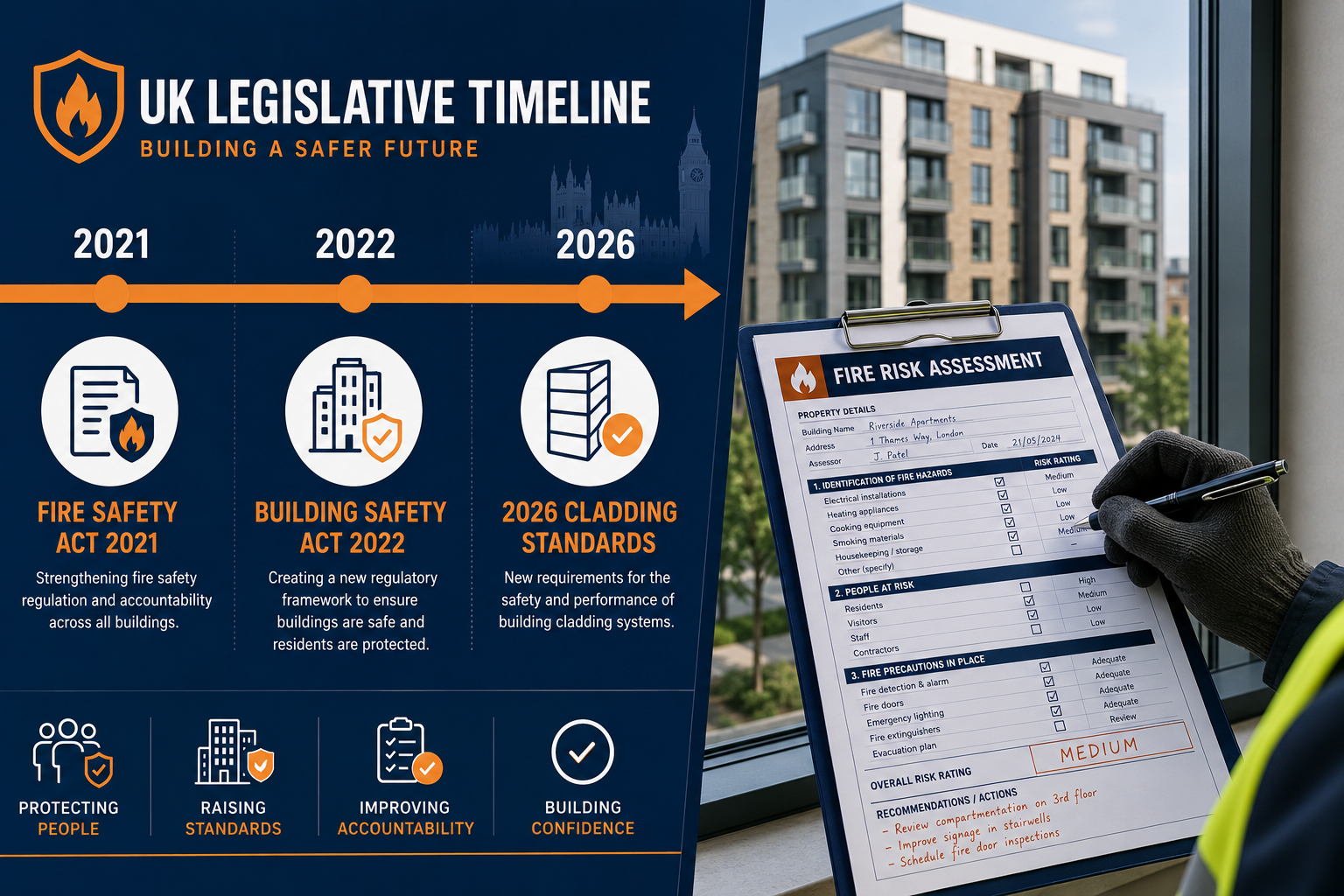
The foundation of fire risk assessment law in England and Wales remains the Regulatory Reform (Fire Safety) Order 2005. It requires the "responsible person" for any non-domestic premises — and the common parts of residential buildings — to carry out a suitable and sufficient fire risk assessment [1]. However, the legislative landscape has shifted significantly since 2021, and surveyors who rely solely on the 2005 Order are already behind.
Three key statutes now layer on top of that foundation:
| Legislation | Key Requirement | Effective Date |
|---|---|---|
| Fire Safety Act 2021 | Extends scope to external walls, flat entrance doors, and building structure | January 2021 |
| Building Safety Act 2022 (s.156) | Mandates full written recording of all fire risk assessments | October 2023 |
| Fire Safety (England) Regulations 2022 | Requires regular checks, resident information, and fire door inspections | January 2023 |
💬 Pull Quote: "Since October 2023, every responsible person must record their fire risk assessment in full — regardless of how small the building or business. There are no exceptions." [2]
The Fire Safety Act 2021 is particularly significant for surveyors. It broadened the scope of assessments to include external walls, flat entrance doors, and the building's structure [3]. This means a surveyor inspecting a converted Victorian terrace or a modern apartment block cannot limit their fire-related observations to internal common areas. The entire building envelope is now in scope.
The 2026 Cladding Standard Change 🏗️
Effective 31 January 2026, European testing standards for cladding fire safety were overhauled. The new framework replaces subjective visual assessments with objective temperature-based criteria, making it far easier to identify non-compliant cladding systems and far harder for building owners to dispute findings [6].
For surveyors, this means:
- Visual inspection of cladding is no longer sufficient on its own
- Survey reports must reference whether cladding has been tested under the new standard
- Where test data is unavailable, the report must flag this as a material risk
This change directly impacts RICS commercial building surveys and any building survey on a property with composite or rendered external wall systems.
Dual Staircase Requirements from September 2026
By 30 September 2026, all new residential buildings exceeding 18 metres in height must incorporate dual staircases [6]. Surveyors assessing new-build or recently completed high-rise properties must verify compliance with this requirement and note any deviation as a significant safety defect. This applies equally to properties under dilapidations surveys where building modifications may have affected escape routes.
The Four Types of Fire Risk Assessment: Choosing the Right Scope
Not all fire risk assessments are the same. The industry now recognises four formal types, and surveyors must understand which type is appropriate for each property they inspect [4]:
Type 1 — Non-Destructive, Common Areas Only
- Scope: Visual inspection of communal areas only
- Best for: Lower-risk buildings with no identified structural concerns
- Limitation: Does not assess individual flats or hidden voids
Type 2 — Destructive, Common Areas Only
- Scope: Includes opening up of wall and ceiling voids in communal areas
- Best for: Buildings where fire stopping integrity is in doubt
- Limitation: Still does not cover individual dwellings
Type 3 — Non-Destructive, Common Areas + Dwellings
- Scope: Visual inspection extended into individual flats
- Best for: Buildings with suspected compartmentation failures
Type 4 — Destructive, Common Areas + Dwellings ⚠️
- Scope: Full intrusive inspection including individual dwellings
- Best for: High-risk buildings, post-fire investigations, or where Type 1–3 findings are inconclusive
- Note: This is the most comprehensive — and most disruptive — option
🔎 Surveyor Tip: Always document in writing which assessment type was used and why. If a client or buyer later disputes the adequacy of the survey, this decision record is critical evidence.
For complex properties, surveyors should consider whether a specific defect report is needed alongside the main survey to address fire-related structural concerns in detail.
The Post-2026 Regulatory Checklist for Structured Fire Risk Assessments in Property Surveys
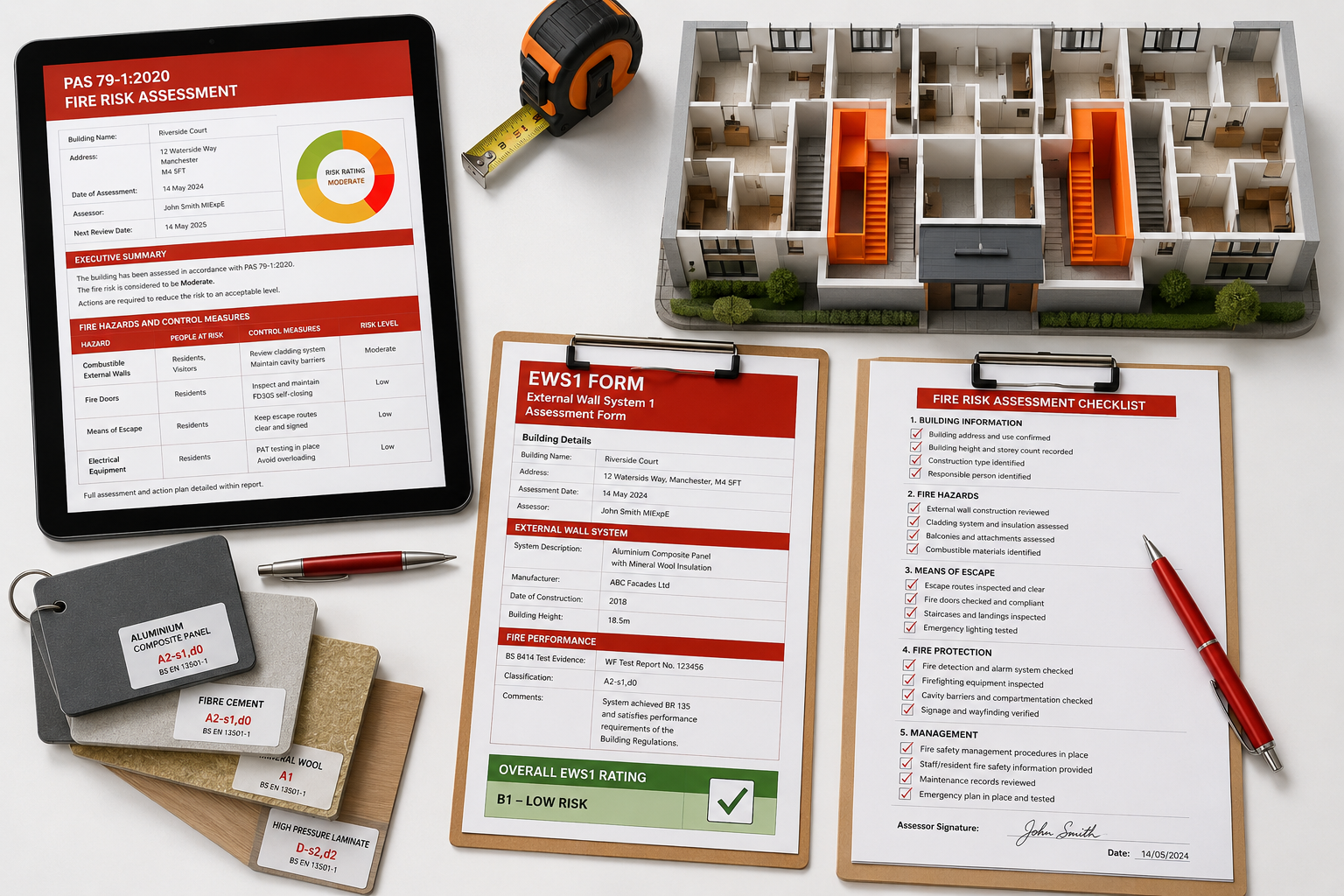
This is the operational core of Structured Fire Risk Assessments in Property Surveys: Post-2026 Regulatory Checklist for Surveyors. The checklist below is structured around the five highest-risk areas identified in current enforcement data and legislative requirements.
✅ 1. External Wall Systems and Cladding
- Identify cladding material type (ACM, HPL, render, timber, etc.)
- Check whether cladding has been tested under post-January 2026 temperature-based standards [6]
- Confirm presence or absence of an EWS1 form (External Wall System survey)
- Note whether intrusive testing or laboratory analysis has been completed
- Flag any cladding that cannot be verified as compliant as a Category 1 hazard
- Record findings using photographic evidence and material references
Why EWS1 matters: EWS1 forms are now essential for mortgage approval on high-risk buildings. Without one, a buyer may be unable to obtain finance — making this a material fact that must appear in the survey report [6].
✅ 2. Balconies and External Features
Balconies are a frequently overlooked fire risk vector. Combustible balcony decking, inadequate fire separation between units, and poorly installed glazing can all accelerate fire spread.
- Inspect balcony decking material (timber, composite, or non-combustible)
- Check fire separation between adjacent balconies
- Assess whether balcony structures penetrate the external wall envelope
- Verify that any glass balustrades meet current fire resistance ratings
- Document any recent modifications or additions not shown on planning records
✅ 3. Conversions and Change-of-Use Properties
Converted properties — particularly Victorian terraces converted to flats, commercial-to-residential conversions, and loft conversions — present the highest risk of inadequate fire compartmentation.
- Verify that floor-to-ceiling compartmentation has been maintained or upgraded
- Check fire door specifications (FD30 or FD60 as appropriate)
- Inspect flat entrance doors for compliance with current standards [3]
- Confirm that fire stopping has been installed around all service penetrations
- Review building regulations completion certificates for conversion works
- Check staircase enclosure and whether escape routes are protected
For properties with loft conversions, surveyors should cross-reference findings with any existing party wall for loft conversions documentation, as structural changes may have affected fire compartmentation.
✅ 4. Fire Detection, Suppression, and Evacuation Systems
- Confirm presence and grade of fire detection system (Grade A–F)
- Check alarm interlink across all floors and common areas
- Verify sprinkler installation in buildings over 11 metres (where required)
- Inspect emergency lighting and exit signage
- Review evacuation strategy (simultaneous vs. stay-put) and whether it is documented
- Check that the evacuation strategy is appropriate for the building type and occupancy
✅ 5. Documentation and Responsible Person Records
Since October 2023, full written recording of fire risk assessments is mandatory [2]. Surveyors must check:
- Is a written fire risk assessment in place and up to date?
- Does it cover the full scope required by the Fire Safety Act 2021?
- Has the responsible person been identified in writing?
- Are action plans documented with completion dates?
- Are records of fire door inspections and maintenance available?
- Is the assessment dated within the last 12 months (or since any material change)?
Digital Documentation Tools and PAS 79 Templates: Protecting Surveyors from Liability
Why Structured Templates Matter in 2026
The introduction of PAS 79-structured templates — including the 2026 version now widely adopted across the profession — represents a significant shift in how fire risk findings are recorded and communicated [8]. These templates provide a standardised framework that:
- Ensures no mandatory check is omitted
- Creates a clear audit trail from inspection to report
- Demonstrates professional competence in the event of a dispute
- Aligns with the full-recording requirement under the Building Safety Act 2022
💬 Pull Quote: "A structured template does not just help the surveyor — it protects them. In buyer disputes, the question is rarely 'did you inspect it?' It is 'can you prove what you found and when?'"
AI-Assisted Defect Detection 🤖
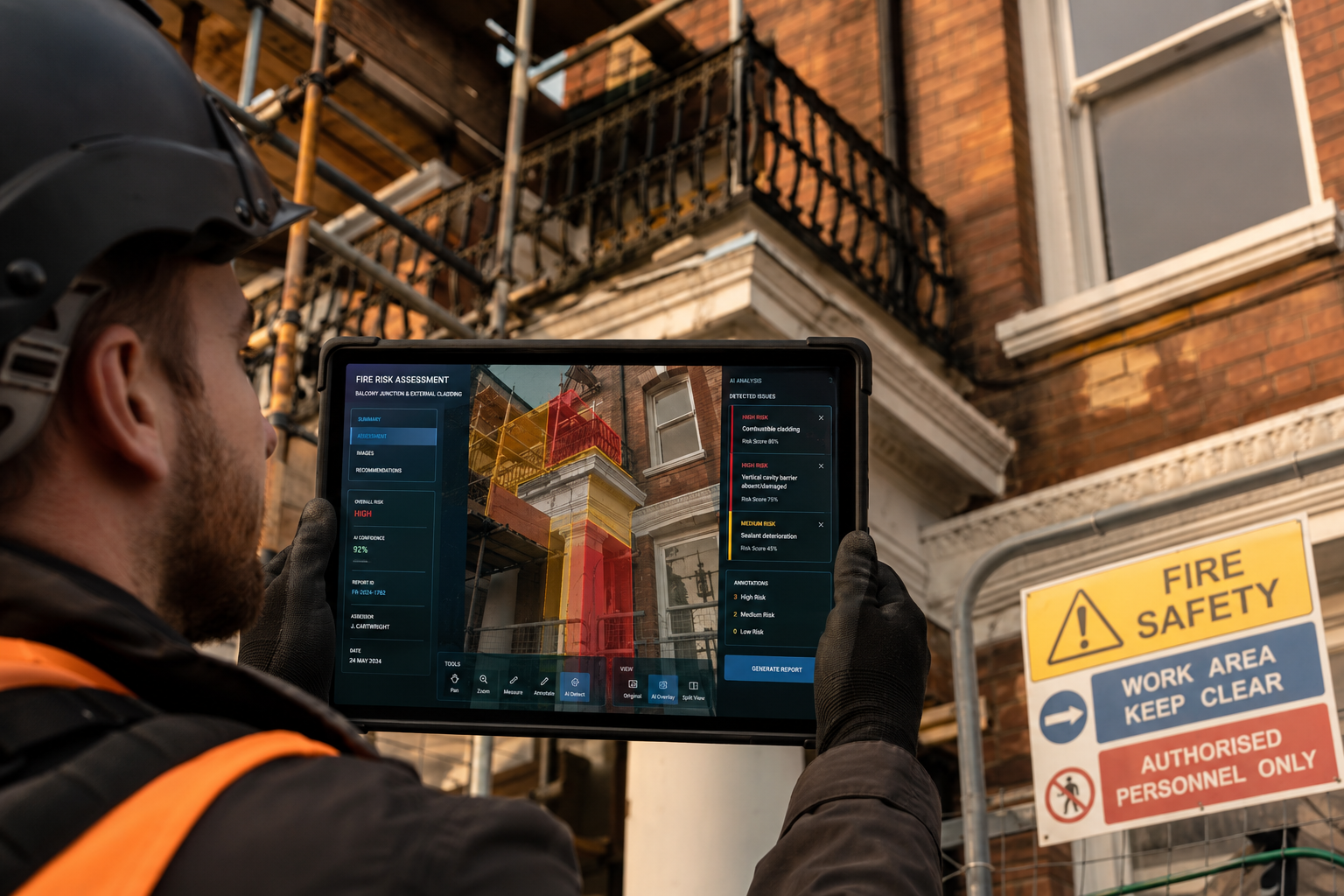
From 9 March 2026, RICS-regulated surveying firms are required to comply with new standards governing the use of artificial intelligence in property assessment and valuation [7]. In the context of fire risk, AI tools are increasingly used to:
- Analyse thermal imaging data for hidden hot spots or electrical faults
- Cross-reference cladding materials against compliance databases
- Flag inconsistencies between building plans and physical inspection findings
- Auto-populate structured report templates with inspection data
Surveyors using AI tools must document which tools were used, what data they processed, and how human professional judgement was applied to the output. AI findings alone are not sufficient — they must be verified by a qualified surveyor.
Digital Evidence Standards for Buyer Dispute Protection
The most effective protection against post-transaction disputes is a complete, timestamped, photographic record linked to a structured assessment template. Best practice in 2026 includes:
- Geotagged photographs of every inspected element, automatically embedded in the report
- Version-controlled digital reports showing when each section was completed
- Material identification records — including product names, batch numbers, and test certification references where available
- Client sign-off records confirming the report was received and its limitations were explained
- Third-party specialist referral notes — where a Type 4 assessment or EWS1 survey is recommended, this must be explicitly stated and recorded
For surveyors conducting RICS building surveys or homebuyer surveys, integrating fire risk documentation into the main report — rather than treating it as a separate annex — reduces the risk of findings being overlooked by clients.
Asbestos and Fire Risk: The Dual Hazard in Older Buildings
In properties built before 2000, fire risk assessments must be read alongside asbestos surveys. Asbestos-containing materials (ACMs) that are disturbed during fire damage or remediation work can create a secondary hazard. Surveyors should note where ACMs are present in locations that could be affected by fire spread or fire-stopping works.
Enforcement Trends and What They Mean for Surveyors
The enforcement data from 2024/25 is unambiguous: 51,020 fire safety audits were conducted by UK fire and rescue services, with 42% rated unsatisfactory [3]. Enforcement notices have risen 46% over eight years. This is not a compliance problem confined to large commercial landlords — it affects converted residential properties, mixed-use buildings, and HMOs across every region.
For surveyors, the practical implications are:
- Clients are increasingly aware of fire safety obligations and will challenge survey reports that do not address them
- Mortgage lenders are tightening requirements around fire safety documentation, particularly for flats in multi-storey buildings
- Professional indemnity insurers are scrutinising fire-related omissions in survey reports more closely
- Buyers in dispute are more likely to succeed if they can show that a material fire risk was visible and went unreported
The schedule of condition prepared before a transaction is increasingly expected to include fire safety observations, particularly for commercial and mixed-use properties.
Conclusion: Actionable Next Steps for Surveyors in 2026
Structured Fire Risk Assessments in Property Surveys: Post-2026 Regulatory Checklist for Surveyors is not a bureaucratic exercise — it is a professional standard that protects clients, buildings, and the surveyor's own practice.
Here are the immediate actions every surveyor should take:
- ✅ Adopt a PAS 79-structured template for all fire risk observations in survey reports — do not rely on narrative paragraphs alone [8]
- ✅ Update cladding inspection protocols to reflect the January 2026 temperature-based testing standards and always check for EWS1 documentation [6]
- ✅ Check dual staircase compliance on all new residential buildings over 18 metres inspected from September 2026 onwards [6]
- ✅ Verify full written fire risk assessment records are in place for all non-domestic and multi-occupancy residential properties [2]
- ✅ Integrate digital, geotagged photographic evidence into every fire-related finding to create a defensible audit trail
- ✅ Cross-reference fire risk findings with asbestos survey data on pre-2000 properties
- ✅ Refer to specialist fire engineers where Type 3 or Type 4 assessments are indicated — and document that referral explicitly
The regulatory environment in 2026 rewards surveyors who are thorough, structured, and digitally equipped. Those who treat fire risk as a tick-box exercise face growing exposure — both to enforcement action and to client disputes. The checklist above is the starting point. Professional judgement, continuous training, and structured documentation are what make it defensible.
References
[1] Fire Risk Assessment Guidelines – https://assesskit.co.uk/blog/fire-risk-assessment-guidelines?utm_source=openai
[2] Fire Risk Assessment Guide – https://www.clearfirecompliance.co.uk/blog/fire-risk-assessment-guide?utm_source=openai
[3] Fire Risk Assessment – https://riskpublishing.com/fire-risk-assessment/?utm_source=openai
[4] Fire Risk Assessment Types Explained – https://www.cardinus.com/insights/property-risk/fire-risk-assessment-types-explained/?utm_source=openai
[5] Alta Nsps Key Changes And Updates In The 2026 Standards – https://www.beneschlaw.com/insight/alta-nsps-key-changes-and-updates-in-the-2026-standards/?utm_source=openai
[6] Fire Safety And Cladding Compliance In Building Surveys Essential Checks For 2026 Property Buyers – https://wimbledonsurveyors.com/fire-safety-and-cladding-compliance-in-building-surveys-essential-checks-for-2026-property-buyers/?utm_source=openai
[7] Valuation Impacts Of Rics Ai Standards On Level 3 Building Surveys March 2026 Compliance Checklist – https://kingstonsurveyors.com/valuation-impacts-of-rics-ai-standards-on-level-3-building-surveys-march-2026-compliance-checklist/?utm_source=openai
[8] Fire Risk Assessment Template – https://assesskit.co.uk/blog/fire-risk-assessment-template?utm_source=openai
