
One of the sharpest sentiment reversals recorded by RICS in recent years — an 18-percentage-point fall in price expectations — landed in the February 2026 Residential Market Survey at precisely the moment when private rented sector (PRS) overvaluation disputes are flooding UK tribunals. For landlords defending rent levels set in 2024–2025, and for tenants challenging those figures as unrealistically high, expert witness valuations in PRS overvaluation disputes: using RICS February 2026 survey data for landlord-tenant litigation have never carried more evidentiary weight — or more professional risk. [3]
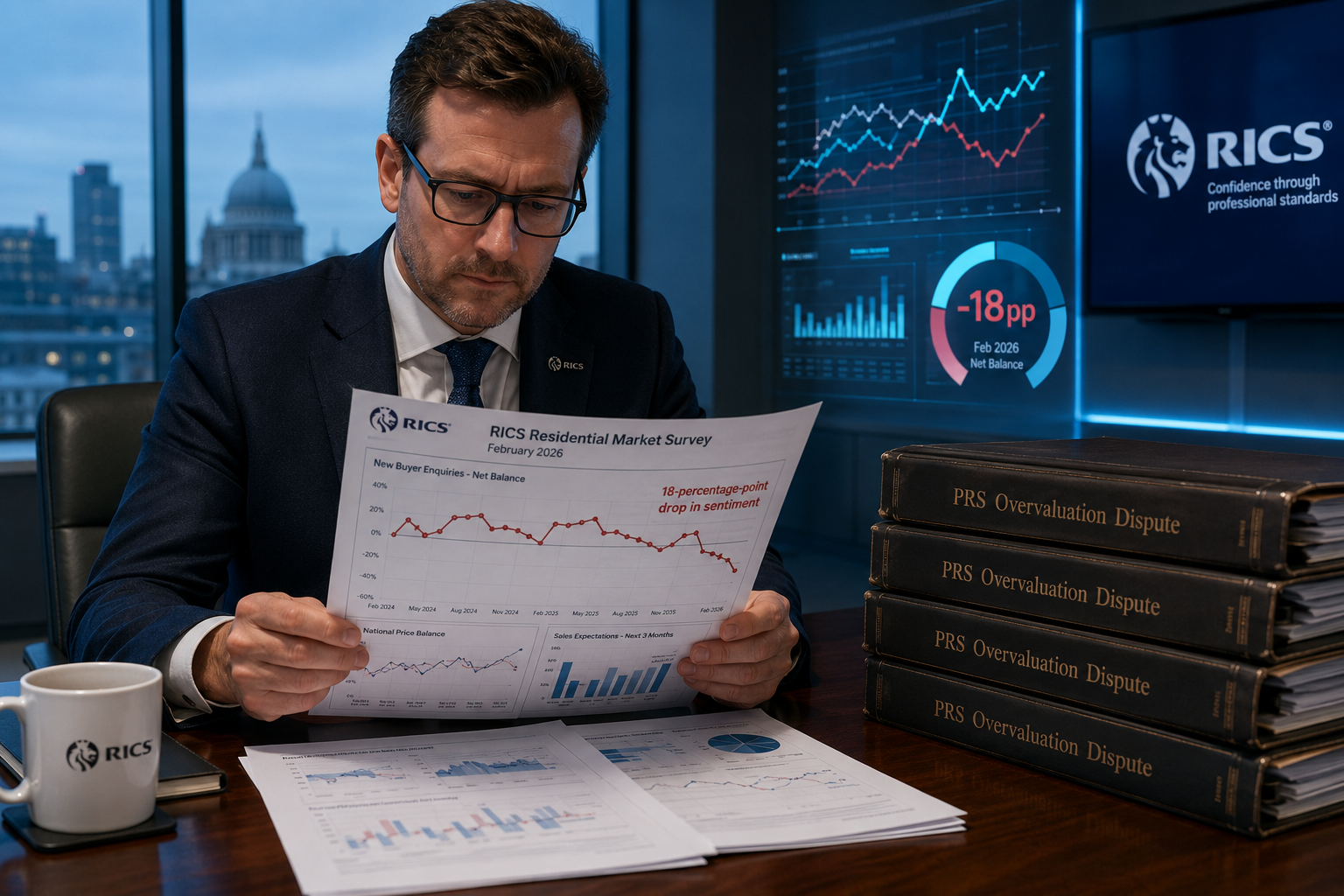
The stakes are clear: get the methodology wrong, misread the market data, or fail to comply with Civil Procedure Rules (CPR) Part 35, and a valuation opinion collapses under cross-examination. This guide explains exactly how expert witnesses should build, present, and defend rent and capital valuations in 2026 PRS disputes.
Key Takeaways 📌
- The RICS February 2026 survey recorded an 18-point drop in price expectations — a critical market signal for PRS overvaluation disputes.
- Expert witnesses owe their primary duty to the tribunal, not to the instructing landlord or tenant; independence is non-negotiable under RICS professional standards.
- CPR Part 35 compliance requires a signed declaration of independence and a clear distinction between expert opinion and advocacy.
- RICS is consulting on a 5th edition of its Surveyors Acting as Expert Witnesses standard, signalling tighter transparency requirements ahead.
- Geopolitical and macroeconomic adjustment factors must now be explicitly addressed in any expert witness report dealing with 2025–2026 valuations.
Why the February 2026 RICS Survey Is a Turning Point for PRS Disputes
Housing market momentum stalled sharply in early 2026. The RICS Residential Market Survey for February 2026 documented a sentiment reversal described as one of the most pronounced in recent years, with price expectations falling by 18 percentage points. [3] Buyer enquiry volumes also softened, compounding a picture of a market recalibrating after years of post-pandemic price inflation.
For landlords and tenants already locked in litigation over rent levels agreed in 2024 or early 2025, this data is explosive. Tenants argue that rents were set during an artificially inflated market peak. Landlords counter that agreed rents reflected genuine market conditions at the time of signing.
"The February 2026 RICS data does not simply describe current conditions — it reframes how tribunals must assess what was 'reasonable' 12 to 18 months earlier."
This is exactly where expert witness valuations become pivotal. A qualified valuer must translate survey statistics into legally admissible, methodologically sound evidence that a First-tier Tribunal or County Court can rely upon. [7]
The PRS Overvaluation Landscape in 2026
Several converging factors have increased the volume of PRS overvaluation claims in 2026:
- 🏠 Renters' Rights Act provisions tightening rent increase mechanisms
- 📉 Falling real wages reducing tenants' ability to absorb historic rent hikes
- 🌍 Geopolitical instability (energy costs, supply chain pressures) affecting household affordability
- 📊 RICS survey data providing tenants with credible statistical ammunition
Each of these factors must be addressed — and appropriately weighted — within any RICS Red Book valuation or expert witness report submitted to a tribunal. [1]
CPR Part 35 Compliance and the RICS Expert Witness Framework
The Overriding Duty to the Court
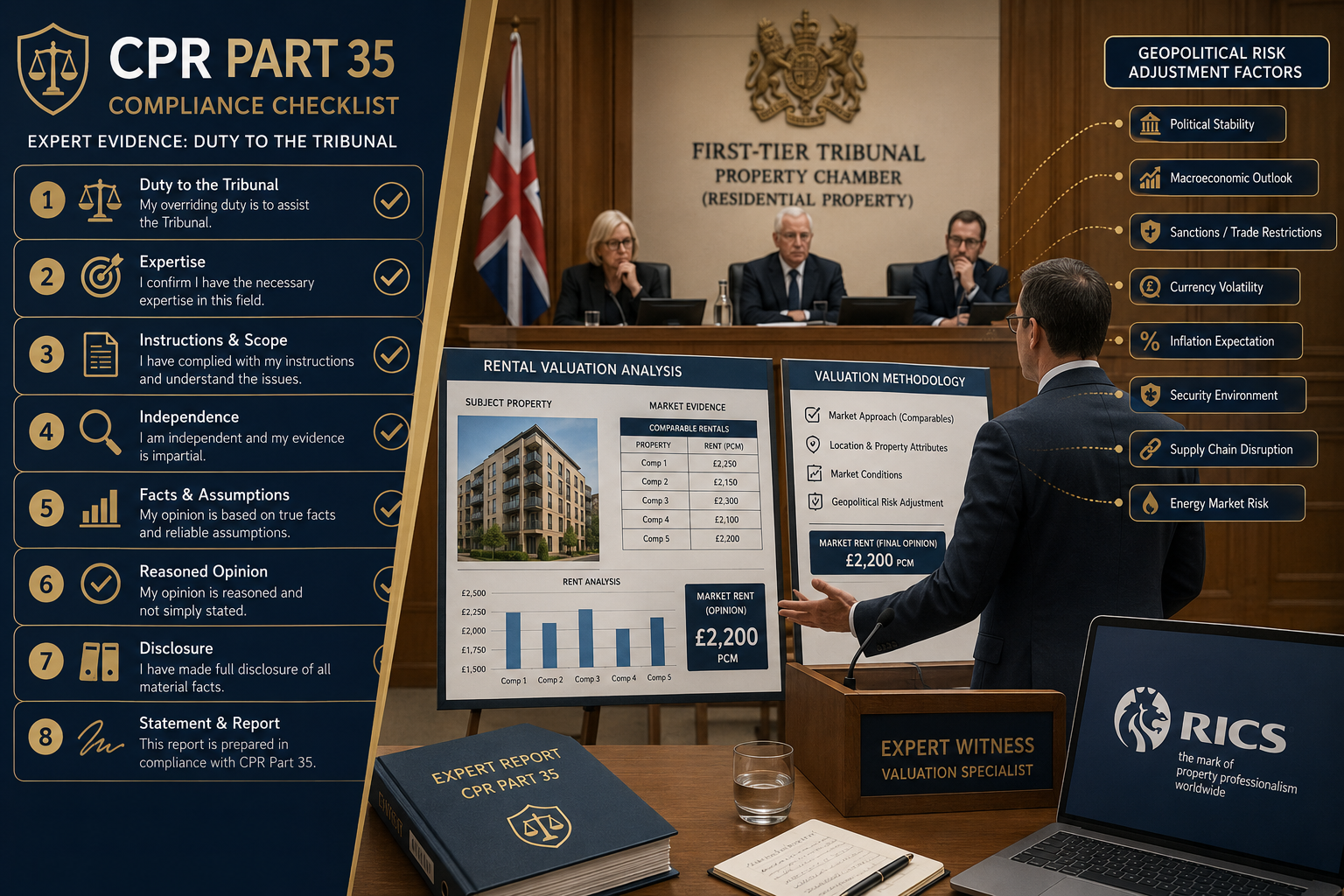
Under CPR Part 35 and the accompanying Practice Direction, an expert witness's overriding duty is to the court or tribunal, not to the party who instructed them. This is not merely procedural formality — it is the bedrock on which the entire credibility of expert witness valuations in PRS overvaluation disputes rests. [7]
RICS reinforces this through its current professional standard Surveyors Acting as Expert Witnesses, which requires that valuers:
| Requirement | Practical Implication |
|---|---|
| Independence & impartiality | Cannot shape evidence to favour the instructing party |
| Transparency of instructions | Must disclose the full scope of the retainer |
| Distinction between expert evidence and advocacy | Opinion must be separated from argument |
| Disclosure of data limitations | RICS survey statistics must be contextualised, not cherry-picked |
Critically, RICS is currently consulting on a 5th edition of this standard. The consultation emphasises greater clarity on the expert's overriding duty, enhanced transparency requirements, and consistency with RICS' broader ethical framework. [2] Expert witnesses instructed in 2026 disputes should monitor this consultation closely, as updated guidance may affect how evidence is structured even before the new edition is formally adopted.
What CPR Part 35 Requires in Practice
An expert witness report submitted to a UK tribunal in a PRS overvaluation dispute must include:
- A signed statement of truth confirming the expert understands their duty to the court
- A clear statement of instructions received from the instructing party
- A summary of the facts relied upon, distinguished from the expert's own opinion
- Disclosure of any material limitations in the evidence base — including the inherent limitations of RICS survey data as a sentiment indicator rather than a transactional dataset
- A range of opinion where a single figure cannot be stated with confidence [4]
For a detailed understanding of what goes into a compliant report, see our guide on preparing an expert witness report that meets both CPR and RICS requirements.
The Evidence Hierarchy in Rent Valuation Disputes
Not all evidence carries equal weight. Tribunals apply an informal but consistent hierarchy when assessing competing valuations:
- 🥇 Comparable transactions — actual lettings at arm's length, as close in time and location as possible
- 🥈 RICS survey data — sentiment and trend indicators, useful for contextualising comparables
- 🥉 Automated valuation models (AVMs) — algorithmic estimates, treated with significant caution
- 📋 Agent opinions — admissible but not independent; rarely determinative
The February 2026 RICS survey data sits firmly in tier two. It is powerful corroborating evidence — particularly for demonstrating that market sentiment had already shifted before a disputed rent review date — but it cannot substitute for properly analysed comparable lettings. [6]
Using RICS February 2026 Survey Data: Methodology and Adjustment Factors
Interpreting the 18-Point Sentiment Reversal
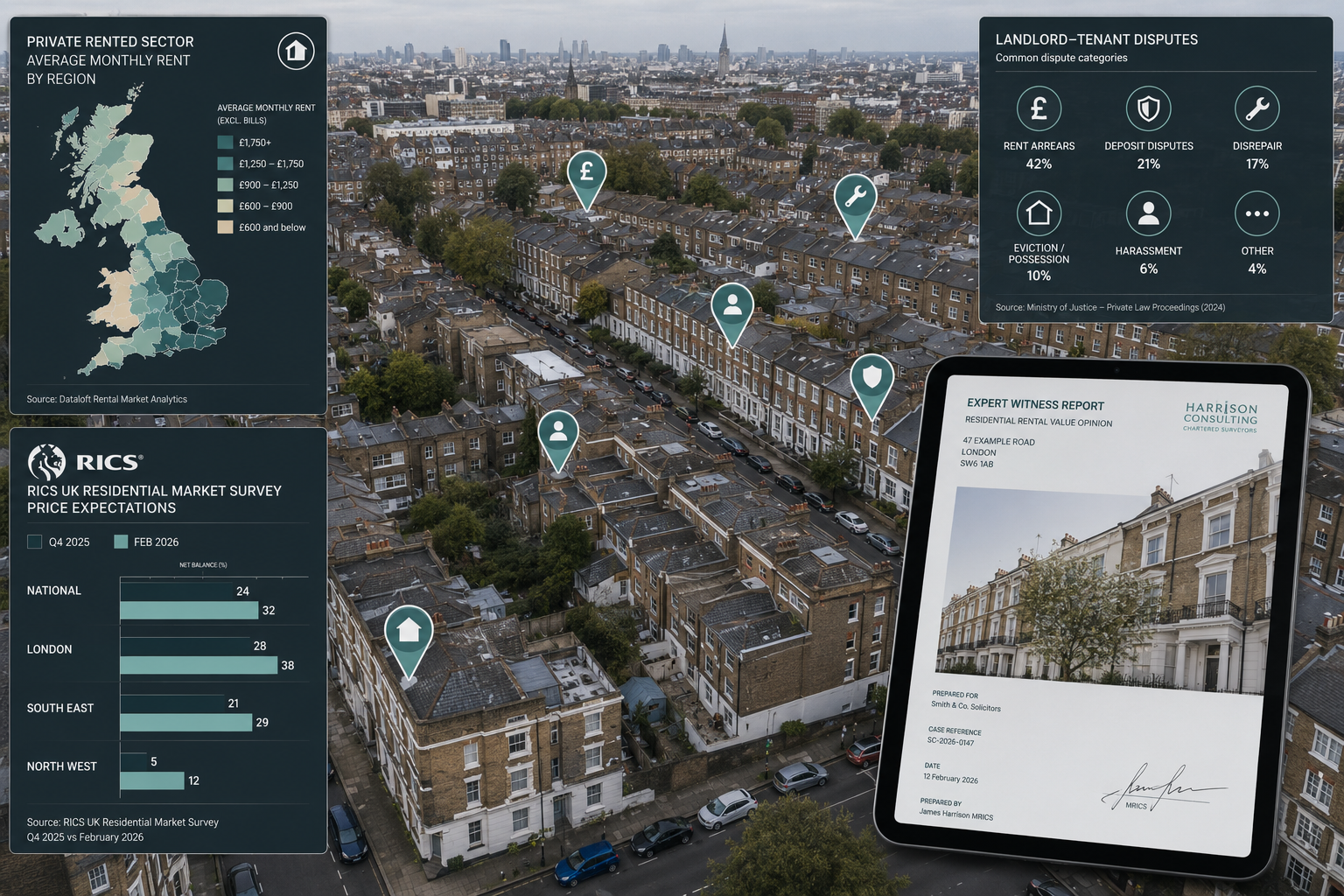
The 18-percentage-point fall in price expectations recorded in the February 2026 RICS survey is a net balance figure — the difference between the percentage of respondents reporting rising expectations and those reporting falling expectations. [3] Expert witnesses must be precise about what this figure does and does not mean:
What it means:
- A significant majority of RICS-registered surveyors observed deteriorating price sentiment in February 2026
- The reversal was unusually sharp by historical standards
- It is consistent with other leading indicators showing softening demand
What it does not mean:
- It does not establish a specific percentage by which any individual property was overvalued
- It does not confirm that rents fell — only that expectations shifted
- It is a national survey; regional variation can be substantial [4]
"Misrepresenting a sentiment indicator as a transactional fact is one of the most common methodological errors in PRS valuation disputes — and one of the first things opposing counsel will challenge."
Geopolitical and Macroeconomic Adjustment Factors
Any RICS valuation produced for litigation purposes in 2026 must explicitly address the external factors that influenced market conditions during the disputed period. These include:
- Interest rate trajectory: The Bank of England's rate decisions in 2024–2025 directly affected mortgage affordability and, by extension, the rent-versus-buy calculation driving PRS demand
- Energy cost volatility: Geopolitical instability in 2024–2025 kept household energy costs elevated, compressing tenant affordability
- Stamp duty changes: The March 2025 stamp duty threshold reversion increased transaction friction in the sales market, pushing more households into the PRS and temporarily supporting rental demand — a factor that may have inflated rents landlords now seek to defend
- Supply constraints: Planning restrictions and the exit of smaller landlords from the PRS (partly driven by tax changes) reduced supply, again temporarily supporting higher rents
Each of these factors requires explicit acknowledgement in an expert witness report, along with a reasoned assessment of how much weight they should carry in the valuation. Failure to address them leaves the report vulnerable to challenge. [5]
Regional Differentiation: A Critical Methodological Point
The RICS February 2026 survey data is not uniform across regions. Expert witnesses must resist the temptation to apply national headline figures to local disputes. Key regional considerations include:
| Region | Notable 2026 Characteristic |
|---|---|
| London (prime) | Price expectations more resilient; international demand a factor |
| London (outer/PRS) | Affordability constraints sharper; sentiment more aligned with national trend |
| Northern England | Stronger relative rental demand; different overvaluation risk profile |
| South East | Commuter belt dynamics; stamp duty reversion impact more pronounced |
| Scotland | Separate rent control framework under Housing (Scotland) Act 2022 |
For landlord-tenant disputes in London, understanding the valuation factors specific to each sub-market is essential before applying any RICS survey statistic as evidence. [6]
Building the Comparable Evidence Base
The most defensible expert witness valuations in PRS overvaluation disputes combine RICS survey data with a robust set of comparables. Best practice in 2026 requires:
- Minimum three to five comparable lettings within a 0.5-mile radius (or the nearest available equivalent in lower-density markets)
- Time-adjusted comparables — lettings from 2024 must be adjusted to reflect the market shift evidenced by the February 2026 RICS survey
- Condition and specification adjustments — documented, quantified, and cross-referenced to inspection findings
- Disclosure of rejected comparables — the report must explain why any apparently relevant comparables were excluded [1]
For complex properties or unusual tenures, a lease extension valuation methodology may also be relevant where ground rent or service charge disputes intersect with PRS overvaluation claims.
Practical Steps for Expert Witnesses Instructed in 2026 PRS Disputes
Given the convergence of the RICS February 2026 data, the evolving regulatory framework, and the increasing sophistication of tenant-side legal teams, expert witnesses should follow this structured approach:
Step 1: Confirm Scope and Independence Early
Before accepting instructions, confirm that the retainer allows for a genuinely independent opinion. If the instructing solicitor's brief is outcome-oriented, the expert must push back or decline. [7]
Step 2: Obtain the Full Instruction History
Understand what rent was set, when, by whom, and on what basis. Request all correspondence, any prior valuations, and any agent's market appraisals used to justify the original rent level.
Step 3: Anchor the Valuation Date
In PRS disputes, the relevant valuation date is typically the date the rent was set or the date of the rent review notice — not the date of the expert's instruction. All market data, including RICS survey statistics, must be calibrated to that date. [3]
Step 4: Build the Comparable Matrix
Compile, analyse, and adjust comparables as described above. Document every adjustment with a quantified rationale.
Step 5: Apply RICS Survey Data as Corroborating Context
Use the February 2026 RICS data to contextualise the direction of market travel, not as a standalone valuation tool. If the valuation date predates February 2026, use earlier RICS survey editions for the primary analysis and reference February 2026 as evidence of a trend already underway. [5]
Step 6: Address Geopolitical Factors Explicitly
Dedicate a section of the report to macroeconomic and geopolitical context. This demonstrates methodological rigour and pre-empts cross-examination challenges. [4]
Step 7: Comply Fully with CPR Part 35
Include all required declarations, limitations, and range-of-opinion statements. Have the report reviewed by a colleague experienced in tribunal work before submission.
Conclusion: Turning Survey Data Into Defensible Evidence
The February 2026 RICS Residential Market Survey has handed both landlords and tenants a powerful statistical narrative. But raw survey data does not win disputes — rigorous, independent, CPR-compliant expert witness valuations do.
For expert witnesses navigating PRS overvaluation claims in 2026, the core disciplines remain unchanged: independence, methodological transparency, comparable-led analysis, and honest acknowledgement of data limitations. What has changed is the evidentiary landscape. The 18-point sentiment reversal is real, significant, and already being cited in tribunal proceedings. Ignoring it is not an option; misusing it is equally dangerous.
Actionable Next Steps ✅
- If you are an expert witness: Review the RICS consultation on the 5th edition of Surveyors Acting as Expert Witnesses and align your current report templates with the proposed transparency requirements now, ahead of formal adoption. [2]
- If you are a landlord: Commission an independent RICS-registered valuer to assess whether your current rent levels are defensible against February 2026 market data before a dispute escalates.
- If you are a tenant or tenant's solicitor: Ensure any expert you instruct can demonstrate familiarity with CPR Part 35, RICS survey methodology, and the regional limitations of national sentiment data.
- For all parties: Engage early with the valuation types most appropriate to your specific dispute — rent review, lease renewal, or capital value — as the methodology differs materially between them.
The intersection of stalled housing momentum, new rent regulation, and heightened tribunal activity makes 2026 a defining year for expert witness practice in the PRS. Those who master the data — and present it honestly — will carry the day.
References
[1] Rics Redbook Expert Witness Valuations – https://www.briksurveyors.co.uk/RICS-Redbook-Expert-Witness-Valuations
[2] Rics Launches Global Consultation On Updated Expert Witness Standard – https://www.rics.org/news-insights/rics-launches-global-consultation-on-updated-expert-witness-standard
[3] Expert Witness Challenges From February 2026 Rics Survey Addressing 18 Price Expectation Shifts In Disputes – https://kingstonsurveyors.com/expert-witness-challenges-from-february-2026-rics-survey-addressing-18-price-expectation-shifts-in-disputes/
[4] Expert Witness Valuations In 2026 Buyer Enquiry Surge Rics Guidelines For Resolving Regional Disputes – https://www.canterburysurveyors.com/blog/expert-witness-valuations-in-2026-buyer-enquiry-surge-rics-guidelines-for-resolving-regional-disputes/
[5] Expert Witness Testimonies In 2026 Valuation Disputes Rics Strategies Amid Stabilising House Prices And Regional Divides – https://nottinghillsurveyors.com/blog/expert-witness-testimonies-in-2026-valuation-disputes-rics-strategies-amid-stabilising-house-prices-and-regional-divides
[6] Valuation Challenges From Rics February 2026 Survey Expert Witness Strategies For 26 Buyer Enquiry Dip Disputes – https://wimbledonsurveyors.com/valuation-challenges-from-rics-february-2026-survey-expert-witness-strategies-for-26-buyer-enquiry-dip-disputes/
[7] Surveyors Acting As Expert Witnesses – https://www.rics.org/profession-standards/rics-standards-and-guidance/sector-standards/dispute-resolution-standards/surveyors-acting-as-expert-witnesses
[8] Expert Witness Valuations – https://winfieldssurveyors.co.uk/rics-valuations/expert-witness-valuations/
[9] Rics Valuation Expert Witness Services – https://edsltd.com/rics-valuation-expert-witness-services/
[10] Rics 2026 Market – https://manchestersurveyors.com/tag/rics-2026-market/
