
From May 2026, the abolition of Section 21 "no-fault" evictions under the Renters' Rights Act 2026 fundamentally changes how landlords recover possession of their properties. With the no-fault route closed, every contested eviction must now travel through Section 8 grounds — and the quality of expert witness evidence has never mattered more. This shift means that Expert Witness Evidence in Section 8 Eviction Disputes Under Renters' Rights Act 2026: Valuation Standards for New Grounds is not merely a procedural concern; it is the difference between a successful possession claim and a dismissed application.
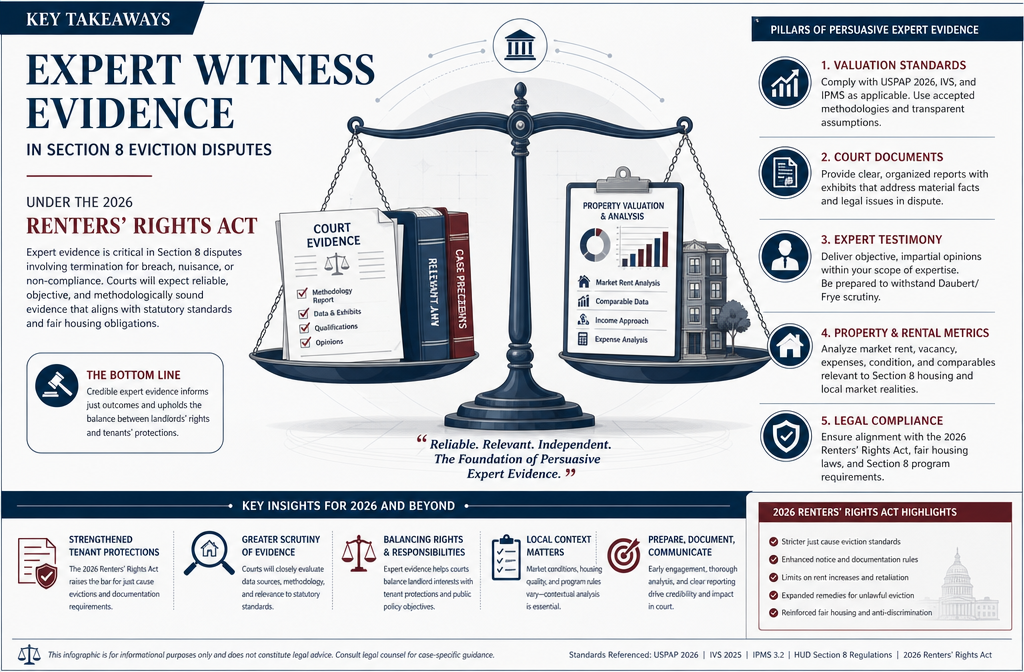
Key Takeaways 🗝️
- Section 21 is abolished from May 2026, forcing all contested evictions through Section 8 grounds where evidence quality is scrutinised closely.
- Expert witnesses — particularly RICS-qualified surveyors — play a critical role in substantiating valuation-based and condition-based grounds.
- CPR Part 35 compliance is mandatory for any expert witness report presented before the First-tier Tribunal (Property Chamber) or County Court.
- New and amended grounds under the Renters' Rights Act 2026 introduce fresh valuation challenges, including market rent assessments and property condition standards.
- Ombudsman challenges add a second layer of scrutiny, requiring expert evidence to be robust, impartial, and methodologically sound.
Why Section 21 Abolition Makes Expert Evidence Central
For over two decades, Section 21 allowed landlords to recover possession without stating a reason, provided correct procedures were followed. That convenience is gone. The Renters' Rights Act 2026 replaces it with a strengthened Section 8 framework that requires landlords to prove a specific statutory ground — and tribunals will examine that proof rigorously.
The practical consequence is stark: where a landlord once served a two-month notice and waited, they must now build an evidence-based case. For grounds touching on rent arrears, property condition, or redevelopment intentions, that case almost always requires a qualified expert witness to provide independent, court-ready opinion evidence.
💬 "The abolition of Section 21 does not make eviction impossible — it makes evidence indispensable."
Grounds most likely to require expert valuation evidence include:
| Section 8 Ground | Valuation/Condition Issue | Expert Role |
|---|---|---|
| Ground 1A (sale of property) | Market value assessment | Comparable sales analysis |
| Ground 6 (redevelopment) | Viability and scope of works | Building surveyor / structural report |
| Ground 7B (below-standard property) | Condition rating and repair costs | Schedule of condition / defect report |
| Ground 8 (rent arrears) | Market rent benchmark | Rental valuation comparables |
| Ground 13 (deterioration) | Damage quantification | Dilapidations assessment |
Understanding the New Grounds: Where Valuation Evidence Is Required
Rent Arrears and Market Rent Benchmarking (Ground 8)
Ground 8 — serious rent arrears — remains one of the most litigated Section 8 grounds. Under the Renters' Rights Act 2026, tenants gain enhanced rights to challenge the reasonableness of rent through the First-tier Tribunal. This creates a direct need for rental valuation evidence that meets RICS Red Book standards.
An expert witness instructed on a Ground 8 dispute must be able to:
- Identify comparable rental properties within a defined search radius and time window
- Adjust for material differences in size, condition, location, and specification
- Produce a written report that explains methodology clearly enough for a non-specialist tribunal panel to follow
The RICS Valuations service provides the professional framework within which rental comparables are assessed. A valuation that lacks methodology, comparable selection criteria, or adjustment rationale will be challenged — and may be rejected entirely.
Property Condition Grounds (Grounds 6, 7B, and 13)
Three grounds under the revised Section 8 framework directly engage property condition:
- Ground 6 (redevelopment): The landlord must demonstrate that works cannot reasonably be carried out with the tenant in occupation. A structural or building surveyor's report quantifying the scope and nature of works is typically required.
- Ground 7B (Decent Homes Standard breach): Where a property fails the Decent Homes Standard, the landlord may seek possession to carry out remediation. Expert evidence must confirm the nature of the failure and the remediation required.
- Ground 13 (deterioration caused by tenant): The landlord must show that the property has deteriorated beyond fair wear and tear. A professionally prepared schedule of condition report — ideally one prepared at the start of the tenancy — provides the baseline against which deterioration is measured.
🔑 Key point: A schedule of condition prepared at tenancy commencement is not just good practice — under the new regime, it is essential evidence infrastructure.
CPR Part 35 Compliance: The Non-Negotiable Standard
Any expert witness giving evidence before the County Court or the First-tier Tribunal (Property Chamber) must comply with Civil Procedure Rules Part 35. This is not optional. A report that fails CPR Part 35 requirements risks being inadmissible or being given little weight by the tribunal.
What CPR Part 35 Requires
CPR Part 35 sets out that an expert's overriding duty is to the court, not to the party instructing them. This principle is fundamental and must be stated explicitly in the report. The key requirements are:
- ✅ A statement of the expert's qualifications and relevant experience
- ✅ A statement of the facts and instructions upon which the opinion is based
- ✅ A clear statement of the expert's opinion, with reasons
- ✅ A statement that the expert understands their duty to the court
- ✅ A signed declaration of truth
- ✅ Disclosure of any material facts that might affect the opinion
Common Failures in Expert Witness Reports
The following failures are regularly identified in tribunal proceedings:
- Advocacy masquerading as opinion: Reports that argue the client's case rather than provide independent analysis
- Unexplained methodology: Valuation conclusions without comparable evidence or adjustment rationale
- Outdated comparables: Rental data that is more than 6–12 months old in a volatile market
- Failure to address contrary evidence: Ignoring the opposing party's valuation without explanation
For landlords and tenants seeking properly qualified expert witness support, understanding the role of an expert witness in property disputes is the essential first step.
Valuation Standards for New Grounds: Methodology in Practice
RICS Red Book and Its Application to Rental Disputes
The RICS Valuation — Global Standards (Red Book) provides the methodological framework for all RICS-regulated valuations in the UK. In the context of Expert Witness Evidence in Section 8 Eviction Disputes Under Renters' Rights Act 2026: Valuation Standards for New Grounds, the Red Book's requirements for Market Rent assessments are directly applicable.
Market Rent under the Red Book is defined as the estimated amount for which an interest in real property should be leased on the valuation date between a willing lessor and a willing lessee on appropriate lease terms in an arm's length transaction, after proper marketing and where the parties had each acted knowledgeably, prudently, and without compulsion.
This definition matters because it sets an objective standard against which any rental valuation in tribunal proceedings will be measured. An expert who departs from this standard — for example, by using asking rents rather than achieved rents, or by failing to adjust for lease terms — will face cross-examination on that departure.
Comparable Selection: The Critical Battleground
In rental valuation disputes, the selection of comparables is often where cases are won or lost. The following table summarises best practice:
| Comparable Criterion | Best Practice Standard |
|---|---|
| Proximity | Within 0.5 miles in urban areas; wider in rural settings with justification |
| Age of transaction | Within 12 months; within 6 months in volatile markets |
| Property type | Same or similar type (flat, house, HMO) |
| Size | Within 10% of subject property GIA |
| Condition | Adjusted for material differences with written rationale |
| Tenure | Assured tenancy comparables preferred post-Act |
Dilapidations and Condition Assessments
Where the dispute involves property condition — whether under Ground 7B, Ground 13, or a counterclaim by a tenant — the expert must produce evidence that is both technically sound and legally structured.
A professional dilapidations survey quantifies the cost of making good any damage or disrepair attributable to the tenant. This must be distinguished carefully from:
- Landlord's repairing obligations under Section 11 of the Landlord and Tenant Act 1985
- Fair wear and tear that cannot be charged to the tenant
- Pre-existing defects documented in the original schedule of condition
The schedule of condition guidance published by RICS-regulated surveyors provides the framework for producing baseline condition evidence that will withstand tribunal scrutiny.
Preparing Expert Witness Evidence for Ombudsman Challenges
The Renters' Rights Act 2026 significantly expands the New Property Ombudsman's jurisdiction, giving tenants a low-cost route to challenge landlord conduct — including the basis of possession claims. This creates a two-front challenge: landlords may face both tribunal proceedings and Ombudsman investigation simultaneously.
What the Ombudsman Examines
The Property Ombudsman (TPO) and the new single Ombudsman scheme established under the Act will scrutinise:
- Whether the landlord followed correct procedure before serving a Section 8 notice
- Whether the evidence relied upon was accurate and fairly obtained
- Whether any valuation or condition assessment was conducted by a suitably qualified person
- Whether the tenant was given adequate opportunity to respond to the evidence
Structuring Evidence for Dual Proceedings
Preparing for both tribunal and Ombudsman proceedings requires a layered evidence strategy:
- Primary expert report: CPR Part 35 compliant, addressed to the court or tribunal
- Supporting documentation: Comparable evidence schedules, photographic records, inspection notes
- Procedural compliance record: Evidence that correct notices were served, timescales observed, and tenant rights respected
- Response to tenant's evidence: A written rebuttal or supplementary report addressing any contrary valuation or condition evidence
For landlords and agents operating across London and the South East, working with RICS-qualified chartered surveyors who understand both the technical and legal dimensions of expert evidence is essential.
Practical Steps for Landlords and Agents in 2026
The transition to a Section 8-only possession regime demands proactive evidence management throughout the tenancy lifecycle, not just at the point of dispute.
Before the Tenancy Begins 📋
- Commission a professionally prepared schedule of condition with dated photographs
- Obtain a rental valuation from a RICS-qualified surveyor to establish the market rent baseline
- Ensure the Energy Performance Certificate, gas safety certificate, and all prescribed information are correctly served
During the Tenancy 🔍
- Conduct and document periodic property inspections with written records
- Keep a rent account ledger showing all payments received and any arrears
- Address any disrepair promptly and document the works carried out
When a Dispute Arises ⚖️
- Instruct a RICS-qualified expert witness at the earliest opportunity — not after the notice is served
- Ensure the expert's report is CPR Part 35 compliant before filing with the tribunal
- Obtain updated rental comparables within 6 months of the hearing date
- Consider whether a specific defect report or structural engineer report is needed to support condition-based grounds
💬 "The best expert witness report is one that was planned for at the start of the tenancy, not assembled in a hurry after a dispute arises."
How Expert Witness Evidence in Section 8 Eviction Disputes Under Renters' Rights Act 2026 Differs From Pre-Act Practice
Under the old regime, expert evidence in possession proceedings was relatively rare — most Section 21 cases were uncontested. The new landscape is fundamentally different:
| Pre-Act (Section 21 era) | Post-Act (Section 8 only) |
|---|---|
| No-fault possession available | All grounds must be proven |
| Expert evidence rarely needed | Expert evidence frequently required |
| Minimal valuation scrutiny | Rental valuation subject to tribunal review |
| Condition evidence optional | Condition evidence often determinative |
| Ombudsman role limited | Expanded Ombudsman jurisdiction |
This shift places RICS-qualified surveyors — particularly those with experience in expert witness work — at the centre of the residential possession process in a way that was previously reserved for commercial property disputes.
Understanding the cost of a professional valuation is now a practical consideration for any landlord contemplating possession proceedings, since the cost of expert evidence must be weighed against the cost of a failed or delayed possession claim.
Conclusion: Actionable Next Steps for 2026 and Beyond
The abolition of Section 21 from May 2026 is not merely a procedural change — it is a structural transformation of the private rented sector's legal framework. Expert Witness Evidence in Section 8 Eviction Disputes Under Renters' Rights Act 2026: Valuation Standards for New Grounds has moved from a specialist niche to a mainstream requirement for any landlord, agent, or tenant navigating the new possession landscape.
Actionable Next Steps ✅
- Audit existing tenancies: Review whether current tenancy files contain a schedule of condition, rental valuation, and complete procedural compliance records.
- Commission baseline valuations: Obtain RICS-compliant market rent assessments for all properties where possession may be sought in the next 12–24 months.
- Instruct early: Do not wait until a tribunal hearing is listed before instructing an expert witness — early instruction allows time for thorough, CPR-compliant report preparation.
- Understand the Ombudsman route: Prepare evidence that will withstand scrutiny in both tribunal and Ombudsman proceedings simultaneously.
- Work with qualified professionals: Ensure that any expert instructed holds RICS membership, has experience in tribunal proceedings, and understands the specific grounds being relied upon.
The Renters' Rights Act 2026 raises the evidential bar significantly. Those who prepare thoroughly — with properly qualified expert witnesses and RICS-standard valuations — will navigate the new regime with confidence. Those who do not will find the tribunals an unforgiving environment.
