
Nearly 60% of neighbour disputes during construction projects in the UK escalate into formal legal claims — yet the majority could be avoided with a single document prepared before a single spade hits the ground. Pre-construction surveys and schedules of condition: the most effective way to reduce party wall damage claims is not just a professional best practice — it is the difference between a smooth build and a costly, relationship-destroying legal battle.
This guide explains exactly what a schedule of condition is, why it matters under the Party Wall etc. Act 1996, how to produce one that will actually hold up as evidence, and the common mistakes that render these documents useless when disputes arise.
Key Takeaways 📋
- A schedule of condition creates a legally defensible baseline record of a neighbouring property's state before construction begins.
- Without pre-works documentation, any crack or defect found after construction is automatically assumed — rightly or wrongly — to be the building owner's fault.
- Photography standards and scope decisions are critical; poor-quality images destroy the evidential value of a schedule.
- Schedules of condition are most important for demolition, excavation, and structural alteration projects near shared boundaries.
- A qualified party wall surveyor should always prepare the schedule to ensure it meets legal and professional standards.
What Is a Schedule of Condition and Why Does It Matter?
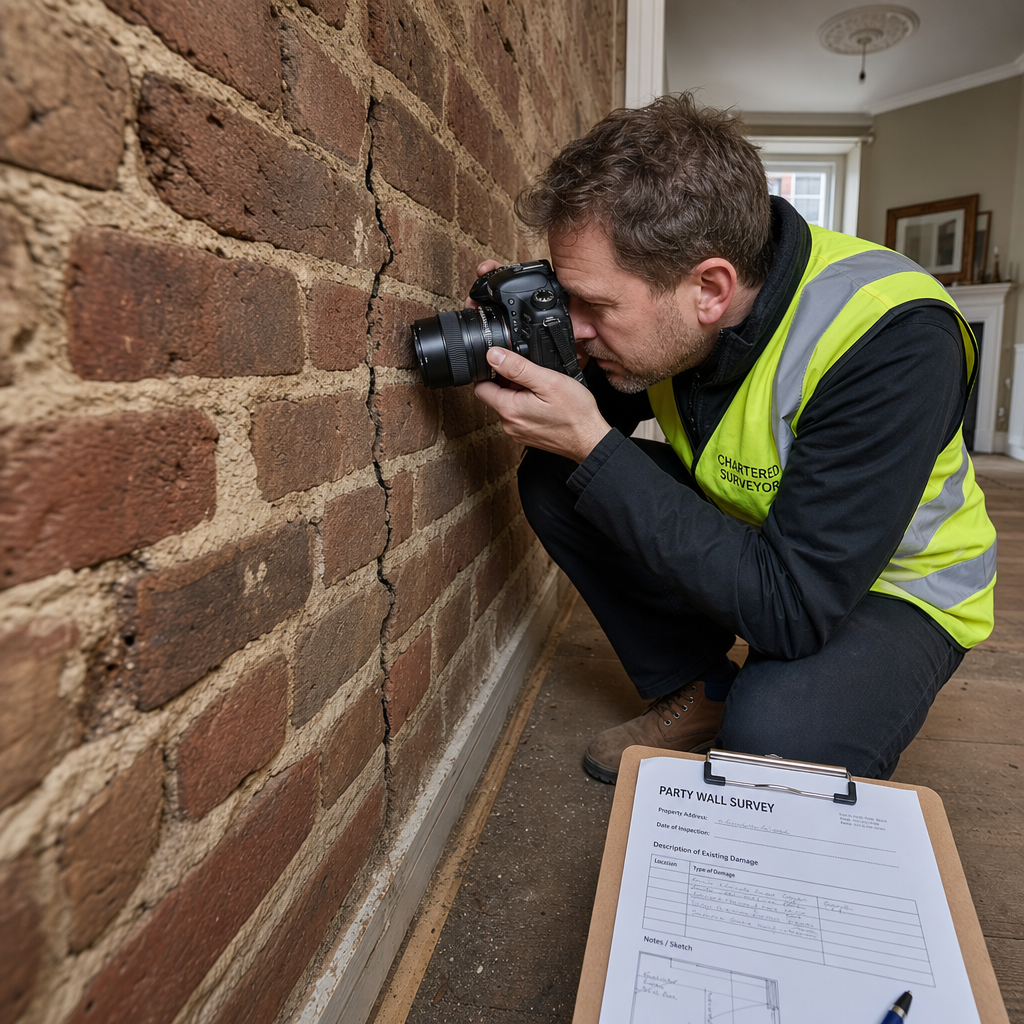
A schedule of condition is a detailed, written and photographic record of the existing state of an adjoining owner's property, prepared immediately before construction work begins. It captures every crack, stain, settlement mark, and structural quirk that already exists — creating an irrefutable "before" snapshot.
Under the Party Wall etc. Act 1996, a building owner must serve formal notice on any adjoining owner before carrying out certain types of work. These include:
- Party wall works — cutting into, raising, or underpinning a shared wall
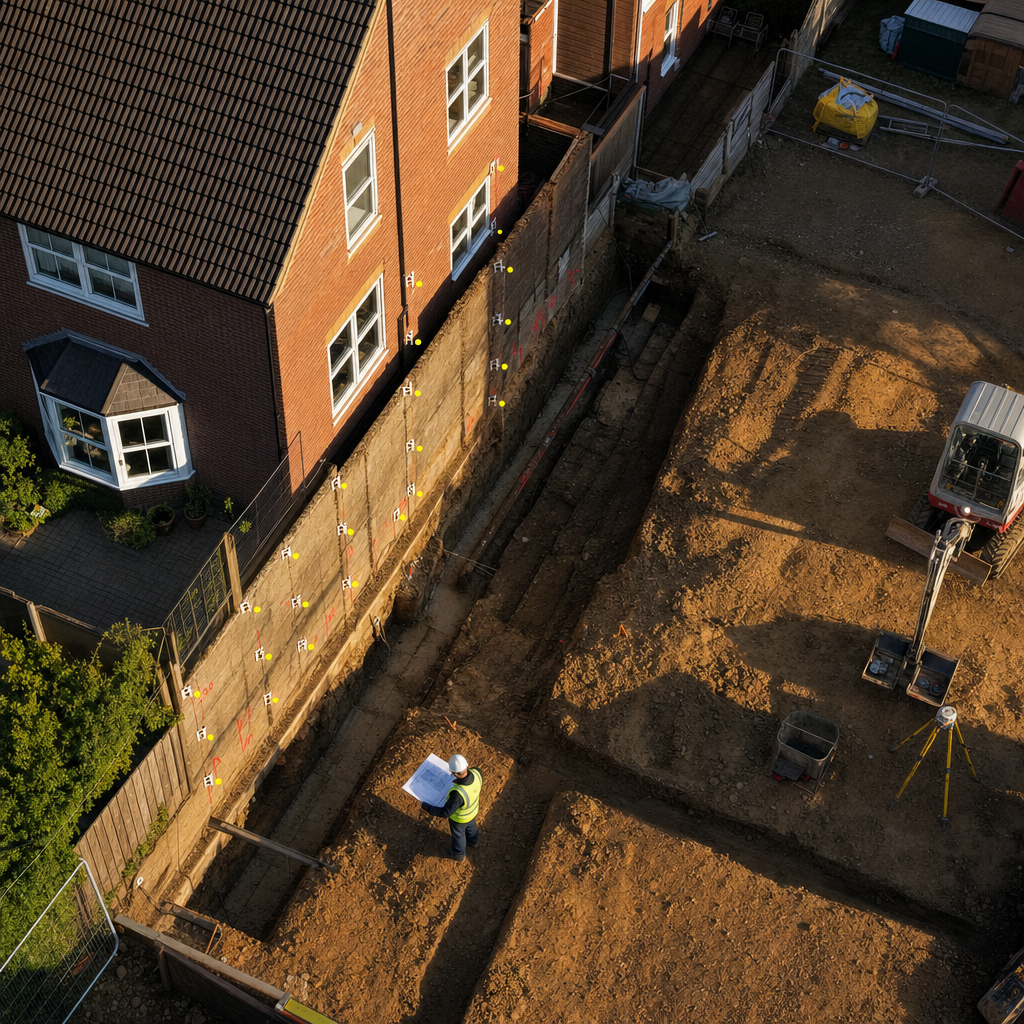
- Excavations — digging within 3 or 6 metres of a neighbouring structure
- New walls — built on or at the boundary line
Once a party wall award is in place, it will typically direct that a schedule of condition be prepared. But the quality and scope of that schedule determines whether it protects anyone at all.
💬 Pull Quote: "A schedule of condition is only as strong as its weakest photograph. Blurry images and vague descriptions are not evidence — they are arguments waiting to happen."
The Legal Stakes
Without a pre-construction record, any damage claim after the works is almost impossible to defend. Courts and surveyors will apply a simple presumption: if the damage wasn't recorded before, it may have been caused by the works. This places the burden squarely on the building owner to disprove causation — an extremely difficult position.
A well-prepared schedule reverses that dynamic entirely. It allows a surveyor to compare pre- and post-works conditions with precision and reach a fair, evidence-based conclusion.
Photography Standards: The Make-or-Break Factor
Pre-construction surveys and schedules of condition are only as effective as the photographic evidence they contain. This is where many schedules fail — not in intention, but in execution.
What Good Survey Photography Looks Like
| Requirement | Why It Matters |
|---|---|
| Dated and timestamped | Proves photos were taken before works began |
| GPS-tagged where possible | Confirms location of each image |
| Scale reference in frame | Allows accurate measurement of cracks |
| Consistent lighting | Enables fair comparison in post-works survey |
| Multiple angles per defect | Prevents ambiguity about size and extent |
| Wide-angle context shots | Shows where each close-up sits within the room |
Every photograph should be cross-referenced to a floor plan or room schedule within the document. A photograph of a crack in isolation, with no reference to where in the property it sits, is nearly worthless as evidence.
Common Photography Mistakes That Weaken Evidence ⚠️
- Using a smartphone without adequate lighting — shadows obscure hairline cracks
- No scale reference — a crack that looks minor in a photo may be 3mm wide
- Skipping "boring" areas — undamaged surfaces matter just as much as defects
- Low resolution images — cannot be enlarged for detailed analysis
- Inconsistent file naming — makes cross-referencing the written schedule difficult
Professional surveyors use calibrated crack gauges, consistent lighting equipment, and structured naming conventions. This is one reason why instructing a qualified party wall surveyor to prepare the schedule — rather than relying on a contractor or homeowner — is strongly advisable.
Scope Decisions: What to Include and What Gets Left Out
One of the most consequential decisions in preparing a pre-construction survey is scope — deciding which parts of the adjoining property to inspect and document. Get this wrong, and the schedule may not cover the areas where damage later occurs.
High-Risk Zones That Must Always Be Included
For demolition, excavation, and structural alteration projects, the following areas carry the highest risk of vibration or settlement damage and should always be documented:
- Ceilings and cornices — highly susceptible to vibration cracking
- Plasterwork — records existing hairline cracks before they are blamed on new works
- Floors — settlement, bounce, and existing cracking patterns
- External brickwork — particularly near the shared boundary
- Chimney stacks and shared flues — party wall shared chimneys are a frequent source of post-works disputes
- Windows and door frames — racking and distortion are early signs of movement
- Drains and drainage channels — excavation can cause significant underground damage
Scope Based on Work Type
Different construction activities carry different risk profiles. The table below helps match scope to project type:
| Work Type | Minimum Scope Recommended |
|---|---|
| Loft conversion | Shared wall, ceilings below, chimney stacks |
| Rear extension | Rear elevation, garden walls, foundations zone |
| Basement/excavation | Full internal and external survey, drains |
| Demolition | Entire adjoining structure, including outbuildings |
| Underpinning | Foundations, floors, all elevations |
🔑 Key Point: For excavation projects, the schedule should extend to the full depth of influence — typically at least one storey below ground level where visible, and certainly to the full extent of any basement or cellar.
The Adjoining Owner's Rights
Adjoining owners have the right to request a schedule of condition as part of the party wall process. If they are not offered one, they should insist on it. Equally, building owners benefit from commissioning a thorough schedule — it protects them from spurious claims just as much as it protects neighbours from genuine damage going uncompensated.
For a full overview of the rights and obligations on both sides, the complete guide to party wall agreements is a useful starting point.
Common Mistakes That Undermine Pre-Construction Surveys
Even when building owners do commission a schedule of condition, a range of avoidable errors can strip it of its protective value. Understanding these pitfalls is essential.
1. Preparing the Schedule Too Late
A schedule prepared after works have already started is not a pre-construction survey — it is a liability. Even a single day of piling or demolition can cause cracking. The schedule must be completed and signed off before any notifiable works commence.
2. Failing to Gain Access to All Relevant Areas
If an adjoining owner refuses access to certain rooms, this must be formally recorded in the schedule. A note stating "access to rear bedroom not granted" is far better than silence — it demonstrates that the surveyor attempted a thorough inspection. In some cases, party wall consent arrangements can include provisions for access.
3. Using Vague Written Descriptions
Descriptions like "some cracking to ceiling" are inadequate. A professional schedule will state: "Diagonal hairline crack to northeast corner of ceiling, approximately 450mm in length, running from cornice to light fitting, consistent with thermal movement." Specificity is evidence.
4. Not Revisiting the Schedule Post-Works
A schedule of condition is only half the picture. A post-works inspection, using the same methodology and covering the same areas, is what allows a meaningful comparison. Without this second survey, the pre-works document cannot fulfil its purpose.
5. Ignoring Pre-Existing Structural Issues
If an adjoining property already has significant structural movement — subsidence, settlement, or previous underpinning — this must be documented in detail. Failing to do so creates ambiguity about whether post-works damage was pre-existing or newly caused. A structural survey of the adjoining property may be warranted in high-risk cases.
How Pre-Construction Surveys Reduce Party Wall Damage Claims in Practice
The practical mechanism by which pre-construction surveys and schedules of condition reduce party wall damage claims is straightforward: they eliminate ambiguity.
Most party wall damage disputes do not arise because building owners are reckless or neighbours are dishonest. They arise because, without a baseline record, neither party can be certain what existed before. Uncertainty breeds suspicion, suspicion breeds accusation, and accusation breeds claims.
A Typical Dispute Scenario — Without a Schedule
A homeowner excavates for a rear extension. Three months later, the neighbour reports a new crack in their kitchen ceiling. The building owner believes it was always there. The neighbour insists it appeared during the works. Neither can prove their position. The dispute escalates to a surveyor-led process, then potentially to a county court. Legal costs accumulate. The relationship is destroyed.
The Same Scenario — With a Thorough Schedule
The same crack is reported. The surveyor retrieves the pre-works schedule, which includes a photograph of the kitchen ceiling taken six weeks before excavation began. The crack is clearly visible in the photograph, measured at 2mm. The post-works inspection shows the crack is now 2.5mm — a minor increase consistent with seasonal thermal movement, not excavation. The claim is resolved within days, not months.
This is why pre-construction surveys and schedules of condition represent the most effective way to reduce party wall damage claims — not by preventing damage, but by making the truth provable.
Cost vs. Risk
A professionally prepared schedule of condition typically costs between £300 and £800 for a standard residential property, depending on size and complexity. A contested party wall damage claim, by contrast, can easily run to £5,000–£20,000 in surveyor and legal fees — before any compensation is considered.
The return on investment is not subtle.
Choosing the Right Surveyor for Pre-Construction Documentation
Not all surveyors are equally equipped to prepare schedules of condition for party wall purposes. The ideal professional will be:
- RICS-qualified — ensuring adherence to professional standards
- Experienced in party wall matters — familiar with the evidential requirements of the Act
- Independent — particularly important if acting as an agreed surveyor for both parties
- Local — knowledge of regional construction methods and building stock matters
For those in London and the surrounding area, working with party wall surveyors in London who understand the specific challenges of dense urban terraced housing is especially valuable.
It is also worth understanding the roles and responsibilities of a party wall surveyor before instructing one — particularly the distinction between an agreed surveyor (appointed jointly) and separate surveyors appointed by each party.
Conclusion: Act Before the First Spade Moves
The evidence is clear: pre-construction surveys and schedules of condition are the most effective way to reduce party wall damage claims, and the cost of not having one is almost always greater than the cost of commissioning a thorough, professional document.
Actionable Next Steps ✅
- Serve party wall notices early — ideally two months before works begin, giving time for a schedule to be prepared without rushing.
- Instruct a qualified party wall surveyor to prepare the schedule — do not rely on contractors or informal records.
- Insist on full photographic coverage — every room, every elevation, every area of existing defect, with scale references and timestamps.
- Define scope based on work type — excavation and demolition require the most comprehensive documentation.
- Commission a post-works inspection using the same methodology to enable direct comparison.
- Keep the original schedule securely — digital copies with cloud backup, plus a hard copy held by the surveyor.
Whether planning a basement conversion, a rear extension, or significant structural alterations, the time to protect both parties is before construction begins — not after the first crack appears.
